Introduction
Psychotic disorders including schizophrenia are severe mental disorders that constitute one of the leading causes of disability worldwide (Global Burden of Disease Study 2013 Collaborators, 2015). The disorders are associated with pronounced functional impairment and incur huge direct healthcare spending as well as indirect cost via loss of productivity and caregiver burden. Substantial evidence has indicated that negative symptoms and neurocognitive impairment, the core features of psychotic disorders representing independent, albeit correlated, illness dimensions (Harvey et al. Reference Harvey, Koren, Reichenberg and Bowie2006), are critically related to poor functional outcome (Green et al. Reference Green, Kern, Braff and Mintz2000; Bowie et al. Reference Bowie, Reichenberg, Patterson, Heaton and Harvey2006). Recent data has further revealed that negative symptoms may mediate the relationship between neurocognition and functioning (Ventura et al. Reference Ventura, Hellemann, Thames, Koellner and Nuechterlein2009). Of note, it is acknowledged that negative symptoms represent a multi-dimensional construct comprising two distinct symptom subdomains (Messinger et al. Reference Messinger, Tremeau and Antonius2011), namely amotivation and diminished expression (DE). Literature has demonstrated amotivation as a robust predictor of functional outcome in chronic schizophrenia (Konstantakopoulos et al. Reference Konstantakopoulos, Ploumpidis, Oulis, Patrikelis, Soumani, Papadimitriou and Politis2011; Strauss et al. Reference Strauss, Horan, Kirkpatrick, Fischer, Keller, Miski, Buchanan, Green and Carpenter2013; Fervaha et al. Reference Fervaha, Foussias, Agid and Remington2014) and early psychosis (Faerden et al. Reference Faerden, Barrett, Nesvag, Friis, Finset, Marder, Ventura, Andreassen, Agartz and Melle2013; Fervaha et al. Reference Fervaha, Foussias, Agid and Remington2015; Chang et al. Reference Chang, Hui, Chan, Lee and Chen2016a ). Emerging evidence has also suggested that amotivation may mediate the impact of neurocognitive impairment on functioning (Gard et al. Reference Gard, Fisher, Garrett, Genevsky and Vinogradov2009; Nakagami et al. Reference Nakagami, Xie, Hoe and Brekke2008). However, mixed findings were observed regarding the relationship between DE and functioning. Some studies showed that DE was associated with functioning (Evensen et al. Reference Evensen, Rossberg, Barder, Haahr, Hegelstad, Joa, Johannessen, Larsen, Melle, Opjordsmoen, Rund, Simonsen, Vaglum, McGlashan and Friis2012; Galderisi et al. Reference Galderisi, Bucci, Mucci, Kirkpatrick, Pini, Rossi, Vita and Maj2013), while others failed to find an independent contribution of DE to functional outcome (Green et al. Reference Green, Hellemann, Horan, Lee and Wynn2012; Fervaha et al. Reference Fervaha, Foussias, Agid and Remington2014, Reference Fervaha, Foussias, Agid and Remington2015; Chang et al. Reference Chang, Hui, Chan, Lee and Chen2016a ). There is a paucity of data on the relationships among DE, neurocognition and functioning.
Recently, there has been growing interest in examining the role of psychological factors on the development of negative symptoms based on the cognitive model theorized by Beck and colleagues (Rector et al. Reference Rector, Beck and Stolar2005; Beck et al. Reference Beck, Rector, Stolar and Grant2009). The model posits that negative symptoms, in particular amotivation could be developed as a consequence of maladaptive attitudinal beliefs generated via repeated unsuccessful goal attainment in real-world circumstances. Schizophrenia patients were found to display higher levels of maladaptive attitudinal beliefs including dysfunctional attitudes and negative self-efficacy when compared with the healthy populations (Grant & Beck, Reference Grant and Beck2009; Ventura et al. Reference Ventura, Subotnik, Ered, Gretchen-Doorly, Hellemann, Vaskinn and Nuechterlein2014). Accumulating data has shown that dysfunctional attitudes, especially defeatist performance beliefs are associated with negative symptoms and poor functioning (Campellone et al. Reference Campellone, Sanchez and Kring2016). Conversely, relationships of self-efficacy with negative symptoms and functioning are less studied. Self-efficacy refers to an individual's perceived ability to perform a task or behavior (Bandura, Reference Bandura1977, Reference Bandura1997). Recent theoretical models have further conceptualized self-efficacy as a broader construct which is defined as a generalized and stable sense of personal competence to deal effectively with a variety of stressful situations (i.e. general self-efficacy) (Schwarzer & Jerusalem, Reference Schwarzer, Jerusalem, Weinman, Wright and Johnson1995; Eccles & Wigfield, Reference Eccles and Wigfield2002). Self-efficacy has been regarded as a crucial determinant of human motivation (Bandura, Reference Bandura1997; Eccles & Wigfield, Reference Eccles and Wigfield2002). Extensive research has consistently demonstrated that higher self-efficacy is associated with elevated motivation, increased effort investment and better functioning across diverse domains such as career development, academic achievement, and physical and mental health (Bandura, Reference Bandura1997). Several previous studies on schizophrenia also indicated that higher self-efficacy was related to better rehabilitation outcomes (Choi et al. Reference Choi, Fiszdon and Medalia2010; Suzuki et al. Reference Suzuki, Amagai, Shibata and Tsai2011). In fact, self-efficacy has been proposed as a potential therapeutic target for negative symptoms and functional enhancement in schizophrenia (Ventura et al. Reference Ventura, Subotnik, Ered, Gretchen-Doorly, Hellemann, Vaskinn and Nuechterlein2014).
Thus far, very few studies have been conducted to investigate the relationships between negative symptoms, self-efficacy and functioning in psychotic disorders (Pratt et al. Reference Pratt, Mueser, Smith and Lu2005; Cardenas et al. Reference Cardenas, Abel, Bowie, Depp, Patterson, Jeste and Mausbach2013; Kurtz et al. Reference Kurtz, Olfson and Rose2013; Ventura et al. Reference Ventura, Subotnik, Ered, Gretchen-Doorly, Hellemann, Vaskinn and Nuechterlein2014; Vaskinn et al. Reference Vaskinn, Ventura, Andreassen, Melle and Sundet2015). Among those few studies, some (Pratt et al. Reference Pratt, Mueser, Smith and Lu2005; Vaskinn et al. Reference Vaskinn, Ventura, Andreassen, Melle and Sundet2015), but not all, found that negative symptoms mediated the effect of self-efficacy on functional outcome. One recent study further revealed that amotivation, but not DE, mediated the relationship between self-efficacy and functioning (Ventura et al. Reference Ventura, Subotnik, Ered, Gretchen-Doorly, Hellemann, Vaskinn and Nuechterlein2014). Nonetheless, it should be noted that most studies have examined negative symptoms as a unitary construct (Pratt et al. Reference Pratt, Mueser, Smith and Lu2005; Cardenas et al. Reference Cardenas, Abel, Bowie, Depp, Patterson, Jeste and Mausbach2013; Kurtz et al. Reference Kurtz, Olfson and Rose2013; Vaskinn et al. Reference Vaskinn, Ventura, Andreassen, Melle and Sundet2015) which precluded delineation of potential differential relationships between negative symptom subdomains and self-efficacy. Additionally, self-efficacy assessment employed by most prior studies emphasized heavily on patients’ perceived competence on symptom management (McDermott, Reference McDermott1995). This measurement, however, may not adequately capture patients’ perception on their capabilities to perform everyday productive activities. General self-efficacy measure may thus represent a conceptually more useful construct in evaluating the impact of self-efficacy on negative symptoms and functioning.
It is well recognized that a significant proportion of first-episode psychosis (FEP) patients exhibit persistent functional impairment even in the presence of clinical remission (Chang et al. Reference Chang, Tang, Hui, Lam, Chan, Wong, Chiu and Chen2012; Verma et al. Reference Verma, Subramaniam, Abdin, Poon and Chong2012). Better understanding of the inter-relationships among negative symptoms, neurocognition, self-efficacy and functioning in the initial stage of illness is crucial to early intervention for psychosis. This facilitates identification of treatment targets and development of effective interventions for early functional recovery. Until now, however, this has rarely been investigated in FEP populations.
To this end, we present a study conducted in a large representative cohort of adult patients presenting with FEP to a specialized early intervention program with an aim to examine the relationships among negative symptom subdomains, neurocognition, general self-efficacy and global functioning. To adequately evaluate the complex interplay among these variables, we employed structural equation modeling (SEM) which has advantages over multiple regression analysis and path analysis by being able to simultaneously examine direct and indirect relationships among a set of measured variables and latent constructs, and to explicitly model measurement errors for more accurate parameter estimation (Hoyle, Reference Hoyle and Hoyle1995; Iacobucci et al. Reference Iacobucci, Saldanha and Deng2007). We hypothesized that neurocognition, amotivation and general self-efficacy would directly predict global functioning. We also predicted that amotivation would mediate the relationship between neurocognition and functioning. Given that self-efficacy has been theorized as a key determinant of motivation for goal accomplishment, we expected that amotivation would be related to and mediate the effect of general self-efficacy on functioning. Based on Beck's cognitive model of negative symptoms which postulates that competence limitation (i.e. neurocognitive impairment) may lead to negative self-appraisal of one's ability (Rector et al. Reference Rector, Beck and Stolar2005; Beck et al. Reference Beck, Rector, Stolar and Grant2009), we hypothesized that general self-efficacy would mediate the relationship between neurocognition and amotivation. The relationships of DE with functioning, neurocognition and general self-efficacy were also investigated.
Method
Participants and setting
This study was conducted as part of the Jockey Club Early Psychosis (JCEP) project (Hui et al. Reference Hui, Chang, Chan, Lee, Tam, Lai, Wong, Tang, Li, Leung, McGhee, Sham and Chen2014a ), which is a territory-wide early intervention service aiming to provide phasic-specific case management to individuals aged 26–55 years presenting with first-episode DSM-IV schizophrenia, schizophreniform disorder, schizoaffective disorder, brief psychotic disorder, delusional disorder, or psychotic disorder not otherwise specified (NOS) in Hong Kong. A total of 355 patients were recruited from publicly funded generic adult psychiatric outpatient units between June 2009 and August 2011. Patients with intellectual disability, substance-induced psychosis or psychotic disorder due to general medical condition were excluded. Data of this study were derived from baseline assessments (conducted with a mean of 119.7 days after treatment initiation) of an ongoing 4-year JCEP study, and findings regarding rate and risk factors of depressive symptoms, and predictors of primary negative symptoms have been reported elsewhere (Chang et al. Reference Chang, Cheung, Hui, Lin, Chan, Lee and Chen2015b , Reference Chang, Lau, Chan, Hui, Chan, Lee, Lin and Chen2016b ). Of the initial cohort, 321 patients who had completed assessments were retained as the sample of the current report. The study was approved by local institutional review boards and all of the subjects gave written informed consent before participation.
Assessments
Best-estimate consensus diagnosis of each participant was ascertained according to DSM-IV criteria by two senior research psychiatrists using all available information including Chinese-bilingual Structured Clinical Interview for DSM-IV (CB-SCID-I/P; So et al. Reference So, Kam, Leung, Chung, Liu and Fong2003) administered at intake, informant histories and medical records. Interview for Retrospective Assessment of Onset of Schizophrenia (IRAOS; Hafner et al. Reference Hafner, Riecher-Rossler, Hambrecht, Maurer, Meissner, Schmidtke, Fätkenheuer, Löffler and van der Heiden1992) was employed to confirm the first-episode status and to determine the duration of untreated psychosis (DUP). Psychopathology was assessed using the Positive and Negative Syndrome Scale (PANSS; Kay et al. Reference Kay, Opler and Fiszbein1987). Negative symptoms were examined by the Scale for the Assessment of Negative Symptoms (SANS; Andreasen, Reference Andreasen1982). As negative symptom construct is consistently shown to comprise two distinct sub-domains of amotivation and DE, we thus derived amotivation and DE domain scores based on the method applied by previous research (Foussias et al. Reference Foussias, Mann, Zakzanis, van Reekum and Remington2009; Chang et al. Reference Chang, Hui, Chan, Lee and Chen2016a ): Amotivation consisted of items of the Avolition-apathy and Anhedonia-asociality subscales (excluding global items); and DE comprised items of the Affective flattening subscale (excluding global item) and the poverty of speech item of the Alogia subscale. Patients’ perceived general self-efficacy was assessed using the Chinse version of the General Self-Efficacy Scale (CGSS; Chiu & Tsang, Reference Chiu and Tsang2004), which is a self-administered questionnaire comprising 10 items evaluating how confident the participants are regarding their abilities to cope with a broad range of stressful or demanding situations on a 4-point Likert scale (1 = not at all true; 2 = hardly true; 3 = moderately true; and 4 = exactly true) (Schwarzer & Jerusalem, Reference Schwarzer, Jerusalem, Weinman, Wright and Johnson1995). The total score ranges from 10 to 40, with a higher score indicating a higher level of general self-efficacy. This is the most frequently used scale for measuring general self-efficacy and has been widely applied to research in healthy populations as well as individuals with various physical and mental disorders (Luszczynska et al. Reference Luszczynska, Scholz and Schwarzer2005). The CGSS has been validated in Chinese schizophrenia patients with good test–retest reliability and excellent internal consistency (Chiu & Tsang, Reference Chiu and Tsang2004). Global functioning was measured with the Social and Occupational Functioning Assessment Scale (SOFAS; Goldman et al. Reference Goldman, Skodol and Lave1992).
A brief battery of neurocognitive assessments was administered at intake to all participants, comprising digit span and digit symbol subtests of the Wechsler Adult Intelligence Scale – Revised (WAIS-R; Hong Kong Psychological Society, 1989a ), logical memory subtest of the Wechsler Memory Scale – Revised (WMS-R; Hong Kong Psychological Society, 1989b ), category verbal fluency and the Modified Wisconsin Card Sorting test (MWCST; Nelson, Reference Nelson1976). A group of healthy controls (n = 50), matched by age, gender and educational level, was evaluated with the same battery of neurocognitive assessments as patients. Standardized z score for each of the neurocognitive tests was computed based on performance of healthy controls.
Statistical analysis
SEM was used to examine the relationships among negative symptom subdomains, neurocognition, general self-efficacy, and global functioning. SEM evaluates multiple hypothesized relationships between latent and observed variables simultaneously by combining confirmatory factor analysis with multiple regression analysis (Hoyle, Reference Hoyle and Hoyle1995). Factor loadings were used to specify the association between an unobserved construct (i.e. latent variable) and its theoretically related measures (i.e. indicator variables). Regression analyses determine the associations between the latent and other observed variables, and are indexed by standardized path coefficients. In SEM, both direct and indirect (i.e. mediation effect by one or more intervening variables between a predictor and a dependent variable) relationships among the variables could be estimated. In the current study, neurocognition was defined as a latent variable, indexed with five indicators including digit span, digit symbol, logical memory, verbal fluency and MWCST perseverative errors. Amotivation, DE, general self-efficacy and global functioning were each represented by a single indicator variable. Correlation analyses were performed to examine the inter-relationships between the observed variables included in the hypothesized models prior to conducting SEM.
We defined our initial SEM model based on the literature and theoretical frameworks regarding the relationships among negative symptoms, neurocognition, self-efficacy and functional outcome in psychotic disorders. Specifically, we tested the following hypotheses: first, neurocognition, amotivation and general self-efficacy would exert a direct effect on global functioning; second, neurocognition and general self-efficacy would have an indirect effect on functioning via the mediation of amotivation; third, the relationship between neurocognition and amotivation would be mediated by general self-efficacy. In addition, we examined whether DE would predict functioning, and if it was, whether it would mediate the effect of neurocognition and general self-efficacy on functioning.
The hypothesized SEM models were estimated using Mplus, v. 7.4 (Muthén & Muthén, Reference Muthén and Muthén2015). Data distributions were checked for normality. Model fit, i.e. the degree to which a SEM fits the sample data, was evaluated with the χ2 test, the comparative fit index (CFI) and the root mean square error of approximation (RMSEA) (Hoyle, Reference Hoyle and Hoyle1995; Hu & Bentler, Reference Hu and Bentler1999). A non-significant χ2 test, CFI value >0.90 and RMSEA value <0.05 indicate a good model fit. The models were compared using Akaike's Information Criterion (AIC), with a lower AIC indicating better model fit (Akaike, Reference Akaike, Petrov and Csaki1973).
To determine an adequate sample size for SEM analysis, it is recommended that the minimum sample size required must be greater than the minimum ratio of at least 10 participants per estimated parameter of the model (Jackson, Reference Jackson2003). Another recommendation indicates that at least 15 participants for each observed variable are needed (Bentler & Chou, Reference Bentler and Chou1987). A minimum sample size of 200 has also been suggested by some experts (Kline, Reference Kline2011). Given that our model comprised 23 estimated parameters (and nine observed variables), a sample size of 321 participants was thus considered to be sufficient for SEM analysis.
Results
Characteristics of the sample
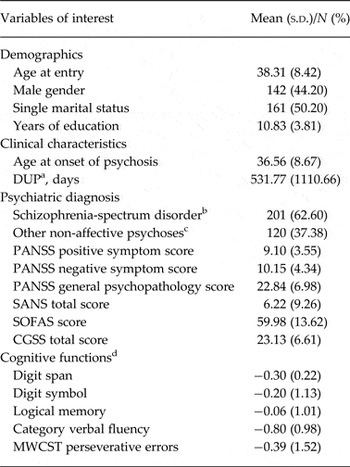
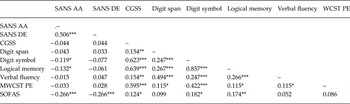
Of the 321 participants in the study, 44.2% were male. The mean age of the sample was 38.3 years (s.d. = 8.4) and the median DUP was 93 days. The majority (62.6%) were diagnosed with schizophrenia spectrum disorder (schizophrenia: n = 140; schizophreniform disorder: n = 58; schizoaffective disorder: n = 3). For other non-affective psychoses, 12.8% (n = 41) of the cohort had brief psychotic disorder, 19.0% (n = 61) had delusional disorder and 5.6% (n = 18) had psychotic disorder NOS. Data on demographics, baseline clinical characteristics, neurocognitive performance and functioning of the sample are summarized in Table 1, and the bivariate inter-correlations among the variables are shown in Table 2.
Demographics, baseline clinical characteristics and cognitive functions of patients with first-episode psychosis

CGSS, Chinese General Self-Efficacy Scale; DUP, duration of untreated psychosis; MWCST, Modified Wisconsin Card Sorting Test; PANSS, Positive and Negative Syndrome Scale; SANS, Scale for Assessment of Negative Symptoms; SOFAS, Social and Occupational Functioning Assessment Scale.
a Median DUP was 93 days.
b Schizophrenia spectrum disorder included schizophrenia, schizoaffective disorder and schizophreniform disorder.
c Other non-affective psychoses included brief psychotic disorder, delusional disorder and psychotic disorders not otherwise specified (NOS).
d Standardized z score for each of the cognitive tests was computed based on performance of healthy controls.
Intercorrelations among measures included in the structural equation models a

AA, Avolition-asociality; CGSS, Chinese General Self-Efficacy Scale; DE, diminished expression; MWCST, Modified Wisconsin Card Sorting Test; PE, perseverative errors; SANS, Scale for Assessment of Negative Symptoms; SOFAS, Social and Occupational Functioning Assessment Scale.
a Pearson correlation analyses were performed and Pearson's correlation coefficients were presented.
*p < 0.05, **p < 0.01, ***p < 0.001.
Initial model
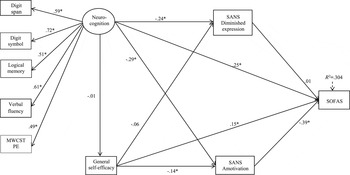
The initial SEM model is shown in Fig. 1. Confirmatory factor analysis for neurocognition revealed good model fit (χ2 = 2.10, p = 0.84, CFI = 1.00, RMSEA<0.001) with all indicators showing significant moderate to high factor loadings (β = 0.49–0.72, p < 0.001), indicating that the latent variable and the indicators were strongly associated. Neurocognition, amotivation and general self-efficacy were proved to have significant direct effects on global functioning, while DE showed no significant effect on functioning. Neurocognition and general self-efficacy also demonstrated significant indirect effects on functioning via the mediation of amotivation. Significant association between neurocognition and DE was observed. There were no significant associations between neurocognition and self-efficacy, and between self-efficacy and DE. Model fit was good (χ2 = 19.05, p = 0.58, CFI = 1.00, RMSEA < 0.001). The model explained 30.4% of the variance on SOFAS score.
Initial structural equation model. Rectangles represent observed measured variables. Circles represents an unobserved latent variables. Values are standardized path coefficients. The squared multiple correlation value (R 2) of a dependent variable, SOFAS indicates the amount of variance explained by its predictors. MWCST, Modified Wisconsin Card Sorting Test; PE, perseverative errors; SANS, Scale for Assessment of Negative Symptoms; SOFAS, Social and Occupational Functioning Assessment Scale. Significant at *p < 0.05.

Final model
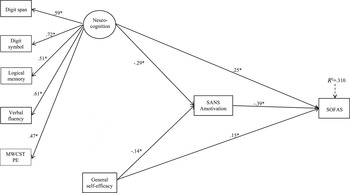
The initial model was modified based on statistical and conceptual considerations. We removed DE from the model as it was not associated with functioning. Non-significant path (i.e. a path between neurocognition and general self-efficacy) was also eliminated. After the modifications, the resulting model (Fig. 2) provided a very good fit for the data (χ2 = 15.48, p = 0.63, CFI = 1.00, RMSEA < 0.001). This model was more parsimonious and had a lower AIC index (8110.8 v. 12154.4) than the initial model, supporting the former as a better model to represent the relationships among variables. The model explained 31.0% of the variance in global functioning. Neurocognition (β = 0.25, p < 0.001) and general self-efficacy (β = 0.15, p = 0.002) showed a positive direct effect on SOFAS score, indicating that better neurocognition and higher general self-efficacy were associated with better functioning. Amotivation had a negative direct effect (β = −0.39, p < 0.001) on SOFAS score, indicating that more severe amotivation was associated with poorer functioning. Significant indirect effect was found between neurocognition (indirect effect: β = 0.11, p < 0.001) and functioning via the mediation of amotivation. The relationship between general self-efficacy (indirect effect: β = 0.05, p = 0.01) and functioning was also mediated by amotivation. Thus, amotivation was demonstrated to partially mediate the effects of both neurocognition and general self-efficacy on global functioning.
Final structural equation model. Neurocognition is a latent variable (with arrows pointing to its respective indicators). SANS Avolition, Neurocognition and General self-efficacy are independent predictors. SANS Avolition is a mediator, and SOFAS is a dependent variable. Values are standardized path coefficients. The squared multiple correlation value (R 2) of a dependent variable indicates the amount of variance explained by its predictors. MWCST, Modified Wisconsin Card Sorting Test; PE, perseverative errors; SANS, Scale for Assessment of Negative Symptoms; SOFAS, Social and Occupational Functioning Assessment Scale. *Significant at p < 0.05.

Discussion
In the current analysis, we sought to examine the relationships among negative symptom subdomains, neurocognition, general self-efficacy and global functioning in FEP patients using the SEM approach. Three major findings emerged from the study. First, amotivation, neurocognitive impairment and general self-efficacy exerted direct effect on functioning. Second, an indirect effect of neurocognition on functioning was mediated by amotivaiton. Third, amotivaiton also mediated the relationship between general self-efficacy and functioning.
Consistent with the literature (Fervaha et al. Reference Fervaha, Foussias, Agid and Remington2014; Chang et al. Reference Chang, Lau, Chan, Hui, Chan, Lee, Lin and Chen2016b ), our model confirms the predictive roles of amotivation and neurocognitive impairment on global functioning. Our result that amotivation mediated an indirect effect of neurocognition on functioning is in line with a recent meta-analytic review which showed that negative symptoms partially mediated the relationship between neurocognitive impairment and functional outcome in schizophrenia (Ventura et al. Reference Ventura, Hellemann, Thames, Koellner and Nuechterlein2009). This finding also concurs with several previous studies which demonstrated motivation as a mediator between neurocognitive impairment and functioning in chronic patients using statistical modeling such as path analysis or SEM (Nakagami et al. Reference Nakagami, Xie, Hoe and Brekke2008; Gard et al. Reference Gard, Fisher, Garrett, Genevsky and Vinogradov2009). In fact, this fits well with the postulation that the willingness and motivation to execute a given task represents a key intervening variable for successful translation of an individual patient's capacity (i.e. neurocognitive functioning) to perform a real-world task into actual behavior and hence desirable functional outcome. Conversely, we failed to find any significant association between DE and global functioning. This is contrary to some prior investigations showing that flat affect, a core symptom of DE, was related to functional impairment (Evensen et al. Reference Evensen, Rossberg, Barder, Haahr, Hegelstad, Joa, Johannessen, Larsen, Melle, Opjordsmoen, Rund, Simonsen, Vaglum, McGlashan and Friis2012). However, our finding accords with a growing body of evidence suggesting that DE does not predict functioning (Fervaha et al. Reference Fervaha, Foussias, Agid and Remington2014, Reference Fervaha, Foussias, Agid and Remington2015; Chang et al. Reference Chang, Lau, Chan, Hui, Chan, Lee, Lin and Chen2016b ). This is also in agreement with two recent studies using SEM in evaluating the hypothesized pathways for functional impairment in chronic schizophrenia and revealed a lack of significant contribution of DE to functional outcome prediction (Green et al. Reference Green, Hellemann, Horan, Lee and Wynn2012; Galderisi et al. Reference Galderisi, Rossi, Rocca, Bertolino, Mucci, Bucci, Rucci, Gibertoni, Aguglia, Amore, Bellomo, Biondi, Brugnoli, Dell'Osso, De Ronchi, Di Emidio, Di Giannantonio, Fagiolini, Marchesi, Monteleone, Oldani, Pinna, Roncone, Sacchetti, Santonastaso, Siracusano, Vita, Zeppegno and Maj2014). Taken together, our results confirm the accumulating evidence which indicates that the predictive power of negative symptoms on functional outcome is mainly attributable to deficits in motivation rather than emotional expressivity (Foussias & Remington, Reference Foussias and Remington2010). The study results also underscore the clinical significance of motivational deficits as a critical intermediary factor, and hence treatment target, linking neurocognitive impairment with real-world functioning.
In line with our a priori hypothesis, general self-efficacy was shown to independently predict functioning. Furthermore, we demonstrated differential relationships between negative symptom subdomains and general self-efficacy. Our SEM analysis indicated that amotivation, but not DE, was related to and mediated the effect of general self-efficacy on functioning. This is in keeping with the only published report so far which has investigated the relationships of two negative symptom subdomains (as opposed to a single composite symptom score) with self-efficacy and functioning (Ventura et al. Reference Ventura, Subotnik, Ered, Gretchen-Doorly, Hellemann, Vaskinn and Nuechterlein2014). This study found that motivational component rather than DE of negative symptoms mediated the impact of self-efficacy on functioning in recent-onset schizophrenia (Ventura et al. Reference Ventura, Subotnik, Ered, Gretchen-Doorly, Hellemann, Vaskinn and Nuechterlein2014). Our result also concurs with a recent study which revealed that negative expectancy appraisal, a construct that is closely linked to self-efficacy, was associated with amotivation rather than DE (Couture et al. Reference Couture, Blanchard and Bennett2011). Hence, our finding provides empirical support to the cognitive model of negative symptoms (Rector et al. Reference Rector, Beck and Stolar2005; Beck et al. Reference Beck, Rector, Stolar and Grant2009) which theorizes that overgeneralized, self-defeating attitudinal beliefs including low self-efficacy contribute to negative symptom development, particularly motivation decrement which in turn results in diminished engagement in constructive activities, and thereby functional deterioration. This finding also corresponds well with two major theories of human motivation, namely expectancy-value theory (Wigfield & Eccles, Reference Wigfield and Eccles2000) and self-determination theory (Ryan & Deci, Reference Ryan and Deci2000). Expectancy-value theory posits that high self-efficacy will lead to positive expectancy to success which will enhance motivation for initiation and maintenance of goal-directed behavior (Wigfield & Eccles, Reference Wigfield and Eccles2000), while self-determination theory identifies sense of competence as one of the three basic psychological needs for promoting intrinsic motivation (Ryan & Deci, Reference Ryan and Deci2000). Thus, our results indicate an important role of general self-efficacy in determining motivation in FEP patients.
Our model revealed that neurocognition was not associated with general self-efficacy. This is contrary to the proposition formulated by Beck's cognitive model that capacity limitation imposed by neurocognitive impairment may contribute to the formation of dysfunctional attitudes and negative self-efficacy (Rector et al. Reference Rector, Beck and Stolar2005; Beck et al. Reference Beck, Rector, Stolar and Grant2009). Our result, however, was consistent with most of those few studies which examined the relationship between self-efficacy and neurocognition in schizophrenia and revealed no significant association between these two variables (Pratt et al. Reference Pratt, Mueser, Smith and Lu2005; Kurtz et al. Reference Kurtz, Olfson and Rose2013; Vaskinn et al. Reference Vaskinn, Ventura, Andreassen, Melle and Sundet2015). Alternatively, the negative finding might be attributable to an inherent difference between ‘objective’ neurocognitive function assessed by standardized battery conducted in laboratory setting and ‘subjective’ perception of self-competence stemming from everyday activities within the context of unstructured real-world circumstances. In fact, literature has also demonstrated minimal or even lack of concurrence between objective and subjective measures of neurocognition in schizophrenia patients (Sellwood et al. Reference Sellwood, Morrison, Beck, Heffernan, Law and Bentall2013; Chang et al. Reference Chang, Chan, Chiu, Hui, Chan, Lee and Chen2015a ). Owing to the scarcity of existing data, further research is needed to verify our finding of a lack of significant relationship between neurocognition and self-efficacy in first-episode populations.
Our results have several clinical implications. First, given that motivational impairment is prevalent in the early course of illness (Fervaha et al. Reference Fervaha, Foussias, Agid and Remington2015; Norman et al. Reference Norman, Manchanda, Harricharan and Northcott2015) and has been affirmed to play a central role in determining functional outcome in FEP patients, more intensive monitoring with detailed assessment of diminished motivation should be conducted on a regular basis to ensure early identification and prompt management. Second, it is known that negative symptoms including amotivation show limited response to current pharmacological and psychosocial interventions (Fusar-Poli et al. Reference Fusar-Poli, Papanastasiou, Stahl, Rocchetti, Carpenter, Shergill and McGuire2015). Our finding that patients’ perceived general self-efficacy influenced their motivational levels indicate that general self-efficacy may represent a promising therapeutic target for treatment of negative symptoms and promotion of early functional recovery in FEP patients. This is in fact congruent with emerging evidence demonstrating that cognitive therapy targeting at modifying maladaptive attitudinal beliefs including negative self-efficacy in conjunction with the use of goal-directed treatment framework was effective in improving motivation and functioning in schizophrenia patients (Grant et al. Reference Grant, Huh, Perivoliotis, Stolar and Beck2012).
Several methodological limitations warrant consideration in interpreting the study results. First, although we used SEM analysis to examine theoretically-driven relationships among variables, the cross-sectional nature of our study cannot confirm causality. Prospective investigation is required to verify the longitudinal relationship and hence the directionality among the investigated variables. Second, evaluation of amotivation by SANS items relies primarily on reports of self-care, occupational performance and interpersonal relationships which overlap with functional outcome measure. Differential relationship of functioning with amotivation and DE might thus be partly attributable to this measurement overlap. Adoption of the recently developed negative symptom rating instruments that incorporate items to assess internal experience of motivation (Kirkpatrick et al. Reference Kirkpatrick, Strauss, Nguyen, Fischer, Daniel, Cienfuegos and Marder2011; Kring et al. Reference Kring, Gur, Blanchard, Horan and Reise2013) could minimize such measurement bias and the potential inflated associations. Third, although the use of a latent variable in our SEM analysis, which allows a number of observed variables (individual neurocognitive measures) to map onto a theoretical construct (neurocognition), can reduce the measurement error in estimating the predictive value of global neurocognition on functional status, this might obscure the potential differential relationships between functioning and specific neurocognitive domains. Fourth, a larger sample size is required to ensure our SEM analysis to have adequate statistical power to include other symptom dimensions such as positive symptoms, disorganization and depression in the modeling so as to derive a more comprehensive prediction model for functional outcome. Fifth, other variables which have been found to be associated with negative symptoms, neurocognition, and/or functioning including social cognition, dysfunctional attitudes and functional capacity (Bowie et al. Reference Bowie, Reichenberg, Patterson, Heaton and Harvey2006; Grant & Beck Reference Grant and Beck2009; Fett et al. Reference Fett, Viechtbauer, Dominguez, Penn, van Os and Krabbendam2011) were not measured in this study. A model (with adequate sample size) incorporating additional candidate variables would likely yield better model fit for the observed data and would enhance explained variance in functional outcome prediction. Sixth, our sample included only adult patients aged 26–55 years, while the majority of first-episode studies also included patients at younger age or focused mainly on adolescent and young adult patients. The relatively older mean age of our cohort may thus render our findings less comparable to the literature of first-episode research as there may be significant variations in illness impacts on clinical and functional outcomes between patients with a more typical age of onset (i.e. late adolescence or early adulthood) and those having their psychosis manifested at later years (Hui et al. Reference Hui, Li, Leung, Chang, Chan, Lee and Chen2014b ). The relatively milder degree of neurocognitive impairment of our cohort as compared to those typical FEP samples whose neurocognitive deficits are mostly found to be 1–2 s.d. below the mean of healthy controls’ performance (Mesholm-Gately et al. Reference Mesholm-Gately, Giuliano, Goff, Faraone and Seidman2009; Aas et al. Reference Aas, Dazzan, Mondelli, Melle, Murray and Pariante2014) may also limit the generalizability of our results.
In conclusion, the current study extends prior research on chronic schizophrenia to FEP regarding the central role of amotivation in determining functional outcome. Using SEM analysis, our results indicate that, alongside its direct effect, amotivation mediates the influence of neurocognitive impairment and perceived self-efficacy on global functioning in FEP patients. Our findings also suggest general self-efficacy as an important treatment target for alleviating motivational deficits and hence promoting functional recovery in the early stage of psychotic illness. Future research using longitudinal follow-up design is required to clarify the temporal relationship among these key variables in predicting functional outcome in patients with FEP. In addition, further investigation is warranted to clarify the neurobiological basis underlying amotivation in psychotic disorders, for instance dysfunctional reward processing (Strauss et al. Reference Strauss, Waltz and Gold2014; Chang et al. Reference Chang, Waltz, Gold, Chan and Chen2016c ) and altered effort-cost computation (Gold et al. Reference Gold, Waltz and Frank2015), to facilitate development of effective treatments to ameliorate motivational impairment and therefore its adverse impacts on functional outcome.
Acknowledgements
This study was funded by the Hong Kong Jockey Club Charities Trust (21009144). The funding body had no involvement in any aspect of the study or manuscript preparation. We thank all the coordinating clinicians and staff from the participating hospitals, clinics and medical records departments for their kind assistance. We are also grateful to the individuals who participated in the study.
Declaration of Interest
Author E.Y.H.C. has participated in the paid advisory board for Otsuka, has received educational grant support from Janssen-Cilag, and has received research funding from AstraZeneca, Janssen-Cilag, Eli Lilly, Sanofi-Aventis and Otsuka. E.H.M.L has been a member of the paid advisory boards for Eli Lilly and AstraZeneca. The remaining authors report no conflicts of interest.