Introduction
The primary goal of agriculture is the provisioning of food, feed and fiber. In light of the enormous impact that agriculture and other human activities have on the world's ecosystems and the services they provide, there is now broad interest in demanding that agriculture augment other ecosystem services, such as regulating water quality, climate and pest populations; supporting soil retention and nutrient cycling; and favoring healthy livelihoods and aesthetic experiences1–Reference Reganold, Jackson-Smith, Batie, Harwood, Kornegay, Bucks, Flora, Hanson, Jury, Meyer, Schumacher, Sehmsdorf, Shennan, Thrupp and Willis3.
Organic farming has been proposed as a means to augment ecosystem services provided by agricultureReference Pimentel, Hepperly, Hanson, Douds and Seidel4–Reference Gomeiro, Pimentel and Paoletti6. It may seem intuitive that organic farming should augment ecosystem services compared with conventional systems since organic farming places greater emphasis on managing ecological processes7, 8. In fact, consumer perceptions that organic farming provides more ecosystem services than conventional agriculture is an important reason that sales of organic food products continue to grow even in the current economic downturnReference Greene, Slattery and McBride9. In the US, for example, the organic food sector grew by 9.4% in 2011 and accounted for about 4% of overall consumer food purchases10.
The goal of organic farming is to maintain productivity while eliminating those inputs that are, or are perceived to be, harmful to the environment and human health: synthetic fertilizers, pesticides and genetically modified organisms (GMOs). In the absence of these common agronomic tools, organic farming relies heavily on diverse crop rotations that include cover crops, animal manures and by-products, and tillage to provide soil fertility, weed, insect and disease management, and soil erosion control. While these tools are not unique to organic systems, their importance is elevated in organic farming. Some authors have strongly criticized organic farming since some tools proven to increase crop yields and reduce soil erosion in conventional agriculture are prohibited from organic productionReference Trewavas11–Reference Hendrix14. These authors argue that lower crop yields in organic systems result in greater deforestation and loss of biodiversity when land is converted to agricultural uses to maintain production at a given level. They also argue that the relatively intense use of tillage in organic systems increases soil erosion.
In this paper, we evaluate the impact of organic farming on the provision of a subset of ecosystem services, focusing on organic grain cropping systems in the US, where the authors have the most experience. While other reviews have focused almost exclusively on comparisons between organic and conventional tilled (CT) systemsReference Pimentel, Hepperly, Hanson, Douds and Seidel4–Reference Gomeiro, Pimentel and Paoletti6, we highlight comparisons between organic and conventional no-till (NT) systems, which are arguably more sustainable than tilled conventional systemsReference Triplett and Dick15. We then explore management practices that can increase ecosystem services provided by organic grain cropping systems: expanding crop rotation diversity, improving manure management, and reducing tillage intensity and frequency.
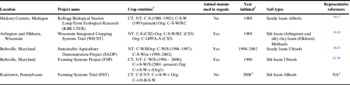
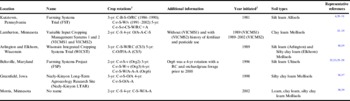
In assessing ecosystem services, we rely strongly on research results from long-term agricultural research sites (LTARs) since an inherent aspect of organic farming is to build soil quality over the long term. In addition, many ecosystem services are best quantified over the long term to account for changes that occur slowly (e.g., C sequestration) and for variables that can have large interannual variability (e.g., crop yields and greenhouse gas emissions). We know of only five LTARs that include a comparison of organic and conventional NT cropping systems, all in the US; three of these also include a CT system (Table 1). Only six US LTARs include comparisons of organic systems with various crop rotations (Table 2).
Characteristics of LTAR projects in the US that include organic (Org) and conventional NT systems (only the treatments with the most similar crop rotations are included for organic treatments; CT systems are listed when present).

1 A = alfalfa (Medicago sativa L.); B = barley (Hordeum vulgare L.); C = corn (maize; Zea mays L.); cc = crimson clover (Trifolium incarnatum L.) cover crop; O = oats (Avena sativa L.); P = pea (Pisum sativum L.); r = cereal rye (Secale cereale L.) cover crop; RC = red clover (Trifolium pratense L.); S = soybean (Glycine max L.); v = hairy vetch (Vicia villosa Roth.) cover crop; W = winter wheat (Triticum aestivum L.).
2 Termination date included where relevant.
3 NT treatments were added in 2008 to the FST, which was initiated in 1981. No results from this expanded experiment are yet published.
Characteristics of LTAR projects in the US that include organic crop rotations with varying crop phenologies (other treatments within LTARs are not included).

1 A = alfalfa (Medicago sativa L.); B = barley (Hordeum vulgare L.); C = corn (maize; Zea mays L.); CS = corn silage; O = oats (Avena sativa L.); P = pea (Pisum sativum L.); r = cereal rye (Secale cereale L.) cover crop; RC = red clover (Trifolium pratense L.); S = soybean (Glycine max L.); v = hairy vetch (Vicia villosa Roth.) cover crop; W = winter wheat (Triticum aestivum L.).
2 Termination date included where relevant.
Ecosystem Services Provided by Organic and Conventional Systems
Soil organic matter (SOM)
One of the fundamental goals of organic farming is to increase or maintain SOM levels to improve system resilience and resistance to perturbation, enhance nutrient cycling, provide healthy and productive crops, and control pests7, 8, Reference Balfour40. Many studies confirm that organic grain cropping systems can increase soil organic carbon (SOC) and total N relative to CT systemsReference Coulter, Sheaffer, Wyse, Haar, Porter, Quiring and Klossner32, Reference Reganold41–Reference Liebig and Doran43, regardless of whether the organic systems rely on legume cover crops alone or in combination with animal manuresReference Drinkwater, Wagoner and Sarrantonio44, Reference Marriott and Wander45. As noted by Leifeld et al.Reference Leifeld, Reiser and Oberholzer46, greater SOC in organic compared with CT systems is likely due to greater C inputs rather than organic management per se.
As NT agriculture increases in prominence in the US, Brazil, Argentina, Australia and elsewhereReference Triplett and Dick15, it is important to consider NT systems when comparing ecosystem services provided by organic and conventional systems. In the US, for example, about 35% of row-crop hectares were NT planted in 2009, with the median rate of adoption increasing by about 1.5% per year from 2000 to 2007Reference Horowitz, Ebel and Ueda47. Marriott and WanderReference Marriott and Wander45 note that mean change in SOC in nine organic cropping systems they studied was 0.35 t C ha−1 yr−1, which is similar to that documented for NT systems (0.36–0.43 t C ha−1 yr−1) in various regions of the USReference Eve, Sperow, Paustian and Follett48–Reference Johnson, Reicosky, Allmaras, Sauer, Venterea and Dell50.
Differences in SOC were variable from LTARs that include both organic and NT systems, depending on the level of organic inputs. At the W.K. Kellogg Biological Station Long-Term Ecological Research (KBS LTER) site in Michigan, SOC in an organic system (10.2 Mg C ha−1), to which no animal manure was added, was 22% less than in a NT (12.4 Mg C ha−1) system after 10 yearsReference Robertson, Paul and Harwood16. Although not reported, carbon inputs, based on aboveground net primary productivity data and management information, appear to be similar in the NT and organic systems. Differences in soil C, then, appear to be due to differences in tillage. SOC was measured only to a depth of 7.5 cm in this study since differences between NT and tilled systems are generally seen at these surface depths.
At the Wisconsin Integrated Cropping Systems Trial (WICST) there was greater SOC at 0–5 cm in a NT corn–soybean (CS2; 26.5 g kg−1) than an organic corn–soybean–wheat/red clover (CS3; 21.9 g kg−1) rotation but no differences at 5–20 cm after 18 yearsReference Jokela, Posner, Hedtke, Balser and Read18. Carbon stocks in the WICST (0–20 cm), calculated from reported soil bulk density and C concentrations, were similar in the NT (56.0 Mg C ha−1) and organic (57.6 Mg C ha−1) systems. Even though the organic system (CS3) included cover crops and manure, C inputs were about 25% lower in the organic than the conventional NT system (CS2), due to lower crop residue yields in the organic system, suggesting that the form or placement of C inputs may have impacted soil C stocks.
At the Sustainable Agriculture Demonstration Project (SADP), which was recently concluded in Beltsville, Maryland, Teasdale et al.Reference Teasdale, Coffman and Mangum20 showed that SOC concentration to a depth of 30 cm was greater in a legume (crimson clover) cover crop plus dairy manure-based reduced-tillage organic system than a NT system after 9 years (13.9 and 10.2 g kg−1, respectively). Soil C concentration on a volume basis was not reported in this study. At another LTAR in Beltsville, Maryland, the Farming Systems Project (FSP), SOC to a depth of 1 m in corn–rye–soybean–wheat/legume rotations was 11% greater in a manure-based organic (Org3; 60.8 Mg C ha−1) than in a NT (54.9 Mg C ha−1) system after 11 yearsReference Cavigelli, Djurickovic, Mirsky, Maul and Spargo22. The NT system had not received manure for at least 14 years. Carbon inputs to the soil were greater in the organic than the NT systems in both Maryland studies, largely due to manure and/or compost additions. Results indicate that tilling sufficient organic materials, particularly manure, into soil may be a more effective means of increasing SOC than eliminating tillage.
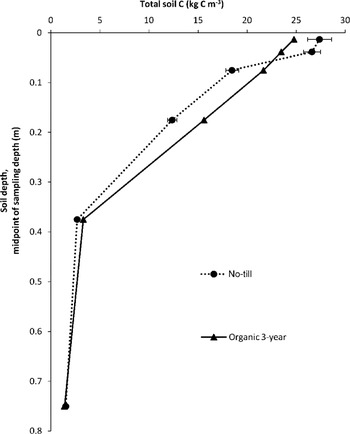
Distribution of SOC with soil depth also differed substantially between the organic and the NT system at the FSP. While SOC in surface soils (0–5 cm depth) was greater in NT than in the organic system, SOC was substantially greater in Org3 than in NT at 5–10 and 10–25 cm depths (Fig. 1). Burying C inputs (poultry litter, ∼4.5 Mg ha−1 every 3 years; and cover crop and crop residues) thus provided protection from repeated tillage in Org3. By contrast, SOC in the surface of NT systems is susceptible to loss following tillageReference Grandy, Robertson and Thelen51. Since the majority of farmers using NT do not use continuous NTReference Spargo, Alley, Follett and Wallace52, results from continuous NT research sites represent an upper limit to C sequestration levels likely achieved on-farm. Results from FSP also suggest that SOC in the organic system at KBS might be greater than indicated by only sampling to 7.5 cm depth. As Doran et al.Reference Doran, Sarrantonio, Liebig and Sparks53 showed, soil samples should be taken to a minimum depth of 30 cm when comparing SOC in conventional and organic management systems.
SOC with depth in 3-year NT and organic corn–soybean–wheat/legume crop rotations at the USDA-ARS Beltsville FSP 11 years after the initiation of the experiment.

SOM and soil fertility
SOM provides a number of supporting and regulating services. Among these benefits, increasing SOM increases soil fertility, reduces global warming potential (GWP) by sequestering atmospheric CO2 in the soil, and, especially at the soil surface, increases water infiltration and helps stabilize soil to resist erosion.
A number of studies have shown that increasing SOM increases soil N fertility (N mineralization potential) in tilled organic systemsReference Clark, Horwath, Shennan and Scow42, Reference Liebig and Doran43, Reference Marriott and Wander45, Reference Reganold, Palmer, Lockhart and Macgregor54, Reference Drinkwater, Letourneau, Workneh, van Bruggen and Shennan55. The relative impact of organic versus NT management on N fertility in organic systems seems to be related to SOM source and/or input levels. At the KBS LTER, where C inputs appear similar in a NT and an organic system, N mineralization potential was greater in the NT than the organic system after 14 years (http://lter.kbs.msu.edu/datatables/56). As with SOC, N mineralization potential seems driven primarily by differences in tillage when organic matter inputs are similar. At the WICST, although C inputs were greater in a NT than in an organic system, there was no difference in N mineralization potential between the two systemsReference Jokela, Posner, Hedtke, Balser and Read18. These results indicate that the quality rather than the quantity of N inputs may have impacted soil N fertility. At the FSP in Maryland, N mineralization potential was greater in the organic than the NT system by 34% after 14 yearsReference Spargo, Cavigelli, Mirsky, Maul and Meisinger23. Greater soil N fertility resulted in 54% greater corn grain yield in the organic than the NT system in microplots to which no N source was added in year 15. At the SADP, also in Maryland, pre-side-dress soil nitrate, an in-season measure of plant N availability, was 42% greater and corn yield was 18% higher in the organic than the NT system during a uniformity trial following 9 years of experimental treatmentsReference Teasdale, Coffman and Mangum20. While it is not possible to separate the impact of organic N input level versus source in these studies, it is likely that both factors played a role in augmenting soil N fertility. In any case, results from FSP indicate that N fertility in manure-based organic systems can be augmented relative to NT systems (non-manure based) in the long run even with relatively conservative rates of animal manure application (∼4.5 Mg ha−1 poultry litter every 3 years).
SOM and GWP
GWP is the balance between the net exchange of the greenhouse gases CO2, N2O and CH4 resulting from on-farm practices and the production and transport of inputs, and is generally driven by changes in SOC and emissions of N2O in upland cropping systemsReference Robertson and Grace56. GWP is expressed in units of CO2 equivalents to account for the GWPs of CH4 and N2O being 25 and 298 times, respectively, that of CO257. Rate of change in SOC was the primary factor driving differences in GWP among cropping systems at both the KBS LTER and FSP sitesReference Robertson, Paul and Harwood16, Reference Cavigelli, Djurickovic, Mirsky, Maul and Spargo22. To our knowledge, these are the only two studies available comparing measured GWP between organic and NT systems; both studies also include CT systems.
At both KBS and FSP, GWP was lower in the organic than the CT system, primarily due to greater SOC in the organic than the CT systems. Other factors contributing to lower GWP in organic than CT included avoiding CO2 emissions associated with N fertilizer production and transport (indirect energy use) and, at KBS, avoiding CO2 emissions associated with dissolution of lime applied to soils.
At KBS, GWP was lower in the NT than the organic system, but the opposite was observed at FSP. At KBS, CO2 emissions from N fertilizer production and transport and from lime dissolution were offset by increases in SOC in NT. GWP was about 2.8-fold lower for the NT than the organic systemReference Robertson, Paul and Harwood16. By contrast, at FSP, Org3 had greater SOC and lower CO2 emissions from indirect energy use (energy used to produce and transport agricultural inputs) than NT, which offset approximately two-fold greater N2O emissions in Org3 than NT. The resulting GWP was negative in Org3 and positive in NTReference Cavigelli, Djurickovic, Mirsky, Maul and Spargo22. An important caveat for the FSP study is that poultry litter was assumed to be produced on-farm (transportation distance of 1 km). While this is not an uncommon situation on the Eastern Shore of Maryland, where there is an important broiler chicken industry, manure transport in other locations can be substantial. The CO2 emissions due to energy use were equal between NT and Org3 if poultry litter was transported 42 km or 114 km for wheat and corn production, respectivelyReference Cavigelli, Djurickovic, Mirsky, Maul and Spargo22.
Soil erosion
Soil erosion is sometimes asserted to be lower from organic than from conventional systems due to the erosion-protecting properties of additional SOM in organic systemsReference Pimentel, Hepperly, Hanson, Douds and Seidel4, Reference Auerswald, Kainz and Fiener58, Reference Papadopoulos, Bird, Whitmore and Mooney59. However, as noted by Siegrist et al.Reference Siegrist, Schaub, Pfiffner and Mader60 reduced soil erodibility in organic compared with conventional systems is not necessarily sufficient to protect against soil erosion during a heavy summer rainstorm.
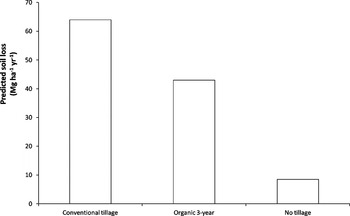
There are very few direct measurements of soil erosion from organic versus conventional systems. A recent study from England showed lower interrill erosion following simulated rainfall from a silt soil managed organically versus conventionallyReference Kuhn, Armstrong, Ling, Connolly and Heckrath61. Phosphorus content of eroded soil, however, was much greater from the organic than the conventional system. These differences did not reflect soil test P, which was lower in the organically managed soil. One study that quantified the impact of organic compared with conventional farming on soil loss showed that soil depth after 37 years of farming was 21 cm greater on an organic farm than a neighboring conventional farm in the Palouse region of the USReference Reganold, Elliott and Unger62. These authors attributed lower soil erosion to greater use of cover crops in the organic system rather than to the soil-erosion controlling properties of additional SOM. Soil erosion is often estimated using mathematical models due to challenges associated with measuring soil erosion directly. When the Water Erosion Prediction Project (WEPP)Reference Flanagan and Nearing63 model was applied to similar 3-year organic (Org3) and CT rotations at the FSP, predicted sediment loss was reduced by 33% in Org3 compared with CT (Fig. 2)Reference Green, Cavigelli, Dao and Flanagan24. Losses of soil P, N and C in sediment runoff followed a similar pattern. Lower losses in Org3 than CT were due primarily to the presence of a winter legume cover crop following wheat harvest in Org3, a period during which there was no winter cover crop in the CT system. Thus, it seems that reduced soil erosion and nutrient runoff in organic compared with tilled conventional systems is due, at least in part, to greater use of cover crops in organic systems, and the role of greater SOM and associated soil properties is not clear.
Sediment loss from CT, organic and NT cropping systems at the USDA-ARS FSP, Beltsville, Maryland, USA predicted using the WEPP model. All systems are corn–soybean–wheat/legume rotations; simulations are for a Mattapeake soil on 5% slope, 60 m slope length and 100-year timelineReference Flanagan and Nearing63.

While we are not aware of any direct measurements of soil erosion in organic compared with NT systems—which are known to reduce soil erosion substantially compared with CT systemsReference Triplett and Dick15—it is very likely that soil erosion is lower in NT than organic systems due to differences in tillage. When the WEPP model was applied to 3-year rotations at FSP, soil erosion was reduced 80% in NT compared with Org3, with commensurate decreases in losses of soil P, N and C in sediment runoff (Fig. 2)Reference Green, Cavigelli, Dao and Flanagan24. However, predicted soil erosion from a reduced-tillage organic system was similar to that from NT (3.7 versus 3.5 Mg ha−1) at the SADP, based on simulations with the EPIC modelReference Watkins, Lu and Teasdale21, suggesting that decreased tillage could enhance erosion protection in organic systems.
Crop yield
Crop yield in organic systems has received considerable research attentionReference Connor13, Reference Lotter64, Reference Badgley, Moghtader, Quintero, Zakem, Chappell, Aviles-Vazquez, Samulon and Perfecto65. A recent meta-analysis shows that organic grain yields, on average, were lower by 26% than those in conventional systems while organic oilseed yields were similar to those in conventional systems (though variability was high for oilseed data)Reference Seufert, Ramankutty and Foley66. As noted by the authors, studies included in this meta-analysis were more rigorously selected than previous studies of this nature.
Lower yields in organic than conventional grain crops are usually related to challenges associated with timely weed control and/or nutrient supplyReference Smith, Menalled and Robertson17, Reference Posner, Baldock and Hedtke19, Reference Cavigelli, Teasdale and Conklin25, Reference Teasdale and Cavigelli26, Reference Coulter, Sheaffer, Wyse, Haar, Porter, Quiring and Klossner32, Reference Porter, Huggins, Perillo, Quiring and Crookston33, Reference Berry, Sylvester-Bradley, Philipps, Hatch, Cuttle, Rayns and Gosling67. One study examined this annual variability in detail and found that corn and soybean yields in organic systems were 74% of those in conventional systems in about 1 of 3 years (over 21 site years), largely because of poor weed control in years with wet soils in the spring. By contrast, during the other 2 of 3 years weed control was effective and corn and soybean yields were essentially the same in organic and conventional systemsReference Posner, Baldock and Hedtke19. These results and those of Seufert et al.Reference Seufert, Ramankutty and Foley66—showing that organic yields approach those of conventional systems when best management practices are used—indicate that despite a dearth of research on organic systems, organic management has the potential to produce crop yields similar to those in conventional systems. Additional research and development, including crop breeding, improved agronomic practices and improved engineering of weed control implements, will be needed to improve the consistency of organic system performance.
Some studies have reported greater grain yields in organic than tilled conventional systems during drought years and have attributed these differences to increased soil water-holding capacity in organic systemsReference Pimentel, Hepperly, Hanson, Douds and Seidel4, Reference Lotter64, another benefit of elevated SOM. Other studies, which tend to be from the southeast US, show that improved SOM and quality in organic systems does not necessarily result in greater yield in organic systems during dry yearsReference Cavigelli, Teasdale and Conklin25 (Chris Reberg-Horton, personal communication). Soils in this region of the country are highly weathered, are more vulnerable to crop stress during droughty summer months, and have less tolerance to weed competition than, for example, Midwestern Mollisols. Variability of results highlights the site-specific nature of cropping systems performance and the need for site-specific research to improve organic systems.
Labor requirements and economic performance
Due largely to the multiple tractor passes required to control weeds in organic systems, organic farming has greater labor and management requirements than conventional methodsReference Hanson, Lichtenberg and Peters29, Reference Mirsky, Ryan, Curran, Teasdale, Maul, Spargo, Moyer, Grantham, Weber and Way68. Concerns about these labor requirements are frequently noted by organic grain farmers as a constraint to increasing organic grain acreageReference Ryan, Mortensen, Wilson and Hepperly69. Critical shortage of organic feed corn throughout the US has required organic beef, dairy and poultry producers to purchase feed from distant locations. While the number of organic dairy farms in the US increased by 60% in 2008, the number of organic crop acres increased by only 8%Reference Benson70. The US organic poultry industry experienced similar growthReference Dimitri and Oberholtzer71. In 2008, certified organic grain cropland was less than 1% of the total acreage while proportions dedicated to corn and soybean were only about 0.2%72.
The number of grain farmers adopting organic methods has been limited by at least four factors: (1) production challenges, including pest and fertility managementReference Cavigelli, Teasdale and Conklin25; (2) perceived risks of returning to tillage-based systems by conventional grain farmers accustomed to the advantages of NT (Aaron Cooper, Farmer, personal communication); (3) high labor and fuel costs that prevent scaling up (Bill Mason and Ed Fry, Farmers, personal communication); and (4) lack of adequate information on sustainable management practices for organic systems among agricultural professionals, including those working for Cooperative Extension and the Natural Resources Conservation Service (NRCS)Reference Mainville, Farrell, Groover and Mundy73.
Despite greater labor requirements and frequently lower grain yields, economic returns for organic systems in North America are generally greater than for CT and NT systems on a per hectare basis, due to substantial economic premiums received for organic grain cropsReference Cavigelli, Hima, Hanson, Teasdale, Conklin and Lu27, Reference Mahoney, Olson, Porter, Huggins, Perillo and Crookston34–Reference Delate, Duffy, Chase, Holste, Friedrich and Wantate36, Reference Archer and Kludze38, Reference Archer, Jaradat, Johnson, Weyers, Gesch, Forcella and Kludze39, Reference Clark, Klonsky, Livingston and Temple74–Reference Chavas, Posner and Hedtke77. However, on a whole-farm basis, returns for organic farms may be lower than for conventional farms due to the smaller size of organic farms78. Thus, labor-saving practices should help increase the number of acres planted to organic grains and improve the economic performance of organic farms.
In summary, results from a limited number of studies indicate that organic cropping systems that include legume cover crops and animal manures can result in greater SOC and soil fertility levels and lower GWP than NT systems, as long as manure transport distance is relatively short. In addition, economic returns on a per hectare basis are usually greater for organic than conventional systems. However, soil erosion is likely lower in NT than tilled organic systems and grain yields and whole-farm economic returns tend to be lower while labor requirements tend to be greater on organic than conventional farms.
Improving Ecosystem Services Provided by Organic Grain Cropping Systems
Can we improve ecosystem services provided by organic cropping systems? Recent and on-going research suggest that ecosystem services from organic systems can be augmented by increasing crop phenological diversity—especially by including perennial forages in the rotation, improving manure management, and reducing the frequency and intensity of tillage.
Increasing Crop Phenological Diversity to Augment Ecosystem Services Provided by Organic Systems
Grain yield
Increasing the phenological diversity of crops in a rotation can increase yields of organic grain crops. At the FSP (Table 2) corn grain yield in a 6-year rotation (Org6) that includes summer annual (corn and soybean), winter annual (winter wheat) and herbaceous perennial (alfalfa) cash crops was, on average, 10% greater than in a 3-year rotation that includes only summer and winter annual cash crops (Org3) and 30% greater than in a 2-year rotation that includes only summer annual cash crops (Org2) (Table 3). These differences were the result of both increases in N availability and decreases in weed competition as crop rotation length and complexity increasedReference Cavigelli, Teasdale and Conklin25, Reference Teasdale and Cavigelli26, Reference Teasdale, Mangum, Radhakrishnan and Cavigelli28. In Org2, opportunities to kill weeds occur at the same time each year since the two cash crops, corn and soybean, are planted at similar times. Thus, summer annual weeds (primarily Amaranthus spp., Chenopodium album, Daturum stramonium, Setaria spp., and Abutilon theophrasti) are favored in this system. When wheat is added to the rotation (Org3), the summer annual weeds either do not germinate or do not reach reproductive maturity as they are cut prior to setting seed when the wheat is harvested, and killed when soil is prepared for planting cover crops after wheat harvest. In Org6, a perennial forage crop, alfalfa, provides an additional level of phenological complexity that provides further weed control opportunities. Alfalfa is cut three to five times per year, a disturbance regime that tends to favor perennial and annual grasses with a prostrate growth habit rather than annual broadleaf weeds. Tillage prior to corn planting provides control of the grasses favored during the alfalfa phase of the rotation. Corn yield loss to weeds, as measured in adjacent weed-free and weedy plots, was reduced from 35% in Org2 to 14% in Org6 (Table 3), whereas, to provide context, yield loss to weeds in the 3-year conventional NT rotation was 7%Reference Teasdale and Cavigelli26.
Impact of increasing crop phenological diversity on corn grain yields, weed pressure, economic risk, soil fertility, reliance on animal manure inputs, soil test phosphorus, soil erosion and soil N2O emissions at the USDA-ARS Beltsville FSP.

1 C = corn (maize; Zea mays L.); r = cereal rye (Secale cereale L.) cover crop; S = soybean (Glycine max L.); v = hairy vetch (Vicia villosa Roth.) cover crop; W = winter wheat (Triticum aestivum L.); F, perennial forage crop, which, from 1996 to 2000, was red clover (Trifolium pratense L.) and orchardgrass (Dactylis glomerata L.); since 2000, has been alfalfa (Medicago sativa L.).
2 75% lower confidence limit of net returns (a smaller lower limit represents a greater risk), as reportedReference Dimitri and Oberholtzer71.
3 Mehlich 3 extractable (M.A. Cavigelli, unpublished data).
4 Calculated using the RUSLE2 for a soil with 2–5% slope and an erodibility factor (K) of 0.28. Results were similar with other settings (T. Pilkowski and M.A. Cavigelli, unpublished data).
5 Means of measurements made in 2008 and 2010 (Org3) or 2010 only (Org2 and Org6), fromReference Singer, Franzluebbers, Karlen, Wedin and Fales80. Research supported by GRACEnet, http://www.ars.usda.gov/research/programs/programs.htm?np_code=204&docid=17271.
Organic grain yields also increased with increasing phenological diversity of crops in a rotation at the two Variable Input Cropping Management Systems studies (VICMS1 and VICMS2) in Lamberton, Minnesota (Table 2). Corn grain yield was 26% (VICMS1) and 50% (VICMS2) greater in a 4-year oat/alfalfa–alfalfa–corn–soybean than a 2-year corn–soybean crop rotationReference Coulter, Sheaffer, Wyse, Haar, Porter, Quiring and Klossner32, Reference Porter, Huggins, Perillo, Quiring and Crookston33. Weed pressure was lower at the VICMS2 site, which had a history of pesticide applications, than at the VICMS1 site, which did not have a history of pesticide applications. At VICMS1 there was no impact of rotation length on organic soybean yield but at VICMS2 soybean yield was 42% greater in the 4-year than the 2-year rotation. In Germany, wheat yields in organic systems were found to be 31% greater when a perennial forage was part of the rotation than when only cash crops were part of the rotationReference Schmidt, Schulz, Leithold, Raupp, Pekrun, Oltmanns and Kopke79.
In other studies, phenological diversity of crops in an organic rotation did not impact crop yields. At the Farming Systems Trial (FST) in Kutztown, PA, there was no difference in corn or soybean yields in a 3-year corn–small grain–soybean–small grain–legume rotation compared with a 5-year corn–rye–soybean–silage corn–wheat/red clover–alfalfa rotation over a 16 year time periodReference Hepperley, Douds, Seidel, Raupp, Pekrun, Oltmanns and Kopke30. At the WICST there was no difference in corn yield between a 3-year corn–soybean–wheat/red clover (CS3) and a 5-year corn–soybean–oat/pea–alfalfa–alfalfa rotation (CS5)Reference Posner, Baldock and Hedtke19. Differences between rotations in these two studies, however, are more subtle than in studies comparing rotations with and without perennial forages (e.g., FSP and VICMS). In Greenfield, Iowa and Morris, Minnesota (Table 2), there were also no impacts of crop phenological diversity during the first 3 or 4 years of experiments comparing 2- or 3- and 4-year rotationsReference Delate, Duffy, Chase, Holste, Friedrich and Wantate36, Reference Delate and Cambardella37, Reference Archer, Jaradat, Johnson, Weyers, Gesch, Forcella and Kludze39. These results may reflect that these studies report data for only the first 3 or 4 years following plot establishment. Weed populations in organic fields that had previously been managed conventionally are usually low but can increase with time in organic management. In the Iowa study, there are also only subtle differences between the 3- and 4-year rotations (Table 2). While rotations that include perennial forages can increase grain yields compared with simple corn–soybean rotations, there is a need to better understand when and how phenological diversity of crops in organic rotations impacts crop yields.
Economic performance
Increasing crop phenological diversity provides some economic benefits. Crops with different phenology tend to respond differently to weather fluctuations such that the economic performance of a more diverse rotation is better buffered against variable weather. At the FSP, net returns for the 6-year rotation that includes a perennial forage, Org6, were substantially greater than the mean for Org2 and Org3 when no organic price premiums were included. Differences were due to lower production costs and greater returns in the longer rotationReference Cavigelli, Hima, Hanson, Teasdale, Conklin and Lu27. When price premiums for corn, soybeans and wheat were included in the analysis, net returns for the three organic systems were similar and substantially higher than without premiums. However, economic risk, measured using the 75% lower confidence limit of net returns, was 7.5 and 3.9 times greater for Org2 and Org3, respectively, than for Org6 (Table 3). At the VICMS project, Mahoney et al.Reference Mahoney, Olson, Porter, Huggins, Perillo and Crookston34 also found lower risk (and greater return) for a 4-year corn–soybean–oats/alfalfa–alfalfa rotation than a 2-year corn–soybean rotation. On the other hand, researchers in Iowa and Morris, Minnesota found no difference in risk between 2- or 3- and 4-year crop rotations, respectivelyReference Delate, Duffy, Chase, Holste, Friedrich and Wantate36, Reference Smith, Clapperton and Blackshaw76. These results, again, might reflect that these studies report on the first three transition years of these experiments.
Nutrient management
Increasing crop phenological diversity can benefit soil nutrient management. At the FSP, N mineralization potential, particulate organic matter N, and SOC were similar among the three organic systems and all were greater than in CT and conventional NT systemsReference Spargo, Cavigelli, Mirsky, Maul and Meisinger23. Interestingly, the longest of the three organic rotations, Org6 relies on fewer external inputs of poultry litter than the two shorter rotations (Org2 and Org3; Table 3). During a 6-year time period, typical poultry litter application rates were 13.4, 17.9 and 9.0 Mg ha−1 in Org2, Org3 and Org6, respectively. Since P removal in harvested crops was greater in Org6 than Org2 and Org3, soil test P was 21% lower in Org6 than in Org2 and Org3 after 16 years (Table 3). Thus, the possibility of overloading soils with phosphorus, an important concern in many watersheds, especially when animal manures are applied, was reduced considerably with Org6 compared with the shorter rotations.
Soil erosion
Increasing crop phenological diversity also substantially decreased predicted soil erosion among organic systems at the FSP. When the Revised Universal Soil Loss Equation, Version 2 (RUSLE2) was applied to the three FSP organic systems, predicted soil loss by erosion was reduced by 40 and 62% in Org3 and Org6, respectively, compared with Org2 (Table 3). These results are consistent with the general finding that small grain crops and perennial forages can reduce soil erosion compared with row crops such as corn and soybeanReference Singer, Franzluebbers, Karlen, Wedin and Fales80.
Soil N2O emissions
Preliminary results from the FSP indicate that annual soil N2O emissions were reduced by about 50% in the 6-year rotation that includes a perennial forage, Org6, compared with the shorter organic rotations, Org2 and Org3 (Table 3). This represents a N2O mitigation potential equal to the best mitigation options in agriculture in the Eastern and Central USReference Cavigelli, Parkin, Liebig, Franzluebbers and Follett81. This reduction was due to a decrease in the proportion of high N demanding crops in the Org6 rotation compared with the two shorter rotations. Although GWP was not calculated for Org6, reducing N2O emissions using a more diverse crop rotation that includes proportionally fewer high N-demanding crops should help decrease GWP considerably given that N2O was a dominant source of GWP at both the KBS LTER and at FSP.
While integrating perennial forages into annual grain cropping systems is an effective way to reduce tillage and improve a number of ecosystem services (Table 3), many producers are reluctant or not able to produce perennial forages due to limitations in equipment, expertise and/or markets. In many areas, development of confined animal feeding operations has concentrated animal production such that large areas have historically low animal populations and forage demand is lowReference Russelle, Entz and Franzluebbers82, Reference Watson, Walker and Stockdale83. Some organic farmers, like their conventional neighbors, are therefore limited to producing primarily grain crops. Thus, there is a need to improve provisioning, regulating and supporting ecosystem services provided by organic rotations that do not include perennial foragesReference Watson, Walker and Stockdale83.
The following sections address research designed to improve ecosystem services provided by organic cropping systems, including improving nutrient management and reducing tillage. Since these are relatively new areas of research, there are fewer data available to assess the viability of these approaches. However, expanding organic grain acreage in the US to meet increasing demand for organic meat and milk products will likely require that we improve existing organic production systems to address farmer concerns with labor (largely tillage) requirements and nutrient management concernsReference Watson, Bengtsson, Ebbesvik, Loes, Myrbeck, Salomon, Schroder and Stockdale84 of traditional organic grain cropping systems. These studies highlight promising approaches to improve ecosystem services.
Improving Manure Management in Organic Systems
Since organic farmers often rely heavily on animal manure applications to meet crop N needs, it is imperative that they pay particular attention to nutrient managementReference Watson, Bengtsson, Ebbesvik, Loes, Myrbeck, Salomon, Schroder and Stockdale84. The ratio of plant-available N:P in manure or compost (approximately 2:1 and 1:2, respectively) is lower than the ratio of N:P in most crops (between 7:1 and 10:1)Reference Heckman, Sims, Beegle, Coale, Herbert, Bruulsema and Bamka85–Reference Spargo, Evanylo and Alley87. Repeated N-based application of animal manure and compost, then, generally leads to an accumulation of soil P in excess of crop needs, thereby increasing the risk of P enrichment of runoffReference Spargo, Evanylo and Alley87–Reference Sims, Simard and Joern89. In severe cases, P can also leach through the soil profileReference Sims, Simard and Joern89.
One strategy for optimizing N and P balance on organic farms is to maximize legume-N inputs and thereby reduce animal manure N needs. Intensively managed legume green manures can satisfy a significant portion of crop N demandReference Crews and Peoples90. In addition, side-dressing or top-dressing crops in-season with manure and other by-products may increase synchrony between N availability and crop N demand. Recent research to evaluate this approach has shown some level of success. In Beltsville, Maryland, researchers applied poultry litter, pelletized poultry litter, feather meal, and a pelletized poultry litter–feather meal blend at side-dress to corn plots where a hairy vetch cover crop had been plowed down. In 2009, side-dress application of all supplemental N materials resulted in a 12% increase in corn yield, a 20% increase in N uptake and a 6% increase in harvest index. In 2010, there were no differences in grain yield or N uptake between pre-plant versus side-dress treatments but harvest index was again 6% higher with side-dress treatments (J.T. Spargo et al., unpublished data). Corn grain yields in side-dress treatments were similar to that in a side-dress ammonium nitrate fertilizer control treatment applied at a similar level of available N. Additional research is needed and there are some constraints to applying organic amendments at side-dress. Nonetheless, better manure management is needed on many organic farmsReference Watson, Bengtsson, Ebbesvik, Loes, Myrbeck, Salomon, Schroder and Stockdale84.
Reducing Tillage in Organic Systems
Conventional NT management has been recognized for its potential to improve soil qualityReference Franzluebbers91, significantly reduce runoff and soil erosionReference Pesant, Dionne and Genest92, sequester atmospheric CO2Reference Franzluebbers49, increase N conservationReference Spargo, Alley, Follett and Wallace52, and reduce machinery, labor, and fuel costs compared with tilled systemsReference Parsch, Keisling, Sauer, Oliver and Crabtree93. The adoption of NT in conventional systems has been facilitated by the development of improved planters and grain drills, introduction of genetically modified crop germplasm, and the use of effective and affordable broad-spectrum herbicidesReference Young94.
By contrast, organic grain production in the Eastern US requires 8–12 tractor operations per year to ensure good weed control (i.e., primary and secondary tillage, seedbed preparation, planting, over the row and between row cultivation). Intensive tillage is an effective weed management tactic, but is energy and labor intensive, and can result in reduced soil quality and increased risk of erosionReference Smith, Reberg-Horton, Place, Meijer, Arellano and Mueller95. While continuous NT is generally considered impractical in organic cropping systems due to perennial weed infestationsReference Mirsky, Ryan, Curran, Teasdale, Maul, Spargo, Moyer, Grantham, Weber and Way68, Reference Peigne, Ball, Roger-Estrade and David96, Reference Ryan, Mortensen, Seidel, Smith and Grantham97, organic farmers are eager to develop reduced-tillage organic systems that would combine the soil-protecting capacity of conventional NT systems with the soil-building properties of organic farming98–Reference Sooby, Landeck and Lipson101.
Research and development of strategies to reduce tillage in corn and soybean on organic farms is expanding rapidly, although the amount of experimental data available is still small and these practices are not yet widely used. Management approaches are linked to regional differences in climate. In northern US, Canada, and Europe, management focuses on reductions in tillage intensityReference Luna, Mitchell and Shrestha102–Reference Shirtliffe and Johnson104. Since growing seasons are short, it is difficult to successfully integrate cover crops. Also, soil disturbance helps to speed spring soil warming, which facilitates crop germination and establishment, and nitrogen mineralization. In these regions, specialized equipment for shallow or zone tillage has been developed, such as a two-layer plow that inverts the surface soil while only loosening soil lower in the profileReference Mader and Berner103. These systems permit subsequent cultivation practices that can control inter- and intra-row weeds. An assessment of this type of system found that soil quality was stratified in the reduced tillage organic system such that microbial biomass C, microbial activity, SOC, and soluble soil P and K were greater in the top 10 cm of soil in the reduced tillage system compared with a conventionally tilled organic systemReference Gadermaier, Berner, Fliessbach, Friedel and Mader105.
In areas with longer growing seasons and adequate precipitation, the frequency of tillage in organic grain production can be reduced by using a cover crop-based, rotational NT system. The cover crop-based approach is similar to that practiced by conventional NT farmers in that some crops in the rotation are managed without tillage while others are managed using reduced tillage techniques. Cover crop-based organic rotational NT grain production involves direct seeding of large seeded grain crops into a cover crop that has been killed mechanically and flattened into a cover crop residue mat using a roller-crimper. Winter cover crops are an important component of this system because they occupy a niche otherwise available to weeds in the fall and early spring, and the unincorporated cover crop residue remaining on the soil surface smothers weedsReference Teasdale and Mohler106. Planting directly into the flattened cover crop residue extends the duration of a living cover crop in the spring, allowing for greater accumulation of biomass, which is crucial for improving weed control and nitrogen contribution from legume cover cropsReference Decker, Clark, Meisinger, Mulford and McIntosh107. The value of other ecosystem services provided by cover crops—preventing loss of sediment and nutrients to the surrounding environment through erosion controlReference Langdale, Blevins, Karlen, McCool, Nearing, Skidmore, Thomas, Tyler, Williams and Hargrove108, building SOM and structureReference Franzluebbers91, increasing soil water infiltration and storageReference Munawar, Blevins, Frye and Saul109, and enhancing habitat for beneficial organismsReference Pullaro, Marino, Jackson, Harrison and Keinath110—can also increase as the duration of living cover is extendedReference Teasdale, Coffman and Mangum20, Reference Snapp, Swinton, Labarta, Mutch, Black, Leep, Nyiraneza and O'Neil111.
The cover crop-based NT approach can also reduce and redistribute labor and energy requirements compared with standard organic grain crop productionReference Mirsky, Ryan, Curran, Teasdale, Maul, Spargo, Moyer, Grantham, Weber and Way68. Preparing soil in the fall prior to planting cover crops and NT planting cash crops in the spring redistributes labor and increases management flexibility in the spring. In a recent analysis of energy use in a corn–soybean–wheat rotation, cover crop-based rotational NT required 27% less diesel fuel and 31% less labor than traditional organic managementReference Mirsky, Ryan, Curran, Teasdale, Maul, Spargo, Moyer, Grantham, Weber and Way68. Reduced management, labor and fuel use have attracted farmer interest in reduced-till organic systems. Further development of these systems could help mitigate regional organic grain shortages by increasing adoption of organic grain production.
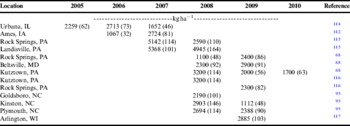
Crop performance and grower adoption of organic reduced-till has been greater for soybean than corn phases of crop rotations in the Mid-Atlantic, Southeast, and Midwest regions of the USReference Mirsky, Ryan, Curran, Teasdale, Maul, Spargo, Moyer, Grantham, Weber and Way68, Reference Delate, Cwach and Chase112, Reference Reberg-Horton, Grossman, Kornecki, Meijer, Price, Place and Webster113. A summary of reduced-till soybean yield potential in these regions is presented in Table 4. On average, yields for organic reduced-till soybean were 89% of county soybean averages for these sites. This system has been more successful for soybean than corn likely because the system relies on a highly persistent cereal rye cover crop to suppress weeds and a legume cash crop that provides its own N requirements. Weeds are suppressed physically by a thick cereal rye mulch and biogeochemically by soil N immobilization due to the high cover crop C:N ratio (C. Reberg-Horton et al., unpublished data). In contrast, the inability to consistently control weeds and insect pests, and provide adequate fertility has greatly reduced the success of reduced-tillage organic corn systemsReference Mirsky, Ryan, Curran, Teasdale, Maul, Spargo, Moyer, Grantham, Weber and Way68.
Soybean yields in cover crop-based organic rotational NT systems in the US. Numbers in parentheses are soybean yields in cover crop-based organic rotational NT systems as percent of soybean yields in counties where research was conducted. County averages were determined using the USDA National Agricultural Statistics Service Quick Stats website (http://quickstats.nass.usda.gov/).

Developing a successful reduced-tillage organic corn production system will require an integrated, multi-tactic approach to weed and fertility managementReference Mirsky, Ryan, Curran, Teasdale, Maul, Spargo, Moyer, Grantham, Weber and Way68. This can be done by designing soil fertility management strategies that meet the agronomic needs of the crop while reducing weed competitiveness. While legume cover crops such as hairy vetch can provide a substantial amount of N to a reduced-tillage corn crop, the residue provides inferior season-long weed suppression compared with vetch/cereal mixturesReference Teasdale and Abdul-Baki118 since legume residues generally decompose more rapidly than those of grasses. A grass–legume mixture should increase weed suppression compared with a legume monoculture, but such mixtures usually reduce release of plant available N compared with a legume monocultureReference Clark, Decker, Meisinger and McIntosh119, Reference Rosecrance, McCarty, Shelton and Teasdale120. Even when grown as a monoculture, legume cover crops often do not supply sufficient plant available N to satisfy all the needs of a subsequent grain crop when grown aloneReference Crews and Peoples90, Reference Decker, Clark, Meisinger, Mulford and McIntosh107, Reference Wagger, Carbera and Ranells121, Reference Clark122. Thus, additional fertility sources (e.g., animal manure and by-products) must be considered in organic corn production systems. Manure placement becomes critical in such circumstances as surface applied animal manure and by-products are susceptible to ammonia volatilization, thus decreasing the N:P ratio of amendments and further increasing the risk of soil P loading and potential off-site environmental impacts.
Recent advances in manure placement technology—dairy manure injectors and subsurface poultry litter banders—may provide solutions to this fertility challenge in the cover crop-based, organic rotational NT corn system. By delaying N-mineralization with a cover crop mixture and localizing N placement with subsurface banding of poultry litter, both the timing and placement of N source should favor corn competitiveness against weeds, allow for a more persistent weed suppressive mulch, improve manure NUE, and optimize grain yield and quality.
Conclusions
Current organic grain cropping systems can provide more ecosystem services than their conventional counterparts but, as with all agricultural systems, best management practices are needed to ensure they are managed sustainably. While the past 20 years have seen a great increase in the amount of research conducted on organic farmingReference Francis123, improving these systems remains in the early stages of development. Promising avenues include increasing phenological diversity of crops in a rotation, improving manure management, and developing rotational NT organic systems that integrate improved cover crop and manure management. Additional research is also needed to improve cash and cover crop varieties for greater yield in organic systemsReference Lammerts van Bueren and Myers124, Reference Maul, Mirsky, Emche and Devine125, address diseaseReference Baysal, Benitez, Kleinhenz, Miller and McSpadden Gardener126 and other pest issues, and develop weed control technologies that are less constrained by climate and edaphic conditions than are current tillage options.
Contemporary comparisons between organic and conventional systems are limited by the fact that there has been comparatively little research conducted on organic compared with conventional systems. Current research should continue to evaluate the long-term impacts of organic and conventional cropping systems on the provision of ecosystem services, while using results of this research to develop improved organic cropping systems for the future. Improving organic grain cropping systems should result in increased adoption rates.
Organic cropping systems provide a unique research environment by relying more acutely on ecosystem functions than conventional systems. Lessons learned from organic systems and associated research should be applicable to all systems: strategic soil incorporation of organic matter can increase SOM, which increases inherent soil fertility; increasing crop rotation length increases many ecosystem services; and cover crops provide multiple agro-ecosystem services. At the same time, organic systems can benefit from technologies and practices developed for conventional NT systems.
Acknowledgements
We thank Alan Franzluebbers for inviting us to present a condensed, early version of this paper at a Symposium on Supporting Ecosystem Services with Conservation Agriculture at the ASA-CSSA-SSSA International Annual Meetings, San Antonio, Texas, October, 2011.
Supplementary online material is available at http://cambridge.journals.org/RAF.