

Introduction
The making of secondary legislation in multiparty cabinets is under-investigated from a political science perspective. However, once administrative acts such as regulations and decrees have been adopted by the cabinet ministers, they are often crucial, since they give effect to the aims of legislation by determining the real policy content of the laws. Perhaps due to their low visibility compared to the primary laws, secondary legislation actsFootnote 1 are usually not settled in coalition negotiations. Ministers can have an incentive to adopt policies through subordinate legislation that deviates from the general compromise reached via the primary legislation.
Several works have pointed out how institutional mechanisms can be employed to curb ministerial drift in multiparty cabinets when the primary legislation is at stake (Müller and Strøm, Reference Müller and Strøm2000; Strøm et al., Reference Strøm, Wolfgang and Torbjörn2008). Parliamentary scrutiny of government bills, known as ‘legislative review’, is an instrument that allows for correction in Parliament of ministers' deviations from the coalitional compromise (Martin and Vanberg, Reference Martin and Vanberg2004, Reference Martin and Vanberg2005, Reference Martin and Vanberg2011, Reference Martin and Vanberg2014). At the level of the executive, it has been shown that junior ministers can ‘keep tabs on coalition partners’ to monitor each other's activity (Thies, Reference Thies2001; Lipsmeyer and Pierce, Reference Lipsmeyer and Pierce2011). In the legislative arena, a similar role seems to be played by the committee chairs (Carroll and Cox, Reference Carroll and Cox2012.)
However, no studies have ever focused on the remedies to ministerial drift of acts of subordinate (secondary) legislation. This article suggests that when legislation of such type is at stake, in some countries coalition partners can rely upon the ex-ante legal scrutiny of courts as an extra-cabinet control mechanism. There are countries, in fact, where especially the administrative courts are involved in executive politics as ‘super guardians’ of the lawfulness of government acts. In other words, the administrative judges can play a role of government advisors by issuing opinions on the coherence of the drafts of government acts with the provisions of primary legislation. This occurs in countries like Italy, Belgium, the Netherlands, France and Greece, where the supreme administrative courts are Councils of State, and Finland and Sweden, where the administrative judges may be consulted on government legislation.
We focus our analysis on the Italian case, where the government can evade or make compulsory the non-binding opinion of the Supreme Administrative Court (Consiglio di Stato: henceforth Council of State). We seek to determine the conditions under which governments decide to submit their acts to the ex-ante control of legality of the Council of State, given the costs in terms of delay in the policy implementations that such a control implies. Our findings support the general hypothesis that the Court's activism as an advisor is generated by the demand in the government for control mechanisms on the secondary legislation. Such a demand is affected by specific political conditions, i.e. the level of government heterogeneity and government alternation.
In the first section of the article, we describe the Council of State of Italy, which is both the highest administrative court and the most important consultative body of the government. In the following section, we present empirical data that show how the ex-ante opinion of the Council of State delays secondary legislation drafting, and we analyse the strategic interaction between governments and the Council of State. In the third section, we illustrate why the Council of State can be very plausibly described as a policy conserver Court. The fourth section sheds lights on the political conditions under which government actors are more likely to resort to the services of the Council of State as an advisor at the cost of considerably extending the duration of decision-making. The fifth and sixth sections present data, variables and the empirical analysis necessary to test the main hypotheses.
In conclusion we suggest that the findings on the Italian case can be a starting point for research on the different levels of involvement of administrative courts in the executive politics that characterize European Democracies.
The dual function of the Council of State in Italy: administrative court and legal advisor
The Council of State is one of the most enduring institutions of the Italian political system. Today, it is the highest administrative court (the ultimate level of decision after the Regional Administrative Tribunals) and the most important advisory body of the government. As a government advisor, the Council provides a compulsory ex-ante control on important categories of acts: regulations and testi unici (drafts of legislation or regulations unifying previous texts). The advisory function of the institution developed in the middle 1800s,Footnote 2 when a model of ministerial government (Laver and Shepsle, Reference Laver and Shepsle1996), that remained broadly unchanged for more than a century, entered the Italian political system. Such a model, introduced by the Cavour reform of 1853, placed ministries with complete autonomy in their department at the political and administrative centre of the government. In order to counterbalance the fragmented decision-making and government instability, the Council of State was entrusted with preserving the continuity and uniformity of the administrative actionFootnote 3 (Calandra, Reference Calandra1978).
The ex-ante legal control of the Council should ensure that governments' acts are coherent with primary laws and administrative procedures. As a court, the Council of State may in fact examine, on appeal, the legitimacy of all government administrative acts. The dual function, of advisor and court, distinguishes the legal consultancy of the Council from other legal services of the ministries and the Presidency, making the institution highly influential.
The Council of State is organized into three legal advisory and four judicial sections. The ‘consultative section for legislative acts’ issues mandatory opinions on government secondary legislation. Councillors do not generally work for more than one section at the same time, but they rotate between the sections and are always assigned to both legal and judicial sections during their careers. Therefore, the institution can be considered a relatively homogeneous body.
The distinctive configuration of the institution, which belongs to both the executive and the judiciary, has induced governments of First and Second Republic to co-opt Council of State members to key administrative positions within ministries as heads of cabinets, heads of legislative offices and legal advisors (Righettini, Reference Righettini1998). This fact has made Council of State members an influential, but also much-criticized élite.Footnote 4
A report by the government of President Mario Monti (2013) describes the advisory function of the Council of State as one of the ‘external causes’ of the delay in the implementation of primary laws.Footnote 5 The regulations submitted to the Council for its preventive scrutiny can require up to three or even four times the amount of time needed to promulgate equivalent acts. Nevertheless, as will be explained, Italian governments often rely on the Council of State's opinion for the drafting of secondary legislation.
Strategic interaction between the government and the Council of State
The Italian government can implement laws and legislative decrees by using secondary legislation acts called ‘regulations’ or others called ‘general administrative acts’ (GAA). Both GAA and regulations concern plural beneficiaries, identifiable only after their approval, but, unlike regulations, GAA do not require the ex-ante control of the Council of State to be enacted. Nevertheless, GAA have general effects, and governments can use them as substitutes for regulations.Footnote 6
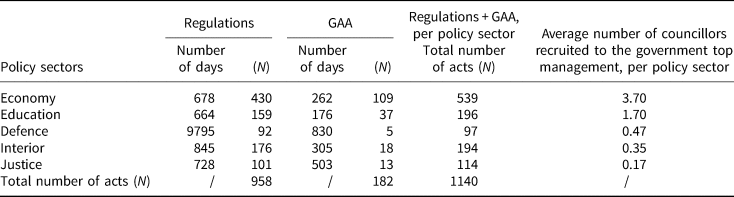
The adoption of GAA is much faster. Table 1 shows the median value in number of days separating the dates of adoption of the laws and of the two types of secondary legislation acts in five fundamental ministries from 1988 to 2014: economy, education, interior, justice and defence.Footnote 7
Timing for the adoption of regulations and GAA by policy sector

Data: personal computations on information available on Leggi d'Italia database (1988–2014). Types of act: D.M., D.P.R., D.P.C.M., acts deriving from laws prior to 1988 excluded. Total observations: 1.142. Personal computations from: ‘Consiglio di Stato: rassegna di giurisprudenza e dottrina’, Righettini (Reference Righettini1998), the Italian Administrative Justice website (http://www.giustizia-amministrativa.it).
Median value of the number of days that separate the date of the law and the date of the administrative decree.
In the ministries of economy and interior affairs, regulations require for their adoption almost three times the number days required by GAA; in the ministry of education almost four. The difference is less marked when we consider the acts promulgated by the ministry of defence. Moreover, the promulgation of GAA requires less time when the acts are promulgated by the ministries that recruit more councillors to their top management, as in the case of the ministry of economy and education.
Political actors are aware that the Council's opinions considerably extend the time taken to adopt secondary legislation acts. The type of secondary legislation act to be adopted is usually defined in the actual texts of the laws themselves. When the legislative actors (including the government) decide which secondary legislation instrument will be used to implement the law, they can choose between acts that do not require the mandatory opinion of the Council of State (GAAs), and those acts that are submitted to the ex-ante control of the Council (regulations). Therefore, the first move is made by the legislative actors, and usually in a prominent position, by the government members, who must reach agreement during the legislative process. If they decide not to introduce the term ‘regulation’ in the final provisions of the law, then they are not obliged to send the act to the Council of State for a non-binding opinion. The Council of State may intervene only as a court of appeal on the occasion of an action (usually brought by a citizen) against the administrative act. Whether the secondary legislation instrument is a regulation or the government still decides to send the draft of the act to the Council, the Council must send the government a non-binding opinion that can be positive, negative or (more often) interlocutory. Positive opinions imply that the Council of State essentially agrees with the content of the draft, finding the act in agreement with statutory provisions. By contrast, interlocutory opinions include comments and remarks. The government, usually the minister responsible for the promulgation of the regulation, decides whether to comply fully with the Council's opinion, to comply partially or to ignore it. Once the act has been definitively promulgated, the Council may intervene as a court of appeal on the occasion of action against the regulation. It can declare regulations and GAAs fully legal, partially legal or void. It is important to note that it is always possible for government actors to counter a negative (or partially negative) Council decision by drafting a new more detailed law supporting government's position and having it approved in the Parliament. Therefore, the Council is the last mover in this strategic interaction only if its decision produces a policy outcome that cannot be changed again through an agreement among government/legislative actors, by a new, more detailed law.Footnote 8
Which preferences? The Council of State as a ‘policy’ conserver court
The Council of State has been described by many commentators as a self-serving institution: that is, as an actor interested in maximizing its role and the prerogatives of its members (Ainis, Reference Ainis2009; Bin Reference Bin2013). We argue that in pursuing this goal the Council of State, both as an advisor and as a court, usually behaves as a special case of a ‘policy’ conserving court.
Strategic theories of judicial behaviour identify two possible sets of court preferences. According to Ferejohn and Weingast (Reference Ferejohn and Weingast1992), courts may not have a specific policy preference. They can behave as politically sophisticated honest agents that give interpretations that are as close as possible to the original legislative intentions.
Steunenberg (Reference Steunenberg1997) calls this type of court a ‘conserver court’, a court that prefers to maintain the original legislation, in contrast to a ‘constrained policy advocate court’, which tries to impose its policy preferences. In both cases, courts prevent ‘strategically’ legislative bodies from overriding their interpretation with a new statute. The easier it is for the legislators to overcome a court's decision by re-legislating, the more the court will be limited in obtaining its ideal point (the most preferred policy) as the policy outcome. Therefore, also in the case of a conserver court, preservation of the ‘original legislation’ (or the original legislator's intent) is limited by the current configuration of the legislative majority.
The types proposed in the literature take into consideration only cases of court's interpretations that can de facto establish new statutes or amend already existing ones (see amongst others: Volcansek Reference Volcansek2000; Santoni and Zucchini Reference Santoni and Zucchini2004, Reference Santoni and Zucchini2006; Brouard Reference Brouard2009; Brouard and Hönnige Reference Brouard and Hönnige2017). Decisions of the Italian Council of State can amend or abolish secondary legislation (administrative acts). We argue that state's councillors, by trying to fulfil their own preferences, tend to follow a procedurally based jurisprudence and preserve the status quo defined by the already existing administrative acts. Sometimes opposition to the change is induced by substantive policy preferences. Arguments in support of this position focus on the rules of composition of the institution and the non-politicization of judges, the low turnover among judges, and the fact that in some policy areas preservation of the status quo corresponds to the preservation of the Council's prerogatives.
Non-partisan recruitment procedure and low level of politicization. Only 25% of the members of the Council of State are appointed by the government. The large majority of councillors are recruited for career seniority or through a competitive examination.Footnote 9
Contrary to the civil judicial system, the national association of administrative justice is not organized into partisan factions. Even the Council of State members that hold extrajudicial offices in the ministries do not present long-term political affiliations. During the Italian ‘Second Republic’ (1994–present), 88% of judges that have held extrajudicial offices in more than one cabinet in the same policy sector were appointed by both centre-left and centre-right governments.Footnote 10
Low level of turnover. Turnover of judges is particularly low: 94% of chairs of the Council of State's sections in 1998 had been in that post for 10 years or more and 90% of section chairs in 2015 already held their position in 2004.Footnote 11 It is therefore reasonable that councillors should prefer acts that they themselves have approved, as well as a jurisprudence that they themselves created.
A self-serving status quo. The Council of State tends to oppose policy change if the change reduces its competence. For instance, both the Council of State and the Regional Administrative Tribunal of Lazio opposed a crucial reform of the public administration that in 1993 privatized public employment relationships. The reform transferred competence on disputes in almost all public-sector employment relationships from the administrative to the ordinary judges (Council of State General Assembly opinion no. 146, August 31st, 1992; T.A.R. Lazio order no. 1171, sec. III-bis, June 5th, 1996 and T.A.R. Lazio, order no. 119, sec. I, July 5th, 1995). Moreover, in some policy sectors, Council of State members have specific interests which induce them to oppose change.Footnote 12
If the Italian Council of State is a policy conserver court, then the delays we observe during the ex-ante control step, when the Council is obliged to give an opinion on the drafting of regulations, are no longer unexplained. It is likely that the more the Council dislikes the change, the more it delays its opinion. What requires explanatory effort is the frequency with which government actors choose regulations instead of alternative acts that would avoid the Council's involvement in the legislative process.
Political conditions at the basis of Council of State activation
When the Council issues opinions on regulations, it checks several aspects of the texts: technical-juridical accuracy, coherence with the overall legal system, the eligibility of the minister or of the government to regulate the issue, and the presence of the formal agreement of all the parties involved. The overall process takes time and by delaying the adoption of regulations extends the life of the status quo. In addition, the Council's interpretations, which tend to be in favour of the status quo, reduce the discretion of the government actors most in favour of change. We contend that this ex-ante review by the Council is more or less valuable for government actors on the basis of the political circumstances that make a possible ministerial drift when secondary legislation is approved more or less costly. In other words, we argue that the Council of State plays a crucial role as an extra-cabinet control mechanism at the level of secondary legislation against opportunistic behaviour by individual ministries (and parties).
Government ideological heterogeneity. Some political forces, and in general interests that do not obtain large ‘improvements’ from the law change (or are even marginally damaged by it), may prefer long delays in the law's implementation rather than a final outcome that is worse for them than the previous status quo. Such parties, when governments are highly heterogeneous, may foster the involvement of a ‘policy conserver’ court in the policy-formulation process, in order to forestall major deviations by the other coalition partners. In such circumstances, the opinion of the Council of State signals to the most ‘conservative’ political forces potential ‘drifts’ in secondary legislation and prevents controversial policy changes.
Government alternation. By contrast, a large government alternation (Tsebelis, Reference Tsebelis2002; Zucchini, Reference Zucchini2011) should make Council's ex-ante control on regulations much less desirable. In a political system where an important government alternation has taken place, current government actors deal with a status quo that is often an inheritance from governments on the opposite side of the ideological spectrum and that all of them strongly dislike. Therefore, not only is policy change possible, it is also large. When all government members support large policy change, there is no reason to delay implementation activating a redundant procedure of legal control on secondary legislation. Moreover, potential remarks of the Council of State in favour of the old status quo are outside the set of the politically viable interpretations. In such circumstances, no government party would encourage an ex-ante review that exposes the acts to the influence of conservative jurisprudence. It must be added also that all government members would agree to override potential judicial decisions that preserve the status quo. A new primary legislation would be approved to make the content of the ‘illegitimate’ acts no longer subject of judgement before the Council.Footnote 13
According to the arguments just illustrated we put forward the following hypotheses:
Hypothesis 1:
Government heterogeneity positively affects the activation of the Council of State (measured by the number of regulations) as ex-ante monitor.
Hypothesis 2:
Government alternation negatively affects the activation of the Council of State as ex-ante monitor.
In addition to Hypothesis 1 and Hypothesis 2, further predictions can be made concerning the effect of the state councillors' recruitment in the ministerial departments.
Government actors may recruit state councillors' in the ministerial departments for the unquestionable informative value of councillors' expertise as judges. In fact, state councillors not only are legal experts. Most of them serve as administrative judges during their career. Councillors recruited in the ministerial departments can signal the orientation of the Council in its capacity as a Court. Insofar as the Council's opinions inform the government actors about the Council's future behaviour as a Court, government actors may use this source of information to substitute the opinion of the advisory section of the Council, thus becoming less inclined to activate the Council as an ex-ante monitor.
Hypothesis 3:
The recruitment of state councillors to key positions within the ministries negatively affects the activation of the Council of State (measured by the number of regulations) as an ex-ante monitor.
Government actors may also recruit state councillors to ministries' top management for signalling their closeness to the Council. By having a staff of state councillors, ministers may be more confident that their views will be supported in the advisory section of the Council, thus becoming more inclined to activate the Council as an ex-ante monitor. This leads to the following alternative hypothesis on the effect of the state councillors' recruitment in the ministerial departments:
Hypothesis 4:
The recruitment of state councillors to key positions within the ministries positively affects the activation of the Council of State (measured by the number of regulations) as an ex-ante monitor.
Data and variables
To test the above hypotheses, original data were collected from between 1988 and 2014 on regulations and GAA adopted on the initiative of five ministries: economy, defence, interior, justice and education. These ministries deal with policies that were not concerned with the constitutional reform of 2001 (riforma del Titolo V della Costituzione), which re-distributed the competence to adopt regulations between central government and the regional administrations. Data were collected from 1988 onwards, since in that year the law on the organization of the Presidency of the Council of Ministers, Law 23 August 1988 no. 400 made the ex-ante control of the Council of State mandatory on all types of regulations. All types of ministerial and governmental decrees were included: ministerial decrees (D.M.), President of the Council of the Ministers decrees (D.P.C.M.), and President of the Republic decrees (D.P.R.). Data were collected from the juridical database Leggi d'Italia. GAAs used as substitutes for regulations were identified by referring to the indication ‘non-regulatory decree’ (‘decreto non-regolamentare’) mentioned in the primary law. If the law did not specify the nature, regulatory or non-regulatory, of the administrative act, indications provided by law scholars to classify the acts were followed.Footnote 14
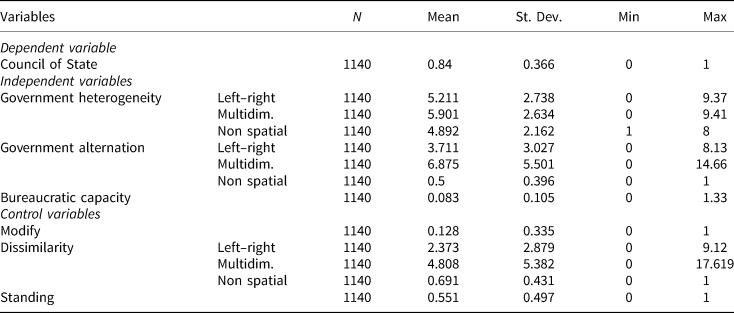
The dependent variable, Council of State, was included as a dummy variable equal to one when the government (or the ministries) adopted a regulation and to zero when it adopted a GAA. In the former case, the decree must be submitted to the Council of State for an ex-ante control.
The main independent variables, Government Heterogeneity and Government Alternation, were operationalized in two alternative ways. In the first, we took advantage of the government party positions in the policy space (spatial measures) inferred from the expert surveys; in the second we considered only the party memberships in the governments (party membership measures).
Spatial measures
We relied upon parties' scores inferred from a number of expert surveys conducted by Laver and Hunt (Reference Laver and Hunt1992), Benoit and Laver (Reference Benoit and Laver2006), Curini and Iacus (Reference Curini and Iacus2008), Di Virgilio et al. (Reference Di Virgilio, Giannetti, Pedrazzani and Pinto2015). With respect to Government Heterogeneity, we considered two alternative measures:
(1) the absolute difference between the scores of the two most extreme government parties on the dimension: ‘increase services versus cut taxes’. Such a dimension is the most important among those considered in the expert survey during the whole period (1988–2014)
(2) the mean of the absolute differences (Tsebelis and Chang, Reference Tsebelis and Chang2004) between the scores of the two most extreme government parties on each of the following four policy dimensions: ‘increase services versus cut taxes’, ‘pro- versus anti-permissive social policies’, ‘pro- versus anti-decentralization of decisions’, ‘the environment over growth versus growth over the environment’. Both measures are equal to 0 when the government is a ‘technical’ caretaker government (i.e., the Lamberto Dini and Mario Monti governments), i.e. when it is entirely composed of non-partisan ministers.Footnote 15
Government Alternation was calculated as the distance in the policy space between previous and current governments. Also in this case we considered two alternative measures, both based on the same expert surveys that we used for the government heterogeneity:
(1) we calculated that distance as the absolute difference between the mid rangeFootnote 16 of two successive governments on the dimension ‘increase services versus cut taxes’ (Left–Right Alternation).
(2) we considered the mid ranges of two successive governments on all four dimensions (‘increase services versus cut taxes’, ‘pro- versus anti-permissive social policies’, ‘pro- versus anti-decentralization of decisions’, ‘the environment over growth versus growth over the environment’), then we calculated the overall multidimensional distance between two successive governments by applying the Pythagoras theoremFootnote 17 (Tsebelis and Chang, Reference Tsebelis and Chang2004).
Party membership measures
The non-spatial measure of Government Heterogeneity is the number of government parties. In the two caretaker technical governments (the Dini and Monti governments), this variable was set equal to 1 as if these governments were formed only by the (not already existing) premier's party.Footnote 18
The non-spatial measure of Government Alternation was calculated as the ratio between new government parties, i.e. the government parties that were not members of the previous government, and the overall number of government parties. In the case of the two caretaker technical governments, this variable was calculated by considering the parties that supported the government's survival during its life.
Bureaucratic capacity
As said above, if the government's need to anticipate the Council's decisions, a ministry is supposed to be more prone to avoid the Council's ex-ante control when it has recruited individual state councillors (third hypothesis). Conversely, if the government wants to signal its closeness to the Council, a ministry is supposed to be more prone to activate the Council as an ex ante monitor when it has recruited individual state councillors (fourth hypothesis). However, the importance of this ‘investment’ depends on the overall number of acts that are usually promulgated. Therefore we consider the variable Bureaucratic Capacity, that is, the ratio between the total number of councillors recruited in a ministerial structure and the number of acts adopted by the same ministerial structure.
Control variables
Some unobserved factors that affect the decision to activate the Council of State can depend on the different ministries where the acts are promoted and on the policy issues that they try to address. The acts are grouped into five ministries (economy, defence, interior, justice, and education) and into eleven policy areas.Footnote 19
We introduced into the analysis two control variables, Modify and Dissimilarity, which referred to the relation of the acts with other previous acts and with the governments in office when the primary legislation was approved. An existing regulation can be usually modified only by the same type of act, that is, by another regulation. In this case the dummy variable Modify is equal to one. Many administrative acts derive from laws adopted by past governments. The variable Dissimilarity captures the difference between the government that approved primary legislation and the government that adopted the administrative act. We expected to find that when dissimilarity is high, current government actors have more limited knowledge about the implications of the statute's implementation and they prefer to rely upon the Council of State's opinion. Therefore Dissimilarity was expected to affect positively the adoption of regulations, i.e. the activation of the Council of State as an advisor. The spatial version of this variable was calculated similarly to alternation. But while alternation captures the difference between successive governments, the measure of government dissimilarity can concern governments very distant in time. The difference between the mid-range position of the government that passed the law and the government that adopted the decree was considered both in the dimension ‘increase services versus cut taxes’ only and in each of the previous four dimensions. Then, in the last case, the square root of the sum of each squared difference was calculated, according to Pythagoras theorem. When the spatial Dissimilarity increased, the propensity to activate the Council of State was also expected to increase. The non-spatial version of the variable Dissimilarity was calculated as the ratio between the number of parties that were both in the government that adopted the decree and in the government that passed the law, and the number of parties that passed the law. It was equal to 1 when the governments that adopted the laws and the governments that promulgated the administrative acts were the same government or shared the same party composition. The variable was equal to 0 if no party of the government that had approved the law was also a member of the government that promulgated the administrative act. Therefore ‘non spatial’ Dissimilarity, in contrast to spatial Dissimilarity, was expected to affect negatively the activation of the Council of State.
A further control variable, Standing, captured the experience of the relevant ministers. Ministers with a longer political experience may need to rely less on the advice of the Council, also because they have a higher standing in the political arena. Standing was therefore coded as a dummy variable equal to 0 if the relevant minister had no previous government experience and to 1 if the minister had at least one experience in a previous government. The variable was expected to have a negative effect on the activation of the Council of State (Table 2).
Summary of the variables

The empirical analysis
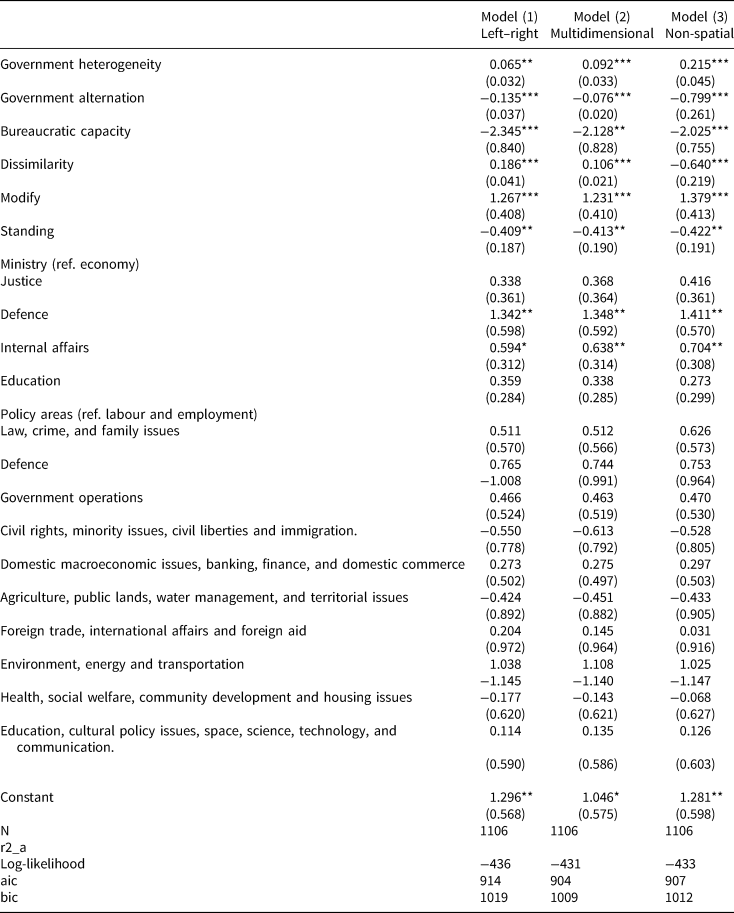
We ran three logistic regressions with the ‘Policy area’ and Ministries as fixed effects. In model 1 we considered the spatial variables that were calculated using parties' positions estimated only on the dimension ‘increase services versus cut taxes’, in model 2 we considered the multi-dimensional spatial variables, and in model 3 the non-spatial variables (Table 3).
Predictors of regulations

* P < 0.1, ** P < 0.05, *** P < 0.01 (standard errors in brackets).
The first three hypotheses seem to be confirmed. In all models, Government Heterogeneity and Government Alternation had a significant effect on the decision to activate the Council of State in the predicted direction.
In particular, in the model with non-spatial measures (3), each increase of one party in the total number of parties in government increased the probability of submitting a regulation to the ex-ante control of the Council of State by around 24%. Conversely, when the non-spatial measure of Government Alternation passed from 0 to 1, i.e. when the government's composition passes from no new parties in government to only new parties in government, the probability of activating the Council of State decreased by 55%.
Likewise, in model 1, a one unit increase in the spatial variable capturing Government Heterogeneity increased the probability of a Council of State's ex-ante control by 7%.
In the regression model 2, where spatial measures were calculated using parties' positions on all dimensions, every unit increase in Government Heterogeneity enhanced the probability of activating a Council of State's ex-ante control by 10%. Instead, for each unit increase of alternation, the probability of a Council of State's ex-ante control decreased by ~13% in Model 1 and by ~7% in Model 2. As predicted by the third hypothesis, in all models the strengthening of legal expertise by the recruitment of state councillors greatly decreased the likelihood of submission of secondary legislation to the Council of State. This result disconfirms the fourth hypothesis, which predicted that the recruitment of state councillors, signalling government closeness to the Council, would have produced an increase in the probability of activating the Council of State's ex-ante control.
Also the control variables affected the dependent variable in the expected direction. In all three models the acts that amended already existing regulations (variable Modify) were very likely in their turn to be regulations, and so too were the acts adopted by governments ideologically different from the governments during which the original primary legislation was approved (variable Dissimilarity). Finally, the political experience of the ministers (Standing) matters. A minister who had already had government experience recorded on average a 34% less propensity to implement a primary legislation by regulations instead of GAA.
Conclusions in comparative perspective
In the study of multiparty governments close attention has been paid to the problems that the divergent preferences of coalition partners create in the law-making process, and to the institutional and political solutions to these problems. However, substantive aspects of policy-making are often specified only through acts of secondary or subordinate legislation (Rose-Ackerman et al., Reference Rose-Ackerman, Lindseth and Emerson2017). They are less visible than the laws, but they can nevertheless be controversial. By giving large margins of manoeuvre to single ministers, these acts can generate problems of coalition governance, especially when they are approved with little or no inter-ministerial cooperation. We suggest that also in the production of this secondary legislation, as well as in the legislative process in the strict sense, some control mechanisms are at work and reduce the risks of discretionary decision-making power of the individual ministers. In particular, when the courts are government legal advisors, like the administrative courts of some countries, they may be part of these mechanisms.
In the case of Italy, the empirical evidence supports the hypothesis that the ex-ante control of the Council of State on regulations is triggered more frequently by specific political conditions, i.e. high government heterogeneity and low government alternation, which make the possible ministerial drift more costly for the government coalition members. The results hold also on controlling by other factors that can affect the propensity to submit administrative acts to the ex-ante control of the Council of State, including legal expertise in the ministries and the government experience of the relevant ministers. The prevalence for a quite long time of these political conditions may contribute to explaining the prominence acquired by the Italian Council of State in the implementation of laws.
The involvement in executive politics of the administrative judiciary is not the same across Europe. In some countries, to varying extents, governments can or are compelled to ask the administrative courts to issue opinions on the drafts of their most important acts of secondary legislation. This is the case not only of countries like France (Mény, Reference Mény and Mény1994), Belgium (Van Damme, Reference Van Damme and Lanotte2001), the Netherlands (de Wet, Reference de Wet, Keller and Stone Sweet2008), Greece, which have Councils of State as supreme administrative courts, but also of Finland and Sweden (Sarvilinna, Reference Sarvilinna2007), which have separate systems of administrative courts whose judges can be consulted as legal advisors on request of the government. By contrast, in other countries like Germany, Austria and Portugal, administrative courts or other courts do not review government acts ex-ante. The same applies in countries like the UK, Spain, Ireland and Denmark, where there are no administrative courts.
Future in-depth research could try to assess if these cross-national differences can be traced back, ceteris paribus, to different levels of government heterogeneity and/or alternation as the study of the Italian case seems to suggest.
Data
The replication dataset is available at http://thedata.harvard.edu/dvn/dv/ipsr-risp
Acknowledgments
The authors are grateful to the anonymous reviewers for their helpful comments and suggestions. Previous versions of the paper have greatly benefitted from their presentation at the 2015 EPSA annual conference and at the 2016 SISP annual conference.
Financial support
The research received no grants from public, commercial or non-profit funding agency.