Introduction
Chitin is widely distributed in invertebrates and microorganisms (Rinaudo, Reference Rinaudo2007). In insects, chitin is distributed in the epidermis, exoskeleton, peritrophic membrane of the midgut, intestinal lining of the foregut and hindgut, and spiral band in the trachea (Lehane, Reference Lehane1997; Andersen, Reference Andersen2003; Merzendorfer & Zimoch, Reference Merzendorfer and Zimoch2003). As the important role chitin plays in insects, chitinase is widely studied as an anti-pest method. Chitinase belongs to the glycoside hydrolase family and is widely distributed. Chitinase in baculovirus and Beauveria bassiana was found involved in the pathogenesis against insects (Fan et al., Reference Fan, Zhang, Yang, Pei, Guo and Pei2007). Chitinase genes were cloned into transgenic cotton (Hao et al., Reference Hao, Chai, Wei, Yi and Liang2005) and Bacillus thuringiensis (Arora et al., Reference Arora, Ahmad, Rajagopal and Bhatnagar2003; Lertcanawanichakul et al., Reference Lertcanawanichakul, Wiwat, Bhumiratana and Dean2004; Hu et al., Reference Hu, Liu, Ding, Yan, Sun, Zhang, Li and Xia2009) for pest control. On the other hand, Chitinase-mediated chitin degradation plays an important role in the molting and pupation of insects (Schrempf, Reference Schrempf2001; Carlini & Grossi-De-Sá Reference Carlini and Grossi-De-Sá2002; Saville et al., Reference Saville, Thomas, Possee and King2002). Insect chitinases are mainly present in the molting fluid as well as in the midgut. The function of the molting fluid is to digest the old epidermis before molting. In addition to digest the old peritrophic membrane, chitinase in the midgut may also be associated with food digestion. In the venom of certain insects, chitinase can be used to assist in the spread of toxic substances in the feeding object (Reynolds & Samuels, Reference Reynolds and Samuels1996).
Previous studies have discovered that insect chitinases are composed of a family with eighteen chitnases (Henrissat & Bairoch, Reference Henrissat and Bairoch1993) and are present in all studied insect orders (Müller, Reference Müller1992). They are mostly internal cleavage enzymes that can hydrolyze chitins containing three or more N-acetamide glucose residues. Several insect chitinases were previously cloned and expressed in different systems such as E. coli (Shinoda et al., Reference Shinoda, Kobayashi, Matsui and Chinzei2001; Paek et al., Reference Paek, Park and Jeong2012; Fan et al., Reference Fan, Mi, Ren, Zhang, Li and Xian2015), Pichia pastoris (Fitches et al., Reference Fitches, Wilkinson, Bell, Bown, Gatehouse and Edwards2004; Wu et al., Reference Wu, Liu and Yang2013; Liu et al., Reference Liu, Chen, Zhou, Jiang, Duan and Yang2017) and insect cells (Shen & Jacobs-Lorena, Reference Shen and Jacobs-Lorena1998; Shinoda et al., Reference Shinoda, Kobayashi, Matsui and Chinzei2001; Yan et al., Reference Yan, Cheng, Narashimhan, Li and Aksoy2002; Zheng et al., Reference Zheng, Zheng, Cheng, Ladd, Lingohr, Krell, Arif, Retnakaran and Feng2002; Fan et al., Reference Fan, Mi, Ren, Zhang, Li and Xian2015; Fan et al., Reference Fan, Yang, Zhang, Ren and Zhang2018). The successful expression of chitinases from different species, including Spodoptera littoralis (Shinoda et al., Reference Shinoda, Kobayashi, Matsui and Chinzei2001), Glossina morsitans (Yan et al., Reference Yan, Cheng, Narashimhan, Li and Aksoy2002), Choristoneura fumiferana (Zheng et al., Reference Zheng, Zheng, Cheng, Ladd, Lingohr, Krell, Arif, Retnakaran and Feng2002), Lacanobia oleracea (Fitches et al., Reference Fitches, Wilkinson, Bell, Bown, Gatehouse and Edwards2004), Mamestra brassicae (Paek et al., Reference Paek, Park and Jeong2012), Ostrinia furnacalis (Wu et al., Reference Wu, Liu and Yang2013; Liu et al., Reference Liu, Chen, Zhou, Jiang, Duan and Yang2017), Lithocolletis ringoniella (Fan et al., Reference Fan, Mi, Ren, Zhang, Li and Xian2015), and Lymantria dispar (Fan et al., Reference Fan, Yang, Zhang, Ren and Zhang2018) has been reported previously. In some studies, insect chitinases expressed in E. coli exhibited lower enzymatic activity (Shinoda et al., Reference Shinoda, Kobayashi, Matsui and Chinzei2001; Fan et al., Reference Fan, Mi, Ren, Zhang, Li and Xian2015) than expressed in insect cells. Therefore, we tend to express the SeChi in insect cells via baculovirus expression system in this study.
Due to the importance of chitinase in insect molting and pupation, several inhibitors of insect chitinase have been discovered. Allosamidin was firstly isolated and reported in 1987, showed strong inhibitory activity against silkworm chitinase (Sakuda et al., Reference Sakuda, Isogai, Matsumoto and Suzuki1987). (GlcN)2–7 not only inhibits OfChtI in vitro but also arrests Ostrinia furnacalis larval stage in vivo (Chen et al., Reference Chen, Zhou, Qu, Zhao and Yang2014). OfChi-h was found inhibited by TMG-(GlcNAc)4 (Liu et al., Reference Liu, Chen, Zhou, Jiang, Duan and Yang2017). Phlegmacin B1 showed inhibitory activities against insect GH18 enzymes such as OfChi-h and OfHex1 (Chen et al., Reference Chen, Liu, Duan, Lu and Yang2017). The traditional screening methods usually directly detect whether a random mixture inhibits the target chitinase and then screen for a single component with inhibitory activity. For instance, the chitinase inhibitor A82516 was screened from the fermentation product of Streptomyces (Somers et al., Reference Somers, Yao, Doolin, Mcgowan, Fukuda and Mynderse1987). A neutral protease with chitinase inhibitory activity was screened from the soil by the plate-clear circle method (Xie et al., Reference Xie, Zhou, Zhang, Lan and Hu2006). ChI-06 bacteria, which are capable of expressing chitinase inhibitors, were screened from marine microorganisms (lv, Reference Lv2007). Traditional methods have massive randomness and require large amounts of the substrate, enzyme, and candidate inhibitor. Since the 1990s, drug development has entered a new stage of ‘rational drug design’, in which the development of computer-aided drug design methods has resulted in a significant breakthrough. For instance, an azide-bearing inhibitor against Serratia marcescens chitinase B (SmChiB) was generated by in situ click chemistry (Hirose et al., Reference Hirose, Maita, Gouda, Koseki, Yamamoto, Sugawara, Nakano, Hirono, Shiomi and Watanabe2013). TKUPSP017, a small synthetic boron-containing molecule with a BF3K side-chain, was confirmed to have inhibition activity against the chitinase purified from Bacillus cereus (Liang et al., Reference Liang, Chen, Pan and Wang2014). Ostrinia furnacalis OfChi-h (a GH18 chitinase) and OfHex1 (a GH20 Hex) were used together to screen a library of microbial secondary metabolites (Chen et al., Reference Chen, Liu, Duan, Lu and Yang2017). A novel inhibitor of T. viride chitinase was designed and synthesized by an in silico target fishing protocol (Maccari et al., Reference Maccari, Deodato, Fiorucci, Orofino, Truglio, Pasero, Martini, De, Docquier and Botta2017).
The chitinase of Spodoptera exigua was discovered in this lab and reported in 2012. Two chitinse genes, namely SeChi and SeChi-h, were identified and silenced through specific double-stranded RNA (dsRNA) injection relatively (Zhang et al., Reference Zhang, Chen, Yao, Pan, Chen and Zhang2012). According to the classification method by Arakane and Muthukrishnan (Arakane & Muthukrishnan, Reference Arakane and Muthukrishnan2010), SeChi contains a signal peptide, a catalytic domain, a PEST-rich linker region, and a chitin-binding domain, thus belongs to the group I Chitinase (Zhang et al., Reference Zhang, Chen, Yao, Pan, Chen and Zhang2012). The reduction of SeChi mRNA led to a death rate around 60% and different phenotypic defects. In the pupal stage of some individuals, the cuticle of the head split open. In the adult stage, some individuals could not shed their pupal shell completely (Zhang et al., Reference Zhang, Chen, Yao, Pan, Chen and Zhang2012). In the meantime, the detailed information of SeChi was up load to gene bank by this lab (ADI24346). Although several insect chitinases have been cloned and expressed in recent years, no further researches on SeChi were reported ever since. In this study, the SeChi gene was cloned and expressed in Hi5 cells by an insect cell expression system, and recombinant Sechi (rSeChi) was obtained by isolation and purification and showed high concentration and high activity. Subsequently, the purified rSeChi was analyzed for enzymatic properties and screened for optimum conditions with the highest chitinase activity. In addition, virtual screening technology was used to obtain SeChi candidate inhibitors. Twenty compounds were tested against the purified rSeChi, and seven showed inhibitory activity. These results provided information for the SeChi and are useful for the development of chitinase inhibitors.
Materials and methods
Cells
The Spodoptera frugiperda cell line Sf9 and the Trichoplusia ni cell strain Hi5 were donated by Professor Weihua Xu. Sf9 cells were cultured in Grace's medium supplemented with 10% fetal bovine serum at 27°C. Hi5 cells were cultured at 27°C in Grace's medium supplemented with 10% fetal bovine serum or Express Five Medium.
Construction of a recombinant baculovirus containing the Spodoptera exigua chitinase gene
In this study, the bacmid bMON14272 was used to generate the rSeChi virus in the Bac-to-Bac system. First, the rSeChi fragment with a 6xHis tag at the 3′ end of the SeChi ORF was generated by PCR with the 5′-RACE-Ready cDNA as the template and with the primers SeChi-F/SeChi-R (the primer sequences used in this study are listed in table 1). The PCR product was subsequently digested with BamH I/Xho I and subcloned into BamH I/Xho I-digested pFastBac1 (donated by Professor Weihua Xu) to generate the donor plasmid pFastBac1-Chi.
List of primers used in this paper.

1 Restriction enzyme sites are underlined. Translation starting and termination codons are in bold.
Because a mini-attTn7 site has been integrated into the AcMNPV polyhedron (polh) locus in bMON14272, foreign genes can be easily inserted therein via site-specific transposition (Luckow et al., Reference Luckow, Lee, Barry and Olins1993). Thus, the donor plasmid pFastBac1-Chi was transformed into competent DH10Bac cells (containing bMON14272 and the helper plasmid pMON7124 as previously described (Wu et al., Reference Wu, Lin, Pan, Yu, Li, Pang and Yang2006), donated by Professor Weihua Xu). The resulting bacmid was named Bacmid-Chi, with rSeChi under control of the poly promotor.
As mentioned above, Sf9 cells were previously cultured in Grace's medium supplemented with 10% fetal bovine serum. For transfection, 9 × 10⁵ Sf9 cells were washed twice with Grace's medium without fetal bovine serum and transfected with 1 µg of Bacmid-Chi using Cellfectin II reagent (Invitrogen Life Technologies). After the culture was incubated for 5 h, the transfection buffer was replaced with TMM-FH medium, and the time point was designated 0 h post transfection (h p.t.). The supernatant was collected and filtered through 22 nm filter membrane at 72 h p.t., and the BV titer was determined by a 50% tissue culture infective dose (TCID50) endpoint dilution assay as previously described (Kitts & Possee, Reference Kitts and Possee1993). The harvested supernatant with recombinant BV was named P1-Chi. For virus propagation, Sf9 cells were infected with P1-Chi at a multiplicity of infection (MOI) of 0.01–0.1 (pfu/cell), and the supernatant was collected and filtrated at 72 h post infection (h p.i.), followed by BV titer determination. The resulting virus solution was named P2-Chi. Similarly, P3-Chi and P4-Chi were harvested and preserved at −20°C.
Expression and purification of the rSeChi
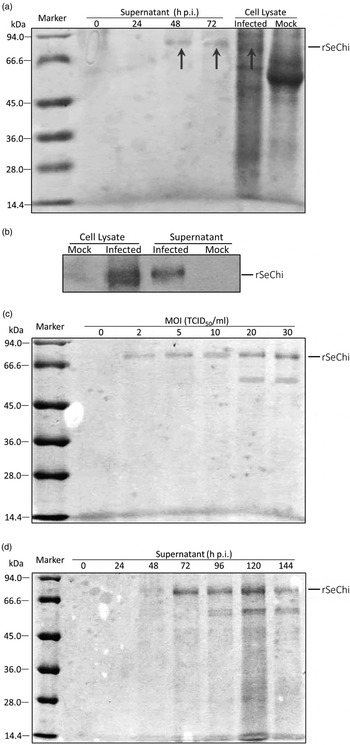
To obtain the highest protein expression level, we explored the best expression conditions for rSeChi. First, 6 × 10⁵ Hi5 cells were seeded in each well of a 12-well plate and infected with P4-Chi of different MOIs (0, 2, 5, 10, 20, and 30). The supernatants and cells were harvested at 96 h p.i. and tested for protein expression level by SDS-PAGE and western blot, in which anti-His or anti-SeChi (a polyclonal antibody prepared by injecting rabbit with the full-length purified rSeChi) was used as the primary antibody. Subsequently, we tested the most suitable time point to harvest the supernatants. Since infection with MOIs of 20 and 30 did not show higher expression levels than infection with an MOI of 10 (fig. 1c), Hi5 cells were infected with P4-Chi with an MOI of 10 in the following experiments. The supernatants were harvested and tested as described above at different time points (0, 24, 48, 72, 96, 120, 144 h) p.i. The results showed that 72 h is the most suitable expression time course (fig. 1d).
Expression levels of rSeChi detected by SDS-PAGE or western blotting. (a) SDS-PAGE showing the proteins in the supernatants and cell lysate of Hi5 cells infected with P4-Chi recombinant virions. (b) Western blot analysis with anti-His showing a 74 kDa protein in the supernatant and cell lysate of Hi5 cells infected with P4-Chi recombinant virions. (c,d) SDS-PAGE showing proteins in the supernatants of Hi5 cells infected with P4-Chi recombinant virions with MOIs of 2, 5, 10, 20, and 30 (pfu/cell) and harvested at 96 h p.i. (c), or with an MOI of 10 and harvested from 0–144 h p.i. (d). Infected, Hi5 cells infected with P4-Chi; mock, mock-infected Hi5 cells.

Based on the experiments above, Hi5 cells were cultured and proliferated in 75 cm2 cell culture bottles until the logarithmic growth phase and infected with P4-Chi with an MOI of 10. At 72 h post infection, the cell medium was harvested and centrifuged (4 °C, 10,000 g) for 10 min; the supernatant after centrifugation was separated from the precipitate and storage at −20°C or applied for purification.
Since the C-terminus of rSeChi has a 6xHis tag, the protein was purified by Ni2+ chelate affinity chromatography in this study. Ni Sepharose™ 6 Fast Flow (GE Healthcare) was used, and the experimental procedure was performed according to the kit instructions. The purified protein was analyzed by SDS-PAGE electrophoresis and western blot analysis, and the protein concentration was measured by the BCA Protein Concentration Assay Kit produced by Mizuno Biology. The procedures for standard curve preparation and sample determination were performed according to the instructions.
Enzyme activity assay of rSeChi
To detect the chitinase activity of rSeChi, CM-Chitin-RBV (Loewe Biochemica GmbH, Germany) was used as a substrate. A total reaction volume of 0.4 ml (250 mg l−1 of purified rSeChi, 0.5 mol l−1 CM-Chitin-RBV, and 50 mmol l−1 sodium acetate solution) at pH 5.5 was added to a 1.5 ml centrifuge tube and placed at 40°C for 2 h. Afterwards, 0.1 ml of 1 mol l−1 HCl was added to the reaction system to terminate the reaction, followed by an ice bath for 10 min and centrifugation (14,900 g, 4°C) for 5 min. The absorbance at 550 nm was measured using a spectrophotometer. The control group was prepared and treated as above except that the reaction time was 0 instead of 2 h.
Enzymatic property assays of rSeChi
The optimum reaction temperature and reaction pH of rSeChi were analyzed. Except for the following differences, the experimental procedure was consistent with the above. To determine the optimum reaction temperature, nine different reaction temperatures (10, 20, 30, 40, 50, 60, 70, 80, 90 °C) were tested. To determine the optimum pH, Britton-Robinson buffer was prepared with 10 different pH values between 1.5 and 12 (2.87, 3.78, 4.78, 5.72, 7.0, 7.96, 8.95, 9.91, 10.88, and 11.92). The experiments under each condition were repeated at least three times.
Detection of the enzyme kinetics of rSeChi
The enzyme activity of rSeChi at different substrate concentrations was measured. Except for the following differences, the experimental procedure was consistent with the above. The final concentrations of the substrate CM-Chitin-RBV were 0.1, 0.2, 0.3, 0.4, 0.5, 0.6, 0.7, 0.8, 0.9, and 1.0 mM. In addition, the reaction time was 1 h instead of 2 h.
Finally, the K m and V max of rSeChi were calculated using the Lineweaver-Burk equation.
Homology construction of the 3D model of SeChi
The amino acid sequence of SeChi (ADI24346) obtained from this laboratory was submitted to the SMART website (http://smart.embl-heidelberg.de/) for domain analysis. The software ‘Discovery Studio v2.5’ was used for homology modeling. The ‘Sequence Analysis’ function was used for a homology search in the PDB database. Three homologous protein structures were downloaded from the RCSB website (http://www.rcsb.org/). Using SeChi as the ‘Input Model Sequence’ and the three templates as ‘Input Template Structures’, homology modeling was performed using the ‘Protein Modeling’ module. The results were evaluated subsequently by the probability density function energy (PDF Energy), DOPE Score, Ramachandran Plot, and Profile-3D; one optimal model was selected. Finally, the unreasonable amino acid residue conformations were manually adjusted according to the Ramachandran plot, and the final model was optimized with the ‘Side-chain Refinement’ function.
Virtual screening for SeChi inhibitors
Based on the results of a series of prescreening benchmark evaluations (data not shown), the modeling packages MOE and Surflex were chosen for inhibitor screening in this study. MOE was used for the initial screening. The SeChi model file was further refined in MOE using the ‘Protonate 3D’ module. Subsequently, a small molecule library, the Guangdong Small Molecule Tangible Library (GSMTL) (Gu et al., Reference Gu, Xu and Gu2010), was screened. According to the calculated binding energy (ΔG) with SeChi, the top 1000 compounds were selected. These compounds were further evaluated with the Surflex module in Sybyl. The eighty compounds with the highest scores were finally selected, twenty of which had available pure samples.
Measurement of the SeChi inhibitor activity of the selected compounds
Each of the twenty obtained compounds was reacted with rSeChi. The reactions were carried out with rSeChi, CM-Chitin-RBV, and each candidate inhibitor. A total reaction volume of 0.4 ml (250 mg l−1 of purified rSeChi, 0.5 mol l−1 CM-Chitin-RBV, and 10−3 mol l−1 candidate inhibitor) at pH 9 was added to a 1.5 ml centrifuge tube and placed at 40°C for 2 h. Afterwards, 0.1 ml of 1 mol l−1 HCl was added to the reaction system to terminate the reaction, followed by an ice bath for 10 min and centrifugation (14,900 g, 4°C) for 5 min. The absorbance values at 550 nm of the inhibition group AX0, the control group A0, the reaction group AX, and the reaction control group AS were detected (where X refers to the inhibitor name).
 $${\rm Inhibition}\% = \lsqb {{\rm (AS} - {\rm A0)}-({\rm AX}-{\rm AX0})} \rsqb /({\rm AS}-{\rm A0})$$
Finally, the three compounds with the highest activity were selected to determine the correlation between inhibitor concentration and inhibitory rate. The reaction procedure was consistent with the above except that each candidate inhibitor underwent ten-fold dilution to obtain gradient concentrations, resulted in a final concentration from 10−8 to 10−4 mol l−1 in the reaction mixture. The IC50 of each candidate was then calculated.
Results
Construction and propagation of the recombinant baculovirus expressing rSeChi
The SeChi gene was previously identified in our laboratory (Zhang et al., Reference Zhang, Chen, Yao, Pan, Chen and Zhang2012), and the detailed information of this gene was up load to gene bank (ADI24346). To study SeChi, we first inserted the SeChi gene into the pFastbac1 commercial vector under the control of the highly expressed polyhedrin promoter. For ease of detection and purification, a 6xHis tag was added to the C-terminus of SeChi, and the resulting protein is referred to as rSeChi hereinafter (Supplementary fig. 1). The resulting recombinant bacmid was named Bacmid-Chi.
Bacmid-Chi was transfected into healthy Sf9 cells with the help of Cellfectin II reagent (Invitrogen Life Technologies). At 96 h p.t., most of the cells ruptured, and the virions were released into the culture medium. Thus we collected the culture medium, to obtain the first generation of recombinant virions, P1-Chi. By 3 generations of propagation, high-concentration recombinant virions (108 pfu ml−1) were harvested. The presence of the recombinant gene was confirmed by PCR with the DNA from infected cell lysate as the template (data not shown). The results of both SDS-PAGE (fig. 1a) and western blot (fig. 1b) showed a protein band of approximately 74 kDa in the culture supernatant after the Hi5 cells were infected with P4-Chi, whereas no corresponding band appeared in the mock-infected Hi5 cells (fig. 1b).
These results indicated that the recombinant protein rSeChi could be expressed in insect cells and secreted into the culture medium. These also indicated that Bacmid-Chi containing the target gene had been successfully constructed, and the recombinant baculovirus was obtained after transfection into Sf9 cells.
Expression and purification of rSeChi
Hi5 cells were subsequently infected with the acquired P4-Chi recombinant virions for rSeChi expression. To explore the optimal expression conditions, different MOIs (0, 2, 5, 10, 20, 30 pfu cell−1) and different harvest times (0, 1, 2, 3, 4, 5, 6 days) were tested, and the expression levels of rSeChi in the culture supernatants were detected by SDS-PAGE. The results of the MOI screening assays showed that for an MOI range of 0–10 pfu cell−1, rSeChi displayed higher expression for higher MOIs. However, for MOIs of 20 and 30 pfu cell−1, no significant increase in expression level but a nonspecific band was observed (fig. 1c), indicated that an MOI of 10 pfu cell−1 was the most suitable. On the other hand, the results of the time point screening assays showed that the best harvest time was 3 days p.i., since no increase in expression level but a nonspecific band was observed at 4 days p.i. (fig. 1d). According to the screening results, the optimal expression conditions for rSeChi were determined, namely, the infection of Hi5 cells with an MOI of 10 pfu cell−1 and harvest of the culture supernatant at 3 days p.i. Protein expression was performed using these conditions in subsequent experiments.
The rSeChi was constructed with a 6xHis tag at the C-terminus and thus can be purified by Ni2+ chelate affinity chromatography. The results showed that miscellaneous proteins were mostly eluted with elution buffer with an imidazole concentration of 30 mM, and rSeChi was eluted with an imidazole concentration of 300 mM in the elution buffer (fig. 2a). The obtained protein was shown to be a single protein band by SDS-PAGE, indicating that the protein was pure.
Purification quality of rSeChi detected by (a) SDS-PAGE and (b) western blotting. (a) Purification of recombinant rSeChi. M, protein molecular weight marker; lane 1, supernatant of Hi5 cells after P4-Chi infection; lanes 2–3, eluted by binding buffer with 30 mM imidazole; lane 4–9, eluted by elution buffer with 300 mM imidazole. (b) Western blot analysis of the purified recombinant protein rSeChi. Chi, purified rSeChi; M, protein molecular weight marker; CK, BSA protein.

The purified rSeChi was subjected to western blot analysis using SeChi antiserum (prepared by the laboratory) as the primary antibody. The results showed a specific band with a size of 74 kDa (fig. 2b), which was essentially consistent with the previous analysis with anti-His antibody (fig. 1b). The results indicated that the purified protein obtained by Ni2+ chelate chromatography was the target protein. The concentration of the purified rSeChi was determined with Pierce™ BCA Protein Assay Kit (Thermo Scientific™), and the results showed that the concentration was 25 mg l−1.
Activity detection and enzyme property characterization of rSeChi
The enzyme activity of rSeChi was measured as described in the experimental procedures. Meanwhile, to assess the viability of rSeChi, a commercial chitinase SgChi (Sigma, best reaction condition 25°C, pH 6.0 from Streptomyces griseus) was used as a positive control. The results showed that the ratio of enzyme activity between SeChi and SgChi (UrSeChi / USgChi) was 0.79, suggesting that the activity of rSeChi was comparable to that of the commercial chitinase.
The activity of rSeChi was then measured at reaction temperatures of 10 to 90°C using CM-Chitin-RBV (Loewe Biochemica GmbH, Germany) as the substrate. It can be seen from fig. 3a that the optimum reaction temperature of rSeChi is 40°C.
Enzyme activity and enzymatic property assays of rSeChi. (a, b) Optimum temperature (a) and optimum pH (b) screening of rSeChi. CM-Chitin-RBV (0.5 mM) was used as the substrate. The highest chitinase activity was defined as 100% in these assays. Every value is the mean of three independent assays. All error bars represent the standard error (n = 3). (c) Lineweaver-Burk plot of rSeChi.

The activity of rSeChi was then measured at reaction pH values between 3 to 12. The results indicated that rSeChi showed the highest activity at pH 9 (defined as 100%) and pH 6 (relative activity approximately 70%), while it showed lower activity (below 40%) when the pH was less than 4 or higher than 11 (fig. 3b). When the pH is less than 3, the substrate was unstable and thus difficult to measure.
The correlation between the concentration of CM-Chitin-RBV and the activity of rSeChi was determined under the reaction conditions of pH 9.0 at 40°C. In the substrate concentration range of 0.1–1.0 mM and after reaction for 1 h, the mean speed was close to the initial speed of the reaction. Each concentration of CM-Chitin-RBV (S, mM) and the relative mean velocity of reaction (V, ΔA550 mg−1 h−1, absorbance of the catalyzed product per μl of rSeChi per hour) were imported to the Lineweaver–Burk equation, 1/S was linearly related to 1/V (fig. 3c). The calculation results showed that the Michaelis constant (K m) of rSeChi was 1.37 mM, and the maximum enzymatic reaction rate (V max) was 5.26 (ΔA550 h−1 mg−1). These results showed that rSeChi has strong catalytic activity.
Homology construction of SeChi 3D model
We analyzed the amino acid sequence of SeChi obtained in our laboratory. The results showed that SeChi belongs to the insect group I chitinase (Zhu et al., Reference Zhu, Arakane, Banerjee, Beeman, Kramer and Muthukrishnan2008) and has a typical chitinase structure, including an N-terminal signal peptide sequence, a catalytic domain, a connection domain, and a C-terminal chitin binding domain. Moreover, we further confirmed that the enzyme belongs to the glycoside hydrolase 18 family, since the catalytic domain (amino acid 24–376) is conserved as in other members of this family.
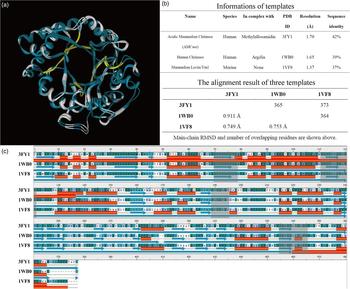
With the software ‘Discovery Studio v2.5’, the amino acid sequence of SeChi was compared with 51,388 protein sequences in the PDB database. The results showed that SeChi had high homology (E-value less than 10−5) with 46 sequences, and the highest identity was 42%. According to the principle of low E-value, high consistency, and high coverage, three sequences were screened, and their high-resolution crystal structures with ligands were acquired from the PDB database for multi-template homology modeling (fig. 4b, c).
Structure and sequence alignments of the three homologous templates of SeChi. (a) Structure alignment. The conserved domains (β3: KTLLAIGGW, β4: FDGLD(F/L)DWEYP, β6: M(T/A)YD(L/F)H, and β8: GAMVWA(I/L)DLDD) are colored in yellow. (b) Sequence information of the three templates. (c) Sequence alignment. The conserved domains are marked in gray boxes. The background color of each residue is based on the similarity among the three templates. The darker the color is, the greater the similarity.

Using prestructural analysis, water molecules, ligands, and metal ions were removed from the three template structures. It can be seen from the template overlay (fig. 4a) that all three templates contain a typical (α/β) 8-barrel structure similar to that of other family 18 chitinases, where the central part is the inner barrel composed of β1-β8, and the peripheral part is the outer barrel composed of α1-α8. The core structures of the three templates are very similar in that the inner barrel is closely attached to the outer bucket, whereas some differences are observed in the random coil between α and β.
The three sequences were compared with the target protein sequence to produce the first sequence profile, and the similarity of the four sequences was 93.2%. As the catalytic domain plays a key role in chitinase, we then analyzed the catalytic domains of the four sequences, resulting in a second sequence profile. The resulting identity was 50%, and the four conserved sequences in chitinase, especially the important amino acid residues in the β4 chain, glutamate (E), aspartic acid (D), and tryptophan (W), were retained.
Using the two resulted profiles, three-dimensional models of the target sequence were constructed and evaluated based on PDF Total Energy, DOPE, and Profile-3D scores. SeChi.B99990003 showed the highest credibility (fig. 5a).
The 3D modeling and inhibitor screening of SeChi. (a) A solid ribbon picture of the SeChi.B99990003 model. Blue, high verify score; white, average verify score; red, low verify score; yellow, lowest verify score (less than 0). (b) Ramachandran plot of the SeChi model. Green regions, the most favored regions; purple regions, favored regions; red dots, amino acids with unreasonable conformations. (c) The ligand binding pocket of the SeChi model (displayed as the yellow region). (d) The inhibitory effects of 3 molecules (Dk21, C_H3, and Dk33) at different concentrations. CM-Chitin-RBV was used as the substrate. Each value is the mean of three independent assays. All error bars represent the standard error (n = 3).

The score of each amino acid from the SeChi.B99990003 model was obtained. The results showed that a low-score region (Verify Score below 0) was located in the outer area of the model (a/β) 8-barrel structure, while the core region was conserved. The Ramachandran diagram was then used to manually adjust the unsatisfactory amino acids, and the ‘Side-chain Refinement’ function was used for optimization. The final model was named SeChi, and its Ramachandran diagram is shown in fig. 5b. The number of amino acids with unreasonable conformations has been reduced to seven (red dots).
Virtual screening of SeChi inhibitors
We evaluated five commonly used molecular docking tools, MOE, Ligandfit, Cdocker, Surflex Dock, and FlexX, and selected MOE and Surflex for subsequent screening work. The SeChi model obtained by homology modeling was then applied as the receptor, and the binding domain of methylallosamidin in the complex was defined as the docking domain.
The compound library of the School of Pharmacy at Sun Yat-sen University was used as the candidate ligands and analyzed by MOE software. According to the molecular docking and binding free energy, 1000 candidates were selected for the second round of docking analysis. In the second round of screening, the 1000 compounds were subjected to scoring in the software SYBYL-X, and 80 compounds were selected.
Inhibitory activity measurement of candidate SeChi inhibitors
Twenty pure samples of the 80 candidate inhibitors were available and were used for inhibition tests with CM-Chitin-RBV as the substrate. The inhibition rates were calculated, and the results showed that 7 compounds had inhibitory activity at a concentration of 10−3 M (table 2), among which the compound Dk21 showed the highest inhibitory activity with an inhibition rate of 96.98%, followed by C_H3 (90.94%) and Dk33 (83.89%). The other 13 compounds did not show obvious inhibitory activity.
List of the inhibition rates of seven candidate inhibitors.

*The values are means of 3 independent assays. All error bars represent standard error.
Compounds Dk21, C_H3, and Dk33, which showed the most significant inhibitor activity, were selected to determine the correlation between inhibitor concentration (from 10−8 to 10−4 M) and inhibitory rate (fig. 5d). Consistent with the inhibition rate assays (table 2), Dk21 has the highest SeChi inhibition activity, followed by C_H3 and Dk33. The IC50 for each inhibitor was then calculated. At rSeChi concentration of 250 mg l−1, the IC50 for Dk21 C_H3, and Dk33 are showed in table 3.
List of the IC50 for the top three candidate inhibitors of SeChi.

Discussion
The chitinase of Spodoptera exigua was firstly discovered and studied in our laboratory. Two chitinse genes, namely SeChi and SeChi-h, were identified and silenced through specific dsRNA injection respectively (Zhang et al., Reference Zhang, Chen, Yao, Pan, Chen and Zhang2012). In the meantime, we up loaded the detailed information of SeChi to gene bank (ADI24346). In recent years, no further researches on SeChi were reported ever since. In this study, we managed to clone and express the SeChi gene for the first time.
Insect chitinase undergoes a high degree of posttranslational modification such as glycosylation and signal peptide excision, and it exhibits complex secondary and three-dimensional structure (Kramer & Muthukrishnan, Reference Kramer and Muthukrishnan1997). Therefore, the correct posttranscriptional modification, processing, transport and protein folding are the key to obtaining active insect chitinase. Due to the differences between prokaryotic and eukaryotic expression systems, expression of insect chitinase in insect cells might be a better option. In a previous study on the apple leaf miner moth, the Lithocolletis ringoniella chitinase LrCht5 was expressed in both E. coli and Sf9 cells, and the LrCht5 expressed in insect cells exhibited chitinolytic activity (Fan et al., Reference Fan, Mi, Ren, Zhang, Li and Xian2015). Similarly, SeChi expression in this laboratory using E. coli system showed that the resulting protein was present as inclusion body (data not shown). Thus in this study, the recombinant expression of SeChi was performed using the insect cell system. Since Sf9 and Hi5 cells are both derived from Lepidoptera insects, the process of posttranscriptional modification is similar to that of Spodoptera exigua.
Multiple factors affect the expression level, including protein properties, including cell status, MOI, and infection time course (Bernard et al., Reference Bernard, Payton and Radford2001; Kim et al., Reference Kim, Choi, Roh, Lee, Jang and Je2007). In this study, we optimized the protein expression conditions with a selection of screening procedures and eventually selected the Hi5 cell line and used an MOI of 10 for 72 h as the expression conditions. The resulting concentration of rSeChi protein was 25 mg l−1. Western blot analysis with anti-His antibody and anti-rSeChi antiserum confirmed the successful expression of rSeChi with a molecular weight of approximately 74 kDa, which was larger than the predicted 64 kDa. This phenomenon was also found in other studies (Arakane et al., Reference Arakane, Zhu, Matsumiya, Muthukrishnan and Kramer2003), and the predicted reason was that group I chitinase is rich in S/T residues in the attachment region that are usually O-glycosylated (Zheng et al., Reference Zheng, Zheng, Cheng, Ladd, Lingohr, Krell, Arif, Retnakaran and Feng2002). The rSeChi constructed with a 6xHis tag at the C-terminus was then purified by Ni2+ chelate affinity chromatography. As in other studies (Reynolds & Samuels, Reference Reynolds and Samuels1996), the optimum temperature and pH of rSechi were then screened, and the chitin hydrolysis activity was measured. The enzyme activity of rSechi was similar to that of the commercial chitinase SgChi, indicating that rSeChi exhibits high chitinase activity.
Computer-aided molecular docking technique (Shoichet, Reference Shoichet2011) is an efficient way for virtual screening of the SeChi inhibitor. Previous studies have shown that the catalytic mechanism of family 18 chitinases is a substrate-supporting mechanism. In the substrate binding process, the substrate changes conformation into a boat shape to assist the catalytic process (Fukamizo, Reference Fukamizo2000). In this study, molecular docking technique based on the substrate structure theory was used to study the inhibitors of SeChi. Two rounds of docking (Shoichet, Reference Shoichet2011) were performed, and 80 candidate inhibitors were selected. However, virtual screening is not sufficient to verify inhibitory activity. Thus 20 among the 80 candidates were subsequently tested with the purified rSeChi. As a result, we found 7 candidate compounds that showed inhibitory activity against rSeChi. These results suggested that the molecular docking via 3D modeling in this study is helpful for inhibitor screening. These also indicated that the purified rSeChi displays chitinase activity and is similar to the native SeChi. In conclusion, we harvested active Spodoptera exigua chitinase in this study for the first time. Furthermore, compounds with inhibitory activity against SeChi were discovered using 3D modeling, molecular docking, and in vitro analysis with the purified rSeChi. In the previous study of this lab, we found that the RNA silencing against SeChi led to cuticle and pupa defects of Spodoptera exigua and a death rate of around 60% in in vivo experiments (Zhang et al., Reference Zhang, Chen, Yao, Pan, Chen and Zhang2012). Regrettably, we are currently not able to test whether the SeChi inhibitors can kill Spodoptera exigua, since we have to give a break to this study on the SeChi due to a funding situation. However, we believe that similar to the SeChi dsRNA, the inhibitors screened in this work may cause defect on Spodoptera exigua. Besides, the compounds with inhibitory activity are small molecules. Someday we may find useful compounds that are more stable and lower in cost compared to dsRNA. Thus we believe that this study provided information for the SeChi and is useful for the development of insect chitinase inhibitors.
Supplementary material
The supplementary material for this article can be found at https://doi.org/10.1017/S0007485319000191.
Acknowledgments
The authors acknowledge Prof. Weihua Xu (State Key Laboratory of Biocontrol, Sun Yat-sen University) for providing the Hi5 cell strain, bacmid bMON14272, and plasmid pFastBac1. This work is supported by National Natural Science Foundation of China (No. 81603026). We acknowledge the President Fund of Guangdong Academy of Agricultural Sciences (201601) and Science and Technology Plan Project of Guangdong Province (2016A020210039).
Conflict of interest
The authors declare that they have no conflicts of interest with the contents of this article.
Author contributions
WZ designed the study and revised the paper. LZ expressed and purified the rSeChi, and built the 3D model. ZG wrote the paper. ZP set up the expression system in insect cells. HG screened the inhibitors and tested for inhibitory activity. DZ coordinated the design of this study. JX guide the virtual screening with the small molecule library.