It's bigger than 1994. It's a more decisive repudiation…. That has to be seen as historic.
Newt GingrichThe results of the 2010 congressional elections were indeed historic. The loss of 63 seats by the Democrats was the biggest electoral loss by any party since 1948, making the more recent 1994 and 2006 turnovers pale by comparison. The question that political scientists naturally ask after an event of this magnitude is—why? This article addresses this question by analyzing the role played by the public's attitudes toward Congress.
The standard view in political science has been that public attitudes toward Congress “typically have little relation to the results of congressional elections” (Abramowitz and Sabato Reference Abramowitz and Sabato2010). In the first section of this article, we demonstrate that including the effects of congressional evaluations in traditional political science models—which predominantly focus on presidential evaluations—significantly improves their ability to explain the results of the 2010 midterm elections. However, this exercise also shows that even with this improvement, aggregate models based on past elections still underestimate the number of seats Democrats lost in 2010.
The second section of this article analyzes the reasons for this underestimation, highlighting the unique nature of the public's opinions regarding Congress and the majority party in this election cycle and thus their increased potential to affect the election's outcome. In particular, we demonstrate that since the 2008 elections, Congress has been more salient to the American public than usual, making it easier than ever for voters to hold the party in charge accountable. This salience in conjunction with other factors explains not only the prominent role that public opinion of Congress played in the outcome of the congressional elections generally, but also its stronger than usual role in 2010.
Models
It is not surprising that Democrats lost seats in the 2010 House elections. The traditional referendum theory of elections says that the president's party loses seats whenever the economy is not performing well and his approval ratings are low. Both of these danger signs were present in this election cycle. What is surprising, then, is not the fact that Democratic seats were lost, but the magnitude of the seat losses for the Democrats—more than in any election since 1948. True, the economy was not performing well in 2010 and Obama's approval ratings had fallen from their lofty heights in the wake of his inauguration. However, a closer look at these variables suggests that they were not really low enough to explain such record losses.Footnote 1
Standard electoral models measure the state of the economy using the growth in real per capita disposable personal income in the year leading up to the election. From 1974 to 2008, this pre-election figure averaged 2.3%. In 2010, income growth was about one standard deviation below the mean—low, but not the lowest point recorded during this period. For example, the 1974 election featured income growth almost two standard deviations below the mean. As for the president's job performance, pre-election presidential approval ratings between 1974 and 2008 averaged 49.8%. Obama's 44.9% rating in the quarter prior to the 2010 election was less than half a standard deviation below this mean. Although somewhat low, six other elections featured even lower presidential approval ratings, including Bush's 30.8% rating in 2008.
In our view, the standard model that focuses on the economy and presidential performance is inadequate for explaining the monumental seat swing that occurred in the 2010 election, because it fails to take into account the public's overwhelming frustration with the performance of Congress. In contrast to the only moderately bad ratings of the economy and the president, Congress's 22.2% approval rating before the election was abnormally low even by historical standards—over one-and-a-half standard deviations lower than the mean approval rating of 34.9%. This unusually low number is important because, as recent research demonstrates, disapproval of Congress causes the majority party to lose seats in House elections (Jones and McDermott Reference Jones and McDermott2009). Since Democrats were the majority party in Congress in 2010, the institution's low approval ratings should help explain why seat losses were so much higher than economic and presidential approval variables alone would suggest.
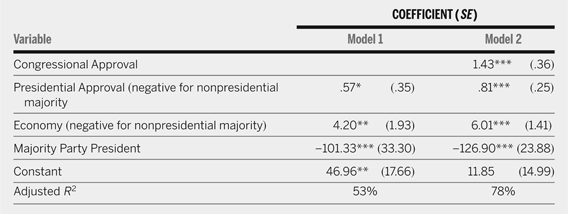
We can test the importance of congressional performance in explaining the results of the 2010 House election by comparing the predictive accuracy of two alternative models of seat swing estimated over the period of 1974 to 2008. The first model is based on the traditional variables of income growth and presidential approval (for a similar construction, see Jacobson Reference Jacobson2009).Footnote 2 The second model includes an additional variable representing congressional approval. To facilitate comparison, the dependent variable in both models is the number of House seats gained by the majority party in the midterm elections. Because economic growth and presidential approval are expected to help the president's party, these variables are multiplied by −1 whenever the president's party is the opposite of the House majority party, and a dummy variable is included as a control.
Table 1 shows that for the 18 prior elections, the public's evaluation of congressional job performance had a significant impact on seat swing over and above the influence of the economy and presidential performance. However, the key question here is: Do public evaluations of Congress help provide a better explanation of the enormous losses suffered by Democrats in 2010? Using the coefficients derived from each model, we can plug in the value of each variable in 2010 and then compare the seat loss predicted by each model. Given that the magnitude of the seat swing in 2010 was larger than in any of the elections from which the coefficients were estimated, it is not surprising that both models estimate losses that are noticeably smaller the actual result. More important for our purposes is the comparative difference between the two models, which is quite stark. Based on the moderately poor income growth and presidential ratings leading up to the 2010 elections, the traditional model predicts a Democratic seat loss of only 26 House seats—a figure that, if correct, would have been considerably short of the 39 seats Republicans needed to retake control of the chamber. But once we take into account the alarmingly low approval ratings of the Democratically controlled Congress in 2010, the second model predicts a loss of 43 House seats—17 more losses than the traditional model and enough to explain the shift in majority control that actually occurred.
Seat Gain by Majority Party in House Elections, 1974–2008

Note. N = 18.
* p < .10;
** p < .05;
*** p < .005, one-tailed.
These findings demonstrate that to understand why Democrats suffered an historic defeat in 2010, it is necessary to understand that voters were reacting not only to the economy and presidential performance, but also to the performance of Congress. However, these results also point out that even after taking congressional performance into account, extrapolating from past elections still underestimates the magnitude of the seat swing that actually occurred in 2010. In the next section, we analyze how key aspects of public attitudes and awareness during the 2010 election cycle may have led evaluations of Congress to play an even greater role in this election than in any previous election, thus helping to produce the Democrats' dramatically outsized losses.
Voters
Several elements of the 2010 elections support the idea that Congress's performance—and particularly the performance of the majority party—was of predominant importance to voters at this time and significantly contributed to the massive turnover in Democratic seats. First, national issues were more important to voters' decisions than usual in congressional elections. Voters were deeply dissatisfied with the state of the nation, particularly the economy, and held Congress more responsible than Obama for the bad conditions. This dissatisfaction was reflected in levels of congressional disapproval rarely seen in past elections. Second, and most important for the one-sided electoral outcome, the public's dissatisfaction with national conditions and Congress' role in fostering them fell squarely on the shoulders of the majority party. Whether a cause or a consequence, the public was uncommonly aware of Democratic control and leadership heading into the election, making the majority party an even easier target than usual.
National Conditions and Congressional Responsibility
In congressional elections, both local and national issues can be important, and which one predominates varies by election cycle. In elections in which voters focus on local issues, candidates may not feel strong effects from national conditions. However, 2010 was a year in which national issues mattered greatly to voters. Figure 1 presents trend data measuring differences in the importance of national issues versus state and local issues from the poll preceding each midterm election (Pew Research Center for the People and the Press 2010a). In 2010, the public rated national issues as more important than local issues by seven points, a higher rating than at any other recorded point, providing the ideal context for a historically powerful national wave.
Differences in the Proportions of Voters Choosing National Issues versus State/Local Issues as Most Important to their Congressional Vote
Source: Pew Research Center for the People and the Press 2010a.

In 2010, approval of Congress hit the lowest level ever recorded prior to a midterm election.Footnote 3 A final pre-election survey conducted by CBS News and the New York Times registered only 10% approval (CBS News/New York Times 2010). This basement-level approval of congressional performance stemmed from two simultaneous and combined forces: the public's overwhelmingly negative view of the condition of the country, and their belief that Congress was to blame for it.
Throughout the course of the 111th Congress, the public's dissatisfaction with the condition of the nation was at abnormally high levels. According to Pew, on average, two of every three voters were dissatisfied with the way things were going in the country. With the exception of the previous Congress, these were levels not seen since the mid-1990s (Pew Research Center for the People and the Press 2010b). The state of the economy contributed in large part to this dissatisfaction. According to ABC News polls, during this same period, Americans were nearly unanimous in judging the economy as bad: on average, more than nine in 10 people classified the economy as either “not so good” or “poor” (ABC News/Washington Post 2010) One reason that Congress's performance ratings suffer in the midst of national conditions such as these is the tendency of the public to blame Congress and its leaders for the national situation. Leading into the 2010 elections, the public placed more blame for the country's poor general and economic conditions on Congress than on the president. In a September 2010 survey for Newsweek, those Americans who expressed dissatisfaction with the direction of the country (68% of the overall national sample) placed the most blame for the nation's problems on Congress: 59% blamed Congress “a lot,” while only 39% and 33% blamed Presidents Bush and Obama “a lot,” respectively (Princeton Survey Research Associates International/Newsweek 2010).
Similarly, Americans blamed Congress more than Obama for the state of the economy. A Fox News survey from January 2010 asked Americans to assign responsibility for the state of the economy. Thirty-six percent of respondents identified George W. Bush as the most responsible party, but Congress came in a close second at 30%, while only 6% placed primary responsibility on Obama (Fox News 2010a). In other words, of those political actors currently in government and thereby available for punishment, Congress was the clear focus of public dissatisfaction.
Why Democrats?
The 2010 election results demonstrate that the public's unhappiness with Congress was a boon to Republicans and a bane to Democrats—a clearly partisan effect. While previous work finds that voters generally hold the majority party responsible in congressional elections (Jones and McDermott Reference Jones and McDermott2009), the effect was even stronger than usual in the 2010 elections. Part of this effect can be traced to the unusually high levels of animosity toward Congress regarding national conditions, as discussed in the previous section. Another factor to consider is the degree to which voters hold a general sense of which party is in control of Congress and therefore who they should specifically credit or blame for its perceived failings. This factor also reached unprecedented levels in 2010.
The salience of both party control of Congress and the Democratic leadership during the term leading up to the elections (2009–10) was higher than in many past Congresses. In turn, this increased prominence made the majority party an even easier target than usual for dissatisfied voters. Since 1989, the Pew Center has surveyed Americans on which party controls Congress. Based on these data, Figure 2 shows that in March of 2009, more Americans were able to correctly answer this question than at any prior time: 86% answered that the Democrats controlled Congress. In fact, ever since the Democrats took control of the House after the 2006 elections, the measure has averaged a higher level than at any previous point recorded.
Correct Answers to the Pew Center's House Control Question
Note. Each measure is the highest recorded for that particular Congress. Republican Congresses are in black, Democrats are gray.
Source: Pew Research Center for the People and the Press 2009.

Knowledge of the actual House leadership has also reached unprecedented levels since the Democrats took over Congress in the 2006 elections. Time magazine asked Americans to name the Speaker of the House in October of 2008, and 66% were able to spontaneously recall (not merely recognize) Nancy Pelosi's name (Time/Abt SRBI 2008). By comparison, at a similar point in his tenure as Speaker, only 53% of respondents could recall Newt Gingrich's name (Gallup/CNN/USA Today 1996). And one year after taking over as Speaker of the House, only 6% of Americans could name Dennis Hastert as Speaker (Gallup 2000).
Congressional party and leadership salience could have multiple causes. The relative proximity of the 2010 election to a changeover in partisan control of Congress likely added to the public's knowledge. Gingrich's relatively high name recall shortly after the Republicans became the majority party in 2004 supports such an idea. Pelosi's status as the first woman Speaker of the House may also make her, specifically, more memorable and thereby the Democrats peripherally. The record levels of partisan polarization during the 111th Congress may also have made party control and party leadership more prominent to voters (Jones Reference Jones2010). Finally, the high level of dissatisfaction with Congress could have boosted the degree to which citizens paid attention to the institution, including its parties and leaders.
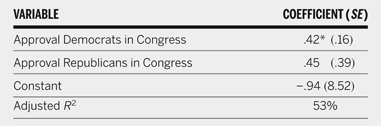
Regardless of what caused congressional control to become so prominent in the public's mind, it is clear that this salience had an effect on voters' judgments of who was to blame for the negative national conditions. Voters' opinions of Congress's overall job performance were tied significantly to their performance evaluations of the Democrats—but not the Republicans—in Congress. Table 2 contains the results of an OLS model regressing the aggregate quarterly approval numbers for Congress as a whole on separate measures for approval of congressional Democrats and approval of congressional Republicans from 2007 to 2010 (the period that Democrats have been in control).Footnote 4 The results demonstrate that Americans' opinions of Congress are driven specifically by their opinions of the majority party in Congress.
Aggregate Effect of Each Congressional Party's Job Performance on Overall Congressional Job Performance, 2007–10

Note. N = 14.
* p ≤ .05.
The public's propensity to blame the majority party for congressional performance is further evidenced in the poll numbers from the Princeton Survey Research Associates International/Newsweek poll (2010) cited previously. This survey asked voters how much they blamed each of a variety of federal actors for their personal dissatisfaction with the direction of the country. According to the results, Congress was the top culprit—59% of dissatisfied Americans blamed Congress “a lot.” However, respondents did not merely blame Congress as a whole, but also the majority party specifically. Forty-two percent of dissatisfied Americans blamed congressional Democrats for national conditions—a higher percentage than for any other actor besides Congress as a whole. In contrast, the public blamed congressional Republicans the least for the state of the nation, not only less than Democrats, but also less than either Bush or Obama.
The end result of this widespread public dismay with and blame of Congress was the Democrats' dismal electoral performance. Over the seven quarters of the 111th Congress leading up to the 2010 election, the correlation between the Democratic vote proportion on the generic congressional ballot and congressional approval was .91. In other words, the national vote percentage for Democratic candidates was almost perfectly correlated with attitudes toward congressional performance overall. Similarly, data from the National Election Pool exit poll on Election Day show that even among voters with a negative view of “Obama's policies,” attitudes toward Congress had a substantial impact on individuals' vote: those who also disapproved of Congress were 15 points less likely to vote for the Democratic candidate in the House election than those who approved (Edison Research/National Election Pool 2010).Footnote 5
The Campaign
We now turn to a brief analysis of campaign factors that also likely contributed to the influence of congressional performance evaluations on the vote. Republicans' campaign strategies demonstrate that they thoroughly understood the context in which the election was taking place—both the readiness of voters to blame Congress and the Democrats and the power of those feelings in determining vote choice.
Whenever widespread public discontent is felt with the state of the nation during the period leading up to an election, strategic imperatives dictate that the party out of power will try to capitalize on this discontent by “nationalizing” the election—making each district race revolve around the most advantageous national issues and personalities. In 2006, for example, Democrats across the country tried to link their Republican opponents to the unpopular Iraq War and George W. Bush. A common campaign ad template highlighted the percentage of times that a House incumbent had “voted with President Bush.”
In the 2010 election cycle, the party out of power—the Republicans—had to decide which national figure to use in their campaigns as the personification of the nation's problems. In 2006, Bush was the natural choice for the Democrats, because his approval ratings were significantly lower than the historical average, while approval ratings of Congress were only slightly less popular than average and no salient leader existed. In 2010, by contrast, the president was only slightly less popular than the historical average, but Congress was significantly more unpopular than usual and had a salient, unpopular leader: Nancy Pelosi. In fact, a Fox News poll in early September 2010 showed a 24% to 56% favorable/unfavorable ratio for Pelosi, compared to Obama's respectable 50% to 46% ratio (Fox News 2010b). Because of these somewhat unusual circumstances, campaign strategists who were working to defeat Democrats in 2010 decided to focus on Pelosi as “the face of what everybody doesn't like about Congress” (Lightman Reference Lightman2010). Pelosi's high public profile made such a strategy potentially powerful.
Republicans made no secret that “a major part of their 2010 electoral strategy” was linking Democratic candidates to the House Speaker (Bendavid Reference Bendavid2009). According to the Campaign Media Analysis Group, far more money was spent ($65 million) and more ads were run (161,203) referencing House Speaker Nancy Pelosi in this election cycle than referenced any other congressional leader in any previous election cycle (Steinhauser and Livingston Reference Steinhauser and Livingston2010). Overall, Pelosi made more unflattering appearances in Republican ads this cycle than did President Obama (Blake Reference Blake2010). The National Republican Campaign Committee alone used Pelosi in 70% of their ads. However, it was not only the Republican Party that ran such commercials. More than half of the $65 million spent on Pelosi ads was spent by individual House campaigns, and $22 million was spent by independent groups such as the Chamber of Commerce. With all of the potentially useful subject matter for campaign ads in 2010, each of these savvy political actors made the strategic decision to devote significant resources to ads about the House Speaker.
Polls suggest that this collective strategic decision was well-grounded. In an NBC News/Wall Street Journal survey conducted in December 2009, a majority of Americans said that they would be less likely to vote for a candidate who supported Speaker Pelosi more than 90% of the time than a candidate who did not (NBC News/Wall Street Journal 2009). In a September 2010 NBC survey, a majority stated that it would be “unacceptable” if Nancy Pelosi were to continue as Speaker of the House after the 2010 election (NBC News/Wall Street Journal 2010a). Finally, in an NBC survey just days before the election (NBC News/Wall Street Journal 2010b), individuals supporting a Republican House candidate were more likely to say that their vote was, at least in part, “in protest against the performance of Speaker Nancy Pelosi and Democrats in Congress” (34%) rather than “in protest against the performance of the Obama administration” (25%).Footnote 6
Overall, all of the factors discussed in this article point to an increased role for public evaluations of Congress in the 2010 elections. Whether this election was an outlier or part of some bigger trend remains to be seen. Certainly, if researchers are correct in predicting an increasing trend of nationalization of congressional elections, we can expect this heightened role for public evaluations of Congress to become more of the norm rather than the exception in future congressional races.