Introduction
Throughout history and in different societies, soldiers have primed the pump for settlers’ colonies. European colonial military forces in Cuba, Algeria, South Africa, and Canada – to mention a few examples – contributed substantially to the growth of settler societies. They were a reliable force in difficult circumstances with high mortality rates. In the age of European mass migration, however, these colonial soldiers became consistently excluded from migration statistics. This article calls for ‘writing these colonial soldiers back into migration history’ and spells out some of the implications for nineteenth-century European emigration history if we do so.
The article begins by emphasizing the role of colonial soldiers in processes of settlement. It reconstructs their numbers and arrives at the conclusion that nineteenth-century empire-building involved millions of European soldiers (both professional and conscripts). It elaborates the argument that there is a nexus between the beginning of the age of mass migration and the exclusion of colonial soldiers from migration history. It points out that their status as un-free labourers developed into an anomaly at a time when free labour and free European migration increasingly became the norm. Particularly in colonies of exploitation, white coerced labour became an anathema, because it was considered to be detrimental to the white man’s prestige. That white colonial soldiers became excluded from migration history obscures, however, the fact that, throughout the nineteenth century, they were recruited in ever greater numbers, and continued to settle in substantial numbers in the colonies after military life, as a much-appreciated, white labour force.
The article concludes by advocating a broader comparative perspective on coercive labour conditions among nineteenth-century European migrants (military and non-military). This can also contribute to an ongoing revision of the perception of the age of European mass migration as overwhelmingly free. Over the course of the nineteenth century, white labour continued to work under various degrees of bondedness or coercion in the so-called settler colonies. Even in late-nineteenth-century North America many migrants were not free from coercion, as has been argued by Steinfeld, Peck, Adelman, and other authors.Footnote 1
European colonial military forces and their numbers
In many overseas European colonies, the garrisons outnumbered the civil presence, at least until the mid nineteenth century. While many colonial soldiers went to the tropical regions, the temperate frontiers too were still highly militarized. South Africa, blessed with a pleasant climate and of singular strategic importance to the British empire, provides a particular case in point. The Cape and Natal received about 35,000 people from the British Isles between 1820 and 1840, of whom 85% were soldiers. Civilian migration was of marginal importance, particularly since many veterans stayed in Natal.Footnote 2 In fact, both in Natal and Algeria, the well-known pattern evolved of populating the contentious borders of the empire with veterans. It was an example that had been set in ancient history by the Roman empire, and in modern history by the Habsburg empire and the Russian tsars; the latter exported their concept of military colonies and Cossack settlements first to the Caucasus and then to Siberia, reaching the Chinese border in the late nineteenth century. An important example outside European history is the Qing empire of China, which expanded between 1600 and 1800 into central Eurasia and also used soldiers as settlers.Footnote 3
Soldiers, and next to them convicts, were ideally suited to serve as primers of the pump for mass migration and as a powerful means of sustaining imperial interests at a time when ever more areas of the world became involved in global commodity production. Every imperial settlement – whether in the US, Canada, Australia, Algeria, or Siberia – had its initial phases of state-engineered migration. Australia and Siberia (but also in earlier times the Portuguese empire) are outstanding examples of colonies created by deporting convicts, followed by state-assisted migration.Footnote 4 Various types of un-free labour migration performed an indispensable role in frontier territories: just shovelling out the indigent, which had been advocated in many books and pamphlets from the seventeenth century onwards, would not have achieved the colonization of new territory. Colonial administrators were reluctant to receive impoverished metropolitan families for the simple reason that they had to be supported upon arrival. It was much cheaper to get only the adult males, and sometimes females, who could be put to work in indentured conditions.Footnote 5 In the early phases of colonialism, soldiers and convicts were, if not the cheapest, certainly the most easily deployed source of labour in the extreme circumstances of a frontier. That may also explain why far more people were sent to the colonies in captivity than was required from a purely penitentiary point of view. In the nineteenth century, the number of European convicts sent overseas or across the Urals amounted to more than a million,Footnote 6 most of them exiled for minor offences such as vagrancy, a word that merely imparts a criminal connotation to poverty or unemployment. The role of these exiles was to prepare the ground for massive migration to extend the empire.Footnote 7
Irrespective of whether a colony was based in a temperate or a tropical zone, mortality rates were high until some kind of civic order was established. Before 1840, intercontinental migration was so dangerous in itself that a tropical environment was only an additional deterrent. Apparently, health conditions at the place of debarkation did not have a strong influence. The high mortality rates in the destinations were known of, but they were not the only deterrent. Many migrants died during the passage, as conditions on ships were deplorable and, until 1835, little was done to alleviate overcrowding.Footnote 8 Cholera could indeed strike in Cuba or Java, but so it could in Texas or Canada. Pioneering circumstances and lack of government regulation of conditions on board were definitely a deadly combination, regardless of climate. The tropics undeniably contained more health hazards for Europeans than temperate zones, and some equatorial regions continued to be the ‘white man’s grave’ throughout the nineteenth century, but a hot climate was not always detrimental to the health of newly arrived Europeans, while temperate zones were not always conducive to survival.Footnote 9
Convicts and soldiers might have lost their lives at appalling rates at their colonial destinations but that was just part of their lot. During the seventeenth and eighteenth centuries, the demand of maritime empires for European sailors and soldiers was immense, not least because of the high death toll among Europeans during their sea voyages and their sojourns in a tropical environment.Footnote 10 Most of the old circuits of recruitment and overseas deployment that used un-free European labour declined during the nineteenth century, but the geographical broadening of European imperialism reinvigorated the demand for labour. Even if we confine ourselves to the European colonial soldiers, there must have been millions, if we extrapolate simply from the fact that almost half a million British troops were sent to overseas possessions in the twenty years between 1817 and 1836.Footnote 11 What Marshall has already observed with regard to British colonial troops therefore has wider implications:
Numerically this dispatch of royal regiments to India was a considerable migratory movement, which certainly deserves a place in the history of labour migrations within the orbit of European imperialism. Members of the poorest strata of British society were shipped out to India to die, at least until the 1870s, at a rate markedly higher than that of indentured Indian labour in the Caribbean.Footnote 12
White European colonial soldiers cannot be considered of marginal numerical importance, even if, in some cases, colonial armies overwhelmingly consisted of indigenous troops. Brunschwig emphasizes the small presence of French troops in West Africa (only 2,000 by the end of the nineteenth century) and the role of West African soldiers in the conquest of Madagascar, but this was not the general rule in the colonies.Footnote 13 In Asia, the European contingent in the colonial armies was substantial. The average proportion of Europeans in the nineteenth-century Dutch colonial army was around 35%, or 13,000 men, almost the same percentage as in post-Mutiny British India, where about 60,000 (one-third) of the colonial army was European.Footnote 14 The Algerian army consisted exclusively of Europeans and numbered 100,000 in the 1840s. The garrisons on the rich sugar-producing islands of Cuba and Puerto Rico, and those involved in the Russian expansion, were of a considerable size too.Footnote 15 According to figures published by Fraginals and Masó, about 550,000 soldiers were sent to Cuba between 1868 and 1899.Footnote 16 Drawing together these and other figures for numbers in military garrisons in European colonies, we arrive at a picture that gives an impressively high number of colonial soldiers.
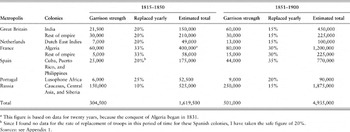
Table 1 presents an estimate of how many young European men were sent to colonial garrisons in the nineteenth century. It is based upon a number of assumptions about the actual strength of the colonial troops in the colonies and about replacement rates. The latter depend on three factors: mortality rates, length of contract, and actual numbers leaving service after the expiration of their contracts. Because of high mortality rates, there might have been considerable discrepancies between formal strength and actual size of the troops. Mortality could range from 200 per 1000 in the early nineteenth century to 20 per 1000 around 1900.Footnote 17 Comprehensive reconstructions of the number of European troops who went overseas are scarce. For the nineteenth century, there is a complete range of data for the Dutch East Indies, and there are some fragmented data on British, French, and Spanish colonies available.Footnote 18
Estimated nineteenth-century migration of European-born military personnel to the most important colonial destinations.

a This figure is based on data for twenty years, because the conquest of Algeria began in 1831.
b Since I found no data for the rate of replacement of troops in this period of time for these Spanish colonies, I have taken the safe figure of 20%.
Sources: see Appendix 1.
Table 1 does not cover all colonial destinations and only represents the nineteenth century from 1815 onwards. But that does not change the general picture that the number of European military personnel who were sent into the non-tropical areas of Algeria and Russia widely exceeds the number of those sent to tropical colonies, particularly in the second half of the nineteenth century. Some may object to the inclusion of Russian soldiers because they were not ‘colonial’, but this is only, I would argue, if we adhere to the definition of European colonialism as a project crossing ‘salt water’. Russian expansion into Central Asia and Siberia definitely involved migration into different cultural zones. Hoerder emphasizes the similarities between the European expansions into North America and into Siberia.Footnote 19 I admit that this argument may open the door to include the United States as well, particularly in the first half of the nineteenth century, when its small army of less than 11,000 soldiers consisted of about 70% European immigrants. Many of these immigrants who had been lured into military service deserted and became part of the settlers’ societies of the Midwest.Footnote 20 The garrisons on the United States’ western frontier were certainly part of a colonial project carried out with Europeans but, since it was not a project of a European power, I have not included these soldiers in Table 1.
Another important caveat to the table above is that it lumps together rather different regimes of military service of shorter and longer duration, and of conscription versus professional contracts. The Dutch, British, French, Portuguese, and part of the Spanish and Russian troops were professional soldiers. A certain percentage of these soldiers served more than one term. Since we have some detailed figures on Dutch and British military recruitment for their colonies, we know that professional colonial armies needed to recruit at least 20% of their army size every year until the mid nineteenth century and 15% thereafter.Footnote 21 The French colonial army soldiers served only four years, so needed higher numbers of replacements. The need for recruitment was even larger for Spain because this country used conscript soldiers for its colonial garrisons later on in the nineteenth century.Footnote 22 Russia is a special case, as its army consisted partly of conscripted serfs, who served for twenty-five years, until 1859, after which the term declined in three steps to six years of active duty in 1874.Footnote 23 Besides conscripts, the Russian army had its martial caste – the cossack horsemen – who were military settlers, serving twenty-five years in the army.
Though what is presented here is not a precise figure of how many Europeans went overseas or crossed the Urals as colonial soldiers, it at least gives an idea of the magnitude of these recruitments for colonial garrisons. That number becomes even more impressive when compared with the roughly three million Indian indentured labourers who went outside South Asia between 1834 and 1937, and, according to McKeown, just over a million Chinese who migrated as indentured labourers to Southeast Asia, the Caribbean, and Africa in roughly the same period.Footnote 24 Between 2% and 4% of the young male population of countries such as Great Britain, France, Spain, and Portugal, and between 1.5% and 2% of young Dutch men were posted to colonial garrisons.Footnote 25
For a number of reasons we can consider the soldiers in the table above as migrants to colonial dependencies and a substantial minority of them as settlers. To begin with migration – if persons are abroad for years and cross considerable spatial and cultural distances, it makes sense to consider them as migrants. The soldiers concerned were garrisoned for at least two years, and the majority of them much longer, in a cultural environment that was utterly unfamiliar to them.Footnote 26 What makes these colonial soldiers qualify as migrants is that a good number of them settled down in the colonies. Although the large majority expected to return, in practice only part of them came back home. For the Dutch East Indies, the figures are a mere 15% in the early nineteenth century but 60% in the late nineteenth century.Footnote 27
As far as patterns of colonial settlement in temperate zones are concerned, there is ample proof of the substantial contribution of soldiers (or veterans) to the growth of the societies there. It is known from Natal and Canada, for example, that there existed a long tradition of absorption into local society of all servicemen, but particularly of non-commissioned officers.Footnote 28 Russia used soldiers as settlers for the protection of its boundaries. But what about European veterans settling in tropical colonies? How many of these servicemen settled in the tropical colonies rather than going home or dying before the end of their term? How does that compare with other migration and settlement patterns? Historically speaking, family migration still gives the highest net migration figures (between 60% and 85%), whereas labour migration of males may yield only 20% of net migration.Footnote 29 For the Dutch East Indies, we have calculated that the percentage of surviving veterans for the latter part of the nineteenth century who stayed behind in the colony after completion of their service neared 20%. Interestingly enough, that seems to be relatively low compared with the almost 50% of the surviving Spanish veterans in Cuba who did not return to Spain between 1868 and 1880.Footnote 30 Little is known about the demographic and social history of European society in India, but Marshall estimates that, in 1861, 28.8% of the British East India Company’s troops were married men, probably to Eurasian women, as were 45% of civilians. We may assume that most of these military men also stayed after their term.
The ‘colour of the frontier’
If the reasons to include European colonial soldiers (regardless of whether they were stationed in temperate or tropical zones) in migration history are convincing enough, the question remains how they could have become excluded from this historiography. The explanation I would like to elaborate is that, in the age of mass migration and vigorous colonial expansion, a distinction between settler and exploitation colonies arose. At the same time, a distinction between free and un-free (labour) migration emerged, a distinction that took on a racialized connotation. Slightly exaggerated, it resulted in the perception that settler colonies were white, moderate in temperature, and – after the mid nineteenth century – the realm of free migration, whereas the tropical exploitation colonies were the realm of un-free (labour) migration, not suited for white settlers but for whites as the ruling elite.
During the 1846–1923 age of mass migration to the United States, the understanding of free labour and the freedom of movement changed fundamentally. The concept of free labour shaped ‘whiteness’, as Jacobson has pointed out, but it also impinged upon the shaping of the racial boundaries of colonialism.Footnote 31 The distinction between settler and exploitation colonies is connected to an epistemic shift in Western understanding of race, labour, and migration. Although there is no such thing as a linear, homogeneous development towards ‘scientific or biological racism’, it is barely contested that a ‘biological’ type of racism emerged in the mid nineteenth century.Footnote 32 The way in which the political economy of colonialism, its ensuing divisions of labour, and ‘scientific racism’ are connected is an important debate in itself, but what concerns us here is how new demarcations and a new sense of geographical domains came into existence. As Thomas Holt argues, it was only around 1850 that the distinction emerged between white settler colonies and tropical exploitation colonies, where white migrants were merely sojourning. Before 1846, the distinction would hardly have been relevant. Free migration became the norm only at the time of the California gold rush and the Irish potato blight, when, for the first time, the number of emigrants from Europe to the United States exceeded a hundred thousand per year.
It is in this context that the white colonial soldier became an anomaly in migration history. Until the early nineteenth century, his status as un-free white labour for a colonial destination – who had to serve his term as stipulated in a written contract and sanctioned by the state – was far from unique. It is well known that white indentureship existed in the British North American colonies before 1776, when between half and two-thirds of all white immigrants came under indenture to work off the cost of passage and other debts. It was only in the 1820s that freedom emerged as the norm in labour relations, as part of the concept of United States’ citizenship.Footnote 33 The rest of the Western world followed and, in the course of the nineteenth century, the position of professional soldiers, and sailors for that matter, became exceptional because of their labour contracts, which included rigid disciplinary clauses. Quitting the job before expiration of the contract was considered to be desertion, a criminal offence rather than any sort of dispute to be settled by civil law.Footnote 34 Second, whereas in many cases indentureship was intended solely to ‘work off the fare’, military contracts could cover up to ten years or even more in colonial armies. And, although the military did not have to ‘work off their fares’, they were often indebted even before they arrived at an overseas garrison, because they were lured into military service by advance payments. In some cases, their debts accumulated during service, which led them to enter a new contract. In short, they not infrequently lived in conditions similar to those to which coolies were subjected.Footnote 35 This similarity, combined with the way in which international migration became defined during the course of the nineteenth century, increasingly rendered white colonial soldiers as an anomaly, particularly because of the racialized environment in which they were deployed. This happened in spite of the fact that their actual numbers increased drastically after 1850, as Table 1 demonstrates.
In the course of the nineteenth century, European colonial soldiers became peripheral to the history of white migrant settlement, and this is particularly true of the colonial military forces who were sent to Asia and Africa. Whereas the areas of ‘white expansion’ – the zones termed ‘transfrontiers’ by Philip Curtin – rapidly became occupied in the western hemisphere, as well as in southern Africa and in Australia, Asia was left out.Footnote 36 This cannot be explained by climate or health conditions because it was precisely in the mid nineteenth century that the advance of medical science dramatically improved the survival chances of migrants who went to tropical environments. Neither was it because the West was empty and Asia such a densely populated continent. The transfrontiers were, after all, the scenes of bloody wars in the nineteenth century: South Africa, the American prairies, the treatment of native Australians, the Indians in Latin America, and so on. In comparison to the frontiers, the east coast of Sumatra, the ‘Wild West of the East’, was really quite sparsely populated, like many islands in the eastern Indonesian archipelago, but they were never defined as transfrontier societies, and nor were the slopes of the Himalayas. We wrongly assume – as has been excellently pointed out by McKeown – that frontiers are white and therefore, by definition, absent in Asia. Frontiers are not necessarily white, but they rely on indentured or at least un-free labour, so labour recruitment policies define their colours. Labour was shipped into Southeast Asia, but not white labour, even though that was seriously contemplated. In some cases, such as the Malay peninsula, the demographic composition was completely changed by the import of Chinese and Indian indentured labour. British politicians advocated bringing Irish, Scots, or Italians to north-eastern India to grow tea. What actually happened was that two million indentured Indian labourers were transferred to Assam in this colonization project.
The ‘colour’ of frontiers is not an autonomous physical factor but the result of colonial political economies. Chinese coolies, and not Europeans, were imported to the newly emerging plantation belt of Sumatra in the late nineteenth century.Footnote 37 That might seem obvious but it is not so, because the choice of whom to recruit for a particular labour force was not just a matter of price. For example, the Dutch government was importing Javanese and Indian indentured labour to Suriname, while neighbouring Brazil recruited Italians; British Guyana, just west of Suriname, had been recruiting Madeirans from the 1830s onwards. There was also a system in this divergence. In all these cases, the central question was how to maintain white male superiority in a colony or post-colony where demographic balances were constantly shifting because of the absorption of territories into the rapidly growing world economy. The widely divergent ways in which labour markets became segmented were predicated upon this overriding concern. Argentina, Brazil, Cuba, and South Africa were willing to pay for white immigration. White manual labourers went to grow sugar in Queensland, and in large numbers to Cuba and Brazil after the abolition of slavery in the late 1880s. The influx of 800,000 Spanish labourers between 1900 and 1930 enabled the Cuban government to close its borders to Haitian labour in 1902.Footnote 38 Brazil responded to the abolition of slavery in 1888, just before the coffee boom of the 1890s, by attracting 900,000 immigrants (90% of them Europeans) through subsidized passages, to put them to work under more or less indentured conditions around São Paulo. The Argentinian government heavily sponsored labour immigration to tend cattle on the pampas and never contemplated importing Asian coolies.Footnote 39
While physical and medical constraints lost their hold on European emigration history, ‘racial politics’ emerged as an increasingly important regulating force in not only European but also extra-European labour migration towards the colonial frontiers. While white settlements in tropical circumstances were becoming a feasible option for colonizing powers in medical terms, the emerging distinction between settler and exploitation colonies foreclosed some colonization options, particularly in Asia where, in the nineteenth century, most of the Europeans arrived in military uniform. The two most important European Asian colonies did not follow the trajectory of Algeria, where the prophylactic application of quinine had paved the way for rapid agricultural colonization by veterans and other settlers from the 1840s onwards.Footnote 40 It is not very well known, however, that, in the mid nineteenth century, colonial experts in Great Britain and the Netherlands seriously investigated how to strengthen white presence in their precious territories. The topic emerged on metropolitan political agendas in spite of the fact that responsible authorities in the colonies were wary of white colonists, who might complicate colonial rule over indigenous societies. That these agricultural projects turned out to be unfeasible was, however, not because of the political tribulations they might have caused but because of their being out of synch with the racial segmentation of the colonial labour market of exploitation colonies. It demonstrates once again the fundamental change in European perceptions of migration and colonization after the 1850s. In British India and the Dutch East Indies, white soldiers continued to be of crucial importance, not just in their military capacity but also as veterans. They did not, however, go down in history as migrants.
Soldiers as migrants and settlers in the Asian colonies
In the course of the nineteenth century, soldiers began to contribute greatly to the growth of the European presence in colonies such as India and the Dutch East Indies. Because mortality rates were significantly reduced in most tropical environments, the relocation costs (that is, the excess of mortality among comparable ages and social classes in the receiving country compared with that in the country of departure) were reduced. Mortality rates among Europeans in Java, for example, still oscillated around 200 per 1000 in 1819, but they then fell rapidly into the fifties in 1844 and into the thirties in the 1850s.Footnote 41 That improvement enormously increased the effectiveness of Dutch troop deployments in the colony, particularly if we compare the situation in Equatorial Africa, where mortality rates had not yet shrunk below 100 per 1000 by the end of the nineteenth century.Footnote 42 This became, as Curtin has argued, an important factor of the rapid military expansion in the age of imperialism.Footnote 43 Great Britain and the Netherlands, for example, were able to intensify their hold on their vast colonial possessions in Asia. They expanded the areas under their control – areas they would surely have lost if they had not been able to recruit fresh troops in Europe and to keep more of them alive. But most importantly – though not mentioned by Curtin – military recruitment became the basis for rapidly growing ‘settler’ populations in colonies such as British India and the Dutch East Indies.
The importance of the white colonial military presence only increased as settlement schemes failed. As mentioned above, in the mid nineteenth century the idea of establishing white settlements in British India and the Dutch East Indies had been seriously considered. At that time, the prospects for colonization in those territories were not thought unrealistic. The British and Dutch governments could have followed the example of Napoleon III by engaging recruiting agencies to bring settlers to the colonies.Footnote 44 The stakes were high enough, and railways and regular steamship connections began to open up their Asian empires; and the Dutch and British colonial governments became increasingly concerned about their small white presence in Asia. The Mutiny in British India from 1857 to 1859 changed strategic concerns. The British and Dutch colonial governments each began to shore up their military presence in Asia and, in tandem with the rising imperialist ambitions of European countries, the Great Mutiny marked the early stages of what came to be known as the age of imperialism. And so the idea of settlements in Asia, pushed to the back of the minds of colonial governments for the first half of the nineteenth century, was seriously investigated by the British parliament in 1857 and 1858, and in 1857 by a Dutch government committee under the presidency of the former Governor General of the Dutch East Indies, Jan Jacob Rochussen.Footnote 45
British and Dutch government colonization committees eventually proposed to create enclaves in healthy locations. This proposal was based on the idea, which emerged after 1850, that Europeans could tighten medical control over both their bodies and the environment. After more than three centuries of European presence in tropical regions, that meant a fundamental shift in the discourse about the survival chances of the Caucasian race: from purely medical and climatic arguments to perceptions about the cultural environments in which European settlers could survive. In the Caribbean region and Brazil, white immigration was considered to be the answer to social and economic stagnation.Footnote 46 Increasingly, ‘white’ was considered to mean both ‘healthy’ and ‘efficient’, whereas the tropical environment became increasingly depicted as mentally degrading, with physical degeneration as the eventual consequence.Footnote 47 A universal racial taxonomy emerged, which allotted the greatest efficiency to free white labour. Members of the British parliament alluded to the backward modes of agriculture, the devastating effects on the work ethos of slavery and servility, and the need to bring ‘Saxon energy’ to lethargic India. Like their Caribbean and Brazilian counterparts, European publicists in India and the Dutch East Indies increasingly came to believe that the right antidote to lethargy was fresh European blood. The ‘enclave’ was the Asian and African variant of emerging cultural-biological perspectives on white colonial settlements and white purity in tropical environments. Since the European settlements were not expected to grow beyond tiny minorities, the notion of enclaves held great promise as a way to balance the exigencies of white prestige and the need to encourage the immigration of strategic quantities of men born in Europe. British advocates of white settlement advanced the argument, for example, that a million Europeans in the hills of Darjeeling would be able to provide a military force that could nip in the bud any repetition of the Mutiny.Footnote 48
But white manual work in these colonies turned out to be doomed to failure. Tests with military veterans or their Eurasians offspring did not work in the Dutch East Indies or British India. What worked only marginally in Algeria, namely to turn veterans into peasants, proved to be a complete failure in Java. Even if the colonization projects were located in physically ideal environments, the institutional conditions were unfavourable. In fact, this turned out to be the case not only in Asia but also in Madagascar, for example.Footnote 49 Those who had sufficient means would immediately hire local labour to do the hard work, indeed to become plantation holders. Again, the failures in British India, Java, and Madagascar hardly amounted to proof that a tropical region could not produce cash crops using white labour, for Queensland and, to a lesser degree, Cuba are examples to the contrary. In the early twentieth century, Queensland became a preserve of ‘white sugar cane’ protected by tariff walls.Footnote 50 Even in Hawaii and Louisiana white labour was employed on sugar plantations.Footnote 51
It was not the tropical climate, of course, but the type of labour that mattered. Although in India and the Dutch East Indies white agricultural colonies never became a feasible option, soldiers easily found other types of employment at the expanding colonial bureaucracies, railways, telegraph and postal services, and trading houses. The railway enclaves – the European-style villages where the European and Eurasian railway employees lived, which were the nodes in a web covering the entire Indian subcontinent – became the paragon of European ‘enclavement’ in Asia.Footnote 52 Meanwhile, increasing job opportunities for former servicemen became part of the solution to the growing problem of how to recruit sufficient soldiers at a time when living standards were rising and imperial ambitions created a burgeoning demand for soldiers. A European of the late nineteenth century was less likely to risk his life for a small financial gain than were his eighteenth-century predecessors, but improving conditions in the colonial armies and better prospects in the colonies for veterans kept pace with these rising expectations. The Dutch colonial army, for example, raised advance payments, shortened contract terms, improved housing conditions, and widened educational opportunities from the 1870s onwards.Footnote 53 At the same time, the chances improved of making a worthwhile career both in the army and in civilian colonial society after service.Footnote 54 We shall return to this point. Prospects for British soldiers also improved, according to Marshall, who has presented some anecdotal evidence from around the mid nineteenth century.Footnote 55
In the course of the nineteenth century, rising economic opportunities, shortening of the draft, and an improvement of labour conditions in the army made colonial military service more attractive, while the rapid growth of Creole and Eurasian societies made it easier for veterans to find partners.Footnote 56 The fact that, in the second half of the nineteenth century, almost 20% of these veterans ended up as settlers in colonial Indonesia can be explained by the easy absorption of their labour into the emerging infrastructure, booming private enterprise, and a growing number of administrative positions.Footnote 57 In 1870, 40% of male European immigrants employed in the Dutch East Indies were ex-servicemen. The same pattern became visible in India in spite of the fact that, according to Arnold, the railway companies and the Indian government were far more sceptical than were their Dutch East Indies counterparts about the qualities of former soldiers and Eurasians as locomotive drivers. Eventually, the Indian government lent its ear to the argument that driving locomotives, being in charge of steam and steel, and having the responsibility for so many passengers, should remain European work;Footnote 58 so the world of steel and steam remained the white man’s preserve. The military needs of empire and the idea of ‘white labour as crucial for colonial domination’ meshed perfectly.
The army not only provided skilled labour but also produced (together with local women) European offspring, who, at least in the case of the Dutch East Indies, were absorbed into colonial society. It was however a process of settlement that was surrounded by tensions and contests, as Stoler has argued, about race, sexual morality, and cultural competence.Footnote 59 These tensions of empire were a concomitant of the growing numbers of civilian migrants who arrived in European tropical colonies from the late nineteenth century onwards. These new European influxes were notably gender balanced and created a new colonial culture, in which sexual relationships of white European men with Indonesian or any other Asian women were no longer openly accepted. At the same time, colonial authorities became increasingly reliant on the mixed-race progeny of Europeans, a portion of the population that grew apace as mortality declined among European settlers. It was in the best interest of colonial rule to include them in the colonial apparatus and to assign them a modest but privileged place within the racial hierarchy. Thus, in the British and Dutch Asian colonies (The Straits, Ceylon, India, and the Dutch East Indies), Eurasian populations were growing rapidly.Footnote 60 Clearly, the presence of European soldiers had been crucial to the demographic growth of European colonial societies in Asia, but it was a story of settlement fraught by uneasiness about its Asian female and European military components.
Conditions had been gradually created that allowed European societies in Asia to reproduce themselves. In the course of the nineteenth century, they began to absorb the demographic sediment of centuries of colonialism – which consisted of European descendants and an outer ring of Christians in India and Indonesia – and to catch up with the Anglo-Indian and Dutch Creole populations.Footnote 61 Whereas governments in the western hemisphere, South Africa and Algeria sponsored white labour immigration, in the British and Dutch colonies in Asia the colonial authorities created patterns of social mobility that strengthened European presence without importing large quantities of white labour. Only the commanding heights of the colonial economy and bureaucracy needed to be occupied by expatriates. Colonial migration circuits, which could easily be sustained after the opening of the Suez Canal, created a class of Europeans who were thoroughly committed to the imperial cause.Footnote 62 Although the emergence of the nationalist movement in the early twentieth century made the existence of a privileged class of ‘native-born Europeans’ problematic, strategic colonial interests delayed the process of abolishing their privileged position,Footnote 63 and colonial governments had a strong interest in maintaining a society of European descendants. The age of nationalism did not change but rather reinforced the colonizer’s strategic interest in maintaining such a population.
Further implications
According to the figures in Table 1, at least six and a half million European soldiers left for the colonies. The numbers of military personnel sent to colonial destinations either overseas or across the Urals are, however, not only impressive when compared to the overall figures of indentured labour during the nineteenth century but also against the backdrop of nineteenth-century European transcontinental migration. Migration historians usually claim that, between 1846 and 1940, about 70% of the fifty million intercontinental European emigrants went to the United States.Footnote 64 If, however, we add to the total number of European emigrants the figures of six and a half million European colonial troops and of six million Russians who crossed the Urals, the balance changes. We then find half of the European intercontinental migrants travelling to other destinations than the US rather than just 30%. Such a rethinking of the numbers may provide another encouragement for expanding the still North-Atlantic-centric approach to nineteenth-century European emigration.Footnote 65
A further implication might be that we have to examine more closely the nexus between colonialism, white migration, state sponsorship, and plantation labour in the nineteenth century, as well as our categorization of free and un-free labour in the context of European emigration. For North America, Steinfeld, Peck, and Adelman, among others, have already presented important caveats to facile assumptions about free labour conditions.Footnote 66 Moreover, in the nineteenth century, at frontiers all over the world many European migrants arrived as part of state-engineered schemes or through the work of contractors, which often made them vulnerable to various degrees of coercion. Millions of Europeans crossed the oceans or the Urals as soldiers or convicts and to work as un-free labourers in plantations, down mines, or on railway construction sites. The grey zones of bondedness were universal in frontier zones from Australia to North America, from Siberia to Argentina. This is a history that can be considered as a counterpart to European colonial military migration.
The mid-nineteenth-century reconfiguration of visions of empire, technology, and race perceptions should be taken into account to explain why so many Europeans emigrated under government-assisted and even outright indentured schemes. The results were paradoxical in terms of how we perceive categories of race and labour in the context of imperialism. The existence of white (manual) labour in coerced conditions has to be uncovered from beneath the dominant image of free mass migration to the United States. Regarding the colonial soldiers, they still have to be integrated into migration history. Military forces played a key role in the early phases of colonization all over the world, from ancient times onwards. Even in such unlikely locations as nineteenth-century British India and the Dutch East Indies – economically the most important colonies of exploitation – soldiers played a crucial role in priming the pump for the emergence of more extensive colonial-metropolitan migration. Armies were the pioneers, and part and parcel of the global system of labour allocation in colonial contexts, in which white supremacy was the overriding interest.
Appendix 1
The following sources are used, and the following assumptions are made, for Table 1.
Great Britain
For figures from 1815 to 1850, see Burroughs, ‘The human cost’, pp. 11–15. The figures for 1851–1900 are based upon the fact that at least half of the British army served outside the British Isles and that, between 1850 and the Boer War, the size of the British army as a whole was 180,000. The strength of the army in India during the second half of the century amounted to 60,000. See Spiers, Army and society, pp. 36, 38–9 and Marshall, ‘British immigration’, p. 183.
Netherlands
Bossenbroek, Volk voor Indië, pp. 357–8.
France
For Algeria: The average strength of the colonial troops in Algeria between 1831 and 1850 was 60,406. The total number of casualties (both in the field and in hospital) amounted to 92,472 over twenty years, which means a mortality rate of 77 per 1000. Assuming a term of duty of four years for these troops, the replacement rate would be approximately 33%. See Mahfoud Bennoune, The making of contemporary Algeria, 1830–1987, Cambridge: Cambridge University Press, 1988, p. 42. In the mid nineteenth century, a third of the French army was stationed in Algeria, i.e. 100,000 men in the 1840s (see A. S. Kanya-Forstner, ‘The French marines and the conquest of western Sudan’, in J. A. de Moor and H. L. Wesseling, eds., Imperialism and war: essays on colonial wars in Asia and Africa, Leiden: E. J. Brill, 1989, p. 121). Based upon the fact that the colony became more and more consolidated, we can assume that the French military presence in Algeria was slightly smaller in the final decades of the nineteenth century than it had been around 1850.
Outside Algeria, in 1821 the strength of the colonial garrisons was established at fifteen companies (each of 115 men and 3 officers) in Guadeloupe, fifteen in Martinique, six in Cayenne, three in Senegal, and six on Bourbon. In total this amounts to 5,310 soldiers (see ‘L’Histoire des troupes de marine’, http://tdm.vo.qc.ca/histoire/hist001.htm (consulted 31 March 2009). The average number of French colonial troops outside Algeria was 14,232 in the early 1890s. The duration of their service was two to three years, which was far less than the time Dutch or British colonial soldiers had to serve. See Burot and Legrand, Les troupes colonials, vol. 1, p. 26. According to Brunschwig, the number of European-born soldiers in West Africa alone was 2,000 in 1900: Brunschwig, Noirs et blanc, p. 62.
Spain
For Cuba see Rau, L’État militaire, pp. 327–32. In the late nineteenth century the average strength of the garrisons in Cuba was 32,000, in Puerto Rico 4,000, and in the Philippines 8,000. This was more than the 2,300 Spanish soldiers that Quirino estimates were stationed in the Philippines (Carlos Quirino, ‘The Spanish colonial army: 1817–1898’, Philippine Studies, 36, 1988, p. 381). According to Fraginals, the Cuban garrisons were 18,000 strong in the 1840s and 1850s, 24,000 in the 1860s, and 30,000 in 1880 (Fraginals and Masó, Guerra, migración y muerte, pp. 64, 100, 120). According to Negroni, the Puerto Rican garrison stood at 3,000 between 1850 and the 1870s, and at 8,000 by 1898 (Hector Andres Negroni, Historia militar de Puerto Rico, Madrid: Ediciones Siruela, 1994).
Portugal
By the end of the nineteenth century, 9,000 Portuguese troops were stationed in the Portuguese colonies of Africa and Asia, a figure which is more or less a proxy for the average for the entire nineteenth and early twentieth centuries. The term of service was four to six years. See René Pélissier, Naissance du Mozambique: résistance et révoltes anticoloniales (1854–1918), Orgeval: Pélissier, 1984, vol. 1, p. 154; Douglas L. Wheeler, ‘The Portuguese army in Angola’, Journal of Modern African Studies, 7, 1969, p. 427.
Russia
In the first half of the nineteenth century, the length of service was twenty-five years, and one army corps was stationed in the Caucasus and another in Siberia. A Russian army corps under Nicholas I consisted of 72,000–96,000 troops, though usually (as in all armies) the actual strength was lower than the strength on paper. We can therefore estimate that the average strength of the Russian ‘colonial army’ was about 150,000 men of a total of 800,000. The number of casualties was probably comparable to that of the French in Algeria – about 7% per year. According to Keep, between 1826 and 1850 about two million men were conscripted into the Russian army, which amounts to 80,000 per year. We can therefore assume that 15,000 recruits went to the Russian armies in the Caucasus and Siberia every year (Keep, Soldiers of the tsar, p. 327). In the second half of the nineteenth century, about 800,000 men were serving in the Russian army during peacetime. Though considerable numbers of soldiers served in the European parts of the empire, we may still assume that about a third were stationed in Siberia and the Caucasus. For the strength of the Russian imperial army, see Walter M. Pintner, ‘The burden of defense in imperial Russia, 1725–1914’, Russian Review, 43, 1984, p. 253. Information about the regional division of troops is scarce. From data available for 1914 and 1916, it can be deduced that about a third of the Russian troops were posted to garrisons in Asia and the Caucasus. In 1914, twelve of the thirty-five army corps were stationed outside European Russia. See also N. N. Golovin, Voennye usiliya Rossii v Mirovoi Voine, Paris: Pariž, 1939, p. 194, and L. G. Beskrovnyi, Russkaia armiia i flot v xix veke, Moscow: Nauka, 1973, p. 33.