1. Introduction
The crinoids Uintacrinus and Marsupites have a global distribution in late Santonian and earliest Campanian Chalk facies, and have been reported from Europe, Asia, North America, Australia, Madagascar and India (e.g. Mitchell, Reference Mitchell1994, Reference Mitchell1995; Cobban, Reference Cobban1995; Gale et al. Reference Gale, Montgomery, Kennedy, Hancock, Burnett and McArthur1995, Reference Gale, Hancock, Kennedy, Petrizzo, Lees, Walaszczyk and Wray2008). Currently a succession of four species (Uintacrinus socialis Grinnell, Marsupites laevigatus Forbes, M. testudinarius von Schlotheim and U. anglicus Rasmussen) is recognized with minimal overlap (Gale et al. Reference Gale, Hancock, Kennedy, Petrizzo, Lees, Walaszczyk and Wray2008). Uintacrinus is unique amongst post-Paleozoic crinoids in having numerous small plates incorporated into the calyx; upon disintegration of the calyx, this provides numerous easily recognizable plates of high biostratigraphic value. The ease of identification coupled with the global distribution of these crinoids in chalk facies has prompted the use of the group to define chronostratigraphic intervals: the appearance of U. socialis being suggested as a possible marker for the base of the Upper Santonian Substage; and the extinction of M. testudinarius defining the base of the Campanian Stage (Ogg, Agterberg & Gradstein, Reference Ogg, Agterberg, Gradstein, Gradstein, Ogg and Smith2005). Although these crinoids are widespread in Chalk facies, they are virtually unknown from other lithologies, suggesting a strong facies control. Furthermore, their distributions occur at northern Tethyal and Boreal palaeolatitudes in the northern hemisphere and southern Tethyal and Austral palaeolatitudes in the southern hemisphere (Gale et al. Reference Gale, Hancock, Kennedy, Petrizzo, Lees, Walaszczyk and Wray2008). There is, therefore, a lack of records from equatorial palaeolatitudes.
In this paper Uintacrinus socialis is recorded from Jamaica, and this represents the first record of this group of crinoids from the Caribbean region and from equatorial latitudes. All material is preserved within the collections of the University of the West Indies Geological Museum (UWIGM numbers).
2. Geological setting
The Cretaceous rocks of Jamaica were deposited as part of the Great Arc of the Caribbean (Burke, Reference Burke1988; Robinson, Reference Robinson, Donovan and Jackson1994; Mitchell, Reference Mitchell, Bartolini, Buffler and Blickwede2003, Reference Mitchell2006) on the northern margin of the Caribbean Plate (Pindell et al. Reference Pindell, Kennan, Maresch, Stanek, Draper, Higgs, Avé Lallemant and Sisson2005). During Santonian time, Jamaica was situated to the south of Mexico at a palaeolatitude of about 14° N (Pindell et al. Reference Pindell, Kennan, Maresch, Stanek, Draper, Higgs, Avé Lallemant and Sisson2005). Cretaceous rocks in Jamaica are exposed as inliers surrounded by later Cenozoic deposits. Uintacrinus socialis was discovered in the St Ann's Great River Inlier in on the north coast of Jamaica (Fig. 1).
Map showing location of St Ann's Great River in northern Jamaica.

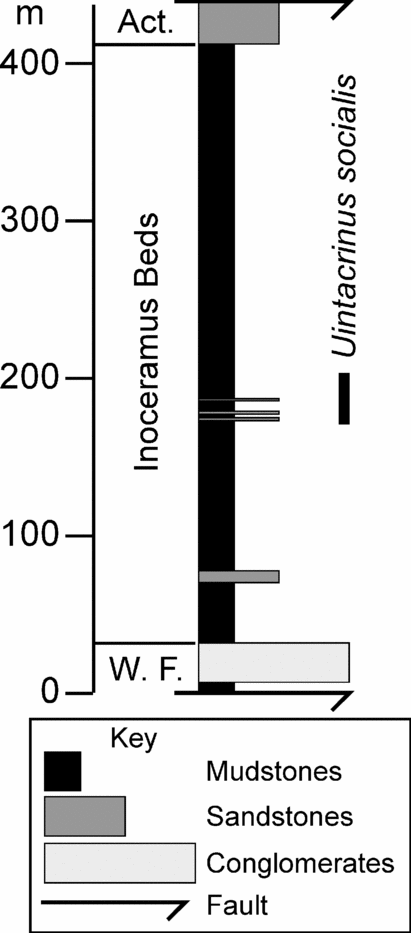
The succession in St Ann's Great River Inlier has been described by Trechmann (Reference Trechmann1927), Chubb (Reference Chubb1958) and Meyerhoff & Krieg (Reference Meyerhoff and Krieg1977). The complete section (more than 1000 m thick) exposed in the inlier has now been logged and a simplified section through the Inoceramus Shales showing the distribution of U. socialis is shown in Figure 2. The Inoceramus Shales represent a mudstone dominated succession some 380 m thick between conglomerate bearing intervals below (Windsor Formation) and above (Actaeonella Beds). Uintacrinus socialis (Fig. 3) has been collected from a 30 m interval in the middle of the unit beginning just below the level of a few thin sandstones/conglomerate beds (Fig. 2). The crinoid is represented by scattered occurrences of smooth calyx plates, about 20 having been collected; these plates are identical to calyx plates of U. socialis collected from England and Texas (Mitchell, Reference Mitchell1994, Reference Mitchell1995; Gale et al. Reference Gale, Hancock, Kennedy, Petrizzo, Lees, Walaszczyk and Wray2008). Interestingly, Donovan et al. (Reference Donovan, Gordon, Veltkamp, Scott, Wright and Robinson1993, fig. 5.2–6) illustrated ‘comatulid’ brachials that were washed from samples collected by Norman Sohl from the same interval as the present material was collected (Sohl, Reference Sohl1998). These brachials are indistinguishable from brachials of Unitacrinus and are probably attributable to this crinoid (cf. Fig. 3).
Simplified stratigraphy of the Inoceramus Shales in St Ann's Great River Inlier showing the range of Unitacrinus socialis Grinnell. W. F. – Windsor Formation; Act – Actaeonella Beds.

Calyx and brachial plates of Uintacrinus socialis Grinnell from the Inoceramus Shales of St Ann's Great River, Jamaica. (a, b) (UWIGM.2009.1.1) calyx plate IIBr3; (c, d) (UWIGM.2009.1.2) calyx plate IIBr5; (e–g) (UWIGM.2009.1.3) proximal arm brachial plate, (h, i) (UWIGM.2009.1.4) distal arm brachial plate.

Previous biostratigraphic studies on the Inoceramus Shales have been controversial, with various assignments to the Cenomanian, Turonian, Coniacian, Santonian and Campanian stages (e.g. Chubb, Reference Chubb1955, Reference Chubb1958; Meyerhoff & Kreig, Reference Meyerhoff and Krieg1977). Planktic foraminifers include Dicarinella concavata (Brotzen), Sigalia deflaensis (Sigal) and Sigalia decoratissima (de Klasz) (Esker, Reference Esker1969, as modified by Pessagno, Reference Pessagno, Reyment and Thomel1978) and indicate that the Inoceramus Shales are of Santonian age. This agrees with inoceramid bivalves, such as, Cordiceramus mulleri (Petrascheck) and Cataceramus balticus (Boehm) in museum collections studied by Kauffman (Reference Kauffman1966), rare ammonite records (Wiedmann & Schmidt, Reference Wiedmann, Schmidt, Wright and Robinson1993), and the discovery of U. socialis in the middle of the unit.
3. Discussion
Bather (Reference Bather1896) suggested a planktic mode of life for Marsupites and Uintacrinus citing the presence of a light flexible calyx, long arms and lack of a stem, as evidence. He suggested that the globular form of the calyx in these crinoids was an adaptation for a buoyancy apparatus. Springer (Reference Springer1901) and Carpenter (Reference Carpenter1866) instead suggested a pseudopelagic mode of life for Uintacrinus with the crinoids using its arms to hold on to floating objects. Milson, Simms & Gale (Reference Milson, Simms and Gale1994) noted the facies restriction of these crinoids. Marsupites and Uintacrinus are largely restricted to chalk (coccolith limestone) facies, having their best records in chalks, such as in the Austin Chalk of Texas, the Chalk of the UK, France and Germany, and the Gingin Chalk of western Australia (Gale et al. Reference Gale, Hancock, Kennedy, Petrizzo, Lees, Walaszczyk and Wray2008). In Northern Ireland and northern France, Marsupites is present in chalks, but absent in laterally equivalent glauconitic sandstone and granular phosphate facies, respectively (Wilson & Manning, Reference Wilson and Manning1978; Jarvis, Reference Jarvis and Bentor1980). On the Russian platform, Marsupites occurs in carbonate, largely chalk, facies in the Crimea, Caucasus and Kopet Dag (Turkmenistan), but is absent from clays and glauconitic sandstones to the north (Pechersky, Naidin & Molostovsky, Reference Pechersky, Naidin and Molostovsky1983). Exceptions to this are rare, for instance, Marsupites occurs in a single bed of sandstone at Plymouth Bluff in Mississippi (Kennedy, Cobban & Landman, Reference Kennedy, Cobban and Landman1997). Milson, Simms & Gale (Reference Milson, Simms and Gale1994) studied the calyx plates of Marsupites and recognized that they were relatively dense and strongly calcified; furthermore, the thecae are not enlarged when compared to arm length discounting a buoyancy device. Thus Milson, Simms & Gale (Reference Milson, Simms and Gale1994) concluded that the facies restriction and functional morphology implied that Marsupites and Uintacrinus were benthic forms. The global distribution was attributed to a relatively long pelagic larval stage.
Yet not all occurrences of these crinoids are in chalks. Uintacrinus socialis occurs throughout much of the Western Interior Seaway from occurrences in chalks in Texas to occurrences in shales as far north as southern Canada (Cobban, Reference Cobban1995; Gale et al. Reference Gale, Hancock, Kennedy, Petrizzo, Lees, Walaszczyk and Wray2008). The new record of U. socialis from Jamaica extends its range into equatorial latitudes, where it is found in a thick clastic mudstone succession containing deep-water planktic foraminiferal morphotypes, such as, Dicarinella and Sigalia (Esker, Reference Esker1969). In the Americas, therefore, Uintacrinus socialis does not show the same strong facies restriction that Marsupites shows, occurring in areas far removed (northern Western Interior Seaway and Jamaica) from classical chalk facies. Perhaps this requires a re-evaluation of the proposed benthic lifestyle of Uintacrinus. Alternatively, perhaps in tropic climates Uintacrinus occurred in deeper waters away from the warm surface waters.
The record of Uintacrinus socialis from Jamaica both extends its known latitudinal range and its palaeoenvironmental distribution (Fig. 4), thus increasing the biostratigraphic potential for using this species to define the base of the Upper Santonian. This record also suggests a possible pathway connecting the northern and southern hemisphere occurrences of Uintacrinus. The presence of Uintacrinus in the Caribbean also provides a valuable marker that will become useful for correlating the shallow-water, endemic carbonate faunas dominated by rudist bivalves, with the global chronostratigraphy. The hunt for further specimens of these crinoids from diverse lithofacies at various latitudes should be encouraged both to increase their palaeogeographical distribution and to constrain global chronostratigraphic correlation within the late Santonian to early Campanian time scale.
Mollweide palaeogeographic reconstruction of late Santonian time (85 Ma) redrawn from Global Tectonics Home Page (http://www.serg.unicam.it/Geo.html) showing distribution of species of Uintacrinus and Marsupites with distributions between 20–50° N and 25–50° S. Uintacrinus in Jamaica is more equatorial (at 14° N). J – Jamaica; WI – Western Interior Seaway; NE – Northern Europe; T – Turkmenistan; It – Italy; A – Algeria; M – Madagascar; In – India; WA – Western Australia.

Acknowledgements
I would like to thank the reviewers, for suggestions on improving the manuscript, and the helpful comments from Graham Budd and Lori Snyder of Geological Magazine. Klaus Wolf (Electron Microscope Unit, UWI) facilitated the photography.