Introduction
Interest in lead-free piezoelectrics and ferroelectrics has grown due to concerns about the toxicity of lead and resultant environmental legislation implemented in several countries1–3 (also see the Bell and Deubzer article in this issue).Reference Bell and Deubzer4 Sodium bismuth titanate, Na1/2Bi1/2TiO3 (NBT), and its solid solutions with other perovskites are some of the most heavily studied lead-free ferroelectric ceramic materials.Reference Rödel, Jo, Seifert, Anton, Granzow and Damjanovic5 NBT, discovered by Smolenskii et al.Reference Smolenskii, Isupov, Agranovskaya and Krainik6 in 1961, is a relaxor ferroelectric. Relaxor ferroelectrics are a class of materials that exhibit a frequency dependence in the temperature of maximum permittivity, T max. NBT has a T max of 320°C with an additional phase transition at a rather low temperature of 200°C.Reference Rödel, Jo, Seifert, Anton, Granzow and Damjanovic5 NBT ceramics exhibit remanent polarization P r = 38 µC/cm2, coercive field E c = 73 kV/cm,Footnote * and piezoelectric coefficient d 33 = 70 pC/N.Reference Jaffe, Cook and Jaffe7 NBT was originally assumed to have a cubic perovskite structure for purposes of calculating the lattice constant.Reference Smolenskii, Isupov, Agranovskaya and Krainik6 Modern characterization techniques have revealed the structure to be much more complex.
Modification of NBT-based systems improves many of their properties. For instance, alloying with BaTiO3 or (K1/2Bi1/2)TiO3 yield piezoelectric coefficients with nearly, or more than double, the values of unmodified NBT.Reference Rödel, Jo, Seifert, Anton, Granzow and Damjanovic5,Reference Nagata, Takenaka and Uchino8 Most optimized coefficients are found at a morphotropic phase boundary (MPB), which is a vertical or near-vertical boundary separating different polymorphic phases. In this article, we discuss the complex structure of NBT and its solid solutions, including their interesting relaxor and functional properties as well as their field-induced structural phase transitions, with a focus on polycrystalline materials.
The complex structure of Na1/2Bi1/2TiO3
The structural description of NBT has changed several times since its discovery 57 years ago. The structure is elusive because of several key features across multiple length scales that cannot be described in a single unit. Though the features of the NBT structure are central to the resultant properties of NBT and NBT-based solid solutions, some details of the structure are still under debate.
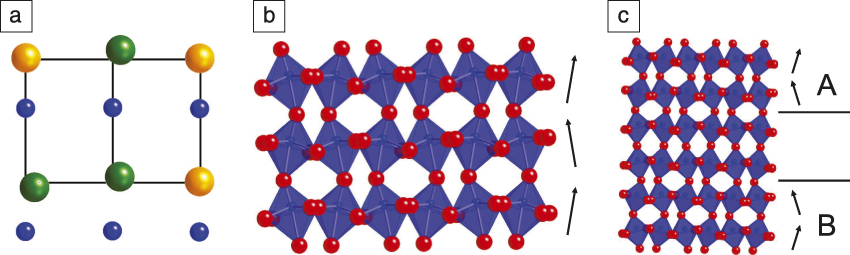
At the smallest length scale, NBT owes much of its unique nature to the electronic structure of bismuth, as originally recognized by Smolenskii et al.Reference Smolenskii, Isupov, Agranovskaya and Krainik6 Bi3+ exhibits a lone pairReference Orgel9 analogous to Pb2+ and a covalent bonding character. The lone-pair effect arises from the hybridization of bismuth 6s 2 and oxygen 2p orbitals. This causes an off-centering of Bi3+ within the BiO12 cageReference Schütz, Deluca, Krauss, Feteira, Jackson and Reichmann10 (Figure 1a). Consequently, the local symmetry around Bi3+ varies significantly from that of Na+ and from the average structure.
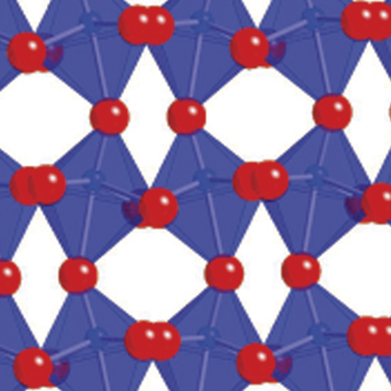
Different structural features of the Na1/2Bi1/2TiO3 crystal structure viewed along a pseudocubic [110] direction at progressively increasing length scales, with Bi3+ shown as green, Na+ as orange, Ti4+ as blue, and O2– as red. (a) Chemically disordered A-site occupancy and Bi3+ displacements. (b) Antiphase octahedral tilting of the octahedra. (c) Tilted octahedra that appear as a different phase when viewed using diffraction, which averages over longer length scales. The specific example in (c) is a model by Dorcet and Trolliard,Reference Dorcet and Trolliard24 though the model by Levin and ReaneyReference Levin and Reaney27 is equally plausible. Arrows emphasize direction of tilts. For clarity, (a) is shown without O2– and (b) and (c) are shown without the A site.

The average structure of NBT at room temperature (i.e., the structure perceived by diffraction techniques) was originally assumed to be cubic.Reference Smolenskii, Isupov, Agranovskaya and Krainik6 Later x-ray diffraction measurements of single crystals showed it to exhibit a rhombohedrally distorted perovskite structure.Reference Zvirgzds, Kapostin, Zvirgzde and Kruzina11 It is essential to note that the structures perceived by diffraction techniques represent the structure averaged over a long length scale in the lattice (∼10 nm) and do not adequately characterize the structure at smaller length scales; thus, the local structure and the average structure are different. Octahedral tilting was observed using neutron diffraction in 2002, showing an a –a –a – tilting system (in Glazer notation, this means that tilting of equal amplitude occurs in alternating sense in all three crystal axes) and corresponding to a rhombohedral R3c space group (Figure 1b).Reference Jones and Thomas12 In 2010, high-resolution x-ray measurements on single crystals provided the first evidence of small monoclinic distortions in the room-temperature structure and suggestions that the average structure is monoclinic.Reference Gorfman and Thomas13 In 2011, the monoclinic Cc space group was shown to best fit the high-resolution and high-intensity x-ray diffraction patterns from polycrystalline materials, a structure with an a –a –c – tilting system.Reference Aksel, Forrester, Jones, Thomas, Page and Suchomel14 The distortions that are represented by the Cc structure are lost slowly while heating over several hundred degrees, suggesting that the average Cc structure observed in diffraction results from changes in the local- or intermediate-range structures.Reference Aksel, Forrester, Kowalski, Jones and Thomas15
Since local chemical and displacement disorder are not visible in Bragg diffraction, other techniques have been applied to investigate the local structure in NBT. Shuvaeva et al. employed x-ray absorption fine structure (XAFS) spectroscopyReference Shuvaeva, Zekria, Glazer, Jiang, Weber, Bhattacharya and Thomas16 and found that Bi–O bonds are 0.3 Å shorter than estimated from diffraction techniques and are displaced in a statistically disordered manner along the body diagonal of the perovskite structure. The local environment of both A-site cations has also been examined with pair distribution function analysis of total scattering neutron data and reverse Monte Carlo modeling.Reference Keeble, Barney, Keen, Tucker, Kreisel and Thomas17 Keeble et al.Reference Keeble, Barney, Keen, Tucker, Kreisel and Thomas17 demonstrated that the distribution of bismuth displacements spreads along an allowable monoclinic plane and that these displacements condense into two different displacement directions upon heating. Aksel et al.Reference Aksel, Forrester, Nino, Page, Shoemaker and Jones18 further showed the length scales at which the local structures converge to the average structure, defining ∼10 Å (approximately three pseudocubic unit cells) as a critical length scale for differentiating local structure from average, as well as the unique local bond valence sums for Na+ and Bi3+. Besides bismuth, attention has also been drawn to the specifics of the local structure of the remaining cations in NBT. The local environment of sodium in the A site was studied with 23Na nuclear magnetic resonance (NMR) spectroscopy,Reference Groszewicz, Breitzke, Dittmer, Sapper, Jo, Buntkowsky and Rödel19,Reference Groszewicz, Gröting, Breitzke, Jo, Albe, Buntkowsky and Rödel20 and significant disorder was observed for the local structure of sodium in NBT, which is attributed to a continuous unimodal distribution of octahedral tilting.Reference Groszewicz, Gröting, Breitzke, Jo, Albe, Buntkowsky and Rödel20 This disordered phase was found to coexist with a phase that has local cubic symmetry.Reference Groszewicz, Breitzke, Dittmer, Sapper, Jo, Buntkowsky and Rödel19 Significant structural disorder was also observed for the B site by means of 47,49Ti NMR,Reference Groszewicz, Breitzke, Jo, Rödel and Buntkowsky21 in line with previous XAFS investigations.Reference Shuvaeva, Zekria, Glazer, Jiang, Weber, Bhattacharya and Thomas16,Reference Rao, Olivi, Sathe and Ranjan22 Figure 1a illustrates some of these local-scale features.
In addition to the local A-site chemical and displacive disorder, NBT exhibits complexity at increasing length scales associated with octahedral tilting and nanoscale defects. There are some consistencies in the observations and interpretations of these longer length-scale structures, although the exact models presented are different. Kreisel et al. first used x-ray diffuse scattering patterns to create a model of a nanoscale structure consisting of planar regions of correlated A-site offsets that generate monoclinic platelets that are separated by a rhombohedral matrix.Reference Kreisel, Bouvier, Dkhil, Thomas, Glazer, Welberry, Chaabane and Mezouar23 Dorcet and Trolliard later utilized transmission electron microscopy (TEM) to suggest that the platelets were tetragonal in structure (with a 0a 0c + tilting) within a rhombohedral matrix (with a –a –a – tilting);Reference Dorcet and Trolliard24 one can think of this structure as a tetragonal boundary structure separating rhombohedral domains (Figure 1c). Dorcet and Trolliard also suggested that satellite reflections observed in TEM are the result of strain fields associated with the elastic relaxation between neighboring tetragonal boundaries, which may correlate with the incommensurate modulations observed in neutron and x-ray scattering.Reference Balagurov, Koroleva, Naberezhnov, Sakhnenko, Savenko, Ter-Oganessian and Vakhrushev25,Reference Thomas, Trujillo, Boudard, Gorfman and Kreisel26 Levin and Reaney presented a continuous phase, single tilting model in which there are short-range-ordered orthorhombic domains (with tilting system a –a –c +); the in-phase tilting component of this structure (c +) exhibits a correlation length of only a few unit cells, thus averaging to the long-range-ordered rhombohedral or monoclinic phases (antiphase tilting systems of a –a –a – or a –a –c –) that are observed by diffraction techniques.Reference Levin and Reaney27 Subsequent studies are not inconsistent with these overarching models of the nanoscale structure of NBT.Reference Beanland and Thomas28
During poling of NBT and NBT-rich solid solutions, the structures at all length scales change, with some compositions exhibiting phase transitions.Reference Daniels, Jo, Rödel and Jones29–Reference Garg, Rao, Senyshyn, Krishna and Ranjan32 In situ diffuse x-ray scattering on 0.96NBT-0.04BT revealed that the application of an electric field removes the features associated with the octahedral tilt boundaries and modulations.Reference Daniels, Jo, Rödel, Rytz and Donner33 The poling field changes the structure from an average tilt of a –a –c – to a –a –a – and also changes the Na/Bi–O bond distances,Reference Rao, Olivi, Sathe and Ranjan22,Reference Usher, Levin, Daniels and Jones34 making it consistent with the average R3c structure. No change is observed in the Ti–O bond distances.Reference Rao, Olivi, Sathe and Ranjan22 Electron diffraction revealed suppression of the short-range in-phase octahedral tilt, confirming a strong correlation between the average Cc structure and the presence of local in-phase tilt, in conformity with the view that the perceived Cc structure with a –a –c – tilt is an average of nanoscale domains exhibiting a –a –c +.Reference Levin and Reaney27 X-ray and electron diffraction evidence a poling-induced average structure change from Cc to R3c, consistent with the aforementioned local scale changes.Reference Ma, Guo, Beckman and Tan31,Reference Rao and Ranjan35 A gradual reduction in the Cc phase fraction is seen with poling field,Reference Rao, Fitch and Ranjan36 akin to the gradual reduction in Cc phase fraction with temperature.Reference Aksel, Forrester, Kowalski, Jones and Thomas15 During poling, the development of piezoelectricity parallels the structural changes with the longitudinal piezoelectric coefficient, d 33, increasing with increased fraction of R3c phase.Reference Rao and Ranjan35
In polycrystalline materials, the structure and properties of NBT are also dependent on processing parametersReference Aksel, Forrester, Jones, Thomas, Page and Suchomel14 and the final grain size.Reference Khatua, Mehrotra, Mishra, Majumdar, Senyshyn and Ranjan37 For samples with grain sizes less than ∼1–2 µm, d 33 is suppressed and the polycrystalline materials cannot transform into the R3c structure upon poling. However, when the poling field is applied on free (unclamped) submicrometer grains in a powder–polymer composite, the transition from an average structure of Cc to R3c is evident.Reference Khatua, Mehrotra, Mishra, Majumdar, Senyshyn and Ranjan37 This result suggests that the limited piezoelectricity in NBT polycrystalline materials with submicrometer grain size is not primarily due to suppression of ferroelectricity in the individual grains themselves, but is instead due to the inability of the electric field to induce long-range structural changes, perhaps due to a clamping effect by the surrounding grains in the polycrystalline structure.
Properties of Na1/2Bi1/2TiO3 and its solid solutions
NBT forms an MPB with other perovskites that exhibit different polymorphs, such as PbTiO3 (PT), BaTiO3 (BT), and (K1/2Bi1/2)TiO3 (KBT). Solid solutions of NBT with other perovskite compounds typically exhibit improved piezoelectric properties, particularly at compositions near their MPBs. The piezoelectric properties are also reasonably stable at elevated temperatures due to the near-vertical nature of MPBs in phase diagrams;Reference Nagata, Takenaka and Uchino8,Reference Takenaka, Maruyama and Sakata38,Reference Nagata, Yoshida, Makiuchi and Takenaka39 this is unlike a polymorphic phase boundary (PPB), such as that present in K0.5Na0.5NbO3 (KNN)-based systems, which is a horizontal or near-horizontal boundary on the phase diagram. Takenaka et al.Reference Takenaka, Maruyama and Sakata38 and Sasaki et al.Reference Sasaki, Chiba, Mamiya and Otsuki40 originally reported the binary solid solutions NBT-xBT and NBT-xKBT that we will highlight. NBT-xKBT exhibits an MPB at compositions of approximately x = 0.18–0.20, where electric-field-induced phase transitions during poling are also detected.Reference Royles, Bell, Daniels, Milne and Comyn41 On the NBT-rich side of the NBT-xBT binary system, detailed structural analysis suggests up to three phase boundaries in the unpoled state,Reference Ma, Guo, Beckman and Tan31,Reference Garg, Rao, Senyshyn, Krishna and Ranjan32,Reference Ma, Guo and Tan42,Reference Jo and Rödel43 but under poling at fields >3 kV/mm, a single MPB is visible between x = 0.06 and 0.07. The field-induced, irreversible phase transitions in NBT-xBT involve changes in oxygen octahedral tilting similar to those in NBTReference Simons, Daniels, Jo, Dittmer, Studer, Avdeev, Rödel and Hoffman30–Reference Garg, Rao, Senyshyn, Krishna and Ranjan32 and are accompanied by apparent volume expansion.Reference Jo and Rödel43 The transition process exhibits a long incubation time (∼1000 s) when the applied field is close to the critical value (1.15 kV/mm for the composition of x = 0.07).Reference Chen, Ayrikyan, Webber and Kamlah44 Consequently, the transitions strongly depend on the loading rate.Reference Royles, Bell, Daniels, Milne and Comyn41
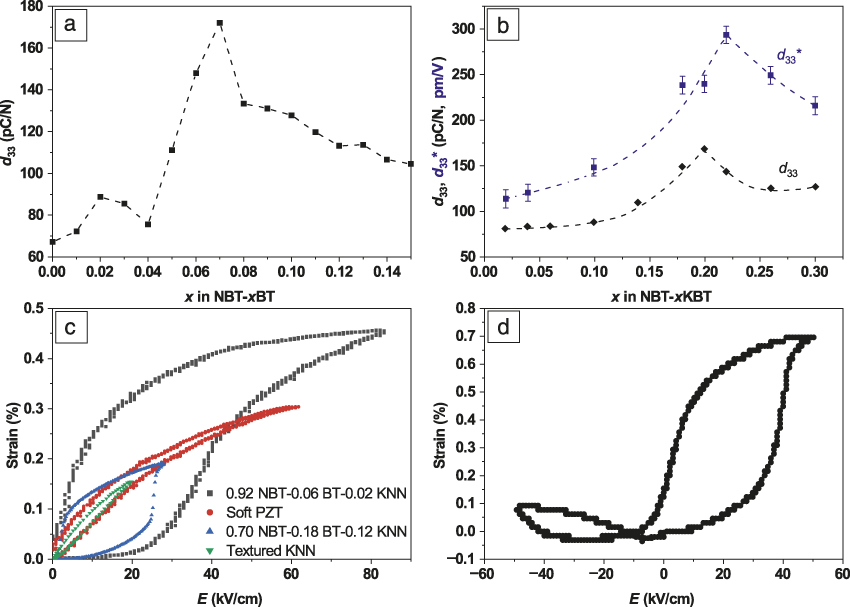
The compositions of NBT-xBT and NBT-xKBT near their MPBs have the largest d 33 values in their binary systems, reaching 17045 and 157 pC/N,Reference Yoshii, Hiruma, Nagata and Takenaka46 respectively (Figure 2a–b). The piezoelectric coefficients for the compositions near the MPB in NBT-xBT and NBT-xKBT are retained up to temperatures of approximately 105°C and 124°C, respectively, defined as the thermal depoling temperature (T d), at which temperature the effects of poling and piezoelectric d 33 coefficient are lost.Reference Davies, Aksel and Jones47–Reference Foronda, Deluca, Aksel, Forrester and Jones49 The thermal depolarization of NBT above these temperatures is associated with the recovery of the average Cc monoclinic structure.Reference Rao, Datta, Chandrashekaran, Mishra, Sathe, Senyshyn and Ranjan50 Interestingly, some samples can retain the memory of the poling-induced structural changes up to temperatures of 300°C,Reference Rao, Datta, Chandrashekaran, Mishra, Sathe, Senyshyn and Ranjan50 which is the temperature at which optical properties become isotropic, or the optical isotropization temperature.Reference Gorfman, Glazer, Noguchi, Miyayama, Luo and Thomas51
Compositional dependence of (a) the piezoelectric coefficient d 33 in Na1/2Bi1/2TiO3- BaTiO3 (NBT-BT) (poled at 60 kV/cm)Reference Jo, Daniels, Jones, Tan, Thomas, Damjanovic and Rödel45 and (b) of d 33 and the normalized strain, d 33Footnote *, in NBT-(K1/2Bi1/2)TiO3 (KBT) (poled at 80 kV/cm).Reference Nagata, Takenaka and Uchino8 Performance is enhanced near compositional phase boundaries. (c) Electric-field-induced strains of NBT-based solid solutions are competitive with soft lead zirconate titanate (PZT) and textured K0.5Na0.5NbO3 (KNN).Reference Jo, Dittmer, Acosta, Zang, Groh, Sapper, Wang and Rödel57 (d) Giant electrostrain developed under bipolar electric fields of ±50 kV/cm in (Na0.84K0.16)1/2Bi1/2)0.96Sr0.04)(Ti0.975Nb0.025)O3.Reference Liu and Tan58 Note: E, electric-field amplitude.

A large number of NBT-based binary and ternary solid solutions have been explored in efforts to further increase the piezoelectric-induced strain and strain coefficients; some of these NBT-based compositions exhibit d 33 values higher than 200 pC/N.Reference Lin, Xiao, Zhu and Yu52,Reference Yuan, Zhang, Zhou and Liu53 However, from a survey of numerous NBT-based solid solutions, d 33 and T d show a trade-off relationship with each other.Reference Nagata, Takenaka and Uchino8 Many of the compositions nearest to the MPB with a large d 33 have a lower T d than other compositions. For example, one of the compositions in the NBT-KBT-BT ternary system has a large d 33 value of 191 pC/N at the MPB but a low T d of 110°C.Reference Nagata, Yoshida, Makiuchi and Takenaka39 Zhang et al. demonstrated how the incorporation of ZnO particles in the NBT ceramic compensate the depolarization field, increasing or even eliminating depolarization.Reference Zhang, Pan, Guo, Liu, Ning, Chen, Lu, Yang, Chen, Zhang, Xing, Rödel, Cao and Chen54 Recently, it was also suggested that a thermal quenching process could be a promising method to increase T d by approximately 50°C without deteriorating the electromechanical coupling effect in NBT and NBT-BT-based solid solutions.Reference Miura, Nagata and Takenaka55,Reference Muramatsu, Nagata and Takenaka56
The d 33 coefficient is typically measured at weak driving amplitudes of stress or electric field. Some actuator applications operate under higher amplitude driving forces, and a different performance metric is used: the strain-to-field ratio under high amplitude driving fields (i.e., S max/E max [sometimes referred to as d 33Footnote *]), which can be reported under either unipolar or bipolar loading conditions. For these applications, the pseudo-ternary system NBT-BT-KNN yields compositions of particular interest with superior values of S max/E max of >650 pm/V at certain conditions.Reference Jo, Dittmer, Acosta, Zang, Groh, Sapper, Wang and Rödel57 Strain-field hysteresis of 0.92 NBT-0.06 BT-0.02 KNN is shown in Figure 2c and compared against other lead-based and lead-free compositions. Higher S max values of 0.7% (so-called “giant electrostrain”) were subsequently reported in a polycrystalline material of composition NBT-KBT with Sr and Nb codopants, as shown in Figure 2d.Reference Liu and Tan58 This large strain is achieved at modest electric-field amplitudes, yielding S max/E max values of 1400 pm/V.58 The origin of these large strains has been suggested to lie in the relaxor nature of these materials.
Relaxors are a special class of ferroelectrics, characterized by strong frequency dependence in both the dielectric permittivity and T max.Reference Cross59–Reference Ahn, Hong, Choi, Kim, Han, Hwang, Jo, Wang, Li, Lee and Kim61 It is widely believed that the origin of this frequency dispersion is related to polar nanoregions,Reference Kleemann62–Reference Ge, Luo, Devreugd, Zhang, Ren, Li, Luo and Viehland65 the dynamics of which depend on their size at a given thermal energy.Reference Pirc and Blinc66 Since their size increases as temperature is reduced,Reference Stock, Van Eijck, Fouquet, Maccarini, Gehring, Xu, Luo, Zhao, Li and Viehland67,Reference Kojima, Ohta, Ariizumi and Zushi68 the dynamics stop at a certain temperature, called the freezing temperature (T f).Reference Burns and Dacol69–Reference Viehland, Jang, Cross and Wuttig71 Below and above T f, the relaxor is in a nonergodic and an ergodic state, respectively.Reference Viehland, Li, Jang, Cross and Wuttig72 Nonergodic relaxors transform permanently into a ferroelectric state when exposed to an electric field large enough to overcome the thermal energy that favors a high entropic state (i.e., relaxor state). On the other hand, an ergodic relaxor always returns to the original state in the absence of an external electric field. Microstructurally, this represents a reversible transition between nanodomains and large lamellar ferroelectric domains.Reference Kling, Tan, Jo, Kleebe, Fuess and Rödel73
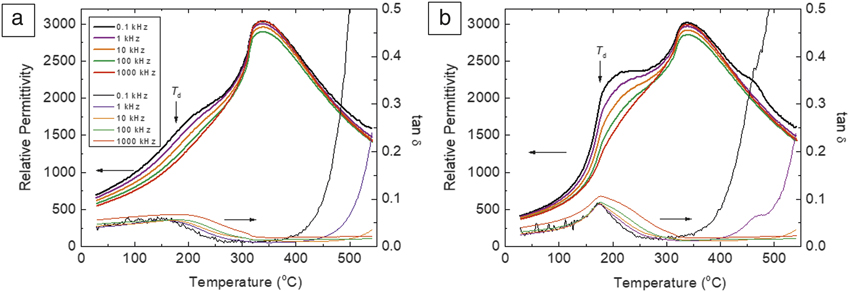
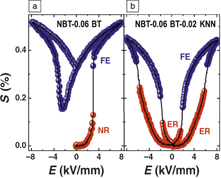
Unmodified NBT is a nonergodic relaxor below T d,Reference Siny, Tu and Schmidt74,Reference Shvartsman and Lupascu75 and there exists clear frequency dependence in the permittivity below T d (Figure 3a). Some NBT-rich solid solutions are nonergodic relaxors. For example, NBT-0.07 BT irreversibly transforms from a nonergodic relaxor into a ferroelectric with an applied field.Reference Daniels, Jo, Rödel and Jones29 The macroscopically measured strain of ∼0.2% associated with the phase transition in NBT-0.07 BT was nearly entirely accounted for by the strain due to the volume change from the transition (0.11%) and the ferroelastic domain alignment in the induced ferroelectric state (0.08%).Reference Daniels, Jo, Rödel, Honkimäki and Jones76 After poling, the frequency dependence of permittivity is substantially reduced in these initially nonergodic materialsReference Aksel, Forrester, Kowalski, Deluca, Damjanovic and Jones77 (Figure 3b). In some cases, solid solutions of NBT with other perovskites will transform NBT into an ergodic relaxor in the unpoled state,Reference Simon, Ravez and Maglione78,Reference Jo, Schaab, Sapper, Schmitt, Kleebe, Bell and Rödel79 evidenced by the appearance of a large, reversible electromechanical strainReference Jo, Dittmer, Acosta, Zang, Groh, Sapper, Wang and Rödel57,Reference Zhang, Kounga, Aulbach, Ehrenberg and Rödel80–Reference Kim, Ahn, Hwang, Lee and Jo82 (Figure 4).
Dielectric permittivity and dielectric loss tangent (tan δ) of Na1/2Bi1/2TiO3 (NBT) as a function of frequency and temperature in the (a) unpoled and (b) poled states.Reference Aksel, Forrester, Kowalski, Deluca, Damjanovic and Jones77 Frequency dispersion in permittivity occurs over a broad temperature range and is influenced by the poling process. Note: T d, depoling temperature.

Phase transitions are apparent in the strain hysteresis, as shown in (a) from nonergodic relaxor to ferroelectric in 0.94 NBT-0.06 BT and (b) from ergodic relaxor to ferroelectric in 0.92 NBT-0.06 BT-0.02 KNN.Reference Jo, Dittmer, Acosta, Zang, Groh, Sapper, Wang and Rödel57 The phase transition behaviors can be tuned by small compositional changes, as shown by comparing (a) and (b). Note: NBT, Na1/2Bi1/2TiO3; BT, BaTiO3; KNN, K0.5Na0.5NbO3; S, strain; FE, ferroelectric; ER, ergodic; NR, nonergodic; E, electric field amplitude.

The structural origins of the relaxor behavior are not yet well understood. Recently, the relaxor characteristics in NBT-based materials were shown to correlate with the distribution of tilting angles of the oxygen octahedron.Reference Groszewicz, Gröting, Breitzke, Jo, Albe, Buntkowsky and Rödel20 Moreover, with increasing BT concentration in the NBT-xBT system, a 23Na NMR study revealed a positive correlation between the extent of tilt disorder and relaxor character.Reference Groszewicz, Gröting, Breitzke, Jo, Albe, Buntkowsky and Rödel20
Other functional properties of Na1/2Bi1/2TiO3 derivatives
NBT and its solid solutions have additional properties that are of importance to both electromechanical and other applications. Near the MPB for NBT-0.06BT, the pseudocubic relaxor phase undergoes an electric-field-induced phase transitionReference Hinterstein, Knapp, Hölzel, Jo, Cervellino, Ehrenberg and Fuess83,Reference Khansur, Hinterstein, Wang, Groh, Jo and Daniels84 with a large longitudinal strain.Reference Tan, Aulbach, Jo, Granzow, Kling, Marsilius, Kleebe and Rödel85 Because of this coupling to strain, the relaxor to ferroelectric phase transition can be suppressed by application of a uniaxial compressive stress. In predominantly ferroelectric compositions, the resulting field-induced strain is lower, but the switching of ferroelastic domains is most active around a uniaxial compressive stress of 200 MPa and persists up to stresses above 300 MPa. This behavior suggests that NBT may outperform lead zirconate titanate (PZT) ceramics in actuator applications that operate under high compressive stresses.Reference Tan, Aulbach, Jo, Granzow, Kling, Marsilius, Kleebe and Rödel85
Since NBT is an A-site co-substituted perovskite and Bi3+ and Na+ have different oxidation states, the stoichiometry plays a crucial role in the material properties. For example, slight variations of the A-site stoichiometry can result in dramatic changes in the electrical conductivity and conduction mechanisms.Reference Li, Zhang, Cook, Li, Kilner, Reaney and Sinclair86 In theory, the stoichiometry should be Na1/2Bi1/2TiO3. However, recent studies revealed that the stoichiometric composition does not exhibit the highest resistance.Reference Li, Zhang, Cook, Li, Kilner, Reaney and Sinclair86–Reference Li, Pietrowski, De Souza, Zhang, Reaney, Cook, Kilner and Sinclair88 In fact, only Bi-rich samples resulted in insulating behavior. In this case, the remaining bulk conductivity is associated with n-type electronic conduction. Na-rich samples exhibited oxide-ion conductivity. Thus, variations of ∼1 at.% can result in changes in conductivity by several orders of magnitude. Careful determination of water in the starting powders is crucial in order to weigh their correct fractions during processing and, therefore, to control material properties in NBT.
Mg doping can increase the diffusion coefficient by orders of magnitude, resulting in oxide-ion conductivities that are competitive for applications such as solid-oxide fuel cells.Reference Li, Pietrowski, De Souza, Zhang, Reaney, Cook, Kilner and Sinclair88 In undoped NBT, which is oxide-ion conducting, a high grain-boundary conductivity is observed. In contrast, the conductivity in Mg-doped NBT is dominated by the bulk component. Nb doping causes the opposite effect and increases bulk resistivity.Reference Li, Li, Zhang, Reaney and Sinclair87 Doping levels above 1 at.% systematically suppress oxide-ion conductivity and result in low dielectric loss even at high temperatures.
Conclusions
Solid-solution systems of NBT with other perovskites exhibit great promise for lead-free piezoelectric applications. While the complex structure of NBT is still being unraveled, these systems have shown promise as competitive lead-free actuators, particularly for achieving high strains and strain coefficients as well as performance under high blocking stresses. Commercial materials based on NBT are already available. With continued advances in understanding the structure as well as exploring new compositions, microstructure designs, and processing conditions, NBT and its derivatives will continue to be valued lead-free piezoelectric ceramic materials.
Acknowledgments
Support is acknowledged from the US National Science Foundation under Award No. DMR-1409399 (A.R.P. and J.L.J.) and DMR-1465254 (X.T.), the Australian Research Council projects DP120103968 and DP130100415 (J.E.D.), the German Research Society (DFG) Grant HI 1867/1–1 (M.H.), the Science and Engineering Research Board, Department of Science and Technology, Government of India under EMR/2016/001457 (R.R.), and the DFG under contract Bu-911–28–1 (P.B.G.).

Alisa R. Paterson is a postdoctoral researcher in the Department of Materials Science and Engineering at North Carolina State University. She received her BS and PhD degrees in chemistry at Simon Fraser University, Canada. Her research interests include the synthesis and characterization of piezo-/ferroelectric ceramics and single crystals, and the development of analyses for diffraction data. Paterson can be reached by email at apaters@ncsu.edu.

Hajime Nagata is a professor in the Faculty of Science and Technology at the Tokyo University of Science, Japan. He received his PhD degree from the Tokyo University of Science in 2001. His research interests focus on lead-free piezoelectric, ferroelectric, and dielectric ceramics, including their electrical properties and characterization. He received the IEEE Ferroelectrics Young Investigator Award in 2012. Nagata can be reached by email at h-nagata@rs.noda.tus.ac.jp.

Xiaoli Tan is a professor of materials science and engineering at Iowa State University of Science and Technology. He obtained his PhD degree from the University of Illinois at Urbana-Champaign in 2002. He received an NSF CAREER Award in 2004. He is an associate editor of the Journal of the American Ceramic Society. His research focuses on the structure–property relationship in electroceramics, with in situ transmission electron microscopy as the primary characterization tool. He has published more than 130 articles. Tan can be reached by email at xtan@iastate.edu.

John E. Daniels is an associate professor in the School of Materials Science and Engineering at the University of New South Wales, Australia. He received his BS and PhD degrees in physics in 2003 and 2007, respectively, from Monash University, Australia. He completed postdoctoral research at The European Synchrotron, where he studied instrumentation and measurement methods for materials characterization. His research interests focus on structural measurement by scattering methods and electromechanical materials. Daniels can be reached by email at j.daniels@unsw.edu.au.

Manuel Hinterstein is an Emmy Noether Research Group leader in Functional Electroceramics at the Institute for Applied Materials of the Karlsruhe Institute of Technology, Germany. He received his diploma in materials science from the Technische Universität Darmstadt, Germany. He held postdoctoral research positions at the Technische Universität Dresden, Germany, the Deutsches Elektronen-Synchrotron, Germany, and the University of New South Wales, Australia. He received the Max-von-Laue Prize (DGK, 2014), a Young Scientist Award (EPDIC, 2014) and the Discovery Early Career Award (ARC, 2015). He has more than 40 publications and 60 conference contributions, including 10 invited talks. Hinterstein can be reached by email at manuel.hinterstein@kit.edu.

Rajeev Ranjan is an associate professor in the Department of Materials Engineering at the Indian Institute of Science, India. He obtained his PhD degree in materials science from the Institute of Technology, Banaras Hindu University (BHU), India, in 2000. He was a faculty member at the Institute of Technology, BHU, from 2002 to 2007, and was an Alexander von Humboldt Fellow at the Ludwig-Maximilians-Universität München, Germany, from 2006 to 2007. His research interests focus on piezoelectric and magnetoelectric multiferroic materials. He has approximately 130 research publications. Ranjan can be reached by email at rajeev@iisc.ac.in.

Pedro B. Groszewicz is a postdoctoral researcher at the Technische Universität Darmstadt (TUD), Germany. He received his MS degree in chemistry at the Universidade Federal do Paraná, Brazil, in 2010, and his PhD degree in 2016 from TUD. His current research interest focuses on the study of structure–property relationships in advanced materials with solid-state nuclear magnetic resonance. He has published 15 articles on topics ranging from functional ceramics to heterogeneous catalysts. Groszewicz can be reached by email at groszewicz@chemie.tu-darmstadt.de.

Wook Jo is a professor at the School of Materials Science and Engineering, Ulsan National Institute of Science and Technology (UNIST), South Korea. Prior to joining the faculty of UNIST in 2014, he had served as a group leader for the Processing of Ferroelectrics Lab at the Institute of Materials Science, Technische Universität Darmstadt, Germany, since 2007. His recent research focuses on the functional properties of ferroelectric materials with special emphasis on lead-free piezoceramics and relaxor ferroelectrics. He has published more than 140 papers, seven books, and holds six patents. Jo can be reached by email at wookjo@unist.ac.kr.

Jacob L. Jones is a professor of materials science and engineering and University Faculty Scholar at North Carolina State University (NC State), director of the Analytical Instrumentation Facility at NC State, and director and principal investigator of the Research Triangle Nanotechnology Network. His research interests involve developing structure–property–processing relationships in emerging functional materials, primarily through the use of advanced x-ray and neutron-scattering tools, and he has published more than 200 papers on these topics. Jones can be reached by email at jacobjones@ncsu.edu.