Introduction
The study of evolution and plasticity can provide insights into the roles of ecology and evolution in adaptation and speciation processes (Daniel et al., Reference Daniel, Cleary, Descimon and Menken2002; Adams & Collyer, Reference Adams and Collyer2009). Adaptation of populations to different habitats, regarded as the first step towards ecological speciation (Rundle & Nosil, Reference Rundle and Nosil2005; Schluter & Conte, Reference Schluter and Conte2009), can be induced by natural selection in two ways: first, by direct action on the additive genetic component, and second, by phenotypic plasticity (Johnson & Black, Reference Johnson and Black2008; Hollander & Butlin, Reference Hollander and Butlin2010). Differing mechanisms associated with local genetic adaptation and phenotypic plasticity may ultimately produce similarly high levels of phenotypic differentiation among populations. However, differentiation in morphological traits does not always indicate the occurrence of adaptation, because genetic drift may also influence patterns of variation (Dowle et al., Reference Dowle, Morgan-Richards, Brescia and Trewick2015). Additionally, environmental factors exerting selection, both biological (parasites, predators and competitors) and non-biological (physical factors, for example, wave splash and temperature), may vary with the geographic distribution of a species (Avaca et al., Reference Avaca, Narvarte, Martín and Molen2013). Thus, it is difficult to determine the role of natural selection in shaping geographically partitioned variation. Understanding the role of divergent ecological selection requires quantification of genetic and plastic variation, particularly in response to environmental variables (Dowle et al., Reference Dowle, Morgan-Richards, Brescia and Trewick2015).
Quantifying phenotypic variation is the crucial first step towards understanding the evolution and ecology of species (Adams & Collyer, Reference Adams and Collyer2009). Phenotypic variation may be attributed to genetic differences, phenotypic plasticity, or both. These causes are not mutually exclusive, because evolution of adaptive phenotypic plasticity may lead to the success of organisms in novel habitats, and potentially contributes to genetic differentiation and speciation (Agrawal, Reference Agrawal2001). Habitat-specific convergent evolution and local phenotypic adaptations provide feasible means for testing adaptive hypotheses (Dowle et al., Reference Dowle, Morgan-Richards, Brescia and Trewick2015; Yeaman et al., Reference Yeaman, Hodgins, Lotterhos, Suren, Nadeau, Degner, Nurkowski, Smets, Wang, Gray, Liepe, Hamann, Holliday, Whitlock, Rieseberg and Aitken2016). In both cases, phenotypic traits would be in response to environmental factors rather than neutral genetic drift. Based on information on genetic variation, we can test the hypothesis that traits are adaptations resulting from local selection, through quantification of phenotypic variation.
Among the phenotypic traits, morphology is a general feature related to fitness, and is therefore under strong selective pressure (Johannesson et al., Reference Johannesson, Johannesson and Rolan-Alvarez1993). Marine gastropods can act as useful models for studying fitness, due to the evolutionary and ecological significance of their shell morphology (Solas et al., Reference Solas, Sepúlveda and Brante2013). Among widely distributed species, shell shape variability is a critical factor determining regional adaptation and survival success. Shells of intertidal gastropods over their geographic ranges in oceans commonly display intraspecific variations in size and shape (Preston & Roberts, Reference Preston and Roberts2007), and the extent to which the environment influences shell shape in gastropods is well documented (Vermeij, Reference Vermeij1987). Morphological traits of gastropod shells have been commonly used to investigate phenotypic variability, as they frequently respond to ecological factors predictably (Trussell, Reference Trussell2000).
The Pacific coast of China is characterized by distinct tectonic and geographic features, with a series of marginal seas separating eastern Asia from the Pacific Ocean (Tamaki & Honza, Reference Tamaki and Honza1991). Historical events, such as isolations and temperature fluctuations during the Pleistocene climatic oscillations, are considered to have driven the diversification of marine species (Shen et al., Reference Shen, Jamandre, Hsu, Tzeng and Durand2011; Ni et al., Reference Ni, Li, Kong and Yu2014) in this region. Positioned across tropical, sub-tropical and temperate zones, this region is divided into diverse oceanic environments by various environmental factors, such as sea surface temperature, salinity and oxygen concentrations (Briggs, Reference Briggs1995). The broad latitudinal range encompasses a wide variety of environmental conditions, and thus promotes selection and adaptation of the local populations of marine taxa.
The spatial phenotypic variation in Monodonta labio (Linnaeus, 1758) shells along the Pacific coast of China has not been explored at the broad scale, although this information is important for understanding adaptation and speciation processes, and for complementing the genetic studies in this region. Monodonta labio is a common gastropod species in the intertidal shores and is widely distributed in East Asia. It occupies a wide range of intertidal habitats, including rocky, cobble and boulder shores, as well as mangroves (Chin, Reference Chin2003). A previous study detected intraspecific variations in the shell morphology in three geographic populations along the coast of China (Wang et al., Reference Wang, Xu, Zou, Du, Wang, Zheng, Han and Shui2013). Phenotypic variations associated partially with wave action in wave-exposed shores, suggesting environmental control of shell shape. However, the sampling localities were limited and did not cover all the variable environmental factors of this region. Furthermore, whether the variations in shell shape of M. labio reflect genetic differences remains untested, although five genetically different lineages have been revealed in a phylogeographic study using mitochondrial sequence data (Zhao et al., Reference Zhao, Li, Kong and Yu2017). In addition, the presence of two distinct morphotypes, M. labio labio and M. labio confusa (e.g. Higo et al., Reference Higo, Callomon and Goto1999), also suggests that shell shape is not purely a plastic trait responding to local environment but is genetically constrained.
In the present study, the objectives were to investigate spatial variations in shell shape of M. labio along the Pacific coast of China and adjacent Asia, as the first step in understanding the patterns of gastropod phenotypic variation in this region. Furthermore, we examined whether shell shape variation is best explained by environmental gradients or by genetic structuring based on the prior molecular phylogeographic studies.
Materials and methods
Specimens of Monodonta labio shells used in this study belonged to the DNA-sequenced individuals used in the prior genetic study (Zhao et al., Reference Zhao, Li, Kong and Yu2017); specimens with damaged shells were excluded. The specimens used in this study were randomly collected from different microhabitats (rocky, cobble and boulder shores) in all populations at summer. This set of sequenced samples provided a broad geographic framework for the evaluation of shell variation. Two methods, general measurement analysis and geometric morphometric analysis, were used to describe the morphological variations observed in M. labio.
General measurement analysis
In general measurement analysis, the following six shell parameters were measured: shell height (SH), shell width (SW), apical acuteness, the number of spiral ribs on the upper and lower sides of the last whorl relative to the periphery, and roughness of granules on the spiral ribs (flat or granular) above the suture near the aperture (Figure 1B). Apical acuteness, as defined in Figure 1B, is similar to the conventional measurement of apical angle. Linear measurements (SH and SW) were obtained using a digital calliper (±0.01 mm). Apical acuteness was measured from the shell images using the software, ImageJ 1.52e (Schneider et al., Reference Schneider, Rasband and Eliceiri2012). The number of spiral ribs was counted under a microscope.
(A) Shell of Monodonta labio in lateral view with 16 landmarks indicated by red dots in geometric morphometric analysis. Numbering on the landmarks represents the arrangement followed during digitization in the geometric morphometric analysis. (B) Shell of M. labio in lateral view with definitions of different characters of the shell in general measurement analysis.

Principal component analysis (PCA) is an efficient tool for summarizing and presenting the results obtained from measurement of morphometric parameters. In the present study, to identify the shell parameters that contributed most to the shape differences, the following five shell parameters were used in the PCA: SH, SW, apical acuteness, the number of spiral ribs on the upper and lower sides of the last whorl relative to the periphery. Roughness of granules on the spiral ribs (flat or granular) above the suture near the aperture was excluded in the PCA, because its data type is inapplicable to PCA.
Linear discriminant analysis (LDA) was performed on the first two principal components of the PCA against the main genetic groups (Clade A + B + C and Clade D + E of Zhao et al., Reference Zhao, Li, Kong and Yu2017). The dataset containing all individuals was split into training (143 individuals) and test sets (144 individuals), and LDA model was trained using the training set. To test the accuracy of the LDA model, test set was used to obtain the percentage of correct predictions.
To test the efficacy of all six measured characters in classifying the shells, a regression analysis was performed against the main genetic groups (Clade A + B + C and Clade D + E of Zhao et al., Reference Zhao, Li, Kong and Yu2017). As measured characters included both Boolean and continuous variables, a logistic regression model was used to explain the relationship between measured characters and genetic groups. The dataset containing all individuals was divided into training (143 individuals) and test sets (144 individuals). The training data was used to build a logistic regression model, and then the model was evaluated using the test data.
All statistical analyses were performed in R 3.4.3 (Team RC, accessed online 10 May 2018).
Geometric morphometric analysis
To characterize the morphological variations observed in M. labio, geometric morphometric analysis was conducted for a set of landmarks around shell outline and aperture in ventral orientation.
A standardized image of each shell was taken in a ventral view using a digital camera. Shells were fixed to a plasticine base on a transparent box to prevent movement in anterio-posterior and dorso-ventral directions. Shells were placed in a consistent orientation, with the shell coiling axis parallel to the horizontal plane.
To capture the shell shape, 16 landmarks (LM) were defined by tracing the perimeter of the shell (Figure 1A). LM 1 was placed at the apex of the shell; LM 2 was positioned on the right edge of the outline of the shell, at the end of the lower suture of the penultimate whorl; LM 3 was at the suture of the last whorl; LM 4 was on the right external edge of the shell, perpendicular to the axis of LM 9; LM 5 was at the most external point of the outer lip; LM 6 was on the external edge of the outer lip, parallel to the axis of LM 3; LM 7 was on the external edge of the outer lip on the axis line; LM 8, LM 13 and LM 15 were, respectively, on the left external edge of the last whorl, and on the external and internal edges of the columellar callus, perpendicular to the axis of LM 5; LM 9 was at the extreme left external point of the shell; LM 10 was opposite to LM 2; LM 11 was at the beginning of the aperture; LM 12 was placed at the contact point of callus and the last whorl of the uppermost end of the aperture; LM 14 and LM 16 were the contact points of callus and inner lip on the top and bottom, respectively.
All specimens were digitized using tpsDig2 software, version 2.31 (Morphometrics at SUNY Stony Brook, accessed online 15 April 2018). These landmarks do not necessarily represent homologous landmarks from a biological point of view; however, they enabled the capture and decomposition of shell shape, as noted by Carvajal-Rodríguez et al. (Reference Carvajal-Rodríguez, Conde-Padín and Rolán-Alvarez2005).
Subsequently, landmarks were transformed into raw data containing x-y coordinates, which were subjected to Generalized Procrustes analysis (GPA) to eliminate the variations that are not attributable to the form (position, orientation and scale) and to superimpose the coordinates into a common system. The above procedures were implemented using TpsRelw, version 1.69 (Morphometrics at SUNY Stony Brook). The new Cartesian coordinates generated from superimposition were imported into Morphology 1.06d (Klingenberg, Reference Klingenberg2011), where shell size and shape variation were examined. Shape was assessed using PCA. For each specimen, the centroid size (CS) was used as a proxy for shell size variation, while shape variation was assessed based on principal component (PC) scores across all landmarks. CS is an estimator of size in the absence of allometry (Zelditch et al., Reference Zelditch, Swiderski, Sheets and Fink2004). Each PC partially explains the overall local variation in decreasing order.
To test the significance of differences between groups, a step-wise discriminant analysis using cross-validation and 1000 permutations, was conducted among the clades identified from the prior mtDNA analysis and among the geographic populations, respectively. Additionally, to visualize the distance between the averages of shapes of the above two specified grouping sets, as well as to model an axis of maximum discrimination among genetic groups and geographic populations, canonical variate analysis (CVA) was performed. Procrustes distances among sampling sites were obtained and used in the subsequent modelling. To assess allometric effects, independence between shape and size variables was evaluated by regression of PC scores against CS. Finally, Procrustes coordinates and CSs were averaged across geographic populations and a separate PCA was performed based on this dataset. The PC scores (PC1, PC2, PC5 and PC6) and CSs were also used for the subsequent modelling, because variation of shape along the first CV axis between groups described by deformation grids showed that PC5 and PC6 were the appropriate shell variables to be used to distinguish among different groups (Figure 6).
Environmental modelling
General and mixed linear modelling in R 3.4.3 (Team RC) were used to evaluate whether shape variation of M. labio in East Asia was influenced by local environmental factors or by neutral genetic drift.
Morphometric distances among geographic populations were based on Procrustes distances calculated from the CVA. The function earth.dist of the FOSSIL package (Vavrek, Reference Vavrek2011) in R was used to determine geographic distance between each pair of sites. Due to the intertidal habitat of M. labio, we collected environmental data for each sampling site from WORLDCLIM 1.3 (Hijmans et al., Reference Hijmans, Cameron, Parra, Jones and Jarvis2005) and WORLD OCEAN ATLAS 2013 (Climate Data Guide) databases, using DIVA-GIS 7.4.01 (Hijmans et al., Reference Hijmans, Guarino, Cruz and Rojas2001) and Ocean Data View, respectively. Finally, 19 available Bioclim variables (WorldClim–Global Climate Data; Table S2) of climatic conditions and yearly averages of sea surface temperature and salinity of oceanic conditions were downloaded as the environmental attributes. FST values were calculated using DnaSP 5.10 (Librado & Rozas, Reference Librado and Rozas2009) based on the mitochondrial cytochrome oxidase subunit I (COI) dataset corresponding to the samples of prior study. FST values were chosen as proxies for the pairwise genetic distance.
The relationships among morphometric distance, pairwise genetic distance and geographic distance were examined by mixed linear modelling using the R package LME4 (Bates et al., Reference Bates, Maechler, Bolker and Walker2014), due to the non-independence of the pairwise geographic distance data and pairwise genetic distance. According to the Akaike Information Criterion (AIC) scores, a mixed linear model with random intercepts (AIC = −320.244) was more appropriate to model the morphological, genetic and geographic data, relative to a mixed linear model with random intercepts and slopes (AIC = −316.596).
A general linear model was used to resolve the relationship between shell shape (Procrustes distances), shell size (CSs) and environmental attributes, because the data were independent.
Results
In this study, 287 individuals from 13 sampling sites (Figure 2) were used. Excluding one partially damaged sample, 286 shells were used for geometric morphometric analysis, and 287 shells for the general measurement analysis. The number of samples in each population ranged from 1 to 47 individuals (Table 1).
Sampling sites of Monodonta labio along the coast of China and Korea. The dotted line represents the location of the Dongshan Landbridge. Numbers represent the local maximum temperatures of the warmest month.

Detailed information of sampling localities and number of samples in each locality

N, number of samples.
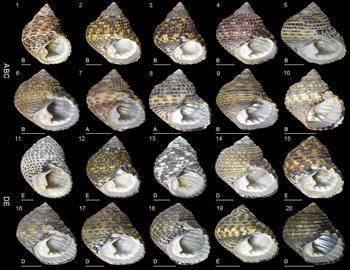
Descriptive statistics of all six shell variables are shown in Table S1. The shells of Monodonta labio populations showed wide variability within the sampling sites. Two distinct morphological forms of M. labio were observed in our samples: (1) globular form with a lower apical acuteness and flat spiral ribs and (2) high-apex form with a higher apical acuteness and granular spiral ribs (Figure 3). Each of them dominates different regions along the Chinese coast, but both of them occurred in the southern areas. Although the globular form was more common in the northern part of the Chinese coast, the high-apex form dominated the southern areas.
Representative shell forms from Clade A + B + C (1–10) and Clade D + E (11–20), respectively. Scale bars: 5 mm; Capital letters next to each individual represent for different clades; 1, 6, 11, 15, 17 = Dongshan (DS); 2–4, 12 = Zhuhai (ZH); 5 = Pingyang (AJ); 7, 8 = Beihai (BH); 9 = Dongtou (DT); 10 = Shanwei (SW); 13, 14 = Jeju-do (CD); 16, 18 = Chungcheongnam-do (KN); 19 = Shenzhen (KS); 20 = Jeju-do (JZ).

In the general measurement method, principal component analysis (PCA) was successful in transforming the original five shell parameters into five components that could decipher most of the variation. Contributions of each of the five shell parameters to the five principal components (PCs) are shown in Table 2. The first two components accounted for as much as 79.9% of total variance (axis 1: 53.1%, axis 2: 26.7%). Ordinations of the first two principal components reveal an obvious segregation pattern between the two genetic clades (Clade A + B + C and Clade C + D; Figure 4), although slight overlap was detected. Linear discriminant analysis (LDA) of the first two principal components correctly classified 86.7% of the training data set and 95.1% of the test data set. According to the logistic regression model, shell height (P = 0.690) and width (P = 0.674) did not have a significant relationship (P > 0.05) with genetic grouping. However, the remaining independent variables, including roughness of granules on the spiral ribs, were statistically significant (P < 0.05). The classification rate was 97.2% based on the test dataset.
Shell shape variation of Monodonta labio as a function of the first two principal components, based on general measurement analysis of the five measured characters (except for the roughness of granules on the spiral ribs above the suture near the aperture).

Summary of the principal components analyses in general measurement analysis

N1, number of spiral ribs on the lower side of the last whorl; N2, number of spiral ribs on the upper side of the last whorl.
Contributions of each of the five characters and percentage of total variance are given to five principal components.
In the geometric morphometric method, 28 principal components were transformed from the 16 landmarks. The first four components cumulatively explained 68.3% of overall variance (axis 1: 27.4%, axis 2: 21.9%, axis 3: 10.4% and axis 4: 8.6%). However, individuals belonging to different genetic groups or geographic populations are mixed up along the first two PC axes (Figure 5A); none of the differences reflected distinctness among genetic groups and sites. In contrast, the degree of separation between the two genetic clades is evident along the PC5 (6.7%) and PC6 axes (5.7%), although they slightly overlap with each other (Figure 5B). The first four components summarized substantial variations, which correlated with characters around the aperture (reflected by the displacement of landmarks, 4–7 and 11–16; Figure 6A, B). Landmarks related to thickness of callus at the uppermost end of the aperture (LM 11 and LM 12; Figure 1A) exhibited the highest variation among the first four components (Figure 6A, B). PC5 and PC6 (Figure 6C, D) mainly reflected the distinctions between height and/or width of the apical whorls (LM 2 and LM 10) and the upper side of the last whorl (LM 3, LM 4 and LM 9), which is probably associated with the apical acuteness of shells (Figure 6C, D).
Shell shape variations of Monodonta labio, based on geometric analyses of 16 landmarks. (A) Shell shape as a function of the first two principal components (PCs) with individuals coloured by different genetic clades in the previous study; (B) Shell shape as a function of the fifth and sixth PCs with individuals coloured by different genetic clades in the previous study; (C) Canonical variate analysis of the geometric data using genetic clades; (D) Canonical variate analysis of the geometric data using geographic populations.

Shape variations shown by deformation grids in the geometric morphometric analysis. (A) Shape deformation associated with principal component (PC) 1; (B) Shape deformation associated with PC2; (C) Shape deformation associated with PC5; (D) Shape deformation associated with PC6; (E) Shape deformation associated with the first canonical variate axis (CV1) in canonical variate analysis (CVA) among genetic clades; (F) Shape deformation associated with CV1 in CVA among geographic populations.

Concordance of shell shape variation among genetic groups was revealed in both canonical variate analysis (CVA; Figure 5C) and discriminant function analysis. Additionally, discriminant function analysis of geometric data revealed a significant morphological differentiation among both geographic populations and genetic clades. Specifically, among the genetic groups, the first canonical axis (CV1) explained 74.58% of the shell shape variation. In contrast, only 35.49% of between-population shape variation was explained by CV1.
The importance of specific characters in discriminating different groups for M. labio can be seen in Figure 6. Recognizable differences among genetic clades represented by the deformation grids in CV1 (Figure 6E) included height of the upper and lower sides of the last whorl (LM1, LM2, LM3 and LM10), apical acuteness (LM2 and LM 10) and width of the aperture (LM13). Among geographic populations (Figure 6F), thickness of callus at the uppermost end of the aperture (LM 11 and LM 12), shape of the aperture (LM5 and LM 16) and apical acuteness (LM2, LM4 and LM10) contributed majorly to the variation represented in CV1.
The regression analysis of shell shape (PC scores) and shell size (CS) showed a high level of significance (P < 0.0001), suggesting the presence of allometry. As a general trend, larger shells had highly elevated apices in both the groups of M. labio. The percentage of shape variation explained by shell size was 8.04%.
Morphology differed significantly among geographically separated populations (excluding locality AJ, where only one individual was sampled) and genetic groups of M. labio based on the discriminant analysis (P < 0.0001).
There was no positive correlation between morphometric distance (Procrustes distance) and pairwise genetic distance (F ST) across populations according to the results of mixed linear modelling (t = 0.427, P = 0.671), indicating that shell morphology is independent of neutral genetic variation. Similarly, no significant linear relationship was detected between morphological and geographic distance (t = − 0.833, P = 0.408).
While examining the relationship between shell morphology and the environment of a local adaptation model, there was a significant association between PC5 and the maximum temperature of the warmest month (t = 3.076, P = 0.0106). A nearly significant relationship between PC5 and mean temperature of the warmest quarter (t = 2.091, P = 0.0605) was also identified.
Discussion
Variation patterns
Revealing patterns of phenotypic variation is the first step towards understanding the mechanisms of evolution and speciation. In this study, a pattern of divergence in shell shape among different populations of Monodonta labio was identified, with the most marked divergence in shell shape between two major genetic groups (Clade A + B + C and Clade D + E of Zhao et al., Reference Zhao, Li, Kong and Yu2017). In a previous study (Takenouchi, Reference Takenouchi1985), morphological diversity of this species was also reported in Japan. Patterns of associated morphological variations (CV1, PC1 and PC2 in general measurement analysis; PC5 and PC6 in geometric morphometric analysis) were consistent with the genetic structure characterized based on the mitochondrial markers (Zhao et al., Reference Zhao, Li, Kong and Yu2017), suggesting their genetic basis. The lack of correlation between genetic and morphometric distances suggests that these morphological variations probably result from local adaptation and not from neutral genetic drift. This view was further supported by the significant association between PC5 and the maximum temperature of the warmest month (an environmental variable). This relationship between phenotypic and environmental variation is indicative of local adaptation (Dowle et al., Reference Dowle, Morgan-Richards, Brescia and Trewick2015).
In addition to genetic components, morphological variation may also result from phenotypic plasticity. In geometric analysis, PC1 showed that the most conspicuous differences in shape were variations associated with aperture shape. These characters do not show a relationship with genetic groups (Clade A + B + C and Clade D + E), indicating the possibility of their plasticity. The absence of correlation between shape variation and geographic distances excludes the effects of low levels of gene flow. In a previous study (Wang et al., Reference Wang, Xu, Zou, Du, Wang, Zheng, Han and Shui2013), wave exposure has been proposed as the main selective pressure associated with the shape variation of this species, among sites. In wave-exposed shores, wave splash is the primary threat faced by the gastropods clinging to rocks. Thus, thin shells and larger apertures, which allow a larger foot area, tend to be advantageous, because these characters can reduce the risk of dislodgement by waves (Trussell et al., Reference Trussell, Johnson, Rudolph and Gilfillan1993; Forrester et al., Reference Forrester, MacFarlan, Holevoet and Merolla2016). In contrast, in the case of protected shores with reduced wave splash, i.e. locations such as Bohai Bay in China, thick shells and small apertures are favoured (Wang et al., Reference Wang, Xu, Zou, Du, Wang, Zheng, Han and Shui2013). However, hydrodynamic conditions were not recorded at sampling sites. Generally, plastic variations are related to local ecological factors, such as wave action, desiccation and predation risk, and their interactions (Vermeij, Reference Vermeij1973). It is also important to note that allometry detected in this study may also result from differing microhabitat environments. These morphological differences were probably associated with sites with different environmental variables, so that at the local scale, those environmental variables may play a strong role. This suggestion is supported by the morphological difference among sites.
In conclusion, the morphological variations in M. labio are due to local adaptation, phenotypic plasticity, as well as allometry, and these factors would maximize fitness under the variable environmental conditions along the Chinese coast and possibly also in other areas in Asia.
Palaeoclimate background
Investigating the processes that produce divergent forms and diversity is vital in understanding the origins of new species in evolutionary biology.
In this study, different distribution patterns of the two forms may indicate the crucial differences in their evolution. As local adaptation led to the morphological differences with genetic background, it is important to identify the selection pressure. So far, information is limited on how selection favours the maintenance of dimorphism in populations of M. labio within the studied geographic area. However, divergence time estimates in a prior study (Zhao et al., Reference Zhao, Li, Kong and Yu2017) may provide some clues for investigating this aspect in a palaeoclimatic context. The presence of two distinct forms is in agreement with the emergence of the Dongshan Landbridge during the early Pleistocene (Zhao et al., Reference Zhao, Li, Kong and Yu2017). Obviously, the geographic separation between the two forms may have been the first step towards their divergence. As morphological variation did not result from neutral genetic drift, temperature gradient-mediated selection between the two sides of the Dongshan Landbridge would have resulted in subsequent genetic adaptation of populations either side to different local environmental conditions.
Because of the north–south orientation of the Chinese coastline, some structural variations in shell shape could correspond to different temperatures (Irie, Reference Irie2005; Watson et al., Reference Watson, Peck, Tyler, Southgate, Tan, Day and Morley2012). During the early Pleistocene glacial epoch (2.5 million years ago), the sea temperature gradient between the ancient East China Sea and the ancient South China Sea was steepened due to the strengthened monsoon (Wang, Reference Wang1994). The difference in upper temperature limits may have acted as a selective force promoting the divergence between the two morphological forms. This idea was partially confirmed by significant correlation between PC5 and the maximum temperature of the warmest month in environmental modelling.
Individuals inhabiting the northern temperate region, in the present study, tended to show smoother spiral ribs and more globular shell. In contrast, the typical southern form exhibited higher apical acuteness, which suggests a higher spire and smaller aperture. This pattern of shape variation is in accordance with the model proposed by Vermeij (Reference Vermeij1973), suggesting that the increase in heat stress on gastropods at lower latitudes tends to favour slimmer shells with smaller apertures (thus reducing the contact area with substrate and enabling more efficient cooling) as adaptations to heat stress. The individuals in southern areas tend to possess granular spiral ribs (Table S1). This trait can maximize the influence of convection by reflecting heat from the shell surface to further reduce thermal stress (Wong & Lim, Reference Wong and Lim2017).
The phenotypic traits and population genetics support the hypothesis that the initial genetic isolation from the geographic separation by the Dongshan Landbridge and subsequent temperature gradient-mediated selection resulted in continued morphological and genetic divergence.
Taxonomic status
Monodonta labio and closely related species (see below) are widely distributed in the Indo-West Pacific. Although its taxonomy has been established and stabilized for a long time, the results of recent studies (Yamazaki et al., Reference Yamazaki, Miura, Ikeda, Kijima, Sasaki and Chiba2017; Zhao et al., Reference Zhao, Li, Kong and Yu2017) and this study suggest that M. labio diversified regionally both in genetic and phenotypic traits. Among the eight valid species or subspecies recognized in Asian Monodonta, at least the following four names are most directly relevant to the populations studied (Higo et al., Reference Higo, Callomon and Goto1999).
(1) M. labio (Linnaeus, 1758): This is the type species and the most common species of the genus Monodonta. The type locality in the original description of ‘African and Asian seas’ is not well detailed. Specimens in the tropical regions have been identified to belong to this species. Morphologically, this species is characterized by a highly pointed apex and prominent granules on the spiral ribs. Shell colour is highly variable, with typically yellowish brown, greenish or reddish background.
(2) M. confusa (Tapparone-Canefri, 1874): This species name has long been used for temperate populations in Japan, Korea and China as a subspecies of M. labio. However, there is ambiguity regarding the identity of this species, because its type locality is Singapore, and not a temperate area. Distinctive features of this species according to the conventional taxonomy are more rounded shell shape and flatter granules on the spiral ribs compared with that of M. labio. Shell colour is often darker than that of M. labio in most specimens.
(3) M. australis (Lamarck, 1822): This name has been used for the populations in tropical oceanic islands between Ogasawara Islands and Australia. The type locality is Australian seas. This species is distinguished from the above two species by a very weak sculpturing on the spiral ribs and greenish colour.
(4) M. trochiformis (Grabau & S. G. King, Reference Grabau and King1928): This species has been treated as a junior synonym of M. labio, but it had not been studied seriously until re-illustration by Coan et al. (Reference Coan, Lutaenko, Zhang and Sun2015: figure 3). The type locality is Peitaiho, northern China.
Among these, the southern Chinese populations (Clade A + B + C in this study) seem to correspond to so-called M. labio because of highly elevated apex and obvious granules. Meanwhile, the northern populations with less obvious granules (clade D + E) fall under the description of M. trochiformis from northern China. The figure shown in the original description (Grabau & King, Reference Grabau and King1928, pl. 11, figure 119) matches with the shells of the northern Chinese population investigated in this study. Based on our current interpretation, these two forms are separable and they cannot be synonymized in agreement with Coan et al. (Reference Coan, Lutaenko, Zhang and Sun2015). The taxonomic treatment of the entire M. labio species group, however, requires a more detailed scrutiny of molecular and morphological characters of the extensive Indo-Pacific populations.
For the M. labio group, the taxonomic conclusions should be drawn cautiously due to the reasons described below. First, the shapes of clades differed significantly from each other, suggesting that high morphology variations still exist within genetic groups (Clade A + B + C and Clade D + E; Figure 3). Moreover, some intermediate or even contrasting forms were also observed within each genetic group (Clade A + B + C and Clade D + E; Figures 3–14, 17). Individuals between the two genetic groups may still breed with each other based on nuclear ITS data (Zhao et al., Reference Zhao, Li, Kong and Yu2017); this can also explain the overlap in morphological separation patterns. Finally, the lack of reliable distributional data in original descriptions and genetic data over the entire distributional range of the genus impedes the assignment of our samples. Further studies covering wider geographic regions in the entire Indo-West Pacific are required to obtain plausible conclusions for the M. labio group.
Supplementary material
The supplementary material for this article can be found at https://doi.org/10.1017/S0025315419000481
Financial support
This study was supported by research grants from Fundamental Research Funds for the Central Universities (201762014), National Natural Science Foundation of China (31772414) and Industrial Development Project of Qingdao City (17-3-3-64-nsh).