Introduction
The development and utilization of mineral resources have left a legacy of mine-tailings deposits dumped as solid waste, causing problems such as environmental pollution, land occupation, and huge potential long-term risks. In addition, most reserves of high-grade ores have been exhausted gradually and the low-grade, finely disseminated ores are now being exploited with new mining technologies, leading to more and finer mine tailings (Yin et al. Reference Yin, Wu, Hu, Wang and Zhang2012; Ke et al. Reference Ke, Zhou, Wang, Wang, Hou and Zhou2016; Yang et al. Reference Yang, Qiu, Jiang, Hu, Li and Li2017).
In recent years, the use of mine tailings in cement materials has attracted attention because the chemical compositions of some kinds of mine tailings are similar to those of building materials. Few reports on the hydration properties (especially the types and microscopic structures of the hydration products) of mine tailings have been reported. In their study of activating iron ore tailings, Cheng et al. (Reference Cheng, Huang, Li, Liu, Li and Wei2016) reported that the mechanically activated, high-silicon iron ore tailings could react with calcium hydroxide released during the hydration of Portland cement to form hydrated calcium silicate in the activated tailings-cement dual system; this indicated that mechanically activated mine tailings were capable of pozzolanic activity and can react with calcium hydroxide to form hydration products. In another study (Yao et al. Reference Yao, Liu, Wang, Wu and Lyu2019a), gold-mine tailings were reported to be capable of pozzolanic activity following mechanical activation, and the activated tailings could react with calcium hydroxide to form hydrated calcium silicate (C-S-H) gel.
To achieve this circular economy and to enable reduction in the amount of mine tailings, establishing an adequate evaluation system for the hydration properties of the tailings is necessary. Based on the complex mineralogical compositions, the investigation of the hydration properties of mine tailings should start from the study of the hydration properties of pure minerals commonly found in them. To date, few studies of the hydration properties of pure mineral phases in mine tailings have been carried out. The effects of the physical and chemical parameters of mechanically activated quartz on the pozzolanic activity and hydration properties of tailings were investigated by Wu et al. (Reference Wu, Lyu, Wang and Hu2017) who found that the mechanically activated quartz (with a specific surface area of 729.1 m2/kg (Blaine method), relative crystallinity of 80%, and surface free energy of 58.98 mJ/m2) exhibited pozzolanic activity and had the capacity to react with calcium hydroxide to form C-S-H gel. That study offered the basis and foundation for the evaluation of the hydration properties of mine tailings containing quartz. The pozzolanic activity of kaolin-containing mica by mechanical and thermal activation was examined by Ilić et al. (Reference Ilić, Radonjanin, Malešev, Zdujić and Mitrović2016), who found that mechanical activation (in a horizontal ball mill for 20 h) of kaolin containing mica was equally suitable, after thermal activation, for achieving pozzolan properties, and the kaolinite phase became much more reactive after thermal activation for 60 min at 700°C. An interesting finding in that study was that significant pozzolanic activity of kaolin was obtained, even with a large mica content, by mechanical activation due to complete amorphization of the mica phase after 20 h of milling. Further study of the pozzolanic reactions of the mechanically activated mica to provide a theoretical basis for the hydration properties of mine tailings was necessary, therefore,
Although mechanical activation is energy-intensive due to its low processing ability (Andrić et al. Reference Andrić, Terzić and Aćimović2014), it has incomparable advantages over other traditional technological methods. The main advantages are: (1) apparent simplicity of the operational procedure; (2) it is environmentally friendly and no chemical activator is needed; and (3) the increase in specific surface area, decrease in particle size, and formation of structural disordering promoted the increase in pozzolanic activity of the minerals (Boldyrev Reference Boldyrev1990; Mitrović and Zdujić Reference Mitrović and Zdujić2014; Yao et al. Reference Yao, Zang, Wang, Wu, Qiu and Lyu2019b). Most studies of mechanical activation of minerals in mine tailings have focused on the pozzolanic activity changes that occurred during the activation; the hydration properties of mechanically activated minerals have scarcely been examined, however, particularly the types of hydration products and their microscopic features.
The effect of mechanical activation on the hydration properties of muscovite (a common mineral phase in mine tailings, especially the fine fraction of mine tailings after separation) in an alkaline environment has not been investigated systematically in previous studies. The main objective of the present work was, therefore, to investigate the hydration properties of mechanically activated muscovite.
Materials and Methods
Materials
The initial muscovite was provided by the Henghao Technology Co., Ltd., Anhui Province, China, and its chemical composition is presented in Table 1. Analytical reagent-grade calcium oxide used in this study was provided by Beilian Fine Chemicals Development Co., Ltd., Tianjin City, China. Prior to the experiment, the initial muscovite was dried at 105°C in an electrothermal, constant-temperature dry box for 12 h.
Chemical composition (wt.%) of the initial muscovite

Methods
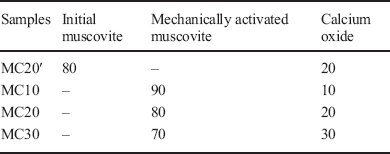
The pozzolanic reaction activity of the initial muscovite (with the BET specific surface area of 0.81 m2g–1 and median particle size (D 50) of 95.24 μm) was improved by mechanical activation using a laboratory vertical planetary ball mill (XQM-4, Changsha Tianchuang Powder Technology Co., Ltd., Hunan Province, China) operating at a rotation speed of 500 rpm with a relative centrifugal force of 32.14×g. Steel balls of diameter 5, 8, and 15 mm were used as the grinding media, in the ratio 3:5:2. Each grinding was performed with 60 g of muscovite in a 500-mL steel can containing 600 g of hardened steel balls. After 160 min of mechanical activation, the activated muscovite (with a BET specific surface area of 28.82 m2g–1 and median particle size (D 50) of 11.7 μm) was blended with calcium oxide (used as an activator at 10, 20, or 30 wt.%) and water to investigate its hydration properties. Meanwhile, the initial muscovite blended with 20 wt.% calcium oxide and water was set as a reference. The mixing proportions of the samples are summarized in Table 2.
Mixing proportion of the samples, wt.%

The paste samples, which were 20 mm×20 mm×20 mm in size, with a water:solid ratio of 0.7, were prepared and then cured in an incubator at constant-temperature of 20 ± 1°C and constant relative humidity of ≥95% during the curing periods. After the prescribed curing periods, unconfined compressive strength tests were carried out on the paste samples. The representative paste samples were selected and soaked in anhydrous ethanol for 3 days to terminate the hydration process. Thereafter, the selected samples were dried at 50°C in a vacuum drying oven for further characterization.
The particle-size distribution of the muscovite powders was measured using a BT-9300Z (Dandong Bettersize Instrument Co., Liaoning Province, China) laser diffraction particle size analyzer, and the specific surface area was calculated according to the Brunauer-Emmett-Teller (BET) method using a Micromeritics ASAP 2460 (Micromeritics Instruments Corporation, Norcross, Georgia, USA) instrument.
To identify the mineral phases in the muscovite and paste sample cured for various times, XRD patterns were collected using a Rigaku (Rigaku Corporation, Tokyo, Japan) Ultima IV diffractometer. The XRD analysis was conducted using CuKα radiation from 5 to 70°2θ at a scanning speed of 5°2θ/min.
Thermogravimetric analysis was conducted using a Mettler TGA 2 instrument (Mettler Toledo Corporation, Greenville, South Carolina, USA) over the termperature range 50 to 1050°C with a rate of increase of 10°C/min in a nitrogen atmosphere.
Micromorphological study of the hydration products was performed using an FEI Nova NanoSEM 430 (FEI, Hillsboro, Oregon, USA) instrument. The paste samples cured for 28 days were crushed and a small portion with a smooth surface was selected for analysis by SEM. The hydration process of the selected sample was terminated and the sample was dried in the same manner as previously described, and then it was sputter-coated with Au in preparation for microscopy. For EDS analysis, a microanalytical unit was employed to determine the chemical compositions of the hydration products, using an accelerating voltage of, typically, 10 kV.
The lattice parameters and unit-cell volumes of the initial and mechanically activated muscovites were calculated from XRD patterns via Rietveld refinement (Harris Reference Harris2009).
RESULTS AND DISCUSSION
XRD Analysis of Initial and Mechanically Activated Muscovite
The XRD patterns of the initial and mechanically activated muscovite (Fig. 1) revealed that the main mineral phase in the initial sample was muscovite ((K1.15Na0.08)(Al1.33Fe0.49Mg0.14) (Si2.98Al1.02)O10(OH)2) of the 3T polytype, based on the chemical compositions and the phase-analysis result. The intensity of muscovite reflections decreased significantly after mechanical activation (Fig. 1b). The reduction in the reflection intensity was caused by amorphization (Kitamura and Senna Reference Kitamura and Senna2001; Alex et al. Reference Alex, Kumar, Roy and Mehrotra2014a). The relative crystallinity of muscovite powder after mechanical activation, calculated based on the cumulative peak area of three major characteristic diffraction peaks using Eq. 1 (Wu et al. Reference Wu, Lyu, Wang and Hu2017), reduced to 13.2%, indicating an obvious amorphization, i.e. an increase in structural disorder of muscovite after mechanical activation (Pourghahramani and Forssberg Reference Pourghahramani and Forssberg2006).

where α is the relative crystallinity of muscovite powder, and A 0 and A are the cumulative peak areas of three major characteristic diffraction peaks (003, 006, and 009) for the initial and mechanically activated muscovites, respectively (Alex et al. Reference Alex, Kumar, Roy and Mehrotra2014a, Reference Alex, Kumar, Roy and Mehrotra2014b). In addition, the decrease in the integral intensity of reflection indicated an increase in structural disorder due to an increase in the amount of amorphous material.
XRD patterns of a initial and b mechanically activated muscovite

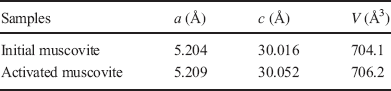
The lattice parameters and unit-cell volumes of the initial and mechanically activated muscovite (Table 3) revealed that mechanical activation caused an increase in the lattice parameters a and c, and in the unit-cell volume of the muscovite powder, indicating that the alteration occurred in 3D space. The increase in unit-cell volume corresponded to a lattice expansion of ~0.3% for the unit cell. Mechanical activation could cause dislocations that produced point defects. Then, the point defects became frozen into the structure as debris, causing lattice expansion at the scale of the unit cell (Gammage et al. Reference Gammage, Glasson, Hodgson and O'Neill1983). The existence of lattice defects may be the main reason for the 0.3% lattice expansion in the unit cell.
Lattice parameters and unit-cell volume of the initial and mechanically activated muscovite

XRD Analysis of Paste Samples
The XRD patterns of the MC20′, MC10, MC20, and MC30 paste samples cured for 3 and 28 days (Fig. 2) revealed that the hydration products were stratlingite (2CaO·Al2O3·SiO2·8H2O) in the MC10 paste sample, as well as Ca-Al hydrotalcite-like (Ht) phases in the MC20 and MC30 paste samples the calcium oxide contents of which were 20 wt.% and 30 wt.%, respectively. For the MC20′ paste sample, the hydration products stratlingite and Ht could not be detected regardless of curing time, and the changes in the portlandite and muscovite reflections were not significant in terms of the increase in curing time. For the MC10, MC20, and MC30 paste samples, however, the portlandite reflections decreased significantly with curing time, indicating a decrease in the amount present caused by pozzolanic reaction between portlandite and mechanically activated muscovite. For the MC10 paste sample, determining whether the calcium hydroxide had been comsumed completely after 28 days of curing time was difficult due to the overlapping diffraction peaks of muscovite and calcium hydroxide, although the TGA technique proved that the calcium hydroxide in the MC10 paste sample was consumed completely at 28 days (as discussed below). The muscovite reflections had also decreased significantly with respect to the decrease in the portlandite reflections with curing time, caused by the dissolution of the mechanically activated muscovite in alkaline solutions. For the MC10 paste sample cured for 3 days, the crystalline phases detected were muscovite and portlandite formed by the reaction of calcium oxide with water. After 28 days of curing time, the hydration product, stratlingite, was detected. C-A-S-H gel is a well-known, typical hydration product of pozzolanic reaction, but its presence was difficult to confirm in all paste samples by XRD. This phenomenon was due to the poor degree of crystallization of C-A-S-H gel, and was also relative to the curing time because of the growth of minerals with time and hydration reaction time. For the MC20 paste sample, the hydration products, stratlingite and Ca-Al Ht, were detected after 28 days, but they were not obvious after 3 days (Fig. 2b), indicating that the amount of hydration product depended on curing time. For the MC30 paste, the kinds of hydration products were the same as those of MC20 paste, but present in different amounts (Fig. 2c). Note that the Ht could not be detected in the MC10 paste sample regardless of curing time, which may be due to the small amount of Ca2+. The formation of CA-S-H gel, stratlingite, and Ht all required sufficient amounts of Ca2+, so the reactions to form C-A-S-H gel, stratlingite, and Ht all competed for the Ca2+. In the hydration process for MC10 paste, the concentration of Ca2+ was too small to form crystalline Ht after combining to form CA-S-H gel and stratlingite. On the contrary, Ht could be detected in the MC20 and MC30 pastes because Ca2+ in the pore solution was sufficient.
XRD patterns of a MC20′, b MC10, c MC20, and d MC30 paste samples cured for 3 and 28 days

The XRD results revealed that the initial muscovite could not react with calcium hydroxide to form hydration products. The mechanically activated muscovite exhibited pozzolanic reaction activity, however. The hydration product of the MC10 paste was mainly stratlingite, but C-A-S-H gel may also exist as a typical hydration product of the pozzolan. When the calcium oxide content was ≥20%, Ht started to form as curing time increased. The decrease in muscovite reflections and the formation of hydration products revealed that the mechanically activated muscovite could be dissolved in an alkaline environment as an aluminosilicate starting material for pozzolanic reactions.
Thermal Behavior
Thermogravimetric (TGA) and derivative thermogravimetric (DTGA) curves of MC20′, MC10, MC20, and MC30 paste samples with curing time (Fig. 3) revealed that four major weight-loss peaks, involving several tiny peaks, were observed:
(1) At temperatures below 250°C, the major weight-loss peaks were attributed to the decomposition of CA-S-H gel (Jin et al. Reference Jin, Gu and Al-Tabbaa2015; Wang et al. Reference Wang, Lyu, Wang, Cao, Zang and Liu2017; Yao et al. Reference Yao, Wang, Su, Wang, Qiu and Lyu2020b), and the small shoulder peaks at ~180–250°C corresponded to the dehydration of stratlingite (L’Hôpital et al. Reference L'Hôpital, Lothenbach, Kulik and Scrivener2016).
(2) The second group of major weight-loss peaks, with small peaks at ~350–380°C, corresponded to the decomposition of Ht (Jin et al. Reference Jin, Gu and Al-Tabbaa2014); at between 380 and 480°C, they were attributed to the decomposition of calcium hydroxide (Wu et al. Reference Wu, Lyu, Wang and Hu2017).
(3) The third weight-loss peaks at ~500–700°C were due to the decomposition of carbonate-containing phases (Krassimir et al. Reference Krassimir, Peter, Leon, Chris, Jack and Biliana2010; Fang and Chang Reference Fang and Chang2015; Wu and Ye Reference Wu and Ye2017). According to a previous study (Borges et al. Reference Borges, Costa, Milestone, Lynsdale and Streatfield2010), carbon dioxide could dissolve in the pore solutions of the paste sample to form carbonate and bicarbonate ions, which could react with calcium ions from Ca(OH)2 and C-A-S-H gel to produce calcium carbonate.
(4) The fourth set of weight-loss peaks, above 800°C, were attributed to the dehydroxylation of initial muscovite (Gridi Reference Gridi2008).
Fig. 3(a, c, e, and g) TGA and (b, d, f, and h) DTGA curves for MC20′, MC10, MC20, and MC30 paste samples cured for various periods


For the MC20′ paste sample, a tiny weight-loss peak corresponding to the decomposition of C-A-S-H gel was detected, indicating that the initial muscovite exhibited slight pozzolanic activity. This phenomenon may be due to the existence of minute particles in the initial muscovite, which could react with calcium hydroxide to form C-A-S-H gel. In addition, the disappearance of the weight-loss peak beyond 800°C in MC10, MC20, and MC30 paste samples revealed that mechanical activation induced the dehydroxylation of muscovite, further evidence that activated muscovite is capable of pozzolanic activity. For the MC10, MC20, and MC30 paste samples, C-A-S-H gel was the only hydration product after 1 day (Fig. 3b,d,f); with increased curing time (3 days), however, stratlingite was detected. The difference was that the hydration product Ht could not be found in the MC10 paste regardless of the curing time, but was detected in the MC20 and MC30 paste samples after 3 days of curing time. This result was consistent with the XRD analysis, indicating that the increase in calcium oxide was beneficial to the formation of Ht.
Non-evaporable water content is usually used to evaluate the degree of hydration of cementitious materials (Haha et al. Reference Haha, Saout, Winnefeld and Lothenbach2011; Magallanes-Rivera and Escalante-García, Reference Magallanes-Rivera and Escalante-García2014; Yao et al. Reference Yao, Cui, Jia, Sun, Anning, Qiu and Lyu2020a). In the current study, the thermal weight loss that occurred in the temperature range of 50–380°C was considered to be the non-evaporable water content, which included the thermal weight loss of the decomposition of the hydration products C-A-S-H gel, stratlingite, and Ht. The calculated non-evaporable water content (Fig. 4) based on the TGA data revealed that the change in the non-evaporable water content for MC20′ paste sample was not significant. But for MC10, MC20, and MC30 paste samples, the non-evaporable water content showed an approximately linear relationship with the hydration time in the early stage of hydration (<7 days of curing time). During the period of day 1 to day 7, the non-evaporable water content of the MC10, MC20, and MC30 paste samples increased to 33.34%, 52.50%, and 58.17%, respectively. Thereafter, the rate of increase decreased significantly to 9.93%, 10.56%, and 12.58% from day 7 to day 28. The non-evaporable water content results revealed that the hydration time affected significantly the hydration degree of mechanically activated muscovite and the quantity of hydration products. In the initial hydration stages – within the first 7 days – the degree of hydration increased markedly, leading to a significant increase in the non-evaporable water content. The hydration rate slowed with extended curing time, however, which may be due to the hydration products precipitated on the surfaces of the muscovite particles, hindering further hydration reaction. In addition, the increase in calcium oxide content was beneficial to the further hydration reaction. The small amount of calcium oxide in the MC10 paste sample was another reason, therefore, for the decrease in hydration rate compared with the MC20 and MC30 paste samples.
Non-evaporable water content of the MC20′, MC10, MC20, and MC30 paste samples with hydration time

The consumption of calcium hydroxide could reflect indirectly the occurrence of the pozzolanic reaction. The more calcium hydroxide consumed, the greater the hydration degree. TGA and DTGA curves (Fig. 3) revealed that the calcium hydroxide content exhibited a decreasing trend with curing time for the MC10, MC20, and MC30 paste samples. The results were consistent with the XRD analysis.
Microstructural Analysis
Based on the XRD and TG-DTG analyses above, the typical paste sample MC20 cured for 28 days was selected for SEM and EDS analyses. Combining with the EDS technique (Fig. 5d, spot A), the microstructural images of the MC20 paste sample hydrated for 28 days (Fig. 5) showed the presence of unreacted muscovite particles, indicating the incomplete hydration of muscovite. In the hydration process, the C-A-S-H gel filled in the gaps among the particles and covered the particle surfaces. A whole structure, therefore, was formed in the matrix and the muscovite particles were joined together by the C-A-S-H gel. The hydration products stratlingite and Ht were difficult to detect, possibly because of the small amounts present. The C-S-H gel solidified K+ and Al3+ during the hydration process to form C-A-S-H gel according to the EDS results (spot B, Fig. 5d).
Microstructural images and EDS analysis of MC20 paste samples after 28 days

According to previous studies (Liu et al. Reference Liu, Zhang, Yao, Sun and Feng2013; Yao et al. Reference Yao, Liu, Wang, Wu and Lyu2019a), Al3+ could replace the Si4+ in the chain of the C-A-S-H gel to form long-chain structures of Al-containing C-A-S-H gel with increasing curing time and, hence, benefit the compressive strength. The net negative charge of the non-equivalent bridging tetrahedral sites due to ion substitution was balanced by the charge-balancing ion (K+).
Compressive Strength
The formation of the hydration products in the paste samples was conducive to the development of compressive strength. The development of the compressive strength of the paste samples over 3, 7, and 28 days (Fig. 6) revealed that the strength increased with the amount of calcium oxide and with curing time for paste samples MC10, MC20, and MC30. The compressive strength for the MC20′ paste sample could not be determined regardless of curing time, however. For the MC10 paste sample, the compressive strength could not be determined at 3 days. Although the hydration products C-A-S-H gel and stratlingite had been formed after 3 days, according to the TG-DTG analysis, the quantity was small, leading to the compressive strength being insignificant and consequently beyond the detection range of the equipment. With prolonged hydration, the compressive strength increased with increase in hydration products, reaching 3.3 MPa after 28 days. Following the addition of 20% calcium oxide (MC20 paste sample), the compressive strength increased significantly compared with the MC10 paste sample after the same curing period, indicating that the calcium oxide content affected significantly the development of compressive strength. The MC30 paste sample with 30% calcium oxide content showed compressive strength values of 3.0, 9.0, and 15.3 MPa after 3, 7, and 28 days, respectively, which corresponded to increases of 213.7%, 96.1%, and 39.4% compared to those of the MC20 paste sample. Combined with the TG and DTG analyses, the increase in strength values was related to the increased quantities of hydration products.
Compressive strength development of MC20′, MC10, MC20, and MC30 paste samples after 3, 7, and 28 days

Conclusions
The present study explored the hydration properties of mechanically activated muscovite in the presence of calcium oxide. The following conclusions were drawn:
(1) The initial muscovite was a stable substance and its pozzolanic activity was minimal. Only some minute particles in the initial muscovite exhibited reactivity. After mechanical activation, muscovite became capable of pozzolanic activity, and could react with calcium hydroxide to form hydration products.
(2) The hydration products of the MC10 paste sample were C-A-S-H gel and stratlingite; Ht were not formed, but they were found in MC20 and MC30 paste samples. According to TG analysis, the quantities of hydration products increased with the increase in calcium oxide content and curing time.
(3) Increasing calcium oxide content and increased curing time both contributed to significant increases in the non-evaporable water content and compressive strength development of the paste samples.
(4) The hydration properties of mechanically activated muscovite provide a theoretical basis for considering mine tailings as a potential pozzolanic resource.
ACKNOWLEDGMENTS
This work was supported by the National Natural Science Foundation of China (No. 51674161) and the Major Program of the Shandong Province Natural Science Foundation (No. ZR2017ZC0735).
Funding
Funding sources are as stated in the Acknowledgments.
Compliance with Ethical Statements
Conflict of Interest
The authors declare that they have no conflict of interest.