Introduction
Losing the motivation or ability to perform everyday activities is one of the primary symptoms of dementia (Voigt-Radloff et al., Reference Voigt-Radloff2012; Giebel et al., Reference Giebel, Challis and Montaldi2016). Everyday activities are categorized into basic activities of daily living (ADLs), including bathing and maintaining continence (Katz et al., Reference Katz, Ford, Moskowitz, Jackson and Jaffe1963), and complex instrumental activities of daily livings (IADLs), including food preparation and shopping (Lawton and Brody, Reference Lawton and Brody1969). Of these, IADLs deteriorate to a great extent in the preclinical and early stages of dementia (Mioshi et al., Reference Mioshi, Kipps, Dawson, Mitchell, Graham and Hodges2007; Verlinden et al., Reference Verlinden, van der Geest, de Bruijn, Hofman, Koudstaal and Arfan Ikram2015), whereas some ADLs deteriorate to a greater extent in the advanced stages (Giebel et al., Reference Giebel, Sutcliffe and Challis2015). The limitations that IADL and ADL deficits can place upon a person with dementia's (PwD) life can lead to institutionalization (Afram et al., Reference Afram2014) and constitute one of the highest cost factors in dementia care (Jones et al., Reference Jones2015). Hence, promoting independence, well-being, and management of dementia post-diagnosis are some of the key priorities of recent governmental initiatives (Norwegian Ministry of Health and Care Services, 2007; Department of Health, 2009; Alzheimer's New Zealand, 2010).
There is little evidence on the detailed deterioration of IADLs in mild dementia (Griffith et al., Reference Griffith2003; Peres et al., Reference Peres2008; Giebel et al., Reference Giebel, Challis and Montaldi2016). The performance of finance management tasks has received most attention in early dementia (Griffith et al., Reference Griffith2003; Martin et al., Reference Martin2013; Chiong et al., Reference Chiong, Hsu, Wudka, Miller and Rosen2014), with available evidence highlighting difficulties with financial concept knowledge, cash transactions, bill payment, and cheque book management, among others (Marson et al., 2000; Griffith et al., Reference Griffith2003). By understanding which IADLs are mostly impaired, interventions can target these IADLs specifically. In particular, a recent review on the efficacy of cognitive interventions for everyday activities showed that targeting individual activities, rather than global functioning, is more efficacious (Giebel and Challis, Reference Giebel and Challis2015).
One important distinction in the assessment of IADL abilities is the intention to perform an activity and the performance itself. In the literature, this distinction is rarely made and is picked up specifically in the Interview for Deterioration in Daily Living Activities in Dementia (IDDD) (Teunisse et al., Reference Teunisse, Derix and van Crevel1991). In previous studies on mild and moderate dementia, variations between initiative and performance deficits did not emerge (Teunisse and Derix Reference Teunisse and Derix1997; Voigt-Radloff et al., Reference Voigt-Radloff2012). In contrast, in a previous examination of mild dementia only, the performance of IADLs was found to be impaired to a greater extent than initiation overall (Giebel et al., Reference Giebel, Challis and Montaldi2016). However, one exception to this pattern of deficit lies in the area of social activities, as carers reported PwD as lacking the initiative to engage in hobbies or maintain an active social life. It is important to evaluate both aspects of behavior separately, as PwD may be able to perform an activity but fail to initiate the activity due to a lack of motivation or through forgetting to perform the task. Alternatively, PwD may initiate the task without any prompts but struggle to complete it successfully. Thus, these two sources of impairment in everyday function can be very distinct from one another and may often require different types of support and interventions, which currently is generally not available.
Limitations in independence impact negatively on the PwD’ and carers’ well-being (Martyr et al., Reference Martyr, Nelis and Clare2014; Sutcliffe et al., Reference Sutcliffe, Giebel, Jolley and Challis2016), although little is known as to how individual IADLs are associated with quality of life (QoL) and carer stress. In a previous study employing a mildly modified version of the IDDD, social activities in particular were found to significantly correlate with PwD and carer well-being (Giebel et al., Reference Giebel, Challis and Montaldi2016). Indeed, evidence has highlighted that general social activities, such as music, singing groups, or art interventions, have a positive effect on PwD QoL (van der Vleuten et al., Reference van der Vleuten, Visser and Meeuwesen2012; Camic et al., Reference Camic, Williams and Meeten2013). It is thus important to understand which individual activities are associated with well-being so that interventions for PwD and their carers can directly target those activities to improve overall QoL and reduce levels of stress.
The aims of this study were twofold. The first objective was to validate the new revised IDDD2 (R-IDDD2) in a sample of carers of people with mild dementia, and thus to assess the level of changes in the initiative and performance of IADLs. The second objective was to investigate the relationship between the initiative and performance of IADLs and carer and PwD QoL, as well as carer stress. Based on previous findings (Giebel et al., Reference Giebel, Challis and Montaldi2016), it was hypothesized that carers would report more deficits in the performance than the initiative of IADLs. Furthermore, social activities were expected to be negatively associated with carer stress, whereas overall everyday activity deficits were expected to be associated with reduced PwD QoL (Giebel et al., Reference Giebel, Challis and Montaldi2016) and reduced carer QoL (Razani et al., Reference Razani2014). Evidence about specific IADL deficits in the early stages can help in the timely diagnosis of dementia and in the development of interventions targeting initiative and performance deficits using separate approaches. Moreover, interventions can be developed that focus on those activities associated with the greatest extent with well-being, a primary objective of national dementia strategies (Department of Health, 2009; Alzheimer's New Zealand, 2010; Alzheimer Nederland, 2012).
Methods
Participants and recruitment
Carers of people with mild dementia were recruited via convenience sampling through memory clinics of nine NHS trusts across England and through the national research directory Join Dementia Research. Staff and research officers from the Greater Manchester NIHR Clinical Research Network identified suitable participants and distributed the questionnaire. Mild dementia was defined by having a Mini-Mental State Examination (Folstein et al., Reference Folstein, Folstein and McHugh1975) score of 21 or above (Earnst et al., Reference Earnst2001), a Montreal Cognitive Assessment (Nasreddine et al., Reference Nasreddine2005) score of 15 or above, or an equivalent score on the third version of Addenbrooke's Cognitive Examination (ACE-III) (Hsieh et al., Reference Hsieh, Schubert, Hoon, Mioshi and Hodges2013). A lower cut off of 65 on the ACE-III was considered to classify mild dementia. Only carers of PwD were considered whose memory scores were obtained in the past six months.
Measures
Revised interview for deterioration in daily living activities in dementia 2 (R-IDDD2)
The R-IDDD2 is based on the original IDDD (Teunisse et al., Reference Teunisse, Derix and van Crevel1991) and on a further adapted version, the R-IDDD (Giebel et al., Reference Giebel, Challis and Montaldi2016), and assesses everyday functioning initiative and performance. The original IDDD investigates the initiative to perform (nine items) and the performance (11 items) of individual daily activities, which can be rated on a scale from “0” (never any difficulties) to “4” (always difficulties). Although the IDDD has good construct validity (Voigt-Radloff et al., Reference Voigt-Radloff2012), the questionnaire has poor concurrent validity and lacks some crucial IADLs such as medication management and transportation. Therefore, Giebel et al. (Reference Giebel, Challis and Montaldi2016) amended the IDDD further and added activities, including monitoring own day and following familiar routes. Carers were also given the opportunity to elaborate on any difficulties when rating an activity as impaired. This R-IDDD was tested in an interview format with 20 carers of people with mild dementia.
Findings from this pilot study informed the further development of the questionnaire into the R-IDDD2. In particular, carers identified additional activities, such as recognizing familiar faces, though it also emerged that some existing activities needed to be split into two separate items because responses suggested that two separate activities were subsumed under the one activity the original version. For example, preparing a meal was split into preparing a cold meal and preparing a hot meal; using the telephone/computer was split into both telephone use and computer use; transport was split into public transport and driving. Engaging in hobbies and maintaining an active social life were merged into one item as responses on both were similar.
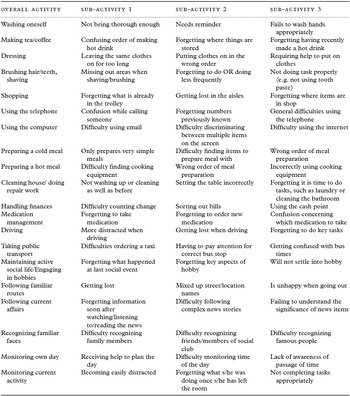
An additional amendment to the R-IDDD was the addition of subcategories for each activity. These subcategories emerged through asking carers in the earlier study (Giebel et al., Reference Giebel, Challis and Montaldi2016) how deficits manifested themselves when responding “1”–“4” for an activity. In the R-IDDD2, each IADL performance has three subcategories, each of which can be rated from “0” to “4.” For instance, if a PwD reportedly struggles with finance management, carers are asked to rate performance on the respective three sub-categories of difficulty counting change, sorting out bills, and using the cash point. Table 1 shows the detailed breakdown of each activity. Some activities may not be relevant to a PwD, if, for instance, they have never used the computer or managed the finances, the total scores for initiative and performance only consider the number of relevant, or completed, activities. For instance, a sum of 30 on 14 completed or relevant activities suggests a higher level of impairment than a sum of 30 on 20 completed or relevant activities. Therefore, the total score is a percentage score with a higher percentage indicating higher levels of impairments.
Performance sub-activities on the R-IDDD2

General health questionnaire (GHQ-12)
The 12-item GHQ-12 (Goldberg and Williams, Reference Goldberg and Williams1998) measures recent psychological distress. Items cover the ability to concentrate, confidence, and worthlessness, which are rated on a four-point Likert scale. Participants compare the current level of psychological distress to usual levels and rate current experiences as similar, greater, or lower. A higher score indicates greater psychological distress.
Adult carer quality of life questionnaire (AC-QoL)
The 40-item AC-QoL (Elwick et al., Reference Elwick, Joseph, Becker and Becker2010) assesses eight areas of carer QoL, including support for caring, caring choice, and carer satisfaction. Each item is rated as “never,” “some of the time,” “a lot of the time,” and “always” by the carer, which equates to a score between “0” and “3.” A higher score (maximum 120) indicates better QoL.
Quality of life in Alzheimer's disease (QoL-AD)
The QoL-AD (Logsdon et al., Reference Logsdon, Gibbons, McCurry and Teri1999) is a reliable measure of PwD QoL either from the PwD or from a proxy perspective (Hoe et al., Reference Hoe, Katona, Roch and Livingston2005). For this study, the QoL-AD-Proxy version was employed. The 13 items on the scale include living situation, physical health, and ability to do things for fun, which are rated from “1” (poor) to “4” (excellent).
Procedure
Ethical approval was obtained via NRES Ethics Committee North West (14/NW/0241) prior to study begin. Prior to the mail out, six carers provided feedback on the questionnaire design. For this purpose, the researcher (CG) visited the carers in their own homes to be present while they completed the questionnaire. This offered the possibility for carers to feed back on the clarity of instructions and color scheme, which could be amended before the main send out. Completing the questionnaire took approximately 20–30 minutes, and the questionnaire was returned via free-post envelopes. Data were collected from April 2014 to October 2015.
Analysis
Data were analyzed using SPSS 22 for Windows. Demographic characteristics and initiative and performance deficits were assessed using frequency analyses. Paired samples t-tests were used to compare deficits on the initiative and performance of individual activities for PwD. Bivariate correlation analyses were employed to explore the associations between initiative and performance of IADLs and carer burden, carer QoL, and PwD QoL. Construct validity of the R-IDDD2 was calculated using Cronbach's alpha. The level to which initiative deficits predicted performance deficits for each activity was analyzed using single linear regression analysis, wherein carers entered scores on one or all three sub-categories of an activity, but no total score, the median of the sub-category scores was calculated to represent the overall activity score. For hours caring for ADLs, IADLs, or supervising, a maximum of 16 hours per day were employed where carers stated 24-hour care. This procedure was also used in a previous study (Wübker et al., Reference Wübker2015). Statistical significance was treated as p < 0.05 across all tests.
Results
Carer and PwD characteristics
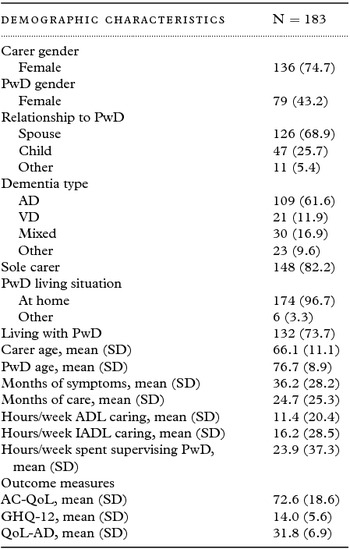
In total, 183 carers completed and returned the questionnaire. Table 2 details the demographic characteristics of the sample. Carers were on average 66 (+/−11) years old and mostly female. Most carers were spouses, lived with the PwD and were their sole carer. Carers spent more time supervising than supporting their relative with ADLs or IADLs. PwD were on average 77 (+/−9) years old and predominantly male (56.8%). Most PwD had Alzheimer's disease (61.6%) that was based on proxy reports and were reported to have shown symptoms for an average of 36 (+/−28) months, whereas carers had cared for the PwD for an average of 25 (+/−25) months. The vast majority of PwD lived at home, with very few living in sheltered accommodation.
Demographic characteristics and well-being scores
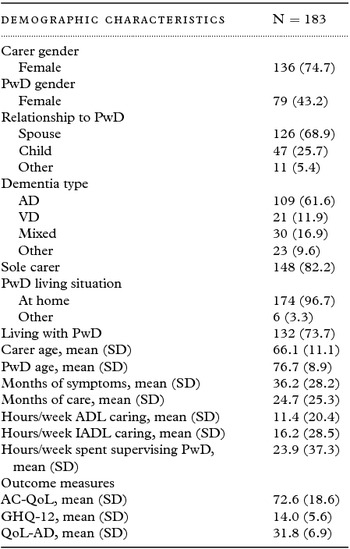
Values are N(%), unless otherwise stated.
Construct validity of the R-IDDD2
The internal consistency of the R-IDDD2 was calculated using Cronbach's alpha for initiative and performance of ADLs (washing oneself, dressing, brushing teeth/hair) and IADLs. The R-IDDD2 demonstrated high internal consistency for the initiative of basic ADLs (α = 0.894), performance of basic ADLs (α = 0.858), initiative of complex IADLs (α = 0.934), and performance of complex IADLs (α = 0.959).
Initiative and performance ratings of everyday activities
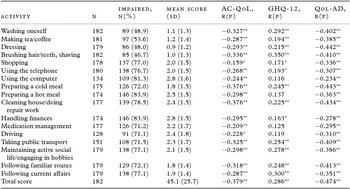
Table 3 outlines initiative ratings. Data were normally distributed with data skewness ranging between −0.896 and 1.133. Of the 17 activities, using the computer, finance management, and preparing a hot meal were most impaired. In contrast, initiating dressing, washing oneself, preparing a hot drink, and brushing hair or teeth were least impaired. With an overall initiative rating of 45.1+/−25.7 of dependency, PwD were overall partially independent, with 100% indicating full dependence.
R-IDDD 2 Initiative scores and Pearson correlations with well-being measures

Note: *Correlation significant at p < 0.05.
**Correlation significant at p < 0.01.
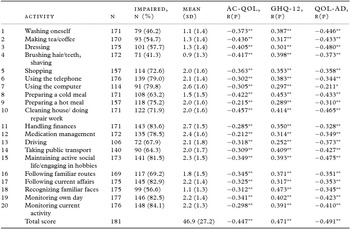
Table 4 outlines the scores on the performance scale. Data were normally distributed with data skewness ranging between −0.775 and 1.043. Of the 20 activities, using the computer, managing finances and managing medication were subject to greatest impairment, whereas the majority of PwD were impaired in monitoring a current activity, managing finances, following current affairs, monitoring own day, and engaging in social activities. Few PwD were reported to experience difficulties in performing dressing, washing oneself, brushing hair or teeth, and preparing a hot drink, and recognizing familiar faces. With an overall performance rating of 46.9 +/−27.2 of dependency, PwD were overall partially independent at performing everyday tasks.
R-IDDD 2 Performance scores and Pearson correlations with well-being measures

Note: *Correlation significant at p < 0.05.
**Correlation significant at p < 0.01.
Across both initiative and performance of IADLs, those activities predominantly noted as “not applicable” were using the computer, driving, and taking public transport. Shopping and preparing a hot meal were also frequently noted as “not applicable” by female carers of male PwD.
Paired samples t-tests revealed that PwD were significantly less able at performing dressing (t(170)= −3.593, p ≤ 0.001) and following current affairs (t(171)= −3.195, p < 0.01) than initiating these activities, whereas being significantly less able at initiating cleaning the house/doing repair work (t(166)= 3.514, p < 0.001), preparing a cold meal (t(164)= 2.097, p < 0.05), and preparing a hot meal (t(154)= 3.989, p < 0.001), than on their performance. Variations in medication management approached significance with poorer performance than initiative (t(166)= −1.877, p = 0.062).
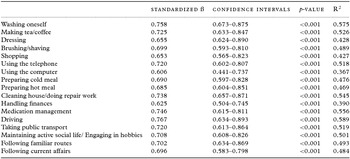
Linear single regression analysis (Table 5) revealed that the initiative of each of the 17 activities covered in both scales significantly predicted the performance of an activity, with between 36.7% (using the computer) and 58.9% (driving) of variance in the performance explained. In all regression models, PwD gender was controlled for.
Single logistic regression analyses

Regression models for each activity initiative predicting activity performance.
Associations with well-being
Table 3 also shows the correlation coefficients between initiating activities and well-being. Nearly all activities were significantly associated with well-being, with higher initiative deficits associated with greater carer burden, and reduced carer and PwD QoL. Only using the computer, preparing a hot meal, managing medication, and driving were not associated with carer burden. Preparing a cold meal (and dressing as an ADL) was most strongly related to PwD QoL, brushing teeth or hair to carer burden, and cleaning the house/doing repair work and preparing a cold meal to carer QoL. The associations between activities and the QoL-AD were stronger than those with the AC-QoL or GHQ-12.
Table 4 also shows the correlation coefficients between performing activities and well-being. Performance on every activity was significantly related to well-being, with higher performance deficits associated with increased carer burden and poorer carer and PwD QoL. Engaging in social activities (and dressing as an ADL) was related most strongly to PwD QoL, recognizing familiar faces to carer burden, and cleaning the house/doing repair work to carer QoL. Performing IADLs was more strongly related to well-being than initiating IADLs.
Discussion
This study first establishes the R-IDDD2 as a suitable and valid assessment tool for everyday functioning. Using this version of the questionnaire, this study provides new insights into the difficulties of initiating and performing IADLs in mild dementia, and how these are associated with the well-being of PwD and their carers. Several activities were found to be impaired to the greatest extent both in their initiative and performance, including using the computer, finance management, medication management, and driving. Both using the computer and driving are activities that are not included in any other IADL instrument and are generally assessed by direct observation. To our understanding, no previous studies have compared these two activities alongside others, particularly with regard to measuring initiative to engage. In comparison to using transport, telephoning, and medication management, one study showed that finance management impairments at baseline were a significant predictor of developing dementia ten years later (Peres et al., Reference Peres2008). Difficulties in medication management have also been reported to be among the most prominent (Giebel et al., Reference Giebel, Challis and Montaldi2016), although research mostly fails to distinguish between medication management and keeping appointments (Brown et al., Reference Brown, Devanand, Liu and Caccappolo2011; Martyr et al., Reference Martyr2012). Therefore, the R-IDDD2 and its use in the current study provide a more detailed assessment of individual IADL difficulties than previous tools and their application have allowed.
Consistent with our hypothesis, some activities showed significant variations between their initiative and performance, although most activities reported similar impairment across the two measures. Although multiple tests of comparison with the initiative and performance might have increased the Type I error, the purpose of this study was to provide a first validation of the R-IDDD2, and applying Bonferroni correction to the analyses would have increased the Type II error considering the number of tests of comparisons performed. The variations evidenced here can have important implications for the effective management of dementia. Most non-pharmacological interventions on everyday functioning focus on global IADLs or ADLs, or on some selected activities (Clare et al., Reference Clare2000; Kurz et al., Reference Kurz, Pohl, Ramsenthaler and Sorg2009; Giebel and Challis, Reference Giebel and Challis2015). These fail to distinguish between the initiative and performance of activities. However, findings from this study distinguishing between initiative and performance deficits suggest that PwD might either need better “triggers” (to encourage initiative) or better training or support (to improve performance) in order to ensure that functioning and independent living are optimized. Across the sample, cleaning/doing repair work and preparing a hot or cold meal were impaired to a greater extent in their initiative than their performance. This suggests that interventions targeting structured training by teaching, for example, the individual steps of those activities would prove minimally effective. Instead, PwD need to be provided with effective triggers, in order to help initiate those tasks. This could be achieved by employing simple memory aids, such as specific alarms (Gibson et al., Reference Gibson, Dickinson, Brittain and Robinson2015) or maybe simply by using lists and signs. In contrast, for dressing, following current affairs, and medication management, triggers would be less effective, as the performance is impaired to a greater extent. Thus, PwD require structured training to improve performance on the individual steps of those tasks. This might be achieved by structured cognitive interventions, which could address the specific cognitive deficits underpinning the impairment in performance of activities. It is worth noting that patterns of everyday functioning deficits in PwD can vary considerably across individuals, even at the early stages of dementia. Therefore, the approach of using either triggers or training needs to be adapted to the individual IADL deficits of PwD.
Overall, there appears to be no clear message as to whether initiative or performance deficits are more prominent in early dementia. This corroborates previous evidence obtained with mild-to-moderate dementia populations (Teunisse et al., Reference Teunisse, Derix and van Crevel1991; Voigt-Radloff et al., Reference Voigt-Radloff2012). One possibility for not finding clearer distinctions between initiative and performance could be the presence of significant individual differences across PwD as mentioned above. Old age and its increased likelihood of comorbidities might have been a biasing factor in this study, considering also that PwD were on average ten years older than carers. Furthermore, levels of everyday functioning are associated with depression, physical limitations, differing cognitive deficits, and environmental modifications (Fauth et al., Reference Fauth, Schwartz, Tschanz, Ostbye, Corcoran and Norton2013; Liu-Seiffert et al., Reference Liu-Seiffert2015). These were not assessed in this study, so as to not overburden carers, and hence, these unexplained factors may have played a role in IADL activity. Future research should investigate how these potentially biasing factors might differentially influence initiative and performance.
In support of our second hypothesis, the majority of IADLs were strongly associated with the well-being of both carers and PwDs. Engaging in social activities was particularly strongly associated with PwD QoL, consistent with previous evidence (Giebel et al., Reference Giebel, Challis and Montaldi2016), suggesting that the loss of one's capacity for social engagement has a particularly negative effect on the well-being of PwD. The majority of studies employ proxy reports for everyday functioning and/or well-being (Mioshi et al., Reference Mioshi, Bristow, Cook and Hodges2009; Beerens et al., Reference Beerens2015), similar to this study so that future research should evaluate whether there are variations in PwD perspectives of well-being. Although nearly all activities were significantly associated with well-being, it would be interesting to explore this relationship further in the more advanced stages of dementia. As PwD and carers become more accommodated to their new circumstances and caring roles, it might be the case that other activities impact on the well-being than those in the initial early stages. This is based on the hierarchy of daily activity decline reported first by Reisberg et al. (Reference Reisberg1984).
Conclusions
This study established the R-IDDD2 as a comprehensive tool that evaluates several layers of everyday functioning. Its application here provides novel insights into impairments in initiating and performing IADLs in mild dementia, and how these could be effectively managed. As opposed to previous scales (i.e. Lawton and Brody, Reference Lawton and Brody1969; Sikkes et al., Reference Sikkes2012), the purpose of the R-IDDD2 is to focus on individual activities and sub-activities. Given this level of detail, the R-IDDD2 appears to be a suitable, and internally consistent, tool in capturing subtle changes in everyday functioning, which might not only help in the diagnosis of very mild dementia, but also in possibly identifying specific deficits suitable for interventions. Findings from this study suggest that interventions to improve functioning need to address initiative and performance deficits in a targeted way, by either employing triggers or providing structured training or support. Future research should also explore how well-being is related to individual IADLs in more advanced stages of dementia and how specific subtypes of dementia may experience different levels of impairments.
Conflict of interest
None.
Description of authors’ roles
CG collected the data, performed statistical analysis, and wrote the manuscript. CG and DM designed the study. DM and DC provided feedback to drafts of the manuscript.
Acknowledgments
We wish to thank staff at the following NHS Trusts for their support in recruiting participants: Catherine Turton, Joanne Woodward at 5 Boroughs Partnership; Ritchard Ledgerd, Alexandra Feast, Charlotte Stoner, Dr Joanne Rodda at North East London; Paula Harman, Dr Farhad Huwez at Southend University Hospital; Joanne Tomkins, Laura Lord, Dr Tarik Qassem at Black Country Partnership; Olga Balazikova, Sarah Hamilton, Ramin Nilforooshan at Surrey and Borders Partnership; Lisa Wilkinson-Guy, Prof George Tadros at Heart of England; and Kim Thompson, Leigh Franks, Dr Rashi Negi at South Staffordshire and Shropshire Healthcare. We also wish to thank Division 4 Greater Manchester NIHR Clinical Research Network for recruiting participants to this study through Manchester Mental Health and Social Care and Greater Manchester West NHS Trusts. Our thanks also extend to the JoinDementiaResearch Network for allowing us to recruit carers through their network. This paper presents independent research supported by the National Institute for Health Research (NIHR), under its Programme Grants for Applied Research programme (Grant Reference Number: DTC-RP-PG-0311-12003), and forms part of the doctoral thesis of CG.