1. INTRODUCTION
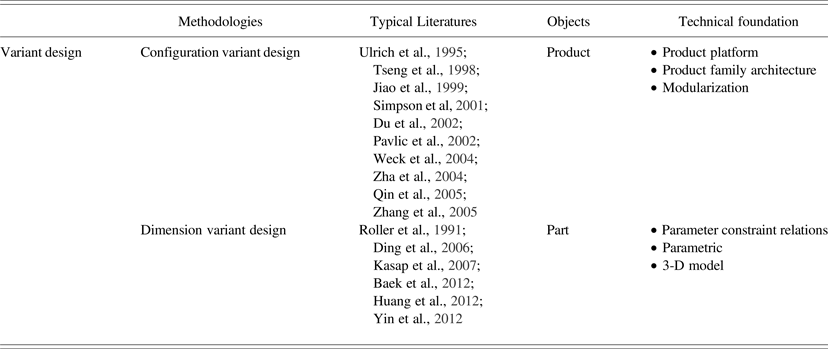
Mass customization aims to best satisfy the individual needs of customers with nearly mass production efficiency (Pine, Reference Pine1993). Mass customization has become one of the popular production modes in the 21st century. As a valid method to achieve the goal of mass customization, variant design has been well recognized in both the academy and in industry and accounts for approximately 80% of the design tasks (Prebil et al., Reference Prebil, Zupan and Lucic1995). Wilkes and Leonard (Reference Wilkes and Leonard1988) asserted that variant design is a method of automating the process of mechanical artifact design. Prebil et al. (Reference Prebil, Zupan and Lucic1995) advocated the use of the variant design method to increase the intelligence of a computer-aided design (CAD) system. The strategy of variant design involves the derivation of individual product instances based on existing designs and establishing designs to relieve designers from iterating similar design processes, shorten the product development cycle, and reduce cost (Wang, Reference Wang2001). The advantages of variant design in efficiency and effectiveness have led to significant research focusing on this area. Fowler (Reference Fowler1996) investigated the key approaches used in product variant design. From the perspective of methodology, product variant design can be grouped into two primary categories: configuration variant design and dimension variant design. However, from the perspective of objects, variant design can generally be classified into part (component) variant design and product (assembly) variant design (Wang, Reference Wang2001). Table 1 presents the methodologies of variant design and their technical foundations. Configuration variant design focuses on how a wide variety of end products are derived through model combination. Product platform and product family architecture that are based on modular technology are the most valid measures to implement configuration variant design, while dimension variant design derives product variants from a parametric model by scaling the parameters of the part or assembly. Both of them can derive various products to meet the individual requirements of customer.
Methodologies of variant design and their technical foundations

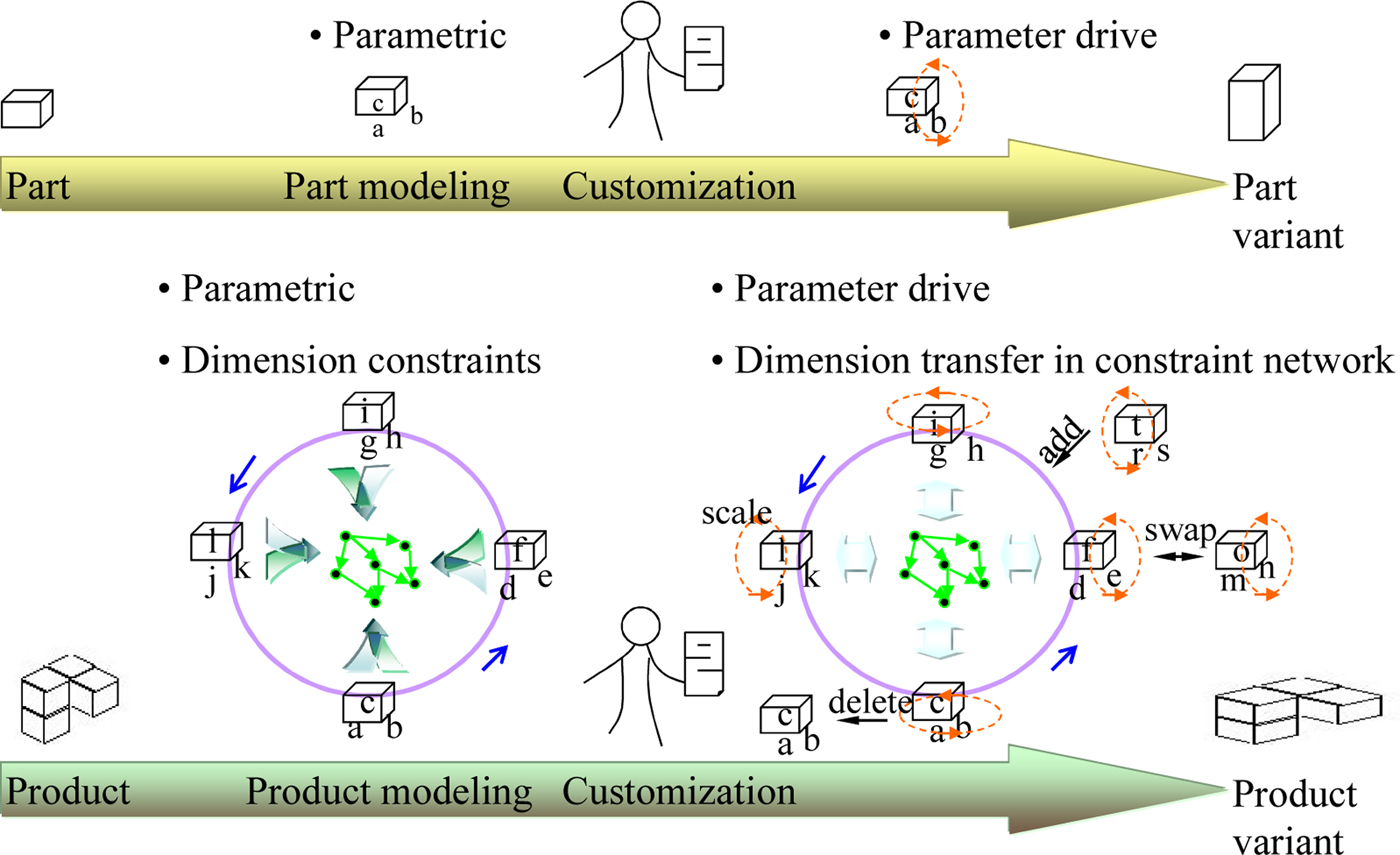
With the goal of discovering the information transfer characteristics of dimensions in the product variant design process, this paper focuses on the dimension variant design at the product level. To facilitate the descriptions of issues, the technical views of part and product variant design are presented in Figure 1. Constructing parametric models and driving parameters are the main tasks of part variant design. However, product variant design, apart from the parametric model of each part, requires establishing the dimension constraints among mating parts (Forster et al., Reference Forster, Fothergill and Arana1997). It is through these dimensions and the constraint relations formed by them that variant information can be transferred from one part to another.
Technical view of part and product variant design.

Part variant design is simpler than product variant design because the former involves only a single part. The dimension constraints among mating parts increase the difficulties in product variant design because a dimensional change in one part may require necessary changes in the dimensions of the parts mating with that part, while the incomplete transferring of variant information will lead to the uncertainty of the dimensions in constraint relations. Therefore, it is very significant to make full use of the information transferring characteristics of the dimensions in constraints to decrease the uncertainty of the product variant design process.
1.1. Dimension variant design
Generally, dimension variant design derives product variants from a parametric model by scaling the parameters of the part or assembly. Roller (Reference Roller1991) developed a variant processor based on the store parametric model. Ding et al. (Reference Ding, Tan, Zhang, Song, Wang, Kovacs, Wozny and Fang2006) proposed a parametric variant design for mass customization. Kasap and Magenenat (Reference Kasap and Magnenat2007), and Baek and Lee (Reference Baek and Lee2012) presented a parametric human body variant design for human-centered products. Huang et al. (Reference Huang, Yang and Chu2012) investigated a parametric design based on principal component analysis to derive different glass geometries by scaling the parameters of three-dimensional glass models. Yin and Ma (Reference Yin and Ma2012) proposed a parametric feature constraint modeling method for variant design. In addition, some commercial CAD software, such as AutoCAD, Pro/E, and SolidEdge, also implements dimension variant design based on parametric technology. It is one of the mainstream applications in digital engineering.
Dimension variant design can derive a series of various product instances with similar form and topology that cannot be changed in general. However, implementing dimension variant design solely is not always enough to derive a valid product variant instance to effectively meet the requirements of customers. Module configuration and parameter scaling are coupled in nature (Du et al., Reference Du, Jiao and Chen2014). An optimal module configuration should depend on how module attributes/parameters are scaled (Lamothe et al., Reference Lamothe, Hadj-Hamou and Aldanondo2006). Thus, Siddique and Rosen (Reference Siddique and Rosen1999, Reference Siddique and Rosen2001) presented product variety approaches that allow configuration modification in a product's functions and/or parametric changes in a product's geometry. Myung and Han (Reference Myung and Han2001) proposed a knowledge-based parametric design of mechanical products based on the configuration design method. Nayak et al. (Reference Nayak, Chen and Simpson2002) presented the variation-based platform design method for a product family to derive a product variant for a range of performance requirements. Messac et al. (Reference Messac, Martinez and Simpson2002) proposed a scalable product platform to derive variant models by selecting the common and scaling parameters of families of products. Germani and Mandorli (Reference Germani and Mandorli2004) proposed a self-configuration component approach for variant product development. Siddique and Boddu (Reference Siddique and Boddu2005) presented a template approach to represent a CAD model for an entire family that considers both modularity and scaling. Li et al. (Reference Li, Huang and Newman2007) also presented an adaptive product platform based on parametric technology to generate feasible product variants to meet customer requirements. Similarly, Zhang et al. (Reference Zhang, Wu, Li, Zong and Zhou2008) developed parameter scaling and modular configuration to rapidly conduct the variant design of the tunnel boring machine main frame. Liu and Xi (Reference Liu and Xi2011) presented a case-based parametric design approach. All the variant design methods mentioned above can promptly generate product variants to satisfy the individual needs of customers.
1.2. Changes caused by variant design
The product variant design method can derive sufficient variety product instances to satisfy the individual requirements of customers. However, diversity in product function, structure, and parameter exponentially increases the variety and complexity of the manufacturing process (Tseng et al., Reference Tseng, Kjellberg and Lu2003; Wang et al., Reference Wang, Zhu, Wang, Lin and Chen2011) and significantly increase the production cost (Flores et al., Reference Flores, Jensen and Shelley2002). Aiming to these problems, Jiao and Zhang (Reference Jiao and Zhang2005) proposed an approach based on an object-oriented petri-net with changeable structures to address process variety. Zhang et al. (Reference Zhang, Jiao and Helo2007) developed a process platform based on a unified modeling language to alleviate process variety. However, studies on these issues typically employ the artifact perspective. Their objective is to design a process platform or framework to address the conflict between product variety and process variety. Extensive studies that focus on the process platform or frameworks have been conducted. However, research on the informatics of the product variant design process remains limited. Figure 1 indicates that the primary works on product variant design involve the information transfer among mating parts, which propagates variant dimensions to all the parts of a product. As a result, all parts are involved in variant design. Similarly, Fang and Shen (Reference Fang and Shen2006) asserted that product variant design process involves the transfer of variant dimensions in the dimension constraint network (DCN) among mating parts. Therefore, it is very significant to investigate the information transfer issues in product variant design process in order to understand it well. For example, Liu and Qi (Reference Liu and Qi2007) investigated the variant dimension transfer in a DCN and determined the algorithm for calculating the dimension transfer result once a dimension change is presented. Xu et al. (Reference Xu, Cheng and Li2009) analyzed the complexity of the dimension transfer path in the DCN from the perspective of informatics during the product variant design process. Further, Zhou and Liu (Reference Zhou and Liu2012) proposed a method to reduce the complexity of the dimension constraint in the product variant design process based on a directed parameter graph.
However, neither academia nor industry investigates the information transfer characteristics of dimensions in product variant design process such as the real-time status of the dimensions of the parts during the product variant design process and the capability of a dimension to transfer variant information among mating parts, much less using the information transfer characteristics of dimensions to make the product variant design process more reasonable. The present study focuses on the issues of the information transfer characteristics of dimensions in the constraint network, and uses them to plan the product variant design process effectively. After analyzing the dimension constraints for variant design and the natural dynamic of the DCN, the information efficiency of the DCN that specifies the information transfer character of it is defined based on a simple path. On the basis of this, the information centrality of the dimensions and those of the parts are defined to describe the information transfer capability of them. An approach of planning the variant design sequence of parts constituting a product based on the information centrality of parts is proposed to keep the uncertainty of the DCN minimal in the end. This study provides suggestions for the effective management of the product variant design process from the perspective of informatics.
2. FUNDAMENTAL ISSUES OF DIMENSION CONSTRAINT ANALYSIS FOR VARIANT DESIGN
2.1. DCN
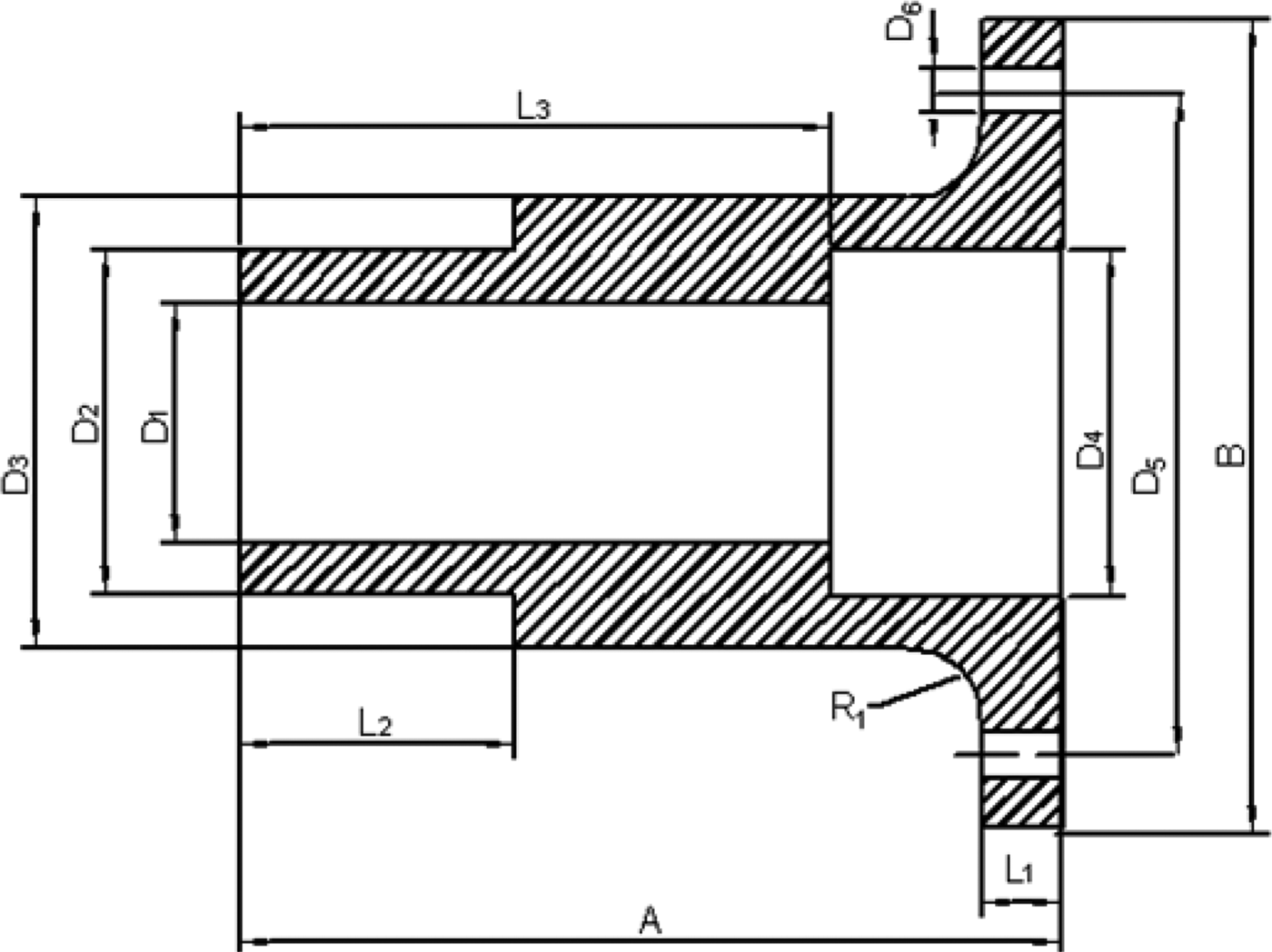
On the basis of parametric technique, part can be described by a series of key variables that correspond to the dimensions of this part. For example, the part in Figure 2 can be described by parametric dimensions such as A, B, D1, D2, D3, D4, D5, D6, L1, L2, L3, and R1. In order to keep the mechanical performance of this part and (or) its form requirement, the constraints between dimension B and dimension D5 must satisfy the following equation (Liu & Qi, Reference Liu and Qi2007):
 $$B{\rm} = {\rm} D5{\rm} + {\rm} 30\comma \,$$
where 30 is a constant.
Parametric dimension descriptions of a part.

However, a complex mechanical product always consists of many parts that fit with each other. The dimensions corresponding to their mating faces form the strict constraints (Wang, Reference Wang2001). Due to the natural of multimating features of parts, there are many these kinds of dimension constraints in a product. Therefore, the dimension constraints among them are more complicated. In order to analyze the information characteristics of the product variant design process effectively, an effective description form is necessary.
DCN is the graphical description of the mathematical constraints of dimensions among mating parts (Liu & Qi, Reference Liu and Qi2007). It is the basis of transferring variant dimensions to other dimensions during the product variant design process. The graph of the DCN can be defined as a 3-tuple G DCN = 〈V, E, γ〉, where V is a finite set of nodes, which are the dimensions in this work; E:V × V is a finite set of arcs, which connect different dimension nodes; and γ is a set of coefficients that describe the mathematical constraints between two dimension nodes.
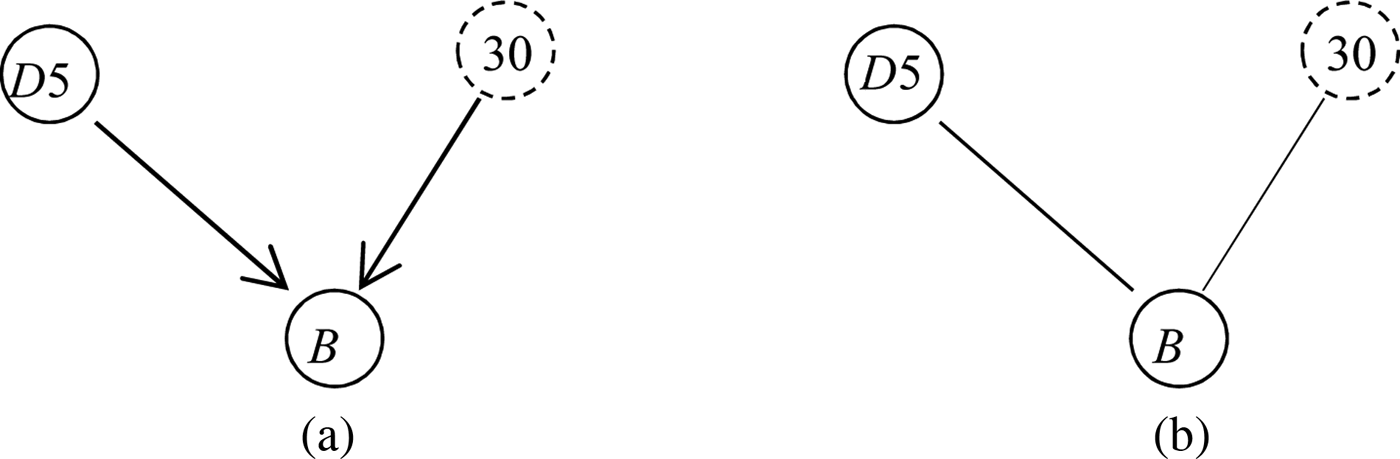
For example, the dimension constraints in Eq. (1) can be described through the directed graph in Figure 3a in which the dimensions at the right of Eq. (1) point to the dimensions at the left of Eq. (1), respectively. This denotes that dimension D5 must be transferred to dimension B, while reverse transfer is not allowed. Because the dimension D5, which is always a key dimension for the part's locating or installing, is more important than the dimension B. At the same time, the directed graph description of the dimension constraint can avoid the repeated transfer of variant dimensions in the DCN. This is can be explained by using the undirected graph description of Eq. (1) in Figure 3b. For example, the change of dimension D5 requires a corresponding change of dimension B. However, the change of dimension B also requires a corresponding change of dimension D5. As a result, the changes of any dimensions all require the changes of other dimensions that associate with it. In this way, the dimensions in the DCN will be changed repeatedly. Obviously, this increases the difficulty of implementing product variant design. However, a directed graph, which specifies the direction of transferring variant dimensions in the DCN, can avoid this situation effectively. Therefore, it is an effective description of the dimension constraints among mating parts.
Directed graph description of Eq. (1).

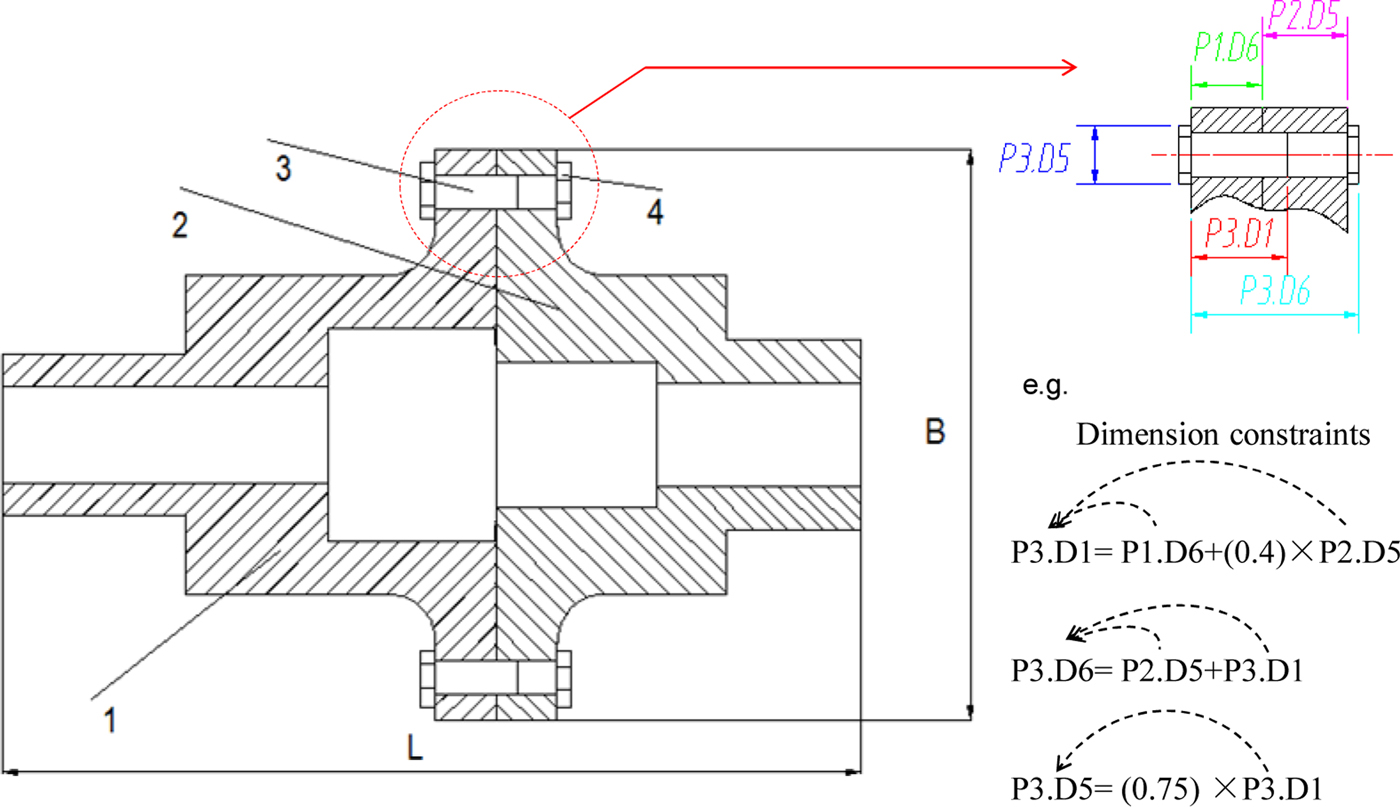
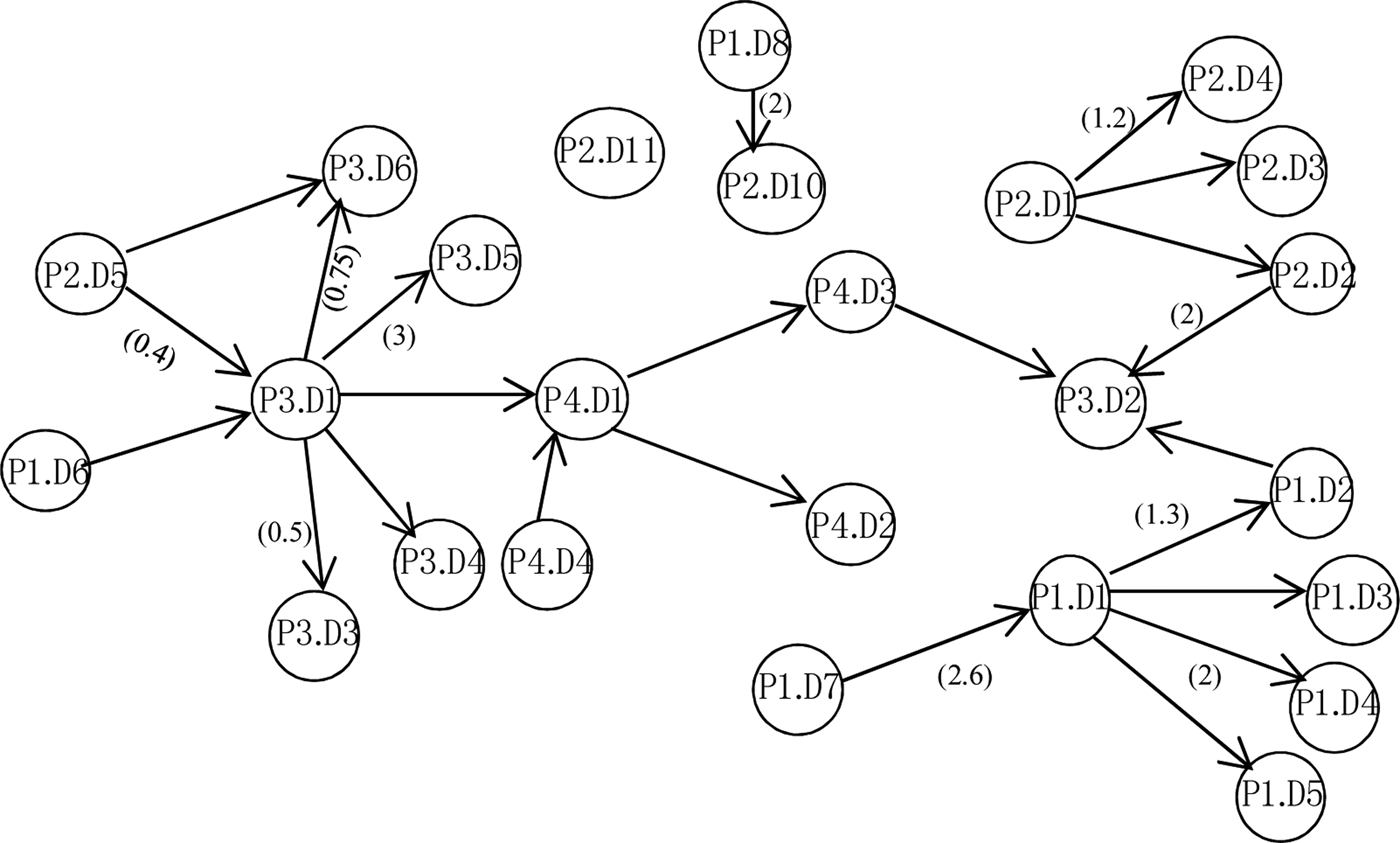
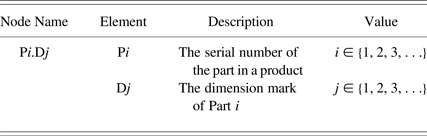
To distinguish between the part and its dimensions in the DCN, the naming rules of the dimension node are established, as shown in Table 2. The first element of a name is the serial number of a part in a product, and the second element of the name is the dimension mark of the part Pi. For example, the dimension node P1.D6 denotes that it is the sixth dimension of the first part of this product. On the basis of this, the dimension constraint network of the subassembly presented in Figure 4 is constructed in Figure 5.
A subassembly instance.

Dimension constraint network of a subassembly (partial).

Naming rules of dimension nodes

Due to the page limitation, only a local assembly relation and its dimension constraints [such as P3.D1 = P1.D6 + (0.4) × P2.D5; P3.D6 = P2.D5 + P3.D1; P3.D5 = (0.75) × P3.D1] are presented in Figure 4, and only key dimensions of parts are presented in Figure 5. The dimensions of each part are named according to the rules in Table 2.
DCN consists of a collection of nodes that are the dimensions and a collection of arcs that indicate the mathematical constraints among the dimensions. Only one arc exists between each pair of dimensions.
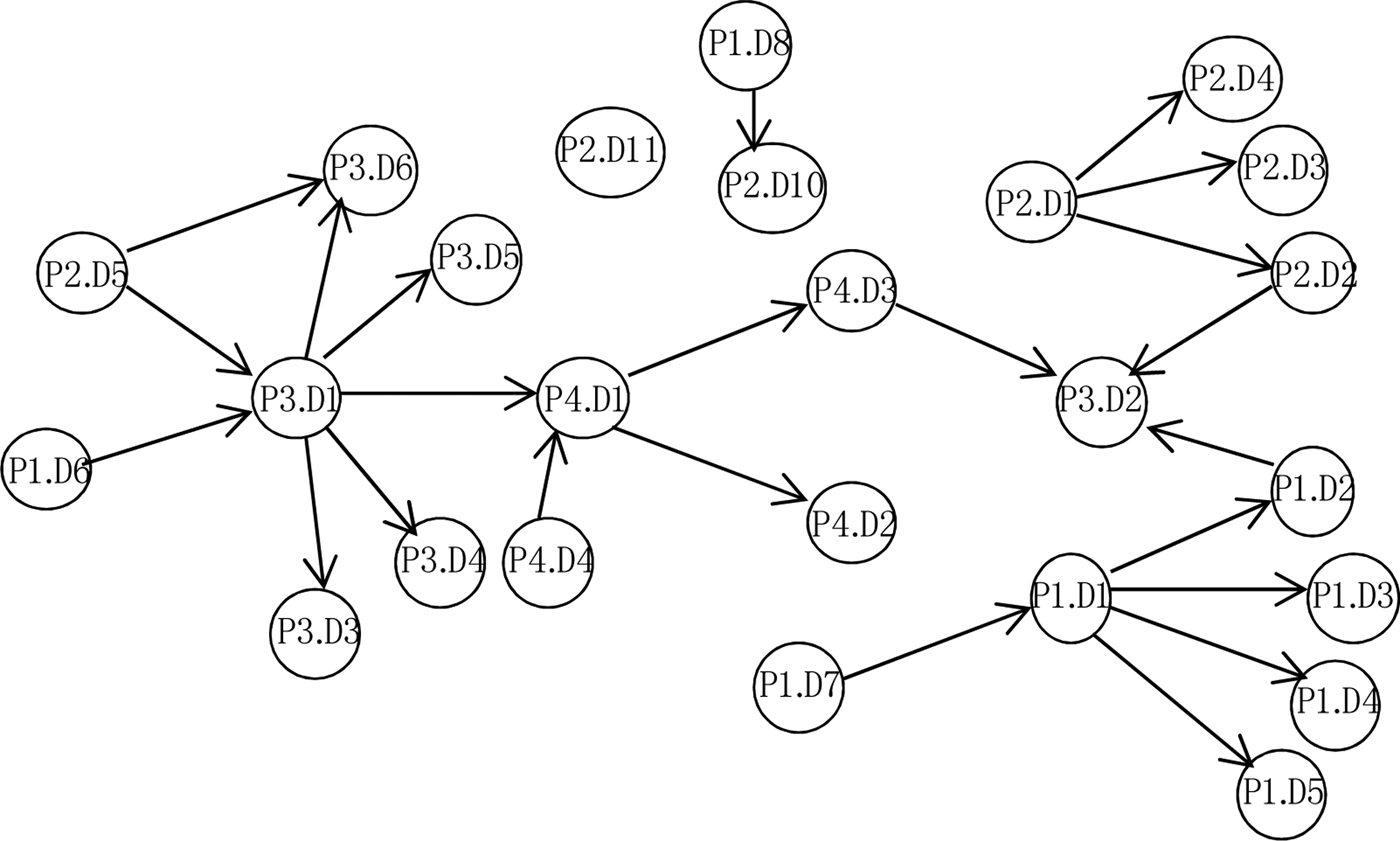
In this work, we focus on whether or not a constraint exists between two dimensions because we only want to know whether or not variant information can be transferred between two dimensions. Therefore, the DCN can be simplified as an unvalued unweighted directed graph. As a result, Figure 5 is simplified as presented in Figure 6.
Unvalued unweighted directed dimension constraint network corresponding to Figure 5.

According to graph theory, the DCN in this study can be transformed into an adjacency matrix A, which is an N × N matrix whose entry a ij is equal to 1 if dimension i and dimension j are adjacent, or 0 otherwise. The elements of the main diagonal are not defined. For convenience, the main diagonal values are set to 0.
 $$G(A) = [a_{ij}]_{N \times N} \comma $$
where N is the number of dimensions in the DCN.
2.2. Dimension constraint structures
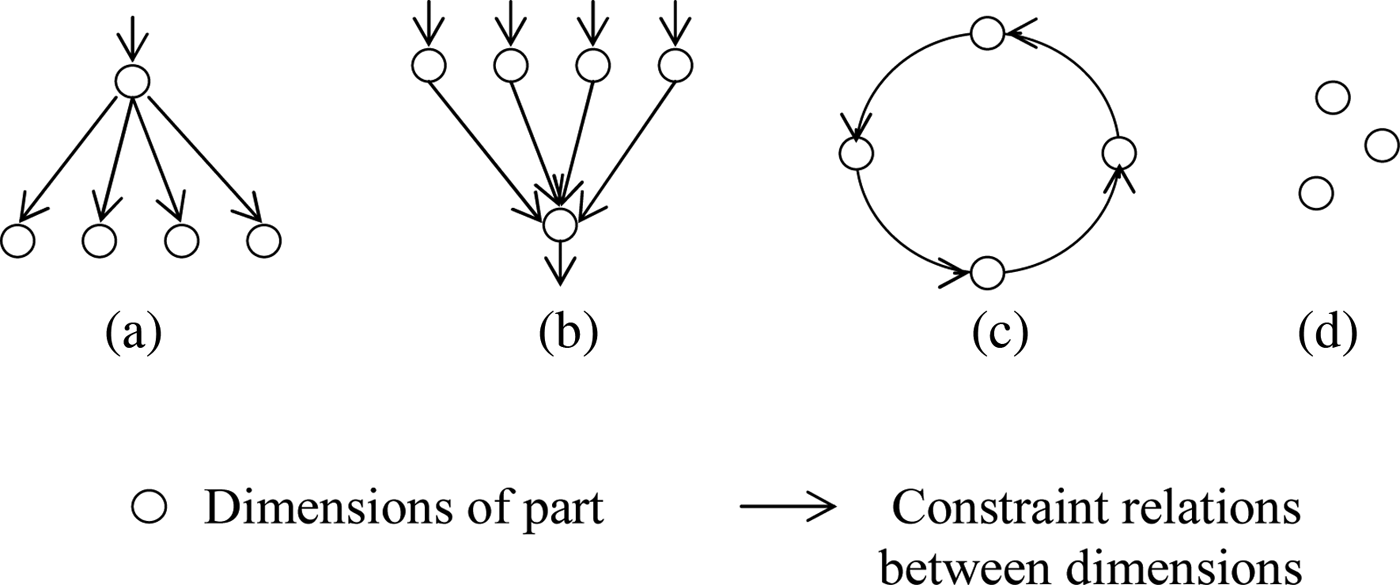
Dimension constraint structures are the basic units of the DCN. Investigating these basic units is crucial to analyze the transfer logic of information in the DCN. From the perspective of topology, four kinds of dimension constraint structures exist, as illustrated in Figure 7.
-
• 1 to n constraint: This constraint unit denotes that one dimension affects two or more other dimensions once it is changed, as shown in Figure 7a. This constraint unit results in many transfer paths.
-
• n to 1 constraint: This constraint unit denotes that several dimensions codetermine a dimension, as described in Figure 7b. Hence, the value of the current dimension can be determined only by all its n in-degree dimensions, which are identified during the product variant design process. Otherwise uncertainty results, which in turn leads to DCN complexity and more difficulties in the product variant design.
-
• Cycle constraint: Dimensions in this unit form a closed loop and constrain each other, as shown in Figure 7c. Cutting off the loop at the appropriate position is necessary to avoid endless information transfer among the dimensions (Liu & Qi, Reference Liu and Qi2007). This will not be discussed here. We assume that the cycle constraint has been cut off properly before constructing the DCN.
-
• Isolated nodes: The isolated nodes are the dimensions that do not connect with any other dimensions in the constraint network. These nodes are always discrete constants that are derived from the design rules or knowledge bases shown in Figure 7d.
Dimension constraint structures.

These dimension constraint structures are nested or combined with one another. Consequently, they form a complex DCN. It is the basis for analyzing the dimension transfer characteristics of the product variant design process.
2.3. Dimension transfer path and simple path
The change of a dimension will lead to a corresponding change of dimensions that associate with it directly (Wang, Reference Wang2001), and these modifications are continuously passed in the DCN. The ordered dimensions in these transfer processes form the dimension transfer paths. The dimensions and these paths are characterized as following:
-
• The dimensions in the transfer path must be modified because of the strict constraints.
-
• A variant dimension may result in many transfer paths.
-
• Different transfer paths may intersect with one another. Intersection increases the complexity of analyzing the dimension transfer characteristics.
For example, the change of dimensions P1.D6 and P1.D7 (Fig. 6), which is attributable to product customization, generate ten dimension transfer paths:{P1.D6 → P3.D1 → P3.D3}, {P1.D6 → P3.D1 → P3.D4}, {P1.D6 → P3.D1 → P3.D5}, {P1.D6 → P3.D1 → P3.D6}, {P1.D6 → P3.D1 → P4.D1 → P4.D3 → P3.D2}, {P1.D6 → P3.D1 → P4.D1 → P4.D2}, {P1.D7 → P1.D1 → P1.D5}, {P1.D7 → P1.D1 → P1.D4}, {P1.D7 → P1.D1 → P1.D3}, and {P1.D7 → P1.D1 → P1.D2 → P3.D2}. Many dimension transfer paths are generated during the product variant design process because of the natural intricate of the DCN. The number of the dimension transfer paths and their length reflect the size and intensity of a dimension that affects other dimensions from the perspective of informatics.
A simple path between two dimension nodes in a constraint network is the path that does not have repeating nodes. For example, two simple paths exist between dimensions P2.D5 and P3.D6, such as {P2.D5 → P3.D6} and {P2.D5 → P3.D1 → P3.D6}. A simple path describes all the transfer passages between two dimensions. These passages determine the validity of information transfer between the two dimensions. More than one simple path generally exists between two dimensions, such as dimensions P2.D5 and P3.D6. Incompetent transfer leads to dimension uncertainty in the constraint network. In engineering, overconstraint among dimensions is always inhibited when a dimension constraint relation is established to avoid constraint conflicts. Thus, the variant dimension is always transferred along with the simple paths between the two dimensions. The simple paths are the shortest, but these paths are complete transfer passages between two dimensions in the constraint network.
3. DYNAMIC NATURE OF THE PRODUCT VARIANT DESIGN PROCESS
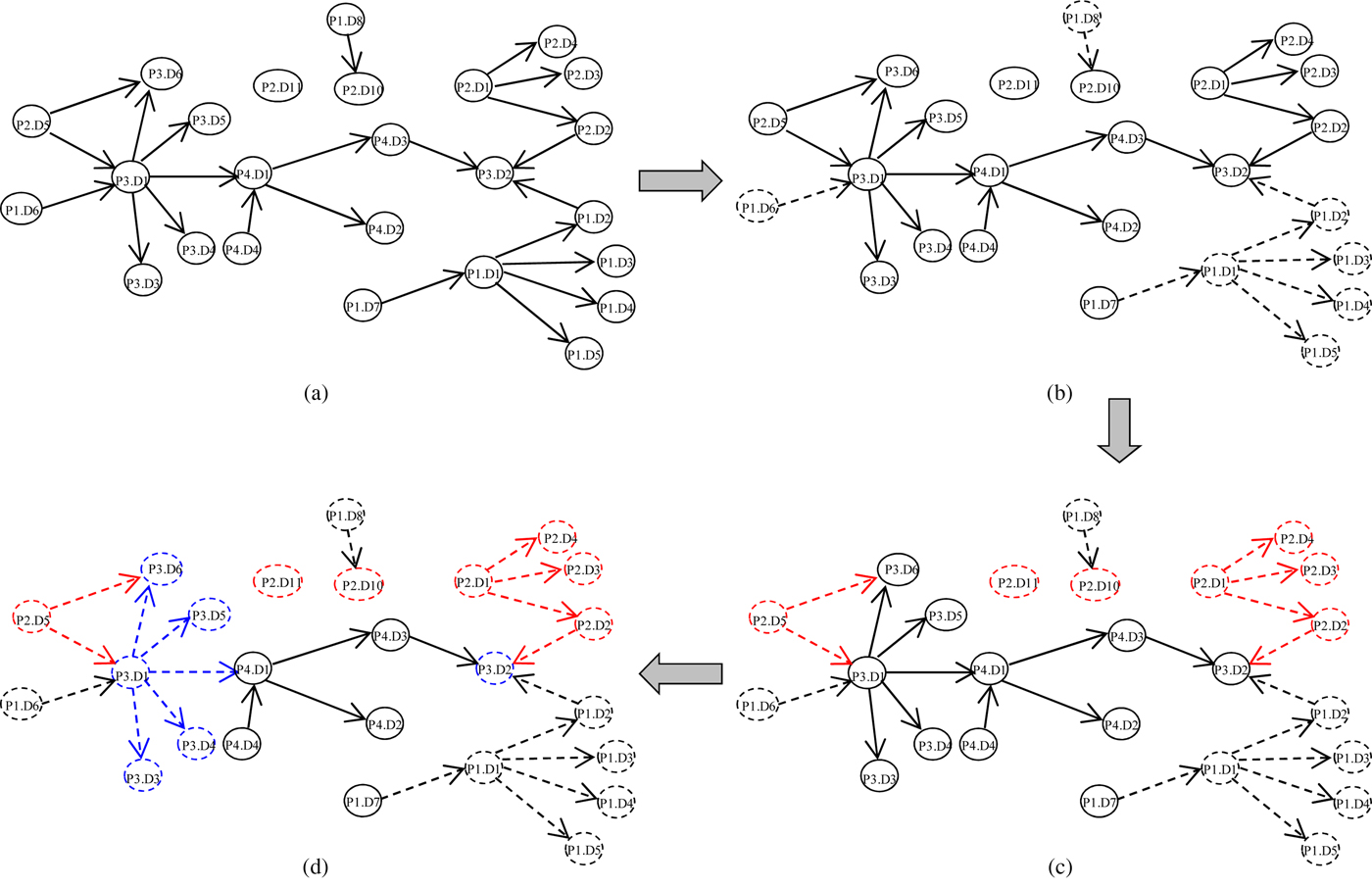
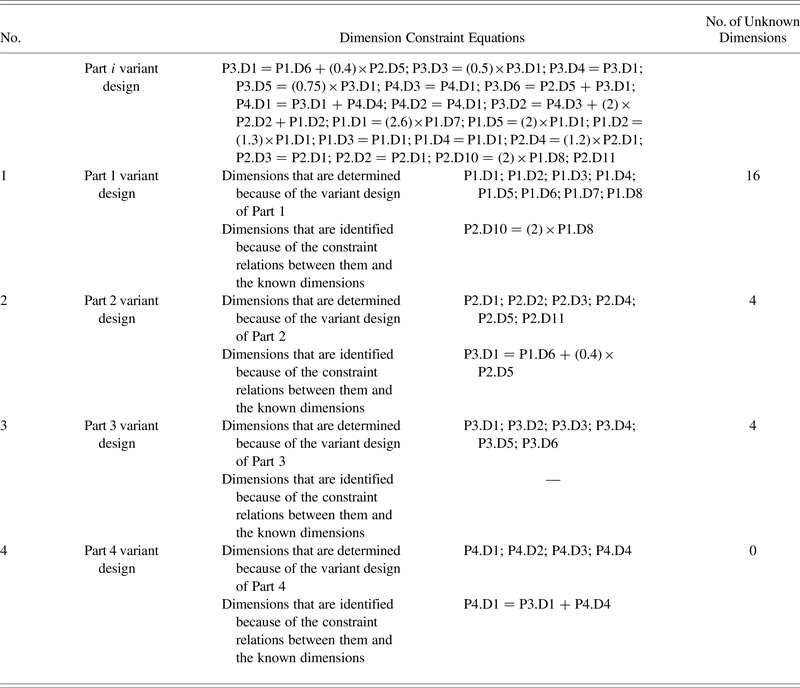
The product variant design process generally involves a sequence of dynamic characters (Xu & Jiao, Reference Xu and Jiao2009). For example, Zhang et al. (Reference Zhang, Wang, Wan and Yifang2005) investigated the dynamic configuration rules and assembly constraints for a made-to-order manufacturing process. Similarly, with the progress of product variant design, the dimension status also continually changes because of the transferring of variant dimensions in the constraint network. According to the construct method of the DCN, the value of a dimension is always determined by its in-degree dimensions. When the in-degree dimensions of the current dimension are determined progressively, the uncertainty of the current dimension drops off gradually. For example, the unknown dimension P3.D1 can be identified only from all its in-degree dimensions, dimension P1.D6 and P2.D5. Table 3 presents the dynamic change (i.e., the unknown dimensions) in the DCN with the sequence of the part variant design, Part1 → Part 2→ Part 3→ Part 4, in Figure 8. It is can be seen that after Part 1 implements variant design, the dimensions of it, such as P1.D1, P1.D2, P1.D3, P1.D4, P1.D5, P1.D6, P1.D7, and P1.D8, will be determined based on the customer's specifications or dimension transferring. At the same time, dimension P2.D10 can also be identified based on the constraint relations P2.D10 = (2) × P1.D8. As a result, the number of unknown dimensions in the DCN is further decreased. Therefore, the number of unknown dimensions that result in the uncertainty of the DNC is changed continuously under this part variant sequence.
Nominal structure change of the dimension constraint network during the product variant design process.

Dynamic change of the number of the unknown dimensions in the dimension constraint network

In addition, the dimensions of the part that complete the variant design will not allow it to be modified again to avoid the endless transferring of variant dimensions in the constraint network (Xu & Jiao, Reference Xu and Jiao2009). This might be considered as that the dimensions of the parts are nominally removed from the DCN. Thereupon, the valid DCN structure, from the perspective of information transfer, changes dynamically also during the product variant design process. For example, Figure 8 presents the nominally changes of the structure in the DCN under the sequence of part variant design, Part 1 → Part 2→ Part 3→ Part 4, which are denoted by the colored dashed lines. It indicates that these dimensions determined after implementing variant design are nominally removed from the DCN.
Based on these analyses, it is known that the natural dynamics in a product variant design process, which are the status of the dimensions and the valid structure of the DCN, are indisputable.
4. INFORMATION CENTRALITY OF DIMENSION BASED ON THE SIMPLE PATH
Dimensions are the basic elements of constructing a DCN. These dimensions carry on the task of transferring variant information in the DCN. The information transfer role of each dimension in the DCN is different. A dimension with a significant information transfer role transmits a larger amount of information to other dimensions when it is identified, whereas it will reduce the information transfer effectiveness of the DCN dramatically once it is removed. Therefore, it is very crucial to measure the information transfer role of dimensions in the DCN reasonably. It will provide the evidence for the product variant design process to make full use of the information transfer role of dimensions.
Information centrality, which reflects the importance of nodes in graph G, from the perspective of information transfer, has been introduced in the literatures (Moreno et al., Reference Moreno, Gomez and Pacheco2002; Motter et al., Reference Motter, Nishikawa and Lai2002; Albert et al., Reference Albert, Albert and Nakarado2004). The efficiency E of graph G is a critical measure index in the conception of information centrality. The efficiency e ij in the communication between nodes i and j is equal to the inverse of the shortest path length d ij . This variable is based on the assumption that the information or communication in a network travels along the shortest paths. The efficiency E of graph G is the average of e ij and measures the mean flow-rate of information over G. Thus, the quantity E(G) varies in the range of [0, 1] and is also perfectly defined also in the case of disconnected graphs. The same measure can be used to quantify the important of groups and classes (Crucitti et al., Reference Crucitti, Latora, Marchiori and Rapisarda2003). This property is highly important in our works.
During product variant design, the variant dimension, based on the construct method of the DCN, is transferred along the simple paths between two dimensions because of the strict assembly constraint among the parts. For example, two simple paths exist between dimensions P2.D5 and P3.D6, such as {P2.D5 → P3.D6} and {P2.D5 → P3.D1 → P3.D6}. The change in dimension P2.D5 is transferred through these two paths, namely, {P2.D5 → P3.D6} and {P2.D5 → P3.D1 → P3.D6}, and not just the shortest path {P2.D5 → P3.D6}. Thus, an alternative to avoid the shortest path assumption in calculating the efficiency E of the DCN is to identify the efficiency E with the mean flow rate of the variant dimension over the DCN, in which the efficiency e ij of the communication between dimensions i and j is equal to the reciprocal sum of the simple path length d ij . Based on these steps, an adaptive efficiency model E(G) that is used for DCN is constructed as following:
 $$E(G) = \displaystyle{1 \over {N(N - 1)}}\sum\limits_{i \ne j,i \in G}^N {\sum\limits_{\,j \ne i,j \in G}^N {\sum\limits_p^P {\left( {\displaystyle{1 \over {d_{ijp}}}} \right)}}}, $$
where N is the number of dimensions in the constraint network, including the disconnected node, d ijp is the length of the pth simple path between dimensions i and j, and P is the number of the simple paths between dimensions i and j.
Thus, the information centrality
 $C_k^I $
of the kth dimension is defined as the relative drop on the efficiency caused by the removal of the kth dimension from the G (DCN).
 $$C_k^I = \displaystyle{{\Delta E} \over E} = \displaystyle{{E(G) - E({G}^{\prime})} \over {E(G)}}\comma\quad k = 1\comma \, \ldots \,\comma \, N $$
where G′ indicates the graph with N dimensions and M arcs obtained by removing the arcs directly connected with the kth dimension from the G (DCN).
According to this definition, every time all the simple paths of the DCN need to be determined to calculate the efficiency E of the graph
 $G_{}^{\prime} $
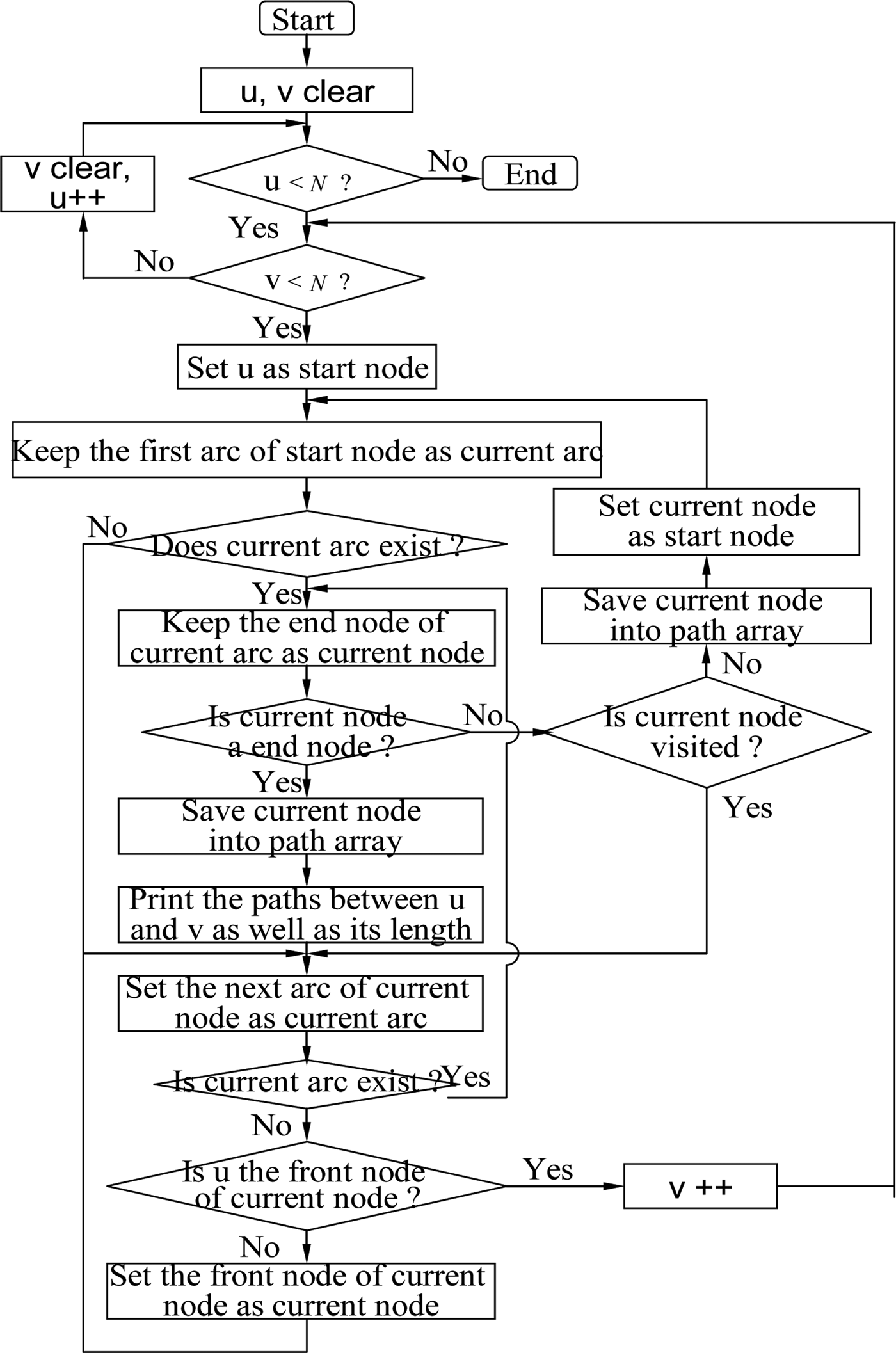
when a dimension is removed. Thus, searching all the simple paths between the two arbitrary dimension nodes from the DCN is a crucial issue in this work. The algorithm for searching all the simple paths from the DCN is designed and is presented in Figure 9. First, the DCN is transformed into an N × N dimension adjacency matrix A, where N is the total number of dimensions in a constraint network, and u and v are used as intermediate variables to describe the start and end dimension nodes, respectively. Second, the first arc of the start node is kept as the current arc, and the end node of the current arc is kept as the current node if the current arc exists. Third, if the current node is not an end node and the current dimension node is not visited, then the current node is written into the path array. Then the current dimension node is set as the start node, and this process is repeated until all the dimension nodes are visited. Through this iterative process, all the simple paths in a current DCN are searched and recorded. The length d
ijp
of each simple path can be calculated as the following:
 $$d_{ijp} = Number(Array_{ij}(\,p)) - 1\comma \eqno \lpar5\rpar$$
where Number is the function of eliciting the total elements in Array ij (p), and Array ij (p) saves all the dimension nodes in the pth simple path between dimensions i and j. The length of the simple path is the basis for calculating the efficiency E(G) of the current DCN.
Algorithm workflow of searching all the simple paths in a dimension constraint network.

The parts are generally the basic units of implementing the product variant design. Thus, dimensions are always simultaneously removed from the DCN nominally after a part implemented variant design. Consequently, the information centrality
 $C_{}^I $
of a part can be extended as the following:
 $$C_{}^I = \displaystyle{{\Delta E} \over E} = \displaystyle{{E(G) - E({G}^{\prime \prime})} \over {E(G)}}\comma $$
where G′′ is the graph obtained by removing all the dimensions belonging to part i from the original DCN and the arcs connected directly to all these dimensions.
Information centrality
 $C_k^I $
and
 $C_{}^I $
specify the information transfer capability of the dimension and part in the DCN from the perspective of informatics. A dimension or a part with a larger information centrality will transmit a larger amount of information to other dimensions when the dimension or the part is identified. Thus, the number of unknown dimensions in the DCN will be decreased dramatically. It is very significant for the management of the product variant design process.
 $C_k^I $
focuses on the single dimension relative to the DCN, while
 $C_{}^I $
aligns with the application requirements of the product variant design.
5. ANALYSIS OF INFORMATION CENTRALITY AND MANAGERIAL IMPLICATIONS
Information centrality reflects the information transfer role of the dimensions or the parts in the DCN. Dimensions with different information centralities may result in different statuses (such as unknown) of other dimensions in the constraint network once they are determined after implementing variant design. Furthermore, it will affect the difficulty of the product variant design process. Thus, information centrality can be used as evidence to reasonably plan the product variant design process. In this work, we use a spherical valve subassembly to explain the applications of information centrality in the product variant design process.
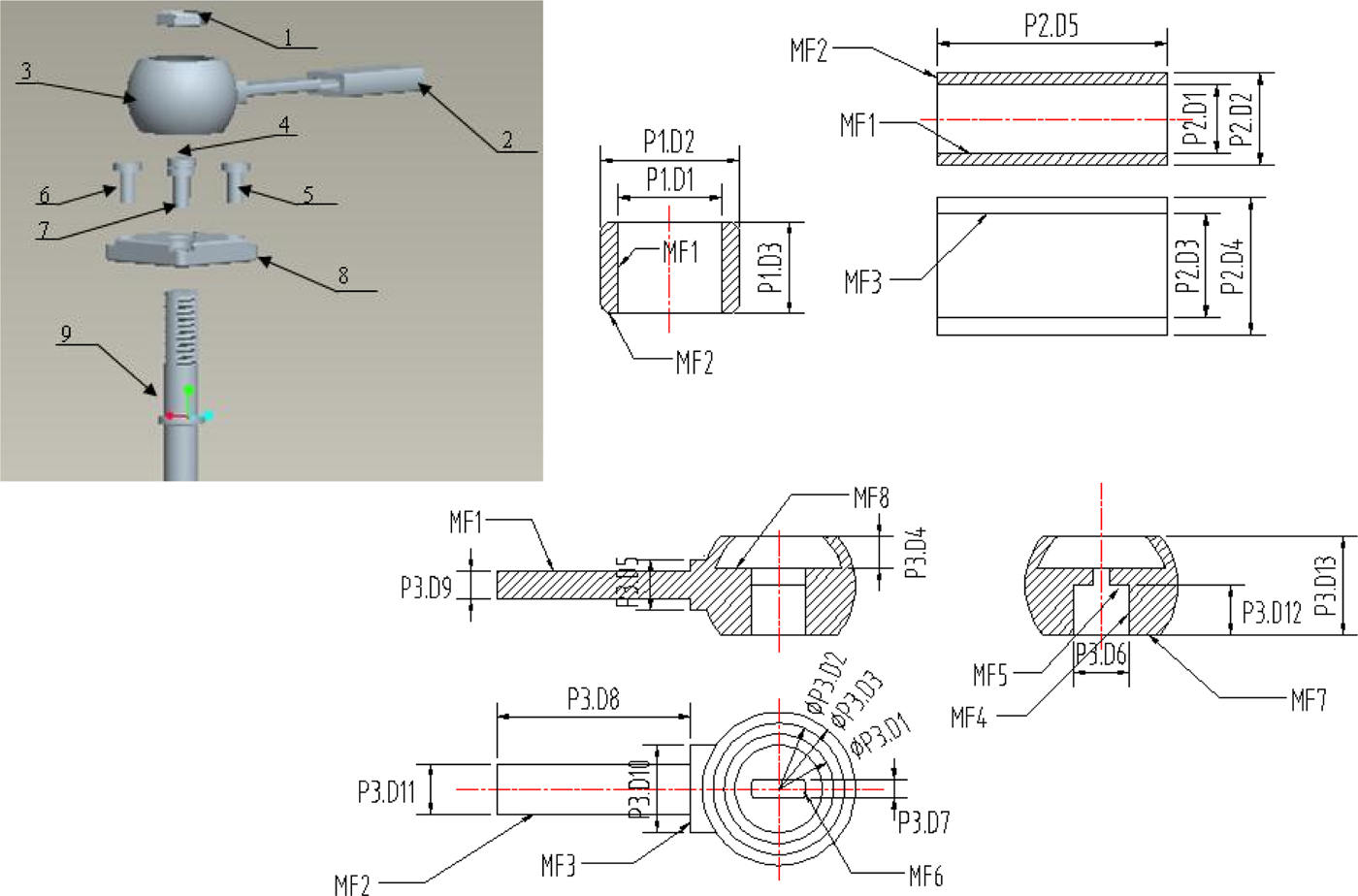
Spherical valve is a kind of fluidic control unit. There are many series of spherical valves from Dayu Flow Control Technology Co., Ltd. (China). Q41F is one kind of spherical valve. Generally, customers can customize a spherical valve based on their production requirements, such as production mode and working load. In order to meet these individual requirements, manufacturers usually modify the existing spherical valve model by implementing variant design to keep the goal of the cost of the customized product and its lead time. Dimension modification is the most common measure to achieve it. The assembly model of this spherical valve and the cross-section of the partial parts are presented in Figure 10, and the mating features of each part and its main dimensions are labeled. The mating features and dimensions of the other parts can also be defined in the same way.
Spherical valve subassembly and its cross-section view (partial).

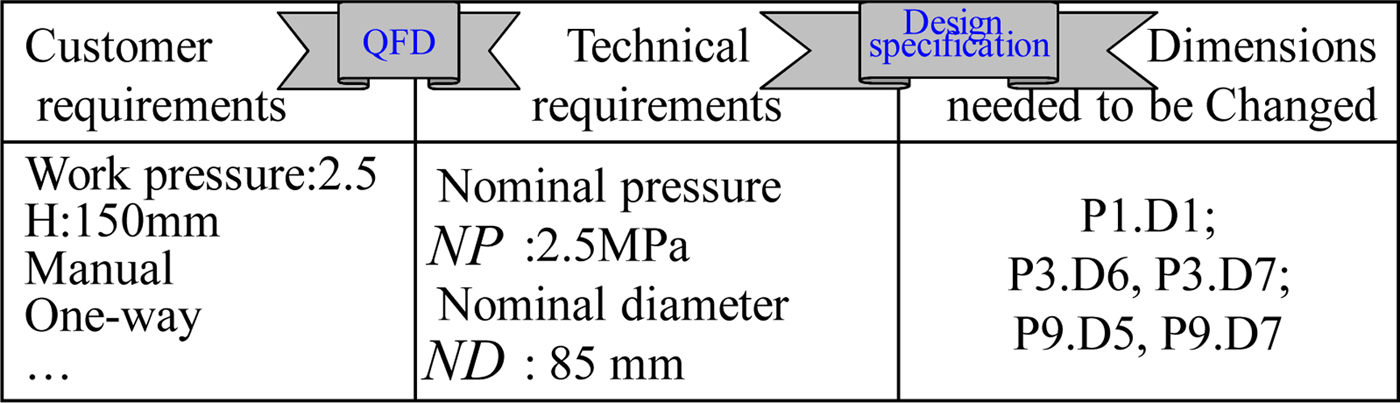
Generally, the individual requirements from customers, based on quality function deployment, can be transferred into a series of technical requirements, and further the dimension modifications of some parts. Figure 11 presents these processes that transfer the customized requirements of spherical valve from customers to the design modification of dimensions of some parts constituting this spherical valve. According to the requirements from customers illustrated in Figure 11, dimensions P1.D1, P3.D6, P3.D7, P9.D5, and P9.D7 should be modified to achieve the individual spherical valve requirements from customers. The modifications of these dimensions may cause a series of dimensions and modifications of other parts that involve in the dimension constraint group (Wang, Reference Wang2001). All these parts need to be implemented in variant design in the end. However, what is the sequence of part variant design is very important to keep the difficulty of implementing the spherical valve variant design minimal. The information centrality provides evidences to achieve it effectively.
Customized requirements from customers and corresponding design specifications of parts.

5.1. DCN of the spherical valve subassembly
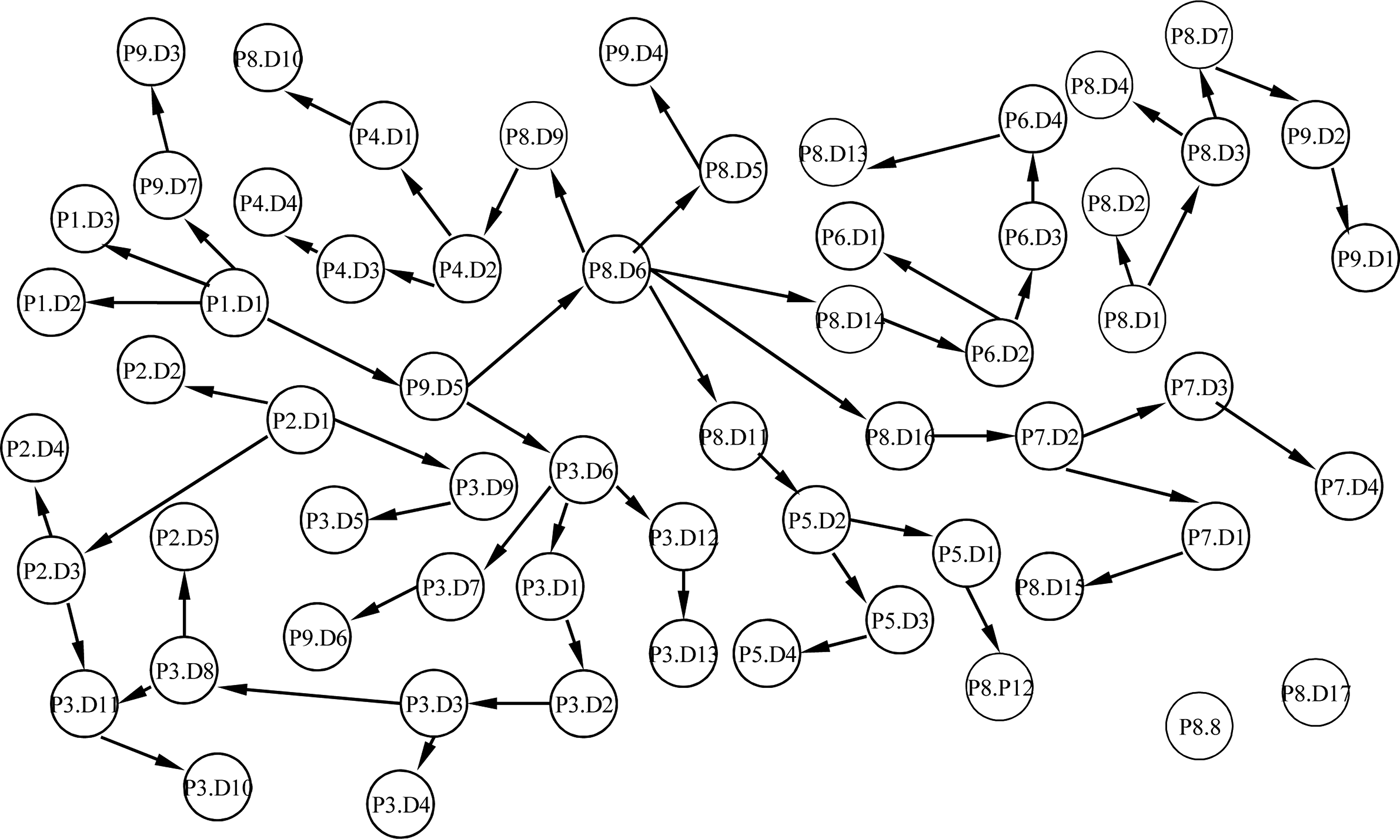
Following the above-mentioned construction method of DCN (Liu & Qi, Reference Liu and Qi2007), we construct the DCN corresponding to this spherical valve as an unvalued directed unweighted graph G with 60 dimension nodes and 57 arcs connecting each 2 dimension nodes. Thereupon, G can be described by the 60 × 60 adjacency matrix ⌊l ij ⌋60 × 60. If a link between dimensions i and j exists, the entry l ij is equal to 1. Otherwise, l ij is equal to 0. The numerical constraint between two dimensions is not given in this work because we focus only on whether or not a constraint between two dimensions exists. The dimension constraints in the inner parts are the main constraint forms, and the dimension constraints among the parts are achieved through the dimensions that correspond to the mating features illustrated in Figure 10. All the dimension constraints form a complex network, as illustrated in Figure 12. The dimension constraints form the basis of our analysis.
Dimension constraint network of a spherical valve.

5.2 Uncertainty of the DCN
On the basis of the informatics theory, the unknown number of dimensions in the DCN leads to the uncertainty of the DCN that causes the difficulty of implementing product variant design. The information transfer in the DCN through dimensions or parts, which could identify some unknown dimensions, will decrease the uncertainty of it. Therefore, the uncertainty of the DCN and its change after part performed variant design can verify the information transfer capability of dimensions or parts during the product variant design process. In this work, the uncertainty of the DCN is defined as follows:
 $$\hbox{U(DCN)} = \sum\limits_{i = 1}^I {\sum\limits_{\,j =} ^J {\Omega _{ij}}}, $$
where U(DCN) indicates the uncertainty of the DCN, which is the total number of unknown dimensions in the DCN; j is the serial number of the dimension in a part; J is the total number of the dimensions in a part; i is the serial number of the part in a product; I is the total number of the parts in a product; and Ω ij indicates whether the jth dimension in the ith part or not. Its mathematical formulation is as follows:
 $$\Omega _{ij} = \left\{ \matrix{1 & \hbox{P}i.\hbox{D}j &\hbox{is }\hbox{unknown}\cr 0 &\hbox{P}i.\hbox{D}j &\hbox{is} \hbox{ known}\hfill\cr}\right. $$
The uncertainty of the DCN provides an index to measure the information transfer effect of parts after it implemented variant design.
5.3. Information centrality of dimension and its correlation analysis
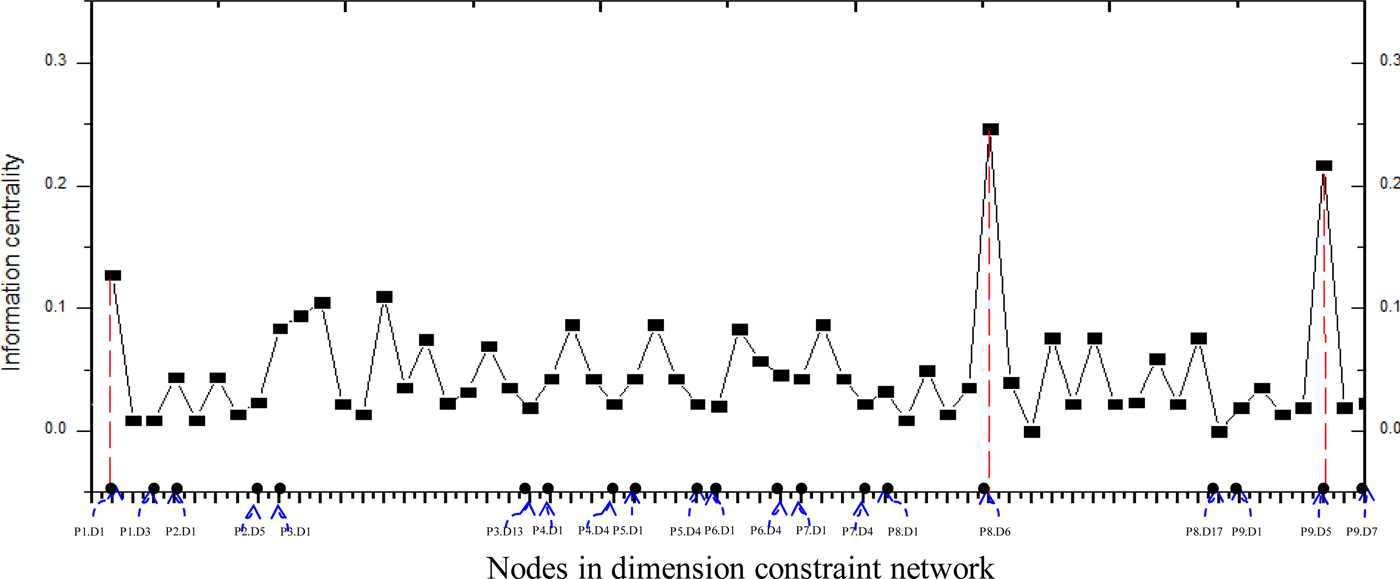
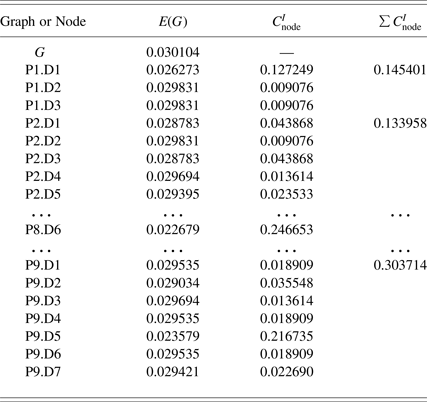
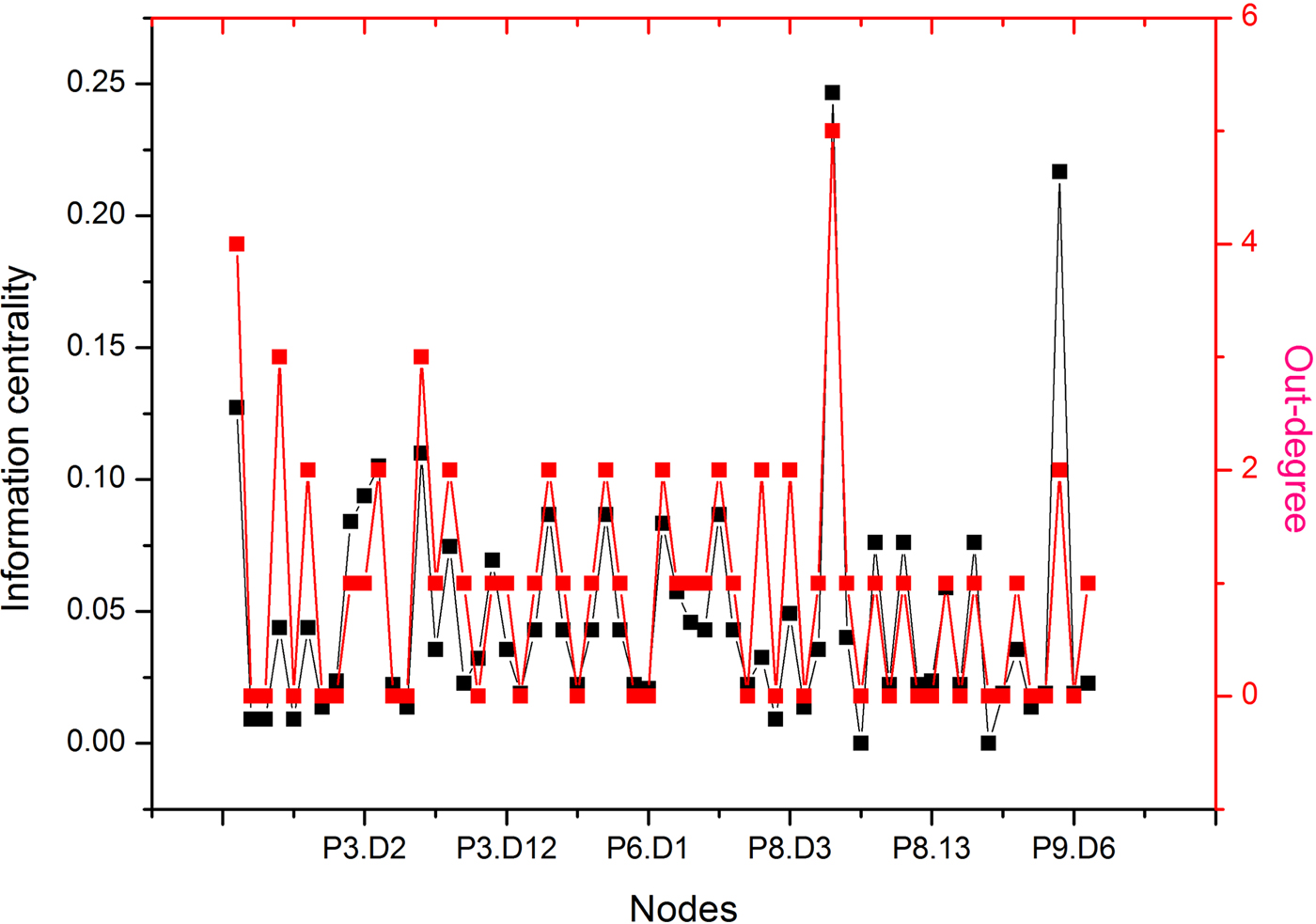
According to the definitions in Section 4, the efficiency and information centrality of each dimension in Figure 12 are calculated, as shown in Table 4, by developing a C++ program module based on the algorithm in Figure 9 and Eqs. (2)–(4). Information centrality reflects the information transfer capability of a dimension during the product variant design process. Thus, information centrality is also a significant index to measure the importance of the dimensions in the constraint network. According to the calculation results, the information centrality
 $C_{}^I $
of each dimension in the constraint network is plotted in Figure 13. The x-coordinate represents the dimension nodes, and the y-coordinate denotes the information centrality
 $C_{}^I $
of dimensions. It can be seen that dimension P8.D6 is the most important dimension in the constraint network from the perspective of variant dimension transfer, followed by P9.D5 and P1.D1 because these dimensions have relatively larger information centralities. Thus, these dimensions should be given more attention during parametric analysis or product modeling to make full use of their information transfer capabilities.
Information centrality of each node in the dimension constraint network.

Efficiency and information centrality of each dimension

We also find that the dimensions with the same number of connected arcs have nearly the same information centrality
 $C_{}^I $
but are not exactly consistent. This result indicates that the information centrality of a dimension is influenced by other factors. Based on this consideration, the correlations between the information centrality
 $C_{}^I $
of each dimension and its in-degree, out-degree and position in the DCN are analyzed, respectively.
The results shown that the information centrality of a dimension is positively proportional to its out-degree illustrated in Figure 14. The Pearson correlation coefficient between the information centrality of the dimension and its out-degree is 0.804. This means that the out-degree of the dimension is the key factor to determine the information transfer capability of the dimension. This provides simple and practical evidence to judge the importance of dimensions in DCN from the perspective of informatics.
Information centrality of dimensions and their out-degrees.

5.4. Information centrality of parts
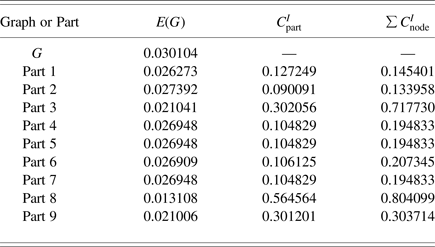
The part is generally the basic unit of implementing product variant design. Thus, calculating the information centrality of a part is more crucial in investigating the product variant design process. It is assumed that the part that had completed the variant design will not participate in the variant design process again. Thus, all the dimensions belonging to this part are nominally removed from the DCN. Therefore, the information centrality of a part can be calculated by measuring the efficiency loss of the DCN when a batch of dimensions is simultaneously removed from it. Based on these steps, the information centrality of each part is calculated, which is presented in Table 5. A summary of the information centrality of each dimension belonging to a part is also given in Table 5. The information centrality summary
 $\sum {} C_{{\rm node}}^I $
of the dimensions is not equal to the information centrality
 $C_{{\rm part}}^I $
of the corresponding part. This observation indicates that information centrality does not meet the linear superposition character. It also means that the influence of the batch removal of dimensions from a constraint network on the information transfer efficiency differs from the summary of the influence of removing a single dimension from a DCN on its information transfer efficiency. Therefore, it is necessary to define the information centrality of a part through the batch removal of dimensions.
Efficiency and its information centrality of each part

5.5. Planning a variant design sequence based on the information centrality
 $C_{\,\bf part}^I $

The information centrality
 $C_{\,\rm part}^I $
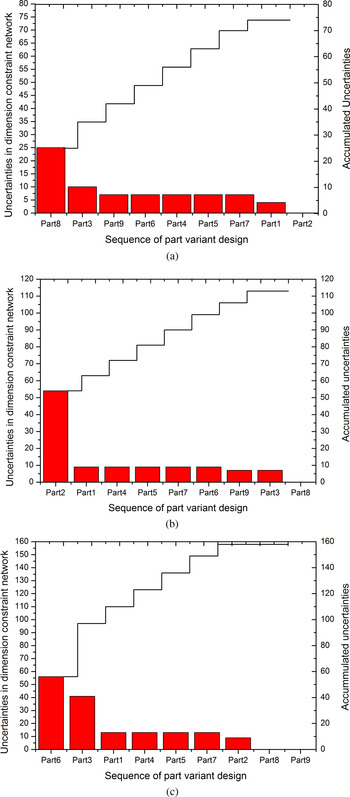
of a part reflects its information transfer capability in the DCN. The larger the information centrality of a part is, the sooner the part should be implemented with variant design to make full use of its information transfer capacity. As a result, the uncertainty of DCN will be eliminated gradually. In addition, the difficulty of implementing product variant design will be decreased also in the end. With these considerations, the variant design sequence of parts constituting a product can be planned based on their information centralities. The sequence of a part variant design and the uncertainty of the DCN caused by removing a part from it are presented in Figure 15. To analyze the validity of planning the sequence of part variant design based on its information centrality, several different sequences of part variant design and corresponding uncertainties of the DCN under these sequences as well as the accumulated uncertainties of the DCN under these sequences are calculated. For example, Figure 15a presents the uncertainty of the DCN under the sequence of descending information centrality of the part and its accumulated uncertainty. The maximal real-time uncertainty of the DCN is less than 25, and the accumulated uncertainty of the product variant design process is less than 75. The maximal real-time uncertainty of the DCN under a random sequence of part variant design is larger than 50, and its accumulated uncertainty is also higher than 110, as shown in Figure 15b. We also calculate the maximum real-time uncertainty of the DCN under an ascending number of dimension constraints, as asserted by some works in the literature. The maximum real-time uncertainty of the DCN is larger than 55, and the accumulated uncertainties of the DCN at this sequence are almost equal to 160, as illustrated in Figure 15c. Obviously, the uncertainty at descending information certainty of a part is the lowest among all the uncertainties and accumulated uncertainties. This result verifies the rationality of planning a part variant design sequence based on descending information centrality. It can minimize the uncertainty of the product variant design process.
Part variant design sequence and its uncertainty state. (a) Sequence of the part variant design: Part8, Part3, Part9, Part6, Part4, Part5, Part7, Part1, and Part2. (b) Sequence of the part variant design: Part2, Part1, Part4, Part5, Part7, Part6, Part9, Part3, and Part8. (c) Sequence of the part variant design: Part6, Part3, Part1, Part4, Part5, Part7, Part2, Part8, and Part 9.

6. DISCUSSION
This paper presents a methodology with insight into the information transfer characteristics of dimensions in a constraint network by introducing the concept of information centrality. Exploring the information transfer capability of a dimension and its influence on the uncertainty of the DCN are important. The results of these analyses provide a basis for planning the product variant design process.
The DCN, constraint structure, and simple path presented in this paper are the foundation for analyzing the information transfer characteristics of a dimension. The natural dynamics of the DCN are identified from two aspects: the status of the dimension and the structure of the DCN. The underlying reason is the modification of information transfer conditions in the DCN. The information transfer capability of a dimension is the key factor.
It is very significant to use the relative loss of information efficiency of the DCN when a dimension is removed from it to measure the information transfer capability of this dimension. It reflects the importance of dimension in a constraint network from the perspective of informatics. Besides, the information transfer capability of a dimension is positively proportional to its out-degree.
Planning the sequence of part variant design based on the information centrality of the parts is recognized as a new method beyond complexity that describes the uncertainty of a current dimension or part. At the same time, we compare the real-time uncertainty of a DCN and its accumulated uncertainty under the sequence of the descending part's information centrality with those of a random sequence of the part variant design, as well as those of a part variant design sequence under ascending dimension constraints among mating parts. The results show that the real-time uncertainty of the DCN and its accumulated uncertainty under the sequence of the descending information centrality of the parts are all lowest. Therefore, a specified product variant design can be implemented with minimal uncertainty. This result verifies the validity of our approach.
Some topics for future work/extensions are the following: dividing the structure of the DCN based on the interdependent characteristics among dimensions, identifying the priority of the dimension constraint satisfaction based on the importance of the dimension in a constraint network, analyzing the performance and cost of the product variant design process based on the sequence of part variant design generated from our research results, and developing a dynamic increment batching removal framework. These issues are crucial in enhancing and verifying the practicability of the methods in this work.
7. CONCLUSIONS
Product variant design is one of the key enabling technologies to achieve the goal of mass customization. The process of product variant design is essentially the transfer of variant information in a DCN among mating parts from the perspective of informatics. The dimensions of a part, which are the elements that comprise a DCN, directly conduct the information transfer task during the product variant design process. The information transfer capability of a dimension has significant effects on the product variant design process, such as uncertainty. Therefore, investigating the information transfer characteristics of dimensions is very important for insight into the product variant design process from the perspective of informatics.
This study discusses the issues about the information transfer capability of dimensions and its influence on the information efficiency of the DCN during the product variant design process. From the perspective of informatics, the status of a dimension and the structure of the DCN change during the product variant design process because of the modification of the information transfer form under the assumption that once a part has completed variant design, all its dimensions would not participate in the information transfer task again.
Based on the simple path, the information centrality of a dimension is defined by measuring the efficiency loss of the DCN when the dimensions are removed from it. The information centrality of a part is also defined by simultaneously removing the dimensions of a part that implement the variant design from a constraint network. The information centrality of dimension and that of a part reflect the importance of that dimension and part at the dimension level and part level, respectively, from the perspective of informatics. The potential significance of these practices depends on the fact that these methods provide the management support to keep the uncertainty of implementing product variant design minimal. With these considerations, an approach to planning the sequence of a part variant design based on the descending information centrality of a part is proposed. This approach is verified by comparing the uncertainty of the DCN under the part variant design sequence with that of other part variant design sequences. It is a novel strategy for managing the product variant design process.
ACKNOWLEDGMENTS
We are grateful for the support of this work by grants from the Natural Science Fund of China (51175486, 51379198, and 51405462), the Zhejiang Province Fund of Natural Science, China (LY16G010006), and the Zhejiang Province Fund of Application Technology Research for the Public, China (2014C31117). We also acknowledge Dr. Rong Xiang for developing the simple path algorithm program and scholar Yangke Ding for processing the graph and data in this work.
Xinsheng Xu is an Associate Professor in the Institute of Industrial Engineering at China Jiliang University. He obtained his MS in mechanical engineering from Hubei University of Technology and his PhD in mechanical engineering from Zhejiang University. Dr. Xu's research interests include mass customization, advanced manufacturing technology, and computer integrated manufacturing.
Tianhong Yan is a Professor in the Institute of Mechatronics Engineering at China Jiliang University. He obtained his PhD in mechanical engineering from Harbin Institute of Technology. Dr. Yan's research interests include precision engineering and advanced manufacturing technology.
Yangke Ding is an undergraduate student in the Institute of Industrial Engineering at China Jiliang University. His research interests include mass customization and computer integrated manufacturing.