By demonstrating the value added by creating a canvas painted with the voices of art educators framed within scientific research, this study fills a significant gap in the academic literature. John Sabraw's (Reference Sabraw2013a, Reference Sabraw2013b, Reference Sabraw2013c) artwork uncovers this gap in the academic literature through his paintings and environmental work, which is framed within art and scientific scholarly research. The works of artist and educator Sabraw depict the interdisciplinary synergistic work of the arts and sciences working in a coordinated effort to both clean the water from contaminated coal mine runoff while simultaneously creating pigments for painting from the toxins in the water. Sabraw's work presented in Figures 1 and 4 (images #1 and #2) were created from Ohio University's collaborative research, which was influenced by Sabraw's decision to incorporate more sustainable practices in his studio, life, and public matters. His painting methods coax reciprocity and synthesis over a period of several months, resulting in enigmatic paintings that achieve a harmony between the constrained and natural processes. Sabraw's works come from a personal desire for sustainability and a research perspective focused on the dangers associated with environmental degradation. Integrated practices such as Sabraw's and the scientists at Ohio University work in a unified pursuit to clean the water from the contaminated abandoned coal mines’ water runoff by removing toxins, which are then turned into pigments for Sabraw's artwork. Production of these pigments for other artists holds the potential to draw attention to the toxins in the water as well as to fund the cleaning of contaminated watersheds. The United Nations, scientists, and many arts educators (e.g., teaching dance, drama, visual arts, music, media arts, music) concur that environmental degradation is one of the largest threats facing the world today (Anderson & Guyas, Reference Anderson and Guyas2012; Blandy & Fenn, Reference Blandy and Fenn2012; Drijfhout et al., Reference Drijfhout, Bathiany, Beaulieu, Brovkin, Claussen, Huntingford and Swingedouw2015; Nadius, Reference Nadius2009; Penuel, Stapler, & Hagen, Reference Penuel, Stapler and Hagen2013). Unfortunately, conventional techniques (e.g., lobbying the government, advertising) to bring about environmental stewardship and environmental literacy have been ineffective in changing negative environmental behaviours (Anderson & Guyas, Reference Anderson and Guyas2012; Blandy & Fenn, Reference Blandy and Fenn2012; Eisner, Reference Eisner2002; Nadius, Reference Nadius2009; Ross, Reference Ross2002). This exploratory empirical study was designed to examine K-12 educators’ perceptions of the value of eco-arts as social change agents, their level of desire to integrate eco-arts into K-12 arts education curricula, and their perceived barriers to integration.
Image No. 1.

This study highlights the impact of standardisation of the K-12 education core curricula on arts education. The majority of U.S. public schools are standardising the creativity of students, silencing the arts’ ability to become an expressive vehicle for social change, and limiting future generations’ ability to find creative solutions to environmental problems. As Dewey (Reference Dewey1934), Froebel (Reference Froebel1899), Montessori (Reference Montessori1917), and Pestalozzi (Green, Reference Green1905) documented, students’ hands-on involvement in learning through the arts and play is critical for them to find their place in this world and the environment, and in cultivating their self-knowledge (Niland, Reference Niland2009). Stifling environmental education does a disservice to the world and students by disconnecting them from the reality they will inherit. When children are treated as ‘capable’, they develop the self-efficacy needed to become the change makers and critical thinkers the world relies on to solve future issues. Students feel empowered when they are given the opportunity to solve problems and to contribute in a positive manner. To achieve these goals, specifically in environmental education, Cutter-Mackenzie, Edwards, Moore, and Boyd (Reference Cutter-Mackenzie, Edwards, Moore and Boyd2014) suggest a shift from unstructured pedagogically themed play toward a reciprocal educator-student specific inquiry and reflections during play-based learning (p. 19). Several ways of being a positive agent of change are by working to create art from upcycled or recycled or repurposed materials; creating art for other children in ecologically damaged areas to show empathy across the miles; and to be innovative by turning trash into treasures, to change a seemingly hopeless situation into a hopeful one (Stevenson & Dillon, Reference Stevenson and Dillon2010). As arts are reduced or removed from K-12 education, the impact on students’ abilities to creatively solve problems is diminished (Smith, Reference Smith2009). Rather than survey the typically hands-off administrators, this study surveyed 76 hands-on arts educators located in south-eastern United States. These educators were asked to identify what they believe about standardisation's impact on future generations of critical thinkers. Further, their viewpoints were explored to find out the extent of their interactions with a relatively new form of arts education (i.e., eco-arts education) in the K-12 classrooms and their desire to integrate eco-arts into their curricula. Additionally, the researchers sought to learn both the barriers to and opportunities for integrating eco-arts into the already anaemic arts curricula across the United States. Thus, this exploratory empirical research study examined the critical literature on the role of the arts and arts education as illuminators of culture and as agents of social change.
Literature Review
Definitions for arts education used in this study draw upon four streams of influence on how arts education is informed by: (1) expressionism (i.e., a vehicle of expressive and imaginative work; Dewey, Reference Dewey1934); (2) reconstructionism (i.e., transforming individuals and society; Efland, Reference Efland1990); (3) scientific rationalism (i.e., understanding arts education in relationship to knowledge through aesthetic experiences or cognitive functions; Dewey, Reference Dewey1934; Efland, Reference Efland1990; Eisner, Reference Eisner2002); and (4) 21st century postmodernism (i.e., a view of the arts as an agent for positive change; Nadius, Reference Nadius2009; Ross, Reference Ross2002). The researchers hold that irrespective of subset definitions, arts education's role in educating society is best viewed as an integrated approach and not isolated from the very society it intends to serve.
For the purpose of this study, eco-arts education is defined as environmental education integrated with arts education as a vehicle for increasing the understanding of and contact with environmental issues, including environmental literacy, environmental stewardship (i.e., environmental responsibility), and sustainability (Inwood, Reference Inwood2008; Nadius, Reference Nadius2009). Environmental stewardship is defined as ‘the responsibility for environmental quality shared by all those whose actions affect the environment’ (U.S. EPA Office of Policy, 2016). Orr (Reference Orr1992) defined environmental literacy as ‘a way of thinking about the world regarding its interdependent natural and human systems, including a consideration of the consequences of human actions, and interactions within the natural context’ (p. 155).
Before the written word, the arts were the primary means of creatively educating others about opportunities for commerce and elements of the surrounding environment and of preserving worldviews for future generations. The arts have been viewed as a medium for sharing and influencing cultures between societies (Belfiore & Bennett, Reference Belfiore and Bennett2006; Curtis, Reid, & Reeves, Reference Curtis, Reid and Reeve2014; Frock, Reference Frock2013) and as a valuable means of communication about societies’ dominant discourses (Belfiore & Bennett, Reference Belfiore and Bennett2006; Frock, Reference Frock2013). It has been shown via research that early exposure to arts education and continued exposure to the arts can create a lifetime of original thinking and problem solving in an individual that can help them in all their future endeavours (Children's Music Workshop, 2006; Dewey, Reference Dewey1934; Eisner, Reference Eisner2002). Arts education is known to improve motivation, concentration, confidence, and teamwork (Smith, Reference Smith2009) and to provide students with new ways of thinking about knowledge gained in science, technology, engineering, and math (STEM) subjects, opening them to new ways of applying knowledge in significant ways as agents of change. Studies of the brain have confirmed that human intelligence is extremely complex and contains many facets (Colom, Karama, Jung, & Haier, Reference Colom, Karama, Jung and Haier2010). One's knowledge of the world is formulated through sight, touch, sound, and movement (Dewey, Reference Dewey1934; Eisner, Reference Eisner2002; Robinson Reference Robinson2001). Humans learn about their world audibly, tangibly, and visually through the arts, including music, dance, architecture, technology, theatre, while forming relationships, beliefs, and values (Dewey, Reference Dewey1934; Robinson, Reference Robinson2001). Students become well-rounded adults through arts education and can think critically and independently to solve problems, including problems pertaining to current and future ecological degradation (U.S. Department of Education, 2012).
As an educational tool, arts education has the ability to elicit innovative and visionary answers to issues the world faces (Dewey, Reference Dewey1934; Eisner, Reference Eisner2002; Ross, Reference Ross2002). Nevertheless, K-12 U.S. schools are focused on the No Child Left Behind (NCLB) Act of 2001 (U.S. Department of Education, 2001) and most recently on Obama's 2009 Educate to Innovate initiative emphasising STEM (The White House, 2013). There has been a steady decline in exposure to arts (e.g., the number of courses offered in K-12, amount of time allotted for the arts, fewer arts-related field trips, and so forth) in both public and private US K-12 schools over the past two decades (Eisner, Reference Eisner2002; IES National Center for Education Statistics, 2008). Resources continue to be reallocated toward STEM disciplines and away from arts education, hence away from possible eco-arts education. The reduction of arts education in grades K-12 has decreased the tools available to students to further develop their creativity through artistic, intellectual, and kinesthetic experiences provided by the arts (Eisner, Reference Eisner2002; Robinson, Reference Robinson2006). Some outcomes of this shortsighted, standardised curricula and the decrease in arts education offerings result in reductions of students’ divergent thinking skills and diminishes their capacity for innovation, which is needed to find answers to questions and even questions we do not currently know exist (Eisner, Reference Eisner2002; Robinson, Reference Robinson2006). Education in which the arts are part of the learning experience sparks innovative thinking and original problem solving that enables people to think creatively and frees them from the status quo mentality offered within the core curriculum (Garrett, Reference Garrett2010). In this failing model of education, arts education does not fit in the bottom line economic approach to schooling (IES National Center for Education Statistics, 2008). Although the bottom line economic (i.e., profitability) model approach may temporarily solve school budget issues, it is far from the best option for students and society in the long run. In fact, it is counterintuitive to exclude arts education from STEM because, as Smith (Reference Smith2009) explains, ‘involvement in the arts is associated with gains in math, reading, cognitive ability, critical thinking, and verbal skills’. Arts education provides students with new ways of thinking about knowledge acquired in STEM subjects, opening them up to new ways of applying knowledge in significant ways as agents of change; therefore, the arts should be part of the core curricula (STEAM, not STEM). The work of artist John Sabraw and scientists at Ohio University highlighted in this article provide an excellent example of how the arts and sciences can work together toward a more sustainable world.
Thus, as an educational tool, arts education offers students the ability to find innovative and visionary answers to the environmental issues the world faces (Dewey, Reference Dewey1934; Eisner, Reference Eisner2002; Marks, Reference Marks2015; Ross, Reference Ross2002). Human beings have an incredible ability to create culture through which all living beings can thrive and grow; thus, with increased eco-arts education, a pro-environmental culture can be created (Lehtonen, Juvonen, & Ruismaki, Reference Lehtonen, Juvonen and Ruismäki2014; Robinson, Reference Robinson2001).
Eco-arts education provides students, educators, and community members with tools to tackle multifaceted scientific issues in the ecosystem and create environmental awareness, create positive environmental behavioural changes, spread environmental literacy, increase sustainability initiatives, and bring insight into environmental problem solving (Chiarotto & Leman, Reference Chiarotto and Leman2011; Curtis, Reference Curtis2010; Marks, Reference Marks2015; York, Reference York2014). Eco-arts education is a relatively new form of artistic expression that empowers individuals to creatively address the growing problems associated with environmental degradation (Orr, Reference Orr1992; Robinson, Reference Robinson2001; Ross, Reference Ross2002; Smith, Reference Smith2009). Eco-arts education holds the potential to help achieve P21 (Partnership for 21st-century learning) goals, including arts education, creativity, global awareness, and environmental education, which recognise the roles of both the arts and sciences in problem solving (National Education Association, 2002). Unfortunately, by 2016, only 16 U.S. states had engaged in P21 (Bishop, Reference Bishop2016).
The arts are a means of expanding students’ minds, including ideas from other cultures (Dewey, Reference Dewey1934; Efland, Reference Efland1990; Eisner, Reference Eisner2002; Marks; Reference Marks2015; York, Reference York2014). The arts are not only integral to the U.S. culture; they have and continue to be agents of change within all societies. Eisner (Reference Eisner2002) wrote:
The arts liberate us from the literal; they enable us to step into the shoes of others and to experience vicariously what we have not experienced directly. Cultural development depends on such capacities, and the arts play an extraordinarily important role in their contribution to such an aim. (p. 10)
Arts education programs, including eco-arts education, are an integral part of the K-12 curriculum (Ross, Reference Ross2002; Weintraub, Reference Weintraub2012). By using eco-arts as a conventional form of communication, individuals are able to move through recognition of something they have learned, towards making cultural changes for the betterment of society over time (Dewey, Reference Dewey1934; Marks, Reference Marks2015; Robinson, Reference Robinson2006; York, Reference York2014).
Although eco-arts are somewhat new in the history of the arts, they have gained traction since the 1960s and are now a well-established genre of the arts (Weintraub, Reference Weintraub2012). Editors Kastner and Wallis (Reference Kastner and Wallis1998) and author Weintraub (Reference Weintraub2012) explored a range of major artworks that are relevant to the field of eco-arts: They range from Robert Smithson's 1968 Earth Projects and Spiral Jetty, 1970 to literary art such as Alexis De Tocqueville's Journey to America in 1960 and land art that includes Walter De Maria's 1977 Lightning Field, Nancy Holt's 1973–76 Sun Tunnels, and Ant Farm's Cadillac Ranch in 1974; to an ecological space for dance, theatre, and community arts by Bonnie Ora Sherk's 1975–76 Crossroads Community and natural sculptures such as Andy Goldsworthy's Ice Piece in 1987. Recent eco-artists include YouTube rap and spoken word artists Earth Guardian Crew (e.g., ‘Indigenous Roots’ and ‘What the Frack’) Prince Ea (e.g., ‘Why I Think This World Should End’) and Xiuhtezcatl Tontiuh Martinez (e.g., ‘Spoken Word for the World’). These eco-artists use their voices to deconstruct the dominant consumerist culture and to create a vision of what the future may look like in the Anthropocene era (a term coined by ecologist Eugene Stoermer in 1980, meaning an informal geological chronological term for the proposed epoch that began when human activities had significant global impact on the earth's ecosystem [Trischler, Reference Trischler2016]) if the world continues along the current destructive trajectory (Dieleman, Reference Dieleman, Kagan and Kirchberg2008; Nadius, Reference Nadius2009; Pollak & MacNabb, Reference Pollak and MacNabb2000; Weintraub, Reference Weintraub2012). Other eco-artists portray a future with environmental literacy and stewardship as the prevailing culture (Curtis, Reference Curtis2010; Curtis et al., Reference Curtis, Reid and Reeve2014; Weintraub, Reference Weintraub2012).
The development of environmental literacy through eco-arts is a valuable approach to introducing students to the beauty of nature as well as to environmental concerns (Blandy & Fenn, Reference Blandy and Fenn2012; Dewey, Reference Dewey1934; Inwood, Reference Inwood2008; Nadius, Reference Nadius2009; Weintraub, Reference Weintraub2012). Blandy and Fenn's (Reference Blandy and Fenn2012) article addressed arts and sustainability as a path for teaching an interdisciplinary curriculum on environmental literacy, environmental stewardship, sustainability, and their challenges. They agree that sustainability is, in fact, one approach to teaching about the ecological crises and is useful pedagogically for understanding systemic responses to environmental concerns. Their claims are reiterated in a study by Curtis et al. (Reference Curtis, Reid and Reeve2014) in which researchers found evidence that the arts have a positive impact on pro-environmental behaviours, help to form pro-environmental social norms, and could assist in building communities in pro-environmental actions, resulting in better stewardship. Arts by their very nature encourage personal engagement and sustained attention with the work of art and the surroundings. The arts assist in facilitating learning about new concepts such as environmental literacy and sustainability since the participants viewing the art actively participate and are able to make meaning of complex subject matters through the arts (Curtis, Reference Curtis2010; Curtis et al., Reference Curtis, Reid and Reeve2014).
Robinson (Reference Robinson2001) proposed that arts education, as a contributor to long-term problem solving, may be the answer to the shortcomings of traditional methods of social change; in this case, ecological issues. Traditional attempts to positively affect environmental literacy and environmental stewardship have not significantly affected environmental behaviours; for example, 71% of U.S. consumers in 2013 considered, but not necessarily acted upon, the environment when making purchases, up only 5% from 2008 in spite of extensive traditional efforts (e.g., ads, laws, promotions) made to bring awareness to the need for changing behaviours (Dailey, Reference Dailey2013). In the United States in 2009, only 34% of citizens recycled the waste they created. This statistic means that another 161 million tons of material (3 pounds per capita per day) were thrown into landfills in 2009 despite the 9,000 curbside recycling programs, proving that recycling was not being utilised to its fullest potential (KAB.org, 2009). The Environmental Protection Agency (EPA) estimated that 75% of solid waste is recyclable; however, only about 30% made it into the recycling process in 2014 (Green Waste, Reference Waste2014). Since traditional methods for improving environmental stewardship are not working, eco-arts education could provide an additional avenue for changing existing paradigms and offer hope for a cultural shift toward more environmentally responsible behaviours.
Learning about eco-arts in a child's early years (grades K-12) has the potential to foster environmental literacy and environment stewardship in which the child has the ability to think outside the box and thus create a cultural shift in society (Chiarotto & Leman, Reference Chiarotto and Leman2011; Inwood, Reference Inwood2008). The inclusion of holistic and positive lesson plans that scaffold and integrate environmental education and arts education have the capability to create a new environmentally responsible culture within a population that influences positive social change as to societies’ view of biophilia (i.e., the affinity of human beings for other life forms), and resource management (Marks, Reference Marks2015; Ward, Reference Ward2010). Resource management views trash as treasure and waste as avoidable through repurposing, reducing, recycling, and reusing materials. Positive changes to environmental attitudes across cultures are also perpetuated in eco-arts education through the depiction of complex environmental issues that are accessible to ‘lay’ people outside the science community (Curtis, Reference Curtis2010; Curtis et al., Reference Curtis, Reid and Reeve2014); through acts of revaluing parts of the natural world (Curtis, Reference Curtis2009); by strengthening recognition of the value of the natural environment; and by eliciting empathy for the beauty of all life (Curtis, Reference Curtis2009; Marks, Reference Marks2015; McKnight, Reference McKnight2010; York, Reference York2014).
Culture exists on multiple levels (e.g., individual, family, group, local, regional, national, global). At the societal level, culture includes mainstream norms, beliefs, attitudes, and behaviours found within a society. Individual culture involves participation in the values, beliefs, and behavioural tendencies of the culture, although individuals’ cultural values and norms may or may not be the same as those held by the larger society's culture in which they reside (Triandis, Reference Triandis1995). Cultural fit accounts for the significance of cultural context and the importance of person-situation interaction with one's culture. Culture has been defined in many ways. Nakata and Huang (Reference Nakata and Huang2002) define culture as a system made up of inner elements (i.e., history, identity, beliefs, values, and work view), cultural activities (i.e., roles, art, expression, communication patterns, rules and customs, technology, and material culture), and cultural systems (i.e., religion, politics, economics, law, health, family, education, work, and social organisations). Hofstede (Reference Hofstede2001) views culture as a ‘collective programming of the mind that distinguishes one group of people from another’ (p. 9). Others define culture as the statistical distribution that shapes individuals within a group's behaviour consisting of beliefs, values, and modes of thinking such as notions of fairness (Ferraro & Cummings, Reference Ferraro and Cummings2007). Similarly, Matsumoto (Reference Matsumoto2000) defines culture as:
A dynamic system of rules — explicit and implicit — established by groups in order to ensure their survival, involving attitudes, values, beliefs, norms, and behaviors, shared by a group but held differently by each unit within a group, communicated across generations, relatively stable but with the potential to change across time. (p. 24)
It is reasonable to assume, to some extent, that individuals differ from societal norms on any given dimension of culture. Therefore, conceptualising culture at the individual level may not be appropriate or productive when examining sociological relationships that exist between humans and the natural world (Lu, Reference Lu2006). For the purpose of this study, culture is defined by Matsumoto's (Reference Matsumoto2000) definition as it pertains to ensuring survival.
Due to the current rate of environmental degradation, measures must be taken to address environmental literacy, environmental stewardship, and sustainability from several angles. One way of dealing with these issues is through arts education. Per Blandy and Fenn (Reference Blandy and Fenn2012), the field of arts education must engage with these concepts, wherein culture is integral with eco-cultural logic if cultural capital is to be effective (i.e., one in which community cultural development is interwoven into the economic and social development promoting livable and sustainable communities; Blandy & Fenn, Reference Blandy and Fenn2012; Bourdieu, Reference Bourdieu1989). The effectiveness of this philosophy has been seen through crafts activists’ work to create social change as reflective contributors in participatory democracy (Garber, Reference Garber2013). Baudrillard (Reference Baudrillard and Lotringer2005) stands out by holding to philosophy in which the arts are a force that reaches the masses, discrediting falsehoods and myths. Baudrillard does not argue against the arts as a change agent only as a means for truths or falsehoods. The arts expose myths and falsehoods of current discourse and offer opportunities for viable solutions to reverse the misconceptions that lead to environmental degradation of natural resources while promoting conservation that influences cultural change. Historically, artists have been the culture keepers and societal commentators (Nadius, Reference Nadius2009). Human beings have an incredible ability to create their culture through which all living beings can thrive and grow (Eisner, Reference Eisner2002), especially when pedagogy challenges the Anthropocentric view (i.e., humankind is considered the central element of existence), decentres human beings, and emphasises the holistic view of interdependence with the ecosystem (Taylor & Pacini-Ketchabaw, Reference Taylor and Pacini-Ketchabaw2015).
From the research literature examined, we determined that eco-arts education has a significant potential to influence cultural change as it relates to environmental literacy and environmental stewardship, resulting in increased sustainability. Although eco-arts education has been shown to have many benefits as a social and cultural change agent, it is important to determine whether educators see its benefits and, if given a chance by their schools, have the desire and financial resources to integrate it into their curricula. For the purpose of the study, it was also important to determine whether respondents were familiar with terminology relevant to this study. Therefore, this study empirically examined R1: ‘Do the majority of art educators (K-12) desire to integrate environmental stewardship and environmental literacy through eco-arts into the curriculum, and if so, why; if not, why not?’; and R2: ‘What are the most significantly perceived challenges for arts educators who desire to integrate environmental stewardship and environmental literacy through eco-art into the curricula?’
Methodology
A self-report, online survey instrument was designed specifically for arts educators (i.e., respondents) to inquire into their desire to integrate environmental stewardship and environmental literacy into the class curriculum through the eco-arts, the challenges they face in doing so, and the resources needed. Self-report is appropriate for this type of study as respondents are knowledgeable about their personal attitudes, beliefs, and behaviours. A quantitative study was used to provide generalisability of the findings to a larger population. The survey instrument contained both quantitative (i.e., forced choice) and qualitative (i.e., open-ended) questions that addressed the ‘why’, adding depth to the quantitative question responses asked in the study.
Prior to the current study, in order to ensure that the survey instrument met face validity, it was pilot tested on a group of 10 art educators from the south-eastern United States. All recommended changes were investigated, and if determined by the researchers as adding validity to the survey instrument, then appropriate changes were made.
A randomly selected sample of participants was obtained from the membership database of the National Art Education Association (NAEA; a representative population of arts educators). An online survey was sent electronically to 350 arts educators in the United States as potential respondents. A total of 76 respondents completed the questionnaire instrument, creating a response rate of 22%.
The survey provided the respondents with a consent form and confidentiality agreement (i.e., the choice to sign electronically and remain anonymous). The survey consisted of 33 scale items: 4 nominal (e.g., ‘Do you as an educator want to include environmental stewardship and environmental literacy into your curriculum?’); 2 open-ended (e.g., ‘What are the challenges when attempting to use eco-arts supplies?’); 7 mark all that apply (e.g., ‘If you are not currently integrating environmental stewardship into your curriculum, what are the barriers that keep you from including environmental lessons into your current lesson plans?’); 13 knowledge scale items (e.g., ‘What is your level of knowledge of the meaning of the following terms: Earth Art, Earthworks, Eco-Art, Ecocentrism, Ecovention, Environmental Art, Green Art, Green Washing, Land Art?’ 1 = no knowledge, 2 = some knowledge, 3 = knowledgeable, 4 = extremely knowledgeable) and 7 demographic (e.g., ‘How many years have you been an educator?’). For the purpose of this study, an educator was defined as K-12th-grade educators. Thirteen of the 33 scale items had the option to provide ‘other’ details (e.g., ‘Why might you or might you not want to integrate environmental stewardship and environmental literacy into your curriculum?’) to clarify the respondents’ answers to forced choice questions.
The open-ended questions and the 13 scale items with the option of other were analysed through content analyses by examining recurrent overarching categorical themes and reduced to smaller categories where appropriate. The quantitative scale items were analysed using SPSS® statistical software.
To remove confusion as to the central concepts in the survey, definitions of environmental terminology were provided in strategic locations throughout the survey instrument.
Analyses and Findings
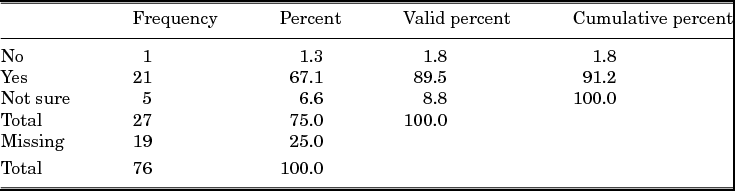
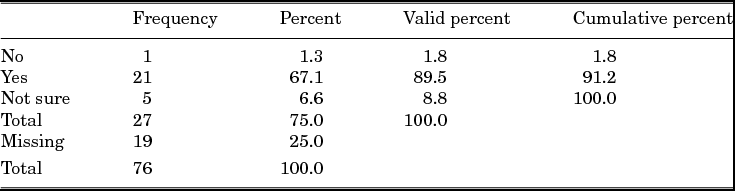
To measure R1, a frequency analysis using SPSS® was conducted (n, 76). The analysis revealed that 89.5% of the respondents reported that they were in favour of integrating environmental stewardship and environmental literacy into their curriculum. See Table 1 for details.
Frequency Analysis: Integrating Environmental Stewardship and Environmental Literacy Into the Curriculum
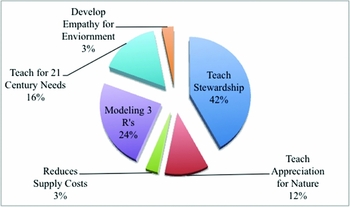
Once it was established that the majority of respondents were in favour of integrating environmental stewardship and environmental literacy through eco-arts education into the curricula, a content analysis (n, 58) of responses to the question, ‘Why would you like to integrate environmental stewardship and environmental literacy into your curriculum?’ revealed six discrete categories (Figure 2). The content analysis revealed that 42% of respondents identified ‘teaching environmental stewardship’ for why they want to engage in this curricular change. These findings support R1.
Reasons for integration of environmental stewardship and environmental literacy into the curriculum.

R1 was also supported by many of the respondents who reported that they valued eco-arts education as an environmental change agent and expressed their desire to take an integrative approach to environmental stewardship and environmental literacy in the arts curricula. One respondent said, ‘With the planet in dire need of any and all assistance, I believe it is my duty as an educator and artist to bring my students to environmental and activist awareness.’ Another respondent explained:
Integrating stewardship and environmental literacy into the curriculum allows my students to connect their art world with the world in which they live. As students make sense of the world, educators can provide linking opportunities that are tangible, visible, and meaningful. Curricula that support and encourage environmental stewardship may possibly generate the feeling of ownership (our world) as well as demonstrate cause and effect — a life lesson.
A third respondent stated, ‘It is important to include environmental literacy into our arts curriculum so that children become more aware of the world in which they live. Awareness can bring love of our environment and with that comes a sense of responsibility to nurture and protect it.’ A fourth stated:
I feel environmental understanding and more specifically understanding of the world around us is extremely important to the wellbeing of the individual, collective, world, universe, etc. Understanding of nature is the bases of where all knowledge comes from so it is important to reconnect humanity to that understanding without the fragmentation, disconnect, and confusion that is felt in regard to nature currently; which is reflected in all of our actions in regard to the world around us.
This response clearly identifies with Smith's (Reference Smith2009) statement, ‘involvement in the arts is associated with . . . cognitive ability, critical thinking, and verbal skills’.
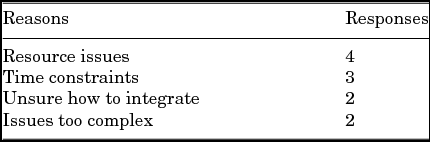
Multiple scale items addressed R2 to identify perceived barriers to integrating environmental stewardship and environmental literacy (eco-arts) into the arts curricula. One scale item asked the respondents why they would or would not integrate environmental stewardship and environmental literacy (eco-arts) into their curriculum. From a content analysis of 11 responses to this question, four discrete categories were exposed. The top reason was resource issues. See Table 2 for details.
Reasons for Barriers to Integrating Environmental Stewardship and Environmental Literacy Into the Curriculum
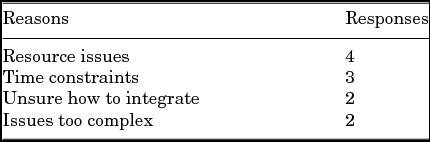
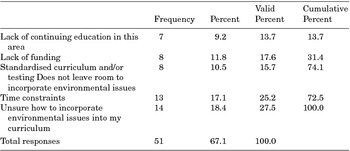
Further, respondents were asked whether they integrate environmental stewardship into their arts curriculum. Of the 21 who responded that they did not, they chose from a list of potential barriers identifying those that were significant to them. Their responses were analysed with a frequency analysis using SPSS®. Table 3 reveals that the majority (53%) of the 21 respondents identified time constraints and being unsure of how to integrate it into the curriculum as major barriers.
Barriers to Integrating Environmental Stewardship and Environmental Literacy Into the Curriculum

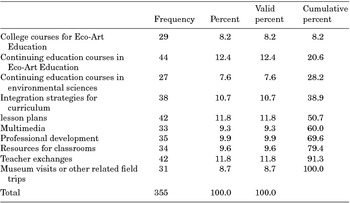
To further address perceived barriers, respondents identified resources that arts educators believe they needed to integrate environmentally friendly initiatives through eco-arts in their lesson plans. The 76 respondents were able to mark all that apply from nine predetermined resources, resulting in a total of 355 responses. A frequency analysis using SPSS® was conducted on the 355 identified needs; however, from the resulting categories, no single category received a majority of the responses. Interestingly, the largest percentage of respondents felt that continuing education courses in eco-arts education, lesson plans, and educator exchanges were the most significant resources needed. This finding aligns with the responses of ‘unsure how to integrate and too complex of issues’ seen in Table 2 and ‘unsure how to integrate environmental issues into my curriculum’ found in Table 3. See Table 4 for the needs identified.
Needs Identified to Overcome Barriers to Integration

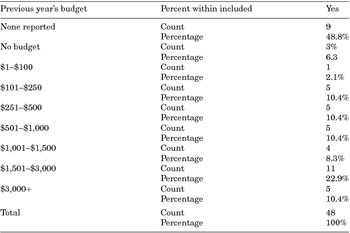
Due to educational budget cuts in the United States, it was important to examine whether budgets (i.e., financial resources) are a factor in deciding to integrate eco-arts into arts curricula. A cross-tabulation using SPSS® examined responses from 48 respondents who reported that they desired to integrate environmental stewardship and environmental literacy into their curricula against their annual class budget for 2012–2013. Findings revealed that of the 48 respondents to this question, 63% reported that they planned to or already integrated environmental stewardship into their curriculum. However, nearly 37% of the sample did not currently or do not plan to integrate environmental stewardship or environmental literacy into their future curricula. The respondents reported a wide variety of annual arts budgets. The majority of respondents reported annual arts budgets above $1,501. As reported, respondents’ annual budgets do not present as the primary influencer as to the integration of environmental stewardship or environmental literacy into their curriculum. See Table 5 for details.
Cross-Tabulation Budget: Integration of Environmental Stewardship and Environmental Literacy Into the Curriculum

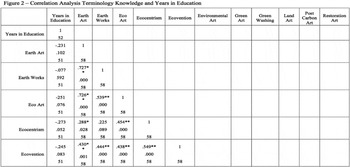
To determine whether respondents’ years of teaching correlated with their understanding of what various environmental art terminology means, a Pearson correlation (2-tail) analysis was conducted. Findings revealed that knowledge of the meaning of four specific terms (eco art sig <.10,−.251; ecocentrism sig <.10,−.273; ecovention sig <.10,−.245; land art sig <.05,−.324) used in art as it relates to the environment were inversely related to years teaching arts education. This data indicates that educators with fewer years in the teaching field understood more of the terminology than the educators with longevity in arts education. Further, the correlation analysis revealed that if respondents knew one term, they were likely to know all of the terms. However, the relationships were weak and should be considered with caution. The most highly correlated knowledge of terms (n, 58) were between earth art/earth works (sig <.01, .727); earth art/eco art (sig <.01, .726); earth art/environmental art (sig <.01, .620); environmental art/green art (sig <.01, .631); earth works/environmental art (sig <.01, .688); earth works/green art (sig <.01, .626); land art/restoration art (sig <.01, .601) and longevity in the field. These strong relationships may be explained by the fact that land art (coined in the late 1960s by Robert Smithson) and restoration art (popularised in the 1980s) have been around for decades. Also, green art may be recognisable in relationship to earth works because the term green has been commercialised in the popular press over the last several decades. Also, eco as a prefix has been popularised in the United States for many years, as has the term environmental. Arts educators in this study clearly understood the terminology surrounding environmental stewardship and environmental literacy. Thus, terminology was not a confounding factor for this study. See Figure 3 for details.
Correlation analysis terminology knowledge and years in education.

Image No. 2.

By empirically examining the second research question R2, ‘What are the most significantly perceived challenges for arts educators who desire to integrate environmental stewardship and environmental literacy through eco-arts into the curricula’, it was found that although respondents were provided with a list of possible resources, none of these were significantly more important or less important to the respondents. This finding is an indication that the arts educators perceive the need for these resources as equally important. However, as would be expected, additional need for financial resources was listed among those perceived as important. Those with the largest budgets were more inclined to integrate eco-arts into the curricula. Budget increases to STEM fields come as no surprise to the arts education field, as more money and resources in general are transferred into STEM curricula.
A lack of funding is an issue that has often confronted the arts. The importance of funding the arts so that eco-arts education can take place and elicit change could not be stated better than the words of one respondent to this study:
Environmental problems are cultural problems, not scientific ones; we have enough data to begin, we know what we need to do, technology is prepared to offer solutions. What is needed is cultural change, and that is why artists must be leaders in collaboration with scientists, community leaders, educators, and policy makers. Artists provoke the cultural shifts that lead to truly adaptive behavior.
Conclusions
Individually and collectively, the influence of the arts as a social change agent comes through the arts’ ability to communicate empathy, biophilia, and change — visually, orally, and kinetically (Belfiore & Bennett, Reference Belfiore and Bennett2006; Curtis et al., Reference Curtis, Reid and Reeve2014; Nadius, Reference Nadius2009; Ross, Reference Ross2002; Smith, Reference Smith2009; Stevenson & Dillion, Reference Stevenson and Dillon2010). This study was framed in cultural theory and social identity theory (i.e., communication theory of identification). Communication theory of identification holds that there is mutual influence between identity and communications. Through communication, one's identity-grounded-in-culture is defined and reflected in social roles and relationships through communication (Hecht, Reference Hecht1993; Hecht, Jackson, & Ribeau, Reference Hecht, Jackson and Ribeau2003). Idealist identification occurs when an individual becomes aware of common ground (e.g., environmental sustainability; Quigley, Reference Quigley1998; U.S. Department of Education, 2012). Thus, the message strategy as the form of expression leads the receiver to participate in the situation (e.g., cultural change and pro-environmental behaviours; Lehtonen et al., Reference Lehtonen, Juvonen and Ruismäki2014; Robinson, Reference Robinson2001).
Both the qualitative and quantitative findings of this study echo Robinson (Reference Robinson2001), ‘Education and training are meant to be long-term answers for all of those asking how they are to survive the coming turbulence’ (p. 24). Perhaps a generation exposed at an early age to the truth about the environment and its ecosystem through integration of the sciences and arts is the right choice for all economies and will better influence cultural change in a positive pro-environmental manner than the sciences alone. Critical thinking, innovative art problem solving, and scientific inquiry can empower individuals with the knowledge needed to reject the propaganda and myths of others and to make the most informed environmental decisions (Baudrillard, Reference Baudrillard and Lotringer2005; Nadius, Reference Nadius2009; Robinson, Reference Robinson2001).
Academic research has clearly shown the benefits of the arts education and, by extension, eco-arts education programs as agents of change within a culture (Curtis, Reference Curtis2010; Marks, Reference Marks2015; Orr, Reference Orr1992; Ross, Reference Ross2002). Research shows that environmental devastation knows no borders and is a continuous and growing problem globally (United Nations, 2016). This empirical research clearly shows that arts educators value eco-arts’ contributions to education for our future global citizens and for a more sustainable world. As seen in the findings of this study, the barriers to integration are not insurmountable and could be easily available via professional development (PD) programs for educators. By creating preservice education courses that incorporate environmental education into the arts and through PD, the tools would be available to ensure a culture of environmental survival (Marks, Reference Marks2015; Matsumoto, Reference Matsumoto2000; Ross, Reference Ross2002). It is evident from the findings of this study that K-12 administrators need to hear the voice of logic and reason, weigh the preponderance of evidence that demonstrates that creative thinkers are valuable problem solvers, recognise that STEAM without the A (STEM) limits great minds of the future in finding solutions to problems by constraining their ability to address problems creatively, and empower the arts educators to integrate eco-arts into their curricula. STEAM as a holistic educational paradigm presents options to the ‘. . . students who are motivated and competent in bringing forth solutions to tomorrow's problems. When push comes to shove, it's not STEM vs. STEAM — it's about making every student a fully literate 21st-century citizen’ (Jolly, Reference Jolly2014). From this study, it is clear that if an education system is to be considered premier (i.e., one that produces the world's best problem solvers), then administrators must look for solutions outside of cutting the arts budgets to solve their financial problems. They must consider the global concerns of creating future citizens who have the tools needed to reduce and possibly reverse environmental degradation through innovative, critical-thinking, problem-solving arts programs (Dewey, Reference Dewey1934; Eisner, Reference Eisner2002; Marks, Reference Marks2015; Ross, Reference Ross2002).
The findings of this study are relevant to policy makers around the globe as financial constraints on arts programs and environmental sustainability are not just a U.S. problem. It is clear that educators see the benefits and needs of the arts as necessary for problem solving (Children's Music Workshop, 2006; Dewey, Reference Dewey1934; Eisner, Reference Eisner2002; Marks, Reference Marks2015; York, Reference York2014). If given a chance, solutions to education systems’ critical thinking, innovation, divergent thinking, sustainable initiatives, environmental empathy, and financial problems may very well come from individuals schooled in STEAM (Chiarotto & Leman, Reference Chiarotto and Leman2011; Curtis, Reference Curtis2010; Marks, Reference Marks2015; Orr, Reference Orr1992; York, Reference York2014).
Limitations of the Study
This exploratory study is limited by a relatively small sample size. However, this study is a first step in providing a basis to understand arts educators’ perspective on the importance of integrating environmental stewardship and environmental literacy into K-12 curricula and in the identification of barriers to that integration.
Future Research
Future studies should examine a larger sample of the population to gain generalisability across cultures. Further, it is also recommended that research should delve into the perceived value of integrating environmental stewardship and environmental literacy into the K-12 grade curricula as a mechanism to propel environmental and cultural change to the forefront of the minds of future generations. An examination across age ranges is also recommended that compares levels of creativity in problem solving between those who were in school when the arts were a significant part of every curriculum and those who were in the K-12 U.S. education system after the arts were reduced or removed. This should provide insights into the influence of arts education in problem solving. Further, a study conducted across countries in which the arts have remained an integral part of the education systems and the United States, where arts education has been minimised, comparing problem-solving skills, would add value to the academic literature. Another recommendation is to conduct further empirical research on the difficulties of integrating eco-art into K-12 courses. The findings from the study hold the potential for professional development that is beneficial to arts and sciences teachers.
Author Biographies
Jeniffer Sams. After completing her undergraduate degree from East Tennessee State University, Jennifer earned a Master's degree in Art education from the University of Florida. Currently, she is a 4th-year Art Education doctorate student at Indiana University. Sams works in the fields of eco-arts education, community education, museum education, and photography. Her photographs are a visual communication about both the artistic beauty and tragedy of environmental issues. Her ‘Legacy We Leave’ series is included in the National Art Education Association digital gallery. Sams aims to utilise her experiences and education to create broader environmental awareness within the global community.
Dr Doreen Sams, PhD is a professor of marketing and Faculty Coordinator of Mentored Undergraduate Research and Creative Endeavor (MURACE) at Georgia College and State University. She earned her PhD from the University of South Florida, Tampa in 2005. She serves on several editorial review boards for journals and conferences. She is published in environmental sustainability. She is the co-author on an invited chapter in the book Sustainable Water Use and Management: Examples of New Approaches and Perspectives (edited by Walter Leal Filho and Vakur Sümer). She is the founder and chairperson of the annual GC Shades of Green, an Environmental Sustainability Educational Week of Events.
Image contributor: Artist and Professor of Art at Ohio University, John Sabraw, contributed images of his artworks for this journal article. The authors are truly grateful to this environmental artist for the work he does and the use of his images. Sabraw's paint pigments contain iron oxide, which is obtained by cleaning up toxic, acidic water coming from Ohio mines. Engineers retrieve the toxic iron oxide for the paint pigments by treating the water and then the cleaned water is returned to the watershed. By combining arts and sciences, Sabraw and his peers are cleaning up the environment and bringing visual attention to the problem in their state.