





In the 2023/24 academic year, 186 273 children attended alternative education settings in England(1). These settings include special schools that provide tailored education for those with special educational needs or disabilities (SEND) and alternative provision (AP) that provides education for those unable to attend other school types due to exclusion, illness or other reasons(1). A large proportion of children attending AP have SEND and/or require behavioural support(1). Special schools and AP are together considered as ‘alternative education settings’ within this paper.
Children with specific learning needs or disabilities have a high risk of obesity and dental caries(Reference da Silva, Gimenez and Souza2–Reference Slevin, Truesdale-Kennedy and McConkey4) and lower intakes of fruits and vegetables(Reference Evans, Must and Anderson5). Children attending AP may also be at greater risk of nutritional issues but remain an underserved, under-researched population(Reference Taylor and McCluskey6). Those attending special schools and AP are more likely to be in receipt of government-funded free school meals (FSM), which are provided to pupils from families receiving income-related benefits, with 49·2 % and 63·2 % of children eligible in state-funded special schools and AP respectively v. the England average of 25·7 %(1). School lunch contributes a significantly greater proportion of daily nutrient and energy intake in pupils receiving an FSM, compared with those who do not(Reference Nelson, Lowes and Hwang7), underlining the importance of the nutritional quality of meals served in these settings.
The diets of almost all children in England fall short of current dietary recommendations, with a need to increase intakes of fruit, vegetables, fibre and oily fish and decrease intakes of free sugars, sugar-sweetened beverages, confectionery and saturated fats(8). These dietary patterns are associated with poorer childhood health outcomes including increased adiposity, poor dental health and risk of premature cardiometabolic disease in childhood(Reference Ambrosini, Emmett and Northstone9–Reference Hardy, Bell and Bauman11), which in-turn contribute to poorer psychosocial and educational outcomes(Reference Guarnizo-Herreño and Wehby12–Reference Rankin, Matthews and Cobley14). These concerns are compounded in the SEND population, which may in part relate to the presence of physical, cognitive, emotional, social, behavioural and mental health conditions that can affect eating(Reference Pinto-Silva, Nunes Costa and Tello-Rodrigues15,Reference Andrew and Sullivan16) . Clinical conditions, such as feeding and swallowing disorders, may result in reduced dietary diversity, malnutrition and the need for medical feeding support(Reference Goday, Huh and Silverman17).
School food policy in England comprises the school food standards (SFS) and accompanying School Food Plan (SFP). Mandatory SFS underpin the nutritional quality of food served in educational settings and are a legal requirement for state-funded schools(18), whilst the SFP provides a voluntary framework for establishing a healthy eating culture in schools. Recent evaluations of SFS implementation in primary and secondary schools indicate wide variation in schools’ compliance with SFS, with specific standards being problematic for many schools(Reference Pallan, Murphy and Morrison19–21). However, there have been no published evaluations of SFS implementation in alternative education settings, meaning that the nutritional quality of meals in these settings is unknown. Given that a review of England’s national SFS is underway(22), understanding how the current standards are implemented in varied school settings is essential to ensure practicable and inclusive revised standards.
This study aimed to understand how alternative education settings implement national school food policy and to identify challenges in implementation and potential opportunities for support.
Methods
We used a convergent parallel mixed methods study design(Reference Curry and Nunez-Smith23). The quantitative component aimed to establish the extent to which alternative education settings are (1) compliant with the SFS and (2) implementing actions featured in the SFP, through a cross-sectional assessment of food provision and SFP actions. The qualitative component aimed to explore the views and experiences of school leadership, teachers, governors and caterers in implementing the SFS and SFP actions. A mixed methods design was used to build a comprehensive understanding of both the extent of implementation and the experience of and contextual influences upon implementation, to better inform future policy and practice(Reference Curry and Nunez-Smith23). The study design is outlined in Figure 1.
Mixed methods study design.

Figure 1. Long description
The flowchart outlines a mixed methods study design. It starts with two approaches: a cross-sectional survey of food provision and school food policy actions, and a qualitative study to understand experiences of implementation. The sampling aims for 6-8 schools with variation across region, school type, and catering provider. The sample includes 37 staff/governors from 8 schools, with specific percentages for region, school type, and catering. The analysis involves assessing compliance with standards and action implementation, along with thematic framework analysis. The results are merged through a joint display table, and the final step is interpreting the merged results, including convergence or divergence of findings.
Setting and participants
The study was conducted in state-funded special schools and AP with pupils of primary and/or secondary school age (4–18 years) in two regions of England: the West Midlands (WM) and North East (NE). Both areas have high prevalence of health inequalities(24,25) and include urban and rural communities.
Participants were school staff with a role in school food, including catering teams, school leadership, teaching staff and school governors.
Sampling
We aimed to recruit 6–8 schools within a purposive sampling frame that included region (WM, NE), school type (special school, AP) and catering model (in-house, external), to capture some variation in contexts and experiences. Special schools and AP account for 76 % and 24 % of state–funded alternative education settings respectively(26). In-house catering refers to a school self-managed service, whist external catering refers to a contracted out-sourced service, typically provided by a private company or local authority.
For the qualitative component, we aimed to recruit 3–4 members of staff from each school (total n 32), with variation in role, to capture a wide range of perspectives on implementation.
The characteristics of schools and staff participants are provided in Appendix 1 and 2.
Recruitment and consent
All eligible schools were emailed a promotional flyer. Interested schools were sent an information sheet and invited to a recruitment meeting with researchers. Participating schools identified a liaison person and signed a study agreement. Some targeted recruitment of schools was undertaken to ensure the sampling aims were met. Schools were compensated £300 for their involvement and provided with a school-specific summary of findings.
Relevant school staff were identified by the school liaison and emailed a participant information sheet. Participating staff provided written informed consent. School and catering staff were not compensated for their time as interviews occurred during the working day. Governors were gifted a £10 shopping voucher, as they were taking part in their own time.
Data collection
We convened a public involvement group comprising educators, health professionals and public health practitioners, to support design of the study and materials.
The quantitative component involved assessment of food provision and actions to support healthy eating. Outcomes were percentage compliance with SFS, and SFP actions implemented. To assess SFS compliance, we reviewed 3 weeks of current menus and observed all eating occasions across one school day. Both methods were required to ensure accurate assessment of compliance, since some standards apply on a daily, weekly or three-weekly basis (Appendix 3).
To assess SFP implementation, school liaisons completed a survey featuring selected actions from the SFP(Reference Dimbleby and Vincent27) and associated guidance(28–30). Actions were selected from the SFP with input from the public involvement group and cover a range of topics relating to food provision, whole school initiatives, feedback and monitoring and staff training. Actions relating to food education and eating environments are out of scope of the current analysis.
The aim of the qualitative component was to understand staff perspectives on how schools implement national SFS and policy, which was part of a broader aim of exploring how staff, parents and pupils experienced school food. Staff took part in in-person or online single or group interviews that were guided by a topic guide (Appendix 4) and informed by public involvement activities. All researchers involved in interviewing (MM, JT, ES, EKH, GM, EF, AM and RK) were female and employed as Research Fellows/Associates or were students at the time of data collection. Four (MM, JT, EKH and ES) were trained and experienced in qualitative interviewing and provided support to students. Interviews were audio-recorded, transcribed verbatim by an external transcription service with identifiable data removed and assigned an ID number. Written field notes from food observations were recorded.
Data analysis
Compliance was assessed according to a previously published approach(Reference Pallan, Murphy and Morrison19), with two researchers independently assessing compliance and resolving any discrepancies (MM, IAB). We calculated the percentage of SFS complied with in each school, as well as for sub-categories of standards outlined in the published guidance for schools: (a) school lunch (n 16); (b) food provision outside of lunchtime (n 4) and (c) additional whole day standards (n 12). We calculated the median and interquartile range for all schools. We calculated the percentage of schools compliant with individual standards to identify problematic standards. Additional exploration was carried out to identify any patterns in types of standards with high or low compliance. The types selected related to the stated purpose of the SFS(31) and to key population-level nutritional issues: (a) standards aiming to increase dietary variety (n 15) and (b) standards aiming to restrict high fat, salt and sugar foods and drinks (n 13).
For SFP implementation assessment, we calculated the percentage of schools implementing each SFP action. For both SFS and SFP actions, in cases where a judgement could not be made, the school or standard was removed from the denominator respectively.
For the qualitative component, thematic framework analysis was used(Reference Gale, Heath and Cameron32). MM, JT, ER and ES completed all coding in NVivo v14, with each researcher inductively coding all transcripts and field notes related to specific schools, followed by charting in Microsoft Excel and writing coding summaries for each school, to build an in-depth picture of the implementation context. The team met regularly to develop the framework, compare coding summaries and interpret themes iteratively as coding was completed for each school.
Analytical integration of the quantitative and qualitative components was achieved through merging using a joint display(Reference Guetterman, Fetters and Creswell33). We initially grouped quantitative and qualitative findings iteratively, then meta-themes were identified and described, alongside consideration of the extent to which the quantitative and qualitative findings converge or diverge.
Results
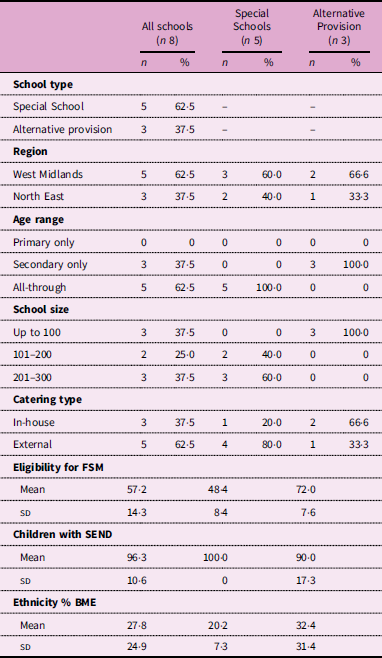
Table 1 describes the participating schools. Of 280 eligible schools, 216 were sent an invitation. Of eight participating schools (response rate = 3·7 %), five (62·5 %) were special schools (all had both primary and secondary aged pupils, ranging in size from 101 to 300 pupils), and three (37·5 %) were AP (secondary only, all with ≤100 pupils). Five schools used an external catering provider (all were catered by the local authority caterer), and three employed in-house catering teams. The mean percentage of pupils eligible for FSM across all schools was 57·2 % (sd = 14·3); higher in AP (72·0 %, sd = 7·6) than in special schools (48·4 %, sd = 8·4). All children in special schools had SEND, while the mean percentage of pupils with SEND in AP was 90·0 % (sd = 17·3). The mean proportion of pupils from Black or Minority Ethnic groups was 27·8 % (sd = 24·9), with a higher mean percentage in AP (32·4 %, sd = 31·4).
Table of school characteristics

Table 1. Long description
The table compares characteristics of eight participating schools, divided into special schools and alternative provision. It includes data on school type, region, age range, school size, catering type, eligibility for free school meals (FSM), children with special educational needs and disabilities (SEND), and ethnicity. The table has 16 rows and 7 columns, with headers for All schools, Special Schools, and Alternative Provision, each providing counts and percentages. Notable trends include a higher percentage of pupils eligible for FSM in alternative provision compared to special schools, and all children in special schools having SEND.
FSM, free school meals; SEND, special educational needs and disabilities; BME, Black and minority ethnic groups.
School food standards compliance
Figure 2 displays the range, median and spread of compliance for participating schools. On average, schools complied with 66·7 % (interquartile range = 61·3–70·0) of standards. Compliance was highest for lunchtime standards (73·3 %, interquartile range = 68·2–75·3), and lowest for standards that apply across the whole school day (50·0 %, interquartile range = 36·4–59·1). Compliance with individual standards is provided in the supplementary material (Appendix 5).
Box plots summarising percentage of School Food standards (SFS) complied with by school type.

Figure 2. Long description
Panel A: A vertical box-and-whisker plot showing the percentage of school food standards (SFS) compliance for all schools, lunchtime SFS, outside of lunch SFS, additional whole day SFS, SFS to encourage dietary variety, and SFS to restrict high fat, salt, and sugar. The horizontal axis lists these categories, and the vertical axis ranges from 40 to 100 percent compliance. Panel B: The plot includes three data series represented by different colors: green for all schools, orange for special schools, and purple for alternative provision. Each box plot shows the median, lower quartile, upper quartile, and whiskers indicating the range of data. Outliers are marked as individual points. Notable trends include higher compliance for outside of lunch SFS and lower compliance for additional whole day SFS.
Actions from the School Food Plan
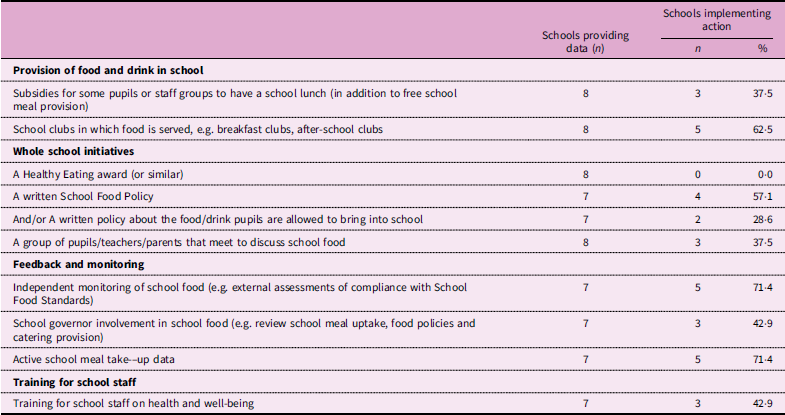
Table 2 displays the implementation of SFP actions. High performing actions included independent monitoring of SFS compliance and monitoring of school meal take-up data (both 71·4 %) and themed food days (87·5 %). Actions with the lowest levels of implementation were subsidies for pupils or staff groups to have a school lunch (in addition to free school meal provision; 37·5 %); a group that meet to discuss school food (37·5 %) and a policy about foods and drinks brought from home (28·6 %). No schools had a Healthy Eating award; and fewer than half of schools had training on health and well-being for staff (42·9 %).
Implementation of specified actions, identified from School Food Plan

Table 2. Long description
A table with 10 rows and 3 columns. The columns are labeled ‘Schools providing data (n)’, ‘Schools implementing action (n)’, and ‘Schools implementing action (%)’. The rows are grouped into categories: Provision of food and drink in school, Whole school initiatives, Feedback and monitoring, and Training for school staff. Each row lists specific actions and the corresponding number and percentage of schools implementing them. Notable actions include subsidies for school lunch, school clubs serving food, healthy eating awards, written school food policies, independent monitoring of school food, school governor involvement, active school meal take-up data, and training for school staff on health and well-being.
Views and experiences of implementation
Of forty-one staff and governors invited, thirty-seven participated (90 %). Most participants were senior leaders (e.g. Head, Assistant Head, Year/Subject Lead, Business Manager, or similar; 40·5 %), followed by teaching staff (e.g. teacher or teaching assistant; 27·0 %), governors (18·9 %) and catering staff (e.g. cook, catering manager; 13·5 %) (see Appendix 2).
Qualitative themes
Framework analysis resulted in three themes relating to food provision and relevant to SFS and policy implementation. Descriptions are presented below alongside selected illustrative quotes. Additional quotes are provided in Appendix 6.
Theme 1: Challenges in meeting the school food standards
Sub-theme A: School food system constraints
The SFS were seen as challenging alongside school food system constraints, including a limited budget in the context of rising food costs, and limited kitchen facilities exacerbated by increasing pupil numbers.
‘Well, I mean there are things like, you know, obviously fresh fruit, that’s a limited resource, and is a huge barrier. Because we used to provide fresh fruit for the whole school, but we’re not able to do that cost wise. We’ve had to cut that back so it’s much less than it used to be’. School 7, Teaching
Some groups of pupils ate in a different building or ate in classrooms depending on individual need, so school meals had to be transportable, restricting the types of meals that could be offered at scale and impacting on compliance with some standards.
Menu design and food quality were also perceived to be influenced by the catering model, with external caterers using menus that were centrally designed, and one interviewee perceiving a ‘profit-motive’ which they felt impacted upon food quality:
‘But I think they [caterers] have to use cheap ingredients for the price, and sometimes you can tell that’s a cheap alternative. I’m being honest here … I know they’re a company, they’ve got to make a profit, they’ve got to do it within a certain budget’ School 2, Teaching
Subtheme B: Complex and varied needs of pupils
Schools were required to cater for highly restrictive diets relating to the medical, feeding, dietary and personal needs of pupils, resulting in a flexible approach to food provision which sometimes conflicted with SFS requirements. For example, it was not possible to blend some foods (e.g. highly fibrous foods) safely, and when drink thickeners were required, these were reportedly used with sweetened drinks for palatability.
There were high levels of food selectivity or sensitivity, related to pupils’ SEND such as Autism Spectrum Disorder and Avoidant Restrictive Food Intake Disorder, resulting in made-to-order (off-menu) dishes being prepared for some pupils. These were typically highly palatable, high-fat foods (e.g. chips, sausages, crisps, etc.) and flavoured drinks.
‘A lot of our children won’t eat from that menu so that’s why the chef is having to knock up a lot of alternatives and those alternatives are not hitting the school food standard … You’ll see today, there will be, it’s not the chef today, there’ll be the Smiley Faces, there will be the chicken nuggets, there’ll be sausages … But what do you do, children need to be nourished and whatever little nourishment there is in those, they will, that’s what they’re used to eating’ School 6, Leadership
These were offered to ensure children ate whilst at school, which was seen as a duty of care, viewed as even more important due to the hunger and food insecurity experienced by some pupils. In addition, fostering a positive approach to food was prioritised over emphasising nutritional value.
‘But we do need to find a balance with specifically our pupils and knowing that they will have had something to eat today, even if that is half a plate of chips, it’s something that’s gone in them that will sustain them for like the rest of the day. But it isn’t your apple as a pudding and you know your protein and your stuff like that. So we go as best as we can by it [the things we have to meet] but then like I said you wouldn’t send a child away hungry with nothing if half a plate of chips is what they’d eat’. School 7, Leadership
Sub-theme C: School food standards use and perceived value
Most catering staff planned lunch menus using the SFS. However, they were viewed as less relevant for these settings due to other priorities for food, such as ensuring the safety of children (in terms of meeting their feeding and dietary requirements), providing some autonomy around food choice and enjoyment of eating, and ensuring children were fuelled for learning.
‘it’s very difficult, because it’s more important the children’s physical needs are met in this point than other needs. I’m not saying there’s anything wrong with the food standards, but I think the needs of the children to be able to eat, to be sociable, and to actually enjoy their food is probably the most important’ School 3, Governor
Standards were also seen to lack their intended impact, as pupils often did not choose or consume the meals on offer. Compliance with standards was not viewed as equating to a high ‘quality’ offer.
‘I think there’s been some tokenistic gestures towards putting a bit of a salad bar on the side, or a bit of fruit on the side. But ultimately to be blunt, what I’ve seen is a lot of children eating probably quite high fat level, yellow food if I’m honest in the amount of times we’ve looked at children’s plates and there’s no real colour to them. There are a lot of yellow food’ School 5, Leadership
Theme 2: Staff engagement with school food policy
Sub-theme A: Food-related roles and responsibilities
Although catering staff largely saw engagement with the standards as a part of their role, and other staff demonstrated an awareness of them, there appeared to be a lack of knowledge and application of the standards by non-catering staff. This impacted on compliance with the standards outside of lunch, for example, some schools had informal breakfast or snack provision, organised by staff (e.g. breakfast club) or pupils (e.g. tuck shop). Although most schools made options such as fruit, toast or milk available, these mealtimes also featured restricted items such as cereal bars, confectionery, sausage rolls and crisps.
Staff roles in relation to food focused on safety and pastoral aspects of eating, which meant that staff focused on offering familiar foods that children would eat.
‘So my role basically is to make sure the kids are fed, and that’s why I do “safe” food’ School 2, Catering
However, it was noted that in one school, a non-catering designated lead for healthy eating showed high levels of engagement with promoting healthy eating across the school:
‘I’m taking on the healthy eating lead within the school… [name redacted] has got a small working group for healthy eating, and so I’m connecting with them and trying to push that within the school’. School 5, Teaching
Training needs identified were focused on meeting feeding needs and increasing children’s exposure to different textures. Some schools felt that having kitchen staff with high levels of expertise and skills was crucial. One participant also felt that training was needed for wider school staff to ensure school food policy was understood.
‘I think we need to educate them as well, and some of the staff, because I think some of the staff were like, “Well we used to be able to give them X and Y, why not now?” And it’s educating the staff as well on these school food rules and regulations that we have’ School 4, Governor
Sub-theme B: Leadership on school food policy
Governors saw oversight of the quality of food provision as part of their wide-ranging role but lacked working knowledge of the SFP and SFS.
‘I haven’t read it, because it’s [being governor] such a far-reaching role then obviously on top of other things as well, part of the role is trust in the school to manage those things. So in terms of the people that have to lead on that do, and were in the policies. I see 30/40 policies a week, so just I’d be lying if I sat here and went yeah I’ve been through page by page’. School 5, Governor
However, some governors saw a role in monitoring or collecting feedback on school food, e.g. through visiting student council meetings, visiting the dining hall at lunchtimes.
Those in leadership or governance roles sometimes assumed that the SFS were being met and monitored by catering teams/providers and/or put high levels of trust in external agents to assess compliance.
‘I know that the school will work, because we’re part of a Trust, we have to adhere to every rule and guidelines, so I know they will be working towards those. But I’m not hands-on with those’. School 1, Leadership
Senior leadership engagement with school food varied, with staff indicating that some were hands-off, whilst others appeared to be supportive and advocated for improving school food.
Theme 3: Monitoring on school food policy implementation
Sub-theme A: Communication and interaction on school food
Schools used pupil voice opportunities to engage pupils in school food, including menu design, although some staff felt that suggestions by pupils were not always adopted. Direct dialogue between the school council and catering teams in some schools was seen to be of value.
Staff-to-staff interaction appeared to be focused on meeting pupils’ feeding and dietary needs, practical aspects of food provision (e.g. food ordering) and sometimes menu design, rather than healthy eating or school food policy.
‘The SLT [senior leadership team] have requested staff opinions on the quality and how things are going. That’s a fairly regular dialogue. I think we seem to talk about food and snacks all the time as we review the costs and how much it’s coming in as, and whether we need to change the systems, so there’s that. But with the focus on healthy eating, I don’t think there’s that much of a conversation on that, as a school. Because of the issues or the barriers we just mentioned really. Everyone seems to understand the challenges that we have’. School 7, Teaching
Sub-theme B: Monitoring and evaluation on school food policy
Some schools carried out periodic or one-off monitoring of the SFS, usually via central or external agencies, who were viewed as ‘the experts’. This involved either assessment of submitted menus, meetings with an auditor or an in-person approach and included recommendations on how to make improvements. Some schools used consultancy services to advise on menu design and meeting the SFS, although changes were not always enacted.
‘we paid for somebody to come in and consult, and look at the equipment they had, and look at the food that was provided, and wrote us a bespoke menu, and instructions on how to prepare it, but that didn’t get adopted’. School 4, Leadership
An important metric to schools was school meal uptake, and schools identified a need to improve monitoring of this.
‘my aim is to have as few children as possible bringing food from home.’ School 5, Leadership
One school planned school food improvement through its formal inclusion in their school development plan, indicating that its presence on the plan means ‘we’re going to be promoting it’.
‘so it’s on our school development plan, we’ve consulted parents, we’ve consulted staff, we’ve consulted students about what they would like’. School 5, Leadership
Mixed methods integration
The analytical integration of quantitative and qualitative results is presented in Table 3. Four meta-themes were identified relating to successes and challenges in implementation, with summaries and level of agreement presented.
Joint display table of meta-themes linked to quantitative and qualitative components, including level of agreement (quotes featured in Appendix 6)

Table 3. Long description
A table with four rows and five columns. The columns are labeled ‘Meta theme’, ‘Linked Quant Data’, ‘Linked Narrative quotes from Qual data’, ‘Summary and indication of agreement’, and ‘EDH’. The rows are labeled with different meta-themes: ‘Dietary variety & school food policy’, ‘Healthy eating and school food policy’, ‘More planning, staff training and compliance across settings’, and ‘School Food Plan actions’. Each row contains detailed information about the meta-theme, linked data, narrative quotes, summary, and EDH. The table provides a comprehensive overview of the successes and challenges in implementation, with summaries and levels of agreement presented for each meta-theme.
SFS, School Food Standards; IQR, interquartile range.
a International Dysphagia Diet Standardisation Initiative, is a global standard for describing texture–modified foods and thickened liquids.
Discussion
This study is the first to explore English school food policy implementation in alternative education settings. We found incomplete implementation of the SFS in the eight schools in our sample, with particularly problematic compliance with standards restricting foods/drinks high in fat, salt and sugar. This aligns with findings from previous research across primary and secondary schools,(Reference Pallan, Murphy and Morrison19,Reference Khan, Petrikova and Eltholth20) which showed similar levels of compliance (median of 68 % and 63·9 %, respectively) and similar problematic standards. However, our findings reveal both parallel (e.g. school food system constraints)(Reference Pallan, Murphy and Morrison34) and unique (e.g. texture modification, bespoke meal preparation) barriers to implementation, with issues relating to the intensive and highly individualised approaches to school food that are required in alternative educational settings.
The findings indicate a need for specific consideration of alternative education settings within school food policy, including some flexibility in offering off-menu items to pupils that might result in non-compliance with standards, aligning with recommendations from a recently developed School Food Policy Toolkit(35). This is particularly important in light of the current revision of standards in England(22), the increased focus on monitoring(36) and recent expansion to FSM eligibility(22). Revised standards should be accompanied with guidance on how schools might support pupils with food selectivity and sensitivity to increase exposure to a range of foods in a safe and pressure-free way that does not compete with meeting their energy needs and advice on how familiar and safe foods can be adapted to improve their nutritional value. Guidance should also be sought from health professionals, such as speech and language therapists, specialist dietitians and occupational therapists, so that the needs of children with feeding and swallowing disorders can be met in the healthiest possible way, for example identifying what alternatives there are to highly fibrous foods that can be appropriately blended, and what compliant drinks can be used alongside drink thickeners. Schools would also be able to offer a fuller range of menu items to pupils requiring texture modification if they had appropriate funding for blending equipment and additional staffing resource.
Non-catering staff involved in breakfast and breaktime provision need to be aware of the requirements of the standards. This could be supported with resources and training regarding which types of breakfast and breaktime foods and drinks meet SFS and which are restricted. Schools should also build in processes for ensuring communication between non-catering staff and catering teams to review overall compliance. Senior leaders and governors would benefit from a clearer understanding of their roles and responsibilities in relation to school food, and the benefits that this may bring to their pupils. Checklists for senior leaders and governors already exist(28,29) , but do not appear to be universally used. The National Governors Association has recently released E-training on the standards in partnership with the DfE(37), which may go some way to improving the governor role within school food if well-promoted and accessed. In addition, schools would benefit from support (e.g. from a school food team or local authority) and easy-to-use resources to support self-monitoring of compliance. Given many schools are using external organisations for independent monitoring of school food standards, these organisations should ensure they are reviewing all food offered across the day or make clear the limitations of carrying out menu-only assessments. Any new monitoring process, e.g. from local authorities, needs to look at food and drinks that are offered across the whole school day. The outcomes of monitoring should be focused on improvement rather than penalty oriented(35) and should support schools with action planning and delegation of responsibility to named staff.
Improved communication channels between pupils, parents, school management and catering teams may inform future improvements to school food provision. Schools may value suggestions or examples of good practice. School food system constraints, such as limited budgets and increasing food costs, and catering models that are profit-oriented have consistently been identified as barriers to implementation(Reference Pallan, Murphy and Morrison34,38,Reference Hawkins and Rundle39) and are also an issue for alternative education schools.
Globally, ninety-three countries are known to have legislation, compulsory standards or guidance on school food and beverages(40), and these findings may be informative for other countries in adapting existing policy and developing new policies. It is not clear how many countries have specific regulations or guidance for children with SEND, but United Nations Educational, Scientific and Cultural Organization have identified a need for adapting school health and nutrition policies to ensure they address the needs of learners with disabilities(40). In England, legislation places a legal duty upon schools to ensure eligible children can access their free school meal entitlement, and that reasonable adjustments are in place for children with a disability to access school food.(41,42) . Our research has highlighted that schools are making accommodations for children with SEND to meet these legal duties. However, schools may benefit from additional guidance on how this interacts with the legal requirement to meet school food standards. This might include individualised provision being exempt from SFS where physical or behavioural needs require. Rates of FSM eligibility are especially high in alternative education schools in England(26), yet recent research shows that as little as 25 % of eligible pupils in special schools are taking up their entitlement(Reference O’Connell, Denyer and Holford43). Recommendations highlighted in this report (e.g. increasing children’s exposure to a range of foods; and examples of good practice) may also support schools in improving access to FSM for those with the most complex needs.
Previous work has identified key actions for addressing the challenges of school food for secondary schools(35,Reference Murphy, Dobell and Pallan44) many of which apply to alternative education settings. The current study adds specific and tailored actions for alternative educational settings and complements the recommendations by other researchers(Reference O’Connell, Denyer and Holford43) on improving school food for children with SEND.
Future research priorities for alternative educational settings include the need to ensure that school food interventions and programmes are sufficiently tailored to this population, appropriately evaluated for their impact on dietary intake and eating behaviours as well as a wide range of other outcomes that are important to schools and families (e.g. school engagement, well-being, skills and widening food exposure), and effectively address the dietary inequalities faced by children attending these schools. Another key focus for future research is to develop a clearer idea of what ‘healthy food provision’ and ‘positive eating environments’ look like for alternative education settings, including from the perspective of pupils, which may differ from ‘mainstream’ ideals.
Strengths and limitations
This is the first study to look at SFS implementation in alternative education settings, so our findings fill an established gap in the literature, particularly in a population that does not typically feature in school food research despite the large potential for dietary inequalities. Our mixed methods approach allowed for both quantification of implementation for comparison to other settings, as well as in-depth exploration of implementation and contextual influences through qualitative investigation. Our analytical integration drew on existing approaches(Reference Guetterman, Fetters and Creswell33,Reference Johnson, Grove and Clarke45) to provide added value. However, our sample was limited to eight schools in two regions, so this low number precluded any exploration of whether certain school types (e.g. special schools v. AP) have differential compliance, and there is likely to be some self–selection bias. In addition, it is acknowledged that wider influences may play an important role in facilitating healthy eating practices within schools, such as how schools foster a whole school approach to food or deliver high-quality food and nutrition education. Although we did not explore these influences in the current analysis, these are considered within other aspects of our study reporting(Reference Murphy, Brownlee and Pallan46).
Conclusions
Alternative education settings had incomplete compliance with national school food standards, in part due to the intensive, highly individualised approaches to school food required by these settings to meet the complex and varied needs of their pupil population. The development of future school food policy, such as the revised school food standards, being introduced in England from 2027, presents an opportunity to consider the unique challenges for these settings and the need for flexibility, additional funding and staffing, tailored resources and staff training to support schools to implement policy more effectively. School food programmes should evaluate impact upon dietary intake and eating behaviours in this population to ensure they help address the dietary inequalities experienced by children attending these schools.
Supplementary material
For supplementary material accompanying this paper visit https://doi.org/10.1017/S1368980026103607
Acknowledgements
We would like to acknowledge the support of the co-investigators Dr Gurpinder Lalli (University of Wolverhampton), Dr Irina Pokhilenko (University of Birmingham), Dr Corinna Grindle (University of Birmingham), Carlie Bruce (public contributor) and Ffion Robinson (National Association for Special Educational Needs). We also acknowledge the support of the Study Advisory Committee Members Dr Sarah Martin-Denham (University of Sunderland), Dr Julie Young (Newcastle University), Dr Kathy Ledbitter (Manchester University), Kate Bradley (Freelance Inclusion and SEND Consultant) and Jude Ragan OBE. Thank you to Rosie King who supported data collection and to Breanna Morrison for providing statistical guidance. We would like to thank the participating schools, staff, parents and children; as well as members of the Child, Parent and Schools and Practice Advisory Groups, and Dr Annette Roebuck and members of Communciate2U for their input into the study design.
Author contributions
M.M., I.A.B., M.D., S.F. and M.P. conceived of the project and its design. M.M., J.T., E.S., E.K.H., G.M., E.F. and A.M. were involved in the acquisition of data and data preparation. M.M., I.A.B., J.T., E.S., E.K.H., G.M., E.F., A.M. and S.F. were involved in data analysis and/or interpretation. M.M. drafted the manuscript. All authors critically reviewed and edited the manuscript and approved the final version.
Financial support
This project is funded by the NIHR Public Health Research programme (NIHR164391). The views expressed are those of the authors and not necessarily those of the NIHR or the Department of Health and Social Care.
Competing interests
None.
Ethical standards
This study was conducted according to the guidelines laid down in the Declaration of Helsinki and all procedures involving research study participants were approved by the University of Birmingham Science, Technology, Engineering and Mathematics Committee (ERN_2786-Oct2024). Written informed consent was obtained from all adult subjects. For child subjects, written, verbal or indicative assent was provided with the support of school staff, and parental consent was obtained. Child assent was witnessed and formally recorded.




 Open access

