



Introduction
Childhood adversity is associated with a wide range of negative mental and physical health outcomes (e.g., Felitti et al., Reference Felitti, Anda, Nordenberg, Williamson, Spitz, Edwards and Marks1998). Thus, understanding the mechanisms through which childhood adversity disrupts well-being is of critical importance. One potential mechanism is the impact of childhood adversity on the hypothalamic–pituitary–adrenal (HPA) axis, a major component of the neuroendocrine system. The end product of the HPA axis, the glucocorticoid hormone cortisol, not only contributes to the body’s immediate response to stressors but also to the body’s overall diurnal regulation. As a result, alterations to the HPA axis may impact the ability to regulate key bodily systems, making it important to understand how childhood adversity contributes to diurnal cortisol regulation. However, to date, literature in this field has provided mixed results.
The hypothalamic–pituitary–adrenal axis and cortisol
Cortisol is produced within the body when the hypothalamus releases corticotropin-releasing factor and arginine vasopressin. Corticotropin-releasing factor and arginine vasopressin then prompt the pituitary gland to release ACTH, which binds to the adrenal cortex and triggers the release of cortisol (Lupien et al., Reference Lupien, McEwen, Gunnar and Heim2009). Cortisol may then bond with either mineralocorticoid receptors, which are involved in the maintenance of the HPA axis’s circadian rhythm and regulation of key bodily functions, or glucocorticoid receptors, which are activated during stress responses and often work in opposition to the effects of mineralocorticoid receptors (Gunnar & Quevedo, Reference Gunnar and Quevedo2007). The HPA axis’s circadian rhythm typically produces a diurnal cortisol pattern that involves a sharp peak in the morning approximately 30 minutes after awakening, known as the cortisol awakening response (CAR), followed by a decline in cortisol throughout the day (Fries et al., Reference Fries, Dettenborn and Kirschbaum2009; Van Cauter, Reference Van Cauter1990). The CAR constitutes a unique effect of the HPA axis that includes aspects of both reactivity and diurnal regulation (Stadler et al., Reference Stalder, Lupien, Kudielka, Adam, Pruessner, Wüst, Dockray, Smyth, Evans, Kirschbaum, Miller, Wetherell, Finke, Klucken and Clow2022). When faced with a stressor, the body may mount an additional cortisol stress response that appears to enhance cardiovascular activation, mediate metabolic responses, and suppress immune responses, memory formation, and reproduction (Sapolsky et al., Reference Sapolsky, Romero and Munck2000).
Although activation of the HPA axis in response to adversity may have immediate benefits in the face of a stressor, repeated activation of the HPA axis over time can lead to alterations in its overall functioning. When initially faced with stressors, individuals often experience increases in cortisol, or hypercortisolism; however, over time, responsiveness to stressors may decrease, resulting in hypocortisolism (Loman & Gunnar, Reference Loman and Gunnar2010). Furthermore, differences in the nature of the stressor (e.g., acute vs. chronic, physically vs. socially threatening) may also contribute to variability in patterns of cortisol dysregulation. For example, one meta-analysis found that although chronic stress broadly was associated with lower morning cortisol levels, higher afternoon/evening cortisol levels and a more blunted diurnal slope, stressors that involved social threat or that were potentially controllable were associated with higher morning cortisol levels (Miller et al., Reference Miller, Chen and Zhou2007). Given that disruptions in the HPA axis are associated with various mental health and physical health outcomes (e.g., Felitti et al., Reference Felitti, Anda, Nordenberg, Williamson, Spitz, Edwards and Marks1998), HPA axis functioning may provide an important link between adversity and well-being (e.g., Doom & Gunnar, Reference Doom and Gunnar2013).
Childhood adversity and diurnal cortisol
Adversity in childhood may be particularly impactful to HPA axis functioning. Childhood adversity has been defined as “negative environmental experiences that are likely to require significant adaptation by an average child and that represent a deviation from the expectable environment” (McLaughlin et al., Reference McLaughlin, Weissman and Bitrán2019). Although there are a wide range of possible experiences that can be considered childhood adversities, many involve threat to one’s safety and well-being (e.g., abuse, exposure to violence) and/or deprivation of expected resources and stimulation (e.g., neglect, poverty, institutionalization; McLaughlin & Sheridan, Reference McLaughlin and Sheridan2016). Because children are dependent on external sources for survival and regulation, children may be unable to manage adversity on their own and are reliant on a caregiver to buffer against adversity’s potential impact (e.g., Gunnar & Donzella, Reference Gunnar and Donzella2002). As a result, adversity that children face without support from a caregiver and adversity that disrupts sensitive caregiving (e.g., maltreatment, parental psychopathology) may have an especially strong impact on child development and later outcomes. Early social deprivation, in particular, has been identified as a key contributor to early HPA axis development (e.g., Koss et al., Reference Koss, Hostinar, Donzella and Gunnar2014). It has been proposed that early adversity involving caregiving stress may accelerate emotional development including self-regulation (Callaghan & Tottenham, Reference Callaghan and Tottenham2016).
Thus, a key aspect of childhood adversity is that it has the potential to alter normative developmental processes, which in turn can contribute to negative outcomes later in life, including psychopathology (McLaughlin, Reference McLaughlin2016). Children facing adversity are often exposed to high levels of stress, which can have a direct impact on the functioning of their HPA axis. Multiple theories aim to explain physiological changes that provide adaptation to adversity, such as the general adaptation syndrome model (Selye, Reference Selye1946), the biological sensitivity to context model (Boyce & Ellis, Reference Boyce and Ellis2005), the biological embedding model (Hertzman, Reference Hertzman1999; Miller et al., Reference Miller, Chen and Parker2011), the three-hit hypothesis (Daskalakis et al., Reference Daskalakis, Bagot, Parker, Vinkers and de Kloet2013) and the adaptive calibration model (Del Giudice et al., Reference Del Giudice, Ellis and Shirtcliff2011). These models are often based at least in part in the concept of adaptive calibration, which proposes that individuals respond to current stressors with biological adaptations that assist them in achieving allostasis amid adversity (Del Guidice et al., Reference Del Giudice, Ellis and Shirtcliff2011). These biological adaptations may differ (e.g., hyper- vs. hypocortisolism) based on the nature of the adversity faced. Importantly, both hyper- and hypocortisolism result in deviations from the typical diurnal cortisol pattern described above, which in turn have been associated with a wide range of physical and mental health problems (Adam et al., Reference Adam, Quinn, Tavernier, McQuillan, Dahlke and Gilbert2017; Shirtcliff & Essex, Reference Shirtcliff and Essex2008). As a result, understanding early contributors to diurnal cortisol dysregulation, defined as either hyper- or hypocortisolism, may provide critical avenues of intervention to prevent significant downstream consequences.
Consistent with these theories, many studies have provided support for a link between childhood adversity and dysregulation of diurnal cortisol patterns. For example, among preschool-age children, higher cumulative risk comprised of indicators including adolescent parent status, single parent status and low education has been associated with lower morning cortisol levels and more blunted diurnal slopes (Zalewski et al., Reference Zalewski, Lengua, Thompson and Kiff2016). In addition, moderate amounts of cumulative adversity comprised of socioeconomic disadvantage, negative life events and traumatic events have been associated with a higher CAR and less steep diurnal slope among children (Gustafsson et al., Reference Gustafsson, Anckarsäter, Lichtenstein, Nelson and Gustafsson2010). However, results are often inconsistent across studies.
Previous studies examining adversity have included numerous indicators of adversity, such as socioeconomic status, parental mental health, parental marital status, parental criminal conviction and parental education (e.g., Atkinson et al., Reference Atkinson, Beitchman, Gonzalez, Young, Wilson, Escobar, Chisholm, Brownlie, Khoury, Ludmer, Villani and Eapen2015; Evans, Reference Evans2003). Many of these indicators are not direct measures of threat or deprivation but rather serve as proxies for adversities such as socioeconomic hardship or a lack of sensitive caregiving. For example, parental mental illness or having a single parent may not be an adversity if the parent is able to care for their child consistently and sensitively but rather becomes an adversity when it interferes with sensitive caregiving or results in a lack of necessary resources in the family. In addition, the impact of adversities may vary based on the extent to which the child is protected by other factors, such as sensitive caregiving. Given that a child’s experience of whether an event is an adversity may vary based on the child’s broader context, experiences and level of support from caregivers, measuring adversity directly can prove challenging. As a result, studies examining multiple adversities have often relied on indirect proxies for threat and deprivation (e.g., parental mental health, single parent status) as well as more direct measures of threat and deprivation (e.g., community-level stressors, discrimination, financial strain, maltreatment, difficulties in parenting and parent–child relationships, parental substance use, surrogate care), with the overarching goal of capturing experiences that frequently convey deviations from the expectable environment producing significant stress for the child (either directly or indirectly) and therefore requiring physiological adaptation within the HPA axis.
Characteristics of adversity
Studies examining childhood adversity and diurnal cortisol regulation are numerous and cover a wide range of childhood adversity. However, some studies have begun to identify aspects of childhood adversity that may be particularly important in adversity’s association with HPA axis functioning and diurnal cortisol patterns. For example, McLaughlin and Sheridan’s (Reference McLaughlin and Sheridan2016) dimensional model of childhood adversity suggests that categorizing adversities along dimensions of deprivation and threat may add additional insight beyond cumulative adversity models that simply tally the number of adversities. Although not yet examined with diurnal cortisol, this framework has revealed that childhood violence exposure, but not social deprivation, was associated with a blunted cortisol response to stress in urban adolescents, providing evidence that threat and deprivation may have different impacts on the HPA axis (Peckins et al., Reference Peckins, Roberts, Hein, Hyde, Mitchell, Brooks-Gunn, McLanahan, Monk and Lopez-Duran2020). Thus, examining specific characteristics of adversity is critical to understanding the impact of childhood adversity on diurnal cortisol regulation.
Timing of adversity
Many studies provide evidence that the timing of adversity exposure may be critical in associations between childhood adversity and diurnal cortisol. For example, age at which adversity occurs, time since adversity onset and length of adversity have all been associated with diurnal cortisol pattern differences (e.g., Doom et al., Reference Doom, Cicchetti and Rogosch2014; Flannery et al., Reference Flannery, Gabard-Durnam, Shapiro, Goff, Caldera, Louie, Gee, Telzer, Humphreys, Lumian and Tottenham2017; Isenhour et al., Reference Isenhour, Raby and Dozier2020; Leneman et al., Reference Leneman, Donzella, Desjardins, Miller and Gunnar2018; Lupien et al., Reference Lupien, King, Meaney and McEwen2001; Quevedo et al., Reference Quevedo, Johnson, Loman, LaFavor and Gunnar2012). Time since onset and duration of adversity may play important roles in shifts from hypercortisolism to hypocortisolism. Sensitive periods and critical windows may also be important to understanding the impact of childhood adversity on diurnal cortisol regulation.
Previous research indicates the possibility of multiple such sensitive periods. Both animal and human models provide evidence of a potential hyporesponsive period early in life in which cortisol responses to stressors are lessened with parental care playing a critical role (Gunnar & Donzella, Reference Gunnar and Donzella2002), suggesting that the impact of adversity in the first few years of life may depend at least in part on the availability of sensitive caregiving for external stress regulation. In addition, exposure to adversity between ages 3 and 7 has been identified as an important period for CAR dysregulation in adulthood, which may be related to early amygdala development during this period (Raymond et al., Reference Raymond, Marin, Wolosianski, Journault, Longpré, Leclaire and Lupien2021). Puberty may also be an important developmental period given evidence for recalibration of cortisol reactivity during puberty (Gunnar et al., Reference Gunnar, DePasquale, Reid, Donzella and Miller2019), which suggests continued development of the HPA axis in adolescence.
Although much remains to be explored, these studies provide initial evidence that the timing and chronicity of childhood adversity may play a critical role in the impact of adversities on diurnal cortisol regulation. This may in part result from the critical role that caregivers play in helping their children to regulate stress, especially early in life, as well as the continued development and plasticity of biological structures and pathways related to stress regulation throughout childhood and adolescence.
Previous meta-analytic and systematic review evidence
Given the inconsistent literature, it is critical to examine previous meta-analytic findings to understand the current state of the field before planning future studies further examining associations between childhood adversity and diurnal cortisol regulation. Fogelman and Canli (Reference Fogelman and Canli2018) found no significant overall associations between early life stress and the CAR. However, their results indicated significant heterogeneity among effects such that sexually, emotionally, or physically abusive forms of early life stress were associated with a heightened CAR. Similarly, Bernard et al. (Reference Bernard, Frost, Bennett and Lindhiem2017) found no significant overall associations between maltreatment and wake levels, the CAR, or diurnal slope; however, associations between maltreatment and lower wake levels were significant specifically for agency-referred samples (e.g., following child welfare involvement, rather than via self-report). Additionally, Hackman et al. (Reference Hackman, O'Brien and Zalewski2018) found no overall association between parenting and morning cortisol but significant heterogeneity among effects. Specifically, there were significant associations between warm/sensitive parenting and higher levels of morning cortisol within intervention (as opposed to observational) studies and among samples that experienced maltreatment. Furthermore, associations became more positive as the interval between the measurement of parenting and cortisol increased. Taken together, these meta-analyses indicate potential associations between childhood adversity and diurnal cortisol patterns, although the overall associations remain unclear.
Additional insight can be gleaned from meta-analyses and systematic reviews examining childhood adversity and other aspects of cortisol. For example, hair cortisol serves as a proxy for cumulative levels of HPA axis activity indicating chronic stress over previous months (Gow et al., Reference Gow, Thomson, Rieder, Van Uum and Koren2010). Previous meta-analyses and systematic reviews have provided mixed results for the association between adversity and hair cortisol levels, including significant associations only for adversity that occurs in adulthood (Khoury et al., Reference Khoury, Enlow, Plamondon and Lyons-Ruth2019), limited associations for social adversity in childhood (Bryson et al., Reference Bryson, Price, Goldfeld and Mensah2021) and associations with childhood adversity that vary with the age at which hair levels are measured (Grant & Meyer, Reference Grant and Meyer2021). An additional cortisol measure, reactivity to stressors, reflects the HPA axis’s short-term response to more immediate stressors rather than the daily regulation captured in diurnal cortisol measures. Meta-analyses and systematic reviews examining childhood adversity and cortisol reactivity have also indicated mixed results, with some indicating that childhood adversity is associated with blunted cortisol reactivity (e.g., Brindle et al., Reference Brindle, Pearson and Ginty2022; Bunea et al., Reference Bunea, Szentágotai-Tătar and Miu2017; Hakamata et al., Reference Hakamata, Suzuki, Kobashikawa and Hori2022), others indicating mixed directions of effects (e.g., Hosseini-Kamkar et al., Reference Hosseini-Kamkar, Lowe and Morton2021; Hunter et al., Reference Hunter, Minnis and Wilson2011) and one indicating a possible lack of significant associations (Lai et al., Reference Lai, Lee and Leung2021). Although examination of both hair cortisol concentration and cortisol reactivity were beyond the scope of the present meta-analysis, findings in previous studies present a consistent picture of complex potential associations between childhood adversity and HPA axis functioning.
The present study
Given the substantial literature examining childhood adversity and diurnal cortisol, quantitative meta-analytic methods provide an opportunity to examine overall associations between childhood adversity, broadly defined, and indicators of diurnal cortisol regulation. To our knowledge, no meta-analysis has yet examined associations between childhood adversity broadly and all aspects of the diurnal cortisol pattern included herein. The present study sought to address this gap by examining associations between childhood adversity and concurrent or subsequent diurnal cortisol measures (i.e., wake levels, the CAR, diurnal cortisol change and bedtime levels) in nonintervention studies. Categories of adversity within this meta-analysis include community-level stressors, cumulative adversity, difficulties in parenting and parent–child relationships, discrimination, financial strain, maltreatment, parental status, parental mental health, parental substance use, surrogate care and other family/parenting stress. (See Supplemental Materials for additional details.) The primary aim of the present study was to estimate the magnitude of these associations. As exposure to adversity has been associated with both hypercortisolism and hypocortisolism and both are considered forms of dysregulation, we did not specify directional hypotheses. A secondary aim was to explore potential moderators of these associations, including type of adversity, timing of adversity, age at which diurnal cortisol regulation was assessed, study-level sociodemographic indicators, methodological approaches and publication year.
Method
Procedure
This meta-analysis was reported in accordance with Preferred Reporting Items for Systematic Reviews and Meta-Analysis (PRISMA) guidelines (Moher et al., Reference Moher, Liberati, Tetzlaff and Altman2010).
Search strategy
A systematic search of peer-reviewed journal articles and dissertations was conducted in PsycINFO and PubMed through February 2020. The search term “cortisol” was combined with terms related to a range of adverse childhood experiences (see Supplemental Materials for Boolean phrases).
Eligibility criteria
Papers were included if they were written in English and met the following criteria: (a) included at least one diurnal measure of salivary cortisol, (b) included at least one measure of childhood adversity experienced before the age of 18 years and (c) included human participants. Additionally, papers were excluded if: (a) cortisol was measured exclusively after an intervention; (b) cortisol was measured in the first two months after birth; (c) the sample was composed of pregnant women, people receiving hormonal treatment, or people with endocrine disorders; or (d) the paper was a meta-analysis, literature review, case study, or editorial.
Study selection
A total of 23,536 papers were initially screened for eligibility based on titles and abstracts by the first author. The first and second authors conducted a full-text eligibility assessment on all manuscripts initially screened for inclusion, yielding an inter-rater reliability Kappa of 0.63. All discrepancies were discussed to reach consensus for inclusion or exclusion, with the final author being consulted for any discrepancies that were difficult to resolve. Full-text eligibility assessment yielded 303 papers representing 209 unique studies for inclusion (see Figure 1 for PRISMA diagram).
Preferred Reporting Items for Systematic Reviews and Meta-Analysis (PRISMA) Flowchart. Note. The broad and inclusive search terms likely led to an inflated number of initial records for screening, resulting in the large number of records excluded at the screening level.

Of these papers, 156 papers from 104 studies were included in the quantitative synthesis based on the availability of relevant effect sizes either reported in the paper or provided by contacted authors (see additional details below). Given the magnitude of the present meta-analysis, we included several overlapping studies from previous meta-analyses investigating the association between early life stress and cortisol regulation. However, the studies represented in this meta-analysis differed from those included in previous similar meta-analyses. Of the studies included in the present meta-analysis, 11.43% were included in the meta-analysis by Bernard et al. (Reference Bernard, Frost, Bennett and Lindhiem2017), 4.76% were included in the meta-analysis by Fogelman and Canli (Reference Fogelman and Canli2018) and 4.76% were included in the meta-analysis by Hackman et al. (Reference Hackman, O'Brien and Zalewski2018).
Decision rules and coding
The first and second authors coded all eligible studies for effect sizes and moderators, with the exception of the quality and threat/deprivation moderators, which were double-coded by the first, third and fourth authors. Discrepancies were discussed and resolved through conference for use in analyses. When the same sample was reported across multiple papers, authors first prioritized effect sizes from the largest sample and then effect sizes with the greatest time elapsed between assessment of childhood adversity and assessment of cortisol to prioritize longitudinal effects. Only samples that did not include individuals from the same family (e.g., siblings) were included to ensure independence of data. If siblings were included in a sample, authors were contacted to see if an effect size for a sample with one randomly selected individual in each family was available. One effect size was coded for each combination of childhood adversity and diurnal cortisol measure to avoid issues related to nonindependence of multiple effect sizes from the same study. However, following completion of coding, we modified our analysis plan to conduct multi-level meta-analyses following the guidelines of Assink and Wibbelink (Reference Assink and Wibbelink2016).
Childhood adversity. In order to capture a wide range of potential childhood adversities, childhood adversity was broadly defined as adverse experiences external to the child (i.e., not characteristics of the child such as psychopathology or illness). Studies examining cumulative adversity (e.g., Atkinson et al., Reference Atkinson, Beitchman, Gonzalez, Young, Wilson, Escobar, Chisholm, Brownlie, Khoury, Ludmer, Villani and Eapen2015; Evans, Reference Evans2003) were used as a basis for generating the categories included. Categories included cumulative adversity, community-level stressors (e.g., crime, low neighborhood socioeconomic status), discrimination, financial strain, maltreatment, difficulties in parenting and parent–child relationships, parental mental health, parental substance use, single parent status, surrogate care, other family stress and other (any adversity external to the child not encompassed in previous categories). See the Supplemental Materials for definitions from the coding guidelines used to identify variables included in each category. When multiple childhood adversity measures were available in the same category, decision rules prioritized, in order, measures that: (1) spanned the longest window of time in childhood, (2) were continuous, (3) were observed (rather than self-report), (4) included a greater proportion of individuals exposed to the adversity and (5) related to the primary caregiver (or mother when primary caregiver not noted). In addition, decision rules specific to each category were considered (see Supplemental Materials). When these rules did not yield a decision, the measure was selected randomly. When the same adversity measure was assessed at multiple time points, effect sizes were averaged when possible.
Diurnal cortisol. Although there are a wide range of measures for HPA axis cortisol production (e.g., reactivity in response to stressors, area under the curve, diurnal pattern), the present meta-analysis focused on measures that reflect the diurnal pattern of cortisol: wake levels (within 30 minutes of awakening), bedtime levels (within 30 minutes of bedtime), CAR and diurnal cortisol change. Of note, these measures are not independent since wake levels contribute to the CAR, and both wake and bedtime levels contribute to the diurnal cortisol change. A diurnal cortisol change effect size was included if the study included at least two samples that either were related to the participant’s wake-up time and bedtime or that spanned a range from morning to afternoon/evening on the same day. For studies in which samples were taken at specific times of the day rather than in relation to participants’ sleep patterns, diurnal cortisol change was included if at least one sample was planned to be collected at or before 10:00 AM and at least one same-day sample was planned to be collected at or after 3:00 PM. This approach was selected to include a wide range of the effect sizes available in the current literature while ensuring that effect sizes captured variability across the day. If cortisol was measured at multiple waves, the decision rules were to prioritize, in order: (1) the wave that included the greater number of days of cortisol samples and (2) the most recent wave to prioritize longitudinal effects. Only continuous cortisol measures were included. For the CAR and diurnal cortisol change, only measures representing the difference between earlier and later samples (e.g., simple/residualized difference scores, HLM slopes, regression lines, mean percentage increase) and not measures reflecting total cortisol production (area under the curve) were included.
Moderators. Several within-study moderators were coded to explore theoretical questions about the potential associations between childhood adversity and diurnal cortisol patterns. Given that different types of childhood adversity may have different associations with diurnal cortisol patterns, category of childhood adversity was included as a within-study moderator. Each effect size was categorized as one of the childhood adversity categories described above, and this categorical moderator was included in moderation analyses. Category was selected as opposed to specific characteristics of adversity (e.g., controllability, threat to physical vs. social self) because information on categories of childhood adversity was more consistently available in manuscripts and therefore consistently codable.
At the same time, differences in the nature of childhood adversity may impact associated outcomes. One example is McLaughlin and Sheridan’s (Reference McLaughlin and Sheridan2016) threat and deprivation model of adversity. To examine threat vs. deprivation (which was added after an initial round of reviewer feedback), three coders independently reviewed all included studies to identify any coded effect sizes that reflected threat (i.e., physical abuse, sexual abuse, emotional abuse, witnessing domestic violence, exposure to violence outside the home, or bullying victimization) or deprivation (i.e., physical neglect, emotional neglect, food insecurity, low cognitive stimulation, institutional care, foster care, or poverty). Measures coded as threat or deprivation were based on guidelines from previous meta-analyses examining these dimensions (e.g., Johnson et al., Reference Johnson, Policelli, Li, Dharamsi, Hu, Sheridan and Wade2021). Threat versus deprivation was then examined as a post hoc exploratory moderator within the subset of studies that included a measure of threat or deprivation.
Furthermore, given that timing may influence adversity’s impact on diurnal cortisol regulation, age at which adversity occurred was included as a within-study moderator. Age at adversity was coded for each effect size as one of the following categories: infancy (birth through age 2), early childhood (ages 3 through 8), middle childhood (ages 9 through 12), adolescence (ages 13 through 17), or multiple time periods (if the adversity spanned multiple of these age groups). In addition, mean age of participants at the time at which diurnal cortisol was assessed was coded as a between-study continuous moderator variable to capture the timing of diurnal cortisol regulation. More specific timing aspects (e.g., duration, chronicity and time since onset of adversity) were not coded as this information was not available consistently across studies.
Several additional study-level moderators were coded. Because diurnal cortisol patterns have been found to vary with sex (e.g., Larsson et al., Reference Larsson, Gullberg, Råstam and Lindblad2009; Netherton et al., Reference Netherton, Goodyer, Tamplin and Herbert2004), percent of the sample identified as female was coded as a continuous moderator variable. Additionally, race/ethnicity has been associated with differences in diurnal cortisol patterns when examining potential adversity or stressors (e.g., DeSantis, Adam et al., Reference DeSantis, Adam, Hawkley, Kudielka and Cacioppo2015; Zeiders et al., Reference Zeiders, Hoyt and Adam2014). Thus, the percent of the sample identified as a racial/ethnic minority was coded as a continuous moderator variable. Racial/ethnic minority status was defined as any race/ethnicity other than non-Hispanic/Latin White for samples in the United States or based on the authors’ definition for samples outside the United States. Furthermore, several design characteristics likely to increase the methodological rigor of diurnal cortisol collection were coded as categorical moderators to reduce potential noise from methodological variability: number of days of cortisol collection (one or multiple), whether cortisol was transformed, time of diurnal cortisol change (whether included samples at both wake and evening/bedtime defined as after 5:00 PM as opposed to sample(s) taken in the morning and/or in the afternoon), whether participants were instructed to take wake samples at awakening (as opposed to within a certain number of minutes after awakening), and a variable reflecting study quality. The study quality variable was defined as in previous meta-analyses examining diurnal cortisol (e.g., Adam et al., Reference Adam, Quinn, Tavernier, McQuillan, Dahlke and Gilbert2017; Chida & Steptoe, Reference Chida and Steptoe2009) as a count of how many of the following covariates were accounted for within each study: age, sex, smoking, use of steroid-based medications, wake time, sampling day (weekday or weekend), self-reported adherence with sampling times, objective adherence with sampling times (e.g., electronic monitoring) and clear sampling instructions given to participants. Finally, two variables were coded for exploratory moderator analyses: whether data were received from authors or coded from the paper and publication year (to examine if effect sizes reported in the literature have changed over time).
Kappas or ICCs for these moderators were above 0.90 for all variables except time of diurnal cortisol change, which had a Kappa of 0.69; age at adversity, which had a Kappa of 0.60; and whether data was received from authors, which was not double-coded. Given the nature of our approach to coding threat vs. deprivation (retrospectively identifying effect sizes that met criteria), reliability could not be calculated. Any discrepancies for threat versus deprivation were resolved through consensus. To decrease the likelihood of Type I errors given the number of moderators examined, a Bonferroni correction was applied to the alpha level by dividing by the number of moderators, yielding a significance cutoff of p < 0.004 for analyses related to wake levels and diurnal cortisol change and p < 0.005 for analyses related to the CAR and bedtime levels.
Contacting authors. Authors were contacted if any relevant effect sizes could not be coded from the paper. Although at least one effect size could be estimated for 49 (23.44%) of studies screened for inclusion, authors were contacted for all 209 studies (representing the 303 papers included) since at least one effect size was not codable from each study. Authors provided additional data for 78 studies (37.32% of those requested), including additional effect sizes for some studies for which at least one effect size was already estimated from the text. Means and standard deviations were requested for categorical adversity variables and correlations for continuous adversity variables. Authors were asked to provide simple difference scores for the CAR and diurnal cortisol change whenever possible as this measure was most likely to be available across studies (compared to more complex measures such as change over time). In addition, missing moderator variables were requested if authors were contacted for effect sizes.
Calculating effect sizes. Effect sizes were calculated as correlation coefficients (r). Means and standard deviations and t-values were converted to correlation coefficients using the Practical Meta-Analysis Effect Size Calculator (Wilson). In addition, based on Peterson and Brown’s (Reference Peterson and Brown2005) findings that using beta coefficients to impute missing correlation coefficients produces relatively accurate effect size estimates, 14 standardized beta coefficients were converted to correlation coefficients using the conversion formula they recommend as producing the best approximation of the relation between correlation and beta coefficients:
 $$r = \beta + .05\lambda $$
where λ equals 1 when β is nonnegative and 0 when β is negative. This formula accounts for the tendency of nonnegative beta coefficients to be somewhat smaller than corresponding correlation coefficients. Inter-rater reliability for effect sizes was acceptable as indicated by an ICC of .64. All effect sizes were coded such that positive effects indicate adversity is associated with elevated (higher) wake-up cortisol, a greater CAR, less cortisol change and elevated (higher) bedtime cortisol levels.
Data analyses
Analyses were conducted in R (Version 4.0.3). First, outlying effect sizes defined by Tabachnick and Fidell’s (Reference Tabachnick and Fidell2013) guidelines of a standardized z-score greater than 3.29 or smaller than −3.29 were “winsorized” to three standard deviations from the mean, which included three effect sizes (two wake and one bed). All correlations were converted to Fisher’s Z scores for analyses using the escalc function of the metafor package (Viechtbauer, Reference Viechtbauer2010). Results were converted back to correlation coefficients (r) for ease of interpretation.
Because multiple effect sizes were often included from the same study (i.e., one for each type of adversity examined) and were therefore dependent, we utilized the multilevel approach to meta-analysis describe by Assink and Wibbelink (Reference Assink and Wibbelink2016) with effect sizes nested within study samples. This approach allowed us to examine variance in effect sizes across three levels: level 1 examined variance between participants within each study (sampling variance), level 2 examined variance between effect sizes within the same study (within-study variance) and level 3 examined variance in effect sizes between studies (between-study variance). An overall effect for childhood adversity was calculated for each measure of diurnal cortisol (i.e., wake level, CAR, diurnal cortisol change, bedtime level) with a random-effects three-level meta-analytic model using Restricted Maximum Likelihood (REML) estimation method through the rma.mv function of the metafor package. The Knapp and Hartung (Reference Knapp and Hartung2003) adjustment was applied to decrease the likelihood of obtaining unjustified significant results. Next, overall inconsistency of results of studies was assessed using the I 2 statistic (Higgins et al., Reference Higgins, Thompson, Deeks and Altman2003), and heterogeneity of within-study variance (level 2) and between-study variance (level 3) was examined using one-sided log-likelihood-ratio tests.
Moderators related to the primary aims of this study (i.e., type of adversity, threat vs. deprivation, age at adversity and age at cortisol collection) were examined using omnibus tests as described by Assink and Wibbelink (Reference Assink and Wibbelink2016). In addition, if one-sided log-likelihood-ratio tests indicated significant heterogeneity, additional study-level potential primary (i.e., sex, racial/ethnic minority, number of days of cortisol collection, cortisol transformation, diurnal cortisol change timing, whether participants were instructed to take wake samples at awakening, study quality) and exploratory (whether data was received from authors, publication year) moderators were examined. Finally, a post hoc analysis examining the study methodological quality variable as a moderator was conducted. Additional post hoc moderation analyses examining individual indicators of methodological quality (e.g., objective monitoring of awakening, compliance monitoring, instructions about eating/drinking/brushing teeth, assessment of endocrine condition, quality of sleep, etc.) were also performed (please see Supplemental Materials for additional details and results). For categorical moderators, a reference category was chosen for each analysis. (Of note, selection of reference category does not make a statistical difference in overall moderation effect.) If an initial omnibus test for a moderator with multiple categories was significant, additional analyses were conducted examining each individual category as the reference category to determine which pairs of categories were associated with significantly different effects. For type of childhood adversity, only categories of adversity for which there were more than 5 studies were included in moderator analyses for each cortisol measure to ensure sufficient representation for each category; categories with 5 or fewer studies were excluded using listwise deletion for that moderator analysis. For threat versus deprivation, moderation was examined within the subset of effect sizes that reflect threat or deprivation. In addition, given that the sociopolitical context varies across countries, having a racial/ethnic minority status likely conveys different impacts in each country. As a result, moderation analyses for the percentage of participants identified as having a racial/ethnic minority status were repeated using only the studies conducted in the United States. The United States was selected both because enough studies were conducted in the United States to examine that location uniquely (56 studies in the United States, compared to 12 in Canada, the next highest nation) and because significant racism and systemic discrimination have been documented for individuals with a racial/ethnic minority status within the United States (e.g., Wright et al., Reference Wright, Jarvis, Pachter and Walker-Harding2020).
Finally, analyses were conducted to assess for potential publication bias and missing data. Funnel plot asymmetry was examined using Egger’s regression test (Egger et al., Reference Egger, Smith, Schneider and Minder1997). Additionally, Rosenthal’s fail-safe N was calculated for significant effects to assess the number of missing or unpublished effect sizes needed to produce a nonsignificant effect (Rosenthal, Reference Rosenthal1979). Based on Rosenthal’s (Reference Rosenthal1979) suggestion, an effect was considered resistant to the file drawer problem if the fail-safe N was greater than 5k + 10, where k is the number of studies included. These analyses were included to be consistent with previous meta-analyses and to provide potential indicators of publication bias, even though these methods have not been tested for a multilevel approach to meta-analysis (Assink & Wibbelink, Reference Assink and Wibbelink2016).
Results
Wake levels
A total of 148 effect sizes from 83 distinct study samples were included in the meta-analysis examining childhood adversity and wake cortisol levels. The sample sizes ranged from 14 to 2,162 with a median of 102. See Table 1 for details about the studies included and Table 2 for the number of effect sizes in each category of childhood adversity.
Study characteristics

Note. Papers are grouped together based on study. If effect sizes were pulled from a specific paper, that paper is included. If authors provided data for a study, all papers related to that study are included. Papers are listed in alphabetical order.
1 The Structured Clinical Interview for DSM-5; 2Center for Epidemiologic Studies Depression Scale; 3Childhood Trauma Questionnaire – Short Form; 4Childhood Trauma Questionnaire; 5Beck Depression Inventory-II; 6Kiddie Schedule for Affective Disorders and Schizophrenia
Number of effect sizes in each category of childhood adversity by diurnal cortisol measure
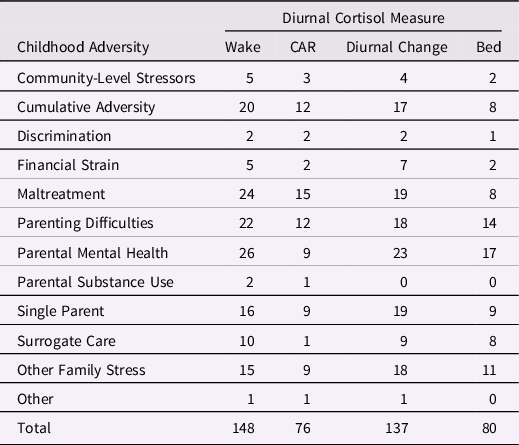
Overall effect
The overall effect for childhood adversity and wake levels of cortisol was not significant, r = −0.008, 95% CI [−0.024, 0.008], t = −0.949, p = 0.344 (see Supplemental Figure 1). One-sided log-likelihood-ratio tests indicated that there was not significant variation within, σ2 < 0.001, χ2(1) = 1.372, p = 0.121, or between, σ2 = 0.012, χ2(1) = 1.186, p = 0.138, studies. The distribution of variance across levels was 81.36% at level 1 (i.e., 81.36% of the total variance can be attributed to sampling variance within studies), 10.66% at level 2 (i.e., 10.66% of the total variance can be attributed to differences between effect sizes within studies) and 7.98% at level 3 (i.e., 7.98% of the total variance could be attributed to differences in effect sizes between studies). The overall I 2 reflecting heterogeneity in effect sizes across both levels 2 (within studies) and 3 (between studies) was 18.64% (i.e., 18.64% of the variability in effect size estimates resulted from differences in effect sizes within and between studies rather than sampling error).
Moderators
See Table 3 for information on moderator variables for each study and Table 4 for descriptive statistics for moderator variables. None of the moderators related to primary aims yielded significant results: type of adversity, F(6, 126) = 1.911, p = 0.084; age at adversity, F(4, 143) = 1.064, p = 0.377; and age at cortisol collection, F(1, 142) = 0.122, p = 0.727. Given that the between-study variance was not significant, none of the additional between-study moderators were examined. Finally, neither the post hoc analysis examining threat vs. deprivation as a moderator in the subset of studies that included threat or deprivation effect sizes (n = 18), F(1, 16) = 0.581, p = 0.457, nor the post hoc analysis examining study methodological quality, F(1, 146) = 0.024, p = 0.876, were significant. (See Supplemental Materials for more detailed methodological quality analyses.)
Additional information on moderator variables by study

Note. This table includes information on moderator variables not already provided in Table 1. Papers are grouped together based on study. If effect sizes were pulled from a specific paper, that paper is included. If authors provided data for a study, all papers related to that study are included. Papers are listed in alphabetical order.
Moderator variable descriptive statistics

Publication bias
Egger’s regression test did not indicate significant funnel plot asymmetry, z = 0.567, p = 0.571 (see Figure 2).
Funnel Plots with Trim and Fill. Note. In each figure, the shaded area represents significant effect sizes (p < .05). Black circles represent coded effect sizes. White circles represent effect sizes added by trim and fill analysis.

Cortisol awakening response
A total of 76 effect sizes from 45 distinct study samples were included in the meta-analysis examining childhood adversity and the CAR. Sample sizes ranged from 15 to 2,162 with a median of 89. See Table 1 for details about the studies included and Table 2 for the number of effect sizes in each category of childhood adversity.
The overall effect of childhood adversity on the CAR was not significant, r = 0.021, 95% CI [−0.013, 0.054], t = 1.223, p = 0.225 (see Supplemental Figure 2). One-sided log-likelihood-ratio tests indicated that variation was significant between, σ2 = 0.006, χ2(1) = 6.019, p = 0.007, but not within, σ2 < 0.001, χ2(1) < 0.001, p > 0.500, studies. The distribution of variance across levels was 50.59% at level 1 (sampling variance), <0.01% at level 2 (within-study variance) and 49.41% at level 3 (between-study variance), with an overall I 2 of 49.41%.
Moderators
None of the moderators related to primary aims yielded significant results: type of adversity, F(5, 60) = 0.674, p = 0.645; age at adversity, F(4, 71) = 1.129, p = 0.350; and age at cortisol collection, F(1, 73) = 0.174, p = 0.678. Given the significant between-study variance, study-level variables were also examined as potential moderators of the overall effect. None of the primary or exploratory moderator variables were significant (see Supplemental Table 1). Finally, neither the post hoc analysis examining threat vs. deprivation as a moderator in the subset of studies that included threat or deprivation effect sizes (n = 9), F(1, 7) = 0.279, p = 0.613, nor the post hoc analysis examining study methodological quality, F(1, 74) = 1.979, p = 0.164, were significant. (See Supplemental Materials for more detailed methodological quality analyses.)
Publication bias
Egger’s regression test did not indicate significant funnel plot asymmetry, z = −0.506, p = 0.613 (see Figure 2).
Diurnal cortisol change
A total of 137 effect sizes from 71 distinct study samples were included in the meta-analysis examining childhood adversity and diurnal cortisol change levels. The sample sizes ranged from 15 to 2,088 with a median of 100. See Table 1 for details about the studies included and Table 2 for the number of effect sizes in each category of childhood adversity.
The overall effect of childhood adversity on diurnal cortisol change was not significant, r = 0.017, 95% CI [−0.010, 0.043], t = 1.264, p = 0.215 (see Supplemental Figure 3). One-sided log-likelihood-ratio tests indicated significant variation between, σ2 = 0.006, χ2(1) = 9.960, p = 0.001, but not within, σ2 = 0.001, χ2(1) = 0.879, p = 0.174, studies. The distribution of variance across levels was 47.77% at level 1 (sampling variance), 6.01% at level 2 (within-study variance) and 46.21% at level 3 (between-study variance), with an overall I 2 of 52.23%.
Moderators
None of the moderators related to primary aims yielded significant results: type of adversity, F(7, 122) = 0.321, p = 0.943; age at adversity, F(4, 132) = 2.402, p = 0.053; and age at cortisol collection, F(1, 134) = 1.351, p = 0.247. Because there was significant between-study variance, study-level variables were also examined as potential moderators. None of the primary or exploratory moderator variables were significant (see Supplemental Table 1). Finally, neither the post hoc analysis examining threat vs. deprivation as a moderator in the subset of studies that included threat or deprivation effect sizes (n = 15), F(1, 13) = 0.072, p = 0.793, nor the post hoc analysis examining study methodological quality, F(1, 135) = 1.711, p = 0.362, were significant. (See Supplemental Materials for more detailed methodological quality analyses.)
Publication bias
Egger’s regression test did not indicate significant funnel plot asymmetry, z = −0.021, p = 0.983 (see Figure 2).
Bedtime levels
A total of 80 effect sizes from 42 distinct study samples were included in the meta-analysis examining childhood adversity and bedtime levels of cortisol. The sample sizes ranged from 26 to 580 with a median of 103.5. See Table 2 for the number of effect sizes in each category of childhood adversity and Table 1 for details about the studies included.
A significant effect was found for childhood adversity and bedtime levels of cortisol, r = 0.047, 95% CI [0.005, 0.089], t = 2.231, p = 0.028, indicating that children exposed to higher levels of adversity had higher bedtime cortisol levels than children exposed to lower levels of adversity (see Supplemental Figure 4). One-sided log-likelihood-ratio tests indicated significant variation between, σ2 = 0.012, χ2(1) = 20.727, p < .001, but not within, σ2 < 0.001, χ2(1) < 0.001, p > .500, studies. The distribution of variances was 39.09% at level 1 (sampling variance), <0.01% at level 2 (within-study variance) and 60.91% at level 3 (between-study variance), with an overall I 2 of 60.91%.
Moderators
None of the moderators related to primary aims yielded significant results: type of adversity, F(6, 68) = 0.877, p = 0.516; age at adversity, F(3, 76) = 1.175, p = 0.325; and age at cortisol collection, F(1, 76) = 0.513, p = 0.476. Given the significant between-study variance, study-level variables were also examined as potential moderators of the overall effect. None of the primary or exploratory moderator variables were significant (see Supplemental Table 1). Finally, neither the post hoc analysis examining threat vs. deprivation as a moderator in the subset of studies that included threat or deprivation effect sizes (n = 9), F(1, 7) = 0.355, p = 0.570, nor the post hoc analysis examining study methodological quality, F(1, 78) = 0.090, p = 0.765, were significant. (See Supplemental Materials for more detailed methodological quality analyses.)
Publication bias
Egger’s regression test did not indicate significant funnel plot asymmetry, z = 0.902, p = 0.367 (see Figure 2). In addition, Rosenthal’s (Reference Rosenthal1979) fail-safe N indicated that 299 unpublished or yet-to-be-conducted studies with nonsignificant findings would be necessary to produce a null overall effect. Since this is above the cutoff of 220, the fail-safe N indicates that the effect is not likely to be due to publication bias alone.
Discussion
Meta-analytic findings
Within this meta-analysis, the only significant overall effect was the association between childhood adversity and higher bedtime cortisol levels, which could not be accounted for by publication bias alone. The lack of significant overall effects for wake, the CAR and diurnal cortisol change is consistent with previous meta-analyses that have not yielded significant overall associations between childhood adversities of early life stress, maltreatment and parenting and components of the diurnal cortisol pattern (Bernard et al., Reference Bernard, Frost, Bennett and Lindhiem2017; Fogelman & Canli, Reference Fogelman and Canli2018; Hackman et al., Reference Hackman, O'Brien and Zalewski2018). However, the significant association between childhood adversity and bedtime cortisol levels is a novel meta-analytic contribution that suggests those who have experienced childhood adversity have more difficulty downregulating cortisol production as the day ends.
Understanding the magnitude of this effect is challenging as the current literature does not provide clear guidelines as to what magnitude of change in diurnal cortisol regulation is associated with clinically significant outcomes. Although this effect would be categorized as “small” by Cohen’s benchmarks, Cohen also emphasized the necessity of considering the research area and methodology when examining the magnitude of effect sizes (Cohen, Reference Cohen1988). This meta-analysis examines bedtime cortisol values on a small sample of days. Though the effect of childhood adversity on cortisol levels measured at a single bedtime (or small sample of bedtimes) is clearly small, the cumulative effect over thousands of bedtimes (365 each year) may be consequential (see Funder & Ozer, Reference Funder and Ozer2019). Future studies examining the relationship between diurnal cortisol effect sizes and the magnitude of corresponding clinical impacts, especially cumulatively, will enhance our understanding of the significance of the overall effect presented here.
Despite significant heterogeneity within and between studies, no moderation effects were identified. This heterogeneity may be explained by substantial variability in methods utilized to assess diurnal cortisol, including timing of samples collected, number of collection days, use of adherence protocols, methods for data cleaning/preparation and calculation of outcome measures, which may contribute to mixed results. Heterogeneity in diurnal cortisol methodology has been found within randomized controlled trials that include diurnal cortisol as an outcome, highlighting the need for more consistent methods (Ryan et al., Reference Ryan, Booth, Spathis, Mollart and Clow2016). We attempted to capture this methodological heterogeneity by examining multiple moderators related to methods. As can be seen in Table 4, there was substantial variability across most methodological moderators examined herein; however, these moderators do not provide an indicator as to which methodological characteristics may be of particular importance as none were significant.
Findings in the context of current theoretical models
Interpreting these results within the context of the current literature on diurnal cortisol regulation may add insight into these meta-analytic results. Many theoretical models, including the cumulative adversity, biological embedding and three-hit models, suggest that the impact of childhood adversity on diurnal cortisol regulation may change over time. This is consistent with the concept of adaptive calibration (Del Giudice et al., Reference Del Giudice, Ellis and Shirtcliff2011), in which the body adapts in response to stressors and changes in the environment to maintain stability, such as by producing an initial increase in cortisol production (hypercortisolism) in response to an adversity at onset but shifting to a blunted response (hypercortisolism) with prolonged adversity duration. Thus, any attempt to capture overall associations between childhood adversity and diurnal cortisol regulation may include effects that differ in magnitude and direction based on the adversity’s timing of onset, duration, chronicity, current presence or absence and time since initial onset.
One implication of this is that the associations between childhood adversity and diurnal cortisol regulation may not be linear. Previous studies have provided evidence for such potential nonlinear relationships. For example, the study by Zalewski et al. (Reference Zalewski, Lengua, Thompson and Kiff2016) examining associations between cumulative risk and diurnal cortisol among preschool-age children found that both high and low levels of cumulative risk were associated with lower morning levels of cortisol and more blunted cortisol slopes compared to moderate levels of cumulative risk, suggesting that the association between amount of adversity and diurnal cortisol response may not be linear. Similarly, studies have indicated that the association between childhood adversity and diurnal cortisol regulation may not be linear across development, such as a study by VanTieghem et al. (Reference VanTieghem, Korom, Flannery, Choy, Caldera, Humphreys, Gabard-Durnam, Goff, Gee, Telzer, Shapiro, Louie, Fareri, Bolger and Tottenham2021) that found morning cortisol levels in previously institutionalized children shift across development from blunted during childhood to heightened in adolescence. As a result, understanding the associations between childhood adversity and diurnal cortisol may require analytic methods that examine possible nonlinear relationships that could not be captured in the present meta-analysis.
An additional implication is that including elements of adversity timing is crucial to understanding childhood adversity’s impact on diurnal cortisol regulation. Although the current meta-analysis aimed to capture aspects of childhood adversity timing, these attempts were limited by information available in the current literature. Studies do not consistently include information on the onset, duration, chronicity and current presence (except when childhood adversity and diurnal cortisol are measured concurrently) of childhood adversities, and few studies examine these associations longitudinally. As a result, we were restricted to coding timing of adversity as the developmental period for which the adversity was being assessed (e.g., infancy, adolescence, multiple periods). This methodological approach carried significant limitations, as it only provides information on whether the adversity was present during a particular developmental window and does not provide information on the adversity’s duration or presence before or after that developmental period. In addition, most studies examined childhood adversity across multiple developmental periods (e.g., at any point in childhood). Similarly, time elapsed between experiencing childhood adversity and assessing diurnal cortisol is not consistently reported across studies. This meta-analysis examined mean age at time of cortisol assessment as a potential moderator since it is plausible that older samples, especially those including adults, have more time elapsed since childhood adversity onset than younger samples. However, this measure is neither consistent nor precise and therefore provides limited insight. Of note, the feasibility of examining early adversity within the context of sensitive period models has been questioned given the complexity of identifying the nature, timing and duration of early adversities (which are often overlapping) and the possibility that some adversities may impact neurobiology through experience-dependent mechanisms (Gabard-Durnam & McLaughlin, Reference Gabard-Durnam and McLaughlin2019). Thus, the potential impact of adversity’s timing on HPA axis regulation remains a complex question requiring further investigation.
Additionally, a variety of adversity characteristics have been proposed to impact associations between adversity and HPA axis regulation, including traumatic nature, threat to physical self, uncontrollability, elicitation of emotions such as shame or loss, and whether the impact is threat or deprivation (McLaughlin & Sheridan, Reference McLaughlin and Sheridan2016; Miller et al., Reference Miller, Chen and Zhou2007). These characteristics are not consistently reported across studies. Although the present study examined category of adversity as a moderator, these categories were broad and likely contained significant heterogeneity in type, intensity and duration of stressor, which may have obscured effects. Furthermore, measures of adversity sometimes fit into multiple categories. For example, low levels of conflict at home is an example of family stress, but high levels of conflict at home may take the form of domestic violence, which is both a family stressor and a form of maltreatment. Because many measures of family conflict within this meta-analysis included a range of behaviors that could not be considered exclusively domestic violence, we categorized family conflict under other family stress. However, two studies categorized as other family stress did focus specifically on measures of domestic violence (i.e., Hibel et al., Reference Hibel, Nuttall and Valentino2020; Theall et al., Reference Theall, Shirtcliff, Dismukes, Wallace and Drury2017) and therefore would also have been a good fit for the maltreatment category. Similarly, the category of surrogate care includes both foster care or institutionalization and adoption, which may convey different experiences of caregiving and different levels of adversity. (Of note, all children included in the surrogate care category experienced foster care, institutional care and/or maltreatment resulting in separation from biological parents with the possible exception of a subset of Gunnar et al. (Reference Gunnar, Morison, Chisholm and Schuder2001) sample who were adopted so early they had not yet been placed in orphanages.) We attempted to place adversities in the categories with which they would match most consistently, but these instances of overlap mean that categories of adversity are not fully independent.
A further limitation of this approach is the likelihood that some of these categories serve as proxies for childhood adversity but do not capture true “deviation from the expectable environment” (McLaughlin et al., Reference McLaughlin, Weissman and Bitrán2019). A better way to assess childhood adversity, as suggested by McLaughlin (Reference McLaughlin2016), may be to include only events that result in deviations from expected caregiving or other significant adversity for the child. Although we could not make this distinction within the present meta-analysis based on the information consistently available in manuscripts, future studies that consider whether potential adversities constitute significant deviations from the expectable environment will likely enhance our understanding of the impact of early adversity. In addition, it is important to note that intervention efforts should be aimed at addressing sources of adversity directly (e.g., increasing financial and social support for overburdened parents) rather than the proxies for adversity (e.g., incentivizing single parents to be married).
Although we attempted to include a broad range of childhood adversity, other forms of adversity are likely missing. In particular, there was a lack of studies directly examining the impact of systemic racism and discrimination experienced during childhood on diurnal cortisol regulation. Racial and ethnic health disparities have been theorized to stem from increased allostatic load, to which systemic racism and discrimination are likely contributors (Carlson & Chamberlain, Reference Carlson and Chamberlain2005). Understanding associations between experiences of discrimination and diurnal cortisol regulation could help explain racial/ethnic differences in diurnal cortisol patterns (e.g., DeSantis et al., 2007; Martin et al., Reference Martin, Bruce and Fisher2012) and provide insight into pathways through which discrimination may impact health and well-being. Some studies have already provided preliminary evidence in identifying associations between experiences of discrimination and blunted diurnal slopes among individuals with a racial/ethnic minority status (Adam et al., Reference Adam, Heissel, Zeiders, Richeson, Ross, Ehrlich, Levy, Kemeny, Brodish, Malanchuk, Peck, Fuller-Rowell and Eccles2015; Zeiders et al., Reference Zeiders, Hoyt and Adam2014). In addition, it is essential to examine the impact of discrimination on minoritized youth more broadly, such as those with sexual and gender minority identities (Williams & Mann, Reference Williams and Mann2017). In one example, experience of greater LGBT stressors throughout the week was associated with elevated cortisol at awakening and 45 minutes after awakening in young adults (Figueroa et al., Reference Figueroa, Zoccola, Manigault, Hamilton, Scanlin and Johnson2021). Future studies further examining the impact of discrimination on diurnal cortisol patterns among youth with minoritized identities may increase our understanding of pathways contributing to alteration in the HPA axis and possible health disparities.
Finally, the random selection of a single measure of adversity for each category of childhood adversity from each study in the present meta-analysis meant that some effect sizes were excluded due to the study design; however, the use of random selection and the large number of effect sizes included likely provide a representative sample. To supplement our analyses utilizing broad adversity categories, we also attempted to examine whether categorization of adversity as threat or deprivation was a significant moderator of overall effect sizes in post hoc analyses. However, these analyses were limited by the small number of effect sizes included as a result of our retrospective approach to identifying threat and deprivation and of the difficulty of distinguishing between threat and deprivation given that many measures of adversity assessed both threat and deprivation together. As a result, we were likely underpowered to detect significant moderation effects related to threat vs. deprivation. Overall, a more nuanced examination of the characteristics of adversity that was beyond the scope of this meta-analysis may be required to understand complex associations between childhood adversity and diurnal cortisol regulation in future studies.
Strengths and limitations
Several methodological decisions strengthened our ability to capture a broad overall picture of the association between childhood adversity and diurnal cortisol. First, we defined childhood adversity broadly, including a wide range of adversity categories. Further, we utilized multilevel meta-analysis techniques, allowing the inclusion of multiple effects from the same study while accounting for interdependence of effects.
This meta-analysis also included several limitations in addition to those related to assessment of childhood adversity timing and nature discussed above. First, although the use of simple difference scores to calculate diurnal cortisol change and the CAR allowed us to include findings across a wide range of studies, these measures did not reflect change over time. Given the importance of timing to diurnal cortisol patterns, this may have resulted in inconsistencies in the included cortisol measures. In particular, timing is of critical importance to the accurate measurement of the CAR, and current recommendations include repeated sampling across the period after awakening, particularly at wake-up and from 30 to 45 minutes after awakening, as well as objective monitoring of participant adherence (Stalder et al., Reference Stalder, Kirschbaum, Kudielka, Adam, Pruessner, Wüst, Dockray, Smyth, Evans, Hellhammer, Miller, Wetherell, Lupien and Clow2016). This meta-analysis relied on authors’ determinations of timing for their measure of the CAR and therefore did not restrict inclusion of measures of the CAR based on sample timing. As a result, variability in the timing of the CAR measurements included herein may be creating additional noise in the data that could obscure true effects.
Similarly, diurnal cortisol change was included if cortisol samples from at least two time points (one at awakening or in the morning and one in the afternoon, evening, or at bedtime) were available to include the wide range of the effect sizes available in the present literature while also capturing variability across the waking day. However, it is important to note that there are numerous approaches for measuring changes in cortisol across the day, including wake to bedtime, peak to bedtime and morning to afternoon among others. The true effect for diurnal cortisol change may be obscured by the range of methodologies of the studies included in this meta-analysis. In a preliminary exploration of this possibility, whether diurnal cortisol change samples were collected at awakening and bedtime was included as a moderator and was not significant; however, the design of this meta-analysis precluded more nuanced examination of differences in diurnal cortisol change measurement. Furthermore, more comprehensive measures of change in cortisol throughout the day such as diurnal cortisol slope may provide a clearer picture of the association between childhood adversity and diurnal cortisol patterns. Examination of cortisol collection methodology suggests the diurnal cortisol slope is well approximated by methods that include fixed samples at awakening and bedtime as well as at three additional points in the day, providing guidance for future studies (Hoyt et al., Reference Hoyt, Ehrlich, Cham and Adam2016). In addition, we did not examine other biomarkers or genetic factors that may contribute to an individual’s response to stress and interact with the diurnal cortisol pattern.
Another limitation is that our examination of racial/ethnic minority status as a study-level moderator may be impacted by differences in the experiences of those with racial/ethnic minority statuses that likely vary within and across countries. Although we attempted to explore this by examining this moderator in the subset of studies specific to United States, this moderator may be capturing diverse experiences even within a single country.
Finally, our measure of study quality was limited by the information reported on methodology within each manuscript. It is possible that some studies did account for covariates included within this measure that were not reported in their manuscripts, resulting in a lower quality score and adding noise to this measure of study quality. In addition, this measure weights every covariate equally and does not account for variability in the rigor of methods used to account for these covariates. Furthermore, although our post hoc analyses examined whether biobehavioral variables were accounted for by authors in the original study (i.e., included as a covariate, used as an exclusion criterion, or examined in follow-up analyses), they do not reflect whether these variables were accounted for as covariates in the effect sizes reported in this meta-analysis. As a result, although the majority of the post hoc moderation analyses examining study methodological quality and individual biobehavioral variables presented here were not significant, the potential noise within these variables in combination with the extensive previous literature indicating the importance of these variables prevents us from concluding that they are not relevant to cortisol analyses related to early adversity. Both consistent use of rigorous and high-quality methodological approaches and consistent reporting of such measures taken will be important for future studies.
Implications and future directions
In the present meta-analysis, the association between childhood adversity and bedtime cortisol levels emerged as the only significant association. This finding indicates that measuring bedtime cortisol levels may provide an important opportunity to capture the impact of early adversity on diurnal cortisol regulation in future studies. Clinically, developing interventions that ameliorate the negative impact of childhood adversity on bedtime cortisol levels is also important.
A consistent result throughout this meta-analysis was the lack of significant overall and moderation effects. Given that current theoretical models emphasize the importance of the timing and nature of childhood adversity, the lack of significant findings may in part result from the nuanced and complex nature of associations between adversity and HPA axis regulation. Many of these nuances were unable to be examined on a meta-analytic level, in part because they are not consistently examined or reported in the current literature. As a result, this meta-analysis highlights the importance of capturing specificity in the timing and nature of childhood adversity when examining associations with diurnal cortisol. When possible and relevant, future studies should make efforts to assess and report:
-
1. Age of onset of adversity
-
2. Ages at which adversity occurred
-
3. Duration/chronicity of adversity
-
4. Whether the adversity is concurrent
-
5. Time between adversity onset/termination and diurnal cortisol measurement
-
6. Characteristics of adversity, including whether it was traumatic, threatened physical integrity and involved deprivation or threat
-
7. Participants’ perceptions of adversity, including whether it was uncontrollable, whether it elicited emotions such as shame or loss, and its intensity
Furthermore, when considering age it may be important not only to consider chronological age but also to consider pubertal status since puberty may be an important developmental window for HPA axis functioning. Although it likely will not be feasible to assess each of these characteristics in every study, moving toward greater inclusion of these factors and considering the implications when they are unknown will likely strengthen the literature.
In addition to these recommendations specific to examining childhood adversity, it is of critical importance that studies continue to follow methodological guidelines for the accurate assessment of diurnal cortisol (e.g., Hoyt et al., Reference Hoyt, Ehrlich, Cham and Adam2016; Stalder et al., Reference Stalder, Kirschbaum, Kudielka, Adam, Pruessner, Wüst, Dockray, Smyth, Evans, Hellhammer, Miller, Wetherell, Lupien and Clow2016). Given the importance of timing to the accurate assessment of diurnal cortisol, collecting wake samples immediately upon awakening and utilizing objective monitoring of sample timing (e.g., with MEMS caps) are necessary for consistent and accurate measurements of the diurnal cortisol pattern. Of note, instructions to take samples immediately upon awakening were included in the study description for only 72.79% of wake level effect sizes in the present meta-analysis, and objective monitoring of adherence to sample timing was included in 18.37% of studies included in this meta-analysis, suggesting that inconsistencies in diurnal cortisol measurement may be a methodological limitation of the literature broadly. Furthermore, it is important to account for covariates related to the day of sampling (e.g., sleep quality, weekday vs. weekend) and traits of the individual (e.g., age, sex, contraception use) that may impact diurnal cortisol production, as well as to consider possible exclusion criteria for factors that cannot sufficiently be controlled (Stalder et al., Reference Stalder, Kirschbaum, Kudielka, Adam, Pruessner, Wüst, Dockray, Smyth, Evans, Hellhammer, Miller, Wetherell, Lupien and Clow2016). Consistent adherence to methodological recommendations in future diurnal cortisol studies will reduce potential noise that may interfere with identifying true effects.
In addition, it is important to note that diurnal cortisol patterns also reflect individual differences and day-to-day variability. As a result, person-centered approaches to examining individual diurnal cortisol profiles (e.g., Hoyt et al., Reference Hoyt, Zeiders, Chaku, Niu and Cook2021), particularly longitudinally, may provide additional insight. Furthermore, longitudinal examinations of associations between childhood adversity and diurnal cortisol will be crucial to our ability to understand the impact of timing, intensity, chronicity and type of adversity on diurnal cortisol regulation.
Finally, this meta-analysis only examined diurnal cortisol as defined as cortisol levels at awakening or bedtime, the CAR, or diurnal cortisol change and did not capture measures of overall cortisol output (e.g., area under the curve), cumulative measures of cortisol (e.g., hair cortisol), or cortisol reactivity, which may provide additional insight into the impact of childhood adversity on HPA axis functioning. As discussed earlier, nonsignificant, significant positive and significant negative effects have all been found for associations between childhood adversity and hair cortisol levels (Bryson et al., Reference Bryson, Price, Goldfeld and Mensah2021; Grant & Meyer, Reference Grant and Meyer2021; Khoury et al., Reference Khoury, Enlow, Plamondon and Lyons-Ruth2019) or cortisol reactivity (Bunea et al., Reference Bunea, Szentágotai-Tătar and Miu2017; Hakamata et al., Reference Hakamata, Suzuki, Kobashikawa and Hori2022; Hosseini-Kamkar et al., Reference Hosseini-Kamkar, Lowe and Morton2021; Hunter et al., Reference Hunter, Minnis and Wilson2011; Lai et al., Reference Lai, Lee and Leung2021), suggesting many complexities remain to be untangled related to childhood adversity’s impact on HPA axis functioning. As a result, future studies examining these additional cortisol measures may be important to our understanding of childhood adversity and stress regulation.
Conclusions
In summary, the present meta-analysis found a significant association between childhood adversity and higher bedtime cortisol levels, with no significant moderation effects. These findings highlight that childhood adversity may particularly impact the ability to downregulate cortisol levels throughout the day, resulting in higher bedtime levels. In contrast, the overall effects for childhood adversity and other measures of diurnal cortisol (e.g., morning levels, the CAR and diurnal cortisol changes) were not significant. Given the limitations discussed above, it is not yet clear whether these null effects result from the complexity of these relationships or are a true reflection of overall associations. Associations between childhood adversity and diurnal cortisol may be too complex to capture with studies, including the present meta-analysis, that examine adversity broadly defined and diurnal cortisol regulation measured across developmental stages at varying lengths from the onset of adversity. As it is possible that the lack of stronger effects resulted from variability in the timing and characteristics of childhood adversity assessed, future longitudinal studies utilizing consistent rigorous methods and adversity assessment that allow for the possibility of nonlinear relationships will be necessary to clarify possible nuances in the relation between childhood adversity and diurnal cortisol. Such studies have great potential for increasing our understanding of the likely complex impact of childhood adversity on diurnal cortisol regulation.
Supplementary material
The supplementary material for this article can be found at https://doi.org/10.1017/S0954579423000561.
Acknowledgements
We would like to thank Christopher Facompré for providing consultation, resources and advice in preparing a meta-analysis.
Funding statement
This work was supported by the National Science Foundation Graduate Research Fellowship (LP and DT, grant number 1315232).
Competing interests
None.



