Introduction
Public support for welfare state policies is at the core of the main theoretical perspectives of (welfare) state development (Brooks and Manza Reference Brooks and Manza2006; Pierson Reference Pierson2001). Yet, there is scant knowledge about whether and how people change their attitudes towards the welfare state over time. In particular, we do not know how people react to increased reform pressures such as financial crises, rising public deficits or population ageing. Do people ask for a stronger welfare state to be protected against hard times, or do they accept retrenchment when faced with budgetary constraints?
On the macro level (that is on the country level) it seems that attitudes towards the welfare state are very stable in the long run (Jeene and van Oorschot Reference Jeene and van Oorschot2014). This is confirmed by the public opinion literature for various other political issues (Erikson, Mackuen and Stimson Reference Erikson, Mackuen and Stimson2002). In contrast, various other studies suggest that changes in the socio-economic, political and institutional context are correlated with changes in aggregated public opinion (Soroka and Wlezien Reference Soroka and Wlezien2009). However, these macro studies face the empirical challenge of establishing causality and of determining whether attitudes affect the political and institutional context or vice versa (Brooks and Manza Reference Brooks and Manza2006). Also, research on the macro–micro link misses a specific theoretical explanation of how and why people change their attitudes on the individual level in reaction to socio-economic or institutional changes (Mettler and Soss Reference Mettler and Soss2004). Whereas the individual determinants of attitudes are rather well known (i.e. self-interest and values; Kumlin Reference Kumlin, Dalton and Klingenmann2007; Larsen Reference Larsen2006; van Oorschot, Reeskens and Meuleman Reference van Oorschot, Reeskens and Meuleman2012), our knowledge is still limited when it comes to explaining individual attitude change. In contrast to aggregated public opinion, individual attitudes seem to be rather unstable and it seems as if ‘opinion statements vary randomly across repeated interviews of the same people’ (Zaller Reference Zaller1992: 28). In the absence of (cross-national) panel data, it remains a research lacunae to link socio-economic and institutional change on the macro level and attitudinal change on the individual level moving beyond static comparisons of countries at a single point in time.
Following up on these lines of research, we investigate whether people change their attitude towards the welfare state when faced with increasing pressures to reform. We use pension reform preferences as our empirical test case. First, in terms of spending the pension system is the most important one in most European welfare states. Second, pension reforms are back on the political agenda due to population ageing, and third, attitudes towards pensions have recently gained renewed scientific attention (Jaime-Castillo Reference Jaime-Castillo2013; Naumann Reference Naumann, Kumlin and Stadelmann-Steffen2014; Prinzen Reference Prinzen2014). More specifically, we examine whether an ageing society, as one of the major challenges for the financing of the pensions system, affects pension reform preferences.Footnote 1 In this we add to recent research that examined how demographic ageing affects retirement plans and preferences (Hofäcker Reference Hofäcker2014). In order to narrow the theoretical and methodological gaps outlined above, we will combine the welfare state attitudes literature with findings from political psychology. First, the paper contributes to welfare state attitudes research on a theoretical level by elaborating mechanisms of individual attitude formation. In this respect we rely on an extensive literature from political psychology that examines attitude formation and change on the individual level (e.g. Chong and Druckman Reference Chong and Druckman2007; Zaller Reference Zaller1992). Second, we apply a new method and make use of a survey experiment that externally manipulates the reform pressure.Footnote 2 Survey experiments may help to overcome some of the problems inherently linked to cross-sectional data analysis and can complement existing research (Gaines, Kuklinski and Quirk Reference Gaines, Kuklinski and Quirk2007).
Enduring popularity of the welfare state in times of crisis?
One core claim of the current welfare state literature is that ‘contemporary politics of the welfare state take shape against a backdrop of both intense pressures for austerity and enduring popularity’ (Pierson Reference Pierson2001: 410). This argument is based on the assumption that interest formation in times of welfare state retrenchment follows a quite different logic when compared with times of welfare state expansion. As long as the welfare state was expanding, reforms were basically about distributing additional benefits. Even if benefits were not distributed equally and interests might be conflicting, opposition to reform is assumed to be less pronounced as people usually agree with a reform if they at least benefit to a certain degree. The context of austerity changes the logic of attitude formation. Reforms are aimed at cutting back benefits or at least at recalibrating the welfare state. Opposition to such reforms is assumed to be much stronger as groups who benefit from the welfare state will defend ‘their’ programmes and acquired rights.Footnote 3
The relevance of public opinion in the policy process is a long-standing topic in political science (Burstein Reference Burstein2003). In the light of The New Politics of the Welfare State argument (Pierson Reference Pierson2001), it has gained renewed attention and public opinion is identified as a possible and powerful veto player blocking reforms. Two mechanisms are distinguished. First, attitude change might alter vote choice, thereby directly affecting the composition of the government. Second, fearing electoral backlash politicians might not propose any policy that goes against public opinion.Footnote 4 In this way, support for the welfare state might also block welfare state retrenchment indirectly without necessarily affecting voting behaviour.
Somewhat surprisingly, reforms take place in times of austerity (Häusermann Reference Häusermann2010) and voters do not necessarily punish retrenchment efforts (Giger Reference Giger2011). Despite this evidence, the starting point of the new politics argument, i.e. that increasing reform pressures do not affect the popularity of the welfare state, still remains rather unquestioned in the welfare state attitudes literature. This is even more surprising given that theoretical explanations of welfare state attitudes lead to competing expectations of how people should react to increasing reform pressures. Both explanations rely on self-interest and values as the basic mechanisms that determine attitudes.
In line with the new politics argument, people might maintain their high welfare state support (or are even more inclined to support the welfare state) out of self-interest since more people have to rely or expect to rely on the welfare state (Blekesaune Reference Blekesaune2007). Value-oriented explanations stress that increasing reform pressures affect welfare state attitudes via deservingness perceptions of welfare recipients (van Oorschot and Meuleman Reference van Oorschot, Meuleman, Kumlin and Stadelmann-Steffen2014). When more people (and possibly also family and friends) rely on the welfare state, sympathy and reciprocity with those people increases. Moreover, some scholars even argue that ‘Samaritan’ values will be strengthened in hard times (Goul Andersen et al. Reference Goul Andersen, Pettersen, Svallfors, Uusitalo, Kautto, Heikkila, Hvinden, Marklund and Ploug1999).
A competing argument also relies on self-interest and values but leads to the expectation that people withdraw their welfare state support in reaction to increased pressures. Self-interest-oriented explanations assume that people have a fixed preference on how much should be spent on welfare (i.e. how much they are willing to pay). If current levels of welfare provision are maintained, increased reform pressures such as population ageing and financial crises will lead to increased costs and more spending. People should then withdraw their welfare state support since the increased welfare spending overshoots their preferred level of spending (Soroka and Wlezien Reference Soroka and Wlezien2009). Other approaches have a broader understanding of self-interest and show that people are also guided by socio-tropic motivations and long-term self-interest (Kinder and Kiewiet Reference Kinder and Kiewiet1981). Retrenchment and short-term individual losses might be acceptable when they ensure the functioning of the economy and contribute to the long-term existence of the welfare state. People thus might accept cutbacks in order to be protected in the future. Finally, value-oriented explanations assume that economic circumstances affect basic values such as generosity. ‘People are only as generous as they can be’ (Alt Reference Alt1979: 184).
Convincing empirical evidence on whether and how people change their welfare state attitudes in times of welfare state retrenchment is scarce. The standard approach analyses cross-sectional data (preferably with multi-level models) and tries to link institutional differences and levels of welfare state support across European countries (Dallinger Reference Dallinger2010; Fernandez and Jaime Castillo Reference Fernandez and Jaime-Castillo2013). Findings are inconclusive. For example, Fernandez and Jaime-Castillo (Reference Fernandez and Jaime-Castillo2013) do not find a consistent impact of reform pressures (measured as the share of the population aged 65 or older) on pension reform preferences. They compare three pension reform alternatives (increasing the retirement age, increasing contributions and reducing benefits) to the reference category of no change. In countries with a higher pressure to reform (that is in countries with an older population), people prefer no change over an increase in contributions. One reason for these mixed findings might be the methodological challenge of low case numbers on the country level paired with low variation between countries. Usually only between 10 and 15 per cent of the total variance is due to the country level. Moreover, these studies miss a dynamic component. Observed differences in attitudes are explained by current institutional indicators but these differences might be the result of past policy developments as well.Footnote 5
The few studies examining time trends find that aggregate public opinion changes very slow (Jeene and van Oorschot Reference Jeene and van Oorschot2014; Taylor-Gooby Reference Taylor-Gooby2001) and that attitudinal change over time is rather the result of generational replacement (Svallfors Reference Svallfors2010). Nevertheless there is some evidence that people also adapt their attitudes in the short run reacting for example to the business cycle (Raven et al. Reference Raven, Achterberg, van der Veen and Yerkes2011; Shivo and Uusitalo Reference Shivo and Uusitalo1995; van Dalen and Henkens Reference van Dalen and Henkens2005). Although the first two studies examine data from the Netherlands between the mid-1980s and the mid-2000s, the results are contradictory. Whereas Raven et al. (Reference Raven, Achterberg, van der Veen and Yerkes2011) find that support for higher social security expenditures increases if the unemployment rate is high, van Dalen and Henkens (Reference van Dalen and Henkens2005) find lower solidarity with older workers in times of recession.
Given the theoretical arguments and the inconclusive empirical evidence, we propose two competing hypotheses:
-
• Hypothesis 1a: When faced with population ageing and increasing pressures to reform, people maintain their high welfare state support and oppose retrenching reforms.
-
• Hypothesis 1b: When faced with population ageing and increasing pressures to reform, people withdraw their high welfare state support and are more willing to accept retrenching reforms.
How individual attitudes change in times of crisis
One reason for the inconclusive evidence might be its lack of a theoretical micro-foundation. It is not clear to which aspects of the political and socio-economic development people react. An implicit assumption of most arguments is that people are aware of increased reform pressures such as population ageing, or at least act as if they were informed (Erikson, Mackuen and Stimson Reference Erikson, Mackuen and Stimson2002; Lau and Redlawsk Reference Lau and Redlawsk2001). This assumption is at odds with psychological models of attitude formation that stress the importance of information processing. Zaller (Reference Zaller1992) describes the process of attitude formation in three steps: people receive information, they accept it (or not), and when finally forming their attitude they rely on a sample of related evaluations, considerations and attitudes already stored in their memory (Receive–Accept–Sample model). A possible bias might emerge because, at the stage of information reception cognitive engagement with an issue is related to actually perceiving and comprehending information. Moreover, at the stage of acceptance people tend to resist arguments that are inconsistent with their political predisposition. Finally, at the stage of constructing opinion statements, people make greatest use of ideas that are most immediately salient to them (Zaller Reference Zaller1992: 52). What remains unclear in most arguments in welfare state attitudes research is what exactly people perceive and how they process the information about the socio-economic developments that are assumed to affect their attitudes. That is why we focus on the question of whether information on population ageing (that is what we provide as a treatment in the survey experiment) affects reform preferences. An increased awareness of population ageing is possibly one of the immediate consequences of the actual process of population ageing. Elderly people are increasingly present and visible in the daily environment and the media will broach the issue of population ageing. Information on population ageing will possibly affect attitudes before other, more substantial aspects of population ageing, such as financial problems of the pension system or an increased burden to the health-care system, come into play.
Significant information effects are found at both the aggregate and the individual level (Althaus Reference Althaus1998; Blinder and Krueger Reference Blinder and Krueger2004). Our argument why people seem not to react to increasing reform pressures builds on these information effects. We assume that information on population ageing might not immediately be available or directly linked to pension reform preferences in the sampling process. Then, people just do not take related reform pressures into account when forming their reform preferences. It is thus not surprising that reform preferences seem to be unaffected by increasing reform pressures. In contrast to the new politics expectation, we hypothesise that people react to reform pressures such as an ageing society and adapt their reform preferences if they are (made) aware of them. If people are aware of increasing reform pressures, they give up their opposition to reform and are willing to accept retrenchment.
-
• Hypothesis 2: When (explicitly) faced with population ageing and increasing pressures to reform, people are willing to accept retrenching reforms.
It is a strong assumption that all respondents are able to establish a causal link between population ageing and pension reform preferences. Thus, we expect that the information effect is not uniform across all individuals but moderated by the political awareness of people. Political awareness can be understood as whether people are interested in politics and what people know about politics. Political awareness affects attention to and reception of messages (Zaller Reference Zaller1992). It increases the ability to counter-argue communications (Krosnick Reference Krosnick1990). Moreover, as political awareness increases, reliance on cues drops whereas reliance on issue relevant information rises (Kam Reference Kam2005). Individuals with a high political awareness should be more likely to have already heard about the increased reform pressures and adapted their preference accordingly. Both general political information (Blinder and Krueger Reference Blinder and Krueger2004) as well as specific information about the functioning of the pension system (Boeri and Tabellini Reference Boeri and Tabellini2012; Boeri, Borsch-Supan and Tabellini Reference Boeri, Borsch-Supan and Tabellini2001) increases the willingness to accept reforms. For example, Boeri, Borsch-Supan and Tabellini (Reference Boeri, Borsch-Supan and Tabellini2001) find a positive correlation between correct information on the net costs of a pension system and the acceptance to privatise parts of it. Moreover, people with a high political awareness should form their preferences independent of additional information provided in the survey since their attitudes are grounded in rather stable values. In contrast, we expect that less politically aware individuals will react stronger to cues about increasing pressures to reform. The third hypothesis thus implies a heterogeneous effect across groups with differing political awareness:
-
• Hypothesis 3: The effect of increased reform pressures on pension reform preferences is stronger among people with a low political awareness.
The previous argument was mainly concerned with the moderating effect that the strength of already-existing attitudes can have. In addition to the strength of attitudes, also their content is supposed to moderate the effect of additional information. How do people that are already in favour of retrenchment react to information? Also does their reaction differ from those who tend to oppose retrenching reforms? Leeper and Slothuus ‘make the case why political parties should be given center stage attention in understanding processes of public opinion formation’ (Reference Leeper and Slothuus2014: 132). They show that elite partisan polarisation affects attitude formation and intensifies the impact of party endorsements on opinions. At the same time, the impact of substantive information decreases (see also Druckman, Peterson and Slothuus Reference Druckman, Peterson and Slothuus2013). In contrast to American politics, the political context of European welfare policies seems not to be characterised by strong partisan polarisation. For example, Castles (Reference Castles2008) shows that the party colour of governments has little impact on the level of public involvement in welfare. This work argues theoretically that governments in the aggregate represent the preferences of their voters. Consequently, partisan polarisation at the individual level should also matter less for individual attitudes towards the welfare state.
Against this background, substantive and credible information on population ageing might become more relevant for attitude formation. Constrained by the popularity of the welfare state, parties (and voters) of the right are not able to follow ‘their’ retrenchment policies, whereas parties (and voters) of the left have to adapt to the reality of economic and demographic pressures and cannot adhere to a policy of welfare state expansion any more.Footnote 6
-
• Hypothesis 4: Neutrally framed information on reform pressures decreases the cleavage between reform supporters and reform opponents.
The German pension system
How people view and evaluate reform alternatives depends on the institutional context and, in particular, on the existing pension system (Fernandez and Jaime-Castillo Reference Fernandez and Jaime-Castillo2013; Naumann Reference Naumann, Kumlin and Stadelmann-Steffen2014). For a better understanding of our empirical results, we provide a description of the main characteristics of the German pension system in the following.
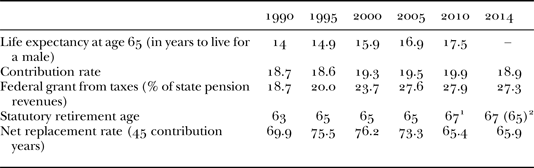
The German pension system can be seen as an ideal type of a Bismarckian social insurance system (Ebbinghaus Reference Ebbinghaus2011). It puts a strong emphasis on income maintenance and benefits are mainly provided by the public pillar. The statutory pension scheme is a mandatory pay-as-you-go system, i.e. benefits are paid directly from current workers’ contributions. It is mainly financed by social contributions of employers and employees that account for 18.9 per cent of gross income. About a fifth of the statutory pension revenues come from tax-financed federal grants. The public pension is roughly proportional to average lifetime earnings and has only few redistributive elements. Until the mid-2000s, the replacement rate increased to more than 70 per cent of earnings and made up the major part of retirement income (around 86 per cent of pension income of people aged 65 and older) (Ebbinghaus Reference Ebbinghaus2011). Supplementary pensions (i.e. the second and the third pillar) only play a minor role in providing retirement income. Occupational pensions account for 8 per cent of old-age income and are largely restricted to better paid employees. Private pensions (mainly in the form of life insurance schemes) account for 6 per cent of old-age income, though private pensions are becoming much more popular, in particular among younger workers (Hinrichs Reference Hinrichs, Bonoli and Shinkawa2005).
Three major reforms of the German pension system have been enacted in the last two decades. The first two in 2001 and 2004 are paradigmatic changes towards non-state pensions. The Old Age Savings Act of 2001 supports occupational and private pension savings by granting tax reductions and direct tax subsidies (Riesterrente). The 2004 reform introduced a sustainability adjustment factor which leads to gradual cutbacks of pension benefits. A third major reform enacted in 2007 gradually raised the statutory retirement age from 65 to 67. In 2012 the first cohorts were affected by this gradual increase and had to work for one month longer.
The main characteristics of the German statutory pension system are summarised in Table 1. All three reforms make reference to the challenges for the pension system due to population ageing. They were driven by diverse goals such as maintaining the financial sustainability of the pension system, reducing non-wage labour costs and achieving a balanced public budget (Ebbinghaus Reference Ebbinghaus2011). These goals were achieved by shifting the responsibility to provide adequate retirement income from public to private. This meant either explicit cutbacks by reducing the replacement rate or implicit cutbacks by increasing the retirement age (Table 1).
Characteristics of the German pension system – first (public) pillar

Notes: 1. The retirement age will be steadily increased from 65 to 67. The new retirement age of 67 applies to all retirees born in 1964 or later. 2. In 2014 the increase in the retirement age was partly taken back so that employees with 45 contribution years can retire at the age of 65 years without any reduction in benefit levels.
Source: Ebbinghaus (Reference Ebbinghaus2011: 129), updated for the recent years 2010 and 2014.
Data and methods
Data for this paper comes from the third wave of the German Internet Panel (GIP) that has been in the field since January 2013. The GIP is a new large-scale online panel based on a random probability sample of German-speaking individuals living within households in Germany. Panel households are initially approached offline, with a short face-to-face interview. The response rate of households was 52 per cent according to the formula for Response Rate 2 of the American Association for Public Opinion Research Response. To minimise non-coverage bias, households without access to the internet were provided with the necessary hardware and/or a broadband internet connection. Subsequently, all household members aged 16–75 years are invited to complete a bi-monthly questionnaire; 42 per cent of the invited household members registered with the GIP according to the formula for Response Rate 1 of the American Association for Public Opinion Research Response. The recruitment phase and a first wave of interviews were completed in September 2012 with 1,468 participants (Blom, Gathmann and Krieger Reference Blom, Gathmann and Krieger2014). Due to panel attrition, the sample size of the January 2013 wave consists of 974 individuals. The GIP is a random probability sample and should thus be representative of the German population between 16 and 75 years old. Due to varying response and participation rates, some socio-demographic groups are underrepresented in our sample when compared to census data (e.g. low educated and older people). To adjust for non-response bias we weight the data so that it resembles the target population with regard to age, gender and education.
Dependent variables: reform preference and opposition to reform
The reform preference is measured by responses to the following question:
-
• The ageing of society puts the financing of the state pension at its current level at risk. Which of the following reform proposals would you most likely support? And which one would you prefer the least?
Answer categories to choose from include:
-
• State pensions should be kept at their current level, but contributions of the insured should be increased.
-
• The government should increase taxes in order to be able to keep state pensions at their current level.
-
• State pension and contributions should be kept at their current level, but the statutory retirement age should be increased.
-
• State pensions should be reduced according to the demographic change.Footnote 7
The first two reform alternatives would preserve the status quo in terms of benefit levels and retirement age and increase contributions or taxes instead. An increase in contributions is the reform alternative that is most in line with the status quo of the contribution-based German pension system, whereas the strengthening of tax financing can be seen as a departure from the general idea of contribution-financed pensions. Although both reforms would not explicitly expand welfare benefits, the maintenance of the status quo would implicitly lead to welfare state expansion in terms of spending if population ageing continues. In contrast, the last two reform alternatives are retrenching the welfare state by increasing the retirement age or reducing pensions. Both retrenchment measures have been part of the recent pension reforms in 2004 and 2007.
Compared to standard measures of welfare state attitudes,Footnote 8 the question has the advantage that it poses a trade-off among specific and realistic policy alternatives (Fernandez and Jaime-Castillo Reference Fernandez and Jaime-Castillo2013). Moreover, these reform alternatives reflect the main characteristics of the first pillar of the German pension system (Table 1). What is not covered by the response options are proposals to transfer government's responsibility to provide old-age income to private pension schemes, e.g. to extend occupational or private pensions. The non-exhaustiveness of the list of reforms might be one reason for the comparable high share of ‘don't know’ answers (12%) and missing values (4%). In addition to answering ‘none of these’ or a combination of all four reforms, these respondents might have wished to suggest more radical, paradigmatic reforms. Our results are robust to the inclusion of ‘don't know’ answers and missing values as a separate answer category. In particular, the share of ‘don't knows’ is not affected by the experimental condition. Nevertheless, the assertions of our paper are clearly limited to the public part of the pension system.
Moreover, we do not only ask for the preference for a reform but also for opposition to a reform alternative, the least preferred reform alternative. In the light of the theoretical argument that public opinion is considered a possible veto player blocking reforms, the least preferred reform alternative might be as important as the most preferred one for the success or the failure of the reform process.
Independent variable: population ageing as a reform pressure – the survey experiment
The ageing of society is one of the major reasons why welfare states have come under great pressures for austerity. In this study, we manipulated the introduction to the question measuring reform preferences so that in different versions the awareness of an ageing society is likely to be higher or lower. We assume that a higher awareness of an ageing society is closely linked to the perception of higher pressures to reform. Respondents were randomly assigned to one of the two experimental conditions. In the treatment condition with information on an ageing society, the following introduction was added to the question:
-
• People in Germany live longer than before. In 1990 a 65-year-old man on average could expect to live for another 14 years. Today a 65-year-old man will approximately live until he will be 82.5 years old, thus he can expect to live for another 17.5 years. The ageing of society puts the financing of the state pension at its current level at risk. Which of the following reform proposals would you most likely support? And which one would you prefer the least?
Originally, survey experiments were aimed at examining methodological questions like question-ordering or question-wording effects. But they can also be used to examine substantive research questions (Mutz Reference Mutz2011). By comparing responses to manipulated questions, a researcher can identify causal relationships that exist in the real world. Survey experiments mimic an experiment where one group of people is randomly assigned to a condition in which the perception of reform pressures is higher than in the control condition. The information describing population ageing was kept as neutral as possible, providing only very basic and objective facts. If mentioning an ageing society leads to changed preferences in the context of a survey, then information on an ageing society and increased pressures to reform in the real world presumably will do the same.
Three aspects of our design need to be discussed in order to set expectations right. First, how can we measure individual attitude change with cross-sectional data? An ideal experimental research design to investigate whether individuals change their attitude in response to population ageing would measure our attitude variable at two time-points for two groups: a randomly determined intervention group, who received a treatment (e.g. lives in a country with population ageing); and a control group, who did not. An attitude change from pre- to post-treatment measurement in the treatment group (compared to the control group) can then be causally linked to the treatment. In our design we only have post-treatment attitude measures. Therefore, we cannot completely rule out the possibility that post-treatment differences are some left-over effect of (usually random) pre-test differences between the groups. The between-group comparison at one point in time can still be a valid estimate of how individuals in the treatment group have changed their attitude if we assume that treatment and control group did not differ in their pre-treatment attitude. We argue that this is a reasonable assumption if the random assignment to treatment and control group worked well. We will empirically show that treatment and control group are ‘balanced’ with respect to observed characteristics that do not change over time.
Second, population ageing, and even more specifically information on population ageing, is only one aspect of increasing reform pressures. Other reform pressures such as the demographic change or the financial crisis might have different consequences on attitudes. Population ageing is thus one reason (among others) to accept (or oppose) retrenching reforms. Still, we are convinced that the effort to examine each reform pressure separately will contribute to our understanding of the overall effect.
Third, we designed the experiment in a way that it represents a hard test for our theoretical expectations. The dose of the treatment is very small since both groups answer the questions in a similar frame that mentions that the ageing of society puts the financing of the state pension at its current level at risk. The treatment then consists only of some very neutrally presented information that additionally raises the awareness of the fact of population ageing. This small dose runs the risk that results and effects will be very small. Still, in addition to a ‘hard test’ for our theoretical expectation, this scenario also comes very close to reality and thus increases our confidence in the external validity of our results.
Causal heterogeneity due to political awareness and political predisposition
The information provided in the introduction might affect preference formation differently depending on individuals’ political awareness. Consistent with recommendations, we rely on political knowledge as an indicator of political awareness. We measure political knowledge with an additive scale consisting of responses to two questions about political knowledge and five questions about the parties politicians (presented on pictures) belong to (Delli Carpini and Keeter Reference Delli Carpini and Keeter1993; Zaller Reference Zaller1990).Footnote 9 We took the median number of correct answers as the cut-off point to split respondents into two groups. Respondents with five or more correct answers (the median) are defined as those with high political knowledge, whereas people with less than five correct answers are defined as having a low political awareness (Table 2). Since this division is somewhat arbitrary, we checked our results for their robustness when different cut-off points are used. In this study we rely on general political knowledge instead of domain-specific (i.e. pension-specific) expertise. The main reason for this decision is that we can rely on a widely used set of knowledge questions that have been shown to be reliable and valid measures for political knowledge. Moreover, previous research suggests that those who are well informed about one issue are likely to be well informed about other issues as well (Delli Carpini and Keeter Reference Delli Carpini and Keeter1996).
Political awareness

Notes: N = 940. Missing values: 3.5 per cent (N = 34).
In order to capture the already-existing political predisposition of respondents, we rely on the vote intention people have for the next national election that took place in September 2014, around half a year after the survey (Table 3). In general, supporters of parties from the right (i.e. the conservative CDU and the liberal FDP) tend to favour retrenching reforms whereas voters of more leftist parties (such as the social democratic SPD, the Greens, and the socialist Die Linke) should oppose retrenchment. This expectation is reflected in the pension-specific reform plans that the parties proposed in their manifestos. The CDU and the FDP promised to keep contributions stable and to maintain the retirement age of 67. Moreover, they were in general strongly against tax increases. Both parties carefully chose not to mention consequences for benefit levels that necessarily would decrease. In contrast, the SPD and the Greens explicitly promised to maintain the current level of pension benefits, Die Linke even proposed to increase pension levels. All three parties would accept moderate increases in contributions and also proposed to finance part of the pensions system with taxes. The vote intention was asked in a previous wave of the GIP four months earlier and thus was not affected by the treatment.
Political predisposition

Notes: N = 613. Missing values: 32.5 per cent (N = 295; 6.4% do not intend to vote, 17.3% don't know yet and 8.8% did not want to say which party they intend to vote for).
Political awareness and partisanship are not correlated for the main parties. Respondents from the CDU and FDP and respondents from the SPD, the Greens and Die Linke on average answered 5.4 questions correctly. Only those supporting other parties seemed to be significantly less informed, with only 4.1 correct answers. In the multivariate analysis we use age (four categories: 17–30 years old, 31–50 years old, 51–64 years old, and 65 years and older), gender and education (three levels of educational achievement: five or less years of secondary education (Hauptschule), six years of secondary education (Realschule), eight or nine years of secondary education (Gymnasium)) as control variables since previous research has shown that they are associated with pension reform preferences but also with partisanship and political awareness.
Method
We start our analysis with a simple comparison of the reform preferences between treatment and control group. Due to the random assignment of the treatment (i.e. the reform pressure), the two groups should not differ with regard to all observed and unobserved characteristics that might potentially bias the estimation of the treatment effect. As for the observed socio-demographic characteristics, we can show that the randomisation worked. As expected, the two experimental groups do not differ significantly in terms of the distribution of gender (χ2(1) = 0.3, p = 0.57, N = 660), age (χ2(3) = 3.4, p = 0.33, N = 660), education (χ2(2) = 0.93, p = 0.63, N = 635), political knowledge (χ2(1) = 1.14, p = 0.29, N = 660) or vote intention (χ2(2) = 1.77, p = 0.41, N = 464). This assumption is not met when we explore the moderating effect of political awareness or existing political attitudes. For example, younger respondents, low-educated respondents and women score lower on our measure for political awareness. At the same time, these socio-demographics are known to be important factors shaping pension reform attitudes. To get unbiased results for the moderating effect of political awareness and existing political preferences, we estimate multinomial logit models and include these socio-demographic variables as controls. To test whether the effect of reform pressure on reform preferences differs according to political awareness or existing political preferences, we add interaction terms to the multinomial logistic regression model. To account for the difficulties linked to the interpretation of interaction terms in logistic regression models, we will present predicted probabilities and differences between these predicted probabilities for our variables of interest (Long and Freese Reference Long and Freese2006).
Results
As argued before, both preferences for and opposition to reform can be important determinants for the success or the failure of a reform process. Consequently, we will examine the effect of rising reform pressures on each of them separately.
Reform preferences
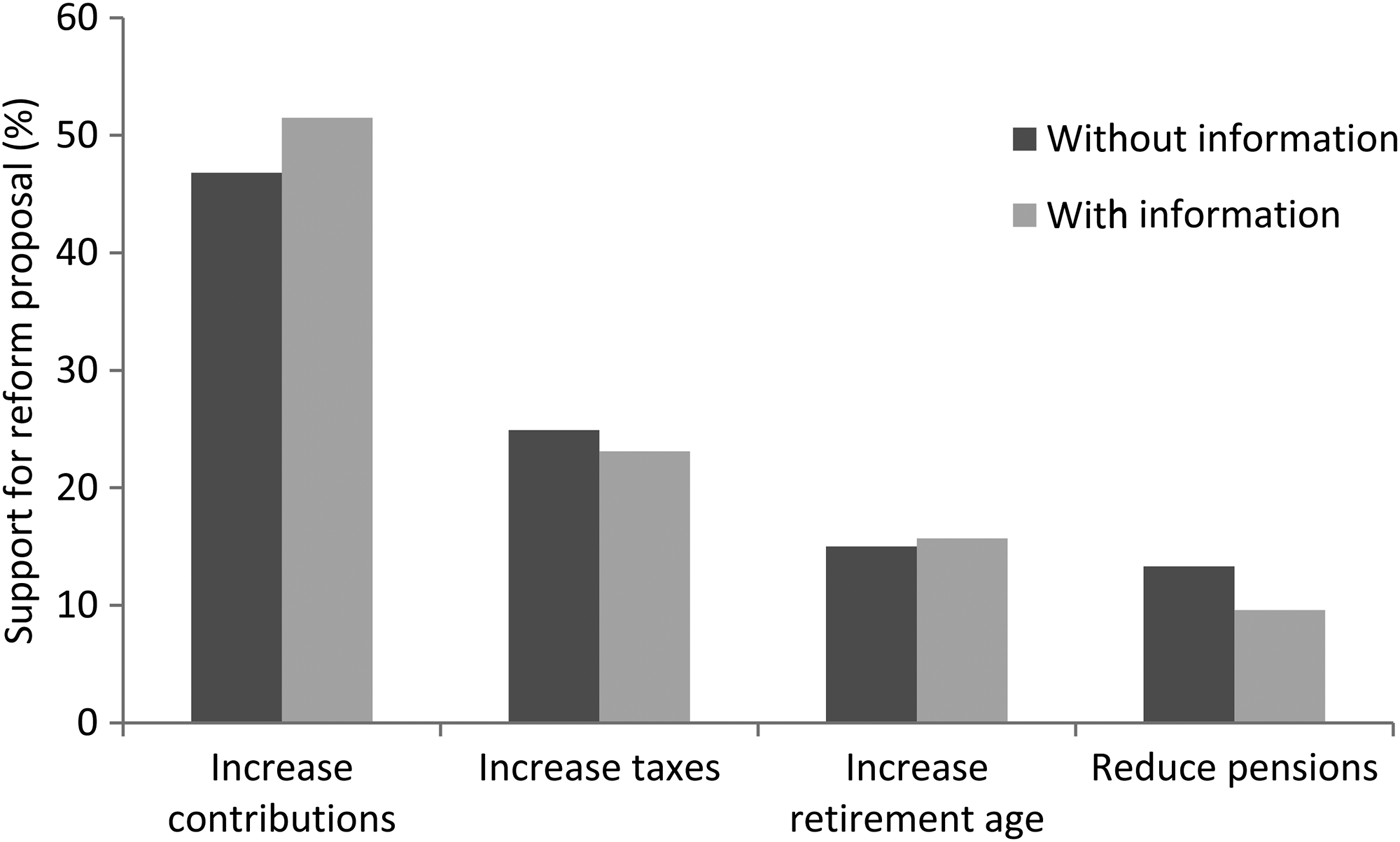
Not surprisingly, the reform alternative almost a majority of respondents prefers is to increase contributions (46.8%). On the aggregate level, the second best option is to increase taxes (Figure 1). Both findings are in line with expectations that the pension system is very popular and people would rather pay more than cut benefits. Consequently, only 15.0 per cent of the respondents would increase the retirement age, implicitly cutting benefits. The reform alternative that gets the lowest support is the explicit reduction of benefits by reducing pensions (13.3%). The information on an ageing society and increased pressures to reform did not change the ranking of reform alternatives. The two status quo-preserving reforms are supported by a vast majority of approximately 75 per cent of respondents, and in sum even gained popularity. These changes are not significant and hence support the new politics argument that increased reform pressures do not change reform preferences. People want to maintain a strong welfare state even in hard times.
The effect of increased reform pressures on support for pension reform proposals.

Opposition to reform
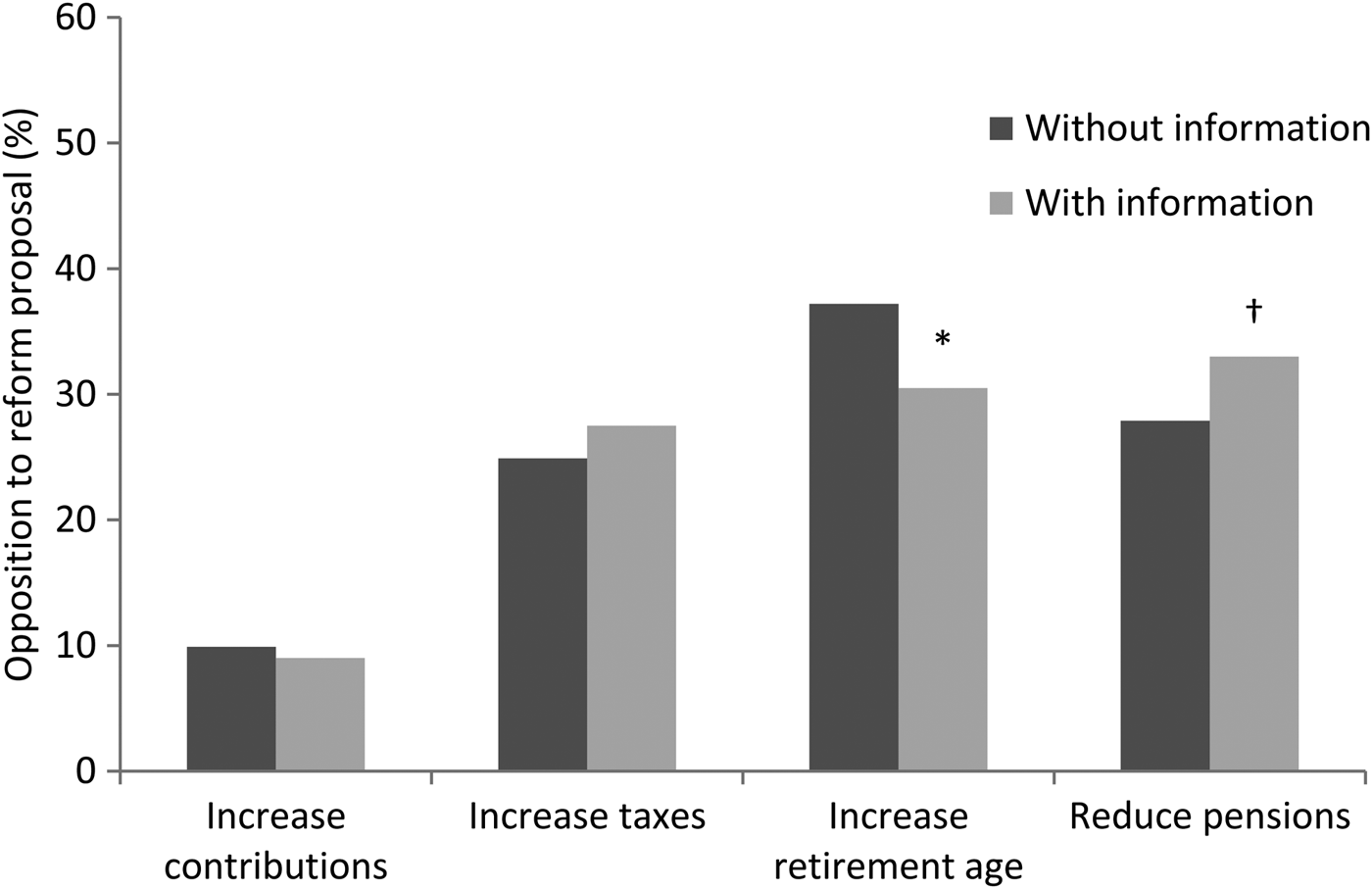
The identification of public opinion as a possible veto player blocking reforms suggests that the success of a reform proposal not only depends on support but is in particular affected by the opposition to a reform proposal. If people give up their strong opposition to retrenching reforms, their implementation might become more likely. As protests in Germany and also in other countries suggest, an increase in the legal retirement age is the most opposed reform alternative. More than a third of the respondents (37.2%) oppose such a reform proposal (Figure 2). The reduction of pension levels (27.9%) as another retrenching reform proposal is refused by roughly a third of the respondents. The other two reform options, increasing taxes or contributions, face far weaker opposition. Again, the ranking of the least preferred reform alternatives is not considerably changed by the treatment. But when faced with increased reform pressures, people give up their reluctance to increase the retirement age. The share of people opposing this reform proposal decreases significantly from 37.2 to 30.5 per cent (−6.7 percentage points). At the same time increased reform pressures lead to an increase in the opposition against an explicit retrenchment by reducing pension benefits (+5.1 percentage points).
The effect of increased reform pressures on the opposition to pension reform proposals.

The moderating effect of political awareness
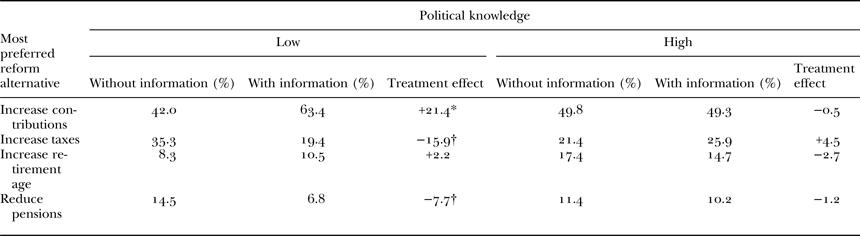
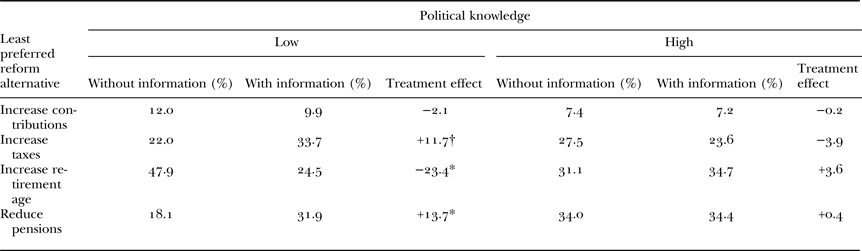
Based on the literature on information effects, our expectation was that the effect of increasing reform pressures is heterogeneous and varies between groups of different political awareness. In particular, we expected that the preference formation of those with a low political awareness should be more affected by additional information. In Table 4 we present the predicted probability to support each of the four reform alternatives for the two groups separately. Table 5 shows the results for the least preferred reform alternative. All estimates are based on multinomial logistic regression models that control for age, gender and education.
The effect of increasing reform pressures on the support for reform

Notes: N = 654. The table shows the predicted probabilities to support each reform alternative. Estimates are based on a multinomial logit regression that controls for age, gender and education. Predictions are estimated at the means of control variables.
Significance levels: † p < 0.10, * p < 0.05.
The effect of increasing reform pressures on the opposition to reform

Notes: N = 759. The table shows the predicted probabilities to support each reform alternative. Estimates are based on a multinomial logit regression that controls for age, gender and education. Predictions are estimated at the means of control variables.
Significance levels: † p < 0.10, * p < 0.05.
Independent of political knowledge, both groups strongly prefer an increase in contributions whereas support for the two retrenching reforms is very low. In sum, only 22.8 per cent of those respondents with a low political knowledge would support an increase in the retirement age or pension benefit cuts. Support for retrenching reform proposals is somewhat higher among the political knowledgeable (28.8%). As expected, the information on population ageing does not affect attitude formation among the political knowledgeable. In contrast, those with low political knowledge react to increased reform pressure. Their support to increase contributions significantly increases (+21.4 percentage points) whereas they become less likely to support a tax increase or pension benefit cuts.
As for the opposition to reform, we also find considerable differences between the two groups (Table 5). Among those with low political awareness, 47.9 per cent oppose an increase in the retirement age whereas the opposition against an increase in the retirement age is much weaker among the respondents with high political awareness. This finding supports previous research that has shown that higher-educated people are more likely to support an increase in the retirement age (Fernandez and Jaime-Castillo Reference Fernandez and Jaime-Castillo2013). Instead, respondents with high political awareness rather oppose an increase in taxes or a reduction of pension levels. Comparing the treatment effect of increasing reform pressures between the two groups, we find our expectation of a heterogeneous effect confirmed. People with a low political awareness react to reform pressure by abandoning their strong opposition to increasing the retirement age (−23.4 percentage points). Instead, their opposition against increasing taxes (+11.7 percentage points) but also against a reduction of pension benefits (+13.7 percentage points) increases. In contrast, there is no evidence for a significant preference change among the politically knowledgeable respondents. Their reform preference remains unchanged by the information on population ageing and this confirms our previous results for reform support.
In summary, these results provide unambiguous support for our expectation that political awareness moderates the effect of reform pressure on reform preferences. People with a high political knowledge are unaffected by the information on increased reform pressure. In contrast, people with a low political knowledge change their reform preferences when faced with increasing reform pressure. As for the direction of the attitude change, results are less clear. Our analysis of the most preferred alternative provides some support for the expectation that people maintain their high welfare state support in times of increasing reform pressure. In contrast, our findings for the least preferred reform alternative point to the competing expectation that increased reform pressure leads to a higher acceptance of retrenching reforms. For example, the opposition against increasing the retirement age drops substantially from almost 48 to 24.5 per cent. As a result of this attitude change among the respondents with a low political awareness, it is a tax increase that meets the strongest opposition when information on population ageing is provided.
The moderating effect of political predisposition
For the political process it is of high relevance how the electorate reacts to increased pressures to reform. Will party cleavages and political conflict increase or do reform pressures unite the electorate in their reform preferences? In addition to this political relevance, the theoretical debate is concerned also with the question of whether supporters and opponents of a reform proposal react to an argument differently.
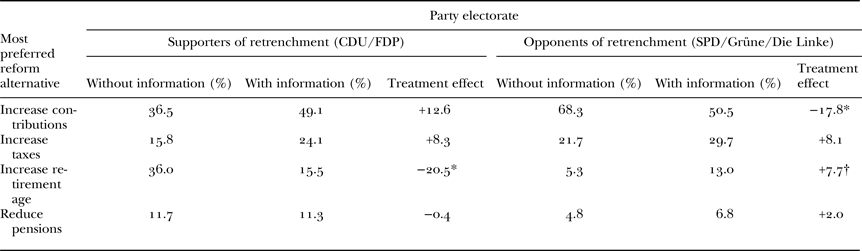
In Germany, right-leaning parties (the CDU and FDP) either implicitly or explicitly favoured the two retrenching reform proposals of cutting pension benefits or raising the retirement age in their manifestos for the national election in September 2013. In contrast, parties from the left (SPD, Die Grünen and Die Linke) favour a strong role of the state in the pension system, and prefer to keep up benefit levels and increase contributions or taxes instead. These reform positions are reflected in the attitudes of the electorate (Table 6). Without information, the two groups differ significantly in their reform preferences. Supporting previous research by Jaime-Castillo (Reference Jaime-Castillo2013), we find that a vast majority of almost 90 per cent of the voters of leftist parties strongly prefer one of the status quo-preserving reform alternatives of increasing contributions (68.3%) or increasing taxes (21.7%). Although these two reform alternatives also get a slight majority among the CDU and FDP electorate, 48 per cent among the right-leaning electorate prefer retrenchment by increasing the retirement age or reducing pensions.
Effect of increasing reform pressures on the support for reform

Notes: N = 396. The table shows the predicted probabilities to support each reform alternative. Estimates are based on a multinomial logit regression that controls for age, gender and education. Predictions are estimated at the means of control variables.
Significance levels: † p < 0.10, * p < 0.05.
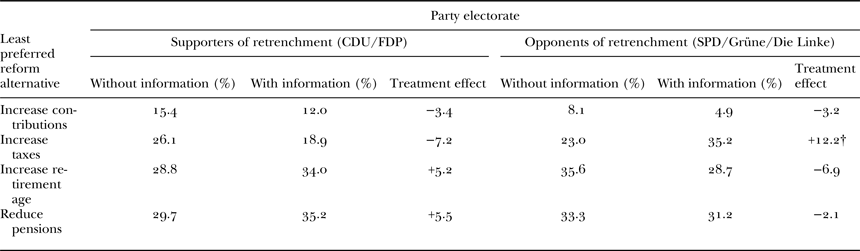
Based on the new politics argument and empirical findings that the party colour does not predict welfare spending any more, we expected that the two groups would become more alike when confronted with increased reform pressures. Constrained by the popularity of the welfare state, supporters of retrenchment are not able to follow ‘their’ retrenchment policies, whereas opponents of retrenchment have to adapt to the reality of economic and demographic pressures and cannot adhere to a policy of welfare state expansion any more. Comparing the two groups of the electorate with information, we find that their reform preferences get more alike. People from the right withdraw their support for retrenching reforms and an increase in the retirement age gets 20.5 percentage points less support. In contrast, people from the left withdraw their support for expansive reforms (an increase in contributions loses 17.8 percentage points) and even increase their support for a retrenching reform such as increasing the retirement age (+7.7 percentage points). A similar trend can be observed for the least preferred reform alternative (Table 7). The initial supporters of retrenchment increase their opposition against retrenchment and seem to be more willing to accept the maintenance of the status quo by increasing taxes or contributions. In total, the opposition against these two expansive reform proposals goes down by 10.6 percentage points among the right-leaning electorate. In contrast, the strong opposition of left-leaning voters against retrenching reforms somewhat crumbles (−6.9 percentage points against an increase in the retirement age) whereas they become more critical of a tax increase (+12.2 percentage points).
Effect of increasing reform pressures on opposition to reform

Notes: N = 440. The table shows the predicted probabilities to support each reform alternative. Estimates are based on a multinomial logit regression that controls for age, gender and education. Predictions are estimated at the means of control variables.
Significance levels: † p < 0.10, * p < 0.05.
Supporting the hypothesis of a declining relevance of political partisanship in an era of austerity (Pierson Reference Pierson1996), the information on increasing pressures to reform decreases partisanship differences in the electorate.Footnote 10 Whereas this claim has been mainly confirmed on the aggregate level – e.g. partisanship of the government shows no effect on social expenditures (Huber and Stephens Reference Huber and Stephens2001) – our results suggest that a similar logic might apply to individual-level attitudes.
Discussion and conclusion
This paper set out to examine the claim of high and stable welfare state support and strong reform opposition in times of austerity. We relied on theoretical explanations from political psychology in order to improve our understanding of attitude change and formation on the individual level. We tested our hypotheses with newly available data from a survey experiment that was fielded in a German online survey at the beginning of 2013. We find that a majority of the German population favours status quo-maintaining pension reforms and seems to be willing to pay for increased costs by increasing either contributions or taxes. This confirms expectations of a high welfare state support and that proposals to cut pension benefits meet strong opposition. Moreover, our results support the expectation that this opposition against retrenchment remains strong in times of increased reform pressures. Nevertheless, we also found some evidence suggesting that there might be more room for reform than expected. In the light of an ageing society, the opposition against increasing the retirement age significantly decreases. This effect is particularly pronounced among those parts of the electorate with a low political awareness and hints at the importance of a clear communication of policy aims and motives for a successful policy process. Moreover, not only political awareness but also the predisposition (i.e. partisanship) affects whether and how people change attitudes. Information on population ageing led to a convergence of reform preferences of people from the left and from the right.
A methodological contribution of our paper is the explicit distinction between reform preferences and reform opposition. Whereas the relevance of this distinction is obvious in most political contexts, it is not yet reflected in standard survey questions that usually ask what people want and rather omit what people do not want. A stronger focus on what people oppose might add valuable insights to our understanding of reform success and failure since opposition to reform proposals might be politically more relevant. Moreover, our findings suggest that they are more reliable on the individual level. Respondents in our study were quicker in choosing the least preferred reform alternative than the most preferred one. Moreover, fewer missing values occurred when asked for the least preferred reform option.
One limitation every experimental study has to face is the external validity of its results: is the effect we find valid and relevant in the real world? What we explicitly use here to examine our research question is the framing of a survey question. Several authors argue that such framing effects are only a temporary ‘mood change’ since they only affect the sampling process by increasing the salience and accessibility of some arguments that already exist. In contrast, attitude change is defined as ‘permanent alterations in long-term response probabilities’ and arguments (Zaller Reference Zaller1992: 118). Research in this direction reinforces this concern as effects of political debate (Luskin, Fishkin and Jowell Reference Luskin, Fishkin and Jowell2002) or elite framing (Druckman and Nelson Reference Druckman and Nelson2003) on public opinion vanished after two to three weeks. However, the theoretical model of attitude change does not assume that those permanent alterations happen immediately but rather incrementally. Even when the effect we find vanishes after some weeks our findings would at least provide some hints of the potential and the direction of attitude change in the long run. With an ageing population, people possibly do not get information on increasing reform pressures once but get informed repeatedly. Future research thus needs to explore how repeated information affects attitudes.
If we extend our focus from immediate, short-term effects to long-term attitude changes, an important explanatory factor for attitude change is the role of political discourse (Schmidt Reference Schmidt2010). For example, population ageing can be framed as a financial burden to public budgets. Other political actors such as the World Health Organization promote the view that healthy older persons are a resource to their families, communities and economies (Boudiny Reference Boudiny2013; World Health Organization 2002). Experimental studies show that different frames of the same information but also different senders of the same information affect how people change their attitudes in response to information (Chong and Druckman Reference Chong and Druckman2010; Druckman, Fein and Leeper Reference Druckman, Fein and Leeper2012). With this in mind, our results are clearly limited in their validity to the current political context in Germany or similar ‘discursive contexts’ in other countries. Whereas our results support the claim that even low-educated people link population ageing to increased reform pressures and adapt their pension reform preferences accordingly, we cannot rule out that this link depends on how dominant arguments within the public debate view population ageing and its consequences.
Despite, or rather because of these challenges, we think that it is a worthwhile endeavour to follow this line of research. We are convinced that our and similar other papers using survey experiments can complement existing studies in welfare attitudes research. ‘When used with representative samples, therefore, survey experiments can provide firmly grounded inferences about real-world political attitudes and behaviour’ (Gaines, Kuklinski and Quirk Reference Gaines, Kuklinski and Quirk2007: 2). The strength of experimental studies is the focus on the individual mechanisms of attitude change and the internal validity of its causal claims. Future research is needed though that also relies on longitudinal data and tests the external validity of findings from experimental studies.
Acknowledgements
The author acknowledges support from the Research Center 884, ‘Political Economy of Reforms’, funded by the German Research Foundation (DFG).