Introduction
Replacement heifers provide the basis for profitable milking herds as they are a source of genetically superior cows, allow for culling of marginal cows, expand the dairy operation and/or provide a source of added revenue by selling surplus animals (Hutjens Reference Hutjens2004). Therefore, to have good dairy replacement stock, an efficient calf-feeding system is crucial because it determines the future income and sustainability of a dairy enterprise.
There are different milk feeding systems for dairy calves. In a conventional milk-feeding method, calves receive roughly 0.10 of birth weight of milk or milk replacer (~4 litres/day) during the whole milk (WM)-feeding period (Khan et al. Reference Khan, Lee, Lee, Kim, Ki, Hur, Suh, Kang and Choi2007a, Reference Khan, Lee, Lee, Kim, Kim, Ki, Ha, Lee and Choib; Silper et al. Reference Silper, Lana, Carvalho, Ferreira, Franzoni, Lima, Saturnino, Reis and Coelho2014), supporting under 0.5 kg/day of weight gain (Appleby et al. Reference Appleby, Weary and Chua2001; Jasper & Weary Reference Jasper and Weary2002). This restricted milk feeding is generally associated with depressed performance because of low nutrient availability (Egli & Blum Reference Egli and Blum1998; Appleby et al. Reference Appleby, Weary and Chua2001), depressed behaviour (Chua et al. Reference Chua, Coenen, Van Delen and Weary2002), poor health (Huber et al. Reference Huber, Silva, Campos and Mathieu1984) and reduced productivity of dairy calves (Pollock et al. Reference Pollock, Rowan, Dixon, Carter, Spiller and Warenius1993). A contrasting approach is to allow calves much greater intake of milk during early life, which is closer to natural conditions where calves would have ad libitum access to milk (7–8 litres/day milk from days 1 to 30, ~0.20 of birth weight). This feeding method has been called accelerated growth (Drackley Reference Drackley2008) in which milk feeding rates are approximately twice those of conventional systems. Over the past decade, several studies have investigated the effects of increasing the supply of milk to young calves (Appleby et al. Reference Appleby, Weary and Chua2001; Diaz et al. Reference Diaz, Van Amburgh, Smith, Kelsey and Hutten2001; Jasper & Weary Reference Jasper and Weary2002); these studies have reported higher weight gains (0.7–1 kg/day) and more natural behaviour in calves fed more milk. Benefits of improved nutritional status in the first 2–3 weeks may be a greater ability to withstand infectious challenges, reaching breeding age (and thus calving age) sooner and possibly increased milk production (Soberon & Van Amburgh Reference Soberon and Van Amburgh2013; Hoseyni et al. Reference Hoseyni, Mahjoubi, Zahmatkesh and Yazdi2016).
Previous studies have focused on comparison of different procedures of milk feeding to dairy calves (step-down v. conventional; step-up/step-down v. conventional) on dairy calf performance (Khan et al. Reference Khan, Lee, Lee, Kim, Kim, Ki, Ha, Lee and Choi2007b; Omidi-Mirzaei et al. Reference Omidi-Mirzaei, Khorvash, Ghorbani, Moshiri, Mirzaei, Pezeshki and Ghaffari2015); however, no study has compared the effects of different step-down feeding to weaning programmes from an initial period of feeding for accelerated growth or for more than 2 months (as 30 days intervals) on the performance and health of dairy calves and especially on breeding variables. The objectives of the present study were to compare the effects of three different types of step-down feeding to weaning programmes on the health and performance of dairy calves, first breeding age and conception rates. It was hypothesized that extending milk feeding beyond 60 days in a step-down method, has not short- and long-term effect on heifer performance.
Materials and methods
Animal and housing
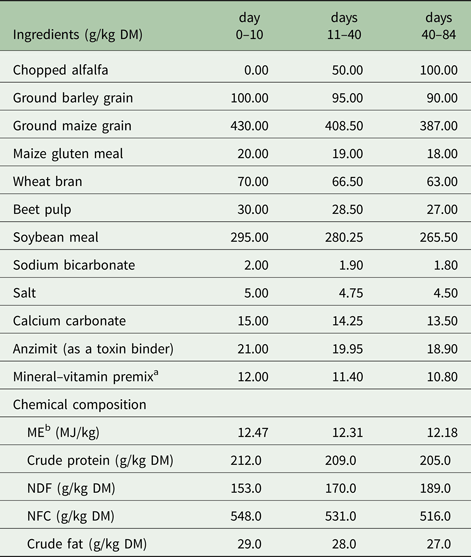
The current experiment was carried out using 60 female Holstein calves at a commercial dairy farm (Sharif-Abad Agri-Animal production CO; Qazvin, Iran) according to the guidelines of the Iranian Council of Animal Care (1995) from November 2014 to February 2016. This farm is located in a tropical area (50°10′E, 36°11′N) where average daily milk production was about 38 kg/cow/day. After birth, all the calves received colostrum (at least 4 litres within the first 12 h of life) and were enrolled in the study within 72 h of birth. Calves were housed in individual pens (1.5 × 2.5 m2) bedded with straw. Bedding was replaced weekly and fresh bedding was added as needed. The front of each pen had two openings for access to pails (diameter = 25.4 cm, height = 23.0 cm, capacity = 8 litres) mounted on the outside of the door. All calves had free access to fresh water in one pail with solid feed plus alfalfa hay offered ad libitum in the second pail. Diets for growth periods, days 0–10, 11–40 and 40–84 were formulated using software available from the Dairy NRC (NRC 2001). The ingredients and nutrient composition of the basal diet are shown in Table 1.
Ingredients and chemical composition of diet (DM basis)

ME, metabolizable energy; NDF, neutral detergent fibre; NFC, non-fibre carbohydrate.
a Contained per kilogram of mineral–vitamin premix: Ca, 180 g; Na, 50 g; P, 70 g; Mg, 30 g; Fe, 4130 mg; Cu, 370 mg; Zn, 3000 mg; Mn, 5000 mg; Co, 20 mg; I,200 mg; Se, 20 mg. 400 000 IU of vitamin A; 100 000 IU of vitamin D; 1000 IU/kg vitamin E.
b Estimated using the NRC software (2001) individual dietary ingredients.
Treatments
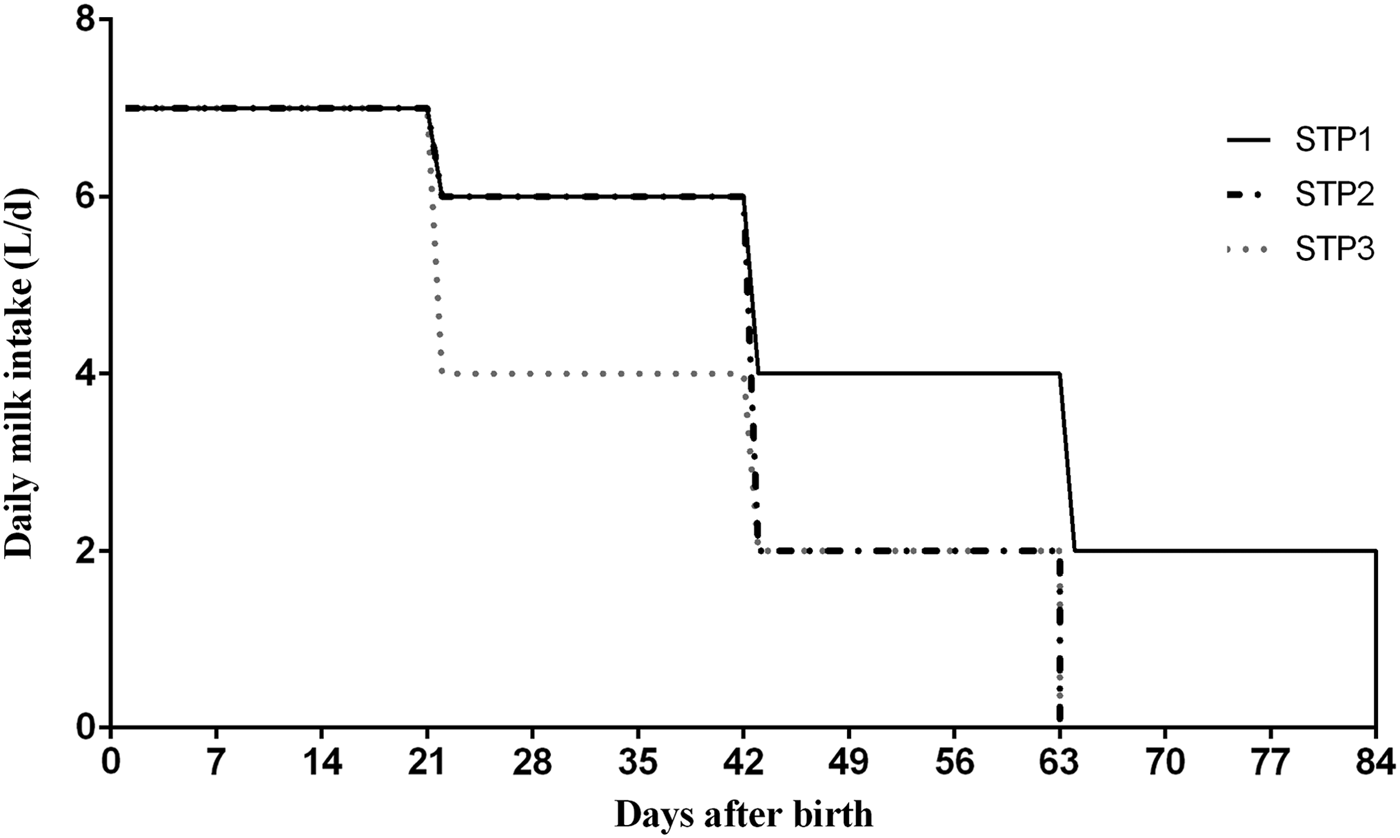
Female calves (birth weight of 38 ± 4.9 kg) were assigned randomly to one of three step-down feeding to weaning programmes (20 calves per group; Figure 1): (1) step-down 1 (STP1: 7.5 litres/day milk from days 1 to 21, 6 litres/day milk from days 22 to 42, 4 litres/day milk from days 43 to 63 and 2 litres/day milk from days 64 to 84 of the study); (2) step-down 2 (STP2: 7.5 litres/day milk from days 1 to 21, 6 litres/day milk from days 22 to 42 and 2 litres/day milk from days 43 to 63 of the study); and (3) step-down 3 (STP3: 7.5 litres/day milk from days 1 to 21, 4 litres/day milk from days 22 to 42 and 2 litres/day milk from days 43 to 63 of the study). Calves received WM three times daily at 06.30, 14.00 and 21.30 h from days 3 to 21, twice daily at 06.30 and 14.00 h from days 22 to 42 for STP2–3 and from days 22 to 63 for STP1 and once daily at 06.30 h from days 43 to 63 for STP2–3 and from days 64 to 84 for STP1. The STP1 or longest milk-fed calves were weaned on day 84 and other claves were weaned on day 64. One calf was removed from the STP2 group because of a general weakness issue and her data were not included in the statistical analysis. Whole milk was stored in a portable tank and transported to the calf housing prior to feeding.
The schematic represents the amounts of milk consumed (kg/d) by calves fed milk by different procedures: STP1 (7.5 litres/day milk from days 1 to 21, 6 litres/day milk from days 22 to 42, 4 litres/day milk from days 43 to 63 and 2 litres/day milk from days 64 to 84), STP2 (7.5 litres/day milk from days 1 to 21, 6 litres/day milk from days 22 to 42 and 2 litres/day milk from days 43 to 63) and STP3 (7.5 litres/day milk from days 1 to 21, 4 litres/day milk from days 22 to 42 and 2 litres/day milk from days 43 to 63).Calves in STP1 group were weaned at 84 days of age and calves in STP2–3 groups were weaned at 64 days of age.

After weaning, calves were fed daily based on an as fed basis with the following diet until 7 months of age: 2.5 kg alfalfa (2.2 kg dry matter (DM), 150 g/kg crude protein (CP)), 5–6 kg maize silage (1.1 to 1.3 kg DM, 80 g/kg CP) and 3 kg concentrate (2.65 kg DM; 550 g/kg barley grain, 300 g/kg wheat bran, 100 g/kg soybean meal, 20 g/kg carbonate, 20 g/kg mineral–vitamin premix and 10 g/kg salt; 185 g/kg CP). From 7 to 12 months of age, the same amount of alfalfa and concentrate + 10 kg maize silage (2.2 kg DM, 80 g/kg CP) and 1 kg wheat straw (0.9 kg DM, 38 g/kg CP) were offered to heifers. The projected average daily gain (ADG) was 900 g/day after weaning through calving, based on the recommendations provided by Kertz (Reference Kertz2009). The feed was offered as a total mixed ration once a day at 10.00 h.
After weaning at day 62, STP2 and STP3 calves stayed in the same stall until days 83 to provide a better comparison among treatments during that time frame. Then they were kept in groups of 12 animals per pen for 2–3 weeks, after which they were moved into groups of 24 calves per pen. After 4 months of age, all heifers were housed in a single group. Heifers were bred according to their body weight (BW; at least 340 kg) and wither height (WH; at least 127 cm) at 12.5–14 months of age. Heifers received two shots of PGF2α (3 cc at each injection for ovarian cycle synchronization; CLOPROST, Nasr Pharmaceutical Co., Mashhad, Iran) at a 7-day interval before insemination. Conception rate at first insemination was also calculated.
Sampling and analysis
Consumption of WM and starter were recorded daily throughout the experiment. Body weight and WH were recorded monthly (first, second, third and fourth month after birth) before the morning feeding and ADG was calculated as the difference between BW taken 1 month apart divided by 30. Data for age, WH and BW at first breeding were recorded for calves. Health status was assessed daily according to Larson et al. (Reference Larson, Owen, Albright, Appleman, Lamb and Muller1977) and Heinrichs et al. (Reference Heinrichs, Jones, Van Roekel and Fowler2003). Faecal scoring was as follows: 1 = firm and well-formed; 2 = soft and pudding-like; 3 = runny and similar in consistency to pancake batter; and 4 = liquid splatter and similar in consistency to pulpy orange juice. Respiratory scoring was as follows: 1 = normal, 2 = slight cough, 3 = moderate cough, 4 = moderate to severe cough, 5 = severe and chronic cough.
Milk composition (only fat and protein content), to calculate the milk energy, was considered based on daily milk analysis reported by milk factory; milk fat and CP contents were about 33–37 and 30–31 g/kg, respectively, throughout the study.
Jugular vein blood samples were collected 3 h after the morning feeding on day 60 of the study. Blood samples were centrifuged at 2000g for 15 min at room temperature and plasma was harvested and frozen at −20 °C for future analysis. Plasma concentrations of glucose (GOD-PAP, Pars Azmun Laboratory, Tehran, Iran) of total protein (TP; Biuret, Pars Azmun Laboratory, Tehran, Iran) and of β-hydroxy butyric acid (BHBA; Abbott Diabetes Care Ltd. Rang Road. Witney, Oxon, OX29 OYL, UK) were determined enzymatically using commercially available kits. The plasma samples were analysed by a BT 1500 automatic biochemistry analyser (Biotechnica Instruments S.p.A, Rome, Italy).
Statistical analysis
Data were analysed using the PROC MIXED procedure of SAS (version 9.1; SAS Inst. Inc. Cary, NC, USA) to evaluate the fixed effects of treatment, day and month and calf as a random effect in a completely randomized design. Daily and monthly measurements (starter intake, total DM, ADG, WH, etc.) for each calf's respective parameters were analysed by repeated measures with an auto-regressive covariance structure and day/month as the repeated effect. For specific pre-planned comparisons, orthogonal contrasts were made (STP1 v. all STP2–3) for detecting significant differences among treatments to specifically determine the effect of weaning day. Conception rate was evaluated by PROC GENMODE in SAS. Three, one and one heifers left the study from STP1, STP2 and STP3, respectively, because of gastrointestinal problems.
As in a previous study (Jahani-Moghadam et al. Reference Jahani-Moghadam, Mahjoubi, Hossein Yazdi, Cardoso and Drackley2015), faecal score data (1 to 4) was categorized as number of days with faecal score ⩾2, respiratory score (1–5) was categorized as number of days with respiratory score ⩾2 and general appearance (1–5) was categorized as number of days with general appearance score ⩾2. Faecal score was square-root transformed for better homogeneity of the distribution of residuals. Age, BW, WH and days to first service was also analysed to detect any treatment effect. Data are reported as least square means and the PDIFF statement in SAS was used to determine differences between treatments at specific time points. Significance was declared at P < 0.05 and trends discussed when P < 0.10.
Results
Calf performance and health
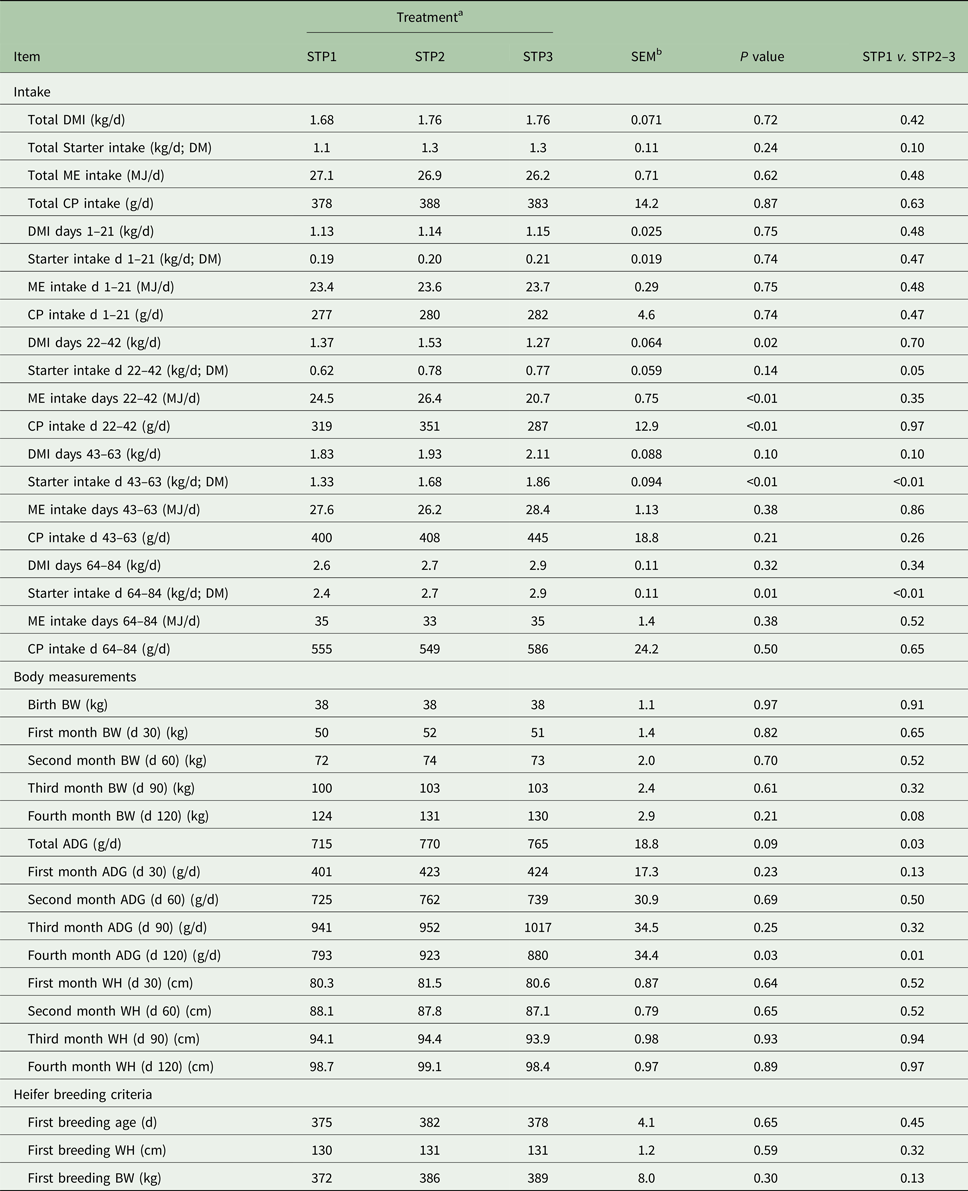
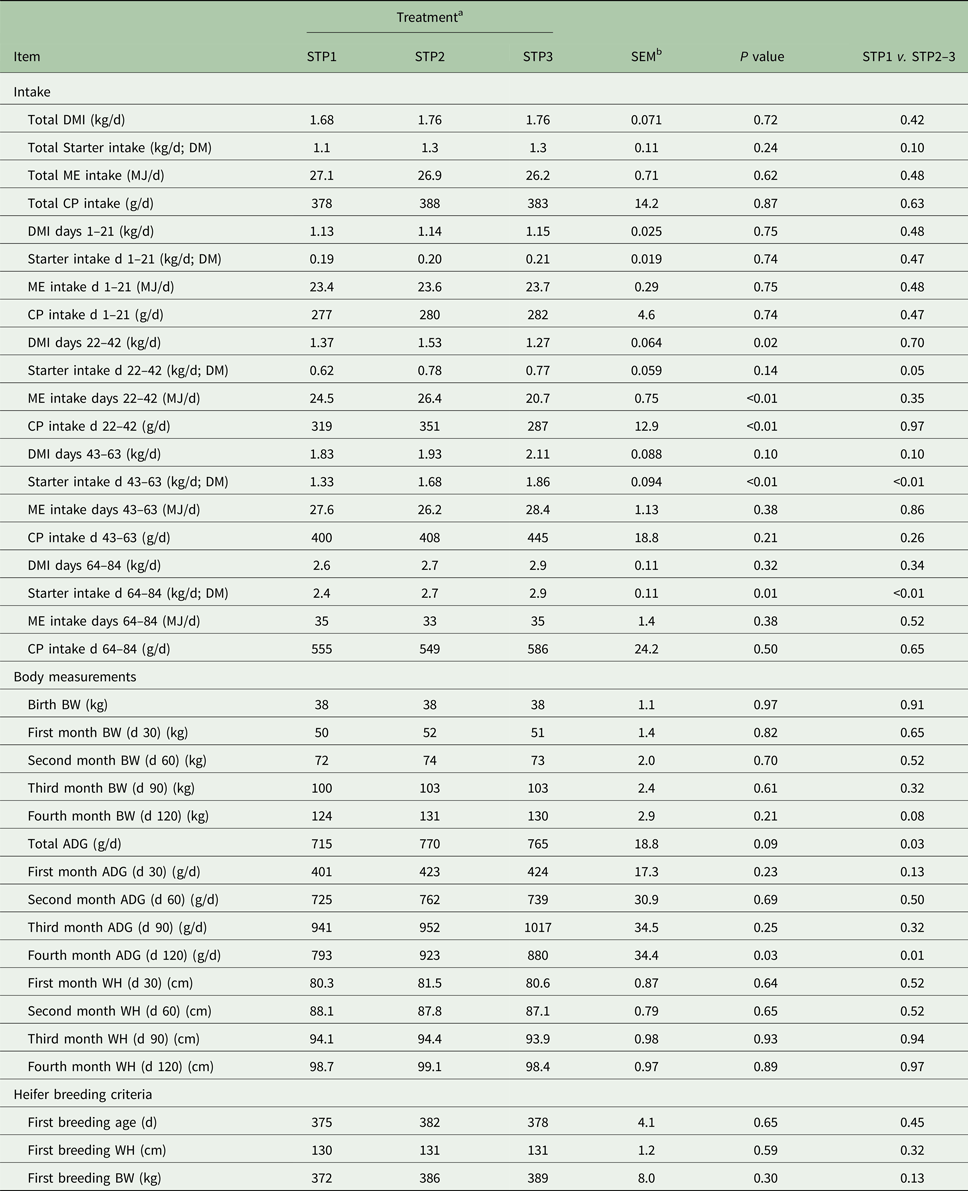
Calf performance is shown in Table 2. Total dry matter intake (DMI) and total starter intake were not affected by treatment, but the STP3 calves consumed less DM than the STP2 animals during days 22–42 (P < 0.02). Starter intake was greater in STP2 and STP3 groups compared with STP1 during days 43–63 and 64–84 (P < 0.01) and tended to be greater (P = 0.082) for these groups than for STP1 during days 85–105. There were no differences between treatments for total metabolizable energy (ME) and CP intake (Table 2). However, during days 22–42, STP1 and STP2 calves consumed more ME than STP3 animals (P < 0.01); accordingly, CP intake was greater for the STP2 group than for STP3 (P < 0.01), but not for STP1.
Least squares means for dry matter intake (DMI), body measurements and breeding criteria in calves fed milk through different strategies
ME, metabolizable energy; CP, crude protein; BW, body weight; ADG, average daily gain; WH, wither height; d, day.
a STP1 7.5 litres/d milk from d 1 to 21, 6 litres/d milk from d 22 to 42, 4 litres/d milk from d 43 to 63 and 2 litres/d milk from d 64 to 84 of the study, STP2 7.5 litres/d milk from days 1 to 21, 6 litres/d milk from d 22 to 42 and 2 litres/d milk from days 43 to 63 of the study, STP3 7.5 litres/d milk from d 1 to 21, 4 litres/day milk from d 22 to 42 and 2 litres/d milk from d 43 to 63 of the study.
b SEM, standard error of mean.
Although BW in the birth, first, second and third month of life was similar across treatments, it tended (P = 0.084) to be lower in STP1 calves compared to other groups by the fourth month (Table 2). Total ADG was greater in STP2 and STP3 calves than those in STP1 (P = 0.035). The contrasts all showed that there was no difference in ADG in the first 3 months of life (Table 2). The ADG was less for STP1 calves compared to other groups (P < 0.01) only by the fourth month. First to fourth month's WH were similar among calves in different treatments (Table 2).
There was no effect of treatment on breeding age, BW or WH (Table 2). The service per conception (1.93, 2.00 and 1.74 for STP1, STP2 and STP3, respectively; P = 0.797) was not different among treatments. In addition, conception rate at first breeding was not influenced by treatment (53.3, 52.6 and 47.4% for STP1, STP2 and STP3, respectively; P = 0.919).
Throughout the experiment and at in different measurement times (days 1–22; 22–42; 43–63 and 64–84) faecal scores (1.09, 1.08, 1.07 for STP1, STP2 and STP3, respectively), respiratory score (1.04, 1.03, 1.05 for STP1, STP2 and STP3, respectively) and general appearance score (1.05, 1.03, 1.05 for STP1, STP2 and STP3, respectively) were not affected by treatment. Likewise, the number of days with faecal score ⩾2 (4.84, 4.15, 4.20 days for STP1, STP2 and STP3, respectively), with increased respiratory score (2.53, 2.10, 2.55 days for STP1, STP2 and STP3, respectively) and with altered general appearance score (3.05, 2.15, 2.95 days for STP1, STP2 and STP3, respectively) in calves were not influenced by the milk-feeding method.
Blood parameters
Concentrations of plasma metabolites are presented in Table 3. Blood data on day 1 were included as a covariate and so data are not shown in Table 3. No changes were detected in plasma metabolite concentrations among treatments.
Average blood metabolites concentrations of Holstein calves fed milk through different strategies

a STP1 7.5 litres/d milk from d 1 to 21, 6 litres/d milk from d 22 to 42, 4 litres/d milk from d 43 to 63 and 2 litres/d milk from d 64 to 84 of the study, STP2 7.5 litres/d milk from d 1 to 21, 6 litres/d milk from d 22 to 42 and 2 litres/d milk from d 43 to 63 of the study), STP3 7.5 litres/d milk from d 1 to 21, 4 litres/d milk from d 22 to 42 and 2 litres/d milk from days 43 to 63 of the study.
b SEM, standard error of mean.
Discussion
Calf performance and health
Pre-weaning calf rearing operations are usually costly and the shortening the pre-weaning period is beneficial for farmers. In contrast, there are farmers worldwide (e.g. in the Middle East) who extend this period beyond 60 days. According to the initial hypothesis, extending the pre-weaning period for longer than 60 days had no beneficial effects. The greater starter intake in STP2 and STP3 groups compared with STP1 during days 43–84 is probably a result of calves in both groups (STP2 and STP3) receiving less WM during these days. Another reason for the increased consumption of starter may be attributed to a hyperphagic response caused by the reduced supply of milk and nutrients (Khan et al. Reference Khan, Lee, Lee, Kim, Ki, Hur, Suh, Kang and Choi2007a). Lower DMI of STP3 between days 22–42 was because of lower milk, not starter intake and this observation shows that calves fed a high level of milk need time to adapt to solid feed; in other words, a decrease from 7.5 to 4 litres/day did not necessarily lead to an immediate increase in starter intake. However, nutrient supply did not appear to be different because the similar ADG across treatments implies that rumen function was adequate and rumen capacity needed to increase to accommodate adequate starter intake.
The relatively low ADG in the first month was partly unexpected, though it was within the range suggested by Drackley (Reference Drackley2008), where expected ADG from days 0 to 42 was suggested to be 0.6–0.8 g/day; gains during days 0–21, however, should be 0.5–0.6 g/day which is greater than the daily gains found in the present study. Although ADG of ~270 g/day was reported in the first month of life in high milk-fed calves by Jahani-Moghadam et al. (Reference Jahani-Moghadam, Mahjoubi, Hossein Yazdi, Cardoso and Drackley2015), that experiment was done with a milk replacer which has been reported to decrease ADG if nutrient intakes are restricted (Moallem et al. Reference Moallem, Werner, Lehrer, Zachut, Livshitz, Yakoby and Shamay2010). It appears that there is no strong relationship between ME intake and ADG, at least in the first month of life. Based on the data provided by Van Amburgh & Drackley (Reference Van Amburgh, Drackley and Garnsworthy2005), a 50-kg calf under thermal neutral conditions needs ~18.4 MJ to gain 800 g/day and according to those calculations the calves in the present study should have gained more than 1 kg/day. However, in agreement with the current results, Korst et al. (Reference Korst, Koch, Kesser, Müller, Romberg, Rehage, Eder and Sauerwein2017) showed that in calves fed WM ad libitum (~9.4 litres/day by days 2–27, which was 2 litres/day greater than the present study), ME intake was 26.2 MJ/day and observed ADG was close to 800 g/day. Some of the variability in ADG can imply the occurrence of illness and the environment; for example, days with faecal score ⩾2 was ~4.5 days in the present study compared with ~5.2 days in a previous study (Jahani-Moghadam et al. Reference Jahani-Moghadam, Mahjoubi, Hossein Yazdi, Cardoso and Drackley2015) where calves had a lower ADG. Moreover, using tabular values to calculate ME intake from milk, growth rates of calves in the first 21 days after birth in the present study are much lower than expected. The improved ADG in the STP2 and STP3 calves relative to STP1 calves during the overall periods could be due to the greater starter intake in these animals during days 43–84. More consumption of starter probably induced earlier rumen development and establishment of ruminal fermentation. de Passillé & Rushen (Reference De Passillé and Rushen2016) favoured late weaning at 89 day based on BW gain, which is in contrast with the present study; however, they did not provide the data following weaning for those late-weaned calves and in the current experiment, there were no differences in BW at 20 weeks of age. More recently, Khani et al. (Reference Khani, Ahmadi, Ariana, Omidian, Sharifi, Ghaffari and Beiranvand2017) showed that the method of milk feeding might not be as important for ADG as the volume of milk fed, as long the calves receive the same amount of milk. In other words, the absolute amount of milk nutrients provided is more crucial to determine growth parameters.
Results regarding body measurements herein are in agreement with those reported by Omidi-Mirzaei et al. (Reference Omidi-Mirzaei, Khorvash, Ghorbani, Moshiri, Mirzaei, Pezeshki and Ghaffari2015) and Daneshvar et al. (Reference Daneshvar, Khorvash, Ghasemi, Mahdavi, Moshiri, Mirzaei, Pezeshki and Ghaffari2015), who did not find differences in WH between STP and conventionally reared calves. Despite the fact that WM-fed calves had higher ADG, Moallem et al. (Reference Moallem, Werner, Lehrer, Zachut, Livshitz, Yakoby and Shamay2010) also did not show any effect on WH. In this regard, Khani et al. (Reference Khani, Ahmadi, Ariana, Omidian, Sharifi, Ghaffari and Beiranvand2017), in two different experiments, found no difference between variable step-down, step-up and -down and continuous milk-feeding regimes on body height and length. Khan et al. (Reference Khan, Lee, Lee, Kim, Ki, Hur, Suh, Kang and Choi2007a) reported greater WH at 2 months of age in calves fed with step-down programme.
Benefits of improved nutritional status in the first 2–3 weeks may include reaching breeding age (and thus calving age) sooner, an improved ability to withstand infectious challenges and increased subsequent milk production (Drackley Reference Drackley and Garnsworthy2005). Although potential benefits of accelerated milk feeding programmes were originally postulated as reducing the time to breeding size and age at first calving, a recent analysis of about ten studies by Kertz & Loften (Reference Kertz and Loften2013) indicated that primary benefits may be an increased first, and possibly later, lactation milk yield. The present study demonstrates that feeding milk until ~ 90 days of age has no effect on future breeding performance or growth measurements. Despite a similar birth BW between studies, Moallem et al. (Reference Moallem, Werner, Lehrer, Zachut, Livshitz, Yakoby and Shamay2010) showed that calves fed ad libitum milk or milk replacer until 60 days of age were bred at ~14.5 month of age, which is ~2 months later than the current experiment. Taken together, these experiments show that greater milk feeding does not necessarily result in decreased age at breeding, as indicated in accelerated feeding programmes (Drackley Reference Drackley2003). Likewise, although Kiezebrink et al. (Reference Kiezebrink, Edwards, Wright, Cant and Osborne2015) showed a greater BW at 12 months of age in calves fed 8 litres compared with those fed 4 litres of WM during the pre-weaning period, the difference was only 8–12 kg between the two treatments and this statistical difference no longer existed after 18 months. Part of this discrepancy between the present study and Kiezebrink et al. (Reference Kiezebrink, Edwards, Wright, Cant and Osborne2015) might be because of the method of milk feeding (continuous 8 v. 4 litres/day milk feeding from birth to weaning) and the experimental conditions, where Kiezebrink et al. (Reference Kiezebrink, Edwards, Wright, Cant and Osborne2015) housed the calves inside an insulated, mechanically ventilated, temperature-controlled barn. Based on 10 years data collection, Heinrichs & Heinrichs (Reference Heinrichs and Heinrichs2011) concluded that a weaning age of between 60 and 90 days adversely affects future milk production of heifers with restricted growth rates before weaning. It appears that this strategy is not economically reasonable because more milk (409.5 v. 325.5 and 283.5 litres/calf for STP1, STP2 and STP3, respectively) is offered without any beneficial result.
It is clear that young calves are prone to respiratory diseases and diarrhoea during the milk-feeding period (Svensson et al. Reference Svensson, Lundborg, Emanuelson and Olsson2003; Omidi-Mirzaei et al. Reference Omidi-Mirzaei, Khorvash, Ghorbani, Moshiri, Mirzaei, Pezeshki and Ghaffari2015; Jahani-Moghadam et al. Reference Jahani-Moghadam, Mahjoubi, Hossein Yazdi, Cardoso and Drackley2015). Despite the fact that Khan et al. (Reference Khan, Lee, Lee, Kim, Ki, Hur, Suh, Kang and Choi2007a) reported ~ 7.2 days with scour which is roughly 2.5 days greater than the present study, the growth performance was better in their study, in part because of greater quantity of offered milk (2 litres/day more) and a higher (225 v. 200 g/kg) starter crude protein concentration (which is roughly equal with ~ 0.2 kg ADG/day, according to Van Amburgh & Drackley Reference Van Amburgh, Drackley and Garnsworthy2005) compared with present study, which finally led to better performance.
Blood parameters
In agreement with previous experiments (Silper et al. Reference Silper, Lana, Carvalho, Ferreira, Franzoni, Lima, Saturnino, Reis and Coelho2014; Daneshvar et al. Reference Daneshvar, Khorvash, Ghasemi, Mahdavi, Moshiri, Mirzaei, Pezeshki and Ghaffari2015; Omidi-Mirzaei et al. Reference Omidi-Mirzaei, Khorvash, Ghorbani, Moshiri, Mirzaei, Pezeshki and Ghaffari2015), no differences were observed in blood glucose concentration among treatments. As expected, no change in blood TP concentration was observed when the same quantity of milk was fed to dairy calves for all milk feeding methods. This is in line with previously reported data by Khan et al. (Reference Khan, Lee, Lee, Kim, Ki, Hur, Suh, Kang and Choi2007a) and Daneshvar et al. (Reference Daneshvar, Khorvash, Ghasemi, Mahdavi, Moshiri, Mirzaei, Pezeshki and Ghaffari2015), who found no differences in blood total protein concentration of calves fed milk through STP and conventional methods.
Conclusion
Three different step-down milk feeding programmes were compared in the present study. The results showed that if the calves are fed with a large amount of milk (~20% of BW) during the first month of life, changing the milk amount (in stepped decreases as used in the present study) would not have any effect on the growth performance of Holstein calves. It was also discovered that feeding milk beyond 64 days of age had no effect on body size and age at breeding under the conditions of this study.