


Introduction
Behavioural and Cognitive Psychotherapy (BCP), published by Cambridge University Press, is the main journal of the British Association for Behavioural and Cognitive Psychotherapies (BABCP). The BABCP is the leading organization in the United Kingdom that promotes, disseminates information and contributes to the training of behavioural and cognitive therapists. How BCP contributes to these aims should be clearly acknowledged.
As a key academic part of BABCP, the BCP journal began as a Bulletin (1973‒1977) before becoming Behavioural Psychotherapy (1978‒1992). Finally in 1993, it became Behavioural and Cognitive Psychotherapy. BCP has a main Editor, Professor Paul M. Salkovskis, a board of Associate Editors (all from the United Kingdom), a board of International Editors, an International Editorial Board and an International Editorial Advisory Board, with 50 members in all. It also has an Editorial Assistant (Miss Lydia Holt) and a Book Review Editor (Dr Rachel Hiller). Manuscripts in French, Spanish, German or Italian can be submitted. If they are accepted, they should be translated into English. The BCP is an international, multidisciplinary journal with a very broad scope. The following types of articles are suitable for Behavioural and Cognitive Psychotherapy:
-
(1) Reports of original research employing experimental or correlational methods, and using within- or between-subject designs.
-
(2) Review or discussion articles based on empirical data that have important new theoretical, conceptual or applied implications.
-
(3) Brief reports and systematic investigations in a single case that employ innovative techniques and/or approaches.
With such a long history in the field and with these aims, one wonders, what kind of reports are published?; what are the main focuses?; are reviews or discussion articles more important than empirical ones?, etc. Therefore, this paper aims to describe what has been published in the BCP journal from 2000 to mid-2016 by looking at the main areas of interest in such a representative journal in the behavioural and cognitive therapy field.
Method
Sample
All the contributions to BCP made between 2000 (volume 28) and July 2016 (volume 44, issue 4) were analysed using a PDF provided by the journal Editors.Footnote 1 This PDF included the names of the authors, institutions, the title and abstract of each paper, plus keywords. BCP has published 813 papers in over 15 years. The range went from 33 (in 2000) to 65 (in 2008), with a mean of 47.82 (SD = 7.9) per year. From 2000 until 2005, it published four issues per year, but from 2006, it published five or six issues per year.
Procedure
All the rating procedure was done by this paper's author, a cognitive therapist with 35 years of expertise in the field. The main criterion was ‘to describe and explain’ by reaching an intermediate point between too broad categories (of no audience interest) and too narrow categories, which would probably form a list of about 813 entries for each descriptive aim. Some categories were purely descriptive, such as ‘country’ or ‘gender’. However, other categories were constructed per block to make the range of publications clearer. Needless to say, it is impossible to not construe categories in an attempt to integrate publications from a ‘too broad‒too narrow’ perspective. n = 1 needs to be avoided and attempts have been made to keep the ‘miscellaneous’ block to a minimum. The following steps were taken to develop blocks/categories.
-
(1) The year 2000 was reviewed five times. The followed procedure involved drawing up a very specific list of each main issue explored. Therefore, each new paper opened a new category, at first. However, if a paper focused on depression, and another also on depression, both were tallied conjointly. This was the first template used to keep going. Obviously, it was easier to categorize ‘country’ or ‘gender’ than to categorize the other blocks described below.
-
(2) A similar procedure was followed for the years 2001‒2004. They were explored and categorized four times. Therefore the years 2000‒2004 were used as a template to proceed with the rest of papers until mid-2016. Then a categorization of the other years was made.
-
(3) Once the papers had been categorized, they were all reviewed several times. After the review was made, I attempted to collapse and organize categories. This implied another series of reviews by main blocks. Checking and cross-checking all the papers in each block took several rounds of reviews. Categorization took two and a half months.
-
(4) The information used for the blocks other than ‘gender’ and ‘country’ was firstly the title of the paper, and then the abstract was read. This information was usually enough to tally the paper to the different categories/blocks. However, it was sometimes necessary to use the different keywords provided by the authors. In a few instances, content was checked with the full article.
This procedure offered the following blocks:
Country: only of the first/single author of each paper.
Gender: only of the first/single author of each paper. When the author's first name was not clear due to cultural differences or if only initials appeared in the PDF, it was checked through Google and through the universities and research webs where the authors were affiliated.
Kind of contributions: looking for the kind of ‘contribution’ established a main differentiation. BCP publishes theoretical papers (e.g. see Barton, Reference Barton2000); i.e. those without statistical data where a new model is presented or a key CBT issue is addressed or reviewed (Salkovskis, Reference Salkovskis2002a). This category included theoretical, systematic reviews, qualitative synthesis and theoretical process studies, among others. Nevertheless, the main block of papers tended to be empirical studies of any kind. Firstly, some studies were experimental ones that were distinguished as randomized and non-randomized. The first category included randomized controlled/clinical trials (RCTs) (Stoltz et al., Reference Stoltz, van Londen, Dekovic, de Castro, Prinzie and Lochman2013), and experimental studies where subjects were ascribed, at random, to groups, but whose authors did not describe or label them, in the abstract and title, as being a controlled or a clinical trial (Kohtala et al., Reference Kohtala, Lappalainen, Savonen, Timo and Tolvanen2015). Non-randomized studies included those that tested the usefulness of a procedure, but subjects were assigned to groups by clinical criteria (e.g. Echeburúa et al., Reference Echeburúa, Salaberría, de Corral and Cenea2006; Manjula et al., Reference Manjula, Prasadarao, Kumaraiah and Raguram2014).
Another category was correlational, which included all kinds of studies that attempted to find any kind of association between variables (Veale and Lambrou, Reference Veale and Lambrou2006). Descriptive studies included qualitative studies (i.e. thematic analyses; Allen-Crooks and Ellett, Reference Allen-Crooks and Ellett2014), studies based on surveys (e.g. Keeley et al., Reference Keeley, Williams and Shapiro2002), etc.
Other papers were categorized in relation to a category of ‘case studies’, including single-case designs (Freeston, Reference Freeston2001), case series (Burgess and Chalder, Reference Burgess and Chalder2001) and case studies (Paulik et al., Reference Paulik, Hayward and Birchwood2013). Finally, a category about meta-analysis was opened (Ewing et al., Reference Ewing, Monsen, Thompson, Cartwright-Hatton and Field2015).
Kind of therapeutic approaches and models: this block refers to a group of categories that encompassed the main approaches and models used by the authors in each paper. It pays particular attention to the evolvement of the behavioural and cognitive therapy field, including a category of third wave therapies (i.e. mindfulness, acceptance and commitment therapy and dialectical behaviour therapy). In order to emphasize its present representativeness when any third wave therapy was compared or was adjunctive to other procedures, it was included in this block if this was the main aim of the paper. Papers were categorized using author/authors use of labels in the title and abstract, as well as keywords. When there was no explicit mention of any therapy or model, the contribution was categorized as ‘no therapy’.
Kind of samples: this block refers to the samples studied by the authors in each paper. Samples could be clinical (Arendt et al., Reference Arendt, Thastum and Hougaard2016) and non-clinical (Lopes and Pinto-Gouvela, Reference Lopes and Pinto-Gouveia2013). Some studies used two, and interrelated, kinds of samples; for instance, ‘parents and children’ were studied in their relation to each other (Moens and Braet, Reference Moens and Braet2012). This was acknowledged in the categorization. The best possible descriptive focus was kept. Some disorders were separated and not tallied under a more general category. This was especially the case for ‘anxiety disorders’.
Kind of focus/topic: this block was the most difficult one, with many reviews and cross-checking of all the papers. Based on frequencies and the content of each paper (and on the paper's aims), it was considered more descriptive to organize categories according to ‘change’, ‘therapists’, ‘improving the CBT/CT’ and ‘categories on psychopathology’. This sub-block included studies on the general variables that influenced psychopathology (Ladouceur et al., Reference Ladouceur, Freeston, Fournier, Dugas and Doucet2002), and studies on the cognitive variables and processes (i.e. schemata, attributions, cognitive distortions, biases, etc.) that influenced psychopathology (Vassilopoulos, Reference Vassilopoulos2004).
There was also another sub-block that included ‘other categories’, which differed from the previous ones, such as ‘culture’ (Yang, Reference Yang2013) or ‘affective variables’ (Drysdale et al., Reference Drysdale, Jahoda and Campbell2009).
Each paper was classified within the whole range of blocks. No block category duplicated categories in other blocks. For instance, if a paper focused on treating depressive clients, it was tallied as depression in ‘sample’, and could be tallied as ‘looking for change in psychopathology’ in the focus/topic block. Therefore, each block included the classification of 813 entries. As there were six different blocks, 4.878 frequencies were tallied in all.
Finally, one of the main criteria to organize the above blocks and categories was ‘frequency’. For instance (see Results), papers that used the internet, telephone treatment, DVD, virtual reality, etc., were quite frequent (e.g. see Trautmann and Kroener-Herwig, Reference Trautmann and Kroener-Herwig2008). After reviewing papers several times, I decided that this should be a category in the ‘therapeutic approaches’ block, independently of the specific therapeutic approach. This decision followed one of the common issues alleged in these papers: this treatment format is important to spread CBT and reach more people.
Results
I will begin this Results section by offering some brief introductory data. BCP has published, from 2000 to mid-2016, 11 Editorial Statements on several matters and only one Letter to the Editor that was followed by an answer from the authors and a final rejoinder.
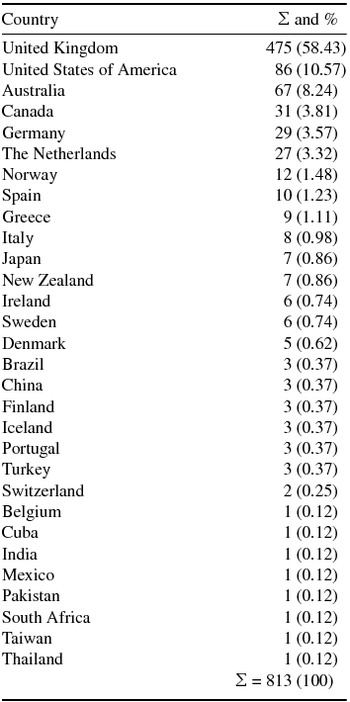
The results of first author countries are given in Table 1. As we can see, BCP receives contributions from many different countries, which range from eastern countries (Thailand or China) to western ones (USA or Germany). Nevertheless, differences exist in representativeness terms. The main contributions have been made by English-speaking countries, with authors from the UK being the most representative sample, as well as authors from the USA, Australia or Canada. Authors from other countries, such as Norway, Finland, Belgium, Pakistan or South Africa, tended to contribute to BCP to a lesser extent.
Frequencies and percentages of first author/single author countries

Figure 1 shows the percentages, by year, of first author's gender. At the beginning of the analysis (2000) until 2008, males predominated as first or single authors. However, after 2009, female first authors tended to increase, while males decreased. By mid-2016, female authors contributed 72.7% of the papers, and males 27.2%. The total frequencies were 391 (48.09%) for males, and 422 (51.91%) for females.
Percentages, by year, of first author's gender

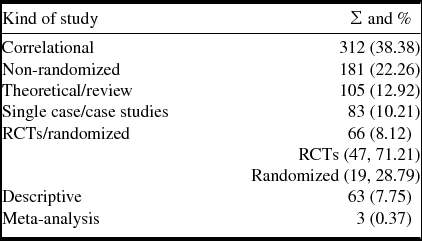
In relation to the kind of contributions, Table 2 shows the frequencies and percentages. Empirical studies (87.08%) of any kind surpassed theoretical contributions and reviews (12.92%). Correlational studies (38.38%) are the most popular among contributors of BCP, followed by non-randomized (22.26%) and theoretical/review papers (12.92%). Other empirical contributions are classified as single case/case studies (10.21%), randomized (8.12%) and descriptive studies (7.75%). Finally, very few meta-analyses appear (0.37%).
Frequencies and percentages of the main kind of contributions

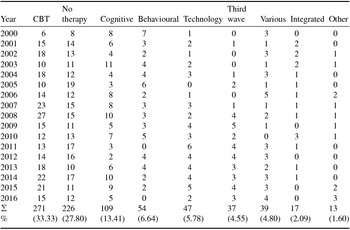
The vast majority of papers were ascribed by their authors as coming under the cognitive behavioural therapy heading (33.33%; see Table 3). It should be pointed out that many contributions did not make any explicit reference to a given model or therapeutic approach (27.80%). These included a wide range of papers, from those on the development of a clinical scale to others on different variables. Then studies came in two main denominations: cognitive therapy (13.41%) and behavioural therapy (6.64%). Very few papers corresponded to third wave approaches (4.55%), which mostly stood alone, being compared (n = 6) or considered adjunctive (n = 2) in a very few papers. Some papers used various procedures, and usually compared them (4.80%), as well as technology/internet (5.78%; see the above explanations). Other categories (‘integrative’ and ‘other approaches’) appeared less frequently.
Frequencies and percentages of the main kind of therapeutic approaches

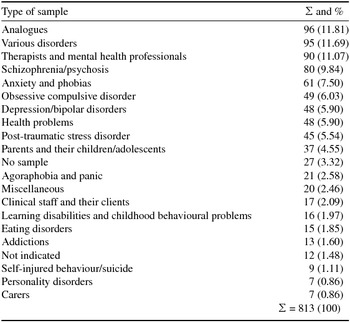
Table 4 shows the frequencies and percentages of the samples studied in each contribution. No sample showed greater representativeness. The first one was the analogue population (11.81%), which came very close to the study of various disorders (11.69%), and to the study of therapists and mental health professionals (11.07%). Regarding disorders, the main ones were ‘schizophrenia/psychosis’ (9.84%) and ‘anxiety and phobias’ (7.5%). Other disorders followed next, such as ‘obsessive compulsive disorders’ (6.03%), ‘depression and bipolar disorders’ (5.9%), and any kind of ‘health conditions’ (5.9%) and ‘post-traumatic stress disorders’ (5.54%). I wish to emphasize that when studies examined childhood problems, ‘parents and children/adolescents’ were usually studied conjointly (4.55%). This was also the case, be it less frequently, of the studies that included both ‘clinical staff and their clients’ (2.09%). Other categories, such as ‘eating disorders’ or ‘personality disorders’, appeared less frequently.
Frequencies and percentages of the main kind of samples

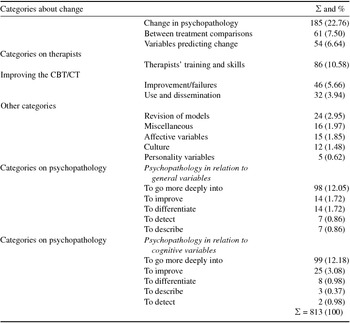
For the final ‘kind of focus/topic’ categorization, frequencies and percentages are given in Table 5. Categories about change, such as ‘change in psychopathology’, ‘between treatment comparisons’ and ‘variables predicting change’, were the most representative (300 in all; 36.9%). Then came studies on psychopathological conditions, which I classified as psychopathology in relation to general variables (140 in all; 17.22%) and in relation to cognitive variables (137 in all; 16.9%). Each subcategory included studies that ‘go deeper into a psychopathology’ and attempted ‘to improve our knowledge of it’, ‘to differentiate between pathologies’ and ‘to describe’ and ‘to detect’ a psychopathology. In both sub-categories, ‘to go more deeply into’ was the main one (12.05 and 12.18%, respectively).
Frequencies and percentages of the main kind of focus/topic

After these studies, I should emphasize those that attempted to improve ‘therapist's training and skills’ (10.58%), as well as ‘improving CBT and CT’ (78 in all; 9.6%). The rest of the categories were of various kinds, e.g. ranging from specific ‘revision of models’ (2.95%) to studying ‘personality variables’ (0.62%).
Discussion
In this paper, I have attempted to describe what has been published in BCP. Several interesting issues have arisen, which I think could all be listed under the heading of ‘variability’. There is a vast range of papers and I like to assume that they could partly exemplify the state of the art of behavioural and cognitive psychotherapies. Briefly, I wish to emphasize that ‘variability’ is particularly seen in the kind of studied focuses and samples. The categorization shows that BCP authors follow a strong empiricist trend in two main fields: change in and study of psychopathology. It is highlighted that this corresponds to two main issues in the CBT field, i.e. to provide specific theorization and conceptualization about psychopathology by showing, at the same time, its great application possibilities and effectiveness. These two issues have gone hand-in-hand in the CBT field since its beginning (Lambert and Suplee, Reference Lambert, Suplee, Hogan, Johnson and Briggs1997).
In relation to first author countries, as BCP is published in English and is the main publication of BABCP, countries whose first language is English, especially the UK, are best represented in this journal. However, the list of countries shows its international scope.
An interesting result found was the degree of representativeness of males vs females as first and single authors. Traditionally, women have been less represented in research than men (Gormick, Reference Gormick2009). However, these results do not show a wrong picture. According to an USA APA review, in 2005, 72% of PhDs and PsyDs were women (Cynkar, Reference Cynkar2007), which seems to be a steady and growing tendency.
Yet one may wonder, what happened in 2009 in BCP for gender representativeness to reverse? As far as I know, there was no call for female researchers to send articles, nor any kind of special issue to facilitate this notion. I assume that this has simply happened and that it represents the increasing participation of women in science, particularly social sciences. Therefore, it would be interesting to see if this tendency is maintained over time.
Most studies have been conducted under a common denomination. Although there was a high percentage of papers that did not use any therapeutic approach, or at least did not list it, it seems clear from the obtained data that the commonest denomination for the field of treatment is the combined and eclectic label of cognitive behavioural therapy. This is particularly the case when papers showed the application and use of these therapies. Some authors included both labels in the abstract and keywords by assuming, may I infer, that ‘cognitive’ and ‘cognitive behavioural’ are interchangeable labels. However, this is still a controversial issue from my point of view and from some others’ perspective (e.g. Dobson and Dozois, Reference Dobson, Dozois and Dobson2001). One could wonder why are there such diverse denominations, sometimes within the abstract and the title? Why did some authors choose one label rather than the other? What is the best label for a specific and differentiated conceptual and therapeutic model? From my point of view, this calls for a general reflection to be made in the field in different forums and settings.
There are two approaches that have appeared less frequently: behavioural therapy and third wave therapies. In relation to behaviour therapy, I suggest that many behavioural contributors included their approach under an eclectic cognitive behavioural label. In relation to third wave therapies, this tendency appears widely in the field in specific journals, websites and organizations. We also have to consider that this category includes only three approaches and mostly stood alone, while others, such as CBT, could include a wider variability. So perhaps this result is not an unusual one.
In relation to relevance of change, the first categorization in a general block on empirical studies and contributions showed that authors tended to favour empirical papers more than theoretical papers and reviews. There are plenty of empirical papers in many areas of interest for the BCP audience.
A high percentage of papers can be considered outcome studies (cf. Greenberg and Pinsof, Reference Greenberg and Pinsof1986), which shows the applicability of behavioural and cognitive psychotherapies for treating diverse disorders. Although they are less frequent, many research works have attempted to explore, describe and predict (Greenberg, Reference Greenberg and Walker1983) what kind of variables tend to influence the process of change and the best way to achieve this. Some of these studies are correlational and a few are purely theoretical. Therefore, the two main psychotherapeutic research perspectives are present in the BCP journal. From my point of view, and according to several reviews, behavioural and cognitive psychotherapies are firmly established in the field; i.e. different behavioural and cognitive psychotherapies have shown their effectiveness, efficacy and clinical utility (Butler et al., Reference Butler, Chapman, Forman and Beck2006). Those treatments are usually listed as empirically supported treatments (Lyddon and Jones, Reference Lyddon and Jones2001). However, we should not only study what works, but how it works (Elliott, Reference Elliott1998). This tendency to empirically validate treatments and outcome studies should be as relevant as the tendency to show what clients and therapists do, how this influences change, and how this process of change develops session by session.
For some years now, RCTs have been the gold standard for showing the efficacy of psychological treatments. To qualify as an RCT, studies should comply with a set of strict guidelines. Applying treatment under strict conditions is complex and controversial. First of all, those studies are high in internal validity, but low in external validity. For this reason, some authors have claimed that effectiveness (applying treatment under natural conditions closer to real clinical world) is a better perspective for studying psychotherapy. Both efficacy and effectiveness studies are useful strategies for showing that a psychological treatment works (Consumer Reports, 1995; Seligman, Reference Seligman1995).
The results show that some RCTs exist, at least judging by titles and abstracts. Many studies in BCP used a random assignment, but are not qualified as being RCTs, or at least, they are not described as such by authors. RCTs are at the core of efficacy studies (Barker et al., Reference Barker, Pistrang and Elliott2002). However, due to the difficulties for translating efficacy studies to a real clinical setting, randomized trials that do not follow strict guidelines could be used to show effectiveness (Kråkvik et al., Reference Kråkvik, Gråwe, Hagen and Stiles2013; Singal et al., Reference Singal, Higgins and Waljee2014).
Secondly, some years ago, a set of guidelines to establish the validity of RCTs was developed (Begg et al., Reference Begg, Cho and Eastwood1996; Moher et al., Reference Moher, Schulz and Altman2001). It was assumed that the CONSORT (Consolidated Standard of Reporting Trials) Statement improved the quality of reporting RCTs, and many journals included it as part of their publication policy. BCP does not advise contributors to follow these guidelines before publishing RCT studies, which does not preclude authors to follow them. Based on analyses of abstracts, no study mentioned having followed CONSORT. However, this is not an unusual result. Even the journals that promote CONSORT publish studies that do not follow those guidelines, or do not report key methodological issues (Deveraux et al., Reference Deveraux, Manns, Ghali, Quan and Guyatt2002). Moher et al. (Reference Moher, Schulz and Altman2001) suggested that authors doing RCTs tend to not report their studies properly.
Thirdly, in RCTs all patients allocated to a treatment are analysed together, regardless of whether they received treatment or not. In fact any efficacy or effectiveness studies should do statistical analyses following an intent-to-treat approach (Singal et al. Reference Singal, Higgins and Waljee2014). This information is explicitly referred to in the abstracts of only 16 papers. For this reason, it is difficult to judge if this has been a key element in the Method section of the papers.
Finally, BCP encourages (Salkovskis, Reference Salkovskis2002b) the publication of ‘empirically grounded clinical interventions’. In fact this is a Section of the journal. This Section should develop treatment approaches or new ones, based on a variety of sources, such as a well-founded theory (a relatively not excessively low percentage of theoretical reviews that could contribute to establish solid bases for clinical knowledge is included in the Results), experimental studies of any kind, plus outcome data and clinical phenomenology. The results from publications tend to illustrate this Editorial Call. More specifically, I could assume that there is more growing interest in addressing effectiveness than efficacy. This is not unusual as BCP is the leading journal of BABCP, and the interest of members and of contributors and readers of the journal could lie in the undertaking of studies that facilitate their clinical work, taking clinical decisions and making suggestions in real clinical settings. In recent years this interest has contributed to the development of CER (Comparative Effectiveness Research; Rogers, Reference Rogers2014) in the medical field. Judging by the analysis of abstracts in BCP papers, no paper in our context has mentioned this specific trend.
Another way of judging evidence for behavioural and cognitive therapies is to perform systematic reviews and meta-analyses. Both methods are different, but aggregate and synthesize evidence that is already available (Hoffman et al., Reference Hoffman, Cambrosio, Battista, Levy and Sovolev2016). Nevertheless, these studies barely appear. They are difficult to do and require a previous background of knowledge; knowledge, I may infer, that already exists in our field. CBT has contributed to develop and refine Scientist Practitioner knowledge (Salkovskis, Reference Salkovskis2002b), but judging by the analyses of 16 years of publications, this is based more on correlational and non-randomized studies. Due to the difficulties to control intervention variables and randomization (Barker et al., Reference Barker, Pistrang and Elliott2002), these studies come closer to the clinical reality, and I suggest, answer issues that are of interest to a clinical audience, such as what factors influence the development of a treatment, which clients do better in a particular psychological intervention, what variables affect any psychopathology, what kind of evidence could we provide to establish the validity and reliability of an assessment measure, etc. Barker et al. (op. cit.) emphasized that depending on the nature of research and of our security on the research topic, different research designs are called for: from descriptive and correlational to RCTs based on previous and available evidence. In fact, some studies published during our study period have taken data from RCTs (i.e. Bendall et al., Reference Bendall, Jackson, Killackey, Allott, Johnson, Harrigan, Gleeson and McGorry2006; Price et al., Reference Price, MacDonald, Adair, Koerner and Monson2016).
Therefore, in order to better judge the research status of the field, a longitudinal search for research evolvement of topics could be performed. Clearly, this has not been an aim of the present study; i.e. I cannot fully answer whether our field focuses on those research designs because of the nature of the addressed topics, or because clinical settings and requirements of institutions favour this trend. My suggestion is that different kinds of designs and research works in BCP reflect more economic, clinical, etc. conditions than our insecurity about prospective research questions.
Abstracts show that authors provide different kinds of information about their studies. On some occasions, not enough information is included. For instance, some studies do not include n of samples and obtained effect sizes. This probably calls for guidelines of specific issues that each part of the abstract should include in relation to the kind of paper. This would help readers acquire basic information about the paper and would draw their interest.
It is important to emphasize that change is shown mainly through studies that have attempted to analyse it in various disorders or in comparing CBT treatments in the same field. The samples used in different studies once again indicate the wide variability of the CBT field and its applicability to a vast range of human psychological problems. Results about studies with different samples should also be understood in relation to the main focus and topic areas.
Obviously, there are common areas of interest for CBT, such as anxiety disorders. Although these disorders have been differentiated (see Table 4), they are a key focus of CBT treatments. Traditionally, cognitive therapy development owes part of its applicability to the field of depression (Beck et al., Reference Beck, Rush, Shaw and Emery1979). Yet it easily spread to other areas, such as anxiety and phobias (Beck et al., Reference Beck, Emery and Greenberg1985; Clark and Beck, Reference Clark and Beck2010). It is important to note how a model, whose aim relies on changing cognitive thinking patterns, can be used in samples of clients with schizophrenia/psychosis, just as some papers published in BCP have shown (Steel, Reference Steel2008). Those studies reveal the adaptation possibilities of CBT and how it can be included as a key approach in the field for a vast range of disorders. In addition, these possibilities are reported in the many studies that centre on and apply a CBT perspective to various and co-morbid disorders.
Basically, and in relation to the above categories, each psychopathology has been studied in two main ways. Studies on general and cognitive variables have indicated an important trend in the field (e.g. Clark et al., Reference Clark, Beck and Alford1999). In each case, the aim has been to emphasize those variables that play a mediational role, and to test the limits and focus of cognitive and cognitive behavioural models for each psychopathology.
It is worth stressing that analogue samples are still common in the area. Despite acknowledgement that there are problems with such studies, and that their conclusions should be carefully translated into the clinical field (Stopa and Clark, Reference Stopa and Clark2001), this often seems to be the only possibility to keep advancing or developing new models.
An interesting dual perspective has also appeared in several papers; i.e. some studies have focused on samples that could (and should) be studied conjointly, such as parents and their offspring, and therapists and their clients. This dual perspective focus on inter-relationships between family members and on therapy participants obviously offers more in-depth insight into them.
I would like to emphasize how relevant the focus on both therapists and mental health professionals is for journal contributors. From my point of view, this is an example of a mature field. Studying clients’ samples has become more common in not only the CBT field, but also in other approaches. Nevertheless, therapists and mental health professionals are key elements of the therapeutic equation and competency needs to be developed in the field. Therefore, cognitive therapy has also been interested in teaching and training therapists, and in developing, for instance, scales to achieve this aim (Blackburn et al., Reference Blackburn, James, Milne, Baker, Standart, Garland and Reichelt2001). Through these papers, BCP contributes to enhance these capabilities and skills. The fact that it is an academic journal within a professional association could favour and justify these papers, and I would like to assume that this tendency will increase over time.
Limitations
This is a descriptive study of a specific journal in the behavioural and cognitive field, and no other rater has been involved in the study because it is a purely descriptive one. Nor have specific hypotheses been tested. Although I have assumed that it could partly exemplify these therapies, obviously this is merely a tentative assumption. No comparison with other journal publications, or with specific or similar reviews in the field, has been made. Besides, analyses and suggestions are exclusively based on abstracts, titles and keywords, which could partly reflect the whole authors’ work.
The focus has been cross-sectional, not longitudinal. Not all BCP publications have been categorized since its beginning, nor has it been possible to look for evolvement patterns. As almost 16 years have been studied, this cross-sectional perspective seems obliged.
Nevertheless, I hope that this paper has been able to show BCP's contribution to the field of cognitive and behavioural psychotherapies. From my reading and understanding of such a collection of papers, the tendency to show its applicability and effectiveness in various disorders will increase, as will the relevance of offering better cognitive and behavioural explanations of various disorders.
In addition, I suggest attempting to study more clinical samples than analogues, although this could make conducting any study more difficult. Finally, I suggest that behavioural and cognitive therapies, as a mature field, will also gain some benefits from theoretical and review papers that attempt to confer some sense and background to these empirical studies.




Comments
No Comments have been published for this article.