Introduction
Depression is common, and adequate treatment is difficult to access and is at best only partially successful in averting years lived with disability (Andrews et al., Reference Andrews, Issakidis, Sanderson, Corry and Lapsley2004). Thus, effective strategies for depression prevention, based upon an understanding of risk factors for depression, are sorely needed. Modifiable risk factors provide targets for psychosocial interventions. Such interventions are more likely to be preferred over medications for preventing depression and have proven effective in reducing the incidence of major depression (Cuijpers et al., Reference Cuijpers, Smit and Straten2007). Because most black patients receive mental health care from their primary care physicians, if at all, and depression is underdiagnosed and undertreated in this population, it is imperative to detect risk factors both for diagnosis and intervention purposes (Cooper-Patrick et al., Reference Cooper-Patrick, Gallo, Powe, Steinwachs, Eaton and Ford1999). This need is underscored by the fact that minority elders demonstrate a greater vulnerability to mental health problems and elderly blacks have been shown to endorse significantly greater depressive symptoms than elderly whites (Jang et al., Reference Jang, Borenstein, Chiriboga and Mortimer2005).
Most studies and reviews that have examined risk factors for depression have focused on patient samples that are mostly white with few black patients included (Bruce, Reference Bruce2002; Cole and Dendukuri, Reference Cole and Dendukuri2003). However, there is growing recognition of the importance of specifically examining risk factors among black populations due to the different social worlds they may inhabit, which includes more disability, greater health risks, lower educational attainment, and lower likelihood of marriage compared to white people (U.S. Department of Health and Human Services, 2000). One recent review found that negative coping strategies, such as substance abuse, a lack of social support systems, low income, and racism/discrimination were major risk factors for depression in black men (Watkins et al., Reference Watkins, Green, Rivers and Rowell2006). Miller and colleagues (Miller et al., Reference Miller, Malmstrom, Joshi, Morley and Wolinsky2004) found that among blacks with a mean age of 57 years living in the community, female sex, lower income, health limitations, obesity, and lower social support were factors that contributed to clinically relevant levels of depressive symptoms. In one study that compared depressive symptoms among community-dwelling black and white adults aged 60–84 years, lower education, greater functional disability, lower sense of mastery, and poorer satisfaction with support were common risk factors for depressive symptoms in both groups (Jang et al., Reference Jang, Borenstein, Chiriboga and Mortimer2005).
In order to compare the frequencies of previously established risk factors for depression (Bruce, Reference Bruce2002; Charney et al., Reference Charney2003) between subsyndromally depressed older blacks and whites, we present data from our ongoing NIH-funded randomized clinical trial [NCT 00326677] of prevention for depression (Sriwattanakomen et al., Reference Sriwattanakomen2008).
Methods
Recruitment
This study was a cross-sectional study of baseline data from an ongoing randomized clinical trial – “Prevention of Depression in Older African Americans” (Sriwattanakomen et al., Reference Sriwattanakomen2008) – which examines the use of problem-solving therapy in primary care (PST-PC) for subsyndromally depressed older individuals. The study enrolls adults aged 50 years and over in metropolitan Pittsburgh, Pennsylvania, and surrounding communities. Briefly, “PREVENTION” recruitment strategies involve referrals from collaborating primary care physicians (PCPs) as described in the PROSPECT study (Bruce et al., Reference Bruce2004). PREVENTION also recruits from: (1) community-based wellness initiatives such as the Healthy Black Family Project (HBFP: http://www.cmh.pitt.edu/hbfp.asp) and the Center for Healthy Hearts and Souls (CHHS: http://www.healthyheartsandsouls.com); (2) advertisements in both print and on-air media; (3) university-based research registries; (4) presentations to lay groups of older adults and their families; and (5) use of electronic medical records providing “pop-up” information to PCPs who have recorded a diagnosis of depression in their patients’ charts. In this study, the majority of white participants were recruited from primary care practices, while black participants were primarily recruited through community agencies such as HBFP and CHHS. These differential paths to study participation reflect the real-life experiences of blacks and whites and the practical necessity of using multiple strategies to recruit a racially diverse study group.
Participants
PREVENTION addressed “indicated” preventive intervention, as defined by the Institute of Medicine (Mrazek and Haggerty, Reference Mrazek and Haggerty1994). Indicated prevention targets those who currently have subsyndromal symptoms of depression. Enrolled participants were considered to have subsyndromal symptoms of depression if they scored 11 or more on the Center for Epidemiological Studies Depression Scale (CES-D) in the absence of Structured Clinical Interview for DSM-IV (SCID) criteria for current major depressive disorder (MDD). Participants were required to have a Mini-mental State Examination (MMSE; Folstein et al., Reference Folstein, Folstein and McHugh1975) score ≥24. Potential participants were excluded from the study if they were using antidepressant medication or had concurrent mental health treatment. PREVENTION also excluded those who endorsed an episode of major depression or alcohol/substance abuse within the past 12 months, a lifetime history of bipolar disorder or other psychotic disorder, or a diagnosis of any neurodegenerative disorder such as dementia. Past or present anxiety disorders did not preclude participation.
This research project was approved by the Institutional Review Board at the University of Pittsburgh.
Measures
Risk factors
We compared the prevalence of known risk factors for depression and scores for continuous measures of factors associated with depression between black and white participants. Sociodemographic and psychosocial risk factors included: (1) gender (Cole and Dendukuri, Reference Cole and Dendukuri2003), (2) educational attainment in years (Ladin, Reference Ladin2008), (3) household income (Cohen et al., Reference Cohen, Houck, Szanto, Dew, Gilman and Reynolds2006), (4) bereavement within the past year (Bruce, Reference Bruce2002; Schoevers et al., Reference Schoevers, Beekman, Deeg, Geerlings, Jonker and van2000), (5) living alone (Wilson et al., Reference Wilson, Mottram and Sixsmith2007; Weyerer et al., Reference Weyerer2008), (6) being a caregiver (Zivin and Christakis, Reference Zivin and Christakis2007; Adams, Reference Adams2008) and (7) interpersonal support (Bruce, Reference Bruce2002; McKnight-Eily et al., Reference McKnight-Eily2009). Medical and health-related risk factors included: (8) presence of functional disability (Bruce, Reference Bruce2002; Schoevers et al., Reference Schoevers, Beekman, Deeg, Geerlings, Jonker and van2000), (9) chronic pain (McCarthy et al., Reference McCarthy, Bigal, Katz, Derby and Lipton2009) and (10) obesity (Almeida et al., Reference Almeida, Calver, Jamrozik, Hankey and Flicker2009). Psychiatric risk factors included: (11) history of major depressive disorder (Cole and Dendukuri, Reference Cole and Dendukuri2003), (12) chronic insomnia (Taylor, Reference Taylor2008), (13) current anxiety disorder (Vink et al., Reference Vink, Aartsen and Schoevers2008), and (14) history of substance abuse (Bolton et al., Reference Bolton, Robinson and Sareen2009). Cognitive risk factors included scores on tests of (15) executive function (Alexopoulos, Reference Alexopoulos2003) and (16) overall cognitive status (Vinkers et al., Reference Vinkers, Gussekloo, Stek, Westendorp and Van Der Mast2004; Weyerer et al., Reference Weyerer2008).
In addition to these 16 “core” measures of risk factors, the remaining six measures constituted a variety of clinical descriptors of patient health status, quantification of depression and anxiety symptoms, and measurement of sleep quality.
Sociodemographic and psychosocial variables
Age was calculated from the subject's reported date of birth. Education was measured in years as reported by respondents. Participants self-reported their gender. Household income was estimated using census block estimates (U.S. Census Bureau, 2000). Participants were asked about recent bereavement, defined as current distress over the loss of a loved one within the past year. Participants were asked whether they were currently living alone and if they provided caregiving to another. The Interpersonal Support Evaluation List (ISEL) provided a measure of the perceived availability of social support and self-esteem (Cohen et al., Reference Cohen, Mermelstein, Kamarck, Hoberman, Sarason and Sarason1985). It is broken up into four subscales: self-esteem, which measures the perceived availability of a positive comparison when comparing one's self to others; belonging, which measures the perceived availability of people one can do things with; appraisal, which measures the perceived availability of someone to talk to about one's problems; and tangible, which measures perceived availability of material aid.
Medical comorbidity and health-related quality of life
Body mass index (BMI) was calculated for each participant. Obesity was defined as a BMI of 30 or greater. Chronic pain was self-reported and defined as pain of at least moderate intensity, more days than not, for at least the past three months. The presence or absence of functional disability was adjudicated by our nurse practitioner based upon a physical and neurological examination of each subject. Her decision was then confirmed by our diagnostic consensus process. The Cumulative Illness Rating Scale adapted for use in geriatrics (CIRS-G; Miller et al., Reference Miller1992) was used to assess chronic medical illness burden. The Medical Outcome Survey (MOS/RAND12; Ware and Sherbourne, Reference Ware and Sherbourne1992) was used to evaluate physical and mental health related quality of life. The Late Life Functional Disability Inventory (LL-FDI; Jette et al., Reference Jette2002) was administered to assess participant's limitations in activities of daily living and social role functioning. We used the disability subscale of the LL-FDI, which yields measures of activity limitation (“can do”) and frequency (“does do”).
Psychiatric and psychological measures
The Structured Clinical Interview for DSM-IV was administered before any study procedures to diagnose current and past mental illness. SCID diagnoses were categorized as follows: MDD and related conditions (e.g. dysthymia, depressive disorder not otherwise specified (“minor” depression)), anxiety disorders, adjustment disorders, primary insomnia or insomnia related to another disorder, breathing-related sleep disorder or sleep disorder due to a general medical condition, and substance use disorders. We assessed depression severity using the Hamilton Rating Scale for Depression-17 item (HRSD; Hamilton, Reference Hamilton1960). The Brief Symptom Inventory (anxiety subscale) (Derogatis and Melisaratos, Reference Derogatis and Melisaratos1983) was used to assess anxiety severity. Sleep quality was measured with the Pittsburgh Sleep Quality Index (PSQI; Buysse et al., Reference Buysse, Reynolds, Monk, Berman and Kupfer1989). The Social Problem Solving Inventory-Revised (SPSI-R; D'Zurilla et al., Reference D'Zurilla, Nezu and Maydeu-Olivares2002) was used to assess subjects’ perceptions of their approach toward solving problems in everyday living. This inventory consists of five scales. One of these scales, Positive Problem Orientation, measures an individual's orientation toward problems, including the tendency to view problems positively, to see them as challenges rather than threats, and to believe in one's ability to detect and implement effective solutions.
Cognitive measures
The Executive Interview (EXIT) (Royall et al., Reference Royall, Mahurin and Gray1992) was used to measure executive function and corresponding deficits associated with frontal lobe and subcortical disease. The Mini-mental State Examination (MMSE) provided a screening measure of overall cognitive status.
Statistical analysis
We examined associations between each risk factor and race using χ2 or t tests. The mean number of risk factors between black and white participants was assessed only for categorical risk factors, of which there were 11. These included being female, bereavement, living alone, being a caregiver, obesity, chronic pain, functional disability, history of MDD, chronic insomnia, anxiety disorder, and a history of drug/alcohol abuse. The means were compared using the two-sample t-test.
Results
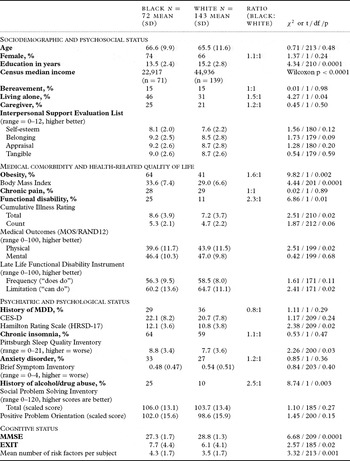
Since September 2007, 215 participants have been recruited into the PREVENTION study: 72 are black and 143 are white. Black participants had significantly lower median income and years of education (see Table 1 for all numbers and p-values). They also had significantly greater rates of living alone but similar rates of bereavement and being a caregiver. Blacks and whites also had similar perceived availability of social support across all four domains of the ISEL. The prevalence of history of MDD, current anxiety disorder, and chronic insomnia was similar between the two groups, but black participants had significantly higher rates of past substance abuse. Although there was a similar prevalence of chronic insomnia, black participants reported having significantly worse quality of sleep. With regard to medical and health-related risk factors, black participants had significantly higher rates of functional disability and obesity, but similar rates of chronic pain. Accompanying the higher rates of functional disability, black subjects also had a significantly higher total score for medical comorbidity on the Cumulative Illness Rating scale, lower physical health related quality of life (MOS-SF36), and greater limitation in functional ability (LL-FDI). Cognitive assessments revealed that black participants had significantly lower MMSE and higher EXIT scores (more impaired executive function) than white participants.
Risks in prevention group by race

Bold indicates main risk factor.
MDD = major depressive disorder; CES-D = Center for Epidemiological Studies Depression Scale; MMSE = Mini-mental State Examination; EXIT = Executive Interview
Overall, black subjects experienced a greater mean number of risk factors (M = 4.3, SD = 1.69) than white subjects (M = 3.5, SD = 1.69) (t(213) = 3.32, p = 0.0011).
Discussion
Black participants had higher frequencies of risk factors for depression and a greater mean number of risk factors compared to whites. The former were also found to have lower median income and years of education and higher rates of living alone, functional disability, obesity, and substance abuse as well as worse cognitive status and executive function. The findings of lower income and years of education and higher rates of living alone, functional disability, obesity, and substance abuse confirm previous literature, which describes the large societal gap that still exists between blacks and whites (U.S. Department of Health and Human Services, 2000; Williams and Williams-Morris, Reference Williams and Williams-Morris2000). Those with lower socioeconomic status (SES) are at increased risk for onset of first depression and have a more severe and refractory course of depression (Cohen et al., Reference Cohen, Houck, Szanto, Dew, Gilman and Reynolds2006). Individuals with lower income and fewer years of education are set-up to have increased psychosocial stressors, poorer health habits, and consequently poorer health (Blazer and Hybels, Reference Blazer and Hybels2005).
The higher rates of functional disability in combination with the higher scores for comorbid medical conditions on the Cumulative Illness Rating Scale, the worse physical health-related quality of life, and greater limitations on function as measured by the LL-FDI among the black participants, create a clear picture of the poor physical health and function experienced by the black subjects in our cohort. Functional disability is a common source of stress and important risk factor in depression (Bruce, Reference Bruce1999). However, functional disability has been shown to interact with the protective factor of sense of mastery in predicting depressive symptoms. One analysis determined that the correlation between functional disability and depressive symptoms was greatly attenuated in people with high sense of mastery compared to individuals with low mastery (Jang et al., Reference Jang, Borenstein, Chiriboga and Mortimer2005). The importance of a strong sense of self-efficacy to cope with disability, buffer the effects of negative consequences from physical health problems, limit depressive symptoms, and possibly prevent major depression makes problem-solving therapy (the intervention arm of our trial) particularly applicable in our population. Although subjects scored relatively high on the SPSI, PST can assist patients in further strengthening their sense of self-efficacy as well as help them solve problems stemming from disability. Furthermore, PST has proven efficacy in treating dual-diagnosis patients, including improvement in substance abuse outcomes (Bender et al., Reference Bender, Springer and Kim2006). Given that a quarter of black subjects have a history of substance abuse in our sample, it is important that our prevention strategy can target this risk factor.
Black participants endorsed significantly greater mood symptoms on the HRSD-17. The difference was small but agrees with previous literature demonstrating a small but significant difference in depressive symptoms endorsed by older adults by race (Jang et al., Reference Jang, Borenstein, Chiriboga and Mortimer2005). Black and white participants’ mean scores on the HRSD classify both groups as “mildly depressed,” consistent with subsyndromal depression. Chronic insomnia was highly prevalent in both groups confirming the close association between insomnia and depression (Taylor, Reference Taylor2008). Although the two groups did not differ in the prevalence of this risk factor, black participants endorsed worse sleep quality. The fact that both groups had PSQI scores greater than 5 is indicative of significant sleep disturbance (Buysse et al., Reference Buysse, Reynolds, Monk, Berman and Kupfer1989). The black group had poorer MMSE and EXIT scores, but the differences between blacks and whites on these measures were minimal and unlikely to be clinically significant. Scores were well within the normal range indicating non-impaired cognitive status and executive functioning.
It is likely that the probability of depression increases progressively with the accumulation of risk factors (Schoevers, Reference Schoevers2003). In our study, black participants had on average about one greater risk factor than whites. This is a conservative estimate, as the continuous measures of years of education and income were not taken into account. Taken in the context of lower socioeconomic status, the higher prevalence and overall greater mean number of risk factors seems to place black participants in our sample at higher risk for depression than whites. This may explain the slightly higher depressive symptom burden experienced by black subjects. However, it is perhaps surprising that despite the greater number of risk factors and large discrepancy in socioeconomic status the difference in depressive symptoms between races is not greater. Although there were no significant differences in self-esteem, interpersonal support, and scores on the Social Problem Solving Inventory, black participants scored higher on each of these measures. Such coping skills and resources may buffer the effects of negative psychosocial factors on depressive symptoms (Williams and Williams-Morris, Reference Williams and Williams-Morris2000). Given that black subjects are disadvantaged on most measures of physical health compared to whites, those who survive to old age are perhaps more robust or resilient than equally aged white people (Williams and Williams-Morris, Reference Williams and Williams-Morris2000).
This study has several limitations. Because we used geographically defined samples, these findings cannot be generalized to the population at-large. Also, subjects who agree to participate in a prevention study that entails many tests, scales, and interviews are not necessarily representative of other subsyndromally depressed individuals. The study design is cross-sectional and recruited subjects suffer from subsyndromal depression; thus, we cannot make causal inferences. We do not know whether the examined factors led to the depression or if the depression led to the presence of these factors. Our study also had no measure of racial discrimination, which is an important risk factor among blacks (Watkins et al., Reference Watkins, Green, Rivers and Rowell2006).
In conclusion, black participants had a higher prevalence of multiple risk factors for depression as well as a greater mean number of risk factors compared to whites in our sample. Given the morbidity caused by depression and the limited effectiveness of depression treatments, future research should continue to examine the use of preventive interventions focused on specific risk factors. The differing risk profiles between black and white individuals may help physicians identify patients at risk for depression and inform the construction of targeted preventive interventions. As underscored by the National Comorbidity Survey-Replication (NCS-R), depression may be a greater contributor to disability than many physical disorders (Kessler and Merikangas, Reference Kessler and Merikangas2004). These depression prevention efforts are particularly important in socially disadvantaged populations already burdened with greater medical comorbidity and disability.
Conflict of interest
None.
Description of authors' roles
All the authors participated in the drafting and critical revision of this paper. C. F. Reynolds was the principal investigator of the study, and J. Q. Morse and S. B. Thomas were co-investigators.
Acknowledgments
Funding for the work has been provided by: Doris Duke Charitable Foundation to RS; T32 MH19986 to RS; National Institutes of Health [P60 MD 000207] to SBT; [P30 MH071944] to CFR; the John A. Hartford Center of Excellence in Geriatric Psychiatry to CFR; the University of Pittsburgh Medical Center (UPMC) endowment in geriatric psychiatry to CFR, the Staunton Farms Foundation to CB, the Kellogg Health Scholars Program [P0117943] to JC, and the Commonwealth of Pennsylvania Department of Health to CFR. We thank the research staff of the Clinical Trials Management Unit (P30 MH071944) for recruitment and assessment of study participants. We also thank participants themselves for volunteering to be subjects in “PREVENTION”.