

Introduction
When the National Health Service (NHS) was founded in 1948, professional employees and support staff, with the exception of General Practitioners (family doctors) worked directly for the state.Footnote 2 From doctors and nurses to cleaners and maintenance staff, workers were employed directly by the state and were all public-sector employees. Since the 1980s, private employment in the National Health Service has steadily grown. Beginning with the outsourcing of support services, the number of privately employed workers in the National Health Service has gradually increased. Since the election of the Blair government in 1997, private sector involvement has massively expanded across the public services. Most new hospitals have been built through private-sector contracts with consortia that design, build, maintain, and operate all nonclinical services in the facilities. At the same time, the private provision of clinical services has increased, through the use of Independent Sector Treatment Centers at which private companies provide routine services (such as cataract surgeries and MRI scans) to NHS patients, funded by the State. The increase in health service capacity since 1997 has been the result of increased expenditure significantly directed to private contractors. This research looks at the employee experience of the Private Finance Initiative, examining the complexities of the employment relationship and the role of trade unions as private-sector service provision increases.
This paper argues that marketization in the health sector has increased dramatically under the New Labour government. As policymakers have moved from ideological to pragmatic justifications for marketization, union opposition has similarly become more pragmatic and less ideological. With unions unable to stop these reforms, they have turned their attention to the practical concerns of their members in partially-privatized workplaces under complex employment arrangements. While protecting current members, unions have an opportunity to expand their membership by appealing to privatized ancillary healthcare staff.
Our research shows that while ideologically opposing marketization, unions and employees have been forced into a more pragmatic position. Some unions, such as Unison, have maintained a twin-track approach, fighting privatization on the national level while also working to protect members in partially privatized workplaces. As Moira Fischbacher and P.B. Beaumont point out, “little is known about the extent and nature of trade union involvement and, indeed, that of staff more generally, or the negative aspects and externalities of a lack of involvement.”Footnote 3 Our research addresses this gap by focusing on the experience of staff in these new, hybrid public-private healthcare workplaces. In their case study of a single Private Finance Initiative (PFI) hospital, they find that “the expressions of exclusion and poor communications indicate that the level of trust between management and the employees may actually have worsened [in the transition to the new PFI facility].”Footnote 4 Our research at two PFI hospitals confirms this finding; communication was often poor and accountability structures were unclear and frequently ineffectual (particularly in one of the two hospitals). Our evidence shows that unions in the workplace have used their resources to protect their members, as thwarting the involvement of the private sector is nearly impossible.
Employees and their unions have fought what they perceived as the creeping privatization of the health service. The unions focused on questions of service quality and value for money, also emphasizing the traditional public-service ethos behind the health service, as contrasted with the profit motive of the private sector. However, with the Labour commitment to private-sector involvement, unions have not been able to stem the tide of marketization. While many still publicly oppose private service provision, employees and their union representatives have shifted their focus to the workplace experience in this new mixed economy of healthcare. This reflects the requirement for public-service trade unions to bolster membership as public-sector union density has declined by 2.9% from 61.5% to 58.6% between 1995 and 2005.Footnote 5
Local union representatives often act as a crucial interface between public and private managers in the same hospital. In responding to members' concerns, these representatives become a crucial point of communication between the different entities and accountability structures supposedly providing a unified service. Unions now need to bargain in a fragmented environment. A key concern for unions has been the so-called two-tier workforce, the situation where new private-sector employees are employed on less-favorable pay and terms and conditions than longer-serving employees, transferred from the NHS, who undertake the same work. A government agreement with the trade unions (the so-called Warwick Agreement of 2005) should phase out this two-tier structure, although the implementation is ongoing.Footnote 6 Employees in new, privately-financed hospitals have expressed particular dissatisfaction with the design of their new workplaces, and with the perceived poor quality of many support services, such as cleaning and catering. In order to retain their influence, unions have tried to recruit these private-sector employees into membership, with varying degrees of success. Unions have taken a twin-track approach: resisting marketization in general while protecting their members in the marketized workplace.Footnote 7
We define marketization as the whole range of practices that introduce both competition and private sector service provision into the NHS. This ranges from simple outsourcing to complex, long-term privately financed and operated facilities. These practices encompass a variety of employment arrangements. This includes outsourcing entire services (such as cleaning, catering, and maintenance), as was begun in the 1980s. It also includes the broader arrangements by which the hospital pays for the service and all management and service provision is performed by private-sector employees. There are also more complex agreements under some of these arrangements, generally negotiated by the unions, in which employees may either be retained as direct NHS employees or may work on protected terms and conditions and pay levels roughly equivalent to those of NHS staff. The emphasis within union and policy discourse on creeping privatization reflects the incremental step-by-step approach adopted by the Labour government that has been subject to little public consultation and has proved difficult to resist.
There are several key public-private hybrid forms of healthcare delivery currently operating in the UK. Almost all NHS facilities have some services provided by contractors, at a minimum parking services, and most often at least cleaning and catering services. We focus on the workplaces with more substantial private-sector employment. Specifically, we look at hospitals operated under the Private Finance Initiative, and more briefly the fully-privatized Independent Sector Treatment Centers (ISTCs). Both of these types of facilities take private employment significantly further than simple subcontracting of support services.
The NHS currently directly employs about 1.3 million people. Of these, fifty percent are professionally qualified (doctors, nurses, and scientific, technical, and therapeutic professions). While the number of professional staff has been increasing in the National Health Service since 1995, the number of nonprofessional staff has not kept pace. Indeed, the number of building services staff directly employed in the NHS declined almost fifteen percent between 1995 and 2005, even as the number of professional staff increased by thirty-three percent and the clinical capacity increased.Footnote 8 This decline in directly employed support staff is a result of the increasing use of private contractors to provide these services.
In the past, the NHS has been perceived as having a strong organizational culture, part of a broader “public sector ethos.”Footnote 9 Historically, the NHS offered its employees generous pensions and competitive wages, even for relatively unskilled workers. The entire UK public sector was often described as a “model employer” and was a reliable source of lifelong employment for many employees at all skill levels.Footnote 10 Since the 1980s however, NHS services have not been wholly operated by public-sector entities. Instead, services are provided by public-private hybrids which are much more varied in their employment practices.Footnote 11
The major unions in the National Health Service fall into two main categories: general unions and professional unions. The largest general union is Unison, a broad public service union with about 1.3 million workers, especially concentrated in the health service and local government sectors. Unison represents 400,000 workers in the healthcare sector.Footnote 12 Other general unions representing fewer healthcare workers include the GMB and Amicus. The largest professional unions in the National Health Service are the British Medical Association, representing about 130,000 doctors, and the Royal College of Nursing, representing about 380,000 nursing staff.Footnote 13 There are also smaller recognized professional unions of groups such as physiotherapists and radiographers.
We argue that the key effects of NHS marketization on employees have been in the form of decentralization and fragmentation of employment. Unions, especially Unison, have tried and failed to end marketization nationally, and instead have adopted a more pragmatic approach to protecting their members in the workplace. Locally, unions have continued to focus on problems with marketized services, both for employees and for service users. Depending on the strength of the local union branch, unions have achieved mixed results with this strategy.
Generally, unions perceive that their members are working under worse pay and conditions than they had been when all services were performed by NHS staff, but they have been able to improve pay and conditions under some circumstances. Where local representation is strong, private-sector employees have reached near parity with their public-sector counterparts, and in some cases government guidelines have added weight to this union claim. The move towards increasing marketization has accelerated since 1997 (the election of Tony Blair's New Labour government), and the union stance, although not uniform, has been reactive rather than proactive. This stems from the relationship between unions and the Labour government, union general support for improvement and increased spending on the health service, and the difficulties of confronting creeping privatization. Union members have also tended to be either ignorant of the implications of reforms, or apathetic when they are not directly affected, asking for union action only once they realize the impact of the changes.
The research presented here was undertaken between 2003 and 2006, both at the peak level and in PFI hospitals. Thirty two semistructured interviews were conducted with national and regional union officers and investors in private finance initiative facilities. In addition, interviews were conducted with managers and union representatives in two PFI hospitals, including revisiting one of the sites. In order to understand the internal union debates around these issues, we also attended annual union conferences where the role of the private sector in healthcare provision and the workplace experience were debated by members and officers. The data, then, does not come from a single perspective, but from the triangulated views of individuals both in the workplace and stakeholders in PFI at a broader level.
The balance of this paper examines the evolution of marketization in the National Health Service since the election of the first Margaret Thatcher government in 1979. We then present our findings on the employee experience of marketization in the workplace, arguing that unions have played an essential role in safeguarding pay and employment conditions in the workplace, even as their national resistance to marketization has largely failed.
The Evolution of Marketization under Conservative Governments 1979–1997
The Conservative government of 1979 was elected on a wave of antiunion sentiment following the extensive industrial action during the previous “winter of discontent.” These events reinforced the Conservative Party's profound distrust of public provision and its antipathy towards the power of public-service trade unions. Eighteen years of Conservative government enabled a more sustained and ideologically motivated reform agenda to be pursued, reflected in the wholesale privatization of nationalized industries and public utilities, alongside the promotion of liberalization to foster competitive markets. Within core public services, especially the high-profile and politically sensitive NHS, the Conservative government proceeded more cautiously. Policies to foster marketization coexisted with the strengthening of managerial hierarchies accountable to central government, whose interventions were frequently orientated to short-term electoral considerations. By 1997, radical reforms in the organization and management of the health service had been introduced and the influence of health service trade unions severely restricted, but concerns about the electoral consequences of too bold an embrace of marketization and the resilience of the professions curtailed the ambitions of successive Conservative governments.
Compulsory Competitive Tendering (CCT)
The use of private firms to supply support services such as cleaning, catering, and laundry to hospitals had not been unknown prior to the 1980s, but was relatively small-scale and arose in response to labor shortages in the 1960s. Private contractors were more costly than in-house provision as hospital administrators were effectively delegating their recruitment problems to private contractors who paid higher wages.Footnote 14 These small-scale, local initiatives were very different from the mandatory regime introduced by the Conservative government from 1983. Health authorities (the administrative organizations that oversaw hospitals) were instructed to test the cost-effectiveness of their support services and to accept the lowest tender unless “compelling reasons” dictated otherwise.Footnote 15 These reforms coincided with measures to strengthen the management process; measures which had been triggered by the recommendations of the Griffiths report, the first government-commissioned report to bring managerialism to the National Health Service.Footnote 16 The implementation of general management led to greater emphasis on individual rather than committee decisions and increased the influence and legitimacy of management in relation to professional staff, particularly doctors.
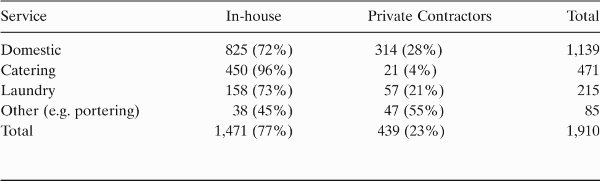
These changes were crucial for the implementation of forms of marketization because the former consensus style of NHS management made the implementation of market-style reforms almost impossible. This near-impossibility was evident from the failure of government efforts to encourage health authorities to market test in the early 1980s, as well as in the hostility of many administrators to the imposition of mandatory tendering.Footnote 17 Ambivalence towards outsourcing within the NHS remained prominent because managers were reluctant to cede control over a significant portion of their workforce to an outside employer, nor did they want to jeopardize service standards by fragmenting ward-based care.Footnote 18 The number of contracts won by private contractors comprised less than a quarter of the total (see Table 1), and the private sector complained vociferously about the structural bias towards in-house bids. More perceptively, and highlighting the sensitivities associated with privatization for government, the Secretary General of the Contract Cleaning Association argued that contractors were:
Learning the hard way that Government is more concerned about minimizing the immediate political problems used by contractors than in treating them fairly.Footnote 19
This is in contrast to the current situation, where PFI contracts almost invariably include the outsourcing of support services as part of the contract.
NHS contracts awarded 1983–1989
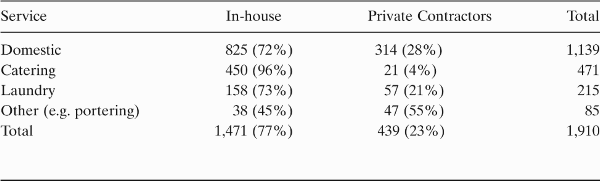
Source: Trades Union Congress, Joint NHS Privatisation Research Unit, 1990.
Irrespective of whether a contract was awarded in-house or contracted out, the tendering process placed downward pressure on terms and conditions of employment and contributed to large-scale job losses among support staff. This was acknowledged by the Treasury when it stated that:
Most of the savings from contracting arises because contractors offer poorer conditions of employment.Footnote 20
Even when basic pay rates were protected, hours of work were often reduced, and bonuses, holidays, and sick pay entitlements were eroded. The deterioration in pay and conditions was invariably greater for women workers, often employed on a part-time basis; private contractors rarely pursued the equal-opportunity policies typically found in the public sector. The imposition of mandatory competitive tendering therefore provided managers with an incentive to alter work organization and increase their control over the labor process, and therefore also contributed to work intensification.Footnote 21
These outcomes contributed to the government's objective of reducing trade-union influence. Support services workers were a particular concern of government because of high levels of trade-union organization and a history of mobilization. Trade unions opposed competitive tendering as part of a broader campaign against privatization, but confronted considerable difficulties in a context of declining membership and deteriorating union finances. The implementation of the policy at local level, over a lengthy period of time and with differing employer strategies, militated against effective national action. Instead, trade unions committed themselves to support local branches that opposed privatization, with ultimately unsuccessful industrial action to prevent contracting out at the hospital level. National union policy encouraged opposition to the tendering process to illustrate the strength of workforce sentiment, but this approach sometimes encouraged authorities to contract out services and enabled the government to portray the trade unions as “producer orientated” and opposed to enhanced efficiency.Footnote 22
A more high-profile strategy focused on highlighting contract failures and challenged the efficiency savings attributed to outsourcing. A stream of publications focused on poor standards of service due to high staff turnover and low levels of training.Footnote 23 These criticisms gained a high public profile, forcing the industry to publish its own rebuttal of what it termed “a smear campaign.”Footnote 24 Although it sensitized the public to poor standards and created a climate of public suspicion towards contracting out, the campaign failed to alter government policy. As discussed below, unions have continued to present evidence that privatization leads to a decline in service quality. By the early 1990s the scale of public-service job losses and the associated decline of union membership had precipitated the merger of three public-service unions to form Unison. Contractors, however, felt that they had been used by the Conservative government to force the NHS to increase efficiency but had gained relatively little market share because of the government's refusal to force hospitals to contract out services.Footnote 25 Managers were also becoming disenchanted with the mandatory nature of competitive tendering as they sought to increase their operational autonomy. The longer-term significance of the competitive tendering initiative was that not only did it undermine union influence among nonprofessional staff but it also established the principle that health authorities need not provide all hospital services themselves, ushering in the next phase of marketization via the creation of the internal market.
The Internal Market and the Emergence of PFI
In the early 1990s market relationships were further embedded in the health service. An internal market was established that separated the commissioning of healthcare by district health authorities from the provision of healthcare. The service providers, NHS trusts, typically comprised a single large hospital or hospitals that competed against each other for government revenue. Trusts were established as corporate bodies with their own board of directors; had scope to employ their own staff directly on trust terms and conditions of employment; were required to meet target rates of return on assets; could borrow subject to annual financing limits and had discretion to dispose of surplus assets. Trust status allowed managers to opt out of nationally determined pay and conditions of employment and the chance to manage budgets more flexibly.
Managers experimented with changes in work organization, skill-mix, and working-time arrangements and made greater use of temporary employment, altering the composition of the workforce and the roles undertaken.Footnote 26 There was also a harder edge to many of the reforms, with more assertive policies on the control of sickness absences and increases in workload throughout the health service.Footnote 27
The central assumption of the internal market was that workload would be linked more closely to resources, with competition between providers stimulating increased efficiency and responsiveness. These changes would in turn facilitate changes in working practices. By separating the financing of healthcare from its provision, it provided opportunities for the expansion of the relatively small private hospital sector. For the first time health authorities could channel resources into the independent sector if they could provide the same level of service in a cost-effective way. The problem was that this form of “dictated competition” embodied contradictory tendencies.Footnote 28 Increased managerial autonomy came up against increased centralized control as the Conservative government became anxious about the political costs of the internal market and intervened to prevent hospital closures or job losses. The Conservative government wanted the benefits of competition without the pain of market adjustment. In a planned health system, the market was inevitably highly regulated and incentive structures were relatively weak. Health authorities sought to protect their own local hospitals in a period of budgetary stringency and had little scope to alter service patterns.
The private hospital sector gained some work from health authorities, mainly linked to initiatives to reduce lengthy waiting times, but the flow of NHS patients to the private sector remained very small. Despite the radical intent of the internal market being blunted Tony Blair's health policy advisor concluded that “some things did change for the better during the internal market period and that whatever efficiency gains were made in the mid-1990s are now in danger of being lost.”Footnote 29 These comments foreshadowed the reintroduction of market-type incentives in the health service from the end of the second term of Blair's Labour government.
The final element of the conservative reforms established the Private Finance Initiative (PFI), during the early 1990s when the public sector borrowing requirement (the budget deficit) was more than £40 billion. Under the PFI system, a private consortium is contracted to finance, design, build and operate public service facilities. It usually involves the outsourcing of support staff as part of the contract, effectively superseding the policy of competitive tendering. The NHS Trust makes an agreed annual payment for the duration of the contract (usually twenty-five to thirty-five years), which represents the first obligation on a trust's revenue. PFI is a system for the procurement of services, rather than only capital assets (like buildings). The attraction of PFI for the government and potentially for service users is that it enables the acquisition of new hospital services more rapidly than could be achieved via conventional financing because of the longer period over which assets are financed. This is in contrast with the upfront investment needed for conventional financing of hospitals, where the government must pay for the capital assets at the start of the project. Such arrangements have been justified by the belief that PFI draws on specialist private-sector expertise that can make efficiency savings and which share the risks of construction delays and other cost overruns.Footnote 30 In practice the degree of risk transfer has proved a highly contentious issue and Unison has argued that profits derived from PFI, including additional profits from refinancing deals, show that unacceptable levels of profit accrue from PFI schemes.Footnote 31 This view is contested by the private sector who argue that it is not straightforward to attract institutional investors to invest in PFI schemes and that PFI schemes are more risky than critics acknowledge.
The Conservative governments were unable to convert their support for PFI into signed PFI contracts for new hospitals due to administrative complexities and associated transactions costs. Private-sector consortia expressed concern that if a trust became insolvent their income stream would cease, making PFI an unattractive investment option. These fears were allayed after 1996 when legislation was passed to ensure that the government took responsibility for such payments in the event of insolvency. Private consortia also expressed concern at the large administrative costs associated with a lengthy and bureaucratic tendering process.
When the Conservatives left office in 1997 they had established the preconditions for a rapid extension of the marketization agenda under New Labour. The influence of public-service trade unions and their capacity to oppose government policy had been severely weakened by the policy of compulsory competitive tendering, and a more critical scrutiny of producer interests had entered the public debate. CCT and the subsequent establishment of the internal market established the principle that healthcare would remain publicly-financed, but not necessarily publicly provided. Although significant administrative and political constraints hindered the degree to which private-sector firms had been able to advance their interests in the nascent healthcare market, by redefining these difficulties as essentially technical problems, New Labour sought to depoliticize their marketization agenda and thereby advance it more fully than under the Conservatives. In this context a particularly important feature of the Conservative legacy was the establishment of a cadre of managers drawn from nonclinical backgrounds that were able to convert government aspirations for a more “business like” NHS into concrete managerial initiatives. Medical staffs' aspirations were increasingly judged in terms of whether they coalesced with the “business” priorities of the trust. These managerial changes facilitated the rapid advancement of the marketization agenda under New Labour.
New Labour's current healthcare policy is based on their repeated assertion that “the key test is what works.”Footnote 32 Contrary to union belief, the government argues that it does not have a bias towards private-sector provision, but rather towards increased capacity and improved service delivery by whichever sector works best. New Labour's current direction is not only a return to something close to the internal market, but also the creation of further channels for private providers to compete for NHS contracts.
The Marketized National Health Service in Practice
Marketized services are now spread throughout the NHS and the role of the private sector is rapidly expanding. The UK Department of Health has built, or is currently building, seventy-nine new hospitals using PFI since 1997.Footnote 33 In contrast, only six new hospitals have been built in the same time period using traditional public funding.Footnote 34 Interviewees stated that the only realistic option for building a new hospital, in almost all cases, was through a PFI scheme. According to a recent report, “by 2008, the NHS will be spending at least £5 billion annually on care supplied by the private sector.”Footnote 35
Much of the prior research on the role of the private sector in delivering NHS care focuses on measures of performance, such as cost-effectiveness and value for money, cleanliness, and total bed numbers. Most of these studies conclude that the private sector has not delivered improved performance, and in some cases it has diminished overall performance.Footnote 36 We focus not on the overall quality of the service for patients but on the changing nature of the employment relationship within the marketized health service. Damian Grimshaw, Steve Vincent, and Hugh Willmott argue that public-private partnership arrangements “represent an important example of how the traditional role of the government as employer and service provider is being transformed.”Footnote 37 Indeed, in the case of many of these new hybrid forms, the government is neither employer nor service provider but only purchaser. “In principle, the antagonistic dualism of public versus private provision is replaced by the harmonious, synergistic duality of partnership.”Footnote 38
Most of the key stakeholders have not changed their positions on PFI based on evidence of PFI in practice. Unions, such as Unison, that were opposed to marketization, have found evidence to confirm this view, while the government has cited new facilities, reduced waiting lists for procedures, and reduced waiting times in hospitals as evidence of success.Footnote 39 The main bases for criticism of PFI hospitals by the unions, and some academics, fall into the following categories: Excessive profits and/or financial terms unfavorable to the public purse; poor-quality building design; poor-quality support services; inferior treatment of private staff as compared with their public-sector counterparts.Footnote 40 These perceived flaws encompass problems for the government (poor value for money), for employees (poor pay and working conditions), and for service users (inappropriate or inflexible design of facilities, inadequate cleaning and catering services, etc.). Union officers from Unison and the Royal College of Nursing (RCN) mentioned specific examples of wards that were too narrow and whole hospitals lacking rest areas for staff. An editorial in the British Medical Journal described the PFI as “a failure” because it is “simply too complicated” for the NHS.Footnote 41 While this diagnosis may be premature, at least as far as the New Labour government is concerned, PFI in practice has remained highly controversial even as it has proceeded apace.
Employee Voice and Staff Involvement
The fragmentation of the hospital workforce among multiple public and private employers was a key concern for union officers and representatives. Staff and union representatives expressed initial dissatisfaction with the day-to-day management of private contractors, especially when compared with the NHS. One transferred porter quoted in a union report described his private employer as “despicable.”Footnote 42 However, the current experience is much more varied. One union representative stated in an interview that his employees were more secure, felt less threatened by layoffs, and had access to better, newer equipment when privatized than they had when employed by the NHS. In some hospitals, unions have successfully negotiated release time for representatives of contract staff. In other cases, direct hospital employees who are union stewards have had to tread a fine line: they are not technically supposed to represent (or use resources or release time from the hospital employer on behalf of) contract employees, yet these staff are in the same workplace and may be facing similar or worse problems with no collective or individual voice. One senior manager for a private contractor showed his awareness of this problem in communication and commitment, stating that “you've got to get the staff on board, you've got to deal with all their hopes and fears, antipathies, whatever; bind them into the unit; work with the new clients and matrons, the trade unions.”Footnote 43
An officer in a professional union, the Royal College of Nursing, who covered an early PFI hospital stated that members often do not systematically object to (or fully understand) these new organizational settings unless or until their ability to deliver high quality care is compromised. She stated that “all [the members] want to do is go into work in the morning, deliver the care to the patient, and go home at night.”Footnote 44 This officer believed that the union should have developed a more strategic response to PFI and public-private partnerships at an early stage, even though its members are not transferred to private employers: “I think that … years ago … .we should have took (sic) on board that even though our members might not be directly affected, indirectly we would be affected and patient care would be affected.”Footnote 45 Instead the professional unions, as opposed to the general public-service unions, have been rather reactive and have become troubleshooters after the new facilities are operational. Another professional union officer covering a different PFI hospital stated that once the hospital became operational, members realized that “this would be a different beast than the one that we had been used to before.”Footnote 46
Finance and Value for Money
Those unions that are opposed to PFI have tended to oppose it in its entirety. They have not differentiated between problems arising from PFI and other more longstanding problems such as poor project management; for example, poorly-designed buildings may not be inherently caused by the system of financing (contractors and finance firms blame poor design on poor specifications written by whichever public agency is purchasing the facility). Unions have usually grouped all the problems with PFI facilities together, in an effort to demonstrate that PFI hospitals deliver badly-designed buildings, poor-quality healthcare, inadequate support services, and undeserved private profits. Unions have pointed out that it is particularly jarring to see private investors reap multimillion-pound profits from refinancing lucrative PFI contracts while staff lose their jobs and services are cut due to budget shortfalls.Footnote 47
Union representatives and officers argued against the financial arrangements of PFI hospitals for two reasons. The first was that the system was simply inappropriate; the private sector should not be profiting from public services and taxpayer money should not go to private profits. The second argument applies more specifically to the earliest PFI hospitals. Union officers argued, and investors generally agreed, that the hospitals had negotiated very poor deals due to their inexperience. As such, investors were able to reap huge profits and at times increase these profits by refinancing the debt at a later stage. This was the case in several early PFI contracts, including the Norfolk and Norwich University Hospitals, where investors received about £80 million from refinancing the project, while several hundred employees are facing layoffs because of hospital budget shortfalls.Footnote 48 The investors in turn argued that this profit was justified as it was a reward both for clever negotiation and for shouldering the risk associated with the investment. One union representative argued that “the private sector is better at negotiating contracts than the public sector; they know how to screw money out of the public sector” and went on to point out that the public employees suffer potential job losses because of this.Footnote 49
Hospitals across the NHS are currently running at a deficit and predicting service cuts and job losses. It is not straightforward to disentangle financial problems caused by the cost of the PFI (and the fixed payment to the consortium every year) and those caused by other problems with NHS funding and rising costs. However, one union representative estimated that about fifty percent of the deficit at his hospital (totaling close to £15 million) was because of the cost of the PFI itself. Some scholars have argued vociferously that PFI projects are too expensive and that the value of risk transferred to the private sector is inflated in order to make the contracts politically palatable, and that the contracts are inflexible because they last for decades. In short, “the private finance initiative substantially increases the cost of hospital building.”Footnote 50 Even the Audit Commission, an independent government body, in its investigation into NHS deficits, stated that PFI projects placed a “burden” on trusts, although it emphasized the drain on “management capacity” more generally rather than specifically on the hospital's budget.Footnote 51 Unions have exploited negative connotations of private-sector profit as part of their general campaign against marketization, but with little progress on this front.
Building Design and Working Environment
New PFI hospitals, especially the first sites in operation, have had serious (and heavily publicized) problems with layouts and physical functioning of buildings. One regional union officer described the PFI hospital in her area as “badly-designed” and went on to mention numerous design flaws, including railings that “are wonderful ligature points for a potential suicide” and hallways that were too narrow. This officer argued that the lesson from this early PFI hospital was “get nurses, get the stewards, get the health and safety reps, get the infection control team, get all these people in [at the beginning].”Footnote 52 Other design problems in PFI hospitals include lack of administrative and clerical space, narrow wards, and ineffective heating, cooling, and waste systems.
Staff and union representatives generally felt that staff had not been consulted on the design of the new buildings. A major problem is that the bidding consortia are made up of many parties, many of whom are remote from the workplace and the frontline of service delivery. One worker argued that “the whole set-up is a complete mess. They claim they consulted staff over the design of the new hospital … they certainly didn't ask the correct staff—the ones working there—or they consulted them and completely ignored them.”Footnote 53 While it is difficult to ascertain the extent to which PFI is to blame for these problems, especially with so few traditionally-financed hospitals for comparison, the perception that PFI hospitals are poorly designed is widespread among union activists. Many interviewees expressed concern that the profit motive led to poor-quality construction. One member in a union report described the building as “cheap and nasty.”Footnote 54
Support Service Quality
The so-called hotel services such as cleaning, catering, and parking have been privatized in most NHS hospitals since at least the early 1990s. In the PFI hospitals, almost all services which are neither clinical nor part of the senior management function are performed by private contractors. This may include lab services, medical records, and other essential support services. Managers in PFI hospitals were aware of the concerns of continuing employees, regarding both working conditions and service quality, and saw the possible pitfalls of ignoring these concerns.
Employees consistently expressed a view that the NHS has functioned more smoothly when support staff were directly employed. This view was disputed by many of the private contractors and investors, one of whom dismissed this as a false “nostalgia,” arguing that there were problems with support services even when staff were all employed by the NHS.Footnote 55 However, the high turnover and the use of subcontractors and temporary agencies were mentioned as a key concern by several union representatives. One member of parliament agreed, that “the NHS is all about team work, and splitting up the workforce is a very worrying development.”Footnote 56 In one hospital, a union representative claimed he had evidence that illegal immigrants were being used to provide support services. In another hospital a nurse alleged that “we had two members of staff, cleaning staff, that were escorted off the ward: one was a sexual offender and one was a drug addict.”Footnote 57 Staff clearly perceive that the increased casualization of this work and the high turnover of support staff is detrimental to overall service quality and may put patients (and indeed employees) at risk.
Many staff in PFI hospitals felt that the hygiene standards in their hospitals were unacceptable. Union publications have highlighted this point. One staff member stated that “the cleanliness here is a joke.”Footnote 58 At a time when hospital-acquired infections have received media and political attention, this has become a rallying point for the unions. A report commissioned by Unison argued that there is a clear link between the contracting-out of cleaning services and the spread of infection in hospitals.Footnote 59 Again, the positions here are rather fixed and difficult to support with evidence; those in favor of marketization argue that there is no intrinsic reason that marketized services cannot be of a high standard. Those opposed to marketization argue that it is the profit motive that directly leads to inferior service quality.
Employee Terms and Conditions and the Two-Tier Workforce
The question of the two-tier workforce (employees with different pay levels, terms, and conditions doing the same jobs) has been a key concern for national and local union representatives since contracting out began in the National Health Service. Under the TUPE (Transfer of Undertakings [Protection of Employment]) law, the pay levels, terms, and conditions of existing employees were protected when their employment transferred to the private sector. However, new employees may be employed by the contractor and would work on whatever conditions were set by the private employer. In practice, this meant that workers doing the same job would be receiving different pay and benefits for the same work.Footnote 60 In 2005 Unison estimated that about 40,000 people were privately employed in the National Health Service, about three-fourths of whom received less than their NHS counterparts in categories such as basic pay, sick leave, and vacation entitlements.Footnote 61 (It is very difficult to estimate the number of employees in this situation, as turnover is extremely high and there is significant use of contingent workers, especially those employed through agencies). Union representatives report frustration with the fragmentation of employment, and the many layers of contracting and subcontracting. One representative reported employees doing the same job under nine different sets of terms and conditions. Differing grievance procedures for each group of employees also complicates management's task. In particular, many interviewees pointed out that the NHS pension has traditionally been very good, and losing access to this pension represents a significant decrease in total compensation. For unions that were initially structured around national, centralized collective bargaining, this creates an enormous organizational challenge.
In its 2001 election manifesto, the Labour Party picked up on the unions' concern about the treatment of privatized staff: “[The] Private Finance Initiative (PFI) should not be delivered at the expense of the pay and conditions of the staff employed in these schemes. We will seek ways in which, within the framework of PFI, support staff could remain part of the NHS team.”Footnote 62 Initially, this meant the “Retention of Employment” model through which staff in service areas which were privatized could continue to be employed by the NHS but managed by the private contractor.Footnote 63 New staff were employed directly by the contractor. However, it took until 2005 to reach an agreement with the unions on ending the two-tier workforce in the NHS, following a critical resolution at the Labour Party conference and union threats to withdraw support from Labour at the election, and the agreement has not yet been implemented. Under the terms of the 2005 Warwick agreement, the Labour government pledged to eliminate differential terms and conditions for employees in the NHS. While welcoming this move, the unions have also expressed concerns that not all employees will benefit from the change. Also, since competitive bidding to provide support services often rests on cutting payroll costs, it is not yet clear whether private contractors will be as eager to bid on services, if they are forced to abide by NHS pay levels. Some private contractors pointed out in interviews that they are relieved that the worst employers will not bid on these projects, leaving contracts available for more scrupulous service providers.
Under the status quo, staff directly employed by private providers have a degree of protection, in that unions and the government are pushing employers to offer staff equivalent pay to their public-sector counterparts. However, it is not clear whether this model will sustain private-sector investment, as the payroll is the largest expense in service delivery, and increasing the payroll may reduce potential profit, or increase costs to the public if the expense is passed on. Unions have continued to emphasize national-level collective pay determination even after the complex pay restructuring exercise of recent years.Footnote 64 However, private contractors have so far been unwilling to negotiate pay nationally, even when they recognize unions and negotiate with them on non-pay issues. Contractors have consistently tried to set wages on a contract-by-contract basis. Private providers are able to gain some flexibility by offering lesser pensions and holiday and sick pay allowances, while broadly adhering to public-sector pay levels. However, private contractors are pushing for flexibility as a means both to innovate, and to profit. One recent report argued that in the context of the increased use of private-service providers, “the relevance of national pay bargaining for the NHS will increasingly be called into question.”Footnote 65
Independent Sector Treatment Centers
The most recent form of private sector NHS provision is in the form of Independent Sector Treatment Centers (ISTCs). ISTCs are private (nonprofit or for-profit) clinics providing routine health services under contract to the NHS. Under the terms of the contract, the private entity provides every aspect of the service, including directly employing the medical and clinical staff. The ISTCs provide diagnostic and routine elective surgeries, such as MRI scans and cataract surgeries. The Department of Health's stated goals for ISTCs including increasing capacity, providing patients with choice, improving innovation and productivity, and introducing “contestability between providers of healthcare services of NHS patients.”Footnote 66 This last objective shows that the ISTCs are a central element of the increased competition and marketization in public healthcare provision in the UK, and increase the incentive for private providers to compete with each other. Overall, the use of ISTCs is increasing rapidly.
The initial impetus behind ISTCs was supposedly to increase NHS capacity and reduce waiting lists and waiting times. The Department of Health expects ISTCs to provide over 170,000 procedures per year by the end of 2007. By the end of 2008, ISTCs may provide 250–400,000 elective procedures per year, and two million diagnostic procedures per year. By 2008, the ISTCs are expected to provide up to fifteen percent of elective surgeries.Footnote 67 The total cost of these centers is expected to be £4–5 billion.Footnote 68
Unions have generally tried to relate their concerns about employment to questions about the overall quality of service provision. For example, Amicus argued that “Amicus members, overwhelmingly highly trained and qualified health professionals, are not averse to change where that change serves the needs of the patients to whom they are committed.”Footnote 69 This appeal to the knowledge and authority of professionals in determining when and how change is appropriate typifies the current pragmatic opposition and response to private health provision. Similarly, in its response to questions on ISTCs, the Royal College of Nursing stated that “we believe good health services are based on a strong workforce that is engaged, consulted and which receives proper investment and fair reward.”Footnote 70 The RCN has generally avoided ideological objections to privatization because many of its members work in the independent sector, and because it is not affiliated to the Labour Party or the Trades Union Congress and therefore tries to avoid party politics.Footnote 71 This statement typifies their view, that professional knowledge must be respected and that the workforce must be treated fairly, regardless of whether a state or private entity is providing the service. In the case of ISTCs, the RCN is eager to ensure that these new facilities provide identical pay and terms and conditions of employment to their private-sector counterparts.
Unison, the large general public-service union, has opposed ISTCs in principle as well as in practice. Its submission to a parliamentary committee stated that: “Unison believes that the money which is currently being handed over to the private sector could be better spent enabling the NHS to increase its capacity.”Footnote 72 It went on to say that: “Unison contends that the future of ISTCs is about a sustainable market for the private sector and not what is in the best interests of patients or the public purse.”Footnote 73 These two statements demonstrate the unions' concerns with ISTCs both in principle and in practice.
Unions are the established employee representatives for directly employed NHS staff at all levels, with pay and terms and conditions (or at least pay frameworks) negotiated nationally.Footnote 74 However, with the marketization of services, the number of employers has increased exponentially. Many private-sector employers have refused to negotiate pay with the unions, although the companies are now under pressure to match NHS pay. Unison has also had difficulty working with at least one private employer, which has been unwilling to recognize or bargain with the union.Footnote 75
Conclusions
The employee experience of the marketized NHS has been decidedly mixed. Employees and their unions have made a number of arguments against the private provision of services. While many unions have started from an ideological opposition to private firms profiting from healthcare, they have since become more pragmatic. Responding to the actual experience of marketized healthcare, unions have argued that these arrangements provide poor value for money, inferior quality care, and unacceptable working conditions and pay. The unions have continued to oppose private provision nationally, but have begun to channel more resources into protecting members in marketized workplaces, and sought to increase membership in the rapidly expanding private services sector, a much more pragmatic strategy. However, it has proved difficult to mobilize the public around these issues, especially in comparison with public campaigns against local hospital closures.
The New Labour government, in office since 1997, has advanced the marketization of the NHS far more quickly and broadly than had previous Conservative governments. New Labour was initially elected with a large majority, such that even sizable parliamentary revolts by its own members could not stop NHS reform legislation. Union pressure on Members of Parliament was not sufficiently influential to thwart the passage of new laws regarding the NHS. Unions tended to agree with the government that reform was needed and that the NHS had long been underfunded, but they disagreed with the solution proposed by New Labour. For its part, Blair and his government have portrayed the unions' view as inflexible and protecting their own narrow producer interests, against the interest of public consumers. Under the guise of “modernization,” New Labour has implemented a series of incremental, complex, and constantly changing reforms, rather than a single radical shift, which the unions, weakened since the Thatcher era, have been powerless to stop.
With no real basis for comparison with pure public healthcare provision, it is almost impossible to disentangle the effects of marketization with broader problems of healthcare delivery, which might exist even in a public workplace. Since marketization has been part of the NHS since the 1980s, there is little basis for demonstrating which of the current problems (with the exception of the ideological issue with private profit in healthcare) necessarily derive from private contractors. However, some of the problems of communications and accountability leading to poor service qualities are certainly perceived by staff on the frontline as direct consequences of privatization.
Although unions seem to have lost the ideological argument on privatization, there have been a few benefits to unions. When disagreements with private employers have come close to strikes, union officers report increased membership, often reaching eighty- to ninety-percent density for support staff. Unions have also begun to put more resources into representing and recruiting these members (for example, Unison created a Private Contractors Unit). This is likely both to help existing members and to enable further recruitment in areas which actually have increasing employment. On the pragmatic front, unions have been able to win many battles, even while losing the ideological war.