1. Israel's constitutional background and the rise of populism
It is hard to put a finger on a specific day when the populist movement landed in Israel; there seems to be no doubt that it is here with us, and has been for a few years now. For more than a decade, right-wing governments in Israel have been following the ‘populist playbook’:Footnote 1 we have witnessed an ongoing attack on the courts, the weakening of the gatekeepers and the civil service, a strong denial of any kind of limitation of governmental power, a fight against independent bodies such as the media, human rights organisations, academia and non-governmental organisations (NGOs). We are also seeing populist legislation, the delegitimisation of non-conformist or opposition opinions and of people, as well as an attack on minorities. All of these factors characterise Israel of recent years. Tolerance towards criticism has greatly diminished and the right wing has instilled a rhetoric that frames at least some human rights organisations as ‘enemies of the people’.
In the comparative constitutional field relating to backsliding democracies, it is difficult to find an example of a single constitutional event that undermines the basic principles of democracy. Democracies nowadays die in a slow and gradual process, when each of the anti-democratic measures passed, in itself, is not fatal for democracy. However, when the measures are examined together, cumulatively, the whole picture is greater than the sum of its parts. It is the big picture, the whole series of legal moves, that brings about a fundamental change in the state's regime until it is no longer a liberal democracy. This is the main argument in this article: the way in which democracies erode poses a challenge for the courts in dealing with specific legislation, which perhaps, in itself, does not justify judicial review on the ground of infringement of democratic values. Judges have not only a right but also an obligation to look at the broader context of populist legislation.
It is important to understand that the structure of the government in Israel exposes it to the dangers of populism even more than is the case in other democratic countries. In almost every democracy there are mechanisms that decentralise political power, such as a rigid constitution that entrenches human rights and the institutions, splitting the legislative authority into two houses, the right of veto on legislation given to the president, a federal structure, a regional electoral system, and sometimes even subordination to international organisations and courts. All of these tools are part of the concept of checks and balances, but none of these exist in Israel.
Israel is unique. It has a strong democratic ‘spirit’ but a rather fragile democratic structure. Israel has no single document known as ‘The Constitution’ but has a series of Basic Laws that have been granted constitutional status by the Supreme Court of Israel.
Israel's Declaration of Independence of 1948 said that a constitution would be adopted by the Constituent Assembly; however, this Assembly, elected as both a constituent and legislative body, after long debates on the future constitution reached a deadlock. It therefore endorsed a ‘compromise’, according to which Israel would introduce a constitution ‘in stages’: the constitution would be composed of chapters; each chapter would be a ‘Basic Law’.
Until the early 1990s, the Knesset completed the enactment of almost all of the Basic Laws relating to the Israeli institutions (such as the Knesset, the government, the judiciary, the President, the army, the State Comptroller). Still missing, however, was a Basic Law on legislation, which would regulate the legislative proceedings for both regular laws and Basic Laws, and establish the power of the Supreme Court to judicially review legislation as part of Basic Law: The Judiciary. A chapter on human rights was also missing because a Basic Law covering human rights was (and still is) considered controversial. Therefore, a further political compromise divided the chapter on human rights (a draft of which was already discussed by the government) into a number of separate Basic Laws. This process made it possible for the Knesset to agree and support the enactment of particular human rights, while leaving pending the discussion of rights which were considered to be ‘problematic’, such as equality, freedom of religion and freedom of speech (other ‘problematic’ rights were not even included in the government's initial draft, such as social rights). Following this new ‘compromise’, two Basic Laws addressing human rights were enacted in 1992: Basic Law: Human Dignity and Liberty, and Basic Law: Freedom of Occupation. Both Laws include a ‘limitation’ clause, stating that a law that infringes a human right is valid only if it was enacted for a proper purpose and is proportional.
The 1992 Basic Laws on human rights were followed by a monumental ruling handed down in 1995, the Mizrahi Bank case,Footnote 2 in which the Supreme Court declared that it has the power to enforce these limitations and to judicially review the Knesset legislation, even if that power is not explicitly mentioned in the Basic Laws.Footnote 3
Following these developments, Israel is today the only country – among countries defined as free or as liberal democracies – that has no tool for the decentralisation of political power. The Knesset is the only institution with the power to legislate, both regular laws and Basic Laws, but the coalition (the government) actually controls the Knesset through coalitional discipline (which means the coalition expects its members to vote according to the decision of its leaders, which is enforced). An ordinary majority of the Knesset can enact and amend almost any Basic Law in a normal lawmaking procedure, in three readings, and even within one day. The dominance of the executive in the legislative process combined with the weakness of the Knesset allow the government to act almost without any limitation, in accordance with short-term political interests and with no other checks and balances other than the courts. There is therefore a greater possibility of abuse of the power to enact Basic Laws than in the case of other democracies, and the only institution that has a balancing power is the Supreme Court.
This means that the political actors in Israel have the ability to change the constitutional rules of the game at any time, and also to benefit those who are in power at a given moment – for instance, by increasing the unchecked power of the government in times of emergency or granting the parliamentary majority the power to disqualify certain opposition parties from running in elections. The Israeli Knesset has 120 members and 61 of them are enough to change Israel's Basic Laws; 61 seats might mean absolute power. The Supreme Court is actually the only branch that may limit this power.
2. Israel 2023: The judicial ‘reform’ – it's all about the power
Following the elections in November 2022 and the formation of a new government headed by Prime Minister Netanyahu, several bills were presented, proposing drastic reforms of the judiciary, curtailing its powers, and granting the coalition absolute control over the selection of judges to all courts. These bills form part of the government's ‘judicial reform’ package, aimed at significantly weakening the authority of the Supreme Court.
In the months that followed, the Chair of the Constitution, Law and Justice Committee of the Knesset (the Constitution Committee) introduced and promoted several bills that were supported by the coalition and sought to implement drastic changes in order to fulfil the government's plan. This reform comprises five main issues.
First, the government proposed an ‘override clause’, which would allow a majority in the Knesset (61 members) to pass legislation declared unconstitutional by the Court. The override clause would involve a procedure through which the Knesset, by a majority, may re-enact a law struck down by the Supreme Court. According to the bill, this override would remain in force for a year following the Knesset's end of term, or permanently if the subsequent Knesset were to reaffirm the decision with an absolute parliamentary majority. Furthermore, the coalition sought to limit the power of judicial review of legislation, enabling only the full bench of the Supreme Court to do so, with an 80 per cent majority of its justices (the original version of the bill called for a complete consensus of all justices).Footnote 4 This means that judicial decisions to strike down laws will be quite rare and, even then, the Knesset would be able to override such decisions. The upshot is that the Knesset would have absolute power to enact any law, even extreme infringements of basic human rights.Footnote 5
Second, the coalition proposed the grant of immunity from judicial review to any ‘Basic Law’, even though it is legislated using the same parliamentary process as all other statutes. The only difference between a regular law and a Basic Law is the title of the enactment. This reform would allow a simple parliamentary majority to pass any law whatsoever, naming it a ‘Basic Law’, which would render it immune from judicial review.
Third, the coalition decided to grant immunity from judicial review to any decision by the government or any minister on the basis of its unreasonableness.Footnote 6 This part of the reform has already been passed by the Knesset as an amendment to Basic Law: The Judiciary. The Israeli Supreme Court uses the standard of reasonableness almost exclusively to review specific types of governmental decision and action, such as the powers of a caretaker government and the appointment of top government officials. This means that if the government and its ministers apply an extremely imbalanced set of considerations, or make an irrational decision, the Court will step in. Why? Because it is the government's duty to act with ‘reasonableness’. The government is the public's trustee – not just the public who voted for it, but the entire public – and therefore must act reasonably and in the public interest. The amendment gives the government a ‘green light’ to make arbitrary decisions and act with unlimited power, for example, in the hiring and firing of officials and gatekeepers. It makes it possible for the government to dismiss the Attorney General and, along with her, any of the gatekeepers who do not immediately align themselves with the will of the regime. The government and its ministers can make extreme, unfounded, or even corrupt decisions, and appoint whomever it wants to the most senior positions. Furthermore, as noted above, the Israeli government already has limited checks on its powers compared with governments in other democracies, with the Court being the only effective check. Indeed, the government has limited accountability with regard to individual governmental decisions and the Knesset enforces little meaningful parliamentary control over executive decisions.
The process by which this amendment to Basic Law: The Judiciary was passed, releasing the government and its ministers from the duty to act with reasonableness, is something to be mentioned. On live television, Israeli people witnessed a procedure that was rapid, aggressive and heavy-handed, and which demonstrated that there was no intention at all to listen to those who appeared before the Knesset Constitution Committee. There was no willingness for discussion or compromise with members of the opposition, or to amend the wording of the bill. The government was simply not prepared to listen: not to the hundreds of thousands of protesters; not to the hi-tech industrialists; not to the leaders of the business and financial sectors; not to the doctors, scientists, jurists, lawyers, heads of universities and senior academics; not to the heads of the security services, past and present, nor to senior IDF officers and the reservists who volunteer in various IDF units. None of these prevented the government from passing a law that dramatically changed Israel's constitutional system. As mentioned before: it is all about the power.
Several petitions were filed with the Supreme Court against this amendment.Footnote 7 The Attorney General, who represents the government in court, decided that she would not represent the government's position in this case, and allowed the government to have a private lawyer. The Attorney General's position in this case is that the Supreme Court should strike down the amendment.Footnote 8 In her detailed opinion, she argued that eliminating the grounds of reasonableness would eliminate the possibility of compelling the government to behave reasonably. ‘Citizens would no longer have a remedy to prevent harm to themselves and to their rights as the result of an extremely unreasonable decision – and this, on a daily basis’.Footnote 9 She writes that if the amendment to the Basic Laws could not be declared ‘unconstitutional’, Israel would have an unlimited executive branch, and it would no longer be possible for the courts to be able to rescue citizens in the event of an abuse of governmental power.
In fact, abolishing judicial review through the standard of reasonableness would not only leave the government free from judicial review in these spheres, but it would also potentially enable the firing of the Attorney General and curtailing the independence of this office. Without that independence, it would be difficult for the Attorney General to make professional decisions, in both capacities of the office: as head of the prosecution, and as chief legal adviser to the government. Her decisions in these fields would be politically motivated rather than legal, and would thus fail to maintain the rule of law. Today, the Attorney General's decisions reflect the law. Abolishing judicial review on the grounds of reasonableness would also have an impact on the independence of the legal advisers, as they act professionally under the direction of the Attorney General.
Fourth, the government's plan states that the legal advice given by the ministerial legal advisers should not be binding on the government or the ministers, that the government should determine the legal position presented in court in its name, and that the government and ministers should be able to seek private representation instead of representation by the Attorney General.Footnote 10 The government also wishes to appoint the legal advisers of all governmental ministries as political appointees, rather than in a public tender process.
Fifth, the last, but not least, part of the package of proposals is the change in the composition of the Committee for the Selection of Judges, according to which politicians will appoint the judges.Footnote 11 The coalition wants a majority on this committee, thus giving the government absolute control over the selection of judges to all of the courts in Israel, including justices of the Supreme Court. The coalition presented this issue as the core of its agenda and declared that the coalition would disregard the convention of seniority, whereby without an explicit formal stipulation in the law, the Committee has so far selected the most senior justice on the Supreme Court's bench as President of the Supreme Court.
These proposals have several characteristics in common. First, as we shall see below (Section 3.4), they remind us of the way in which populist governments in Poland and Hungary acted, in what has been known as a ‘democratic capture’, and, in particular, the focus on capturing the courts as the first course of action.Footnote 12 Second, the new Israeli government wants unlimited power. An override clause along with a provision stating that the Supreme Court cannot strike down a Basic Law would eventually eliminate all restrictions on the legislature. The abolition of the reasonableness test means that the Supreme Court would not be able to review governmental decisions, even if they are irrational or corrupt. Third, almost every public institution – which currently is professional, neutral, objective and independent – would be politicised. Judges will be chosen by politicians, which means political control of the courts, and legal advisers to government ministries will be appointed and dismissed by the ministers. In other words, the governmental plan for a judicial overhaul not only intends to roll back the ‘constitutional revolution’ of the 1990s, but to eliminate the institutional checks on the government's power that developed over decades in Israel, in lieu of an entrenched constitution.
3. Small parts of a big picture
3.1. A short comparative approach
When the reform was proposed, and four of the five parts were included in a bill, the Attorney General presented a long and detailed opinion on these proposals, in which she reminded the government of a fundamental principle: democracy is not only the idea of ‘majority rules’. It is also about the protection of human rights, the rule of law, the separation of powers, and an independent judiciary that can serve as an effective check on the other branches of government. The ‘reform’ says nothing about these principles. I fully agree with her analysis. The proposals would spell the end of Israel as a constitutional liberal democracy with meaningful protection for human rights against rights-infringing legislation and with real limits on the powers of the Knesset. Israel has many human rights challenges; its political culture is increasingly hostile to human rights and pluralism, and senior politicians have been heavily implicated in corruption. In the light of these realities, dismantling the Court as a rule-of-law constraint on governmental power and as a defence mechanism for human rights and minority rights – albeit imperfect – would be disastrous for Israeli democracy.Footnote 13
However, there is another point of view on which I would like to focus, and that is the ‘process’ of democratic backsliding.
As mentioned above, excluding historical coups d’état, it is difficult to find in contemporary comparative law an example of a single constitutional event that undermines the basic principles of democracy. The extensive comparative research on this issue shows that damage to democracy is caused in a slow and gradual process, when every law in itself does not necessarily meet the test of a clear and present danger to democracy.
However, when the measures are examined together, when one looks at the whole picture – and not only at the parts that are being presented by the government as bills – the whole itself is greater than all of its parts. Democratic erosion is achieved through a series of legal moves – it is that which changes completely the state's regime.
According to Erika Frantz,Footnote 14 democratic backsliding refers to changes in formal political institutions and informal political practices that significantly reduce the ability of citizens to make enforceable claims or petitions against the government. In fact, erosion of democracy means a series of events that occur across several areas and, in particular, in the contexts of elections, government accountability, and civil and political liberties. Frantz describes democratic withdrawal as a ‘gradual’ process in which, through strategic manipulation by the government, democracy is undermined to tilt the rules of the electoral game in favour of the government or to ensure that the courts are loyal to the government. Each of these moves in itself harms the quality of democracy, but all together can lead to real democratic failure.
Comparative law indeed shows that the use of democratic and constitutional tools to achieve anti-democratic goals is implemented in a slow and measured manner, step by step, in a plan that was written in advance as an ‘operational plan’ for populist regimes.
Aziz Huq and Tom GinsburgFootnote 15 describe the comparative experience as a sort of operating manual for starting a democratic backsliding using democratic tools. A populist platform must be activated, in which the majority is presented as victim and the opponents of the government as elitists. This was Orbán's strategy in Hungary and Erdogan's in Turkey. They emphasised threats to national security or the purity of the homeland from outsiders, refugees and immigrants. There is also the undermining of opponents in state institutions, such as the judiciary and the military. The electoral mechanism is critical to ensure that future competition is limited. Civil society must be attacked as ‘elites operating with foreign funding from foreign sources’ and a discourse based on intimidation must be created. Free media must be threatened, or limited, as well as the power of the courts. As noted, all of these features are an operating manual, so to speak – common features seen in the experience of democracies going through democratic backsliding in recent years.
Wojciech SadorskiFootnote 16 describes the strategy to weaken democracy by making incremental changes in diverse areas. These include:
• the takeover of institutions: staffing institutions with new people who lack the moral commitment to the original rationale for the existence of the institution;
• duplication of institutions: establishing new institutions parallel to existing ones, with the same apparent capacities that overshadow the original institutions;
• erosion of the selected institution by legal changes, to the point of making an institution redundant;
• expansion: granting unlimited powers to certain institutions;
• migration: transferring powers to another institution.
The changes are often vague and incremental. The toxic effects are actually caused by the interaction between the various changes.
In these situations of gradual erosion, there is not one law that can reveal the magnitude of the change inherent in it. To understand the risk, it is necessary to refer to its overall institutional context; this means that a gradual accumulation of quantity at some point results in a change in the quality of the situation.Footnote 17
3.2. The weakening of the courts
The move that is taking place in Israel today is not that different from historical processes that have occurred in various countries in the distant past, as well as during recent decades. Changes to the legal system, in the courts and judges, are one of first and the main tool used in the process of democratic erosion. Comparative experience shows that when the judiciary is harmed – and especially when judicial independence is challenged – the deterioration of democracy is accelerated.
Erica Frantz, says in this context:Footnote 18
The weakening of the courts … is a critical tactic (and one of the most common) among leaders in office in retreating democracies. The reason is quite clear, since once the judiciary is weakened (in terms of its independence) it is much easier for leaders to succeed in everything on their agenda. The examples are many. In fact, it is hard to think of a case of democratic retreat in recent years where the weakening of the courts was not part of the initial process.
Samuel IssacharoffFootnote 19 argues that in populist regimes, a strong executive authority sees the legal system as a major obstacle to its immediate desires. Populism demands the rule of the majority and, on this basis, promotes agendas that oppose the power of counter-majoritarian governing institutions and social elites. Following this, the dysfunction of the legislative authority leads to the expansion of the powers of the executive authority. Thus, the judiciary becomes especially vulnerable under populist regimes. This is especially true in established democracies, following the German example: powerful constitutional courts that differ from the regular judicial system because they are tasked with curbing the anti-democratic tendencies of government. These courts often find themselves in difficult struggles with political power, precisely because they may take on the role of ‘maintaining the integrity of the legislative process’, and protecting against ‘constitutional backsliding’. The courts then become targets for political attack, for example, in countries like Poland and Hungary, where reducing the power of the courts was a central pillar of the populist agenda. The author adds that in many other countries – such as Israel, South Africa, Argentina – the government tries to use its wave of political support to subdue the judicial system. When Donald Trump railed against ‘so-called judges’ or the ‘Mexican judge’, he joined a well-orchestrated chorus of attacks on the independence of the authority seen as thwarting the demand for ‘immediacy’ in the populist surge.Footnote 20
Populist rulers tend to regard the courts as a dangerous entity and label the institution as a threat.Footnote 21 More than once, immediately after the elections they act to attack the courts. For example, the judges were presented as ‘enemies of the people’ in a headline published in the United Kingdom on 4 November 2016, after three judges ruled that despite the referendum the government must legally obtain the consent of Parliament in order to approve Brexit.Footnote 22 In April 2018, the Supreme Court of Hungary was severely criticised by Prime Minister Viktor Orbán for a decision concerning the elections. Orbán claimed that the Court ‘is not intellectual enough for the task’ and that it ‘interferes in deciding the elections and takes the mandate from the elected’. He used to refer to the courts as the ‘judicial state’ and judges as irresponsible.Footnote 23
Comparative experience shows that the core of the country as a democracy, as well as the independent status of its courts and other gatekeepers, will not collapse because of one law but will erode in a gradual series of moves – the central of which is a change that harms judicial independence and the scope of action of the judicial authority, and the status of the gatekeepers. In both Poland and Hungary, the diminution of judicial review was a significant step in weakening the systems of balance, containment and criticism of governmental power, alongside the moves to capture the judiciary. At the same time as this weakening, and especially after the takeover of the legal system, the governments of Poland and Hungary worked to weaken the media, civil society organisations and academia, and following the changes to the legal system, they also worked to influence the elections. Comparative experience shows, therefore, that once the Court is neutralised, it is difficult, if not impossible, to stop the democratic retreat.
3.3. Israel's judicial overhaul and the ‘big populist picture’
In Israel, the mechanisms of control over the executive authority are particularly weak. As mentioned above, there are no other tools for decentralising governmental power and the judiciary is the main authority that has the ability to balance the power of the majority. Therefore, changes that reduce the Court's ability to review the government must be carefully examined.
Weakening the Supreme Court is, as stated by members of the government, only the appetiser, the ‘salad bar’, before the main course.Footnote 24 The amendment that allows the majority to take control of the selection of judges has already passed the first reading; the Constitution Committee of the Knesset has approved it and it is now ready for a second and third reading vote. A further amendment, which has already passed first reading, will give absolute power to a political majority to enact new Basic Laws or to amend existing Basic Laws without any limitation, denying judicial review. In accordance with the reform plan proposed by the Minister of Justice, the government is planning additional measures, which include the transformation of legal advisers into positions of trust (that is, appointed by the Minister and not selected through public tender) and the abolition of the judicial holding that opinions of the Attorney General are binding on the government.Footnote 25
As comparative law shows, jeopardising the Supreme Court by the diminution or neutralisation of judicial review is, as mentioned, a significant step in preventing criticism of the conduct of the government. It is also worth noting that the governments of Poland and Hungary, after taking over the judicial system, also acted against the media, academia and civil society organisations – a move that became easier after the Court was ‘neutralised’. In Israel, as well, similar steps have begun. Several groups monitor the bills proposed by members of the coalition, which address various aspects of democracy and human rights, and which follow the populist protocols in other countries.Footnote 26 More than 200 bills have been proposed, along with ongoing decisions by the government and ministers. To name just a few:
• the attempt by the Minister of Education to depose the rector of the National Library and to politicise the academic system by different appointments to the Council for Higher Education;
• the proposed reform of the media channels presented by the Minister of Communication, which includes a ban on the financing of media channels with advertisements and the establishment of a regulatory body in place of the Second Authority and the Cable Council;
• a bill which expands the powers of the rabbinical courts – a system of courts which is under the thumb of religious parties that are part of the coalition, and the expanded powers of which would come at the expense of the civil court system;
• a bill amending the tax ordinance (taxation of a donation from a foreign political entity), which is intended to make it more difficult for NGOs to raise donations from abroad.
3.4. Poland, Hungary, and the proposed reforms in Israel 2023: A short comparison
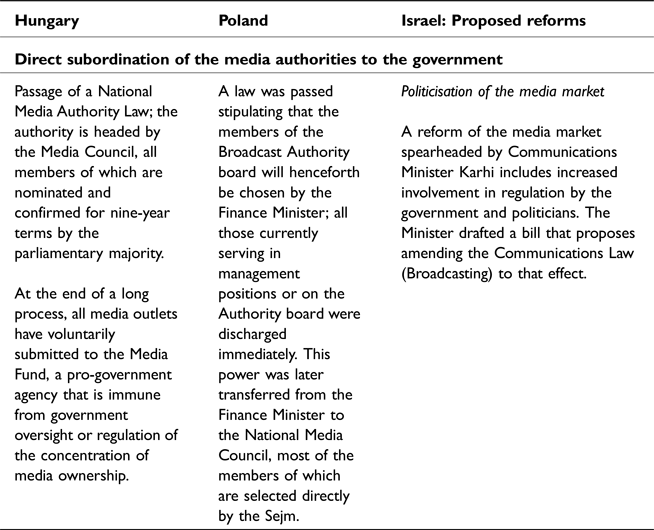
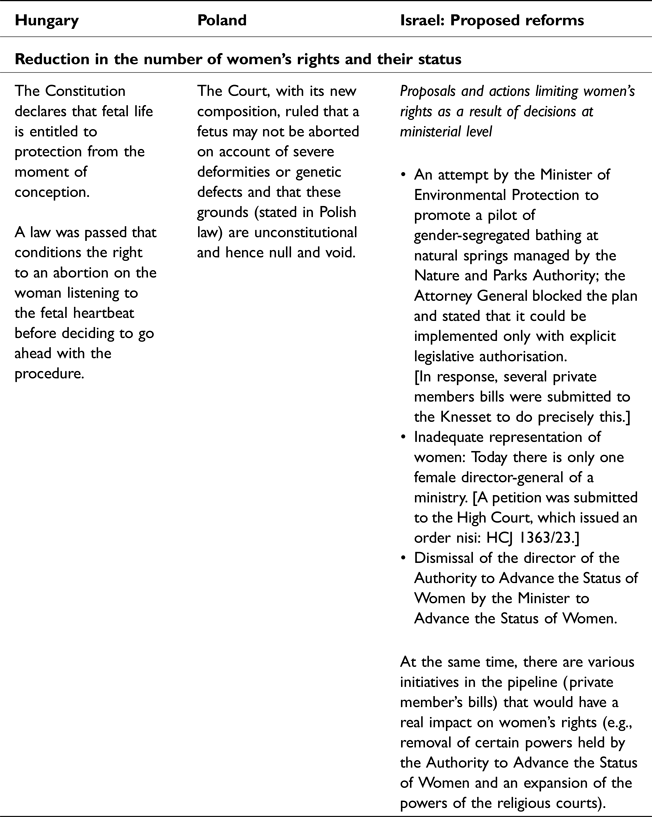
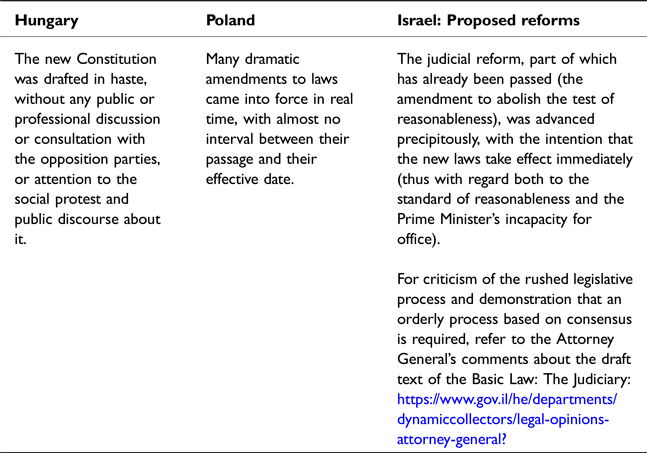
To illustrate the similarity between the processes that have gone through Poland and Hungary and the situation in Israel in recent months, the following summary tables (Tables 1 to 5)Footnote 27 refer to some of the issues only.
Curtailing the independence of the judiciary

Control of the media market

Trimming women's rights

Curtailing the independence of public servants

Hasty passage of legislation

4. Epilogue
Taking over the courts along with the abolition of their legal authority for constitutional review were important milestones in the democratic erosion of several countries. The fundamental element of any democracy is an institutional system of checks and balances on the powers of the legislature and the executive. In Israel, even before the proposed constitutional changes, these mechanisms were weak to non-existent. The Supreme Court is the central institution, with real authority to restrain the power of the majority. Therefore, any discussion of the judicial reform, especially relating to the Court, must be carried out with a broad view, cumulatively, in a manner that is not detached from the context of the ‘reform’ and its goals. Democracies no longer die in one day; they erode, slowly and sometimes out of sight, until the people wake up to a completely different democratic reality.
The judicial overhaul throws light upon the unbearable ease with which changes in the structure of the regime can be passed, without any special process or any deliberate and orderly fashion, and without any broad consensus. In order to resolve the relations and balances among the branches of government, one cannot focus exclusively on the judicial branch without, at the same time, setting boundaries for the executive and legislative branches.
The proposed reform may result in serious harm to the principle of separation of powers and the distribution of governmental powers, which is a core principle in a democratic regime. Moreover, given the importance of imposing limits on governmental power as a central tool for protecting human rights and the ‘rules of the game’ in democratic regimes, the proposed reform would allow serious harm to the protection afforded to these rights and principles: a clear and present danger to Israel's liberal democracy.
Acknowledgements
Not applicable.
Funding statement
Not applicable.
Competing interests
The author declares none.