Central-line bloodstream infection (CLABSI) has been associated with extra mortality.Reference Rosenthal 1 In limited-resource countries, CLABSI rates can be nearly 5-fold higher than those reported by developed countries such as United States, although device use is similar.Reference Rosenthal, Al-Abdely and El-Kholy 2 A disability-adjusted life year (DALY) is 1 lost year of healthy life. Knowledge of this parameter is essential to guide financial resources in prevention and control of several diseases.Reference Murray and Lopez 3 The main purpose of this study was to estimate the years of life lost (YLL) due to premature death and the years lost due to disability (YLD) in patients with CLABSI, as well as the DALY gap between CLABSI caused by multidrug-resistant (MDR) and non-MDR microorganisms detected at a university hospital in a developing country.
METHODS
From December 1, 2013, to December 31, 2014, a cohort study of adult patients with CLABSI was performed in 182-bed public university hospital with a 17-bed medical–surgical intensive care unit (ICU) and several clinical and surgical wards in Niterói, Brazil.
CLABSI cases were detected prospectively by laboratory-based surveillance and were confirmed by bedside and medical record evaluations. Blood cultures were processed with BacT/ALERT (bioMèrieux, Marcy-l'Étoile, France). Identification and susceptibility testing were conducted using the VITEK system (bioMérieux). Each case patient was followed up to 30 days from the onset of CLABSI. All CLABSI cases per patient ≥20 years old were included. Patients whose records lacked data and outpatients and inpatients with febrile neutropenia were excluded.
Demographic and clinical data (ie, gender, age, Charlson index, 7-day clinical outcome) and CLABSI characteristics (ie, Pitt bacteremia score, severity of presentation, antibiotic therapy duration, microorganism detected, and microbiological susceptibility profile) were collected. We used the Centers for Disease Control and Prevention (CDC) definition for CLABSI. 4 Death related to CLABSI was defined as a death that occurred within 7 days after CLABSI onset without any other recognized cause.
This study was approved by the Ethics Committee of the University Hospital Antônio Pedro (HUAP) (reference number 32570).
Statistical Analyses
Categorical variables were described using number, proportion, and Fisher’s exact test. For continuous variables, median, interquartile range (IQR) and Mann-Whitney U were calculated. Attributable risk (AR) was calculated for each Charlson prognostic comorbidity index strata: 0, 1–2, 3–4, and ≥5. The 95% confidence interval (CI) was calculated, and P≤.05 was considered significant.
DALY was calculated based on the 2010 Global Burden of Disease (GBD 2010) methodology.Reference Murray, Ezzati and Flaxman 5 Results were adjusted to 1,000 inpatients. Thus, the DALY (YLL+YLD) estimate was calculated using a modified WHO methodology suitable to evaluate CLABSI burden. YLL was calculated by subtracting age of CLABSI death from the reference life expectancy at that age and then multiplying this result by the deaths in that age-groupReference Murray, Ezzati and Flaxman 5 :
 $$\eqalignno{& {\rm YLL \, {\equals}\, (number}\,{\rm of}\,{\rm related}\,{\rm deaths}\,{\rm in}\,{\rm the}\,{\rm age{\minus}group}\,{\rm Y}\,{\rm by}\,{\rm sex)}\cr & \qquad\ \ {{\times}(life}\,{\rm expectancy}\,{\rm in}\,{\rm the}\,{\rm age{\minus}} {\rm group}\,{\rm Y}\,{\rm by}\,{\rm sex)} $$
YLD was calculated using CLABSI incidence multiplied by estimated disease duration and disability weights for CLABSI sequelae. CLABSI sequela was stratified according to severity in patients (1) without sepsis, (2) with sepsis, or (3) with severe sepsis and/or septic shock and/or death. We considered these sequelae as mild, moderate, or severe acute infectious events and applied the disability weights 0.005, 0.053, and 0.21, respectively, according to the GBD 2010.Reference Salomon, Vos and Hogan 6 The incidence of each CLABSI sequela was calculated by dividing the number of cases in a specific age group and sex by the number of patients admitted to the HUAP in the same age group and sex. The number of days lost due to disability was calculated as the time from the date of positive blood culture or the date antibiotic therapy began (whichever occurred first) to the last day of antibiotic therapy. These values were annualized (ie, days with disability divided by 365). The YLD was adjusted by the discount rate (0.03), according to the GBD 2010 recommendation. The global YLD arose from the sum of the YLD for each of the following sequelae: YLD=(CLABSI without sepsis incidence in the age-group Y by sex×0.005×0.03×number of days annualized)+(CLABSI with sepsis incidence in the age group Y by sex×0.053×0.03×number of days annualized)+(CLABSI with severe sepsis or septic shock or death incidence in the age group Y by sex×0.21×0.03×number of days annualized).
DALY gap (ie, the difference between age-adjusted DALYs per 1,000 infections between 2 different categories of infection) was calculated for MDR and non-MDR microorganisms.Reference Marlow, Maciel and Sales 7
Data were stored and analyzed in Excel software (Microsoft, Redmond, WA, 2016) and Epi Info 7 version 7.1.4 software (Centers for Disease Control and Prevention, Atlanta, GA, 2014).
RESULTS
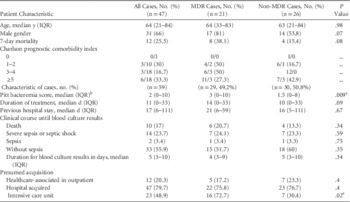
Overall, 59 CLABSI cases (47 patients among 5,820 admissions) were included to describe the DALY. CLABSI incidence was 10.14 per 1,000 inpatients (17.03 per 1,000 among men and 5.47 per 1,000 among women). The 7-day death rate was 25.5%. There was no significant difference in AR for 7-day death according to the Charlson index strata: AR (1–2), 12.5% (95% CI, −10 to −35; P=.72); AR (3–4), 6.2% (95% CI, −5.6 to −18.1; P=.84); AR (≥5), 7.7% (95% CI, −6.7 to −22; P=.68). Other characteristics of patients and cases are listed in Table 1.
Characteristics of Patients and Episodes of Central-Line–Associated Bloodstream Infections Stratified by Microorganism Antibiotic Susceptibility Profile

NOTE. MDR, multidrug-resistant pathogen; IQR, interquartile range.
a P≤.05.
b Pitt bacteremia score was used as the severity index.
Among 67 pathogens, Staphylococcus aureus (34%) was the most frequently detected. In total, 29 (49.2%) CLABSI cases were caused by MDR agents; methicillin-resistant S. aureus (MRSA) was the most common (38%). There was no significant difference in 7-day death when infections caused by MDR and non-MDR agents were compared. The former were significantly more severe and frequent in the ICU (Table 1).
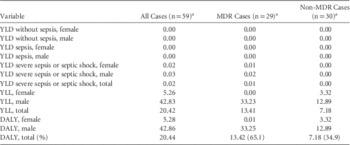
During the study period, the overall rate of CLABSI DALY in patients admitted to HUAP was 20.44 DALYs per 1,000 inpatients. YLL contributed 99.9% of the DALYs. The DALY in men was 7.7 times higher than in women (Table 2). The DALY gap between infections caused by MDR and non-MDR pathogens was 6.24 DALYs per 1,000 inpatients.
Central-Line–Associated Bloodstream Infection Years Lived With Disability (YLDs), Years of Life Lost (YLLs) and Disability-Adjusted Life Years (DALYs) Stratified by Antibiotic Susceptibility Profile

NOTE. MDR, multidrug-resistant pathogen.
a Calculated as cases per 1,000 inpatients.
DISCUSSION
CLABSI has been associated with increased mortalityReference Rosenthal 1 ; thus, an improved understanding of CLABSI burden is extremely important. In the present study, CLABSI DALY was high, showing that this infection can be an important cause of health loss in Brazilian hospitals. YLL contributed almost the entire DALY estimated value, which can be explained by elevated CLABSI lethality. Most DALY were attributed to men. In fact, female gender is described as a protective factor for CLABSI occurrence.Reference Cohen, Choi, Hyman, Furuya, Neidell and Larson 8
The DALY gap between infections caused by MDR compared to non-MDR microorganisms indicated (1) the impact in lost years of healthy life assigned to MDR, (2) what is feasible once antibiotic-resistant infections increase mortality, (3) the need for prolonged antibiotic therapy and extended hospital stays. 9
Our study has several limitations. It was performed in a single hospital population with a small sample size. Case mix was not addressed; however, the study was conducted in a small hospital with a single ICU, which underscores its importance. Further studies including more hospitals are necessary to reproduce and confirm the data and conclusions presented here. CLABSI DALYs were not compared between patient groups with and without CLABSI nor were groups matched for comorbidities. However, the impact of these limitations was reduced once a very narrow concept for death related to CLABSI and disability duration were applied. In addition, death risk was not attributable to any increment in Charlson prognostic comorbidity index.
In this study, we used a modified WHO methodology to calculate CLABSI DALY. The results indicate that CLABSI has an important impact on health loss, especially those caused by MDR microorganisms. The rates of CLABSI and mortality have been successfully reduced in limited-resource countries by bundles of intervention, education programs, outcome and process surveillance, feedback on CLABSI rates, and performance feedback.Reference Rosenthal, Maki and Rodrigues 10 DALY CLABSI estimation can be useful to guide and measure the impact of the prevention actions.
ACKNOWLEDGMENTS
Financial support: No financial support was provided relevant to this article.
Potential conflicts of interest: All authors report no conflicts of interest relevant to this article.