1. Introduction
What is the relationship between individuals’ religiosity and their entrepreneurial activity? While this and related questions have long been pondered, perhaps most famously in The Protestant Ethic and the Spirit of Capitalism (Weber et al., Reference Weber, Baehr and Wells2002 [1905]), it is the subject of only a few modern empirical studies. For example, based on individual-level data from India, Audretsch et al. (Reference Audretsch, Boente and Tamvada2007) find that Islam and Christianity tend to encourage entrepreneurship while Hinduism tends to discourage it. On the other hand, based on a panel of individuals from New Zealand, Carswell and Rolland (Reference Carswell and Rolland2007) find that non-Christian groups tend to be more entrepreneurial than Christians.
However, existing studies have not explicitly considered Baumol's (Reference Baumol1990) thesis concerning productive versus unproductive entrepreneurial activity. Regardless of whether they are conceived of as risk-bearers (Knight, Reference Knight1921), exceedingly creative individuals (Schumpeter, Reference Schumpeter1934), or those alert to hitherto unnoticed profit opportunities (Kirzner, Reference Kirzner1973), entrepreneurs face decisions about whether to pursue wealth-generating activities or, alternatively, to engage in rent-seeking or outright theft. Their choices will largely be a function of the institutions – the ‘rules of the game’ (North, Reference North1990, p. 3) – within which they make those decisions. North (Reference North1990) contends both formal institutions – codified rules – and informal, cultural institutions guide such social interaction. Here we focus primarily on the latter institutional constraints, of which religion represents a single subset.
Schumpeter's (1934) theory of the entrepreneur as responsible for ‘the carrying out of new combinations’ (p. 68) prompted William Baumol to reexamine the role of the entrepreneur. Baumol (Reference Baumol1990, pp. 897–898) observes the following:
If entrepreneurs are defined, simply, to be persons who are ingenious and creative in finding ways that add to their own wealth, power, and prestige, then is it not to be expected that not all of them will be overly concerned with whether an activity that achieves these goals adds much or little to the social product or, for that matter, even whether it is an actual impediment to production?
According to Baumol (Reference Baumol1990), whether entrepreneurs channel their resources into relatively productive or unproductive activities depends ‘heavily on the rules of the game – the reward structure in the economy’ (p. 894):
The central hypothesis here is that the set of rules and not the supply of entrepreneurs [. . .] that undergoes significant changes from one period to another and helps to dictate the ultimate effect on the economy via the allocation of entrepreneurial resources. [. . .] I shall seek to focus attention on the allocation of the changing class of entrepreneurs rather than its magnitude or makeup.
Our hypothesis is along Baumol's lines and in regard to religious institutions. Specifically, we examine data on US states and ask whether there is evidence that religious institutions affect the allocation of the supply of entrepreneurs across productive versus unproductive activities. We conceive of productive entrepreneurs are those whose activities expand the size of the economic pie and unproductive entrepreneurs are those who seek to redistribute it (Baumol, Reference Baumol1990; also Baumol et al., Reference Baumol, Litan and Schramm2007).
There are numerous ways in which religious organizations and belief systems can shape the absolute and relative incentives to undertake productive and unproductive activities. The relative incentives are the focus of Baumol (Reference Baumol1990). For example, if a religion stigmatizes the accumulation of wealth and elevates the priority of the poor, then this may legitimize the redistributive use of political processes relative to innovative market activity. Alternatively, a religion may foster something along the lines of a ‘protestant ethic’ (Weber et al., Reference Weber, Baehr and Wells2002 [1905]) where individual industry is evidence of one's salvation. In that case, productive activities would be inherently more rewarding. A religion may also stress certain values or encourage the accumulation of human capital types that are relatively more effective in either productive or unproductive entrepreneurship.Footnote 1
Religion can also influence the rules of the game in ways that affect the incentives to be entrepreneurial generally. For example, if a religion makes the present value of activity in this world seem small relative to that of the eternal hereafter, then this may dampen an individual's incentives to undertake any type of entrepreneurial activity. Furthermore, religion can create costly obligations on time and other resources for potential entrepreneurs. Time spent in church is time that, by definition, is not spent on entrepreneurial activity; so is time spent in prayer. Income that flows into church coffers is income that does not flow into business ventures. Furthermore, given religious obligations on time and other resources, whether individuals substitute away relatively more from productive or unproductive activities is again a function of the incentives embodied in the religion.
Religious institutions and secular institutions can also play complementary roles. For example, if there is not strong protection of property rights and opportunities exist for expropriation through political processes, then this may allow certain religious values (e.g., concerns for the poor) to find easier expression through public policies. Alternatively, if property rights are well defined and enforced, then it may be other religious values (e.g., thriftiness; industry) that find more effective expression. Depending on which religious values are predominant, secular institutions may have different interactions with productive versus unproductive entrepreneurship. Alternatively, if religion affects entrepreneurship purely through its opportunity costs then we may find that its interactions with secular institutions are similar across all types of entrepreneurial behavior.
In this paper, we take Baumol seriously and explore the relationship between informal institutions, proxied for by religion variables, and entrepreneurship – both productive and unproductive – in data from the cross-section of contiguous US states. There are only a handful of studies of religion and entrepreneurship based on US data to begin with. Dodd and Gotsis (Reference Dodd and Gotsis2007) examine survey data to explore whether individuals’ religious concerns temper their motive to maximize profits. Radmard (Reference Radmard2012) uses county-level data to analyze whether the percent of a population belonging to a religious congregation correlates with self-employment and small firm growth.Footnote 2 None of these studies make a distinction between productive and unproductive entrepreneurship. We do so using productive and unproductive entrepreneurship scores based on Sobel's (Reference Sobel2008) methodology and updated using data from the 2002 to 2008 period.
In measuring ‘religion’, we attempt to break this institutional catch-all down into several of its formal and informal elements. We use data not only on religious affiliation and church attendance, but also on the importance that individuals place on religion in general, their stated belief in God, and the frequency with which they pray. Furthermore, we explicitly account for the percent of individuals who self-report as atheist and/or agnostic. These are individuals who, more than simply not attaching themselves to a particular religious sect, explicitly express a general lack of belief, or even disbelief. Agnosticism and/or atheism may be associated with more self-interested behavior; they may also make entrepreneurial activities less costly in lieu of religious obligations.
We organize the rest of the paper as follows. Section 2 contains a review of some related literature on religion and economic outcomes. We describe our data in Section 3. Results of our regression analysis are to be found in Section 4 and the paper is wrapped up with concluding discussion in Section 5.
2. Related studies
As discussed above, the relationship between religion and entrepreneurship, specifically, has not been the focus of very many recent studies. However, several recent studies examine, more generally, the relationships between religion, institutions, and economic growth.
Robert Barro and Rachel McCleary are at the forefront of this literature. Using cross-country data, Barro and McCleary (Reference Barro and McCleary2003) find that religious beliefs – in particular, a belief in the existence of heaven and hell – are associated with higher rates of per capita income growth. However, they also find that church attendance negatively affects growth. In the authors’ own words, ‘growth depends on the extent of believing relative to belonging’ (p. 760). The data that we use in this paper allow us to evaluate Barro and McCleary's conclusion in regard to entrepreneurial activity in the United States, estimating the effects of belief and belonging separately.
Complementing their earlier paper, McCleary and Barro (Reference McCleary and Barro2006) investigate the effect of both economic development and institutions on religiosity. They conclude that the level of economic development is indeed a determinant of religiosity. Also, religiosity tends to fall with the extent of government regulation of religious activities. Their findings suggest that, in our analysis of religion's influence on entrepreneurship, controlling for income levels will be desirable. Also, even though the formal regulation of religion across US states is minimal due to the first amendment of the federal constitution, we will control for a measure of institutional quality.
There has been relatively little empirical analysis of the channels through which religiosity affects economic growth (e.g., Audretsch et al., Reference Audretsch, Boente and Tamvada2007; Carswell and Rolland, Reference Carswell and Rolland2007). Here, we explore one potential channel through which religiosity may affect growth: entrepreneurship. Numerous studies document a positive relationship between entrepreneurial activity and economic growth (e.g., Audretsch et al., Reference Audretsch, Keilbach and Lehman2006; Baumol, Reference Baumol2002; Baumol et al., Reference Baumol, Litan and Schramm2007; Zacharakis et al., Reference Zacharakis, Bygrave and Shepherd2000). Furthermore, Audretsch et al. (Reference Audretsch, Boente and Tamvada2007) consider the influence of religion on individual decisions to undertake entrepreneurial activity (measured by self-employment) in a cross-country study. They find that certain religions – e.g., Islam and Christianity – tend to encourage entrepreneurship, while others – e.g., Hinduism – discourage it. In a similar study, Carswell and Rolland (Reference Carswell and Rolland2007) find (for a New Zealand panel) that non-Christian groups tend to be more entrepreneurial than Christians.
The main contribution of this paper is to extend the definition of entrepreneurship across a platform of both productive and unproductive activity and examine religion in this context. Baumol (Reference Baumol1990) offered the hypothesis that different institutions, depending on the incentives they embody, largely determine whether entrepreneurs will focus their efforts on productive or unproductive activities. Where institutions create relatively large rewards to rent-seeking behavior, entrepreneurs will focus their efforts primarily on unproductive activities. On the other hand, where institutions primarily support wealth-generating activity, productive entrepreneurs will flourish. Sobel (Reference Sobel2008), Hall and Sobel (Reference Hall and Sobel2008), and Wiseman and Young (Reference Wiseman and Youngforthcoming) provide evidence supporting Baumol's hypothesis using US data. To our knowledge, we are the first to evaluate the Baumol hypothesis in regard to informal, religious institutions in the United States.
3. Data on belief, belonging, and entrepreneurship
We begin by presenting some very basic looks at the US state-level data on religion and entrepreneurship that we use in this study. Religion data are collected from three sources: (1) the Pew Forum's 2007 US Religious Landscape Survey Footnote 3; (2) the Gallup Poll's 2004 and 2008 State of the States surveysFootnote 4; and (3) the U.S. Census Bureau's 2000 and 2010 U.S. Religion Census: Religious Congregations & Membership Study.Footnote 5 The Pew belief measures capture the importance of religion, frequency of prayer, and belief in God; the Pew Forum also provides data on the percent of a state's population that attend religious services weekly. The Gallup affiliation data include the percent of states’ populations that are protestant, catholic, or atheist/agnostic. The U.S. Census Bureau reports a measure of each state's Christian adherents as a percent of the total state population.
Entrepreneurship scores for each of the 48 contiguous US states are based on Sobel's (Reference Sobel2008) methodology.Footnote 6 Sobel uses data from 1995 to 2002 and we update his scores using data from 2002 to 2008. The scores are then based on averages of data that are generally centered on the year 2000. They represent average levels of entrepreneurial activity in a state over a 14-year period.
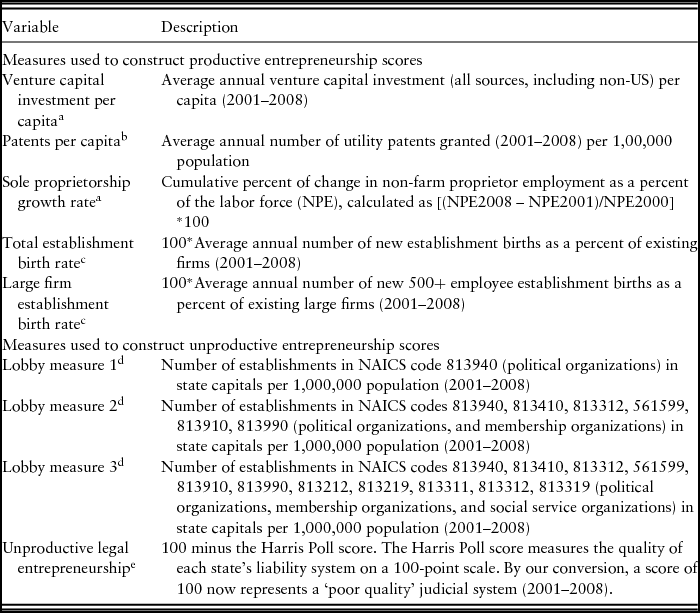
Productive entrepreneurship scores are based on per capita venture capital investments, patents per capita, the self-proprietorship (self-employment) growth rate, establishment birth rates, and large (500 employees or more) establishment birth rates. Numerous studies focus on self-employment alone as a proxy for entrepreneurship.Footnote 7 However, Hurst and Pugsley (2010) use a variety of US survey evidence to demonstrate that the self-employed do not fit common concepts of the entrepreneur. Specifically, they are not particularly innovative nor do their businesses tend to exhibit high rates of growth.Footnote 8 Self-employment may often also be indicative of poor economic conditions where the opportunity cost (in the form of available wage employment) is not high (Rissman, Reference Rissman2003). By focusing on multiple indicators of profit-seeking and innovative activity we hope to capture a broad range of productive entrepreneurial activity. Also, since we look at averages over several years, we hopefully avoid short-run countercyclical self-employment fluctuations that are not indicative of entrepreneurism.
Unproductive entrepreneurship scores incorporate three measures of per capita political and lobbying establishments in a state's capital. These are based on the number of establishments in (i) SIC codes 8650 (political organizations), (ii) SIC codes 8650 and 8690 (membership organizations), and (iii) SIC codes 8650, 8690, and 8390 (social services organizations) (Sobel and Garret, Reference Sobel and Garret2002). The unproductive entrepreneurship scores are also based on (100 minus) an index of liability system quality. The latter is the Harris Poll published by the Institute for Legal Reform and the U.S. Chamber of Commerce in its State Liability Systems Ranking. The Harris Poll is an index of judicial quality on a 100-point scale. (Hence, we take 100 minus this value.) States that have relatively low Harris Poll scores tend to have high rates of legal fraud and abuse in the areas of, e.g., workers compensation, class-action, and medical malpractice. All of these measures attempt to gauge the level of resources in a state that are being expended in legal and political processes rather than in productive market activities.
Table 1 details the underlying data for the entrepreneurship scores. For both productive and unproductive scores, the constituent state-level variables are ranked from 1 to 48, from smallest to largest. A state's score is then the average of rankings across the constituent variables.Footnote 9 This index classification system (a Borda count) normalizes all of the constituent variables and weights all of them equally. Note that, for example, in regard to the per capita establishment variables (i), (ii), and (iii) in the unproductive entrepreneurship score, utilizing a Borda count does not double or triple count constituent SIC industry variables. Rather, it takes an agnostic stance on whether (i), (ii), or (iii) is a better measure, equally weighting each state's rank for each measure in the ultimate unproductive entrepreneurship score.
Data description and sources for variables used in the construction of entrepreneurship scores

Notes: Productive and unproductive entrepreneurial activity scores for our analysis were constructed by first calculating the measures according to Sobel (Reference Sobel2008) methods for the period 2001–2008. We then averaged our scores with Sobel's (Reference Sobel2008) scores. SIC codes used in Sobel (Reference Sobel2008) for the construction of lobby measures have since been updated to the NAICS system. The NAICS codes used here have been mapped to the SIC codes used by Sobel with an index provided at www.naics.com.
aU.S. Department of Commerce, Bureau of Economic Analysis, State and Local Area Data.
bU.S. Patent and Trademark Office, Utility Patent Counts by Country/State and Year.
cOffice of Advocacy, U.S. Small Business Administration, U.S. Census Bureau, Statistics of U.S. Business.
dSobel (2008) and County Business Patterns, U.S. Census Bureau.
eInstitute for Legal Reform and U.S. Chamber of Commerce, State Liability System Ranking.
For some initial perspective on the relationships between our dependent and independent variables of interest, we turn to Figures 1 and 2. These scatters are, of course, indicative of simple bivariate correlations and cannot be taken too seriously. However, we do here discuss some plausible reasons that they manifest. This provides some intuitive motivation before moving on to more formal econometric analysis where the question of these correlations’ robustness will be at the fore.
Relationships between entrepreneurship scores and worship service attendance.
Relationships between entrepreneurship scores and belief in God.
Figure 1 presents scatter plots of worship service attendance rates against the productive and unproductive entrepreneurship scores.Footnote 10 Productive entrepreneurship scores are negatively correlated with worship service attendance. (The correlation is −0.385 and is significant at better than the 5 percent level.) Unproductive entrepreneurship scores are correlated positively with attendance. (The correlation is 0.282 and is significant at the 10 percent level.) Barro and McCleary's (2003) cross-country analysis found that church attendance was associated with less economic growth and conjectured: ‘We think that this negative effect reflects the time and resources used by the religion sector as well as adverse effects from organized religion on economic regulation – for example, restrictions on markets for credit and insurance’ (p. 3). The productive entrepreneurship correlation is consistent with an allocation of scarce resources toward religious activities and away from entrepreneurial ones. Regarding the significant positive correlation between attendance and unproductive entrepreneurship, religion may promote decreases in institutional quality generally, leading to greater opportunities for rent-seeking. It will be imperative in our more formal analysis, then, to control for general institutional quality. Another possibility, inconsistent with Barro and McCleary's conjecture, is that religion may lead individuals to impose costs on others (via regulations on market activity) for the sake of their own (spiritual) gains.Footnote 11
It is interesting to note that attendance's correlation with productive entrepreneurship is both statistically and economically more significant than its correlation with unproductive entrepreneurship. Possibly relevant to this is the fact that a story of ‘the time and resources used by the religion sector’ is apparently relevant to unproductive as well as productive entrepreneurial activities. (More time in church is less time available for either type of activity.) A positive effect of religion on unproductive entrepreneurship associated with institutional quality might be offset (at least in part) by the straightforward opportunity costs of being religious.
Worship attendance is a measure of religious belonging; what about religious beliefs? Figure 2 plots belief in God measures against the entrepreneurship scores. The results are similar to those using church attendance. Productive entrepreneurship scores correlate negatively with belief in God. (The correlation is −0.484, and significant at better than the 1 percent level.) The correlation between unproductive entrepreneurship and belief is positive (0.261) but not statistically significant (p-value = 0.122).Footnote 12 Unlike McCleary and Barro (Reference McCleary and Barro2006) who report different effects on economic outcomes associated with religious belief versus belonging measures, our first cursory look at the data suggests no such distinction when it comes to productive and unproductive entrepreneurship.
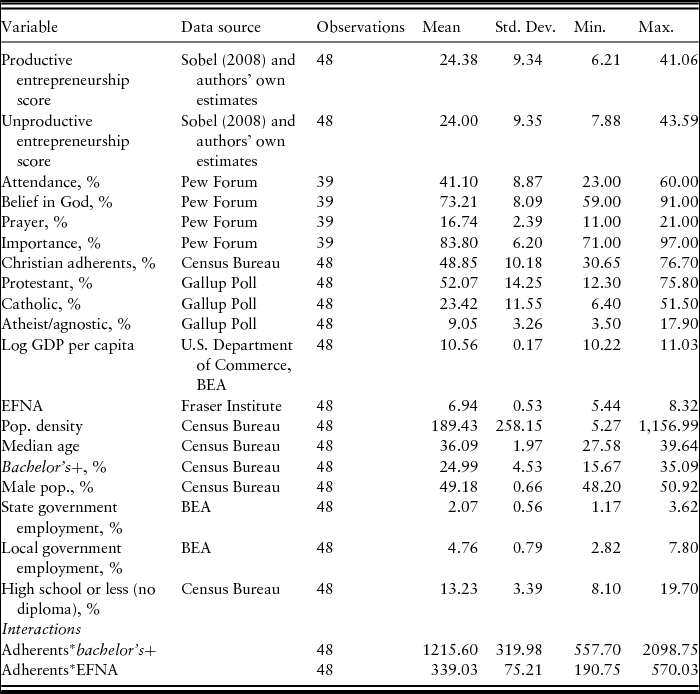
Before moving onto our regression analysis, we mention the additional controls that we will incorporate in that analysis. Importantly, we include a state's (average of 2000 and 2005) Economic Freedom of North America (EFNA) score from the Fraser Institute (Karabegović et al., 2006). The EFNA scores rank US states on a scale of 1 to 10, separately, for three areas of economic freedom: size of government, takings and discriminatory taxes, and labor market freedom. A higher score indicates more freedom (i.e., respectively, smaller government, fewer and lower taxes, and less restricted labor markets). The comprehensive EFNA score is the average score across constituent areas. Another important control variable is a state's (log) GDP per capita. (We again use the average of 2000 and 2005 values.) This is a proxy for a state's relative level of economic development. As suggested by McCleary and Barro (Reference McCleary and Barro2006), the level of economic development may be an important determinant of religiosity. Omitting it from entrepreneurship regressions could then lead to biased coefficient estimates on religiosity. As additional controls we include, using data from the U.S. Census Bureau, a state's population density and median citizen's age; also the percent of its population with a bachelor's degree worth or more of education, and the percent of its population that is male. Summary statistics and sources for all variables used can be found in Table 2.
Summary statistics
4. Results
We run regressions of each entrepreneurial score (productive, unproductive, and net) on (1) a religion variable of interest and (2) a standard set of controls: (log) GDP per capita, EFNA, population density, median age, percent of the population with a bachelor's degree or more, and the percent of the population that is male. The one-religion-variable-at-a-time approach is motivated by the fact that we are somewhat limited in terms of degrees of freedom (based on only n = 48) and, also, there is substantial collinearity among the religion variables.
Our religion variables are broken down into two groupings of four. All variables are in terms of percentages of a state's population. First, there are religiosity measures: regular attendance of religious services, belief in God with absolute certainty, prayer at least once a week, and importance of religion described as ‘very’. Second, there are affiliation variables: total (Christian) adherents, protestant, catholic, and atheist/agnostic. The last of these variables actually expresses the percent of the population that decidedly categorizes themselves as having no religious adherence. Presumably, such individuals do not pray or hold religion of any notable importance in their lives; they rank low in terms of both belief and belonging.
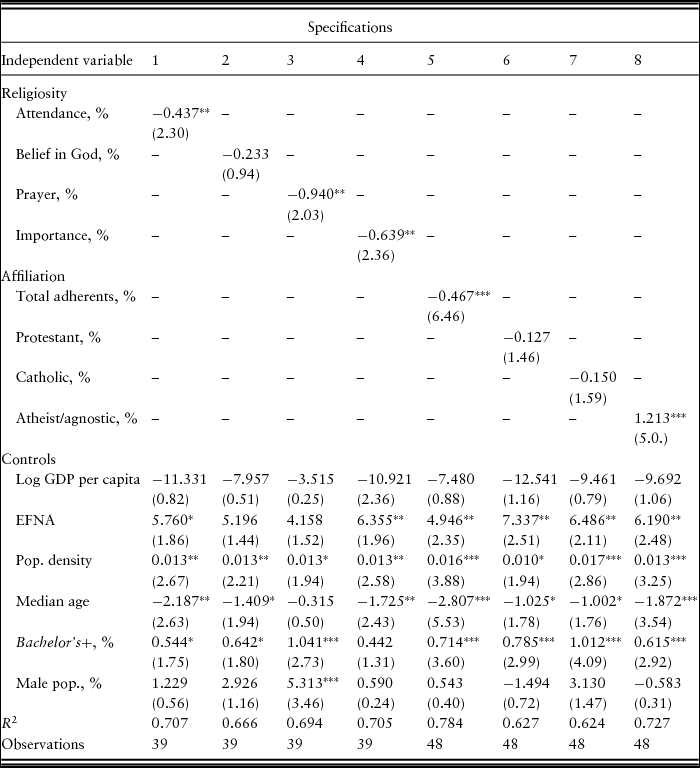
Tables 3 and 4 contain results for productive and unproductive entrepreneurship scores, respectively. Each table has eight columns of results; in a given table, each individual column is associated with a specific religion variable. In the productive entrepreneurship score regressions (Table 3), the coefficient estimates on the first seven religion variables are negative, and four of those estimates are statistically significant at the 5 percent level or better (attendance, prayer, importance, and total adherents). In terms of belief versus belonging, both seem to be quantitatively meaningful. If a state's attendance increases by a sample standard deviation (8.87), this increase is associated with about a four-point decrease in the state's productive entrepreneurship score. The effect is slightly larger for total adherents where a sample standard deviation increase (10.18) is associated with an almost a five-point decrease in a state's productive entrepreneurship score. While a one sample standard deviation increase in belonging-type prayer variable (2.39) is associated with just over a two-point decrease in a state's productive entrepreneurship score, the effect is larger for importance. A sample standard deviation increase (6.20) is associated with about a four-point decrease in a state's productive entrepreneurship score.
Regressions of productive entrepreneurship scores
Notes: Absolute values of t-statistics are in parentheses. *, **, and *** denote significance at the 10 percent, 5 percent, and 1 percent levels, respectively. Constant included, but not reported.
Interestingly, the percent of the population that is atheist/agnostic is positively and significantly related to a state's productive entrepreneurship score. The estimated effect of changes in the atheist/agnostic share of the population is (in absolute value) comparable to that of attendance and importance. A sample standard deviation increase in this atheist/agnostic (3.26) is associated with about a four-point increase in a state's productive entrepreneurship score. Because the score is a Borda count, another approximate interpretation of the size of such an effect is that a state would increase its rank among other states by four spots.
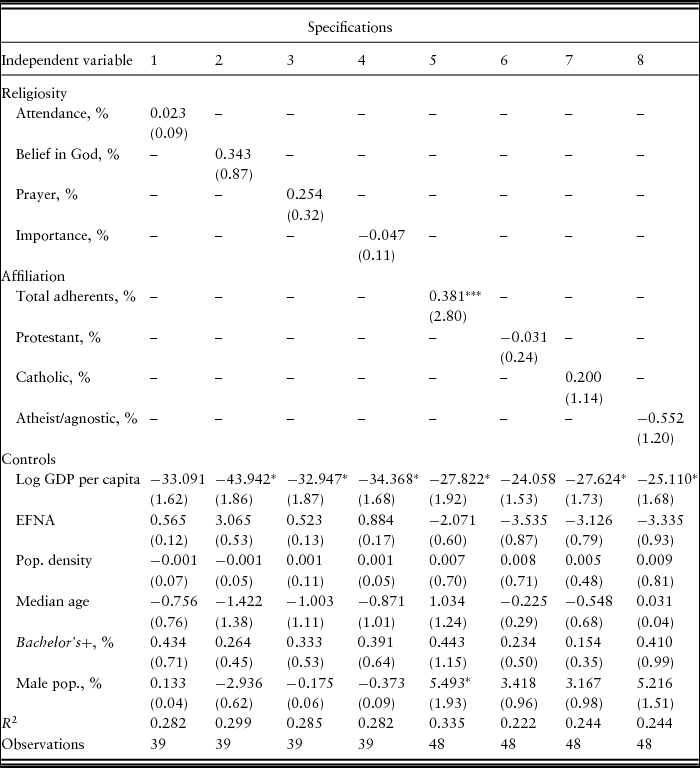
Table 4 reports the results based on using unproductive entrepreneurship scores as the dependent variable. While measures of both belief and belonging appear to be associated with decreases in productive entrepreneurship, this could be because religiosity imposes opportunity costs on time and other resources that could be employed in productive entrepreneurial endeavors; however, it could also be because of increases in the relative net benefits to rent-seeking. In our data, the evidence for the latter story is somewhat weak. Total adherents is positively related to states’ unproductive entrepreneurship scores, and the effect is statistically significant at the one percent level. The effect is economically not negligible. A sample standard deviation increase in total adherents is associated with just under a four-point increase in a state's unproductive entrepreneurship score. However, none of the other religion variables, including atheist/agnostic, enter significantly into a regression of state unproductive entrepreneurship scores.
Regressions of unproductive entrepreneurship scores
Notes: Absolute values of t-statistics are in parentheses. * and *** denote significance at the 10 percent and 1 percent levels, respectively. Constant included, but not reported.
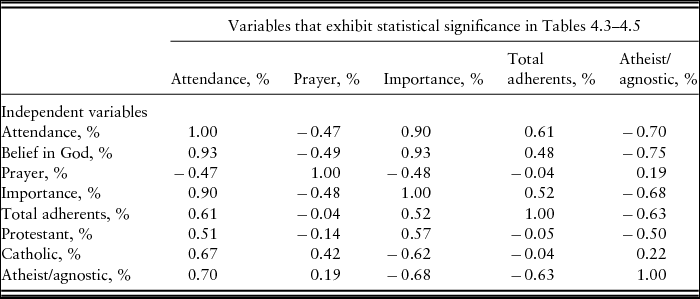
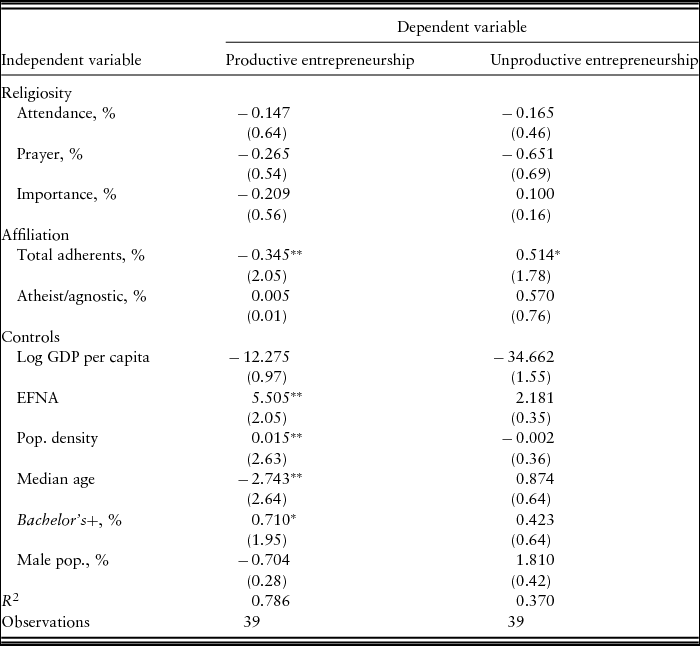
One could argue that, taken individually, significant results reported in Tables 3 and 4 are driven by collinearity with the omitted religion variables in each regression. Table 5 provides a correlation matrix for the belief and belonging variables. In Table 6, we provide regression results for each of our dependent variables that include all religion variables that exhibit statistical significance in the results reported in either Table 3 or 4. Even only that subset of religion variables together is pushing the degrees of freedom available with the US state-level data. Also, introducing such collinear variables is likely to inflate standard errors. However, it is the next logical step as a robustness check and we are interested to see whether or not any of the statistically significant religion variable effects hold up.
Correlation matrix of religion variables
Regressions of productive and unproductive entrepreneurship scores including all previously significant religion variables
Notes: Absolute values of t-statistics are in parentheses. * and ** denote significance at the 10 percent and 5 percent levels, respectively. Constant included, but not reported.
In each specification reported in Table 6, the effect of total adherents is statistically significant and of the same sign as reported in previous tables. A sample standard deviation increase in total adherents is associated with an approximate three-point decrease in a state's productive entrepreneurship score (significant at the five percent level or better); and a five-point increase in a state's unproductive entrepreneurship score (significant at the ten percent level or above). However, none of the other religion variables, including atheist/agnostic, enter significantly into any of the regressions reported in Table 6.
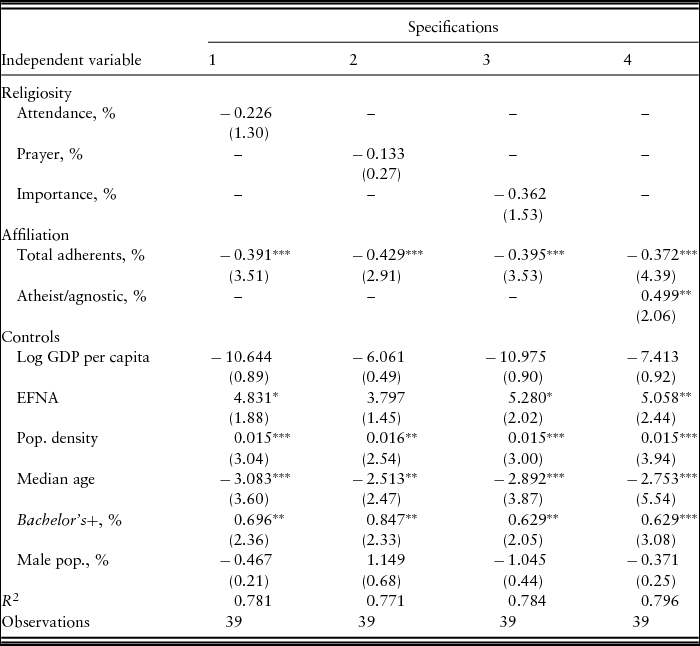
Again, due to collinearity and relatively few degrees of freedom, we do not interpret this as a reason to dismiss the previous significant results, in particular those associated with productive entrepreneurship (Table 3). Rather, what we take from Table 6 is particular confidence that general religious belonging, as measured by total adherents, is negatively related to productive entrepreneurship; positively related to unproductive entrepreneurship. However, as a check on whether other significant results from Table 3 (for productive entrepreneurship) should be dismissed as artifacts of total adherents’ omission, Table 7 reports productive entrepreneurship regressions that include, separately, attendance, prayer, importance, and atheist/agnostic; while total adherents is included (along with the other baseline controls) in all regressions. As it turns out, with one exception all religious variables are rendered insignificant when total adherents is included. The exception is atheist/agnostic (column 4 of Table 7) whose estimated effect is positive and significant at the five percent level. However, the point estimate is less than half the size of that reported in Table 3. A sample standard deviation increase (3.26) in the percent of individuals reporting themselves as atheist or agnostic is associated with about a 1.6-point increase in a state's productive entrepreneurship score.
Regressions of productive entrepreneurship scores, controlling for total adherents
Notes: Absolute values of t-statistics are in parentheses. *, **, and *** denote significance at the 10 percent, 5 percent, and 1 percent levels, respectively. Constant included, but not reported.
Thus far we have focused on the relative effects of religious institutions on productive versus unproductive entrepreneurial activities, treating other variables merely as controls. However, some of those other variables may interact with religion to determine those relative effects. We consider two variables in particular: our measures of institutional quality (EFNA) and human capital accumulation (bachelor’s+). Activities that are associated with, or motivated by, an individual's religion may be constrained by the (non-religious) institutional environment. For example, religious concern for the poor may manifest itself in private, charitable activities under a strong property rights regime. The same concern for the poor may instead lead to political lobbying for redistribution if the definition and enforcement of property rights is weak. Likewise, religious individuals may act very differently depending on whether they have more or less education. Education can change the opportunity costs associated with pursuing religious activities, as well as an individual's perception of what kinds of activities are consistent with their religion. More straightforwardly, if religion suggests to an individual certain types of entrepreneurial activities then their productivity in pursuing those activities can be enhanced by a greater human capital stock.
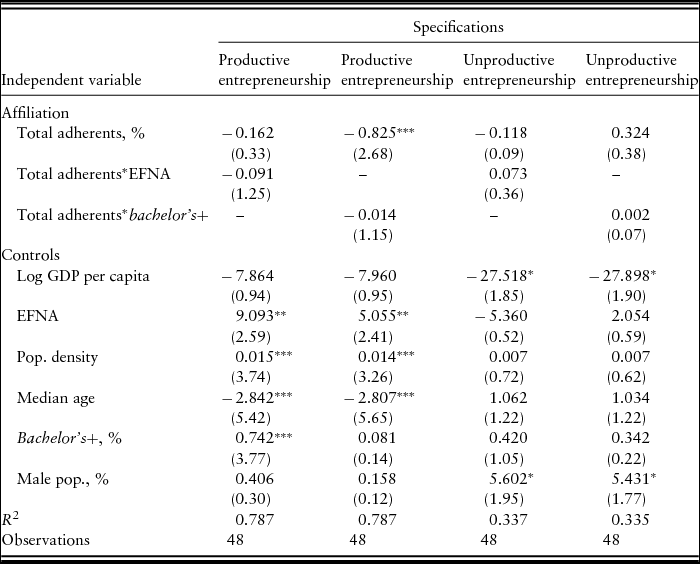
Table 8 reports the results of regressions that include EFNA and bachelor’s+ interaction terms with total adherents.Footnote 13 We report these interactions in both productive and unproductive entrepreneurship regressions. We find no statistical significance for either of the interaction terms, however.Footnote 14 The inclusion of either interaction leads to the coefficient on total adherents by itself being statistically insignificant in an unproductive entrepreneurship regression. The same is true for including an EFNA interaction in a productive entrepreneurship regression. However, the (by itself) total adherents negative effect on productive entrepreneurship is robust to including the interaction with bachelor+ (column 2). We can only take the sign on the (insignificant) interaction term from that regression as suggestive, a starting point for conjecture. The sign is negative, implying that the negative effect of religious belonging on productive entrepreneurship is more pronounced when a state's population has on average higher levels of human capital. This would be consistent with religion fostering a concern for the poor that is perceived to be best served through redistributive policies; more educated individuals are more convinced of this view and/or more productive at pursuing it through political means. This is just one among many possible interpretations and, again, mere conjecture. It is by choice, however, one that is also consistent with the estimated positive (though insignificant) effects of total adherents and its interaction with bachelor’s+ in the unproductive entrepreneurship regression (column 4). Still, conjectures are just that and, ultimately, our takeaway from Table 8 is that there is little evidence that the effects of religious institutions on entrepreneurial activity (productive and unproductive) are dependent on the more general institutional environment or human capital levels.Footnote 15
Regressions of productive and unproductive entrepreneurship scores, controlling for total adherents and interactions
Notes: Absolute values of t-statistics are in parentheses. *, **, and *** denote significance at the 10 percent, 5 percent, and 1 percent levels, respectively. Constant included, but not reported.
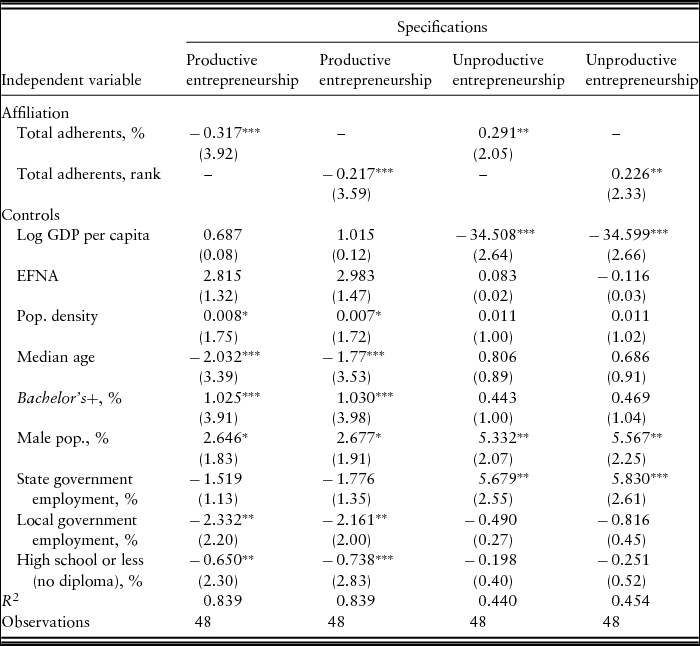
The final results that we report in this section check the robustness of the total adherents effects on entrepreneurial activity to (1) the inclusion of several ‘robust correlates’ with US economic activity that are reported by Higgins et al. (Reference Higgins, Young and Levy2010) and (2) the redefinition of the total adherents variable as a Borda count rank analogous to those of the entrepreneurship scores. Higgins et al. (Reference Higgins, Young and Levy2010) perform a county-level, extreme bounds analysis (EBA) (Leamer, Reference Leamer1983, Reference Leamer1985) of potential determinants of economic growth. Log GDP per capita and bachelor+ were among those robust correlates and already in our control set; we now additionally include state government employment and local government employment as percentages of state populations, and also the percent of a state's population with a high school diploma or less (no diploma).Footnote 16 The conversion of total adherents into a Borda count score (total adherent rank) is a check on whether expressing dependent and independent variables of interest in similar terms makes a difference.
Table 9 reports estimates for both total adherents and total adherents rank, including the benchmark and additional control. In all specifications, the previously reported relationships between religion and entrepreneurship scores (both productive and unproductive) hold. Regressions on productive entrepreneurship scores yield negative coefficient estimates (−0.317 and −0.217 for total adherents and total adherents rank, respectively) that are both statistically significant at the one percent level. Regressions on unproductive entrepreneurship scores yield positive coefficient estimates (0.291 and 0.226 for total adherents, % and total adherents rank, respectively) and are both statistically significant at the five percent level. Across US states, then, there is robust evidence of a negative association between a measure of religious belonging and productive entrepreneurship. There is also compelling (though slightly less robust) evidence of a positive relationship between religious belonging and unproductive entrepreneurship.
Regressions of productive and unproductive entrepreneurship scores controlling for total adherents (percent and rank), government employment, and educational attainment less than high school
Notes: Absolute values of t-statistics are in parentheses. *, **, and *** denote significance at the 10 percent, 5 percent, and 1 percent levels, respectively. Constant included, but not reported.
5. Concluding discussion
In this paper, we have explored the relationships between measures of religiosity and the levels of entrepreneurial activity, both productive and unproductive, using cross-section US state-level data. To our knowledge, this is the only applied analysis of religion and entrepreneurship to incorporate Baumol's (Reference Baumol1990) conjectures on the role of institutions in determining whether entrepreneurs will channel their efforts toward wealth-generating activities or toward zero- or negative-sum rent-seeking. We also utilize various measures of both the belief (e.g., the frequency of prayer) and belonging (e.g., protestant affiliation) dimensions of religiosity. This distinction in religious institutions, both formal and informal, has been stressed by authors such as Barro and McCleary (Reference Barro and McCleary2003).
We find that measures of both religious belief and belonging tend to correlate negatively and significantly with a state's productive entrepreneurship score. However, only a measure most straightforwardly interpreted as belonging (the percent of state's population that reports themselves as Christian adherents) is robustly correlated with productive entrepreneurship. This could be because religion imposes opportunity costs in terms of time and resources that may otherwise have been devoted toward productive entrepreneurship. For example, time spent in church reduces time available for engaging in business activity. More subjectively, religion may create psychic costs to pursuing worldly gains rather than salvation in the beyond. Alternatively, religion may correlate negatively with productive entrepreneurship because its institutions increase the relative net benefits of rent-seeking.
However, the same measure of total Christian adherents is robustly and positively correlated with states’ unproductive entrepreneurship scores. This suggests something beyond a simple opportunity cost story. Presumably religious obligations would consume time and resources that could be used for either wealth-generating or rent-seeking activities. Also, the percent of a state's population that reports themselves as atheist and/or agnostic is positively and significantly related to productive entrepreneurship (even when controlling for total Christian adherents) but has no significant relationship with unproductive entrepreneurship.
One possibility is that productive entrepreneurial activities are largely substitutes for religious ones while unproductive entrepreneurial activities are complementary. Independent of the depth of adherent's beliefs, churches or other religious forums may function as special interest groups. The most well-known example of this is the Christian Coalition of America. We do not wish to suggest that this special interest is especially prone to rent-seeking. However, there may be religious groups generally that, like the Christian Coalition, function as special interests and do indeed work through political processes to capture rents for their members. The time and resources used in these religious activities would not be available for wealth-generating ones, leading to substitution away from productive entrepreneurial activities. Also, a story centered on religious groups as special interests would, in principle, not be critically dependent on the depth of member's actual beliefs.
However, we find no statistically significant evidence of an interaction of total religious adherents with economic institutions, which we might expect to find if such a special interest story were important. However, multicollinearity and limited degrees of freedom may simply be confounding our analysis of the interactions between religious belonging, on the one hand, and economic institutions or human capital accumulation on the other. This is one reason why an analysis of more disaggregated (e.g., county- or individual-level) data would be desirable.
An analysis of more disaggregated (in particular, individual-level) data would also be desirable to alleviate concerns of an ecological fallacy. While we demonstrate robust relationships between religious belonging and entrepreneurial activities (both productive and unproductive) at the US state-level, it is possible that those correlations mask relationships of different size (and perhaps even sign) at the level of the individual. For now, we simply have neither individual-level data on our measures of religious belief and belonging, nor such data on our productive and unproductive entrepreneurship measures.
That being said, we believe that the relationships reported above are intriguing. Across US states, there is robust evidence of a negative (positive) association between a measure of religious belonging and productive (unproductive) entrepreneurship. We do not find such robust relationships for measures more clearly interpreted as religious beliefs. Beyond a few conjectures that we have made concerning potential causal channels, we hope that our results will serve as motivation for the undertaking of more detailed analyses by future researchers.
Acknowledgements
Travis Wiseman gratefully acknowledges financial support from the Institute for Humane Studies, the Charles G. Koch Foundation, and the European Social Fund's Doctoral Studies and Internationalisation Programme DoRa.