Introduction
The production of live piglets by somatic cell nuclear transfer (SCNT) has been reported by some laboratories (Campbell et al., Reference Campbell, Fisher, Chen, Choi, Kelly, Lee and Xhu2007). The culture conditions for in vitro maturation (IVM) and development have been optimized to the point that a large percentage of oocytes undergo nuclear maturation and develop to the blastocyst stage following porcine SCNT (Naruse et al., Reference Naruse, Kim, Shin, Chang, Lee, Park and Jin2007a; Huang et al., Reference Huang, Tang, Xie, Zhou, Li, Zhu, Yuan, Lai, Pang and Ouyang2011). However, the efficiency of pig cloning remains extremely low (Colman Reference Colman1999; Polejaeva et al., Reference Polejaeva, Chen, Vaught, Page, Mullins, Ball, Dai, Boone, Walker, Ayares, Colman and Campbell2000; Lai & Prather Reference Lai and Prather2003; Martinez Diaz et al., Reference Martinez Diaz, Suzuki, Kagawa, Ikeda and Takahashi2003). The cloning of pigs by SCNT depends on a range of factors (Polejaeva et al., Reference Polejaeva, Chen, Vaught, Page, Mullins, Ball, Dai, Boone, Walker, Ayares, Colman and Campbell2000; Lai & Prather Reference Lai and Prather2004): among these, oocyte maturation and subsequent embryonic culture are considered to be key steps that affect directly the development of cloned embryos and the efficiency of SCNT. To improve the maturation rate and in vitro development capacity of porcine oocytes, many studies have focused on varying the components of the culture medium. For example, supplementation of the medium with minimal essential medium (MEM) vitamins (Naruse et al., Reference Naruse, Quan, Kim, Lee, Park and Jin2007a,b), 3-hydroxyflavone (Uhm et al., Reference Uhm, Gupta, Das, Kim and Lee2011), vascular endothelial growth factor (Biswas & Hyun Reference Biswas and Hyun2011; Biswas et al., Reference Biswas, Jeon, Kim, Jeung and Hyun2011), insulin–transferrin–selenium (Hu et al., Reference Hu, Ma, Bao, Li, Cheng, Gao, Lei, Yang and Wang2011) and ascorbic acid (Tao et al., Reference Tao, Zhou, Xia, Wang, Wu and Fu2004; Jeong et al., Reference Jeong, Park, Hossein, Kim, Kim, Lee, Kang, Lee and Hwang2006) have been shown to have beneficial effects on oocyte maturation and/or embryonic development. Other studies have focused on inhibition of intracellular reactive oxygen species (ROS) and increasing glutathione (GSH) levels in the oocytes during IVM (de Matos & Furnus Reference de Matos and Furnus2000; Kobayashi et al., Reference Kobayashi, Lee and Fukui2006; You et al., Reference You, Kim, Lim and Lee2010; Kwak et al., Reference Kwak, Cheong, Jeon, Lee, Choi, Jeung and Hyun2012). Sorbitol has been used as a component of the fusion and/or activation medium in SCNT (Polejaeva et al., Reference Polejaeva, Chen, Vaught, Page, Mullins, Ball, Dai, Boone, Walker, Ayares, Colman and Campbell2000) and has been employed to induce osmotic stress in oocytes and preimplantation embryos (LaRosa & Downs Reference LaRosa and Downs2006; Xie et al., Reference Xie, Zhong, Wang, Trostinskaia, Wang, Puscheck and Rappolee2007). Sorbitol-induced alterations in the osmolarity of the culture medium have also been reported to increase the rate of blastocyst formation following porcine parthenogenetic activation (PA) and SCNT (Im et al., Reference Im, Yang, Lai, Liu, Hao and Prather2005). However, there is limited knowledge of the effect of sorbitol-induced osmolarity changes during IVM on the IVM and subsequent embryonic development of porcine oocytes/embryos. The aims of the present study were to examine the effect of sorbitol supplementation during in vitro culture (IVC) on porcine oocyte maturation and developmental competence following PA. For this purpose, cumulus expansion, nuclear maturation of oocytes, intracellular levels of ROS and GSH, embryonic cleavage, blastocyst formation, and the numbers of cells and apoptotic nuclei were observed.
Materials and methods
Chemicals
All chemicals were purchased from Sigma (St. Louis, MO, USA) unless otherwise indicated.
Cumulus–oocyte complex collection and in vitro maturation
Porcine ovaries were obtained from a local slaughterhouse; within 2 h of sampling, they were transported to the laboratory in physiological saline maintained at 30–35°C. Follicles (3–6 mm in diameter) on the ovarian surface were aspirated using an 18-gauge needle attached to a 10-ml disposable syringe, and the oocytes characterized by a uniform ooplasm and compact cumulus cell mass were selected as cumulus–oocyte complexes (COCs) for IVM. A two-stage maturation process was used.
In the first step, COCs were cultured in 500 μl tissue culture medium (TCM) supplemented with 10% porcine follicular fluid (PFF), 10 ng/ml epidermal growth factor (EGF), 10 IU/ml pregnant mare's serum gonadotrophin (PMSG) and 10 IU/ml human chorionic gonadotrophin (hCG) in each well of a four-well multidish, and grown for 22 h at 38.5°C in a humid atmosphere containing 5% CO2 in air. In the second step, COCs were cultured in the same medium but lacking PMSG and hCG for another 22 h. Following IVM, cumulus cells were removed by treatment with 0.1% hyaluronidase in HEPES-buffered Tyrode's medium (TLH) that contained 0.1% (wt/vol) polyvinyl alcohol (TLH-PVA). Oocytes characterized by a uniform cytoplasm and emission of the first polar body were used for subsequent experiments.
Assessment of cumulus expansion
The cumulus expansion of each COC was assessed after 44 h of incubation, using a subjective scoring method (Gomez et al., Reference Gomez, Kang, Koo, Kim, Kwon, Park, Atikuzzaman, Hong, Jang and Lee2012; Tao et al., Reference Tao, Zhou, Xia, Wang, Wu and Fu2004). The following scores were given: 0 = no response, 1 = a minimum observable response, 2 = expansion of outer cumulus-enclosed oocyte layers, 3 = expansion of all cumulus-enclosed oocyte layers except the corona radiate, and 4 = expansion of all cumulus-enclosed oocyte layers. Those COCs that scored as 3 and 4 were considered to have the best cumulus expansion, and were used for subsequent experiments.
Assessment of the nuclear maturation of oocytes
Oocyte nuclear maturation was evaluated by examination of nuclear morphology. After 22 or 44 h in culture, the oocytes were denuded using hyaluronidase treatment, stained with 4′,6-diamidino-2-phenylindole (DAPI), and classified into the following categories (Kikuchi et al., Reference Kikuchi, Nagai, Ding, Yamauchi, Noguchi and Izaike1999): germinal vesicle (GV) stage, metaphase I (MI) stage, metaphase II (MII) stage, and atypical.
Measurements of intracellular reactive oxygen species and glutathione levels
Reactive oxygen species and GSH levels were measured as described previously (Kwak et al., Reference Kwak, Cheong, Jeon, Lee, Choi, Jeung and Hyun2012; You et al., Reference You, Kim, Lim and Lee2010), using 2′,7′-dichlorodihydrofluorescein diacetate (H2DCFDA; Invitrogen) to detect ROS as green fluorescence and CellTracker Blue 4-chloromethyl-6.8-difluoro-7-hydroxycoumarin (CMF2HC; Invitrogen) to detect GSH as blue fluorescence. Oocytes from each treatment group (approximately 10 per group) were incubated for 30 min in Tyrode's medium plus polyvinyl alcohol (TLH–PVA) that contained 10 μM H2DCFDA and 10 μM CellTracker Blue. The oocytes were washed with Dulbecco's phosphate-buffered saline (D-PBS; Invitrogen) containing 0.1% (w/v) PVA, placed into 10 μl droplets, and examined for fluorescence under an epifluorescence microscope equipped with UV filters (460 nm for ROS and 370 nm for GSH). Fluorescent images were saved as graphic files as TIFF files. Fluorescence intensities were analysed using ImageJ software (Version 1.46r; National Institutes of Health, Bethesda, MD, USA) and normalized with respect to the signals from untreated control oocytes.
Activation of porcine oocytes and in vitro culture
Oocytes with a first polar body were washed three to five times with an activation solution containing 0.3 M d-mannitol, 0.1 mM MgSO4, 0.05 mM CaCl2, and 0.01% PVA. Activation was induced with a direct current-pulse of 1.5 kV/cm for 100 μs using an Electro Cell Manipulator 2001 (BTX, San Diego, CA, USA). After each activation treatment, oocytes were washed with porcine zygote medium-3 (PZM-3) that contained 3 mg/ml bovine serum albumin (BSA), transferred to 50-μl microdrops of the same culture medium in a polystyrene culture dish, covered with mineral oil, and incubated at 38.5°C for 7 days in a 5% CO2 in air atmosphere. Cleavage and blastocyst formation were assessed at 2 and 7 days after activation, respectively.
Nuclear staining
Parthenogenetic blastocysts were washed with PBS containing 0.1% polyvinylpyrrolidone (PVP) and fixed with 4% paraformaldehyde. Nuclei were stained with DAPI for 5 min at room temperature, and the blastocysts were mounted on glass slides and squashed gently with a cover slip. The numbers of nuclei were determined under a fluorescence microscope (Olympus, Japan).
Terminal deoxynucleotidyl transferase-mediated dUTP nick-end labelling
Apoptotic cell death in the blastocysts was evaluated by terminal deoxynucleotidyl transferase-mediated dUTP nick-end labelling (TUNEL); an in situ Cell Death Detection Kit (tetramethylrhodamine (TMR) red; Roche, Germany) was used as described previously by Naruse et al. (Reference Naruse, Quan, Kim, Lee, Park and Jin2007c) with a few modifications. Notably, the embryos were washed three times for 2 min per wash in PBS containing 0.1% PVP after each step. Briefly, the embryos were washed and fixed at room temperature for 1 h in PBS containing 4% paraformaldehyde and 0.1% PVP. The fixed embryos were permeabilized by 0.5% Triton X-100 for 1 h at room temperature, incubated in TUNEL reaction medium for 1 h at 38.5°C in the dark, and then stained and incubated in TCM-199 medium that contained 10 µg/ml Hoechst 33342 for 15 min at 38.5°C in the dark. Finally, the embryos were washed, mounted on glass slides, and observed by fluorescence microscopy. A negative control experiment was performed as described above, except that no terminal deoxynucleotidyl transferase was added.
Sorbitol treatment
Sorbitol was dissolved in treatment medium (TCM-199 or PZM-3) at a concentration of 1 M freshly prepared on the day of use, and this sorbitol solution was diluted with treatment medium at different concentrations according to experimental procedures. The basic maturation medium was TCM-199 (302 mOsm). The osmolarities of the sorbitol-supplemented maturation media were 311, 321, 349 or 396 mOsm for medium that contained 10, 20, 50 or 100 mM of sorbitol, respectively. The basic culture medium was PZM-3 (269 mOsm). The osmolarities of the sorbitol-supplemented culture medium were 288, 317 or 363 mOsm for medium containing 20, 50 or 100 mM sorbitol, respectively.
Experimental design
In the first set of experiments, the IVM medium was supplemented with different concentrations of sorbitol (0, 10, 20, 50 or 100 mM) and various parameters were examined, including the cumulus expansion of oocytes, the nuclear maturation of oocytes, intracellular GSH levels, and intracellular ROS levels. In the second set of experiments, the effects of sorbitol treatment during IVM on post-PA embryonic development were examined. Oocytes were treated as described above for 44 h for IVM, and then cultured in PZM-3 for 7 days. The rates of cleavage and blastocyst formation were assessed on days 3 and 7 of PZM-3 culture. In the third set of experiments, the IVC medium was supplemented with different concentrations of sorbitol (0 mM, 20 mM, 50 mM or 100 mM) and embryonic development examined by stereomicroscopic assessment of cleavage and blastocyst formation. In the fourth set of experiments, the effect of sorbitol on embryo quality was evaluated via TUNEL analysis of apoptosis in day-7 blastocysts.
Statistical analysis
At least three or four replicates were performed for each experiment, and statistical analyses were carried out using SPSS 17.0 (SPSS Inc., Chicago, IL, USA). All percentage data were analysed by one-way analysis of variance (ANOVA), followed by Duncan's multiple range test. The results are expressed as mean ± standard error (SE) and a P-value < 0.05 was considered to represent a statistically significant difference.
Results
Effect of sorbitol on the cumulus expansion of COCs
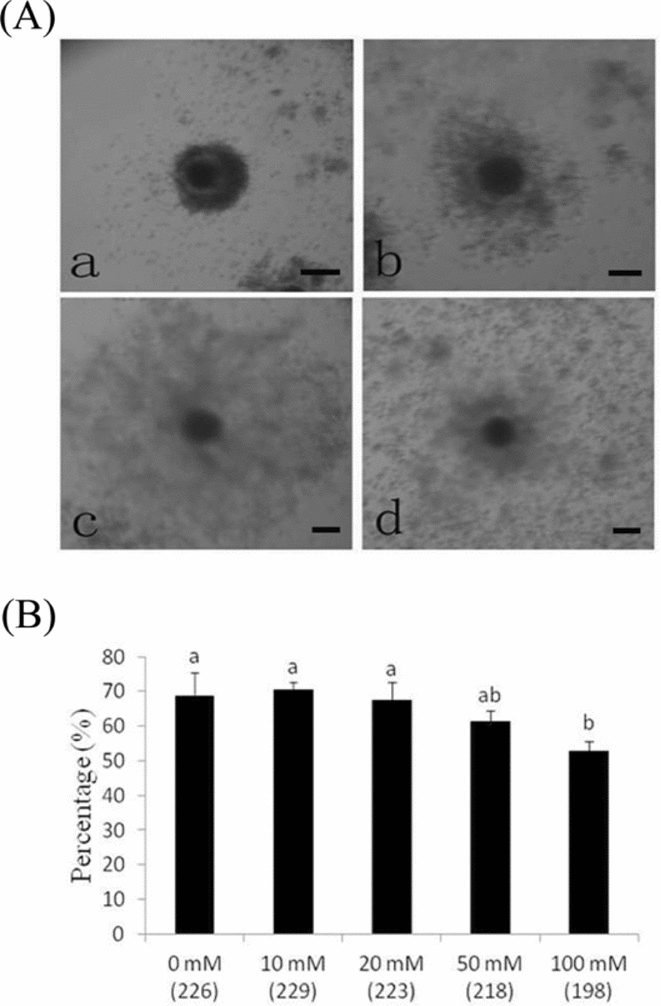
Cumulus expansion was evaluated after 44 h of incubation. All oocytes scored between grade 1 and grade 4 according to status of cumulus expansion (Fig. 1A). No significant differences were observed in the percentages of COCs that were scored as grade 3 plus grade 4 in the 10 mM, 20 mM, 50 mM sorbitol groups compared with those in the control group (Fig. 1B). However, the 100 mM sorbitol group showed significantly decreased rates of grade 3 plus grade 4.
Effect of sorbitol on the cumulus expansion of cumulus–oocyte complexes (COCs). (A) Scores of cumulus expansion. a: grade 1, b: grade 2, c: grade 3, d: grade 4. COCs scored as grade 3 and grade 4 were considered to have normal cumulus expansion. Scale bars, 100 μm. (B) The percentages of COCs that were scored as grade 3 plus grade 4. The number of oocytes examined in each group is given in parentheses. a,bDifferent letters above the bars indicate statistically significant differences (P < 0.05).

Effect of sorbitol treatment during IVM on nuclear maturation
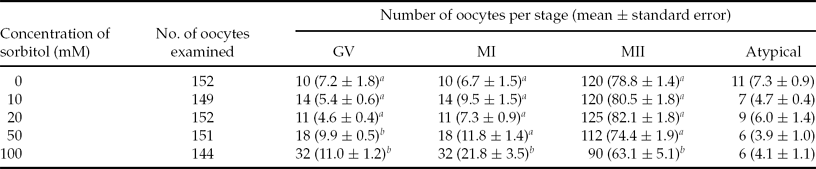
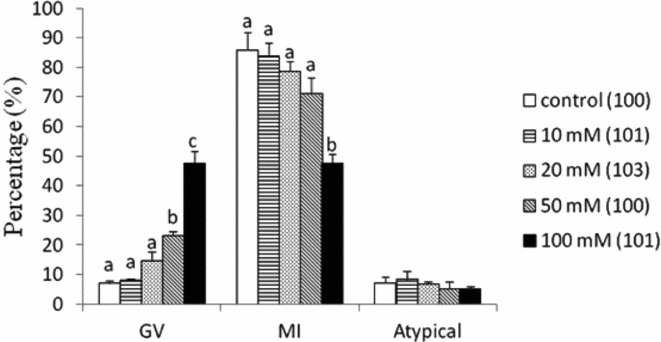
As shown in Fig. 2, after 22 h of maturation culture, no significant differences were observed in the proportion of oocytes at MI stage between the sorbitol-treated and control groups, with the exception of the 100 mM sorbitol group. Next, the effect of different concentrations (0 mM, 10 mM, 20 mM, 50 mM, or 100 mM) of sorbitol on the nuclear maturation of oocytes after 44 h in culture was evaluated. As shown in Table 1, there were no significant differences in nuclear maturation among the 10 mM, 20 mM, and 50 mM sorbitol groups (80.5 ± 1.8%, 82.1 ± 1.8%, 74.4 ± 1.9%, respectively) compared with the control group (78.8 ± 1.4%); however, the 100 mM sorbitol group (63.1 ± 5.1%) showed significantly lower nuclear maturation compared with the other groups.
Effect of sorbitol treatment during IVM on nuclear maturation
a,bValues within columns with different letters are significantly different (P < 0.05).
GV, germinal vesicle stage; MI, metaphase I stage; MII, metaphase II stage.
Distribution (mean ± standard error (SE)) of the nuclear morphologies of porcine oocytes cultured in the absence (0 mM) or presence (10 mM, 20 mM, 50 mM, 100 mM) of sorbitol in the maturation medium for 22 h. The number of oocytes examined in each group is given in parentheses. a,b,cDifferent letters above the bars indicate statistically significant differences (P < 0.05).
Effect of sorbitol treatment during IVM on intracellular levels of ROS and GSH
As shown in Fig. 3, mature oocytes in the 20 mM sorbitol-treated group showed significantly increased intracellular levels of GSH compared with all of the other groups (Fig. 3B). Mature oocytes in the 50 and 100 mM groups had significantly higher ROS levels than the other groups, which did not differ significantly with respect to ROS.
Epifluorescent photomicrographic images of in vitro matured porcine oocytes. (A) Oocytes were stained with CellTracker Blue (a–e), and 2′,7′-dichlorodihydrofluorescein diacetate (H2DCFDA) (f–j), to detect intracellular levels of glutathione (GSH) and reactive oxygen species (ROS), respectively. Metaphase II oocytes from the control (a, f), 10 mM (b, g), 20 mM (c, h), 50 mM (d, i), and 100 mM (e, j) groups. Scale bar represents 50 μm in all images. (B) Effect of sorbitol supplementation during IVM on intracellular GSH and ROS levels in in vitro matured porcine oocytes. The number of oocytes examined in GSH group, N = 30; ROS group, N = 30. a,b,cDifferent letters above the bars indicate statistically significant differences (P < 0.05).
Effects of different concentrations of sorbitol during IVM on the post-PA development of porcine oocytes
As shown in Table 2, when the matured oocytes were subjected to PA and then cultured in PZM-3 medium, the blastocyst formation rate of oocytes matured in 20 mM sorbitol was significantly higher (P < 0.05) compared with those in the other groups. However, there was no significant improvement in the cleavage rate of sorbitol-treated oocytes; in contrast, treatment with 100 mM sorbitol significantly reduced both cleavage and blastocyst formation. There was no significant difference in total cell number between the control and sorbitol-treated groups.
Effects of different concentrations of sorbitol during in vitro maturation on post-parthenogenetic activation development of porcine oocytes
a,b,cValues within columns with different letters are significantly different (P < 0.05).
SE, standard error.
Effects of different concentrations of sorbitol during in vitro culture on the post-PA development of porcine oocytes
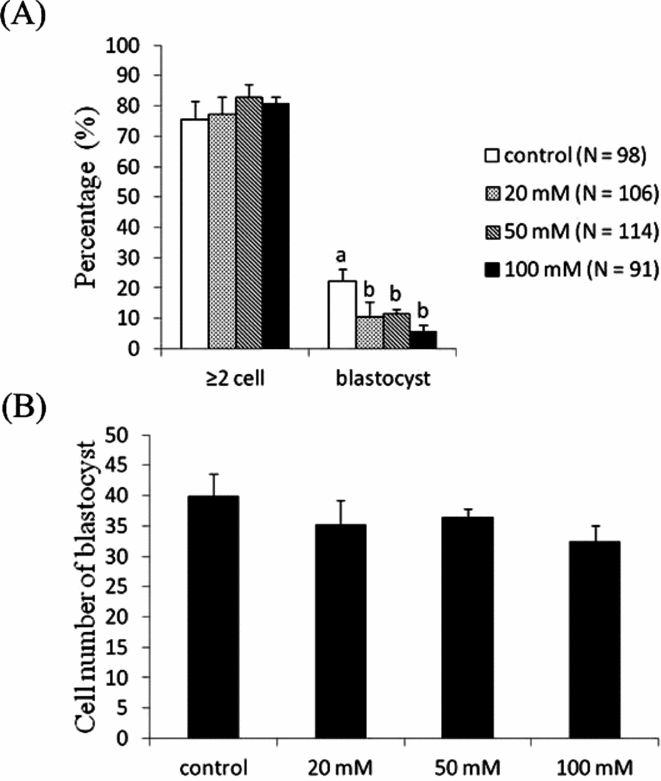
Activated oocytes were subjected to IVC in PZM-3 supplemented with or without sorbitol (0 mM, 20 mM, 50 mM, 100 mM). The cleavage rates of the sorbitol-treated cultures tended to be higher than that of the control, but this difference was not significant (Fig. 4A). The blastocyst formation rate was significantly lower (P < 0.05) in the sorbitol-treated groups compared with the control. There was no significant difference in cell number between the control and sorbitol-treated groups (Fig. 4B).
Effects of sorbitol supplementation during in vitro culture on the post-parthenogenetic activation (post-PA) development of porcine oocytes. (A) The cleavage rate (≥ 2 cell) is given as the percentage of cleaved embryos versus total oocytes, while the blastocyst rate reflects the percentage of blastocysts versus total cleavages. (B) The blastocyst cell number was evaluated 7 days after activation. The number of oocytes examined in each group is given in parentheses. a,bDifferent letters above the bars indicate statistically significant differences (P < 0.05).
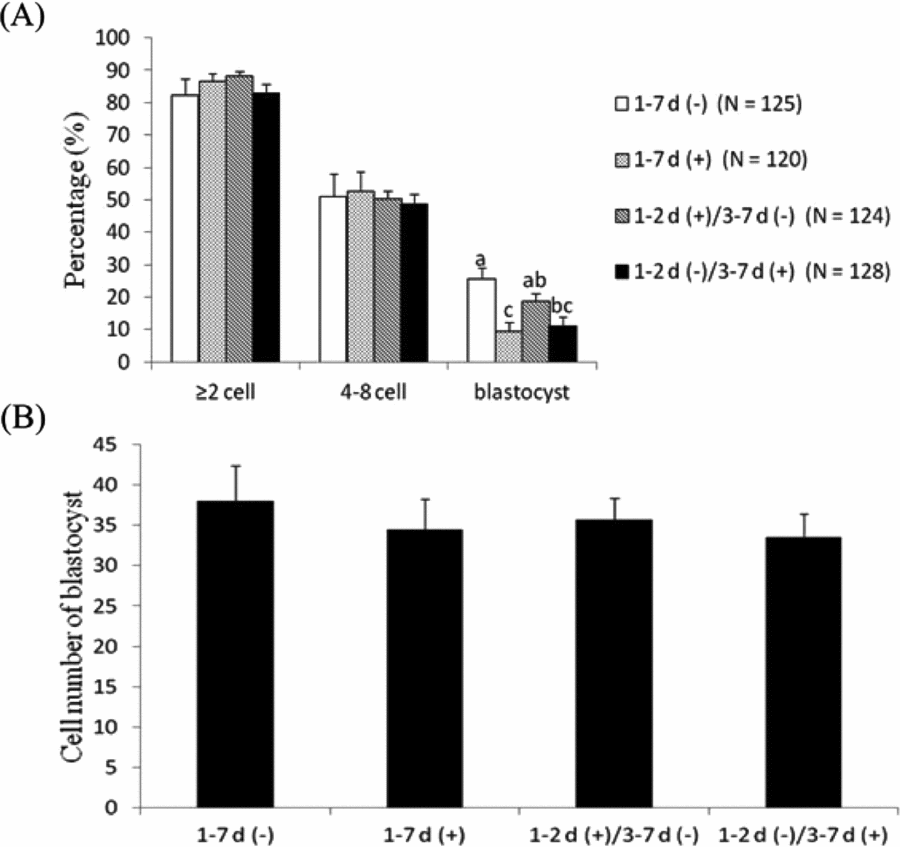
The duration of culture in the sorbitol-containing IVC medium was varied, and the post-PA embryonic development of porcine oocytes was examined. In the last experiment, 50 mM sorbitol yielded the highest cleavage rates. So, in this test, 50 mM sorbitol was used for the experiment. There were no significant differences in the cleavage or 4–8-cell rates between the sorbitol-treated [1–7 day (+), 1–2 day (+)/3–7 day (–) and 1–2 day (–)/3–7 day (+)] groups versus the control group [1–7 day (–)] (Fig. 5A). However, the blastocyst formation rates of the 1–7 day (+) and 1–2 day (–)/3–7 day (+) groups were significantly lower than that of the control group. Although the blastocyst formation rate was somewhat higher in the 1–2 day (+)/3–7 day (–) group compared with 1–7 day (+) and 1–2 day (–)/3–7 day (+) groups, it remained lower than the control value (Fig. 5A). There was no significant difference in cell number between the control and sorbitol-treated IVC groups (Fig. 5B).
Effects of different culture times in sorbitol-containing in vitro culture (IVC) medium on the post-parthenogenetic activation (post-PA) development of porcine oocytes. (A) Cleavage rate (≥2 cell) reflects the percentage of cleaved embryos versus total oocytes; the 4–8-cell rate shows the percentage of 4–8-cell embryos versus total oocytes; and the blastocyst rate indicates the percentage of blastocysts versus total cleavages. (B) The blastocyst cell number was evaluated 7 days after activation. The number of oocytes examined in each group is given in parentheses. a,b,cDifferent letters above the bars indicate statistically significant differences (P < 0.05). Abbreviations: 1–7 d (–) group, the activated oocytes were cultured in PZM-3 for 7 days; 1–7 d (+) group, the activated oocytes were cultured in PZM-3 with 50 mM sorbitol for 7 days; 1–2 d (+)/3–7 d (–) group, the activated oocytes were cultured in PZM-3 with 50 mM sorbitol for 2 days and then cultured in PZM-3 without sorbitol for the remaining time; and 1–2 d (–)/3–7 d (+) group, the activated oocytes were cultured in PZM-3 for 2 days and then cultured in PZM-3 with 50 mM sorbitol for the remaining time.
Effect of sorbitol on the apoptosis of porcine blastocysts
The apoptotic index of blastocysts from the 1–7 day (+) group was significantly higher than those of the 1–2 day (+)/3–7 day (–), 1–2 day (–)/3–7 day (+), 20 mM/IVM (blastocysts treated with 20 mM sorbitol during IVM) and control groups (Table 3, Fig. 6). There were no significant differences in apoptotic cell death rates between the 1–2 day (–)/3–7 day (+) and 1–2 day (+)/3–7 day (–) groups, but these values were significantly higher than those of the control and 20 mM/IVM groups (12.8 ± 1.3%; 11.7 ± 1.8% versus 7.9 ± 1.1%; 8.0 ± 1.3%). The apoptotic index of the 1–2 day (+)/3–7 day (–) group was also somewhat higher than those of the 20 mM/IVM and control groups but not to a significant degree (11.7 ± 1.8% versus 8.0 ± 1.3%; 7.9 ± 1.1%).
Effect of sorbitol on apoptosis in porcine blastocysts
a,b,cValues within columns with different letters are significantly different (P < 0.05).
*The total cell number of the examined blastocysts.
Apoptosis in blastocysts was evaluated by terminal deoxynucleotidyl transferase-mediated dUTP nick-end labelling (TUNEL). Representative images are shown; magnification ×200. Nuclei were stained with Hoechst 33342 (blue; panels A, B and C), and fragmented nuclei were labelled by TUNEL (red; panels A′, B′ and C’). (A, A′) Images of porcine blastocysts cultured with 20 mM sorbitol during in vitro maturation (IVM) (20 mM/IVM group). (B, B′) Images of porcine blastocysts cultured with 50 mM sorbitol during in vitro culture (IVC) (1–7 day (+) group). (C, C′) Images of porcine blastocysts cultured without sorbitol during IVC (control group). Scale bar represents 100 μm.
Discussion
In the present study, sorbitol was added into medium during IVM or IVC and the effects on porcine oocyte maturation and/or post-PA embryonic development evaluated. The results demonstrated that the exposure of porcine oocytes to 20 mM sorbitol benefited post-PA embryonic development by increasing the intracellular levels of GSH (Table 2, Fig. 3). However, sorbitol did not appear to improve the nuclear maturation of oocytes significantly, and sorbitol supplementation during IVC had a negative effect on blastocyst formation.
Most of the previous efforts to improve pig embryo production in vitro have focused on varying the culture conditions, reducing ROS, or increasing GSH. The presence of organic osmolytes such as sorbitol, taurine and hypotaurine in the maturation medium have been reported to improve cytoplasmic maturation of pig oocytes and subsequent embryo development after IVF (Reed et al., Reference Reed, Illera and Petters1992; Funahashi et al., Reference Funahashi, Kim, Stumpf, Cantley and Day1996; Long et al., Reference Long, Dobrinsky and Johnson1999; Funahashi & Romar Reference Funahashi and Romar2004). Sorbitol-induced adjustments in medium osmolarity have been shown to influence the germinal vesicle breakdown (GVBD) of porcine oocytes (Yamauchi et al., Reference Yamauchi, Sasada, Soloy, Dominko, Kikuchi and Nagai1999), reduce fragmentation due to the electrical stimulation used to fuse and activate NT embryos, and support better development to the blastocyst stage (Im et al., Reference Im, Yang, Lai, Liu, Hao and Prather2005). To our knowledge, however, no previous studies have investigated the effects of sorbitol during IVM on subsequent embryonic development after PA, whether improved cleavage rates or embryonic development was not clear. Therefore, the current study investigated the effect of four different sorbitol concentrations (10, 20, 50, 100 mM) on porcine IVM and subsequent embryonic development. The best results were obtained by IVM medium supplemented with 20 mM sorbitol, which yielded the highest blastocyst formation rates (Table 2). A previous study that investigated the effect of sorbitol on cytoplasmic maturation of pig oocytes and early embryo development after IVF had reported that the addition of 12 mM sorbitol to maturation medium had a beneficial effect on embryo development following IVF (Funahashi et al., Reference Funahashi, Kim, Stumpf, Cantley and Day1996). However, in the present study, the addition of 20 mM sorbitol was more beneficial for cytoplasmic maturation of pig oocytes and subsequent embryonic development after PA. This difference may be associated with the different basic maturation medium between the two experiments. The current study also found that high concentrations of sorbitol (100 mM) in the maturation medium decreased the proportions of oocytes in the MI and MII stages, and inhibited cumulus expansion. Notably, although the tested concentrations of sorbitol did not improve the first polar body formation rate, supplementation of the IVM medium with a low concentration of sorbitol appeared to improve cleavage and blastocyst development compared with the control.
Intracellular levels of GSH and ROS in oocytes are critical factors that influence IVM and IVC (Wang et al., Reference Wang, Abeydeera, Cantley and Day1997; You et al., Reference You, Kim, Lim and Lee2010; Kwak et al., Reference Kwak, Cheong, Jeon, Lee, Choi, Jeung and Hyun2012). In the present study, it was found that supplementation of the IVM medium with 10, 20 or 50 mM sorbitol did not improve nuclear maturation, and supplementation with 100 mM significantly decreased the maturation rate (Table 1, Fig. 2). Sorbitol treatment during IVM did not significantly reduce ROS levels, but the 10 mM and 20 mM sorbitol-treated groups showed somewhat lower ROS levels. A previous study found that the presence of sorbitol in a chemically defined medium (modified Whitten's medium) enhanced the cytoplasmic maturation and post-IVF embryonic development of porcine oocytes (Funahashi et al., Reference Funahashi, Kim, Stumpf, Cantley and Day1996). Similarly, the current study found that porcine oocytes matured in TCM199 medium supplemented with 20 mM sorbitol showed better cytoplasmic maturation of oocytes and post-PA embryonic development, and this was associated with increased intracellular levels of GSH.
It was previously reported that sorbitol supplementation during IVM significantly inhibited blastocyst formation and increased apoptosis in a mouse system (Zhang et al., Reference Zhang, Diao, Kim and Jin2012). In the present study, the highest cleavage rate during early development was obtained when PZM-3 was supplemented with 50 mM sorbitol (Fig. 4). To further clarify the findings, activated oocytes were cultured in PZM-3 with 50 mM sorbitol for 48 h, and then the culture continued in sorbitol-free PZM-3 (1–2 day (+)/3–7 day (–) group) (Fig. 5). The blastocyst formation rate in the 1–2 day (+)/3–7 day (–) group was over 18.7%; this rate was significantly higher than that in the 1–7 day (+) group (9.6%), and did not significantly differ from that of 1–7 day (–) control group. A previous study showed that higher osmolarity at early embryonic stage of pig NT and IVF embryos can enhance in vitro development (Hwang et al., Reference Hwang, Park, Moon, Shim, Kim, Yang, Ko, Yang, Cheong and Im2008). This result is similar to that of Im et al. (Reference Im, Yang, Lai, Liu, Hao and Prather2005) who reported that the blastocyst formation rate was significantly higher in cultures with 50 mM sorbitol for the first 1 or 2 days and then without sorbitol compared to with or without sorbitol for the entire experimental period culture groups (Im et al., Reference Im, Yang, Lai, Liu, Hao and Prather2005). However, in the present study, although the blastocyst formation rate in the 1–2 day (+)/3–7 day (–) group was significantly higher than that in the 1–7 day (+) group, and did not surpass the 1–7 day (–) control group. This difference may be associated with a potential difference in sensitivity to sorbitol among developing embryos, quality of oocytes, culture systems or data analysis methods. Reciprocal experiments in which embryos were cultured in PZM-3 without sorbitol for 1–2 days and then transferred to PZM–3 medium with 50 mM sorbitol for days 3–7 (designated the 1–2 day (–)/3–7 day (+) group) were also performed. Interestingly, the blastocyst formation rate of this group was similar to that of the group treated with 50 mM sorbitol for the full culture period (the 1–7 day (+) group), and significantly lower than those of the 1–7 day (–) control group and the 1–2 day (+)/3–7 day (–) group. Thus, the present results indicate that porcine embryos can develop normally to the 2–8-cell stage in the presence of 50 mM sorbitol, and a small number can develop to blastocysts. This finding differs somewhat from the previous finding that 50 mM sorbitol completely blocked the development of mouse oocytes at the 2-cell stage (Zhang et al., Reference Zhang, Diao, Kim and Jin2012).
Apoptosis and the total cell number of blastocysts are important parameters for evaluating embryonic quality, and contribute to implantation and the production of live offspring (Hao et al., Reference Hao, Lai, Mao, Im, Bonk and Prather2004). As such, the TUNEL assay (Fouladi-Nashta et al., Reference Fouladi-Nashta, Alberio, Kafi, Nicholas, Campbell and Webb2005) is considered useful for assessing the quality and viability of embryos produced in vitro. In the current study, the quality of porcine embryos obtained after sorbitol treatment were analysed, and it was found that although there were differences in the blastocyst formation rates, there was no apparent difference in cell numbers between the control and sorbitol-treated groups. In contrast, the apoptotic rate was significantly increased in the 50 mM sorbitol-treated IVC groups (Table 3, Fig. 6). Embryos derived from the 1–7 day (+) group were of poor quality and had a high apoptotic index. Embryos in the 1–2 day (–)/3–7 day (+) and 1–2 day (+)/3–7 day (–) groups tended to have lower apoptotic indexes compared with the 1–7 day (+) group, but these were still significantly higher than those of the control and 20 mM/IVM groups. Thus, addition of sorbitol to the IVC of activated porcine oocytes appears to reduce blastocyst formation and quality by increasing the apoptotic index.
In conclusion, the current study shows that supplementation with a low concentration of sorbitol (20 mM) during IVM of porcine oocytes did not significantly improve nuclear maturation, but improved subsequent embryonic development following PA by increasing the intracellular levels of GSH. In contrast, sorbitol supplementation during IVC appeared to negatively affect blastocyst formation by increasing the apoptotic index of porcine embryos.
Acknowledgements
This work was supported by the BioGreen 21 Program of the Rural Development Administration (grant no. PJ009060) and Bio-industry Technology Development Program (grant no. IPET312060–5), Ministry for Food, Agriculture, Forestry and Fisheries, Republic of Korea.