Introduction
Nurses can play a significant role in providing spiritual/existential care to enhance the well-being of patients at the end of life (Dalgaard et al., Reference Dalgaard, Thorsell and Delmar2010) for many reasons. They are the largest professional group to care for dying patients (Costello, Reference Costello2006) and the most physically present to patients (Taylor et al., Reference Taylor, Mamier and Bahjri2009). Patients often expect spiritual care to be part of the nurse's role, and most nurses accept this as part of their role (Edwards et al., Reference Edwards, Pang and Shiu2010). Furthermore, they have a longstanding commitment to holistic care that includes spiritual/existential dimensions of life (Batstone et al., Reference Batstone, Bailey and Hallett2020). (Hereon, we will use the term “spiritual/existential care” because a systematic review of spiritual care at the end of life found that the terms “spiritual” and “existential” were used synonymously and interchangeably (Edwards et al., Reference Edwards, Pang and Shiu2010).
Health institutions worldwide (e.g., International Council of Nurses, 2012) therefore recommend that nurses provide spiritual/existential care, and some institutions (American Association of Colleges of Nursing, 2016; European Association of Palliative Care (Gamondi et al., Reference Gamondi, Larkin and Payne2013)) provide care guidelines for nurses. Despite these recommendations and guidelines, nurses actually provide spiritual/existential care at the end of life less frequently than desired by patients (Balboni et al., Reference Balboni, Sullivan and Amobi2013).
To understand why nurses provide spiritual/existential care less frequently than desired, numerous studies have sought to identify determinants, barriers, and facilitators of spiritual/existential care provision. These studies are so numerous that two systematic reviews (to the authors’ knowledge) have been conducted: Edwards et al. (Reference Edwards, Pang and Shiu2010) aimed to identify barriers and facilitators of spiritual care at the end of life, and Gijsberts et al. (Reference Gijsberts, Liefbroer and Otten2019) aimed to identify requisite factors to the implementation of spiritual care at the end of life as one objective. These reviews included factors that impacted spiritual care provision, such as confidence, training, team support, time, workload, and staffing.
One limitation of these reviews is that while they combined the perspectives of patients, family caregivers, and healthcare providers (e.g., physicians, nurses, chaplains, volunteers, and management), they had only limited focus on nurses’ perspectives. Not only do nurses play a big role in spiritual/existential care, but their perspective of spiritual/existential health and practice is likely to be different from that of other practitioners (Daaleman et al., Reference Daaleman, Usher and Williams2008). Nurses, compared to physicians, for example, are more likely to subscribe to a holistic model of health (Malik et al., Reference Malik, Hilders and Scheelel2018); view spiritual/existential care as part of their role (Rodin et al., Reference Rodin, Balboni and Mitchell2015; Palmer et al., Reference Palmer, Hyer and Tsilimigras2021); provide spiritual care more frequently (Bar-Sela et al., Reference Bar-Sela, Schultz and Elshamy2019); have different spiritual care practices (Epstein et al., Reference Epstein, Sullivan and Enzinger2015; Palmer et al., Reference Palmer, Hyer and Tsilimigras2021); and report different barriers to care practice (Balboni et al., Reference Balboni, Sullivan and Enzinger2014).
Another limitation of Edward et al.'s and Gijsbert et al.'s reviews is that they did not systematically synthesize determinants into a comprehensive theoretical framework. A theoretical framework enables intervention development to be guided by theory, enhancing implementation success (Michie et al., Reference Michie, Johnston and Francis2008). While a comprehensive tool for classifying barriers and facilitators of spiritual/existential care behaviors is currently lacking, one framework has frequently been used to understand clinicians’ behaviors, barriers, and facilitators (Atkins et al., Reference Atkins, Francis and Islam2017): the Theoretical Domains Framework (TDF) (Cane et al., Reference Cane, O'Connor and Michie2012), which integrates behavioral and psychological process theories operating at individual, social, and organizational levels. The TDF comprises 14 key domains: (i) knowledge (an awareness of the existence of something); (ii) skills (ability or proficiency acquired through practice); (iii) social or professional role and identity (a coherent set of behaviors and displayed personal qualities of an individual in a social or work setting); (iv) beliefs about capabilities (self-efficacy or acceptance of the truth, reality, or validity about an ability, talent, or facility that a person can put to constructive use); (v) optimism (the confidence that things will happen for the best or that desired goals will be obtained); (vi) beliefs about consequences (acceptance of the truth, reality, or validity about outcomes of a behavior in a given situation); (vii) reinforcement (a process in which the frequency of a response is increased by a dependent relationship or contingency with a stimulus); (viii) intentions (conscious decision to perform a behavior, or a resolve to act in a certain way); (ix) goals (mental representations of outcomes or end states that an individual wants to achieve); (x) memory attention and decision processes (the ability to retain information, focus selectively on aspects of the environment, and choose between alternatives); (xi) environmental context and resources (a circumstance of a person's situation or environment that discourages or encourages the development of skills and abilities, independence, social competence, and adaptive behavior); (xii) social influences (interpersonal processes that can cause individuals to change their thoughts, feelings, or behaviors); (xiii) emotion (a complex reaction pattern involving experiential, behavioral, and physiological elements, by which an individual attempts to deal with personally significant matters or events); (xiv) behavioral regulation (anything aimed at managing or changing objectively observed actions) (see Supplementary Table S1 for further definitions of the domains). The TDF has been used to classify barriers and facilitators of a wide variety of clinician behaviors [e.g., prescribing behavior (Paksaite et al., Reference Paksaite, Watson and Crosskey2020), maternal weight management (Heslehurst et al., Reference Heslehurst, Newham and Maniatopoulos2014), alcohol screening (Rosário et al., Reference Rosário, Santos and Angus2021), and stroke management (Craig et al., Reference Craig, McInnes and Taylor2016)]. Our study will use the TDF as a theoretical lens to synthesize the determinants of nurse spiritual/existential care practices.
The aims of this systematic review are to (1) identify determinants of nurse spiritual/existential care practices at the end of life and (2) map these determinants into TDF constructs. In order to include as many studies on spiritual/existential care as possible, we did not predefine spiritual/existential care, but used search terms covering aspects of spiritual/existential care (e.g., care addressing “meaning”, “hope”, and “distress”) (Gijsberts et al. (Reference Gijsberts, Liefbroer and Otten2019) used a similar approach to include as many studies as possible.). The determinants identified by this review will enhance our understanding of spiritual/existential care practices at the end of life, as well as inform the development of improvement interventions. This research answers a call for more research into the development of spiritual care practices of palliative staff (Selman et al., Reference Selman, Young and Vermandere2014).
Method
This review was prospectively registered with PROSPERO (CRD42020186887).
Search strategy
We employed a multi-step approach to the development of search strategies, including the identification of search strategies from previous reviews of suffering (e.g., Cancer Australia, 2013) team consensus on which terms to use as part of the search strategy, and piloting and refining of the search using the CINAHL database before adapting the strategy search for use in other databases. An experienced librarian assisted with development of search strategies and mapping terms across MEDLINE, PsycInfo, and Cochrane Library databases.
The search was performed on 22 April 20 using the following search string in all text fields: nurse* AND (spiritual OR existential OR psycho-spiritual OR religio* OR pastor*) AND (“end of life” OR “end-of-life” OR palliative OR hospice) AND (suffering OR pain OR distress OR crisis OR anguish OR meaning OR transcendence OR hope* OR faith OR peace OR “sense of coherence” OR demoraliz* OR dignity OR “total pain”). A publication date restriction was not applied.
Eligibility criteria
Articles were eligible for inclusion if they had a primary focus on practices that nurses used to provide spiritual/existential care to adults at the end of life; referred to factors that influenced their practice; had registered nurses as the majority of the sample; and reported primary empirical data in peer-reviewed articles, written in English.
Articles were excluded if they were non-empirical, theoretical, or review papers, reports or books; had a secondary focus on spiritual/existential care practices; comprised only a minority of nurses in their samples; did not allow nurse responses to be distinguished from other participants’ responses; or focused on care of pediatric or adolescent patients, or patients with stable, chronic conditions and not at the end of life.
The reference list of each included study was hand-searched for additional relevant studies not identified in the electronic search and assessed for inclusion using the same eligibility criteria.
Selection of studies
Study records from the electronic databases were imported into an Endnote file and de-duplicated. One reviewer screened all titles and abstracts. A second reviewer independently screened 20% of titles and abstracts. Studies with titles or abstracts deemed irrelevant by both reviewers were excluded from further examination. Full papers of the remaining studies were screened and selected for inclusion by two authors and agreed upon after discussion.
Quality appraisal
All papers were assessed using the quality appraisal tool for qualitative and quantitative research, as described by Kmet et al. (Reference Kmet, Cook and Lee2004). One reviewer assessed all papers, and a second reviewer independently checked 10% of them. Due to the nature of the extracted data, studies were not excluded on the grounds of poor quality to avoid omitting studies that might generate worthwhile insights.
Data extraction and analysis
One reviewer abstracted and systematically collated data about the studies’ aims, designs and settings, sample characteristics, and data collection procedures.
Thematic analysis was used to extract and synthesize findings across the included studies using the following process. First, a categorization matrix (Elo and Kyngäs, Reference Elo and Kyngäs2008) was constructed based on the pre-defined domains in the TDF. The matrix was located in a spreadsheet, with the included studies as rows and TDF domains as columns. Then, a coding sheet was developed, adapted from Heslehurst et al. (Reference Heslehurst, Newham and Maniatopoulos2014), which provided descriptions, definitions, and examples of each domain within the TDF. The coding sheet is shown in Supplementary Table S1.
Next, all articles were read thoroughly several times, and data items describing factors influencing spiritual/existential care actions were extracted from sections labeled “results” or “findings’: for qualitative studies, data were extracted from authors' descriptions of results and participant quotations; and for survey studies, data were extracted from results of tabulated statistical analyses and reported association between factors and delivery of spiritual/existential care. The manifest content of the text was extracted, i.e., text that was overtly and obviously related to spiritual/existential care (Graneheim and Lundman, Reference Graneheim and Lundman2004) was extracted. Data items were extracted twice from all articles by the same reviewer, and data extraction of 20% of articles was checked by a second reviewer. Discrepancies were addressed by discussion.
After each data item was extracted, it was then assigned to a TDF domain using the coding sheet to guide categorization. During coding, it was difficult to distinguish between intention and goal domains, so these two domains were combined; this was justified by noting that they are intertwined psychologically (Castelfranchi, Reference Castelfranchi2014), and an earlier version of the TDF (Michie et al., Reference Michie, Johnston and Abraham2005) combined these two domains. It also became obvious that many data items described patient-related social influence, so the social influence domain was split in two: social influence–patient and social influence–other than patient. For data items that could be categorized under multiple domains, only the more obvious primary domain was chosen and reported (e.g., patient–nurse boundaries could be categorized under social/professional role as well as social influence–patient, but the former domain was chosen as the primary domain because the TDF framework formally includes “professional boundaries” as a sub-domain).
After each data item was categorized into the most appropriate domain, a judgment was made as to whether it was a barrier, facilitator, or unspecified. A barrier was defined as a factor that prevents or makes difficult the carrying out of spiritual/existential care; a facilitator was defined as a factor that enables or is required to provide spiritual/existential care; factors that articles described as influencing spiritual/existential care behavior in some way without explicitly stating the direction of effect (i.e., whether it was a barrier or a facilitator) were recorded as unspecific. When coding of data items into domains was complete, one reviewer read and re-read the data items in each domain and grouped similar/related items into themes. A second reviewer checked the coding of data items into domains and the grouping of data items into themes. Discrepancies were addressed by discussion.
After thematic analysis was completed, several frequency analyses were conducted. One analysis determined the number of studies that identified each domain at least once. Additional analyses were conducted to show the distribution of domains by 5-year time periods and major geographical regions.
Results
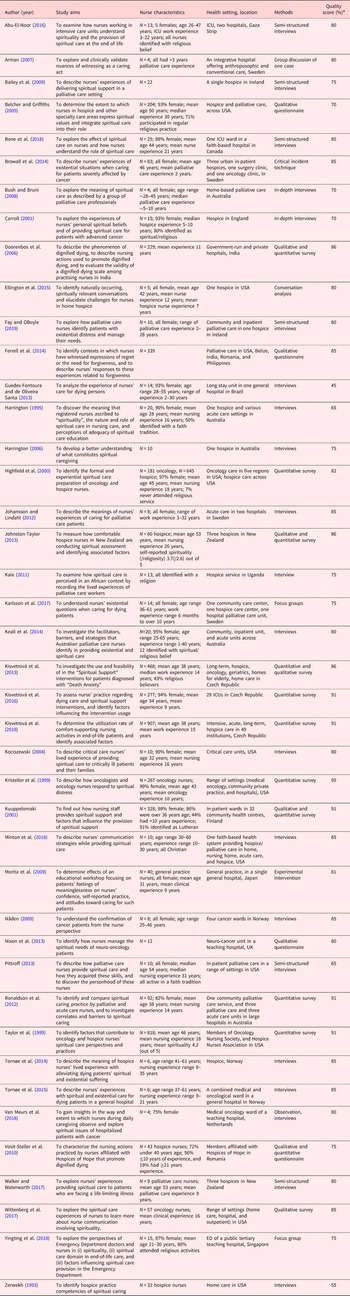
Figure 1 shows the search process flow chart. Table 1 shows the characteristics of the 42 included studies. Quality assessment scores ranged from 45 to 95, averaging 80. Most studies (36/42) employed a qualitative design. A variety of methods were used, including semi-structured interviews, focus groups, surveys, and observation. Seventeen studies were conducted in Europe, 10 in Asia-Pacific, 11 in North America, three in other regions, and one had an international sample. The 4,712 nurse participants worked in a variety of hospital and community settings.
Flow of studies included in the review.

Overview of studies included in the systematic review

a Scores are based on the quality appraisal tool by Kmet et al. (Reference Kmet, Cook and Lee2004).
Table 2 displays synthesized findings for each domain and supporting themes and illustrative data items for each finding. Table 3 shows the frequency of studies that identified each domain at least once. The most frequently reported domains were patient-related social influence (n = 35), skill (n = 29), environment (n = 26), social/professional role (n = 26), and intentions and goals (n = 26). No study reported on the domain of optimism. The remaining domains were reported between 7 and 16 studies. Removing the study that had an average quality assessment score of less than 50% (cf. Gravel et al., Reference Gravel, Légaré and Graham2006) did not change the ranking of the top cited domains.
Thematic synthesis of TDF domains

For a more complete listing of examples of supporting data from included studies, see Supplementary Table S2.
Frequency of studies that identified each domain at least once

a Some factors could be categorized under multiple domains, but only the more obvious primary domain was chosen and reported (e.g., patient–nurse boundaries could be categorized under social/professional role as well as under the patient–social influence, but the former domain was chosen as the primary domain because the TDF framework formally includes “professional boundaries” as a sub-domain).
b It was difficult to distinguish between “intentions” and “goals” domains, so these two domains were combined; this was justified by noting that they are intertwined psychologically (Castelfranchi, Reference Castelfranchi2014) and an earlier version of the TDF (Michie et al., Reference Michie, Johnston and Abraham2005) also combined these two domains.
c During coding, it became obvious that many factors could be categorized under patient-associated social influence, so the “social influence” domain was split into a patient-related social influence, and “other” social influence.
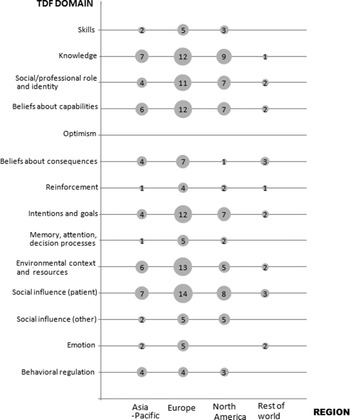
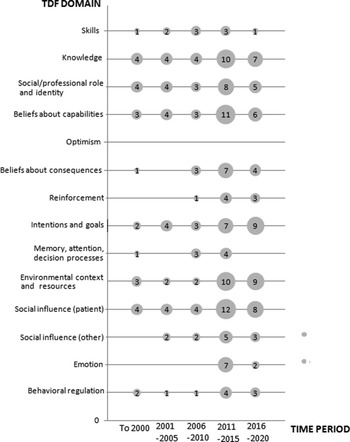
Figure 2 depicts the domains identified by the geographical region of study and shows that almost all domains were identified in all regions. This result suggests that similar factors influence nurse spiritual/existential care practices across diverse cultures and concords with Neathery et al.'s (Reference Neathery, Taylor and He2020) observation that nurses across disparate cultures globally identify similar barriers to spiritual care. Figure 3 depicts the domains identified across 5-year time periods and shows that the identification of domains influencing spiritual/existential care practice has increased steadily over time, reaching a peak during 2011–2015. The domains of memory, emotion, and reinforcement emerged after 2005.
Depiction of domains by the region. (Each circle represents the number of studies mentioning the domain at least once. Studies were assigned to regions based on the locations of nurses sampled.)

Depiction of domains across 5-year time periods. (Each circle represents the number of studies mentioning the domain at least once.)

Discussion
This systematic review used the TDF to synthesize 42 studies that shed light on factors influencing nurses’ spiritual/existential care of patients at the end of life. The review pulled together the views of more than 4,712 nurses across a range of hospital and community settings to show that the most frequently reported domains influencing nurse practice were patient-related social influence, skills, social/professional role and identity, intentions and goals, and environmental context and resources. This review offers several implications for research and practice.
Improved understanding of determinants of nurse behavior
This review identified a range of personal, organizational, and patient-related factors influencing the nurse provision of spiritual/existential care of end-of-life patients. Palliative care managers can use this information as a checklist to gauge a unit's conduciveness to nurse provision of spiritual/existential care and to identify areas requiring attention. Understanding determinants of nurses’ spiritual/existential care practices is a first step to improving the quality of patient care (Grol and Grimshaw, Reference Grol and Grimshaw2003). A useful aspect of the TDF is that relevant interventions for behavior change in each domain have been identified (Michie et al., Reference Michie, Johnston and Francis2008).
The factors identified in this review as influencing nurses’ spiritual/existential care practices incorporate many factors identified in previous reviews. Edwards et al. (Reference Edwards, Pang and Shiu2010) identified several facilitators, including reflection on an individual's own spirituality, ample time, support of team members, and life experience; and several barriers, including high patient turnover, high workload, low staffing, lack of privacy and nurse continuity, task focus, lack of confidence, and feelings of ill-preparedness. They also identified the importance of training staff to recognize spiritual issues of religious groups and noted complexities in assessing and documenting spiritual distress. Gijsberts et al. (Reference Gijsberts, Liefbroer and Otten2019) identified factors including feelings of incompetence, training, self-reflection, differences in the needs and convictions of patients and family members, weak integration of spiritual care in palliative care, and emphasis on patient physical well-being. Because our review collated evidence from nurses only — rather than from patients and health care providers, as in the Edwards et al. and Gijsbert et al. studies — the results provide greater precision regarding these factors. For example, similar to Edwards et al. (Reference Edwards, Pang and Shiu2010), we identified that while time was a factor influencing practice, different facets of time also influenced care. These include temporal demand, duration of a patient's time in the unit, duration of nurses’ time spent with patients, and time available for self-reflection. Also similarly to Edwards et al., we found that professional and personal life experience with loss was beneficial, but our review additionally found a qualification to this factor: that personal experience of loss can affect spiritual care when personal self-disclosure supersedes awareness of client needs (Pittroff, Reference Pittroff2013). As another example, Gijsberts et al. (Reference Gijsberts, Liefbroer and Otten2019) found that feelings of incompetence influenced spiritual/existential care; we also identified skills and beliefs about capabilities as factors, as well as aspects of felt competence, such as courage and learning from others and reflection on one's own existential issues.
Our study did not support the findings of previous reviews entirely, however. For example, we did not identify the potential barriers found in the Edwards et al. review of loss of human touch, and formal spiritual care training and education. These discrepancies may have arisen because the Edwards et al. review included mixed-sample studies (e.g., participants who “… performed a variety of roles: chief executive, manager, nurse, medical director, therapist, artist, volunteer and chaplain” (Wright, Reference Wright2002)). The discrepancies illustrate the value of a profession-specific review, because the findings of systematic reviews are often used in health policymaking and training design.
Our review adds to the findings of existing reviews, such as beliefs about consequences, intentions and goals, reinforcement, and memory. From a psychological perspective, the emergence of these factors is not surprising as they have been well studied in the organizational behavior field. These findings likely arose because the present study did not restrict itself to nurses’ explicit statements of perceived barriers/facilitators (in response to an interviewer's explicit question), but widened the search to include studies presenting statistical findings or nurses’ statements referring to factors influencing their behaviors.
Contribution to nurse competence frameworks
If competence is broadly defined as the ability to do something well (Cambridge Dictionary, 2021), then factors that help or hinder the “doing” of those behaviors may also affect competence in that behavior. To the extent that this premise is true, our study contributes to frameworks of nurse competence in spiritual/existential care, thus answering Selman et al.'s (Reference Selman, Young and Vermandere2014) call for more research into this area.
The extant nursing literature generally views competence in spiritual/existential care as a set of knowledge, skills, and attributes possessed by a nurse. Broad lists of competence items have been developed (van Leeuwen et al., Reference van Leeuwen, Tiesinga and Middel2009; Attard et al., Reference Attard, Ross and Weeks2019; McSherry et al., Reference McSherry, Ross and Attard2020). Many of these items appear to be congruent with factors identified in this review that are intrinsic to nursing (e.g., knowledge, skills, and capability beliefs). For example, an item in Attard et al. (Reference Attard, Ross and Weeks2019) is “[a]cknowledge personal limitations in providing spiritual care and consult other members of the multi-disciplinary team … as deemed necessary”; this factor seems concordant with an item that emerged in the beliefs about capabilities domain “accept/know limits of their expertise and [be] ready to work with other team members.” Another example is an item in Van Leeuwen et al.'s (Reference van Leeuwen, Tiesinga and Middel2009) study: “I have an accepting attitude in my dealings with a patient (concerned, sympathetic, inspiring trust and confidence, empathetic, genuine, sensitive, sincere and personal)”; this item seems concordant with items appearing under the behavioral regulation domain: “be open, honest, caring, respectful, compassionate, and show genuine desire to care and love the patient.” An example from McSherry et al.'s (Reference McSherry, Ross and Attard2020, p. 63) framework is “ … [awareness] of the different world/religious views …”; this factor seems concordant with an item that emerged in the knowledge domain: “knowledge of different religious practices/beliefs and spirituality.”
These concordances, among others, support the idea that factors uncovered in our review can be viewed as aspects of competence, and could therefore be used to elaborate on competence frameworks already developed. For example, our study found courage as a sub-theme in beliefs about capabilities. Attard et al.'s (Reference Attard, Ross and Weeks2019) competence list also refers to courage but only in a vague sense, directed toward all people with whom the nurse interacts, including clients, their families, and colleagues. This vague description of courage could be made more specific by adding details uncovered in our study of the many ways that nurses display courage toward patients: to encounter vulnerability, suffering, and death in patients; to be emotionally intimate; and to ask difficult questions and hear difficult answers. Future research could explore more fully the concordance between extant competence lists and our list of factors.
Another way that our study contributes to the understanding of nurse competence in spiritual/existential care is by proposing the notion of “environment competence.” The notion of “work environment competence” emerged as a category of death work competence among helping professionals (Chan and Tin, Reference Chan and Tin2012) and was defined as a supportive working environment that included appropriate supervision, teamwork, and organizational support. This notion supports our starting premise that factors contributing to the enactment of appropriate nurse behaviors also contribute to nurse competence. It also broadens the view of nurse competence in spiritual/existential care from being a purely individual characteristic, to being an interaction of individual and organizational characteristics. Support for an interactional view of competence is found in the organizational behavior field that considers employee performance (and hence competence) as being shaped by interacting individual and organizational characteristics (Kozlowski and Klein, Reference Kozlowski, Klein, Klein and Kozlowski2000).
The interaction between individual and organizational characteristics is present in extant nursing spiritual care competence lists, but it is overlooked due to item wording that ignores barriers within the nurses’ environment. For example, two items, one in Van Leeuwen et al. (Reference van Leeuwen, Tiesinga and Middel2009, p. 2868) stating “ … I can in a timely and effective manner refer [patients] to another care worker (e.g., a chaplain …)” and another in Attard et al. (Reference Attard, Ross and Weeks2019, p. 100) stating “[f]acilitate … privacy … to maintain clients’ dignity,” assume that spiritual care providers and privacy are readily available at the nurses’ behest. Our study explicitly identifies “availability of spiritual care providers” and “privacy” as factors in the environment domain that influence care practice and thus contribute to spiritual/existential care environment competence.
Suitability of the TDF to study spiritual/existential care practices
Our analysis showed that there were no factors derived from the review findings that could not be accounted for by one of the TDF domains. This indicates that the TDF framework is broadly relevant to nurse behavior in spiritual/existential care, albeit with some qualifications.
One qualification to the use of TDF to study spiritual/existential care is that the frequency of reporting of domains and factors does not necessarily reflect the relative importance or impact of identified factors on care practice. Discordance between reported frequency and effect on spiritual care behavior has been observed empirically by Neathery et al. (Reference Neathery, Taylor and He2020) and Balboni et al. (Reference Balboni, Sullivan and Enzinger2014). In our study, several domains of the TDF had few or no factors (e.g., only seven studies reported factors related to memory, attention, and decision-making, and no study reported factors related to optimism). But we know that they must affect behavior. Nurses are not automatons; they must be attentive to patient cues and use knowledge stored in memory to decide the most appropriate care actions in particular situations. The infrequent reports of some domains in our review could be because (i) the primary studies did not question participants directly about these domains and/or (ii) individuals find it difficult to recall affective attitudes (i.e., emotions) (Thomas and Diener, Reference Thomas and Diener1990) and may not even be conscious of factors affecting their behavior (e.g., Shantz and Latham, Reference Shantz and Latham2009). Future research could therefore explore which factors have the greatest effect on spiritual/existential care practices.
Another qualification to the use of TDF to study spiritual/existential care is that the domains are not distinct, and relationships between domains are not explicit. The TDF identifies constituent domains but not the causal processes linking domains in a coherent explanation of behavior (Michie et al., Reference Michie, Johnston and Abraham2005). This limitation in our review means that the frequency analysis should not be considered in isolation. During coding, we found that some factors could be represented by more than one domain. For example, patient–nurse boundaries could be categorized under social/professional role as well as under patient–social influence; this overlap is not surprising because professional boundaries are defined in terms of limits in social relationships, and palliative care clinicians are susceptible to such boundary challenges with patients (Lawton et al., Reference Lawton, Lawton and Stevens2019). Another example is the difficulty in distinguishing between intentions and goal domains using the data available. While intentions are intertwined psychologically, they are generally more proximal determinants of behavior than goals (Castelfranchi, Reference Castelfranchi2014). Also we noted that optimism was not ostensibly identified as a factor in any study; however, factors that were the outcome of optimism/pessimism could be manifested in the data as beliefs about positive/negative consequences of care practices. This is supported by research that assesses clinician optimism by measuring their expectations (or beliefs) about treatment outcomes (e.g., Byrne et al., Reference Byrne, Sullivan and Elsom2006). These examples illustrate how domains could form a causal network of distal and proximal factors influencing spiritual/existential care behavior. Future research could develop this network for spiritual/existential care.
Strengths/limitations and future research
One strength of the present review is that it is a mixed-methods review. Most of the studies investigating nurse spiritual/existential care practice were single, qualitative, interview-based studies. Individually these studies were not intended to be generalizable and used small samples; but together they provide a more complete depiction of factors influencing spiritual/existential care. Conversely, the few quantitative studies included in the review did not capture all domains, but did allow measurable investigation of factors not normally perceived by nurses. For example, the Doorenboos et al. (Reference Doorenbos, Wilson and Coenen2006) study showed statistically that ethnic culture influences whether nurses focused on religious rituals, but not whether nurses encouraged patients to talk about dying.
Some limitations of our review should be noted. Firstly, as the search was limited to peer-reviewed journal studies on end-of-life care published in English, the included studies were not representative of all cultural or work settings. Even though the generalizability of findings was not an aim of this review, this drawback might reduce the applicability of the findings to some work/country or healthcare contexts. Most included studies involved lengthy, face-to-face interviews with a nurse researcher, which may have introduced bias by self-selection of nurses who valued spiritual/existential care. Future research should set out to overcome these limitations.
The current study provides ample opportunity for future empirical work. Some possibilities have been mentioned, but we will comment on three additional areas. One involves the investigation of discrepancies and gaps in findings. Some factors were reported as both barriers and facilitators (e.g., participation/identification with faith tradition was identified both as a barrier (Kisvetrová et al., Reference Kisvetrová, Klugar and Kabelka2013), facilitator (Pittroff, Reference Pittroff2013), and unrelated (Johnston-Taylor, Reference Johnston-Taylor2013) to spiritual/existential care practices); discrepant findings suggest that a contextual variable may be operating. One gap identified in the frequency analysis is that few studies were conducted in Middle East, Africa and South America, probably because only English language studies were included. Future research could include studies in other languages, which might better capture culture-specific aspects of spirituality (Schultz et al., Reference Schultz, Lulav-Grinwald and Bar-Sela2014). Another gap is the relative absence of studies identifying the emotion domain in the North American region; this might be due to North American nursing research generally lagging in emotion work (e.g., in a 2017 review of emotional labor in nursing work, of 16 relevant international empirical studies, only two were North American (Delgado et al., Reference Delgado, Upton and Ranse2017)). Moreover, even though the domain-by-time-period analysis showed how studies identified barriers over time, all studies were snapshot studies and therefore did not capture how barriers and facilitators — real or perceived — changed over time with individual nurses or their organizational milieus.
Conclusion
Because a nurse can play a significant role in providing spiritual/existential care to end-of-life patients, it is important to understand the determinants of nurse care practices toward these patients. This systematic review of 42 studies involving nurses across a variety of healthcare settings identified a range of personal, organizational, and patient-related factors influencing nurse provision of spiritual/existential care. The most frequently reported factors were patient-related social influence, skills, social/professional role and identity, intentions and goals, and environmental context and resources. By improving our understanding of the determinants of nurse behavior, these factors can be used as inputs to nurse competency frameworks and to gauge a unit's conduciveness to nurse provision of spiritual/existential care. This research thus contributes to the development of spiritual care practices of palliative staff, which is an important research priority for clinicians and researchers in palliative care (Selman et al., Reference Selman, Young and Vermandere2014).
Supplementary material
The supplementary material for this article can be found at: https://doi.org/10.1017/S1478951521001851.
Acknowledgments
We thank D. Isaac and M. Jacobson for their assistance in completing this project.
Conflict of interest
None declared.