The unexpected electoral triumph of Donald J. Trump prompted myriad postmortems seeking to uncover how political pundits and legions of experts got it so wrong. Indeed, former FBI Director James Comey cited his certainty that Hillary Clinton would win as justification for his extraordinary decision to break with protocol and publicly announce, only 11 days before the election, that the Bureau had reopened its investigation into Clinton’s email. Failing to do so, Comey reasoned, could have raised doubts about the legitimacy of her election (Comey Reference Comey2018).
Analysts offered no shortage of explanations for Clinton’s demise. Some suggest it was her poor strategy and lack of messaging (Allen and Parnes Reference Allen and Parnes2017); others point to Trump’s ability to connect emotionally with an angry electorate.Footnote 1 Still others emphasize macro-level forces such as the economy (Schiller Reference Schiller2016). After all, seven of the 2016 electoral forecast models published in PS generated predictions that were within one percentage point of the actual outcome (Campbell et al. Reference Campbell2017). Few emphasize the role of policy differences between the candidates, and virtually no postelection analysis considers the potential impact of foreign policy.
This omission makes sense given that the election seemed to be devoid of serious discussions of policy differences between the candidates. However, one policy area in which the two clearly diverged was in their vision for America’s role in the world. Clinton embraced globalism and, as Secretary of State, was a vocal advocate for the troop surge in Afghanistan and military interventions in Libya and Syria. By contrast, Trump harshly criticized the Iraq War, questioned the wisdom of other military interventions, and promised instead to put “America First.”
The United States has now experienced 18 years of continuous war, the longest stretch in its history. The costs of these conflicts have fallen disproportionately on an extraordinarily small slice of the electorate. Those who served in theater constitute less than 1% of the nation’s population; those who died or were wounded in battle comprise far less than one tenth of 1%.Footnote 2 Even the share of American society with direct personal contact to those who serve is shrinking (Holsti Reference Holsti1998; Schafer Reference Schafer2017; Szayna et al. Reference Szayna2007).
A central tenet of Kant’s democratic peace logic is that voters, who ultimately must bear the costs of war in blood and treasure, will sanction recklessly militaristic leaders at the ballot box. Consistent with this view, an extensive literature documents the electoral costs paid by wartime leaders as the costs of a conflict increase (Cotton Reference Cotton1986; Gartner, Segura, and Barratt Reference Gartner, Segura and Barratt2004; Hibbs Reference Hibbs2000; Kriner and Shen Reference Kriner and Shen2010). Exploiting variation in local casualty rates to identify the impact of war—versus other national factors—on vote choice, research has shown that President Bush suffered significant losses in 2004 in states and counties that had suffered high casualty rates (Karol and Miguel Reference Karol and Miguel2007).Footnote 3 These losses continued in the 2006 midterms as both Senate and House Republicans lost significant electoral ground in high-casualty constituencies (Gartner and Segura Reference Gartner and Segura2008; Grose and Oppenheimer Reference Grose and Oppenheimer2007; Kriner and Shen Reference Kriner and Shen2007).
Existing scholarship, however, is generally silent on whether and how a political party—or a presidential candidate from that party—can recapture such electoral support once lost. Our analysis suggests that Trump’s 2016 campaign resonated with many voters in communities that have borne the lion’s share of the human costs of America’s wars since 9/11. Even after controlling for other factors, we find that there is a significant and meaningful relationship between a community’s casualty rate and its support for Trump.
Our analysis suggests that Trump’s 2016 campaign resonated with many voters in communities that have borne the lion’s share of the human costs of America’s wars since 9/11.
DONALD TRUMP AND THE POLITICS OF WAR CASUALTIES
In retrospect, the bombastic campaign of the billionaire businessman-turned-politician appears consciously calculated to appeal to communities frustrated by 18 years of costly and inconclusive war. The core of Trump’s nationalist, populist message was to “make America great again.” Although the details of the message shifted as the campaign developed, Trump regularly praised the military—while also noting that much of their sacrifice seemed to have been for naught.
On the campaign trail, Trump sometimes sounded like a traditional hawk. He repeatedly mocked the Obama administration’s passive approach toward the Islamic State and boasted of his intention to “bomb the hell out of ISIS.” Similarly, he derided the Iran nuclear pact as one of the “worst deals” ever and promised a more aggressive posture with increasingly bellicose rhetoric. Channeling his inner Reagan, Trump also called for greater military spending across the board, including on nuclear weapons—even if these moves threatened to trigger a new arms race. Perhaps above all, Trump regularly pledged in his stump speeches to take care of the military. He argued repeatedly that the military’s resources, especially its manpower resources, were “depleted.” A Trump administration, he promised, would bring fresh manpower and weapons.
However, other Trump campaign themes were decidedly iconoclastic. Whereas few Republicans openly lauded the Iraq War in 2016, Trump vehemently denounced it and the Republican president who waged it. In his first campaign speech, Trump both criticized the Iraq War and recognized the sacrifice of American troops: “We spent $2 trillion in Iraq, $2 trillion. We lost thousands of lives, thousands in Iraq. We have wounded soldiers, who I love, I love—they’re great—all over the place, thousands and thousands of wounded soldiers.”Footnote 4 In a nationally televised debate before the South Carolina primary, Trump minced few words: “I want to tell you. They lied. They said there were weapons of mass destruction, there were none. And they knew there were none.”Footnote 5 As the campaign wore on, Trump refused to back down; he continued to label the Iraq War “a disaster” and pledged to keep the United States out of “stupid” wars.
In summary, Trump promised a foreign policy that would be simultaneously more muscular and more restrained. Trump promised to rebuild and refocus the military: “Our active-duty armed forces have shrunk from 2 million in 1991 to about 1.3 million today.…Our military is depleted, and we’re asking our generals and military leaders to worry about global warming.” He also promised to be more reticent in its use: “Our friends and enemies must know that if I draw a line in the sand, I will enforce it. However, unlike other candidates for the presidency, war and aggression will not be my first instinct. You cannot have a foreign policy without diplomacy. A superpower understands that caution and restraint are signs of strength.”Footnote 6
ASSESSING TRUMP’S ELECTORAL PERFORMANCE IN HIGH-CASUALTY CONSTITUENCIES
In one sense, all Americans have been affected by almost two decades of nearly continuous war in Iraq and Afghanistan. Americans of all stripes have watched the developments of each conflict unfold through extensive media coverage, movies, and personal stories from veterans returning from combat. Indeed, so great are the posited effects on American society that some analysts proclaimed the emergence of an “Iraq Syndrome,” echoing the growing popular reluctance to use force that emerged after Vietnam (Mueller Reference Mueller2005).
However, on another tangible dimension, some Americans have experienced the costs of war much more acutely than others. Most directly, of course, the costs of war have been concentrated on those men and women who fought and died in foreign theaters as well as on their families. However, Americans’ exposure to these costs also has varied significantly according to the experience of their local communities. In the Iraq and Afghanistan wars, for example, seven states suffered casualty rates of 30 or more deaths per million residents. By contrast, four states suffered casualty rates of 15 or fewer deaths per million. As a result, Americans living in these states have had different exposure to the war’s human costs through the experiences of their friends and neighbors and local media coverage (Althaus, Bramlett, and Gimpel Reference Althaus, Bramlett and Gimpel2012). Past research across multiple conflicts has shown unambiguously that this variation in local exposure to casualties affects Americans’ wartime opinions and political behavior (Gartner and Segura Reference Gartner and Segura2000; Gartner, Segura, and Wilkening Reference Gartner, Segura and Wilkening1997; Hayes and Myers Reference Hayes and Myers2009; Kriner and Shen Reference Kriner and Shen2009).
However, on another tangible dimension, some Americans have experienced the costs of war much more acutely than others.
At lower levels of aggregation, the disparities often are even more extreme. For example, as of the 2016 election, slightly more than 50% of US counties had experienced a casualty rate in Iraq and Afghanistan of one or fewer deaths per 100,000 residents. However, more than 25% had experienced a casualty rate more than 3.5 times greater, and 10% of counties had suffered casualty rates of more than seven deaths per 100,000 residents. Voters in these communities increasingly abandoned Republican candidates in a series of elections in the 2000s.
To examine whether the Trump campaign was able to reverse the GOP’s earlier losses among those constituencies hardest hit by the nation’s recent wars, we conducted analyses at both the state and county levels. Following previous research on the electoral impact of local casualties (e.g., Karol and Miguel Reference Karol and Miguel2007), we operationalized the dependent variable as the change in the two-party vote share received by the Republican candidate from 2012 to 2016. This allowed us to examine where Trump outperformed Mitt Romney four years prior. Moreover, using the change in vote share from one election to the next provided an important measure of statistical control because many factors that affect the GOP vote share in a constituency should have remained roughly unchanged during this short four-year period.
To measure variation in communities’ exposure to wartime casualties, we accessed data from the Defense Casualty Analysis System of the Department of Defense (DoD) on 6,856 American soldiers killed pursuant to operations in Iraq and Afghanistan.Footnote 7 Of these service members, 6,732 listed home-of-record information from one of the 50 states, and 10 hailed from the District of Columbia. From these data, we constructed casualty counts for each state and divided them by state population to construct a casualty rate per million residents. For most of these soldiers, the DoD also provided a home county of record.Footnote 8 To capture the greater nuance in the uneven geographic allocation of casualties across the country, we constructed casualty counts for each county and then divided them by each county’s population to create a casualty rate per 10,000 residents.
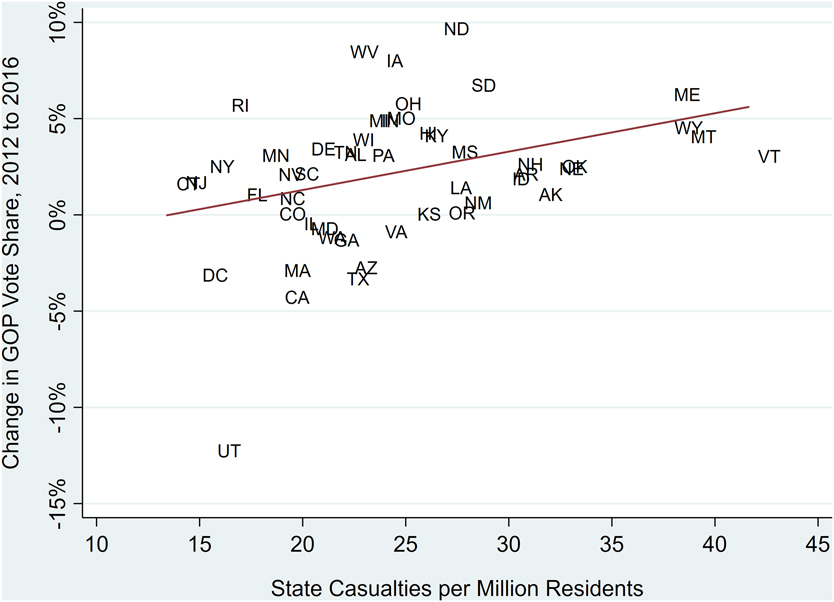
Because the relationship is easiest to visualize at the state level, we first constructed a scatter plot showing each state’s casualty rate on the x-axis and the change in GOP vote share from 2012 to 2016 on the y-axis (figure 1). Trump outperformed Romney in 40 of 50 states. However, the clear positive relationship shown in the scatter plot illustrates Trump’s ability to make electoral inroads among high-casualty states. The bivariate relationship also is substantively meaningful. A two-standard-deviation increase in a state’s casualty rate produced an estimated 2.6% increase in electoral support for Donald Trump. President Trump won the presidency despite losing the national popular vote by almost 3 million votes because of razor-thin margins in Pennsylvania, Wisconsin, and Michigan. All three of these states experienced casualty rates close to the national median. A simple bivariate model suggests that if each state had suffered a lower casualty rate—for example, that of New York—Trump could have lost between 1.4% and 1.6% of the vote. Such a shift would have changed all three states from red to blue and sent Hillary Clinton to the White House.
Trump’s Electoral Success in High-Casualty States

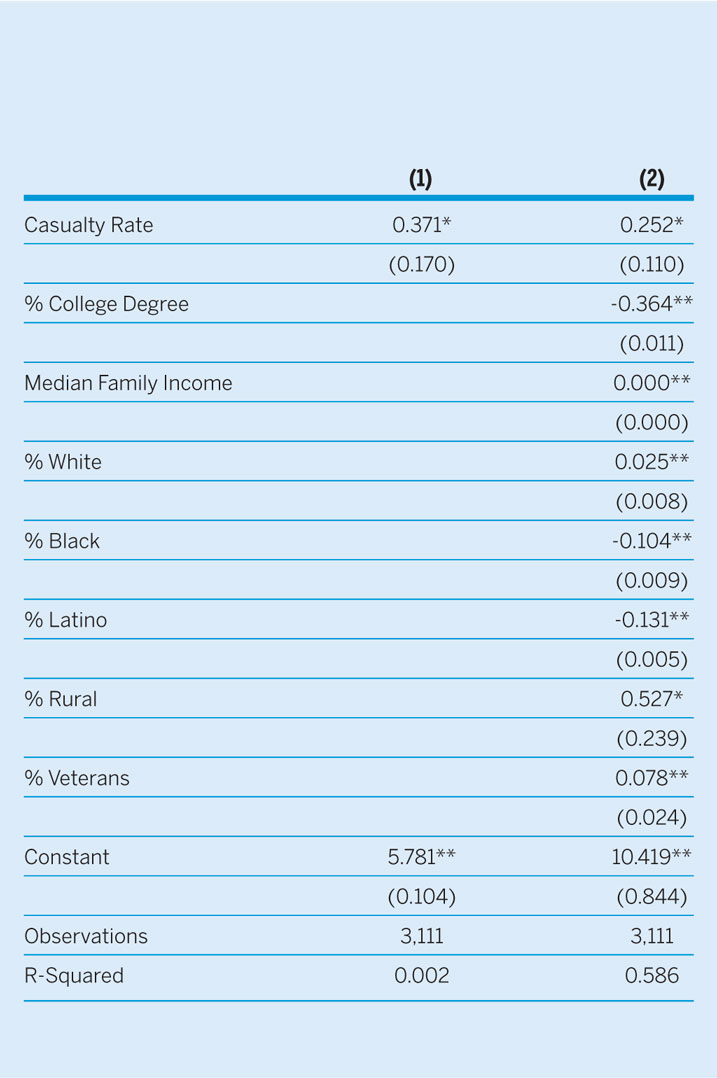
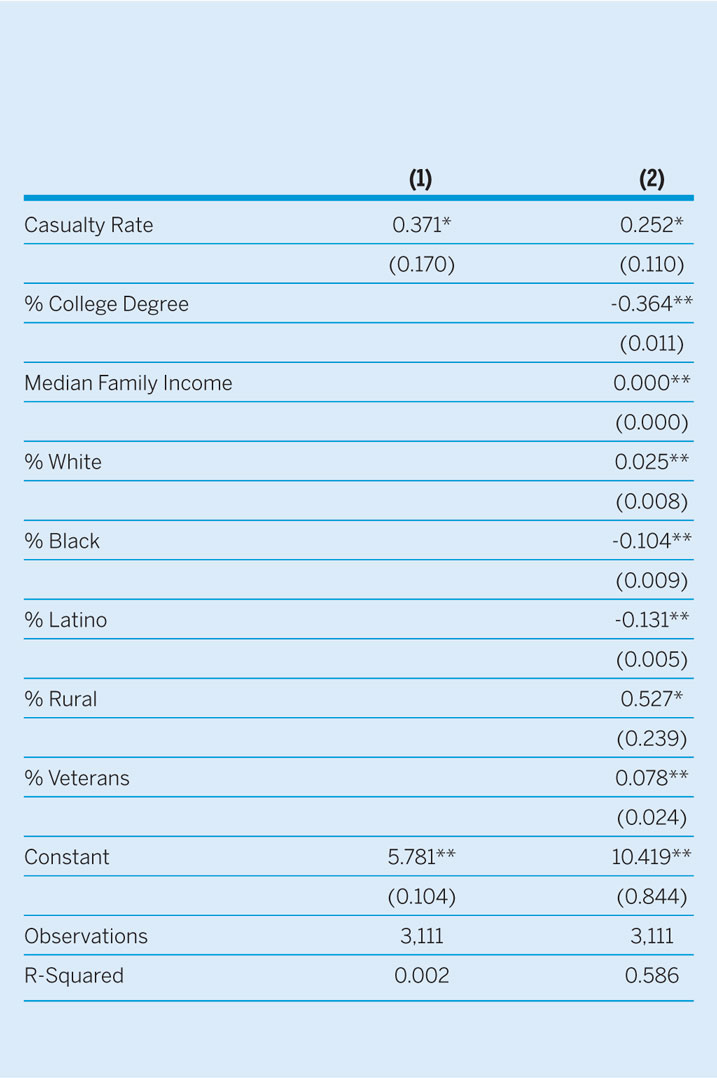
However, most states are large, heterogeneous places. The wartime experiences and direct exposure to war costs of residents of Upstate and Western New York, for example, may look different from those living in the New York City suburbs. To account for these intrastate differences and to paint a more nuanced picture, we conducted a follow-up analysis of the relationship between Iraq and Afghanistan war casualties and Trump’s electoral success at the county level. The first column in table 1 presents results of a bivariate ordinary least squares regression of the change in GOP vote share from 2012 to 2016 on a county’s casualty rate. As in the state-level analysis, the relationship is positive and statistically significant. Trump was even more successful in surpassing Romney’s 2012 performance in communities that had suffered disproportionately high casualty rates.
County Casualty Rates and Change in GOP Vote Share, 2012–2016
Notes: Standard errors are in parentheses. All significance tests are two-tailed. *p<0.05; **p<0.01.
Prior research has shown that Iraq and Afghanistan war casualties are not randomly distributed across the country (Kriner and Shen Reference Kriner and Shen2016). Rather, they correlate significantly with other demographics that also might identify communities particularly receptive to Trump’s candidacy. To ensure that county casualty rates are not serving only as a proxy for another characteristic identifying counties predisposed to support Trump to a greater degree than Romney, we estimated a second regression model including a number of control variables. Perhaps most important, because prior research has shown that recent war casualties have hailed disproportionately from communities with lower levels of income and educational attainment, we controlled for each county’s median family income and percentage of adult residents with a college degree. Exit polls from 2016 showed that Trump performed well among voters without a college degree; as a result, this is a particularly important control. We also included three variables indicating each county’s racial composition: the percentage of residents that were white, black, or Latino. Trump struggled to connect with African American voters, and his hardline immigration policies alienated him from many Latinos. As a result, we expected Trump to struggle to make electoral inroads in counties with large nonwhite populations. Finally, we controlled for the percentage of each county’s population that lives in rural areas, as well as the percentage that are military veterans. The results are presented in column 2 of table 1.
Even after including all of these demographic control variables (for which all of the regression coefficients align with expectations), the relationship between a county’s casualty rate and Trump’s electoral performance remains positive and statistically significant. Trump significantly outperformed Romney in counties that shouldered a disproportionate share of the war burden in Iraq and Afghanistan. At the county level, the relationship between local casualty rates and Trump’s vote share is substantively modest yet politically meaningful. A two-standard-deviation increase in a county’s casualty rate produced more than a half-point swing in the predicted two-party vote share from Clinton to Trump.
AN ELECTORAL CHECK ON MILITARY ADVENTURISM?
Whereas many analysts pointed to public frustration with the Iraq War as a contributing factor to President Obama’s victory in 2008, the greatly escalated war in Afghanistan received little attention in 2012. Moreover, in the postelection analysis of the 2016 cycle, discussion of war fatigue was all but absent. America’s ongoing wars in Central Asia may appear politically invisible precisely because their costs are largely hidden from view and paid disproportionately by a small segment of the electorate. Nevertheless, our analysis suggests that Trump recognized and capitalized on this inequality in sacrifice. Trump recaptured voters in this constituency that had begun to turn away from Republican candidates in the mid-2000s in large part by breaking from the party’s foreign-policy orthodoxy. His message resonated with voters in communities largely abandoned by traditional politicians in both parties.
Nevertheless, our analysis suggests that Trump recognized and capitalized on this inequality in sacrifice.
Nevertheless, whereas Trump’s campaign rhetoric helped him return many voters in high-casualty communities to the Republican fold in 2016, he risks losing key electoral support if he simply continues the military policies of his predecessors. Indeed, Trump has given himself a difficult task—to follow through on his bombastic rhetoric promising renewed military strength while simultaneously avoiding costly policies that threaten a key constituency. From this perspective, Trump’s often wild vacillations during his first three years in office may be at least in part a function of the competing incentives that he faces and not due solely to his erratic personality traits. Trump has followed through on his campaign pledge to “bomb the hell out of ISIS” while resisting calls for more troops on the ground. In August 2017, Trump reversed his prior support for withdrawing from Afghanistan and instead dispatched thousands of additional troops to step up operations against the Taliban. Yet, in private conversations, Trump often expresses support for an early withdrawal.Footnote 9 In June 2018, he shelved his bellicose rhetoric toward North Korea and instead agreed at a summit with Kim Jong Un to end joint military exercises with South Korea, which the president dismissed as “provocative” and costly.
Ultimately, it is impossible to know whether Trump’s militaristic or interventionist impulse will win out. His brusque dismissal of John Bolton in September 2019 coupled with his surprising sudden announcement of the withdrawal of American forces from Northern Syria certainly suggest that by the latter stages of his first term, his noninterventionist leanings were coming to the fore. However, as is his wont, Trump quickly complicated the interpretation of events when he took to Twitter within hours of announcing the Syrian withdrawal to warn Turkey that if it did anything that he—in his “great and unmatched wisdom”—deemed “off limits” in the void left by the American withdrawal, he would “totally destroy and obliterate the Economy of Turkey.”Footnote 10 If Trump were to translate these bellicose sentiments into action against Turkey, Iran, or another adversary, it could spell political peril at the ballot box.
Our results also have important implications for Democrats. Currently, the Democratic Party is engaging in a period of fitful soul searching in a quest to understand its inability to connect with many working-class and rural voters who abandoned the party of FDR for Trump. Much of this introspection has focused on the party’s position on trade policy and economic inequality and emphasizes identity politics. However, Democrats also may want to reexamine their foreign-policy posture if they hope to erase Trump’s electoral gains among constituencies that were exhausted and alienated by 18 years of war.