

Introduction
Maternal diet during pregnancy has long been recognised as an important determinant of neonatal outcomes and child development. Eating a nutritious and balanced diet is important in preparing the body for the demands of pregnancy. 1 Maternal diet also has the potential to influence neonatal birth outcomes, including placental development, Reference Reijnders, Mulders, Van Der Windt, Steegers and Steegers-Theunissen2 birth complications, Reference Kind, Moore and Davies3 preterm deliveries, Reference Saunders, Guldner and Costet4 and birth weight. Reference Zerfu, Pinto and Baye5 Furthermore, poor nutrition in pregnancy, that is, a diet which contains inadequate fruit and vegetables, or excessive discretionary foods high in salt, fat, and sugar, 6 is one risk factor for developing allergies in childhood. Reference Venter, Brown, Maslin and Palmer7–Reference Seyedrezazadeh, Pour Moghaddam, Ansarin, Reza Vafa, Sharma and Kolahdooz10 Poor maternal nutrition during pregnancy is a leading modifiable risk factor associated with risk of disease in adult life; this is known as ‘early life programming’. Reference Moody, Chen and Pan11 This relates to the concept of ‘Developmental Origins of Health and Disease’ which links environmental factors in early life with the state of health in childhood and adult life. Maternal diet is an extremely important maternal factor which can influence neonatal outcomes and a child’s long-term health and development.
The Mediterranean Diet (MD) is characterised by high consumption of fruit and vegetables, legumes, nuts and seeds, whole grains, olive oil, dairy, poultry, a moderate amount of fish, and small amounts of red meat. Anti-inflammatory and antioxidative properties provided in the MD have led to it being well-recognized, with extensive benefits for both non-pregnant and pregnant individuals and the growth of their offspring. Reference Del Chierico, Vernocchi, Dallapiccola and Putignani12 Mediterranean Diet adherence (MDA) in pregnancy has shown to be beneficial in reducing risk of preterm delivery Reference Saunders, Guldner and Costet4 and small-for-gestational-age infants. Reference Martínez-Galiano, Olmedo-Requena and Barrios-Rodríguez13 Although MDA during pregnancy is not associated with risk of childhood overweight risk (defined by WHO as age-specific and sex-specific body mass index (BMI) ≥85th percentile), it has been linked to lower child waist circumference (p = 0.009) in pre-school children, which is a marker of abdominal obesity. Reference Fernández-Barrés, Romaguera and Valvi14 Nutritional intervention with supplemented MD during pregnancy has also shown to reduce risk of maternal metabolic syndrome and gestational diabetes mellitus (GDM), Reference Assaf-Balut, García De La Torre and Durán15 and previous studies have shown that there is a link between high MDA and reducing maternal glucose levels, lowering GDM risk, and improving glycaemic control among women diagnosed with GDM. Reference Assaf-Balut, García De La Torre and Durán15–Reference Olmedo-Requena, Gómez-Fernández, Amezcua-Prieto, Mozas-Moreno, Khan and Jiménez-Moleón17 The MD has been the most widely studied and evidence-based dietary approach to healthy eating and disease prevention in non-pregnancy populations, Reference Estruch, Martínez-González and Corella18–Reference Widmer, Flammer, Lerman and Lerman21 less research has been conducted exploring the beneficial effects this diet has on pregnant populations and neonatal outcomes.
Newborn weight is considered a major determinant in perinatal morbidity and mortality Reference Martínez-Galiano, Olmedo-Requena and Barrios-Rodríguez13 and is largely determined by prenatal diet quality, gestational weight gain, and pre-pregnancy maternal BMI in all maternal weight categories. Reference Parker, Tovar, McCurdy and Vadiveloo22
Neonatal body fat percentage has the potential to influence metabolic diseases later in life, hence it is important that this is assessed and screened early in life. Reference Wiechers, Kirchhof and Balles23 The PEA POD device, using air displacement plethysmography (ADP), is a valuable tool in assessing body composition, specifically body fat percentage in the newborn. PEA POD measurements provide information about fetal energy supply and growth conditions during pregnancy Reference Catalano, Thomas, Huston-Presley and Amini24,Reference Sewell, Huston-Presley, Super and Catalano25 and can also be used as a potential predictor of future obesity and metabolic disease later in life. Reference Aris, Bernard and Chen26–Reference Bao, Threefoot, Srinivasan and Berenson28 A systemic review published in BMC Pediatrics used 14 studies (n = 6231 infants) suggesting that weighted mean body fat percentage was 10 (4.1)% and weighted mean fat-free mass was 2883 (356) g in healthy term infants, and that infant body composition varied depending on gender and ethnicity. Reference Wiechers, Kirchhof, Maas, Poets and Franz29
Recording dietary patterns using a food frequency questionnaire (FFQ) is an important tool to analyse eating behaviours in an individual. The Healthy Eating Index, Reference Guenther, Casavale and Reedy30 The Diet Quality Index, Reference Patterson, Haines and Popkin31 The Healthy Diet Indicators, Reference Huijbregts, Feskens and Räsänen32 and the Mediterranean Diet Score (MDS) Reference Trichopoulou, Kouris-Blazos and Wahlqvist33 are the four ‘original’ diet quality scores which have been validated most extensively. The various indexes differ with exact method of scoring and specific foods; however, all share a common purpose of showing the association between general diet quality and mortality or disease risk. Reference Waijers, Feskens and Ocké34 Of these, the MDS is the most extensively used index to assess MDA and has been created for the evaluation of multiple diet–health relationships. Reference Bach, Serra-Majem and Carrasco35 High MDA has been shown to reduce cardiovascular risk and several forms of cancer in adults. Reference Trichopoulou, Kouris-Blazos and Wahlqvist33,Reference Trichopoulou, Lagiou, Kuper and Trichopoulos36 A recent retrospective cross-sectional study conducted on 218 women and newborns from a Canarian pregnant population showed no trend between MDA and birth weight. Reference Tomaino, Suárez, Domínguez, Cruz, Díaz and Majem37 To our knowledge, however, there has been no research that focuses on MDA in pregnancy and its association with neonatal body composition, specifically body fat percentage of the infant. Using the MDS, this study hypothesised that high MDA in pregnancy would predict lower neonatal body fat percentage, regardless of infant sex, ethnicity, maternal pre-pregnancy BMI, or gestational diabetes, which may be a crucial factor in promoting improved health and reducing risk of metabolic disease in the future. This study aims to investigate the relationship between maternal MDA and neonatal outcomes.
Method
Study design and study population
This study is part of The ORIGINS Project (ORIGINS). Reference Silva, Hagemann and Davis38 The ORIGINS Project commenced in January 2017 and is a decade-long collaborative initiative between the Joondalup Health Campus and the Telethon Kids Institute to establish a Western Australian birth cohort of 10,000 families enrolled in pregnancy over a 5-year period, creating a major research platform with an extensive biobank and databank. ORIGINS aims to collect detailed information about the influence of the early environment’s influences on a broad range of non-communicable diseases through the collection of biological samples (such as blood, urine, stool, cheek swabs, and breastmilk), online questionnaires, and routine collected data. Reference Hagemann, Colvin, Silva and Prescott39
This study focused on a subset of 458 maternal participants in their third trimester of pregnancy, and their newborns. The eligibility criteria for participants (pregnant women) in this study were as follows: (1) participant who consented in The ORIGINS Project; (2) singleton pregnancy; (3) birthing at Joondalup Health Campus; (4) completed online questionnaire during their third trimester of pregnancy; (5) newborns ≥37 weeks’ gestation who obtained a PEA POD measurement. With all inclusion criteria met, data from a total of 458 participants were analysed. Approval from the Ramsay Health Care WA|SA Human Research Ethics Committee (RHC WA|SA HREC) and previously the Human Research Ethics Committee of Joondalup Health Campus (JHC HREC) was obtained prior to commencing this study.
Maternal and newborn information
Birth measurements including APGAR score, newborn length, birth weight, and head circumference were obtained by the attending midwife and stored on the JHC Meditec hospital patient information system, along with information on other birth outcomes, ethnicity, and antenatal risk factors. Socio-Economic Indexes for Areas (SEIFA)/Index of Relative Socio-Economic Advantage and Disadvantage (IRSAD) scores were calculated based on the Australia Bureau of Statistics data cubes which uses participants Postal Area Code. 40 Maternal pre-pregnancy BMI was not a routinely collected measure; however, this was available on 54% of this study population.
Data collection
The Mediterranean Diet index (MDI) consisted of 13 questions, which corresponded to receiving a positive score if patients consumed (1) high ratio of monounsaturated fats : saturated fats, (2) high olive oil intake, (3) high vegetable intake, (4) high fruit intake, (5) low intake of meat and meat products, (6) low intake of saturated fats, (7) low intake of sweetened carbonated beverages, (8) high legume intake, (9) high fish or seafood intake, (10) less sweets/pastry intake, (11) high intake of nuts, (12) higher consumption of white meat: to red meat ratio, and (13) high sofrito (tomato/onion based) sauces used when cooking. In general, the medians of the sample, specific for sex, were used as cut-off points Reference Costacou, Bamia, Ferrari, Riboli, Trichopoulos and Trichopoulou41 and grams per day were used as the intake measurement. Reference Trichopoulou, Kouris-Blazos and Wahlqvist33 A participant received a point if intake was over the sample median for a protective component (vegetables, fruits, etc.) and below the median for non-protective components (dairy products, meat, etc.). A low-moderate alcohol intake has been associated with higher MDA in the vast majority of population studies; however, as alcohol consumption in pregnancy is associated with increased risk of miscarriage, stillbirth, and premature birth, Reference O’Leary42 abstinence from alcohol is recommended in this population hence excluded from this questionnaire. Calculating MDA in this study was based on a similar format to the multicentre PREDIMED trial which used the 14-item MD assessment tool. Reference Martínez-González, García-Arellano and Toledo43 MDA was categorised into three categories based on the overall score from 13 questions (as alcohol intake was excluded from the maternal questionnaires): with low (score 0–4), medium (score 5–7), and high (score 8–13) MDA.
The PEA POD is an ADP system which uses whole-body densitometry to determine body composition in infants weighing between 1 and 8 kg. The PEA POD has been widely used in research as it is easy to use, provides immediate results, is non-invasive, and has been validated for both term and preterm infants against deuterium dilution. Reference Ellis, Yao, Shypailo, Urlando, Wong and Heird44 To determine body composition, the infant is first undressed, and their mass is measured using an integrated scale. The mass and volume calibrations take into account irremovable items from the neonate (two hospital identification bracelets and an umbilical cord clip). The percentage body fat is then computed by a software to the PEA POD system (version 3.0.1) which estimates body composition by whole-body densitometry using a two-compartment model – fat and fat-free compartments. Within the volume calculation, corrections are applied for air within the lungs and in close proximity to the participants skin, which behaves isothermally. The infants percentage body fat is then calculated from body density assuming the density of fat to be 0.9007 kg/L. Age- and gender-specific densities of free-fat mass (FFM) are computed based on the data of Fomon et al. Reference Fomon, Haschke, Ziegler and Nelson45 Once body volume is known and whole-body density is calculated, fat mass (FM) and FFM are estimated. Reference Villar, Puglia and Fenton46 Infants length was measured from heel to crown using an infant length board. Data on the infant were then recorded and incorporated into PEA POD measurements, including birth weight, length, gender, ethnicity, and gestational age using participants date of birth. The PEA POD is routinely calibrated by trained ORIGINS Project staff and is housed in a temperature-controlled room. PEA POD measurements were taken on infants within 7 days post-birth and results were uploaded into The ORIGINS Project Databank. The PEA POD results were based on the estimates of Fomon et al., which uses a number of datasets and assumptions to describe a ‘typical’ boy weighing 3.5 kg and a girl weighing 3.35 kg. Reference Fomon, Haschke, Ziegler and Nelson45
Data analysis
Data were analysed between maternal MDA (high, moderate, and low adherence categories) in the thirdd trimester, and maternal characteristics, birthing characteristics, and neonatal outcomes. Neonatal outcomes included infants’ weight, length, head circumference, and PEA POD body fat percentage measured ≤7 days post-birth.
Data are presented as frequencies and percentages for categorical data and were analysed using chi square or Fisher’s exact test (when expected cell counts <5). For continuous data, means and standard deviations are reported and associations with MDA analysed using linear regression. For the linear regression models, the continuous variable was the outcome and MDA entered in the model as a categorical predictor. Comparisons were made between each MDA group using mean differences and their corresponding 95% confidence interval. Firstly, the regression analysis was performed using univariable (unadjusted) regression and later adjusted for pre-pregnancy BMI, infant sex, ethnicity, and gestational diabetes. There is a substantial drop in sample size in the adjusted models due to incomplete data for BMI; however, as BMI and infant sex are important confounders, we have chosen to still present these results. All data were analysed using Stata 16.1 (StataCorp, College Station, TX). Statistical significance was considered p < 0.05.
Results
A total of 458 mothers and their infants participated in the study with data available for MDI and the PEA POD. There were 67 infants who had their PEA POD measurements taken more than 7 days after delivery and were therefore excluded from the infant body fat percentage analysis. Mothers’ pre-pregnancy BMI data were available for only 54% of the cohort.
Baseline characteristics are presented in Table 1. The mean age of the mother (at the birth of the infant) was 32 years and 6 months (SD 4 years 7 months). Of note, the majority of maternal participants were of high SEIFA/IRSAD background, obtaining a university level of education. Infant sex was evenly distributed with a mean infant weight of 3464 g for males and 3358 g for females.
Maternal demographics and neonatal outcomes in relation to MDA in pregnancy

The majority of mothers reported a moderate MDI score, with 40% classified as low, 50% moderate, and 10.3% high MDA.
Neonatal body fat percentage was not influenced by maternal demographic information for low, moderate, or high MDA groups. No significant difference was seen between the three groups in relation to SEIFA/IRSAD (p = 0.611), maternal education (p = 0.828), marital status (p = 0.888), first pregnancy (p = 0.386), smoking in pregnancy (p = 0.487), gestational diabetes (p = 0.296), or ethnicity (p = 0.531) in pregnant mothers (Table 1). In addition, there was no significant difference in the three MDA groups in relation to birth method (p = 0.808), APGAR score at 1 min (p = 0.570), APGAR score at 5 min (p = 0.805), admission to the neonatal nursery (p = 0.405), or gender (p = 0.704).
The majority of infants (85%, n = 389/458) had PEA POD measurements taken within 7 days of delivery, many of which were within 4 days (with 96 hours) post-delivery (90%, n = 351/389). Table 2 describes the results associations between continuous neonatal outcomes and MDA, highlighting infants born to mothers with high MDA during third trimester of pregnancy had a body fat percentage of 11.3%, whereas infants born to mothers with low MDA had a higher body fat percentage of 13.3% (p = 0.010), and weighed on average 148 g less, although this did not reach statistical significance (p = 0.053). Babies born to mothers who had moderate MDA during third trimester of pregnancy presented on average with 1.0% less body fat compared to those on a low MD (p = 0.029). After adjusting for maternal pregnancy BMI, infant sex, ethnicity, and maternal gestational diabetes, there was still a significant reduction in infant body fat percentage (p = 0.016) between high vs low MDA categories, despite a reduction in sample size.
The relationship between maternal MDA (third trimester) and neonatal outcomes, including PEA POD body fat percentage (%)
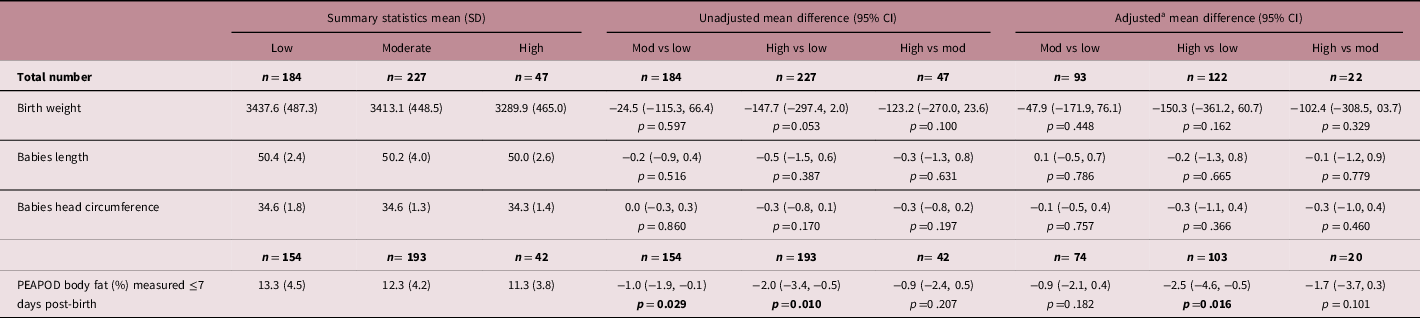
a Adjusted for pre-pregnancy maternal BM, infant sex, ethnicity, and gestational diabetes.
Discussion
MDA in pregnancy has the potential to effect both fetal development and maternal health. This study aimed to investigate the relationship between maternal MDA and neonatal outcomes. The results suggest that maternal MDA is associated with neonatal body fat percentage, which has been recognised as an early and potentially modifiable risk factor for predicting future health and metabolic disease. Reference Forsen, Eriksson, Tuomilehto, Reunanen, Osmond and Barker47,Reference Ibáñez, Ong, Dunger and De Zegher48
Body fat percentage is a measure which can reflect the developmental plasticity an infants’ brain has in response to environmental cues. Reference Wells49,Reference Yajnik, Fall and Coyaji50 This study suggests that high MDA in pregnancy is a possible adjustable factor in reducing the body fat percentage of the newborn.
In human infants, adipose tissue growth is negligible until 24–25 weeks’ gestation. Reference Ziegler, O’Donnell, Nelson and Fomon51 FM increases very rapidly during the third trimester of pregnancy, and peaks around 6 postnatal months. After this time, the rate of the FM growth slows relative to the fat-free mass (FFM) growth, resulting in a decline in percent body fat. Reference Saunders, Guldner and Costet4,Reference Butte, Wong, Hopkinson, Heinz, Mehta and Smith52–Reference Fomon and Nelson54 There are many variables that can influence this timeline based on factors such as feeding mode, nutritional composition, Reference De Zegher, Sebastiani, Diaz, Sánchez-Infantes, Lopez-Bermejo and Ibáñez55,Reference Escribano, Luque and Ferre56 inflammation, Reference Mak R.H.57,Reference Martínez, Cordero, Campión and Milagro58 the insulin/IGF-1 hormone axis, Reference Madsen, Larnkjær, Mølgaard and Michaelsen59 and genetic factors. Reference Choh, Curran and Odegaard60,Reference Demerath, Choh and Czerwinski61 The results from this study suggest that in comparison to low MDA, high maternal MDA in third trimester has a significant association with changing infant PEA POD body fat % (p = 0.010). This aligns with the rapid increase of infant body fat percentage during the third trimester of pregnancy. Reference Strauss and Dietz62,Reference Abrams and Selvin63 Similar to other studies, there was no association between maternal MDA and birth weight Reference Tomaino, Suárez, Domínguez, Cruz, Díaz and Majem37 although high vs low MDA was close to being significant. This research emphasises that it may be worthwhile to encourage high MDA in all trimesters of antenatal care regardless of infant gender.
Studies have shown that during pregnancy, motivation for eating a healthy diet changes relative to that of a non-pregnant state as women prepare for motherhood and consider the impact of their nutritional intake on the baby’s health. Reference Copelton64,Reference Szwajcer, Hiddink, Koelen and van Woerkum65 Although most women are aware that they should consume a healthy diet during pregnancy, many lack the knowledge on specific dietary recommendations or do not have the skills or capacity required to modify their diet. Reference Reyes, Klotz and Herring66 Public health campaigns may address the potential lack of nutritional awareness and create a platform to promote high MDA in pregnancy.
Although high maternal MDA may be an achievable goal in setting the stage for a child’s future health for some, for many individuals, compliance to this nutrient rich diet may be costly. Reference Drewnowski and Eichelsdoerfer67 Foods with the most nutrients and least energy tend to be the most expensive, at least on a per unit of energy (MJ, kcal) basis, and as food prices rise (or the food budget shrinks) the first items dropped from the diet are those which are most costly and most healthy: high quality proteins, meat, fish, vegetable, and fruit. What remains is energy dense refined grains, sugars, and fats. Reference Chan68,Reference Andrieu, Darmon and Drewnowski69 However, Goulet et al. found that promoting a MD diet need not necessarily be associated with higher overall dietary costs. Reference Goulet, Lamarche and Lemieux70
Addressing the limitations
Our study had potential limitations that needed to be addressed. Pre-pregnancy BMI data were only available for half the cohort. Although there was no significant difference in pre-pregnancy BMI and MDA categories when pre-pregnancy BMI was adjusted for the neonatal fat percentage, the results remained significant, which is consistent with other studies. Reference Parker, Tovar, McCurdy and Vadiveloo22 Given this association, gathering data on the pre-pregnancy BMI across the whole cohort would be important.
Online self-report questionnaires have some limitations including the potential to introduce recall and response bias. Even though participants were able to stop and start questionnaires to allow for flexibility, incomplete questionnaires were flagged and reminder texts, emails, and/or phone call reminders were sent from The ORIGINS Project staff to encourage questionnaire completion and reduce the chances of introducing recall bias. Response bias is also a possibility in all self-reported questionnaires and may have been the case in this MD assessment tool. Unlike other questionnaires such as full-length FFQs which usually require >100 items, 24 h recalls, or other time-consuming methods, this assessment tool looked only at a small number of foods measured in servings/day or servings/week in easily understandable units (food servings), Reference Zazpe, Sanchez-Tainta and Estruch71 hence reducing the likelihood of both recall and response bias. Participants confidentiality and data deidentification were also emphasised when consent was obtained to encourage participants to answer truthfully on all questions.
Although previous studies suggest that there is a link between MDA and reduction in maternal glucose levels, this was not included in the study. Although studies have shown that the magnitude of these effects was small, particularly with respect to insulin resistance, it may still be considered an important factor which may have a role to play in future studies.
Another potential limitation was that cord blood was not analysed in this study. As MDA may influence cord blood leptin and adiponectin levels, follow-up studies looking at this information through the ORIGINS Project biobank may be needed to see if these measures have any influence on childhood obesity in the future.
Body fat percentage was taken on infants within 7 days post-birth; however, the vast majority of participants had PEA POD measurements within 92 h post-delivery. A systematic review noted no significant difference in body fat percentage within 92 h post-delivery Reference Wiechers, Kirchhof, Maas, Poets and Franz29 but limited research beyond this timeframe is available.
Future studies
While this study has shown that there is an association between maternal MDA and infant body fat percentage, it is still unclear if having good MDA during pregnancy will have positive effects in the offspring not only during fetal and early life but also in later life. Epigenetic modification and the role oxidative stress, enzyme function, signal transduction, and transcription pathways have on maternal and fetal metabolism could provide an explanation for the benefits high MDA in pregnancy has on neonatal outcomes. Reference Gonzalez-Nahm, Mendez and Robinson72 Future follow-up of participants in The ORIGINS Project will examine whether changes in neonatal body fat percentage significantly impact growth and development in later life.
Conclusion
Pregnancy presents a window of opportunity for healthcare professionals to intervene and improve the health of both mother and child. Reference Amati, Hassounah and Swaka73 Compliance with the MD during pregnancy has been shown to have a significant influence in shaping the neonatal body fat percentage at birth, which is one of the earliest and potentially modifiable risk factors for metabolic disease. This study suggests that an infant’s body fat percentage can be influenced by adjusting the maternal diet. Further studies will be important in examining whether these small but significant changes at birth will set the trajectory for more significant changes in the child’s future health and development.
Acknowledgements
The ORIGINS Project is only possible because of the enthusiasm and commitment of the children and parents in ORIGINS. We are grateful to all the participants, health professionals, and researchers who have made The ORIGINS Project happen. Cosmed, UWA, and JHC who assisted with purchase of the PEA POD.
Financial support
WA Sceptics Society for specific financial assistance with this project.
The ORIGINS Project has received core funding support from the Telethon Perth Children’s Hospital Research Fund, Joondalup Health Campus, the Paul Ramsay Foundation and the Commonwealth Government of Australia through the Channel 7 Telethon Trust. Substantial in-kind support has been provided by Telethon Kids Institute and Joondalup Health Campus.
Conflict of interest
None.
Ethical standards
HREC Name: Ramsay Health Care WA|SA HREC
HREC Code: EC00266
HREC Contact Officer: Joanna Brisbane
Position of HREC Contact Officer: Executive Officer
Contact Officer Phone: 08 9400 9897
Contact Officer Email: RamsayHREC.WA-SA@ramsayhealth.com.au
Ethics approval was granted by the Human Research Ethics Committee of Joondalup Health Campus, ref 1923.



