A central component of developmental psychopathology is that mothers and infants have the potential to interactively influence each other across time, within the context of their environment (Feldman, Reference Feldman2012; Rutter & Sroufe, Reference Rutter and Sroufe2000). This necessarily involves biobehavioral interactions, which in the postpartum period facilitate neurobehavioral development in social affiliation and the ability to cope with stress (Feldman, Reference Feldman2012). Such interactions have been studied in terms of the dyadic cortisol response (i.e., interpartner relations, or lack thereof, of cortisol in a specific context and across time), and have been observed in many contexts, including diurnal rhythm (e.g., Bright, Granger, & Frick, Reference Bright, Granger and Frick2012; Hibel, Granger, Blair, Finegood, & Family Life Project Key Investigators, Reference Hibel, Granger, Blair and Finegood2015), clinical intervention (Middlemiss, Granger, Goldberg, & Nathans, Reference Middlemiss, Granger, Goldberg and Nathans2012), and laboratory challenge procedures (Atkinson et al., Reference Atkinson, Gonzalez, Kashy, Santo Basile, Masellis, Pereira and Levitan2013; Laurent, Ablow, & Measelle, Reference Laurent, Ablow and Measelle2011). In studying the dyadic cortisol response, previous studies have focused on a concept known as mother–infant cortisol attunement (e.g., Atkinson et al., Reference Atkinson, Gonzalez, Kashy, Santo Basile, Masellis, Pereira and Levitan2013; Bright et al., Reference Bright, Granger and Frick2012; Crockett, Holmes, Granger, & Lyons-Ruth, Reference Crockett, Holmes, Granger and Lyons-Ruth2013; Hibel, Granger, Blair, Cox & Family Life Project Key Investigators, Reference Hibel, Granger, Blair and Cox2009; Hibel et al., Reference Hibel, Granger, Blair and Finegood2015; Laurent et al., Reference Laurent, Ablow and Measelle2011; Middlemiss et al., Reference Middlemiss, Granger, Goldberg and Nathans2012; van Bakel & Riksen-Walraven, Reference van Bakel and Riksen-Walraven2008). However, as it stands, this literature has not consistently defined and assessed the concept of cortisol attunement (as has been noted elsewhere; Atkinson, Jamieson, Khoury, Ludmer, & Gonzalez, Reference Atkinson, Jamieson, Khoury, Ludmer and Gonzalez2016; Bernard, Kashy, Levendosky, Bogat, & Lonstein, Reference Bernard, Kashy, Levendosky, Bogat and Lonstein2016; Laurent et al., Reference Laurent, Ablow and Measelle2011). The current study attempts to expand upon the current conceptualization of cortisol attunement, both theoretically and empirically, and examine its association with mother–infant attachment disorganization.
Based on the theory of attachment in dyadic relationships, attunement, whether it be physiological, behavioral, or affective, can be defined as the process of responding to and adjusting with one another over time (Feldman, Reference Feldman2012; Leclère et al., Reference Leclère, Viaux, Avril, Achard, Chetouani, Missonnier and Cohen2014). This conceptualization is similar in many ways to that of parental sensitivity; it involves the capacity to respond appropriately to the other, as necessitated by their signals and environmental context. Of importance, this definition of attunement is not synonymous with statistical correlation between dyadic responses. That is, an attuned response on the part of the mother does not always “mimic” a child's response; it is not always the same or similarly valanced (Atkinson et al., Reference Atkinson, Jamieson, Khoury, Ludmer and Gonzalez2016).Footnote 1 Attuned dyadic responses may involve both partners upregulating or downregulating together and in synchrony to one another, or it could involve a sensitive mother who downregulates her physiology to aid in the downregulation of her physiologically distressed infant (as in Atkinson et al., Reference Atkinson, Gonzalez, Kashy, Santo Basile, Masellis, Pereira and Levitan2013). This conceptualization assumes that attunement involves optimal regulation of the infant, within a particular context.
Consistent with the dimensional nature of sensitivity, responses can also be misattuned, indicating a failure in adjusting one's response appropriately to the other. For example, vascular function is positively affected by laughter and adversely affected by negative emotional states (Sugawara, Tarumi, & Tanaka, Reference Sugawara, Tarumi and Tanaka2010). Therefore, if an adult is amused by the tribulations of a child, the vascular adjustments of both might be misattuned, with the adult's laughter serving to benefit his/her own vascular function while impairing that of the child. Misattunement can be subtle, as in the form of a dampened decline in maternal cortisol in the context of dyadic challenge (e.g., with less sensitive mothers; Atkinson et al., Reference Atkinson, Gonzalez, Kashy, Santo Basile, Masellis, Pereira and Levitan2013) or more profound, as when a mother responds to a stimulus without regard to her infant's state (Milligan, Atkinson, Trehub, Benoit, & Poulton, Reference Milligan, Atkinson, Trehub, Benoit and Poulton2003).
Subtly distinct from misattunement is lack of attunement, which refers to a dyadic cortisol response profile that is neither attuned nor misattuned; the systems of each partner function independently. Of note, lack of attunement can mimic statistical attunement. In such a case, for example, both infant and parent may show correlated increases in physiological reactivity over time (i.e., may look synchronous), but not because they are mutually attuned; rather, each partner may be reacting to the same challenging circumstance independently (Atkinson et al., Reference Atkinson, Jamieson, Khoury, Ludmer and Gonzalez2016). For instance, lack of attunement may occur when a mother is processing a shared situation as threatening to herself (e.g., ongoing intimate partner violence; Hibel et al., Reference Hibel, Granger, Blair and Cox2009) rather than reacting to her infant's stress. Theory is essential when distinguishing between these three heuristics, as the same statistical findings can emerge for each case. By way of example, Hibel and Mercado (Reference Hibel and Mercado2017) showed that mother and infant cortisol response profiles can appear attuned even when members are reacting to their own stressors that occurred at different times (in this case, a conflict discussion with their spouses for mothers, and an arm restraint for infants). We apply these terms to the mother–infant cortisol literature to disentangle the theoretical and empirical inconsistencies within.
Inconsistencies in the mother–infant cortisol attunement literature occur, in part, because attunement is often defined empirically as a statistically significant association between physiologies. However, as we mention above, theoretical attunement is not always present as statistical synchrony and requires an informed assessment of context (as discussed below). Furthermore, as summarized by Bernard et al. (Reference Bernard, Kashy, Levendosky, Bogat and Lonstein2016), even when attunement is defined empirically, results are obfuscated by inconsistent definitions and assessment of two key features: time and interactive reciprocity. In terms of time, if cortisol is assessed at more than one time point, statistical attunement might be conceptualized as simultaneous (i.e., associations between mothers and infants at the same time points), or lagged (i.e., one dyad member's cortisol at a previous time point is related to the other member's cortisol at the next time point). In terms of interactive reciprocity, statistical attunement might be conceptualized as mother led (i.e., mother's cortisol impacts infant's cortisol trajectory), infant led (i.e., infant's cortisol impacts mother's cortisol trajectory; Middlemiss et al., Reference Middlemiss, Granger, Goldberg and Nathans2012), or bidirectional (i.e., mother and infant cortisol impact mother and infant cortisol trajectories). All in all, these many possibilities, and a frequent failure to explicitly recognize them, make it difficult to construct a priori hypotheses regarding which features of attunement will emerge in a given situation.
As noted by Bernard et al. (Reference Bernard, Kashy, Levendosky, Bogat and Lonstein2016), the demonstration of each feature of statistical attunement may require a different analytic approach. For example, correlated growth models, which are multivariate multilevel models, simultaneously predict maternal cortisol, infant cortisol, and their relation (i.e., statistical attunement is conceptualized as the covariation in mother and infant intercept, typically baseline levels, and slope, that is, rate of change in trajectory over time; Kenny & Kashy, Reference Kenny, Kashy, Hox and Roberts2011). Cross-lagged models, in contrast, define statistical attunement as a significant association between one dyad member's cortisol at a specific time point and the other dyad member's cortisol value at the previous time point. As such, cross-lagged modeling assumes that statistical attunement occurs in a lagged fashion (with the lag dependent on the measurement of time available) and permits a data-driven assessment of reciprocity (i.e., mother led, infant led, or both). The differences between the statistical approaches used to assess attunement and how they map on to theoretical attunement are important for interpretation and have been overlooked. As an example, using correlated growth models, Atkinson et al. (Reference Atkinson, Gonzalez, Kashy, Santo Basile, Masellis, Pereira and Levitan2013) found that dyads with more sensitive mothers showed more similar magnitudes of cortisol change across dyadic paradigms than did dyads with less sensitive mothers. Atkinson et al. (Reference Atkinson, Gonzalez, Kashy, Santo Basile, Masellis, Pereira and Levitan2013) argued on theoretical grounds (Spangler, Schieche, Ilg, Maier, & Ackerman, Reference Spanglar, Schieche, Ilg, Maier and Ackermann1994) that maternal sensitivity serves as an external organizer of infant reactivity. This theory-based assumption might have benefited from a more holistic assessment of statistical attunement; for instance, using multiple analytical techniques to determine whether rates of change in trajectories covary (as was shown using correlated growth modeling) and using cross-lagged analyses to assess the potential for mother- and infant-led lagged attunement directly.
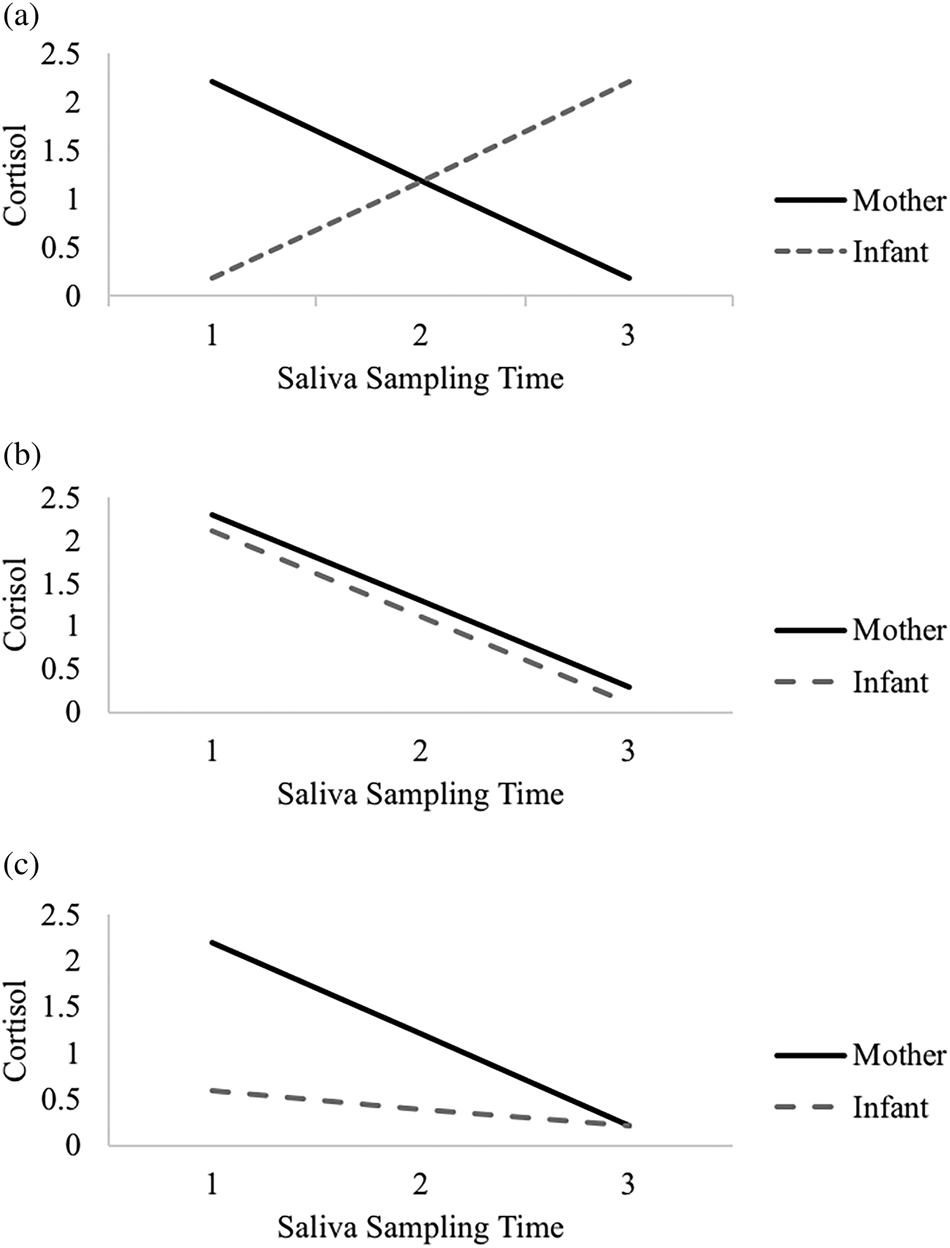
Furthermore, as demonstrated in Figure 1, the theoretical interpretation of statistical attunement results can be equivocal regardless of the type of approach chosen. This occurs, in part, because statistically significant covariation between slopes in multivariate multilevel models describes similarity in change magnitude without specifying the direction of change.Footnote 2 That is, results can reveal that mothers and infants have significantly correlated magnitude of cortisol change across time, regardless of whether trajectories change in different directions and absolute cortisol values are discrepant (Figure 1a), or whether trajectories are in the same direction and absolute cortisol values are similar (Figure 1b).Footnote 3 Without a description of trajectory directionality (that is interpreted in the context of the sample and task), the ability to discern whether the results reflect attunement, misattunement, or lack of attunement is compromised. We ourselves were guilty of this oversight in not discussing trajectory directionality (Atkinson et al., Reference Atkinson, Gonzalez, Kashy, Santo Basile, Masellis, Pereira and Levitan2013). Furthermore, Figure 1c demonstrates a pattern that could theoretically be labeled as cortisol attunement (e.g., it might reflect a mother successfully downregulating her infant), but that would not emerge as a statistically significant effect in correlated growth models because the maternal–infant cortisol slope magnitudes would not be correlated. Thus, this theoretical profile of cortisol attunement could be overlooked as a null effect. As such, different and potentially multiple analytic strategies, in combination with specification of trajectory directionality, may be necessary to adequately assess the nuanced forms of mother–infant cortisol attunement.
Multiple profiles of mother-infant cortisol attunement. Although they depict different relationships between maternal and infant cortisol, both a) and b) would statistically show significant correlation of maternal-infant slope magnitudes. c) depicts attunement that would not be statistically captured by correlation of slope magnitudes. As such, it is important for attunement studies to specify trajectory directionality.

Distinguishing between forms of theoretical attunement is further complicated by the fact that each pattern of dyadic cortisol responses can have different connotations across contexts. For example, as mentioned, Atkinson et al. (Reference Atkinson, Gonzalez, Kashy, Santo Basile, Masellis, Pereira and Levitan2013) linked maternal sensitivity to significant mother–infant magnitudes of cortisol change in a separation procedure. Atkinson et al. (Reference Atkinson, Gonzalez, Kashy, Santo Basile, Masellis, Pereira and Levitan2013) showed that, among sensitive dyads, as infants showed stronger increases in cortisol secretion, mothers showed stronger declines, reflecting Figure 1a (of note, and as mentioned above, Atkinson et al., Reference Atkinson, Gonzalez, Kashy, Santo Basile, Masellis, Pereira and Levitan2013, did not discuss trajectory directionality). Given that sensitive mothers are more likely to structure their interactive behavior in a manner that is contingent and appropriate to infant signals, it could be suggested that more sensitive mothers downregulated their own cortisol secretion so as to sensitively downregulate that of their infants. As such, more sensitive, relative to less sensitive, mothers showed more cortisol attunement with their infants, in the form of Figure 1a (Atkinson et al., Reference Atkinson, Gonzalez, Kashy, Santo Basile, Masellis, Pereira and Levitan2013).
In comparison to the example above, contextual risk factors have been linked to similar statistical patterns of attunement, but we argue that such findings can instead be theoretically interpreted as a lack of attunement. This can be demonstrated by cortisol attunement findings pertaining to intimate partner violence (Hibel et al., Reference Hibel, Granger, Blair and Cox2009) and recent-onset maternal depression (Laurent et al., Reference Laurent, Ablow and Measelle2011). Using latent growth curve modeling (which approximates correlated growth modeling in its treatment of time and interactive reciprocity), Hibel et al. (Reference Hibel, Granger, Blair and Cox2009) assessed dyadic cortisol attunement (defined statistically as the correlation between mother and infant slopes across time) as moderated by intimate partner violence (IPV). Hibel et al. (Reference Hibel, Granger, Blair and Cox2009) describe positive mother–infant slope correlations among IPV dyads. It is unclear whether the correlated slope magnitudes among IPV dyads reflect trajectories changing in different directions with discrepant cortisol values (Figure 1a), or trajectories changing in the same direction with similar cortisol values (Figure 1b). Regardless of directionality, the emergence of statistical attunement in the presence of IPV, a contextual risk factor, indicates an interpretation different from that of Atkinson et al. (Reference Atkinson, Gonzalez, Kashy, Santo Basile, Masellis, Pereira and Levitan2013). We suggest that in the case of IPV, such statistical attunement may reflect a theoretical lack of attunement; that is, maternal and infant physiological responses may be occurring independently of one another as each dyad member reacts independently to the stress of IPV.
We draw a similar conclusion from Laurent et al.’s (Reference Laurent, Ablow and Measelle2011) assessment of mother–infant cortisol attunement (assessed using univariate multilevel growth curve analyses with maternal cortisol entered as a predictor of infant cortisol, suggesting a mother-led conceptualization of attunement). Laurent et al. (Reference Laurent, Ablow and Measelle2011) showed that dyads involving a mother with low prenatal depressive symptoms that intensified postnatally showed greater associations between maternal and infant cortisol than dyads with a mother who was never depressed. Again, each dyad member may be reacting independently to shared adversity. Taken together, these studies suggest that the popular conceptualization of cortisol attunement as statistical association requires further clarification. A given profile of associated mother-infant cortisol responses can be theoretical attunement (or “regulated attunement,” as coined by Bernard et al. Reference Bernard, Kashy, Levendosky, Bogat and Lonstein2016), or in the context of contextual risk factors, can merely look like attunement and thus lack attunement (or “dysregulated attunement,” as per Bernard et al., Reference Bernard, Kashy, Levendosky, Bogat and Lonstein2016).
Beyond contextual factors, dyadic cortisol responses may also be interpreted as attuned or misattuned based on interactional factors (i.e., variables relating to the quality or nature of the relationship). For example, Crockett et al. (Reference Crockett, Holmes, Granger and Lyons-Ruth2013) examined mother–infant cortisol attunement in the Still Face Procedure (wherein the mother alternately engages and disengages with her infant; Tronick, Als, Adamson, Wise, & Brazelton, Reference Tronick, Als, Adamson, Wise and Brazelton1978) and the association of cortisol attunement with disrupted maternal affective communication (e.g., mocking infant and eliciting reassurance from infant). Crockett et al. (Reference Crockett, Holmes, Granger and Lyons-Ruth2013) found that maternal disrupted communication was not associated with the dyadic cortisol response as assessed via a mixed-model analysis of variance, but that it was significantly associated with the dyadic cortisol response as assessed via maternal–infant difference scores (i.e., the absolute value of the differences between maternal and infant cortisol values). Specifically, severely disrupted mothers had blunted cortisol values and similar cortisol declines relative to nondisrupted mothers, and infants of severely disrupted mothers had robust increases in cortisol relative to infants of nondisrupted mothers. As such, the magnitudes of maternal and infant cortisol slopes were not correlated (resulting in a nonsignificant effect in the mixed model), yet maternal and infant cortisol values were significantly discrepant due to blunted values among severely disrupted mothers and elevated values across time among their infants. Disrupted affective communication by definition represents a behavioral and affective misattunement, suggesting that, interpreted from a theoretical perspective, the discrepancy shown by Crocket et al. (Reference Crockett, Holmes, Granger and Lyons-Ruth2013) can be interpreted as reflecting cortisol misattunement.
In the current study, we examine associations between mother–infant attachment disorganization and mother–infant cortisol attunement, with a focus on the potential misattunement among disorganized dyads. Although investigators have shown an association between maternal sensitivity and dyadic cortisol attunement, the issue of mother–infant attachment and cortisol attunement has not yet been addressed. This is surprising because hypotheses regarding cortisol attunement (Atkinson et al., Reference Atkinson, Gonzalez, Kashy, Santo Basile, Masellis, Pereira and Levitan2013; Crockett et al., Reference Crockett, Holmes, Granger and Lyons-Ruth2013; Davis & Granger Reference Davis and Granger2009; Hibel et al., Reference Hibel, Granger, Blair and Cox2009; Middlemiss et al., Reference Middlemiss, Granger, Goldberg and Nathans2012) are often based on findings that behavioral attunement (Isabella & Belsky, Reference Isabella and Belsky1991) and cortisol secretion (e.g., Hertsgaard, Gunnar, Erickson, & Nachmias, Reference Hertsgaard, Gunnar, Erickson and Nachmias1995; Luijk et al., Reference Luijk, Saridjan, Tharner, van IJzendoorn, Bakermans-Kranenburg, Jaddoe and Tiemeier2010) are associated with mother–infant attachment.
Ainsworth, Blehar, Waters, and Wall (Reference Ainsworth, Blehar, Waters and Wall1978) identified three attachment classifications based on mother–infant interactions during the Strange Situation Procedure (SSP). In secure relationships, infants feel confident regarding mother's consistent responsivity, so interactions are well timed, reciprocal, and mutually rewarding (Isabella & Belsky, Reference Isabella and Belsky1991), and infant cortisol levels are buffered (e.g., less reactive to attachment-related stress; Luijk et al., Reference Luijk, Saridjan, Tharner, van IJzendoorn, Bakermans-Kranenburg, Jaddoe and Tiemeier2010). In contrast, infants in resistant attachment relationships do not expect consistent responsivity from the mother; therefore, attachment signals are hyperactivated to increase the probability of maternal response. Infants in avoidant attachment relationships are theorized to expect rejection; therefore, attachment cues are deactivated. Disorganized attachment was later identified as a fourth classification because Ainsworth et al.’s (Reference Ainsworth, Blehar, Waters and Wall1978) classifications did not incorporate all infants (Main & Solomon, Reference Main, Solomon, Brazelton and Yogman1986). Relative to organized (secure, avoidant, and resistant) dyads, wherein the infant shows a consistent strategy for eliciting caregiver response, the strategy adopted by the disorganized infants breaks down and interactions are asynchronous. In the SSP, disorganized infants show inexplicable, contradictory, and mistimed behaviors, including freezing, dashing away from the parent, and simultaneously avoiding and resisting the parent (Main & Solomon, Reference Main, Solomon, Brazelton and Yogman1986, Reference Main, Solomon, Greenberg, Cicchetti and Cummings1990). These behaviors are not designed to elicit caregiver response in service of the attachment relationship. They reflect a breakdown of the infant's organized attachment strategy. As such, by definition, disorganized attachment represents a misattunement between mother and infant (Hesse & Main, Reference Hesse and Main2000; Main & Solomon, Reference Main, Solomon, Brazelton and Yogman1986, Reference Main, Solomon, Greenberg, Cicchetti and Cummings1990).
Regarding disorganized attachment, in particular, Crockett et al. (Reference Crockett, Holmes, Granger and Lyons-Ruth2013) provided insight into the potential association between mother–infant attachment disorganization and cortisol attunement. As described above, they linked maternal disrupted affective communication to larger discrepancies between maternal and infant cortisol values. Disrupted maternal affective communication is a key precursor to mother–infant attachment disorganization (Lyons-Ruth, Bronfman, & Parsons, Reference Lyons-Ruth, Bronfman and Parsons1999), with an effect size of r = .35 (k = 4; n = 384, Madigan et al., Reference Madigan, Bakermans-Kranenburg, van IJzendoorn, Moran, Pederson and Benoit2006). As such, the current study examines whether Crockett et al.’s (Reference Crockett, Holmes, Granger and Lyons-Ruth2013) findings extend to attachment disorganization.
In sum, it is difficult to synthesize the literature on mother–infant cortisol attunement due to inconsistent conceptualizations, statistical approaches, and interpretations (Bernard et al., Reference Bernard, Kashy, Levendosky, Bogat and Lonstein2016). As such, it may be important to use multiple statistical approaches (thereby probing different analytical facets of the broad attunement construct, i.e., time and interactive reciprocity), to specify trajectory directionality, and to carefully consider a priori whether findings may reflect attunement, misattunement, or lack of attunement. The current study uses this comprehensive approach in the context of examining associations between mother–infant attachment disorganization and mother–infant cortisol attunement. As discussed, disorganization has never been examined in relation to cortisol attunement (theoretical or statistical), despite the fact that behavioral misattunement defines disorganized mother–infant relations (e.g., Hesse & Main, Reference Hesse and Main2000) and that mother–infant dyadic cortisol responses have been associated with interactional features related to disorganization (disrupted affective communication behavior; Madigan et al., Reference Madigan, Bakermans-Kranenburg, van IJzendoorn, Moran, Pederson and Benoit2006).
Based on previous findings linking IPV, a correlate of disorganization (West & George, Reference West and George1999; Zeanah et al., Reference Zeanah, Danis, Hirshberg, Benoit, Miller and Heller1999), to correlated mother–infant slope magnitudes (Hibel et al., Reference Hibel, Granger, Blair and Cox2009) and findings linking maternal disrupted communication to larger maternal–infant difference scores (such that maternal cortisol values are lower than infant values; Crockett et al., Reference Crockett, Holmes, Granger and Lyons-Ruth2013), we hypothesized that attachment disorganization, as compared to attachment organization, is associated with more highly correlated mother–infant slope magnitudes and larger mother–infant difference scores (such that maternal cortisol values are lower than infant values). In other words, we hypothesize that the cortisol response pattern of disorganized dyads will follow the form of Figure 1a (maternal and infant trajectories changing in different directions with discrepant cortisol values) and that this pattern can be interpreted as misattunement given the inherent relational dysfunction of this attachment classification. Beyond this general hypothesis, we took an exploratory approach with respect to probing the various facets of attunement (i.e., simultaneous vs. lagged; mother led and/or infant led) as the literature does not point to a specific hypothesis in this regard. As such, we utilized correlated growth modeling (probing a simultaneous model), and cross-lagged modeling (probing a lagged/mother-led and/or infant-led model).Footnote 4 To aid in interpretation of results as well as to conceptually replicate Crockett et al. (Reference Crockett, Holmes, Granger and Lyons-Ruth2013), we utilized difference score analyses to examine the pattern of discrepancies in mother–infant cortisol values across time. To address the interpretation issues discussed above, we also interpret findings with specifications of trajectory directionality and our expanded conceptualizations of dyadic cortisol response profiles (i.e., attunement, misattunement, and lack of attunement).
Method
Participants
A community sample of 314 mother–infant dyads (52% male infants) was recruited through postings in community centers and visits to activity centers and parenting events in Toronto, Canada (Atkinson et al., Reference Atkinson, Gonzalez, Kashy, Santo Basile, Masellis, Pereira and Levitan2013; Pereira et al., Reference Pereira, Vickers, Atkinson, Gonzalez, Wekerle and Levitan2012). This study examines data collected when infants were roughly 16 (M = 15.97; SD = 1.34) and 17 (M = 17.25; SD = 1.92) months of age (although this varies as visits were scheduled as convenient to the mothers) and uses data from a subsample of 256 dyads for which attachment data were available (see below). Maternal age at the 16-month visit ranged from 21 to 46 years (M = 32.94; SD = 4.51). This sample was demographically low risk. Infants were full-term and healthy. Mothers were 18 years or older at childbirth, with no known hormonal or psychiatric disorders and with sufficient English to complete questionnaires. The median household income was $114,000–$149,999 Canadian (25th and 75th percentiles were $92,000–$113,999 and $150,000–$199,999). Maternal self-reported highest education levels were as follows: primary (1.0%), secondary (7.7%), community college (23.4%), university (47.8%), and postgraduate (21.2%). Most mothers did not smoke (95.5%), were working (60.1%), and were in a relationship (95.0%). Mothers self-reported their ethnicity as Caucasian (67.1%), Asian (14.7%), African Canadian (3.1%), Hispanic (5.9%), and Other (including mixed race, East Indian, Middle Eastern, and Persian; 9.2%). Mothers self-reported their infant's ethnicity as Caucasian (74.8%), Asian (8.5%), African Canadian (3.5%), Hispanic (2.2%), and Other (including mixed race, East Indian, Middle Eastern, and Persian; 13.06%).
Procedure
The Research Ethics Boards at the Centre for Addiction and Mental Health and Ryerson University granted approval for this study, and all procedures were implemented in accordance with guidelines. At infant age 16 months, two female experimenters observed the mother and infant in the home and administered maternal inventories. The SSP was conducted at 17 months in the laboratory. Saliva was collected at baseline, and at 20 min after (+20) and 40 min after (+40) the SSP. All visits commenced between 9:00 a.m. and 10:00 a.m.; morning cortisol collection is recommended for infants (De Weerth & van Geert, Reference De Weerth and van Geert2002; Goldberg et al., Reference Goldberg, Levitan, Leung, Masellis, Basile, Nemeroff and Atkinson2003; Toth, Sturge-Apple, Rogosch, & Cicchetti, Reference Toth, Sturge-Apple, Rogosch and Cicchetti2015).
Measures
Strange Situation Procedure
The SSP (Ainsworth et al., Reference Ainsworth, Blehar, Waters and Wall1978) consists of eight 3-min episodes in which the infant is repeatedly separated from and reunited with the mother. SSP episodes (but not procedures) were stopped if the infant cried hard for 20 s or was in danger (e.g., climbing on furniture while alone in room). Mostly due to reluctance to complete the second visit, which was in the laboratory (rather than in the home), 265 tapes were available for attachment coding. Nine of these tapes were only recorded on VHS tapes that had broken or had a reunion episode that was not captured on camera and thus could not be assigned a classification. As such, attachment classifications were available for 256 dyads. Dyads without classifications did not differ from dyads with classifications with respect to infant sex, family income, maternal marital status, maternal education, self-reported ethnicity, or cortisol levels. Dyads with classifications, relative to dyads without classifications, were more likely to have older mothers, t (279) = –2.04, p < .05, and mothers currently working, χ2 (1) = 10.95, p < .01, explaining 1.44% and 3.91% of the variance, respectively.
A trained coder (JL), reliable with Dr. Elizabeth Carlson and Dr. Alan Sroufe coded the tapes. Forty-two (16.4%) tapes were independently double coded by a second trained coder, also reliable with Dr. Elizabeth Carlson and Dr. Alan Sroufe. Raters achieved 81% agreement (34/42 cases) on the disorganized/not disorganized classifications. Kappa was .62 (p < .001), which is considered “substantial” (Landis & Koch, Reference Landis and Koch1977). When raters did not agree, a classification was reached based on consensus.
Salivary cortisol
Mothers were asked to refrain from feeding their infants and feeding/drinking themselves 60 min before procedures to avoid salivary contamination. Two Sorbettes (Salimetrics, State College, PA) were used to collect infant saliva at each time point: 5 min prechallenge (baseline) and 20 and 40 min postchallenge. Sorbettes were placed in the mouth for 60 s. Saliva samples were centrifuged for 10 min at 3,000 rpm at 4° C to extract the saliva and then sealed and stored at –70 °C. Each sample was assayed twice using a salivary cortisol enzyme immunoassay kit (Salimetrics, State College, PA), and average values were used in analyses. Interassay variability was 10.6% and intra-assay variation ranged from 6.9% to 8.3% for high and low values, respectively.
Statistical analyses
The percent of missing values was 18.5% for attachment classification, 24.5%, 21.0%, and 20.7% for infant baseline, +20, and +40 cortisol values (respectively), and 17.2%, 17.2%, and 15.6% for maternal baseline, +20, and +40 cortisol values (respectively). As discussed, missing attachment data were mainly due to reluctance to participate in the laboratory visit (as opposed to home visit). Missing maternal and infant cortisol values were primarily due to infant fussiness in the context of saliva sampling and infant fatigue. The statistical procedures used (multilevel modeling and cross-lagged modeling) are robust to missing data and use available data points to estimate missing trajectories (Hruschka, Khort, & Worthman, Reference Hruschka, Khort and Worthman2005). However, although these procedures estimate missing values for Level 1 variables, they delete (listwise) individuals for which Level 2 data is not available. As such, prior to analyses, we attempted to impute missing attachment data (Collins, Shafer, & Kam, Reference Collins, Schafer and Kam2001). Little's missing completely at random test was significant (p < .001), and therefore imputation was not permissible (Collins et al., Reference Collins, Schafer and Kam2001). This finding emerged because all cortisol variables (baseline, +20, and +40) had to be included in the imputation model, and if a given infant (or mother) was missing a sample at one time point, that infant (or mother) was more likely to be missing a sample at another time point. As such, for the current study, we used the sample of n = 256 dyads for which attachment classifications were available. Furthermore, the difference score analysis excluded an additional 13 dyads due to all three cortisol values being missing for mothers or infants. Of note, cortisol values deviated from normality and were log transformed to address skew.
The first of three statistical attunement analyses used, the correlated growth model, tested the relation between mother–infant cortisol at baseline (i.e., intercept) and across the sampling trajectory. Correlated growth models, a form of multivariate multilevel modeling, simultaneously predict two outcome variables (here maternal cortisol and infant cortisol) and their relation. This is ideal in dyadic analyses (i.e., actor–partner interdependence model; Kenny, Kashy, & Cook, Reference Kenny, Kashy and Cook2006) as individual “actor” effects (here individual dyad member effects) and potential “partner” effects (influence of mother cortisol on infant cortisol and vice versa) are accounted for and tested. Following available procedures (Atkinson et al., Reference Atkinson, Gonzalez, Kashy, Santo Basile, Masellis, Pereira and Levitan2013; Bernard et al., Reference Bernard, Kashy, Levendosky, Bogat and Lonstein2016; Kenny et al., Reference Kenny, Kashy and Cook2006), log-transformed cortisol values were entered as the dependent variable and fixed effects were entered for linear time (coded as baseline = 0, +20 min = 1, and +40 min = 2), role (1 = mother and –1 = infant), disorganization classification (not disorganized = 0 and disorganized = 1), and their interactions. As the sample was limited to three saliva sampling times, nonlinear functions of time could not be assessed. Random effects for the intercept and slope of mother and infant cortisol and their covariation were also entered. This covariation was used to derive dyad cortisol attunement, with an associated Spearman's rho computed by dividing mother and infant covariance (intercept or slope) by the square root of the product of infant and mother variance (Atkinson et al., Reference Atkinson, Gonzalez, Kashy, Santo Basile, Masellis, Pereira and Levitan2013, p. 2946; based on Kenny et al., Reference Kenny, Kashy and Cook2006). Additional models were run to: (a) assess individual fixed-effect estimates for mothers and infants (done by removing the shared intercept and substituting role with separate dummy-coded variables for each dyad member, for example, for mothers: mother = 1, infant = 0); and (b) to isolate differences in attunement in disorganized and not-disorganized dyads. Each model used restricted maximum likelihood and heterogenous compound symmetry variance.
To determine whether mother–infant cortisol attunement occurred in a lagged fashion and the nature of interactive reciprocity (i.e., mother led and/or infant led), we ran a cross-lagged model according to procedures described by Bernard et al. (Reference Bernard, Kashy, Levendosky, Bogat and Lonstein2016). Although this model maintains actor and partner effects, as in the correlated growth model, it uses cortisol values from the previous sampling time to predict subsequent cortisol values. For instance, an infant's cortisol value at +20 would be predicted by his or her own cortisol value at baseline (actor effect) and the mother's cortisol value at baseline (partner effect). Attunement within these analyses is defined as a significant association between an actor's cortisol at a specific time point and the partner's cortisol value at the previous time point. Disorganization classification (disorganized = 1, not disorganized = 0) was entered in interaction with: (s) infant previous cortisol value to predict infant subsequent cortisol (actor effect), (b) mother previous cortisol value to predict infant subsequent cortisol (partner effect – attunement), (c) mother previous cortisol to predict mother subsequent cortisol (actor effect), and (d) infant previous cortisol to predict mother subsequent cortisol (partner effect – attunement). The model was run with no intercepts (to separate mother and infant values) and with various covariance structures to determine best fit (assessed via smaller-is-better model criterion fit and reliable convergence of the model).
The third statistical approach compared difference scores in mother and infant log cortisol across time. Difference scores were calculated for each time point as X + absolute value of lowest negative value of X, where X = (maternal log cortisol – infant log cortisol; Reeves, Fisher, Newman, & Granger, Reference Reeves, Fisher, Newman and Granger2016). We used this method to maintain the following rank order among dyad difference scores: (a) mothers with high cortisol and infants with low cortisol would have the highest values of X, and (b) mothers with low cortisol and infants with high cortisol would have the lowest values of X. This method does not distinguish between dyads where both members have high or low cortisol values, however; this was not a concern for the forwarded hypotheses as the dyads of interest were those with low maternal cortisol relative to high infant cortisol. Furthermore, this method can uniquely (relative to correlated growth and cross-lagged modeling) help aid in interpretation of results by differentiating between Figure 1a, in which maternal and infant cortisol values differ at Time 1 and Time 3 (but are similar at Time 2, or peak reactivity), Figure 1b, in which maternal and infant trajectories and cortisol values are similar at all time points, and Figure 1c, in which maternal and infant cortisol values differ only at Time 1.
Difference scores are typically assessed via point-estimate correlations (e.g., Crocket et al., Reference Crockett, Holmes, Granger and Lyons-Ruth2013; Sethre-Hofstad, Stansbury, & Rice, Reference Sethre-Hofstad, Stansbury and Rice2002). However, we analyzed difference scores via multilevel modeling procedures (Raudenbush, Bryk, Cheong, Cogndon, & du Toit, Reference Raudenbush, Bryk, Cheong, Congdon and du Toit2011) to address the nested quality of cortisol within dyads (intraclass correlation coefficient = .44) and to benefit its robust estimation despite missing values (as above; Hruschka et al., Reference Hruschka, Khort and Worthman2005). Further, this method allows for a better understanding of how difference scores change over time within a dyad, which is typically missing in traditional difference score analysis. A two-level model was used to assess dyad cortisol difference scores (outcome variable) across linear time (baseline = 0, +20 min = 1, and +40 min = 2) nested within dyads. Disorganized attachment classification (disorganized = 1, not disorganized = 0) was entered as a Level 2 predictor. Random effects were tested to measure between-dyad variation in baseline difference scores (i.e., intercepts) and change in difference scores across time (i.e., slopes) across disorganized classification. The model was constructed upward from the null-model according to a priori blocked decisions, model fit testing (as per the log-likelihood ratio test), and reliability of random effects (Ludmer et al., Reference Ludmer, Jamieson, Gonzalez, Levitan, Kennedy, Villani and Atkinson2017; Raudenbush & Bryk, Reference Raudenbush and Bryk2002). The final model was estimated using restricted maximum likelihood and compared to the null model.
Results
Descriptive statistics and preliminary analyses
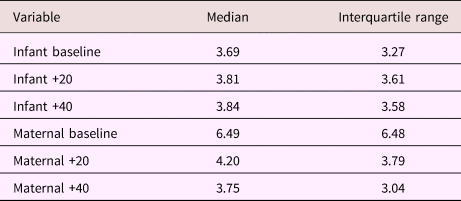
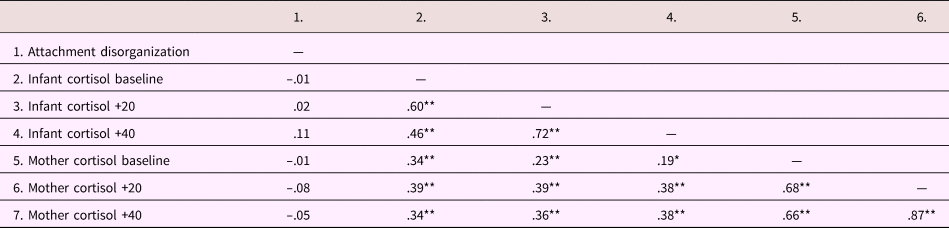
SSP classifications were as follows: 206 (80.5%) not disorganized and 50 (19.5%) disorganized. Of the disorganized infants, 4 (8%) had an underlying avoidant strategy, 20 (40%) had an underlying secure strategy, 21 (41%) had an underlying resistant strategy, and 5 (10%) did not have a classifiable underlying strategy. Cortisol values deviated from normality, and thus medians and interquartile ranges are reported (Table 1). Correlations among main variables are presented in Table 2.
Medians and interquartile ranges of maternal and infant cortisol values

Note: Medians and interquartile ranges are reported because all cortisol variables were positively skewed. Cortisol values reported in nmol/L.
Correlations among main study variables

Note: Attachment disorganization was coded dichotomously as 0 (not disorganized) or 1 (disorganized). Cortisol values are reported in nmol/L and were log transformed to address skew. The disorganization correlations involve point biserial correlations. *p < .01. **p < .001.
We assessed a number of potential covariates that have been previously associated with cortisol secretion: family income, maternal education, maternal relationship status (e.g., Gustafsson, Anckarsäter, Lichtenstein, Nelson, & Gustafsson, Reference Gustafsson, Anckarsäter, Lichtenstein, Nelson and Gustafsson2010), maternal age (van Cauter, Leproult, & Kupfer, Reference van Cauter, Leproult and Kupfer1996), infant sex (Davis & Emory, Reference Davis and Emory1995), maternal and infant feeding times (Khoury et al., Reference Khoury, Gonzalez, Levitan, Masellis, Vincenzo and Atkinson2015), wake times (Wüst, Federenko, Hellhammer, & Kirschbaum, Reference Wüst, Federenko, Hellhammer and Kirschbaum2000), medication status (e.g., Kirschbaum, Pirke, & Hellhammer, Reference Kirschbaum, Pirke and Hellhammer1995), and sleep disruptions the previous night (Lasikiewicz, Hendrickx, Talbot, & Dye, Reference Lasikiewicz, Hendrickx, Talbot and Dye2008), as well as maternal smoking status (Fisher et al., Reference Fisher, Serbin, Stack, Ruttle, Ledingham and Schwartzman2007), menstrual stage (Genazzani et al., Reference Genazzani, Lemarchand-Beraud, Aubert, Felber, Muller, Lavanchy and Gomez1975), breastfeeding status (Tu, Lupien, & Walker, Reference Tu, Lupien and Walker2006), and insomnia status (Lasikiewicz et al., Reference Lasikiewicz, Hendrickx, Talbot and Dye2008). None of these potential covariates were associated with cortisol values in the current sample, and as such, they were not included in analyses.
Main analyses
Correlated growth model exploring the association between mother–infant attachment disorganization and cortisol attunement
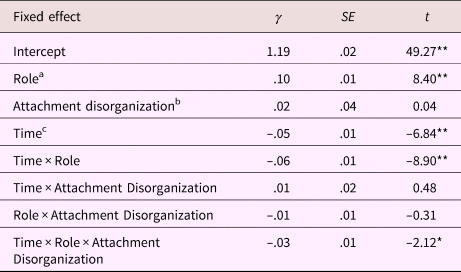
To determine similarities in dyad baseline cortisol and rate of change in cortisol over time (i.e., simultaneous statistical attunement) as a function of attachment disorganization, we conducted a correlated growth model. ×Table 3 details the fixed effects for the overall model. There was a main effect of role on cortisol output, such that mothers had higher cortisol levels than infants, on average (b = .10, SE = .01, p < .001). Linear time also had a significant main effect, with cortisol output decreasing over time (from baseline to +40 min; b = –.05, SE = .01, p < .001). However, as per a significant two-way interaction between role and time, decreases in cortisol pertained to mothers but not infants (b = –.06, SE = .01, p < .001). There was no significant main effect of disorganization or interaction between disorganization and role or disorganization and time. However, there was a significant three-way interaction between disorganization, role, and time (b = –.03 SE = .01, p = .035), warranting further examination. A separate model was run dividing mother and infant effects of time and disorganization. Findings for linear time remained the same (i.e., mothers, but not infants, showed a significant decrease over time). Individually, there was no significant interaction between time and disorganization for mothers or infants.
Fixed-effect estimates from the correlated growth model of mother–infant log-transformed cortisol attunement across linear time

Note: SE, standard error. aCoded as mother = 1 and infant = –1. bCoded as not disorganized = 0, disorganized = 1. cCoded as baseline = 0, +20 min = 1, and +40 min = 2. *p < .05. **p < .001.
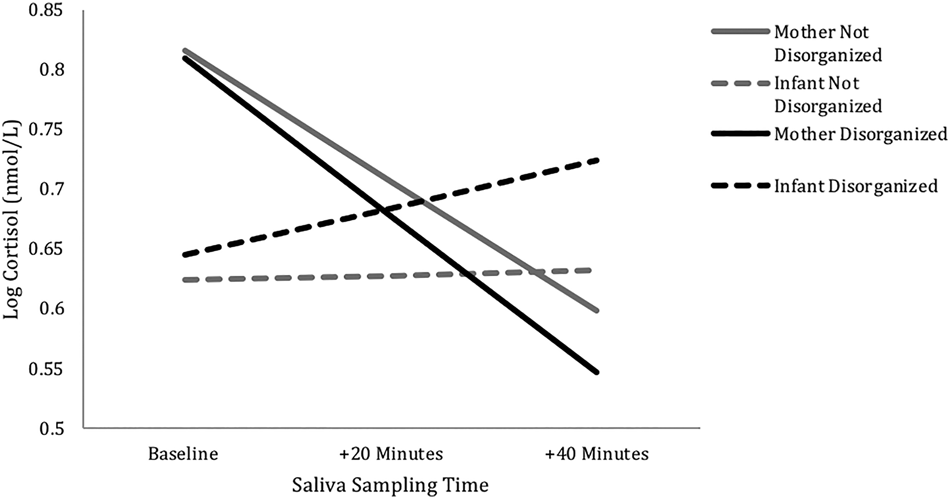
Several random effects emerged. Across dyads, individual mothers varied significantly in baseline cortisol (Wald Z = 8.83, p < .001), as did infants (Wald Z = 7.62, p < .001). Further, across dyads, mothers and infants significantly varied in their cortisol trajectories across time (for mothers: Wald Z = 3.73, p < .001; for infants: Wald Z = 4.29, p < .001). Regarding mother–infant cortisol attunement, baseline cortisol levels were associated within dyads (ρ = .48, Wald Z = 5.15, p < .001), as were cortisol trajectories over time (ρ = .39, Wald Z = 4.29, p < .001). To assess differences in attunement across disorganization classification (warranted based on the significant Role × Disorganization × Time fixed-effect above), separate models were run for disorganized and not disorganized dyads. Regardless of disorganization classification, dyad members’ baseline cortisol levels were associated (disorganized: ρ = .79, Wald Z = 3.42, p < .001; not disorganized: ρ = .40, Wald Z = 3.92, p < .001). However, significant attunement of cortisol trajectories was only found in disorganized dyads (ρ = .67, Wald Z = 2.76, p = .025) and not dyads without this classification (ρ = .27, Wald Z = 1.13, ns). The previously reported three-way interaction between role, disorganization, and time established these patterns as significantly different. That is, among disorganized (but not organized) dyads, both partners’ slopes had significant magnitude of change over time. As depicted in Figure 2, as disorganized infants had greater increases in cortisol, disorganized mothers had greater declines in cortisol. All equations are described in Appendix A.
Graph depicting the simple slopes of mother-infant log cortisol attunement over linear time separated by disorganization classification. Random effects from the correlated growth model found significant covariance between disorganized dyads (rho = .67, Wald Z = 2.76, p = .025) but not dyads without this classification (rho = .27, Wald Z = 1.13, ns).

Cross-lagged model exploring the association between mother–infant attachment disorganization and cortisol attunement
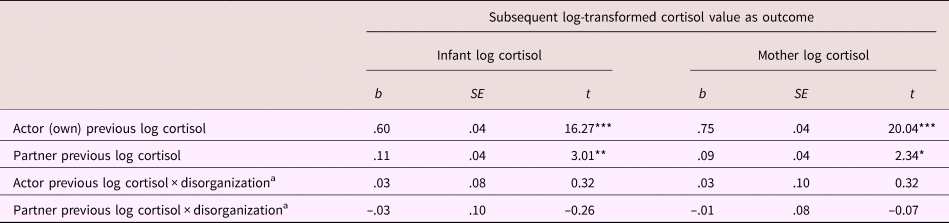
To probe a lagged definition of mother–infant cortisol attunement and to determine the direction of reciprocity between dyad members as a function of attachment disorganization, we conducted a cross-lagged model. The final cross-lagged model used heterogeneous compound symmetry and no random effects. Results from this model are presented in Table 4 and the equation in Appendix B. Findings showed that mother and infant cortisol trajectories were significantly stable across time (b = .75, SE = .04, p < .001, and b = .60, SE = .04, p < .001, respectively), such that individuals with previously high cortisol values, for example, were more likely to have relatively high subsequent cortisol values. Further, within dyads, a mother's previous cortisol value significantly predicted her infant's subsequent cortisol value (b = .09, SE = .04, p = .02), and likewise for infant's previous cortisol predicting mother's subsequent cortisol output (b = .11, SE = .04, p = .003). That is, analyses showed bidirectional reciprocal influence of mother and infant on one another's cortisol reactivity. Disorganization status, however, was not found to influence the nature of the reciprocal relationship. In sum, disorganization status did not predict statistical attunement when modeled in a lagged, reciprocal fashion.
Results from the cross-lagged model of mother and infant log-transformed cortisol attunement and disorganized attachment

Note: SE, standard error. aCoded as not disorganized = 0, disorganized = 1. *p < .05. **p < .01. ***p < .001.
Difference score analysis exploring the association between mother–infant attachment disorganization and cortisol attunement
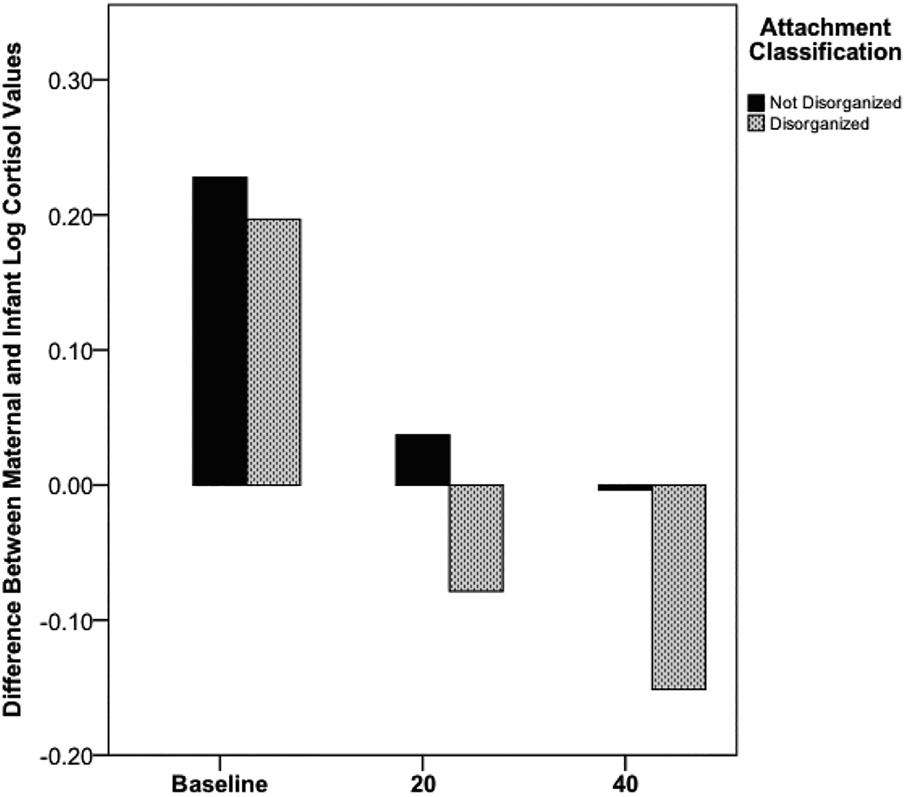
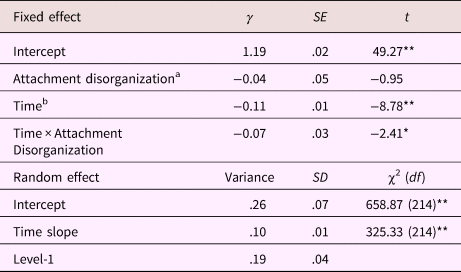
To examine the patterns of discrepancies in mother–infant cortisol values (i.e., to help differentiate between Figures 1a, 1b, and 1c), and to conceptually replicate Crockett et al.’s (Reference Crockett, Holmes, Granger and Lyons-Ruth2013) findings, we examined the association between attachment disorganization and maternal–infant cortisol difference scores across time with multilevel modeling. The final model fit the data significantly better than the null model, χ2 (1) = 120.15, p < .001). Parameter coefficients and standard errors of the final model are depicted in Table 5 and the equation is displayed in Appendix C. At Level 1, fixed effects for linear time significantly improved model fit. Cortisol difference scores significantly declined over time (b = –.12, p < .001). Random effects of time had significant variances, and significantly improved model fit. Based on the intercept (b = 1.19), mothers had higher cortisol levels than infants in the average dyad. Attachment disorganization and Attachment Disorganization × Time interaction terms were entered at Level 2. There was no significant main effect of attachment disorganization on mother–infant cortisol difference scores, but disorganization significantly interacted with time (b = –.07, p < .05) such that, as time increased, disorganized dyads had lower difference scores (i.e., mothers had lower cortisol values than infants) relative to organized dyads (Figure 3). The final model was run with restricted maximum likelihood (Table 5).
Mother-infant attachment disorganization moderating the dyadic cortisol response in the Strange Situation Procedure, as defined by the difference score analysis. Relative to organized dyads, disorganized dyads had larger differences between maternal and infant cortisol values. For illustrative purposes in Figure 3, negative values reflect that maternal cortisol levels are lower than infant cortisol levels. For main analyses, the difference score was calculated for each time point as X + absolute value of lowest negative value of X, where X = (maternal log cortisol - infant log cortisol) (Reeves et al., Reference Reeves, Fisher, Newman and Granger2016).

Fixed and random effect estimates from the final 2-level multilevel model with mother–infant attachment disorganization predicting difference scores of maternal–infant log-transformed cortisol levels

Note: SE, standard error. SD, standard deviation. aCoded as not disorganized = 0, disorganized = 1. bCoded as baseline = 0, +20 min = 1, and +40 min = 2. *p < .05. **p < .001.
Discussion
The mother–infant cortisol attunement literature is difficult to synthesize due in part to the complexity of the attunement construct itself (Bernard et al., Reference Bernard, Kashy, Levendosky, Bogat and Lonstein2016). The present study examined this complexity by using multiple statistical approaches that together probed two key features of attunement identified by Bernard et al. (Reference Bernard, Kashy, Levendosky, Bogat and Lonstein2016), time and interactive reciprocity, by including discussion of trajectory directionality, and by differentiating between three interpretations of dyadic cortisol responses, attunement, misattunement, and lack of attunement. We used this comprehensive approach to examine associations between mother–infant attachment disorganization and mother–infant cortisol attunement.
Our first analytic approach, correlated growth modeling, conceptualized mother–infant cortisol attunement as simultaneous (i.e., examining member cortisol at the same points across time). Results indicated that disorganized dyads had a significantly greater magnitude of change over time, relative to organized dyads. Specifically, compared to organized dyads, as disorganized mothers had greater declines in cortisol, disorganized infants had greater increases. Our second analytic approach, cross-lagged modeling, conceptualized attunement as lagged (i.e., influence of one dyad member's cortisol on the other dyad member's cortisol at later time point) and reciprocal (i.e., data-driven probing of whether attunement is mother led and/or infant led). Our results showed mutual influence of mothers and infants, but they did not reveal an association between disorganized attachment and this cross-lagged definition of attunement. Our third analytic approach, the multilevel model of maternal–infant difference scores, examined the pattern of discrepancies in mother–infant cortisol values over time. This analysis revealed that disorganized, relative to organized, dyads had a greater divergence between maternal and infant cortisol values, such that, over time, maternal values were lower than infant values. These results are discussed here in turn.
In terms of the correlated growth model results, this study supports the notion that, when cortisol is assessed simultaneously, disorganized attachment reflects adrenocortical misattunement between mothers and infants. Among disorganized dyads, mothers and infants have similar magnitudes of change, but in different directions, that is, the greater the increase in infant cortisol levels, the greater the decrease in maternal levels. Although these findings, displayed in Figure 2, bear striking resemblance to Atkinson et al.’s (Reference Atkinson, Gonzalez, Kashy, Santo Basile, Masellis, Pereira and Levitan2013, Figure 1) graph depicting the association between maternal sensitivity and mother–infant cortisol attunement (although see van Bakel & Riksen-Walraven, Reference van Bakel and Riksen-Walraven2008, for contradictory findings), they can be interpreted from a theoretical perspective as misattunement, given that this is an integral feature of disorganization. In Atkinson et al. (Reference Atkinson, Gonzalez, Kashy, Santo Basile, Masellis, Pereira and Levitan2013), the sensitive mothers showed similar magnitudes of change as their infants, but in different directions, with infants increasing and mothers decreasing. We speculate that the attunement associated with sensitive parenting may be attributable to the reciprocity or mutuality of mother–infant interactions. For example, the infant might be appropriately (Atkinson et al., Reference Atkinson, Gonzalez, Kashy, Santo Basile, Masellis, Pereira and Levitan2013) reacting to a stressful situation while, simultaneously, his or her mother is downregulating her own cortisol secretion, thereby protectively downregulating the infant (i.e., “regulated” attunement, as coined by Bernard et al., Reference Bernard, Kashy, Levendosky, Bogat and Lonstein2016). In the current study, we suspect that the same dyadic cortisol response pattern emerged for disorganized dyads for different reasons. For example, mothers in disorganized relationships with their infants may have developed a hyporesponsive hypothalamic–pituitary–adrenal (HPA) axis as a result of persistent parenting difficulties or trauma memories triggered by their infant (Crockett et al., Reference Crockett, Holmes, Granger and Lyons-Ruth2013; Fries, Hesse, Hellhammer, & Hellhammer, Reference Fries, Hesse, Hellhammer and Hellhammer2005; Lyons-Ruth & Jacobvitz, Reference Lyons-Ruth, Jacobvitz, Cassidy and Shaver2016). In contrast, for infants in disorganized relationships, the stress of not being able to rely on a consistent strategy to secure maternal responsiveness (Main & Hesse, Reference Hesse and Main2000) may have heightened stress (and cortisol levels; Hertsgaard et al., Reference Hertsgaard, Gunnar, Erickson and Nachmias1995). The former example represents an infant-driven conceptualization, whereas the latter is mother driven, though it is likely that both drives are occurring and interacting together.
Overall, our findings support the notion that the dyadic cortisol response is a broad concept that is context specific. That is, the response may be attuned and reflect reciprocity, that is, responding to and adjusting physiology with one another over time (e.g., in the case of sensitivity); it may be misattuned and reflect challenges with reciprocity (e.g., in the case of attachment disorganization, and disrupted affective communication; Crockett et al., Reference Crockett, Holmes, Granger and Lyons-Ruth2013); or it may reflect a lack of attunement involving independent reactions to shared adversity (e.g., in the case of IPV or shifts from low to high depression; Hibel et al., Reference Hibel, Granger, Blair and Cox2009; Laurent et al., Reference Laurent, Ablow and Measelle2011).Footnote 5 Furthermore, attunement does not necessarily equate to synchrony of trajectory directions (Figure 1). As discussed, multivariate modeling of dyadic covariation in cortisol trajectories does not differentiate between magnitude and direction of slopes, clouding interpretation of results and synthesis across studies. As such, it will be important for future studies to specify trajectory directionality in hypotheses and interpretations and to graph trajectories.
In regard to the cross-lagged modeling analysis results, we did not find significant associations between disorganized attachment status and attunement: disorganized attachment status did not predict the extent to which maternal and infant cortisol secretion patterns were reciprocal and lagged. These findings are consistent with Bernard et al. (Reference Bernard, Kashy, Levendosky, Bogat and Lonstein2016), who did not find IPV to moderate the extent of attunement when analyzed with crossed-lagged modeling. It is possible that the dyadic cortisol responses associated with relational variables, like disorganization, and contextual variables exclusively reflect simultaneous models, as opposed to lagged/reciprocal models.
It is also possible that cross-lagged analyses are not sensitive to mother–infant cortisol attunement because there is significant individual variability in the time at which cortisol peaks after the stressor. For example, having administered two challenges, Goldberg et al. (Reference Goldberg, Levitan, Leung, Masellis, Basile, Nemeroff and Atkinson2003) found that infants peaked at approximately 20 min postchallenge in one instance, and 40 min postchallenge in the other, and that time of peak on one challenge was not related to time of peak on the other for any given infant. Our inexact understanding of cortisol trajectories (within and between individuals) may contribute error to prediction from one time point to another, particularly when these predictions are made across individuals. This is particularly true with respect to cortisol, where typical assessment involves relatively long delays between saliva samplings. Therefore, measurement error may undermine attempts to assess the mutual influence of dyadic partners where cortisol is concerned.
A more fruitful approach to physiological attunement may lie in repeated real-time measures of stress reactivity (e.g., respiratory sinus arrhythmia and sweat production via skin conductance response). Moreover, assessment of behavioral mother–infant attunement (the foundation for conceptualization and measurement of attachment) often measures lag via microcoded second-by-second time intervals (Leclère et al., Reference Leclère, Viaux, Avril, Achard, Chetouani, Missonnier and Cohen2014). If behavioral dyadic reciprocity is assumed to occur rapidly over time, it follows that physiological reciprocity may also occur on this time scale (e.g., Feldman, Reference Feldman2006). Given such variability in peak times and mismatch between timing of cortisol sampling and dyadic interaction, it may be difficult to statistically demonstrate lagged effects, resulting in Type II error.
In terms of our third analytic approach, the difference score analysis, we found that disorganized attachment was associated with a greater divergence between maternal and infant cortisol values. Given the dearth of replication studies in the psychosocial sciences (Makel, Plucker, & Hegarty, Reference Makel, Plucker and Hegarty2012), it is notable that these results conceptually replicate Crockett et al.’s (Reference Crockett, Holmes, Granger and Lyons-Ruth2013) findings. Specifically, Crockett et al. (Reference Crockett, Holmes, Granger and Lyons-Ruth2013) linked maternal disrupted communication, a predictor of mother–infant attachment disorganization (Lyons-Ruth et al., Reference Lyons-Ruth, Bronfman and Parsons1999; Madigan et al., Reference Madigan, Bakermans-Kranenburg, van IJzendoorn, Moran, Pederson and Benoit2006), to larger discrepancies between maternal and infant cortisol values in the Still Face Procedure. Given that disorganization and disrupted affective communication are both relational risk factors, this consistency between studies provides further evidence that the present findings can be interpreted as physiological misattunement. Most mother–infant cortisol attunement studies focus on slopes and do not examine cortisol value differences. As such, in combination with Crockett et al. (Reference Crockett, Holmes, Granger and Lyons-Ruth2013), the current results support the importance of supplementing slope analyses with an examination of the magnitude of discrepancy between maternal and infant cortisol values.Footnote 6 This can potentially sensitize studies to the impact of relational risk factors on mother–infant cortisol secretion. Furthermore, the difference score analysis can aid in interpretation by helping to differentiate between Figure 1a, in which maternal and infant cortisol values differ at Time 1 and Time 3 (but are similar at Time 2, or peak reactivity), Figure 1b, in which maternal and infant trajectories and cortisol values are similar at all time points, and Figure 1c, in which maternal and infant cortisol values differ only at Time 1. Our results also demonstrate the synthesis of difference score analyses with the robust features of multilevel modeling, allowing for a more accurate nesting structure of dyadic data and changes over time while maintaining a focus on value discrepancy at specific time points.
Of importance, in the current study and in Crockett et al.’s (Reference Crockett, Holmes, Granger and Lyons-Ruth2013) study, the difference score findings were driven by the fact that disorganized and disrupted mothers (respectively) had lower cortisol values than their infants, despite the fact that mothers typically have higher cortisol values than infants. This is true in the context of diurnal rhythm (De Weerth & van Geert, Reference De Weerth and van Geert2002) and with respect to baseline measures prior to challenge in low-risk samples (Atkinson et al., Reference Atkinson, Gonzalez, Kashy, Santo Basile, Masellis, Pereira and Levitan2013; Bright et al., Reference Bright, Granger and Frick2012; Davis & Granger, Reference Davis and Granger2009; Hibel et al., Reference Hibel, Granger, Blair and Finegood2015; Sethre-Hofstad et al., Reference Sethre-Hofstad, Stansbury and Rice2002; van Bakel & Riksen Walraven, Reference van Bakel and Riksen-Walraven2008), wherein mothers had higher or similar cortisol values, compared to their infants. By contrast, in samples characterized by relational risk (Crockett et al., Reference Crockett, Holmes, Granger and Lyons-Ruth2013) and contextual risk (Hibel et al., Reference Hibel, Granger, Blair and Cox2009, Reference Hibel, Granger, Blair and Finegood2015; Laurent et al., Reference Laurent, Ablow and Measelle2011; Middlemiss et al., Reference Middlemiss, Granger, Goldberg and Nathans2012), mothers had lower cortisol values than their infants. It is possible that high levels of relational and contextual risk blunt the maternal HPA axis over time via allostatic load, that is, the “wear and tear” that results from prolonged stress (Atkinson et al., Reference Atkinson, Jamieson, Khoury, Ludmer and Gonzalez2016; Fries et al., Reference Fries, Hesse, Hellhammer and Hellhammer2005). As such, our findings may implicate a dampening of the maternal HPA axis as a mechanism for intergenerational difficulties acting as a regulator in the context of the attachment relationship. In line with this suggestion, Crockett et al. (Reference Crockett, Holmes, Granger and Lyons-Ruth2013) speculated that the normative, midrange cortisol levels of nondisrupted mothers can help these mothers maintain a positive state and cope with infant stress, whereas blunted maternal cortisol levels may interfere with this process.
Taken together, the current results support the notion that dyads in disorganized attachment relationships, who by definition are behaviorally misattuned (Hesse & Main, Reference Hesse and Main2000; Main & Solomon, Reference Main, Solomon, Brazelton and Yogman1986, Reference Main, Solomon, Greenberg, Cicchetti and Cummings1990), are also adrenocortically misattuned. Attachment theory integrates both biological and behavioral systems aimed at augmenting the probability of infant survival and procreation (Goldberg, Grusec, & Jenkins, Reference Goldberg, Grusec and Jenkins1999). If the behavioral system functions appropriately, and the infant can successfully and consistently use attachment cues to secure caregiver responsiveness, there is less pressure on physiological systems (Kraemer, Reference Kraemer1992). The current results may instantiate the case wherein the infant is unable to organize a behavioral strategy for securing caregiver responsiveness, resulting in increased pressure on the physiological stress system. This applies to the mother as well. Specifically, the clarity of infant cues and the extent of infant responsiveness to the mother can impact maternal physiological responses (e.g., Letourneau, Watson, Duffett-Leger, Hegadoren, & Tryphonopoulos, Reference Letourneau, Watson, Duffett-Leger, Hegadoren and Tryphonopoulos2011). As such, from the perspective of developmental psychopathology, disorganized attachment may place both infants and mothers at risk for HPA-related physical and psychological difficulties (Rutter & Sroufe, Reference Rutter and Sroufe2000), and may be an important target for reducing the likelihood of such difficulties.
Future studies can build upon the findings presented here to inform early preventative intervention programs. Specifically, attachment-based interventions are known to be effective at improving the organization of mother–child attachment (e.g., Juffer, Bakermans-Kranenburg, & van IJzendoorn, Reference Juffer, Bakermans-Kranenburg and IJzendoorn2005), as well as infant (Bakermans-Kranenburg, van IJzendoorn, Mesman, Alink, & Juffer, Reference Bakermans-Kranenberg, van IJzendoorn, Mesman, Alink and Juffer2008; Bernard et al., Reference Bernard, Dozier, Bick, Lewis-Morrarty, Lindhiem and Carlson2012; Dozier et al., Reference Dozier, Peloso, Lindhiem, Gordon, Manni, Sepulveda and Levine2006; Dozier, Peloso, Lewis, Laurenceau, & Levine, Reference Dozier, Peloso, Lewis, Laurenceau and Levine2008) and maternal (e.g., Field et al., Reference Field, Scafidi, Pickens, Prodromidis, Pelaez-Nogueras, Torquati and Kuhn1998; Toth et al., Reference Toth, Sturge-Apple, Rogosch and Cicchetti2015; Urizar & Muñoz, Reference Urizar and Muñoz2011) cortisol secretion patterns. Future studies should specifically examine the impact of attachment-based preventative interventions on mother–infant cortisol attunement, as this has not yet been assessed. When evaluating the effectiveness of interventions on mother–infant cortisol attunement, we also theorize that it is important to consider that correlated slopes can reflect either attunement, misattunement, or a lack of attunement, depending on context. For example, an initially disorganized dyad may (a) have correlated cortisol slopes preintervention, (b) no longer be classified as disorganized postintervention, and (c) still have correlated cortisol slopes postintervention, but for different reasons, as speculated above. Furthermore, given previous associations between maternal disrupted communication and mother–infant cortisol attunement (Crockett et al., Reference Crockett, Holmes, Granger and Lyons-Ruth2013), future studies could examine whether intervention-related changes in disrupted communication behavior impact mother–infant cortisol attunement indirectly, through a reduction in disorganized attachment. In addition, it would be interesting for future studies to expand this work and examine associations between attachment and attunement in other biological systems (e.g., autonomic).
The current study has a number of strengths, including its total reliance on objective measures (i.e., observational attachment coding and cortisol secretion), thereby eliminating bias and error contributed by self-report. In addition, our use of a low-risk, community sample supports a developmental psychopathology perspective, such that risk for psychopathology is dimensional and variability in that risk is observable and predictively valid even at low levels.
In terms of study limitations, dyads who discontinued the study after the first home visit, and who therefore were not observed in the SSP, relative to dyads without attachment classifications, were more likely to involve younger mothers and mothers who were not currently working. As such, results may not generalize to younger or unemployed mothers. In addition, the resultant restriction of range may have served to undermine power, important to all analyses, but particularly in the case of cross-lagged analyses.
Future studies might also replicate our model in higher risk or clinical samples, which typically have higher rates of disorganization (Lyons-Ruth & Jacobvitz, Reference Lyons-Ruth, Jacobvitz, Cassidy and Shaver2016). This could potentially help clarify the conditions under which attunement and misattunement emerge. Further, assessment of attunement trajectories was limited to linear modeling of time, due to the availability of only three applicable saliva measurements. The inability to model nonlinear functions of cortisol attunement, while common within the literature (see Bernard et al., Reference Bernard, Kashy, Levendosky, Bogat and Lonstein2016, for summary), is problematic given that most individuals’ cortisol reactivity follows a rise-and-fall, parabolic pattern under sufficiently stressful conditions (Dickerson & Kemeny, Reference Dickerson and Kemeny2004; Jansen, Beijers, Riksen-Walraven, & de Weerth, Reference Jansen, Biejers, Riksen-Walraven and de Weerth2010). Efforts to include more sampling measurements with shorter lags between them may sensitize cross-lagged analyses to cortisol attunement and augment the results reported here. Disorganized attachment, in particular, is associated with unstable patterns of behavioral interaction (Beebe et al., Reference Beebe, Jaffe, Markese, Buck, Chen, Cohen and Feldstein2010; Hesse & Main, Reference Hesse and Main2000), and may therefore be associated with inconsistent patterns of cortisol attunement.
Conclusions
In summary, disorganized attachment was associated with larger slope magnitudes of maternal and infant cortisol trajectories assessed simultaneously in the SSP, such that disorganized mothers showed stronger declines and disorganized infants showed stronger increases, relative to organized dyads. Disorganized attachment was also associated with greater divergence in maternal and infant cortisol values, such that disorganized mothers had lower cortisol levels than their infants. We interpret these findings as consistent with adrenocortical misattunement, in so far as disorganization is considered a behavioral manifestation of the same. Findings point to the potential utility of attachment-based preventative interventions for improving mother–infant psychosocial and physiological regulation. Furthermore, from a methodological standpoint, findings point to the importance of utilizing a comprehensive approach to studying cortisol attunement by including multiple statistical approaches (thereby probing two key features of attunement: time and interactive reciprocity), specifying trajectory directionality, and carefully considering whether findings may reflect attunement, misattunement, or a lack of attunement.
Acknowledgments
The authors would like to acknowledge the contributions of Drs. Susan Goldberg, Robert Levitan, Mario Masellis, and Vincenzo Basile, investigators in the original proposal. Thank you to Dr. Paul Meinz, Sandi Bento, and Dr. David Pederson for their help in attachment coding training. We would like to thank Emilie Boucher and Monica Tan, as well as other research assistants and students who contributed a great many hours to this project. Of course, we appreciate the time and effort of the mothers and babies who volunteered for this project.
Funding Statement
This work was supported by the Canadian Institutes of Health Research (MOP-64301) and Ryerson University with no stipulations other than we complete the work.
Appendix A
Equations for Correlated Growth Models for Mother–Infant Attachment Disorganization Predicting Mother–Infant Log Transformed Cortisol Trajectories
Model for Role * Linear Time * Disorganization Classification:
 $$\eqalign{{\rm Log}\; {\rm Cortisol} & = b0 + b1{^\ast}\lpar {Role} \rpar + b2{^\ast}\lpar {Linear \; Time} \rpar \cr & + b3{^\ast}\lpar {Disorganization \; Classification} \rpar \cr & + b4{^\ast}\lpar {Role{^\ast}Linear\; Time} \rpar \cr & + \,b5{^\ast}\lpar {Role{^\ast}Disorganization\; Classification} \rpar \cr & + b6{^\ast}\lpar {Linear \; Time{^\ast}Disorganization\; Classification} \rpar \cr & + b7{^\ast}\lpar {Role{^\ast}Linear \;Time{^\ast}Disorganization\; Classification} \rpar \cr &+ {\rm error}.} $$
This equation was also run separately for disorganized and not disorganized dyads.
Model Delineating Mother and Infant Effects For Time * Disorganization Classification:
 $$\eqalign{{\rm Infant}\; {\rm log}\; {\rm cortisol} & = b0_b + b1_b{^\ast}\lpar {Linear\; Time} \rpar \cr & + b2_b{^\ast}\lpar {Disorganization\; Classification} \rpar \cr & + b3_b{^\ast}\lpar {Linear\; Time{^\ast}Disorganization Classification} \rpar \cr & + {\rm error}.} $$
 $$\eqalign{{\rm Mother}\; {\rm log}\; {\rm cortisol} & = b0_m + b1_m{^\ast}\lpar {Linear\; Time} \rpar \cr & + b2_m{^\ast}\lpar {Disorganization\; Classification} \rpar \cr & + b3_m{^\ast}\lpar {Linear\; Time{^\ast}Disorganization\; Classification} \rpar \cr & + {\rm error}.} $$
Appendix B
Cross-Lagged Equation for Mother–Infant Attachment Disorganization Predicting Log Transformed Cortisol Attunement
 $$\eqalign{{\rm Infant}_t & = b0_{\rm B} + b_{{\rm actorB}}{^\ast}\lpar {{\rm Infant}_t-1} \rpar + b_{{\rm partnerB}}{^\ast}\lpar {{\rm Mother}_t-1} \rpar \cr & + b_{{\rm actorB}}{^\ast}\lpar {{\rm Infant}_t-1} {^\ast}{\rm Disorganization}\; {\rm Classification} \rpar \cr & + b_{{\rm partnerB}}{^\ast}\lpar {{\rm Mother}_t-1} {^\ast}{\rm Disorganization}\; {\rm Classification} \rpar.} $$
 $$\eqalign{{\rm Mother}_t & = b0_M + b_{\rm actorM}^{\ast} \lpar {\rm Infant}_{t-1} \rpar + b_{\rm partnerM}^{\ast}\lpar {\rm Mother}_{t-1} \rpar \cr & + b_{\rm actorM}^{\ast}\lpar {\rm Infant}_{t-1}^{\ast} {\rm Disorganization}\; {\rm Classification} \rpar \cr & + b_{\rm partnerM}^{\ast} \lpar {\rm Mother}_{t-1}^{\ast} {\rm Disorganization}\; {\rm Classification} \rpar.} $$
Multilevel Model Equation for Mother–Infant Attachment Disorganization Predicting Mother–Infant Cortisol Difference Scores
Level-1 Model
 $${\rm Log}\; {\rm Cortisol}\; {\rm Difference}\; {\rm Score} = P_0 + P_1^{\ast}\lpar {Linear\; Time} \rpar + e.$$
Level-2 Model
 $$P_0 = \beta_{00} + \beta_{01}^{\ast}\lpar {Disorganization} \rpar + {\rm r}0$$
 $$P_1 = B_{10} + \beta _{11}^{\ast} \lpar {Disorganization} \rpar + {\rm r}1.$$
Mixed Model
 $${\rm Log}\; {\rm Cortisol}\; {\rm Difference} {\rm Score} = \beta _{00} + \beta _{01}{^\ast}\lpar {Disorganization} \rpar + \beta _{10}{^\ast}(Linear\; Time) + \beta _{11}{^\ast}\lpar {Disorganization} \rpar {^\ast}(Linear\; Time) + r0 + r1{^\ast}\lpar {Linear\; Time} \rpar + e. $$