Introduction
Over the past century, decreasing fertility and mortality have led to the rapid ageing of the population in Korea. In recent decades, a particularly rapid increase has occurred in the percentage of the population aged >65 years, rising from 2.9% in 1960 to 9.1% in 2008. Furthermore, the period in which the percentage of the population aged 65 and older will double from 7% to 14% is expected to be only 18 years. This is a much shorter doubling period than in most other developed countries, including France (115 years), the US (73 years), Italy (61 years) and Japan (24 years) (Korea National Statistical Office, 2007a).
In Korea, the average life span is 79.1 years, which is longer than that in most developed countries (Korea National Statistical Office, 2007b) and differs by gender, with a mean of 75.6 years for men and 82.4 years for women. The longer female lifespan means that elderly married women will probably spend their final years living without their husbands and will probably confront various unique health and economic problems. Moreover, in Korea, elderly women tend to have a greater range of difficulties related to physical function than do elderly men (Chung, Reference Chung2007). This is reflected in the average rate of independence with regard to activities of daily living, which is higher in elderly men (89.2%) than in elderly women (82.0%). Similarly, the average independence rate of instrumental activities of daily living in elderly men is 83.7%, whereas for elderly women it is much lower at 65.1% (Korea Institute for Health and Social Affairs, 2006).
As Korean society ages, interest in healthy and successful ageing has increased. Previous studies have demonstrated that socioeconomic status affects successful ageing (Rothenberg et al., Reference Rothenberg, Lentzner and Parker1991; Fried & Guralnik, Reference Fried and Guralnik1997; Stuck et al., Reference Stuck, Walthert, Nikolas, Bula, Hohmann and Beck1999; Jang et al., Reference Jang, Choi and Kim2009a). For instance, elderly people with higher individual incomes and higher educational levels tend to age more successfully than do those with lower individual incomes and lower educational levels (Strawbridge et al., Reference Strawbridge, Cohen, Shema and Kaplan1996; Depp & Jeste, Reference Depp and Jeste2006). Moreover, Jang et al. (Reference Jang, Choi and Kim2009a) found that individual income was the most influential factor in social functioning, whereas educational level had the greatest effect on physical and mental functioning. However, although these results indicate some determinants of successful ageing, they do not consider the differences between elderly men and elderly women.
Elderly women tend to be less active in social participation, and more elderly men than women maintain productive paid work and engage in unpaid work after retiring (Herzog & Morgan, Reference Herzog and Morgan1992; Chung & Suh, Reference Chung and Suh1997; Chung, Reference Chung2007).
Understanding the gendered patterns of successful ageing can aid in the development of effective interventions for improving the life quality for both elderly men and elderly women. However, gender differences and gender-specific factors affecting successful ageing remain unclear.
No single accepted definition of ‘successful ageing’ exists, although the criteria of Rowe and Kahn are commonly used. Rowe & Kahn (Reference Rowe and Kahn1997) defined successful ageing as ‘…the absence of disease and disability, maintaining physical and cognitive function, and active engagement with social and productive activities’.
Previous studies have focused on physical and social functioning to explain successful ageing. The most commonly used definition of ‘high physical functioning’ is the absence of difficulties with activities of daily living (ADL) (Roos & Havens, Reference Roos and Havens1991; Berkman et al., Reference Berkman, Seeman and Albert1993; Strawbridge et al., Reference Strawbridge, Cohen, Shema and Kaplan1996; Jorm et al., Reference Jorm, Christiansen and Henderson1998; Lamb & Myers, Reference Lamb and Myers1999; Andrews et al., Reference Andrews, Clark and Luszcz2002; Newman et al., Reference Newman, Arnold and Naydect2003; Depp & Jeste, Reference Depp and Jeste2006). Less often, instrumental activities of daily living (IADL) may be used (Newman et al., Reference Newman, Arnold and Naydect2003; Depp & Jeste, Reference Depp and Jeste2006).
Social functioning has also been used to define successful ageing. In eight of the 29 studies on successful ageing, social functioning, including paid and unpaid work (Strawbridge et al., Reference Strawbridge, Wallhagen and Cohen2002; Garfein & Herzog, Reference Garfein and Herzog1995; Baltes & Lang, Reference Baltes and Lang1997) and participation in outside social activities (Strawbridge et al., Reference Strawbridge, Wallhagen and Cohen2002; Garfein & Herzog, Reference Garfein and Herzog1995), was used to define successful ageing.
In this study, successful ageing is defined as a high level of physical functioning and a high level of social functioning. The study investigates gender-based differences as factors in successful ageing to test the hypothesis that socioeconomic status has a greater effect than do gender-specific issues on the determination of successful ageing.
Methods
Participants
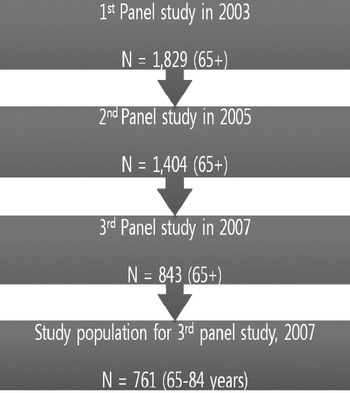
This study examined successful ageing in four age groups. In 2007, a representative sample of 761 individuals, aged 65–84 years (340 men, 421 women) living in the community, were interviewed as part of the third wave of the Hallym Ageing Study. Every two years since 2003, the Hallym Ageing Study has surveyed elderly people living in two Korean cities: Seoul, a major metropolis, and Chuncheon, a small town. The third (2007) survey had a follow-up rate of 50.4% (843 elderly people aged 65 years and older) based on the first survey, which had included 1829 people aged 65 years and older. The participants in the present study were 761 people from this third survey who were between the ages of 65 and 84 (Fig. 1). The study protocol was approved by the ethics committee of Hallym University.
Flow of the Hallym Ageing Study.

Measures
The dependent variable in the present study was successful ageing among people aged 65–84 years. Successful ageing was defined as high levels of physical and social functioning. High-level physical functioning included an absence of difficulties with ADL or IADL (Won, Reference Won2002). High-level social functioning included participation in at least one of the following social activities: job activities, religious gatherings and volunteer service.
The independent variables covered three categories: demographic factors, socioeconomic status and health status; the latter included the presence of chronic conditions. Chronic conditions were defined as having had at least one episode of the following diseases in the past three years: arthritis, hypertension, stroke, diabetes and cancer.
Statistical analysis
The relationships between successful ageing and these factors were compared between elderly men and women. First, multiple logistic regression analysis (odds ratio, OR; 95% confidence interval, CI) was performed to estimate the effects of independent factors on successful ageing. Second, multiple logistic regression analysis was used to evaluate the relationship between each component of successful ageing and the socioeconomic and health status of elderly men and women. All of the analyses demonstrated sufficient goodness of fit (Hosmer–Lemeshow test, p>0.10).
Results
Descriptive analyses
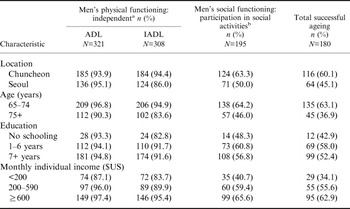
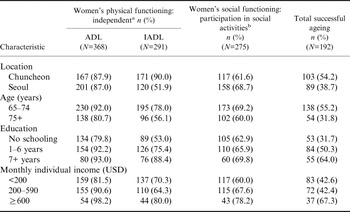
The level of physical functioning was assessed by difficulties in the performance of ADL and IADL. Overall, 94.1% of elderly men and 87.4% of elderly women performed ADL, whereas 90.6% of elderly men and only 69.1% of elderly women were within the independent range for IADL. As the participants aged, their performance of ADL and IADL declined. For elderly women, a higher level of education was associated with better performance of ADL and IADL. A majority of the elderly men (57.4%) and women (65.3%) pursued productive activities and social engagements.
The differences between the two sample locations, Seoul (a city) and Chuncheon (a small town), were remarkable. Elderly men dwelling in Chuncheon tended to display high physical and high social functioning, whereas elderly women from the small town had high physical but low social functioning (see Tables 1 and 2).
Prevalence of independence in components of successful ageing, including physical and social functioning, according to socioeconomic status of 340 men Hallym Ageing Study participants, 65–84 years old in 2007

ADL=activities of daily living; IADL=instrumental activities of daily living.
a ‘Independent’ means having no difficulties.
b Social activities=job activities, religious participation and volunteering; ‘participation’ means participating in at least one activity.
Prevalence of independence in components of successful ageing, including physical and social functioning, according to socioeconomic status of 421 women Hallym Ageing Study participants, 65–84 years old in 2007

ADL=activities of daily living; IADL=instrumental activities of daily living.
a ‘Independent’ means having no difficulties.
b Social activities=job activities, religious participation and volunteering; ‘participation’ means participating in at least one activity.
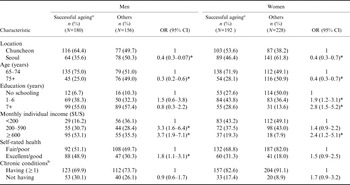
Gender differences were found in the proportions of successfully ageing men and women. Successful ageing in elderly men was significantly related to age, monthly individual income and self-rated health. Higher monthly individual income (≥600$US, OR=3.7, 95% CI=1.9–7.1) and self-rated health (OR=1.8, 95% CI=1.1–3.1) were related to the successful ageing of elderly men.
Successful ageing in elderly women was significantly associated with age, monthly individual income and educational level. Elderly women with higher educational levels (≥7 years, OR=3.0, 95% CI=1.4–6.7) and higher monthly individual income (≥600$US, OR=2.4, 95% CI=1.2–5.1) constituted a higher proportion of those ageing successfully. Location was significantly related to successful ageing of elderly people of both sexes. Both elderly men and elderly women dwelling in Chuncheon aged more successfully than did those from Seoul (elderly men living in Chuncheon, OR=2.3, 95% CI=1.4–3.9; elderly women living in Chuncheon, OR=2.2, 95% CI=1.4–3.5) (see Table 3).
Odds ratios (95% confidence intervals) for successful ageing by socioeconomic status and health status of 761 Koreans (340 men, 421 women) aged 65–84 years

a ‘Successful ageing’ was defined as high ability levels in ADL and IADL for physical functioning and social participation for social functioning; that is, having no difficulties in ADL and IADL and participating in job activities, religious gatherings and/or volunteering.
b ‘Chronic conditions’ were defined as having episodes of the following diseases once or more within the past three years: arthritis, hypertension, stroke, diabetes and cancer.
* p<0.05.
Factors associated with physical and social functioning in elderly men and elderly women
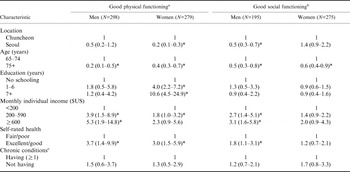
The results of this study indicate that location, socioeconomic status and health status had significant effects on successful ageing. Furthermore, the type of effect these factors had was dependent on gender. Among the components of successful ageing, factors associated with physical functioning clearly differed between elderly men and elderly women. Among elderly men, a higher monthly individual income (≥600$US, OR=5.3, 95% CI=1.9–14.8) and better self-rated health (OR=3.7, 95% CI=1.4–9.9) were related to high levels of physical functioning. Among elderly women, a high level of education is associated with high levels of physical functioning. Highly educated women were more than 10 times as likely to age successfully as were women with low levels of education (OR=10.6, 95% C=4.5–24.9). Good self-rated health status was also correlated with better physical functioning (OR=3.0, 95% CI=1.5–5.9).
Increased age was related to a decline in physical functioning for elderly men (aged 75 and over, OR=0.2, 95% CI=0.1–0.5) and elderly women (aged 75 and over, OR=0.4, 95% CI=0.3–0.7). However, the relationship between socioeconomic and health status and social functioning showed stronger differences between elderly men and women.
Higher monthly individual income was associated with a high level of social functioning in elderly men (≥600$US, OR=3.1, 95% CI=1.6–5.8). However, self-rated health (OR=1.8, 95% CI=1.1–3.1) was significantly related to a high level of social functioning only among elderly men. Social functioning also declined with increasing age in elderly men (aged 75 and over, OR=0.5, 95% CI=0.3–0.8) and elderly women (aged 75 and over, OR=0.6, 95% CI=0.4–0.9).
Residential location was significantly associated with gender differences in successful ageing. Elderly men living in a major metropolis had a lower level of social functioning relative to those living in a small town (for Seoul, OR=0.5, 95% CI=0.3–0.7). Similarly, elderly women dwelling in a major metropolis showed a lower level of physical functioning than did those from a small town (for Seoul, OR =0.2, 95% CI=0.1–0.3).
Discussion
Socioeconomic status has a greater impact on gender differences in physical functioning than in social functioning. In particular, a high monthly individual income showed a significant relationship with high levels of physical and social functioning among elderly men. On the other hand, among elderly women, a high educational level was associated with high levels of physical functioning. Among both elderly men and elderly women, a positive self-rating of health was related to high levels of physical functioning.
Elderly men reporting high individual incomes spent more time engaging in physical activities at work or in their daily lives than did those with lower incomes (Ford et al., Reference Ford, Merritt, Health, Powell, Washburn, Kriska and Haile1991; Seeman et al., Reference Seeman, Charpentier, Berkman, Tinetti, Guralnik, Albert, Blazer and Rowe1994). Those reporting higher incomes had higher levels of physical ability. Income is strongly related to employment and is a sensitive indicator of socioeconomic status for elderly men (Grundy & Holt, Reference Grundy and Holt2001). In general, elderly men engage in more job activities than do elderly women, and as a result, individual income is a more sensitive indicator of successful ageing than is household income. On the other hand, educational attainment, which is usually fixed relatively early in life, is often regarded as the primary indicator of socioeconomic status in elderly women (Grundy & Holt, Reference Grundy and Holt2001).
In this study, a high level of educational attainment was the factor most strongly associated with a high level of physical functioning among elderly women. Several possible explanations for this finding can be proposed.
Odds ratios (95% confidence intervals) for components of successful ageing, including physical and social functioning, by socioeconomic status and health status of 340 Korean men and 421 women aged 65–84 years

a ‘Good physical functioning’ was defined as having no difficulties in ADL and IADL.
b ‘Good social functioning’ was defined as participating in job activities, religious gatherings and/or volunteering.
c ‘Chronic conditions’ were defined as having episodes of the following diseases once or more within the past three years: arthritis, hypertension, stroke, diabetes and cancer.
* p<0.05.
First, elderly women with low educational levels show lower levels of IADL, especially difficulties in handling finances and shopping. In this study, good physical functioning was defined as having no difficulties in ADL and IADL. Ten activities comprise IADL, such as the ability to use a telephone, go shopping, use different modes of transportation and handle finances.
Second, higher educational attainment may be correlated with greater abilities in ADL. Previous studies have shown that educational level is associated with good physical performance, defined as not having difficulty in performing thirteen basic physical activities such as bathing, eating, using the toilet and dressing. Strawbridge et al. (Reference Strawbridge, Cohen, Shema and Kaplan1996) found that elderly people with twelve or more years of education reported better levels of basic physical activity than did those with fewer than twelve years of education.
Third, lower educational levels tend to be related to functional inactivity and unhealthy behaviours. Previous studies have shown that low educational levels are associated with less optimal health behaviours, including a decreased level of physical activity (Kubzansky et al., Reference Kubzansky, Berkman, Glass and Seeman1998). In addition, low educational level is more strongly predictive than is income of the onset of functional disability and the progression of functional limitations (Herd et al., Reference Herd, Goesling and House2007).
The results of the present study demonstrate the association between ‘excellent’ or ‘good’ self-rated health and a high level of physical functioning among elderly men and elderly women. Previous studies have demonstrated the association between self-rated health status and ADL and IADL among elderly people (Gama et al., Reference Gama, Damian, Molino, Lopez, Perez and Iglesias2000). The ability to use stairs and to transfer between a chair and bed among ADL items, and the ability to handle laundry, use transportation and manage finances, among IADL items, show the highest correlations with self-rated health status. Functional limitations in ADL show a significant association with poor self-rated health status (Gama et al., Reference Gama, Damian, Molino, Lopez, Perez and Iglesias2000).
This study suggests distinct regional differences in successful ageing. Among our participants living in a major city, elderly men tended to have low social functioning, and elderly women low physical functioning. In general, elderly men in a city retire, becoming less active due to age. In contrast, elderly men from small towns continue with agricultural activities. This might be a potential determinant of the decline in social functioning, including job activity, among elderly men living in major metropolitan areas.
Wilcox et al. (Reference Wilcox, Castro, King, Housemann and Brownson2000) demonstrated that in urban areas, elderly women face different barriers to physical activities than do elderly men. For instance, the environmental characteristics of a city, such as heavy traffic, high crime and the lack of safe pavements, might be determinants of low physical functioning.
The present study has several limitations. First, this study could not avoid uncertain causality and selection bias due to its cross-sectional design, which focused on the third panel of the Hallym study. The study could not investigate the various changes that occurred for the participants from the first to the third survey, including changes in socioeconomic status, health status, physical functioning and social functioning. In addition, the sample was confined to two cities, Korea's capital (Seoul) and a small town (Chuncheon), and might therefore suffer from an unavoidable selection bias and resultant limitations on generalizability.
Second, the study defined successful ageing in terms of physical and social functioning. However, no universally accepted definition of successful ageing exists. Even so, the definition used here is the one that has most commonly been used.
Third, a debate exists about the relationship between gender and particular risk factors with regard to successful ageing. In general, throughout their lives, men participate in more social activities, such as paid or unpaid work, than do women. In addition, elderly women tend to have lower educational levels than do elderly men. Given these circumstances, findings regarding higher physical functioning among elderly men may have been influenced by higher levels of individual income for elderly men and lower levels of educational attainment for elderly women.
Fourth, the study defined good physical functioning as having no deficit in ADL and IADL. These criteria are stricter than those used in other studies on successful ageing. However, the aim of this study was to explore gender differences in successful ageing as related to socioeconomic status. If we consider gender differences to be biological characteristics, the stricter standard of physical functioning is appropriate if distinct differences between elderly men and elderly women are to be identified.
With the rapid ageing of Korean society, successful ageing has received much attention. This study shows that policies aimed at promoting successful ageing must consider gender differences and their associations with socioeconomic factors.
The social security system of Korea is less advanced than is that in other developed countries (Chang, Reference Chang2003). For instance, only 2.5% of elderly people receive a pension or retirement allowance, and only 8.5% of elderly people are supported by the state, including by supplementary living allowance (Korea Institute for Health and Social Affairs, 2006). The long-term care insurance system, which supports the disabled elderly, was not launched until 2008.
The participation of people 65 years and older in the Korean labour force is high (41.9% for men and 22.5% for women; Korean National Statistics, 2006) compared with other Organisation for Economic Co-operation and Development (OECD) countries (16.7% and 7.6%, respectively; Jones, Reference Jones2005; Jang et al., Reference Jang2009b). However, the employment status of elderly workers is primarily in manual and temporary jobs (Jang et al., Reference Jang2009b).
It is essential, therefore, to create stable jobs that will give a regular income to elderly people so that they may age successfully; this is especially the case for elderly men. Such measures must include attention to elderly women with low educational attainment. Needless to say, job creation must keep pace with the increase in governmental income support in old age.
Acknowledgments
This study was supported by a Korea Research Foundation Grant (KRF-2007-411-J01902), funded by the Ministry of Education and Human Resources Development (MOEHRD), Korea.