Introduction
Psychological distress is characterised by two major symptoms, depression and anxiety (Mirowsky & Ross, Reference Mirowsky and Ross2003). The South African Stress and Health Survey 2003 indicated that 26.7% of South Africans had moderate to high psychological distress (Myer et al., Reference Myer, Stein, Grimsrud, Seedat and Williams2008).
C-reactive protein (CRP) is an acute phase inflammatory protein. Several studies showed positive associations of serum levels of CRP with symptoms of depression and anxiety (Miller et al., Reference Miller, Stetler, Carney, Freedland and Banks2002; Pitsavos et al., Reference Pitsavos, Panagiotakos, Papageorgiou, Tsetsekou, Soldatos and Stefanadis2006; Pikhart et al., Reference Pikhart, Hubacek, Kubinova, Nicholson, Peasey, Capkova, Poledne and Bobak2009; Puustinen et al., Reference Puustinen, Koponen, Kautiainen, Mantyselka and Vanhala2011; Valkanova et al., Reference Valkanova, Ebmeier and Allan2013; Naudé et al., Reference Naudé, Roest, Stein, de Jonge and Doornbos2018), although not all findings are consistent (Steptoe et al., Reference Steptoe, Hamer and Chida2007; Pan et al., Reference Pan, Ye, Franco, Li, Yu, Wang, Qi, Gu, Pang, Liu and Lin2008; Goldman-Mellor et al., Reference Goldman-Mellor, Brydon and Steptoe2010; Rommel et al., Reference Rommel, Simpson, Mounsey, Chung, Schwartz, Pursell and Gehi2013). Some of this inconsistency may be accounted for by sex differences. Several studies found positive associations in men but not women (Danner et al., Reference Danner, Kasl, Abramson and Vaccarino2003; Liukkonen et al., Reference Liukkonen, Silvennoinen-Kassinen, Jokelainen, Rasanen, Leinonen, Meyer-Rochow and Timonen2006; Vogelzangs et al., Reference Vogelzangs, Beekman, de Jonge and Penninx2013), while there is evidence of association in women only (Ma et al., Reference Ma, Chiriboga, Pagoto, Rosal, Li, Merriam, Hébert, Whited and Ockene2011).
The majority of studies on the association between CRP and psychological distress have been conducted among Western populations in high-income countries (HICs). Studies on the association in low- and middle-income countries (LAMICs), including those in Africa, are scarce. This area of research is important because baseline CRP levels may vary by population group, independent of other confounding factors (Kelley-Hedgepeth et al., Reference Kelley-Hedgepeth, Lloyd-Jones, Colvin, Matthews, Johnston, Sowers, Sternfeld, Pasternak and Chae2008), and because psychological distress may be influenced by social-cultural factors and health systems, which differ in LAMIC and HIC contexts (Patel, Reference Patel2000). For example, higher exposures to infections during infancy in South Africa (Dramowski et al., Reference Dramowski, Aucamp, Bekker and Mehtar2017) can lead to a lower chronic inflammatory environment, which may influence inflammation and psychological distress later in life.
Aims of the study
The aim of this study was to evaluate the association of serum levels of CRP with psychological distress, in a large cross-sectional sample of South Africans.
Methods
Sampling
This study analyses data from individuals aged ≥15 who participated in the South African National Health and Nutrition Examination Survey (SANHANES) conducted in 2011–2012. The survey included interviews, medical examination and blood sampling for biomarker analysis.
The SANHANES used a multi-stage disproportionate, stratified cluster sample design to select 10 000 households. Within the occupied households, 27 580 individuals of all ages were eligible to be interviewed and agreed to participate, 25 532 (92.6%) of whom completed the interview. Of the latter number, 12 025 (43.6%) and 8078 (29.3%) individuals volunteered to undergo a medical examination and provide a blood sample, respectively. A total of 3944 participants aged ≥15 had available measures for psychological distress and serum CRP. Additional details of SANHANES methodology and laboratory procedures are reported elsewhere (Shisana et al., Reference Shisana, Labadarios, Rehle, Simbayi, Zuma, Dhansay, Reddy, Parker, Hoosain, Naidoo, Hongoro, Mchiza, Steyn, Dwane, Makoae, Maluleke, Ramlagan, Zungu, Evans, Jacobs and Faber2014).
Ethical approval
The study received approval from the Research Ethics Committee (REC) of the South African Human Sciences Research Council (HSRC) (REC number: 6/16/11/11), which is aligned with the Declaration of Helsinki. Informed written consent/ascent was obtained from all the survey participants.
Analyses of CRP
A blood sample was drawn from the antecubital fossa by the nurse or doctor in the clinic. Blood samples were aliquoted into collection tubes, stored in cooler boxes containing ice packs and couriered daily to the appointed laboratories within 24 h of blood sample collection.
Serum high-sensitivity CRP was quantified using automated immunoassay techniques carried out by the South African National Accreditation System laboratories. No deviations from standard internal laboratory quality control measures were reported and the coefficient of variation for the analyses of all tested biomarkers ranged from 0.5% to 3.75%.
Measures
Psychological measures
Psychological distress was measured using the Kessler Psychological Distress Scale (K10), a 10-item scale measuring current non-specific psychological distress. The K10 has good discriminating ability in detecting depression and anxiety disorders and its use has been validated in the South African context (Andersen et al., Reference Andersen, Grimsrud, Myer, Williams, Stein and Seedat2011). Composite scores range from 10 to 50, where higher scores indicate more symptoms of psychological distress. Respondents scoring ≥20 were categorised as having some level of psychological distress and those scoring <20 as having no distress (Andrews & Slade, Reference Andrews and Slade2001).
Traumatic events were assessed using a modification of the Post Traumatic Stress Disorder (PTSD) section of the World Mental Health Composite International Diagnostic Interview (Kessler & Ustun, Reference Kessler and Ustun2004). Respondents were asked if they had ever experienced any of 14 traumatic events, comprising personal assault, war and terrorism, family and other related trauma.
Covariates
Population groups were classified into African, White, Coloured (mixed-race ancestry) and Indian/Asian, not with the intention of reifying sociocultural constructs, but rather to study ongoing health disparities across groups. Tobacco smoking and current anti-inflammatory medication use was assessed by self-report. Body mass index was calculated based on recommendations for adults by the Centers for Disease Control and Prevention. The age-dependent BMI cut-off points were applied to classify respondents as underweight (BMI < 18 kg/m2), normal weight (BMI 18.0–24.9 kg/m2), overweight (BMI 25.0–29.9 kg/m2) and obese (BMI ≥ 30 kg/m2). High-risk alcohol use was assessed by the AUDIT-C, a three-item alcohol screening tool (Bush et al., Reference Bush, Kivlahan, Mcdonell, Fihn and Bradley1998).
Respondents were classified as having a cardiac disease, if they reported having ever had one or more of the following conditions or diseases: stroke, heart disease, angina, heart failure or rheumatic heart disease. Hypertension was defined as having their either measured systolic blood pressure ≥ 140, diastolic blood pressure ≥ 90 or a self-report of currently taking medication to lower blood pressure (National Center for Health Statistics, CDC, 2006). High blood sugar was defined as having either an HbA1c ≥ 6.5% or a self-report of having been diagnosed and currently taking medication for high blood sugar or diabetes (American Diabetes Association, 2012).
Statistical analysis
CRP levels below the detection limit were substituted with 50% of their detectible limits, as previously described (Feldman & Sbong, Reference Feldman and Sbong2014). The lower detection limit for CRP was 0.2 and 0.1 mg/dl. Values below these limits were therefore assigned values of 0.10 or 0.05 mg/dl, respectively (n = 152). Outliers were classified as values greater than 52.4, which is the mean CRP plus three standard deviations from the mean. CRP values greater than this cutoff were excluded (n = 80).
Data were analysed in Stata 13.0. (StataCorp, TX, USA, 2016). All analyses applied sample weights to adjust for unequal probabilities of selection and non-response. A significance level of p < 0.05 was used.
Data were considered to be missing completely at random. Multiple imputation was used to impute values for missing systolic blood pressure (9.9% missing), diastolic blood pressure (9.8%), HbA1C (5.3%), and self-reported cardiac disease, the lifestyle variables, anti-inflammatory use and trauma experience (all <5% missing). Due to the skewed distribution of CRP levels, natural log transformed CRP (ln-CRP) was used in the regression analyses. The skewness and kurtosis of the transformed CRP variable were −0.206 and 2.49, respectively.
Previous studies presented sex differences between anxiety or depression and CRP. Analyses of covariance were performed to determine the interaction effects for each of age, sex and population group and psychological distress with CRP.
Supplementary Table 1 presents demographic characteristics for the overall interviewed sample and the analytic sample.
Multiple linear regression was performed for psychological distress with CRP as the dependent variable. The following variables were added to the model: unadjusted; model (1) demographics (age, population group and sex), model (2) lifestyle factors (BMI status, tobacco smoking and high-risk alcohol use), model (3) health status and medication use (cardiac disease, hypertension, high blood sugar and use of anti-inflammatory medication), model (4) lifetime experience of traumatic events and model (5) included all variables. The selected variables were included in the models as possible confounders based on a review of the literature, as they have previously been shown to have associations with both psychological distress and CRP. All but two of the selected variables were found to have significant bivariate associations with both psychological distress and ln-CRP. Tobacco smoking and population group were significantly associated with psychological distress, and had weak associations with ln-CRP (Supplementary Table 2), but were included to facilitate comparison with similar studies.
Results
Description of the sample
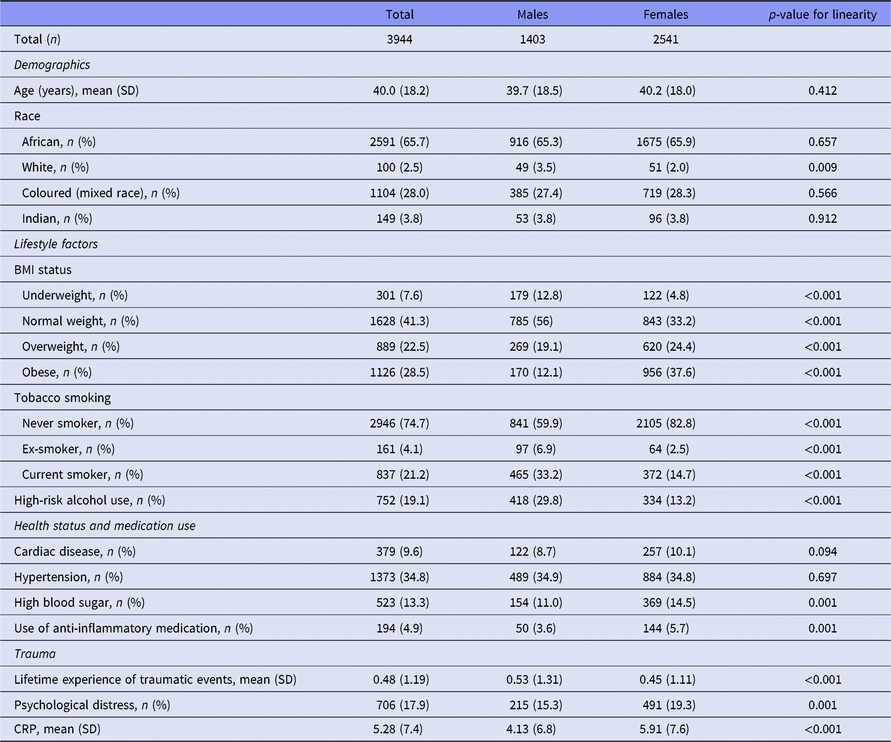
The sample comprised a higher proportion of females (64.4%) (Table 1). The mean age was 40 years and two-thirds of the participants were of African descent (65.7%). Psychological distress was present in 17.9% of the respondents. The mean CRP (5.28) was significantly higher among females (5.91) than males (4.13) (p < 0.001).
Description of participant demographic characteristics, lifestyle factors, health status, psychological characteristics and C-reactive protein levels

Association of psychological distress with CRP level
No significant interactions were found for age, sex or population group with psychological distress, with CRP as the dependent variable (p = 0.102, p = 0.214 and p = 0.098, respectively). However, age-, sex- and population group-stratified analyses were performed to allow a comparison with existing studies.
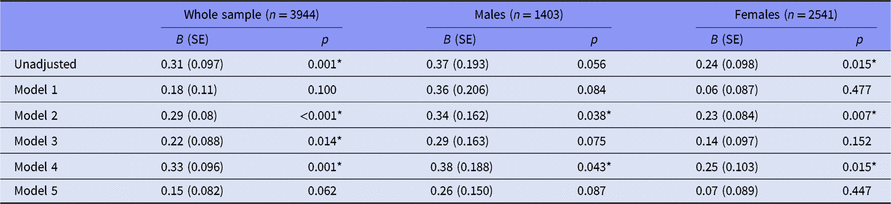
In the whole sample, psychological distress was significantly and positively associated with CRP in the unadjusted model [regression coefficient (B) = 0.31 and p = 0.001] (Table 2). Adjusting for the demographic (model 1) and health and medication use covariates (model 3) each resulted in weaker associations, as measured by the regression coefficient that reduced by 26% or more from that of the unadjusted model. The significance was lost after adjustment for all variables (model 5) (B = 0.15 and p = 0.062).
Regression models examining the association of psychological distress with ln-CRP

B, regression coefficient; SE, standard error of the regression coefficient; p, p-value.
Model 1: Adjusted for demographics (age, sex and population group in the whole sample and age and population group in the male and female subsamples).
Model 2: Adjusted for life-style factors (BMI status, smoking and alcohol).
Model 3: Adjusted for health status and medication use (cardiac disease, diabetes (high blood sugar), anti-inflammatory use and hypertension).
Model 4: Adjusted for lifetime experience of traumatic events.
Model 5: Adjusted for all variables in models 1–4.
* Statistically significant findings, p < 0.05.
The final adjusted model showed that CRP was significantly higher among individuals who were male (B = 0.34 and p < 0.001), older in age (B = 0.02 and p < 0.001), overweight and obese (B = 0.23, p = 0.010 and B = 1.01, p < 0.001), who currently smoked tobacco (B = 0.59 and p < 0.001) and significantly lower among White relative to African individuals (B = –0.46 and p = 0.003). Similar findings persisted in the sex-stratified analyses, with the exception that population group was not significantly associated with CRP in the male subsample. Significant psychological distress – CRP associations were found among individuals of Indian descent (B = 0.81 and p = 0.017) and in individuals aged 65 and older (B = 0.49 and p = 0.014), and these associations persisted after adjustment of all the covariates (Supplementary Tables 3 and 4).
Discussion
This is the first study to characterise the relationship between psychological distress and CRP in a Southern African cohort. Our results show that the presence of psychological distress is associated with higher serum levels of CRP, a finding that is in accordance with similar studies on depression (Miller et al., Reference Miller, Stetler, Carney, Freedland and Banks2002; Pikhart et al., Reference Pikhart, Hubacek, Kubinova, Nicholson, Peasey, Capkova, Poledne and Bobak2009), anxiety (Pitsavos et al., Reference Pitsavos, Panagiotakos, Papageorgiou, Tsetsekou, Soldatos and Stefanadis2006; Vogelzangs et al., Reference Wium-Andersen, Ørsted, Nielsen and Nordestgaard2013; Naudé et al., Reference Naudé, Roest, Stein, de Jonge and Doornbos2018) and psychological distress (Puustinen et al., Reference Puustinen, Koponen, Kautiainen, Mantyselka and Vanhala2011). However, this significance was lost after adjusting for demographic variables, lifestyle factors, health status, anti-inflammatory use and lifetime experience of trauma. The effects of confounders in the association between CRP and psychological distress were also previously reported (Pan et al., Reference Pan, Ye, Franco, Li, Yu, Wang, Qi, Gu, Pang, Liu and Lin2008; Hamer et al., Reference Hamer, Molloy, de Oliveira and Demakakos2009; Rommel et al., Reference Rommel, Simpson, Mounsey, Chung, Schwartz, Pursell and Gehi2013, Valkanova et al., Reference Valkanova, Ebmeier and Allan2013), where demographic factors, BMI, physical activity, substance use, blood pressure and anti-inflammatory use all contributed to predicting CRP levels.
Although not statistically significant at the 5% level, the adjusted strengths of association between psychological distress and CRP were greater for males (B = 0.26) than females (B = 0.07). Notably, the male sample was considerably smaller than that of the females, which resulted in less power to detect significant effects among males. Previously reported findings on the effect of sex in the psychological distress - CRP association are contradictory. In agreement with our findings, associations of symptoms of mental distress and CRP being stronger in men than in women were reported by Danner et al. (Reference Danner, Kasl, Abramson and Vaccarino2003), Liukkonen et al. (Reference Liukkonen, Silvennoinen-Kassinen, Jokelainen, Rasanen, Leinonen, Meyer-Rochow and Timonen2006) and Vogelzangs et al. (Reference Vogelzangs, Beekman, de Jonge and Penninx2013).
Adjustment for demographic variables, namely age and population group, helped to explain the association between psychological distress and CRP. This effect was primarily present in females, where it drastically reduced the strength of association, as measured by the B-coefficient. Our results further show that significant psychological distress – CRP associations were found among individuals of Indian descent and older (≥65 years) individuals. Baseline CRP levels may differ by ancestry (Kelley-Hedgepeth et al., Reference Kelley-Hedgepeth, Lloyd-Jones, Colvin, Matthews, Johnston, Sowers, Sternfeld, Pasternak and Chae2008). In this regard, Goldman-Mellor et al. (Reference Goldman-Mellor, Brydon and Steptoe2010) previously reported higher mean CRP levels among Asian/Indian groups than those of other ethnicities, which is also supported by our findings. Depression and anxiety associations with inflammation in Indian patients have been previously reported (Nayek & Ghosh, Reference Nayek and Ghosh2018). Previous studies have shown depression and CRP associations in older adults (Park et al., Reference Park, Joo, McIntyre and Kim2014; Wium-Anderson et al., 2013). This finding further supports the inflammageing hypothesis of aging, being that increased inflammatory processes as a result of aging pose a risk for depression (Ferrucci & Fabbri, Reference Ferrucci and Fabbri2018).
Excess body fat and tobacco smoking enhance circulating CRP (Hamer et al., Reference Hamer, Molloy, de Oliveira and Demakakos2009). Being overweight or obese and current smoking were significantly associated with elevated CRP in the final adjusted models. BMI status, tobacco smoking and high alcohol use did not, however, cause a loss of significance in the final models. This finding is not consistent with earlier work (Miller et al., Reference Miller, Stetler, Carney, Freedland and Banks2002), where BMI and tobacco smoking confounded the association between mental distress and inflammation.
Several limitations of this study deserve emphasis. First, the cross-sectional design limits the drawing of conclusions regarding causal relationships. Second, other important inflammatory markers such as IL-6 and TNF-α, and other immunometabolic markers were not collected in this study, and so their effects could not be investigated. Third, anti-inflammatory medication use, traumatic experiences, substance use and cardiac disease were subject to self-report bias. Fourth, time elapsed between the interview and the trauma, onset of cardiac disease or onset of hypertension, were not measured, and so could not be adjusted for. Fifth, we did not include specific measures for both depression and anxiety. In terms of confounders, a recent meta-analysis on the association between CRP and depression recommended that other potential confounding factors, such as caffeine, use of statins, anti-depressant medication, education and other chronic diseases, may influence the outcomes in the association between CRP and affective disorders (Horn et al., Reference Horn, Long, Nelson, Allen, Fisher and Byrne2018). These variables were not measured in the present study and may further explain the associations between CRP and psychological distress. Income, which could measure social inequality, was not well recorded and therefore not included in the study. The study’s strengths were that it collected data on a multiracial sample spanning a wide age range and it adjusted for a large number of covariates. Additionally, biomarker data supported the measurement of diabetes and hypertension, rather than reliance on self-report only.
In conclusion, there was a lack of evidence for associations in the broader South African context. A wide range of biological, psychosocial and behavioural factors may contribute to CRP regulation over time. Future research on this population can benefit from investigating other inflammatory markers besides CRP and using longitudinal as well as clinical cohorts.
Supplementary Material
To view supplementary material for this article, please visit https://doi.org/10.1017/neu.2019.27.
Author ORCIDs
Ronel Sewpaul, 0000-0002-2523-1222; Dan J Stein, 0000-0001-7218-7810; Petus JW Naude, 0000-0003-0520-3475
Acknowledgements
None.
Author contributions
RS, DL, PJWN and DJS contributed to the design of the study. DL was involved with data acquisition and supervised the study. RS and PJWN carried out the statistical analysis. RS, PJWN and DJS drafted the manuscript. All the authors assisted with interpretation of the results, contributed to revision of the manuscript and approved the final version.
Financial support
The Department of Health in South Africa and DFID (Department for International Development, UK) funded the SANHANES. The funding sources had no role in study design, in data collection, analysis or interpretation, in the writing of the report or in the decision to submit the paper for publication.
Conflict of Interest
None.
Ethical standards
The authors assert that all procedures contributing to this work comply with the ethical standards of the relevant national and institutional committees on human experimentation and with the Helsinki Declaration of 1975, as revised in 2008.