Introduction
The Santa Gilla lagoon, located in southern Sardinia near the city of Cagliari, is one of the most remarkable wetland areas in both the island and southern Italy. As ‘Stagno di Cagliari’, it was included in the 1976 Ramsar List of Wetlands of International Importance Convention and, between 1990 and 2008, in the Montreux Record of wetlands at risk of adverse changes in ecological character ‘because the ecology of the site has been seriously damaged by thermal, industrial and urban effluent from the city of Cagliari, resulting in nutrient enrichment and major port development projects’ (Anonymous, 2008, 2012 in http://www.ramsar.org). Particularly in relation to human impact, the current morphology of the lagoon has resulted from a series of modifications first introduced approximately 100 years ago. Until 1920, the lagoon extended for approximately 4500 ha; however, following construction of a salt work, airport and a canal harbour, the area exploitable for fishing and aquaculture activities has been reduced to 1200 ha. The intake of fresh water by two rivers is restricted since their flow was consistently diverted directly into the sea, and the main sea mouth is 300-m wide, allowing considerable water turnover with a mean time of 48–72 h. As a consequence, the water salinity ranges between 19‰ and 45‰, depending on rainfall events; in the summer and autumn months, the mean salinity level is often higher than that of the Gulf of Cagliari (38‰). The lagoon has a muddy and/or sandy–muddy bottom and a mean depth of 1 m.
The presence of brackish water, salt- and freshwater in this humid area allows the coexistence of several animal species. In particular, 23 commercial species of fish (both resident and migratory species) and more than 45 breeding and overwintering species of birds are currently recorded. Among the shellfish, seven bivalves and at least two gastropod species are economically important, as they are actively fished and marketed by the local fishing industry.
Despite the ecological importance of this wetland system, and the economic value represented by the exploitation of edible species, the parasitic infections of its fish and shellfish have only been studied since 2001 (Figus et al., Reference Figus, Corriga and Canestri Trotti2002a). The present study summarizes in a checklist the amount of data collected up to date (Figus et al., Reference Figus, Culurgioni and Canestri Trotti2002b, Reference Figus, Culurgioni, De Murtas and Canestri Trotti2004a, Reference Figus, Curridori, De Murtas and Canestri Trottib, Reference Figus, Culurgioni, De Murtas and Canestri Trotti2006; Culurgioni et al., Reference Culurgioni, D'Amico, De Murtas, Canestri Trotti and Figus2006, Reference Culurgioni, D'Amico, De Murtas, Cannella and Figus2008, Reference Culurgioni, De Murtas, Cannella and Figus2010a, Reference Culurgioni, De Murtas and Figusb, Reference Culurgioni, D'Amico, De Murtas and Figusc, Reference Culurgioni, Cannella, Sabatini, Sanna, Torcivia and Figus2011, Reference Culurgioni, Sabatini, Cannella, De Murtas and Figus2012; D'Amico et al., Reference D'Amico, Culurgioni, De Murtas, Cannella and Figus2008), providing information on the parasite fauna of fish and shellfish from the lagoon and comparing these results with those found in other western Mediterranean coastal lagoons (Priore et al., Reference Priore, Orecchia, Ortis, Palladino and Paggi1992; Di Cave et al., Reference Di Cave, Berrilli, De Liberato, Orecchia and Kennedy2001; Merella & Garippa, Reference Merella and Garippa2001; Maillo et al., Reference Maíllo, Vich, Salvadó, Marqués and Gracia2005; Bartoli & Gibson, Reference Bartoli and Gibson2007; Yemmen et al., Reference Yemmen, Ktari and Bahri2012).
Materials and methods
Collection and examination of fish and shellfish
Fish and bivalves from this coastal lagoon were obtained fresh from local fishermen of ‘Consorzio Ittico di Santa Gilla’ between September 2001 and June 2011. A total of 515 samples of 13 fish species, and 2322 samples of seven shellfish species were examined no more than 10 h after sampling. The species and numbers of fish were as follows: Anguilla anguilla L. (103 specimens), Atherina (Hepsetia) boyeri Risso, 1810 (90), Aphanius fasciatus (Valenciennes, 1821) (89), Gobius niger L. (86), Gobius paganellus L. (3), Chelon labrosus (Risso, 1827) (6), Liza aurata (Risso, 1810) (15), Liza ramada (Risso, 1827) (12), Liza saliens (Risso, 1810) (9), Mugil cephalus L. (10), Dicentrarchus labrax (L.) (56), Solea solea (L.) (10), Sparus aurata (26), Cerastoderma glaucum (Bruguière, 1789) (391), Mytilus galloprovincialis Lamarck, 1819 (123), Ensis ensis (L.) (36), Angulus planatus (L.) (23), Venerupis decussata (L.) (1484), Venerupis aurea (Gmelin, 1791) (257) and Venus verrucosa L. (8).
The fish and shellfish specimens were transported to the laboratory and classified. Total fish length and weight, and shell length were measured before dissection. All organs, including viscera and gills, were removed and examined microscopically for the presence of metazoan parasites.
Identification and analysis of helminths
Helminths were enumerated and preserved in 70 or 95% ethanol, or in AFA (alcohol, formalin, acetic acid), and identified morphologically using identification keys and descriptions available in the literature (Palombi, Reference Palombi1933, Reference Palombi1934, Reference Palombi1949; Paggi & Orecchia, Reference Paggi and Orecchia1965; Golvan, Reference Golvan1969; Pearson, Reference Pearson1973; Schmidt, Reference Schmidt1973; Euzet & Suriano, Reference Euzet and Suriano1977; Stunkard, Reference Stunkard1977; Maillard & Saad-Fares, Reference Maillard and Saad-Fares1981; Lebre & Petter, Reference Lebre and Petter1984; Youssef et al., Reference Youssef, Mansour, Hammouda, Awadalla, Khalifa and Boulos1987; Maillard et al., Reference Maillard, Euzet and Silan1988; Bartoli et al., Reference Bartoli, Gibson and Bray1993; Moravec et al., Reference Moravec, Di Cave, Orecchia and Paggi1993, Reference Moravec, Glamuzin, Marino, Merella and Di Cave2003; Moravec, Reference Moravec1994, Reference Moravec2009; Jousson & Bartoli, Reference Jousson and Bartoli2001; Scholz et al., Reference Scholz, Aguirre-Macedo and Salgado-Maldonado2001; Spakulova et al., Reference Spakulova, Macko, Berrilli and Dezfuli2002; Sey et al., Reference Sey, Nahhas, Uch and Vang2003; Laffargue et al., Reference Laffargue, Baudouin, Sasal, Arnaud, Begout Anras and Lagardère2004; Pankov et al., Reference Pankov, Webster, Blasco-Costa, Gibson, Littlewood, Balbuena and Kostadinova2006; Blasco-Costa et al., Reference Blasco-Costa, Montero, Gibson, Balbuena, Raga and Kostadinova2009a, Reference Blasco-Costa, Montero, Balbuena, Raga and Kostadinovab, Reference Blasco-Costa, Montero, Gibson, Balbuena and Kostadinovac, Reference Blasco-Costa, Gibson, Balbuena, Raga and Kostadinovad; Pina et al., Reference Pina, Barandela, Santos, Russell-Pinto and Rodrigues2009; Sohn, Reference Sohn2009; Antonelli et al., Reference Antonelli, Quilichini and Marchand2010a, Reference Antonelli, Quilichini and Marchandb). For identification purposes, Acanthocephala were transferred to fresh water until the proboscis everted before fixation and the metacercarial cysts recovered were measured in a drop of saline and excysted with the aid of two needles. In addition, nematodes of the genus Contracaecum were genetically identified to the level of species by sequential analyses of the mitochondrial gene cytochrome oxidase II (mtDNA cox2).
Prevalence (P), intensity range (IR) and mean intensity with its 90% confidence interval (MI ± CI) were calculated according to Bush et al. (Reference Bush, Lafferty, Lotz and Shostak1997). Voucher specimens of most taxa were deposited in the Zoological Collection of the Dipartimento di Scienze della Vita e dell'Ambiente, University of Cagliari.
Results and discussion
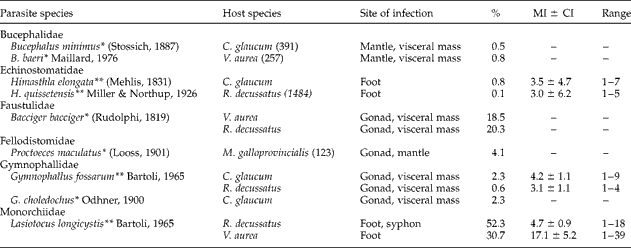
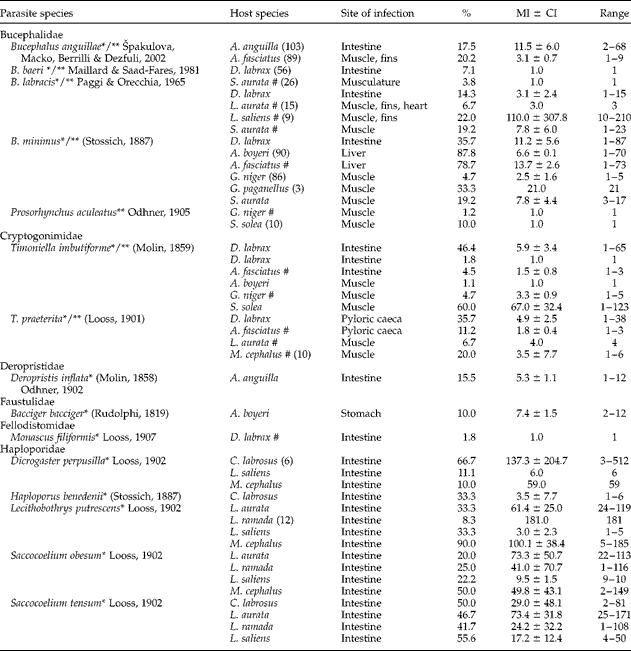
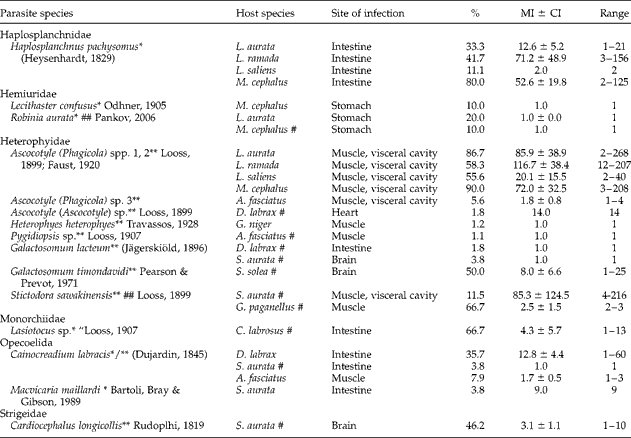
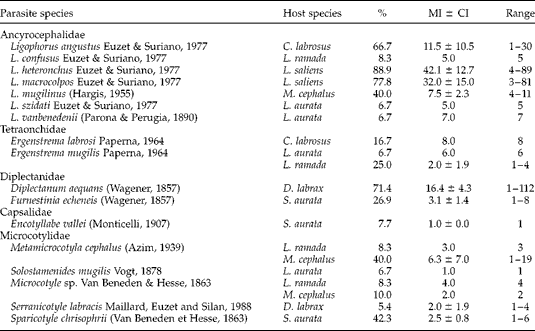
This extensive survey of helminth parasites in fish and shellfish from Santa Gilla lagoon, led to the detection of 69 taxa, 60 of which were identified to a species level by morphological and/or molecular analysis. The resulting checklist (tables 1–6) summarizes all of these helminth species, their hosts, parasitic stage, infection site(s) and the respective epidemiological indices.
The prevalence (%), mean intensity plus confidence intervals (MI ± CI), and intensity range of digeneans in shellfish from Santa Gilla Lagoon, Sardinia; number of hosts examined in brackets; sporocysts and cercaria (*) and metacercaria (**).

The prevalence (%), mean intensity plus confidence intervals (MI ± CI) and intensity range of digeneans within the families Bucephalidae to Haplosporidae in teleost fish from Santa Gilla Lagoon, Sardinia; no. of hosts examined in brackets; adult (*) and metacercaria (**); new host record (#).
The prevalence (%), mean intensity plus confidence intervals (MI ± CI) and intensity range of digeneans within the families Haplosplanchnidae to Strigeidae in teleost fish from Santa Gilla Lagoon, Sardinia; no. of hosts examined in brackets; adult (*) and metacercaria (**); new host record (#), new record for Italy (##).
The prevalence (%), mean intensity plus confidence intervals (MI ± CI) and intensity range of monogeneans on the gill filaments of teleost fish from Santa Gilla Lagoon, Sardinia.
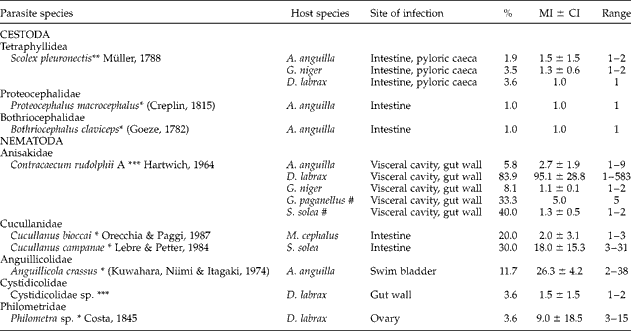
The prevalence (%), mean intensity plus confidence intervals (MI ± CI) and intensity range of cestodes and nematodes in teleost fish from Santa Gilla Lagoon, Sardinia; adult (*), plerocercoid (**), and third-stage larvae (***); new host record (#).
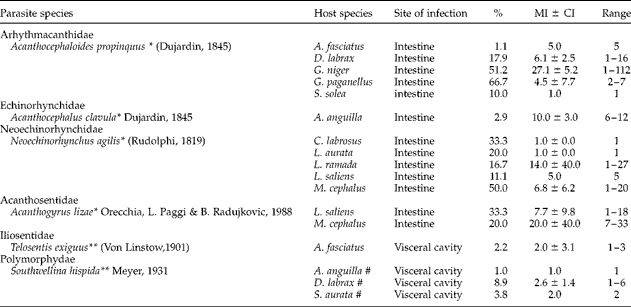
The prevalence (%), mean intensity plus confidence intervals (MI ± CI) and intensity range of acanthocephalans in teleost fish from Santa Gilla Lagoon, Sardinia; adult (*) and cystacanth (**); new host record (#).
In total, 37 of the parasite species detected were Digenea, 17 Monogenea, 3 Cestoda, 6 Nematoda and 6 Acanthocephala. Of these, 39 species were found only as adults, 22 only as larvae, and 8 were recovered both as adults in fish, and as larvae in bivalves and/or fish.
Sixteen of the larval stages collected (14 Digenea, 1 Nematoda and 1 Acanthocephala) were considered to be allogenic species according to Esch et al. (Reference Esch, Kennedy, Bush and Aho1988), because they complete their life cycle in non-aquatic definitive hosts (i.e. piscivorous and benthivorous birds, or carnivores). The remaining 36 species of heteroxenous parasites, found as adults and/or larvae, were classified as autogenic, because they mature within the aquatic system, usually in definitive fish hosts.
Digenea
Digenean species (37 overall, 20 adults (13 only adults), 22 metacercariae (15 only metacercariae) and 5 sporocysts and cercariae (2 only sporocysts and cercariae)) dominated the identified parasite fauna, according to the features of the lagunal system, with a significant presence in a large number of mollusc and fish species acting as intermediate hosts. In addition, 9 digenean species, found in 4 of the 7 bivalve species examined, were found as either sporocysts and cercariae (i.e. Bacciger bacciger, Bucephalus minimus, Bucephalus baeri, Gymnophallus choledochus and Proctoeces maculatus) or as metacercariae (Gymnophallus fossarum, Himasthla elongata, Himasthla quissetensis and Lasiotocus longicystis) (table 1). Of these, B. bacciger, B. baeri and B. minimus were also observed in their respective definitive hosts A. boyeri and D. labrax (table 2).
Seven digenean species were found both as generalist metacercariae and as species-specific adults, respectively, in their intermediate and definitive fish hosts: Bucephalus anguillae, B. baeri, B. labracis, B. minimus, Cainocreadium labracis, T. imbutiforme, T. praeterita. All these observations are generally in agreement with the normal life cycles of the above-cited parasites described in the literature (Palombi, Reference Palombi1933, Reference Palombi1934; Maillard, Reference Maillard1971, Reference Maillard1974; Maillard & Saad-Fares, Reference Maillard and Saad-Fares1981; Gargouri-Ben Abdallah & Maamouri, Reference Gargouri-Ben Abdallah and Maamouri2002, Reference Gargouri-Ben Abdallah and Maamouri2005). Moreover, during the collection of data, new hosts were recorded for most of these parasites, as indicated in tables 2 and 3. An exceptional finding was one adult C. labracis in the gut of S. aurata, which proved to serve both as its second and definitive host. Similarly, one metacercaria of T. imbutiforme was unexpectedly found encysted in the pharynx of D. labrax, which is normally its definitive host.
The occurrence of Monascus filiformis in D. labrax is likely to be accidental, owing to the varied diet of the sea bass. In fact, this fellodistomid has a typical marine life cycle, involving chaetognaths as intermediate hosts and pelagic fish as definitive hosts (Sey et al., Reference Sey, Nahhas, Uch and Vang2003; Daponte et al., Reference Daponte, Gil de Pertierra, Palmieri and Ostrowski de Núñez2006). Most of the remaining digenean species found as adults (in the families Haploporidae, Haplosplanchnidae, Hemiuridae and Monorchiidae) were specific to the gut of mugilid fish, and were already known in Italian waters (Priore et al., Reference Priore, Orecchia, Ortis, Palladino and Paggi1992; Merella & Garippa, Reference Merella and Garippa2001), with the exception of Robinia aurata, which, to date, has only been observed in L. aurata from the Mediterranean coast of Spain (Pankov et al., Reference Pankov, Webster, Blasco-Costa, Gibson, Littlewood, Balbuena and Kostadinova2006), but in this study it is also reported from M. cephalus (table 3). The presence of Lasiotocus sp. in C. labrosus constitutes the first report of this genus in Mugilidae from Italian brackish waters.
The digenean species found only as metacercariae, with the exception of Prosorhynchus aculeatus, which matures in Conger conger (Laffargue et al., Reference Laffargue, Baudouin, Sasal, Arnaud, Begout Anras and Lagardère2004), were all allogenic (G. fossarum, Himasthla elongata, H. quissetensis, Cardiocephalus longicollis, Galactosomum lacteum, G. timondavidi, Ascocotyle (Ascocotyle) sp., Ascocotyle (Phagicola) spp. 1, 2, 3, H. heterophyes, Pygidiopsis sp. and Stictodora sawakinensis). Himasthla and the latter four heterophyid genera have been reported by several authors to be zoonotic (or potentially zoonotic) agents in Asian and Mediterranean waters (Chai et al., Reference Chai, Hong, Lee and Seo1988; Fried et al., Reference Fried, Graczyk and Tamang2004; Elsheikha & Elshazly, Reference Elsheikha and Elshazly2008; Öktener et al., Reference Öktener, Yurdakul, Alaş and Solak2010).
Monogenea
Seventeen monogenean species were detected on the gills of D. labrax, S. aurata and of mugilid fish (table 4). The highest species richness was observed in L. aurata and L. ramada, which both hosted four species of these ectoparasites. Among the Monopisthocotylea, the family Ancyrocephalidae was the most represented, with seven species, identified according to Euzet & Suriano (Reference Euzet and Suriano1977), all found in their specific mugilid hosts. The highest indices recorded were related to Ligophorus heteronchus (P = 88.9%; MI = 42.1) and L. macrocolpos (P = 77.8%; MI = 32.0), both found in the gills of L. saliens. These values are slightly lower than those (97%, 102; 95%, 55; respectively) calculated in the same fish in the lagoon of Mistras by Merella & Garippa (Reference Merella and Garippa2001), who found nine Ligophorus spp. overall in five grey mullet species, which is also in accordance with that observed by Priore et al. (Reference Priore, Orecchia, Ortis, Palladino and Paggi1992) in mullets from the Adriatic Sea. Low salinity is a limiting factor for the Ancyrocephalidae and favours the Tetraonchidae (Anderson, Reference Anderson1981); therefore, the infection indices recorded for these parasites are probably related to the different sampling ( = fishing) period of mugilid species in the Santa Gilla lagoon. Another well-represented monogenean species was Diplectanum aequans, found in 71.4% of the sea bass examined, with a mean intensity of 16.4, although 112 worms were found in the gills of the largest fish examined. The remaining Monopistocotylea found, Furnestinia echeneis and Encotyllabe vallei, were specific to S. aurata.
All the Poliopisthocotylea collected in fish from Santa Gilla belonged to the family Microcotylidae. Three species were specific to the Mugilidae: Solostamenides mugilis, Metamicrocotyla cephalus and Microcotyle sp. In contrast to that reported from grey mullets from other Mediterranean lagoons (Priore et al., Reference Priore, Orecchia, Ortis, Palladino and Paggi1992; Merella & Garippa, Reference Merella and Garippa2001; Yemmen et al., Reference Yemmen, Ktari and Bahri2012), in Santa Gilla lagoon M. cephalus showed a high prevalence, occurring in 40.0% of Mugil cephalus and 8.3% of L. ramada.
Diplectanum aequans, F. echeneis and Sparicotyle chrisophrii are usually detected in their respective hosts (sea bass and gilthead sea bream) in extensive and intensive farming situations (Fioravanti et al., Reference Fioravanti, Caffara, Florio, Gustinelli and Marcer2006; Merella et al., Reference Merella, Garippa and Salati2006).
Cestoda
All three species of cestodes observed were found in the intestine of the eel, A. anguilla: the only two adult specimens were Proteocephalus macrocephalus and Bothriocephalus claviceps (Di Cave et al., Reference Di Cave, Berrilli, De Liberato, Orecchia and Kennedy2001; Maillo et al., Reference Maíllo, Vich, Salvadó, Marqués and Gracia2005). Differently, the plerocercoids were also found in D. labrax and G. niger and were all ascribed to the species complex Scolex pleuronectis (Tetraphyllidea) (table 5).
Nematoda
Four of the six species of nematodes (table 5) were observed only as adult stages of A. crassus in A. anguilla and Philometra sp. in D. labrax, and have already been reported from the Mediterranean (Di Cave et al., Reference Di Cave, Berrilli, De Liberato, Orecchia and Kennedy2001; Čož-Rakovac et al., Reference Čož-Rakovac, Strunjak-Perović, Topić Popović, Hacmanjek, Šimpraga and Teskeredžić2002; Maillo et al., Reference Maíllo, Vich, Salvadó, Marqués and Gracia2005). The other two species were an unidentified cystidicolid larva and the anisakid Contracaecum rudolphii sp. A L3. The latter parasite was identified to the species level by means of diagnostic allozyme genetic markers, as reported by Mattiucci et al. (Reference Mattiucci, Paoletti, Olivero-Verbel, Baldiris, Arroyo-Salgado, Garbin, Navone and Nascetti2008). Contracaecum rudolphii sp. A larvae showed a high prevalence (83.9%) and intensity (MI = 95.1) in D. labrax; its marked dominance indicates the occurrence of the life cycle of this species in the Santa Gilla lagoon, and supports the high population density in the area of its definitive host, Phalacrocorax carbo (Dezfuli et al., Reference Dezfuli, Volponi, Beltrami and Poulin2002; Mattiucci et al., Reference Mattiucci, Turchetto, Brigantini and Nascetti2002, Reference Mattiucci, Paoletti, Olivero-Verbel, Baldiris, Arroyo-Salgado, Garbin, Navone and Nascetti2008; Farjallah et al., Reference Farjallah, Merella, Ingrosso, Rotta, Ben Slimane, Garippa, Said and Busi2008). The recent observations made in marine D. labrax from southern Sardinia (Culurgioni et al., pers. comm.) suggest the probability of finding Anisakis spp. infection also in lagunar sea bass, especially given the migratory behaviour of this fish.
Acanthocephala
The most generalist acanthocephalan species was Acanthocephaloides propinquus, although it seemed to prefer gobiid fish as hosts, with infection values, shown in table 6 (P = 51.2%, MI = 27.1 in G. niger; P = 66.7%, MI = 4.5 in G. paganellus), similar to those recorded in non-Mediterranean reports (Abollo et al., Reference Abollo, Gestal and Pascual1998; Sanmartìn et al., Reference Sanmartìn, Alvarez, Peris, Iglesias and Leiro2001). The occurrence of this infection in the 17.9% of D. labrax examined was, in some cases, related to the presence of the remains of gobiid prey in the gut, suggesting that A. propinquus switch their host during the adult stage. The other acanthocephalans frequently found, Neoechinorhynchus agilis and Acanthogyrus lizae, are family-specific for Mugilidae in Mediterranean lagoons (Priore et al., Reference Priore, Orecchia, Ortis, Palladino and Paggi1992; Merella & Garippa, Reference Merella and Garippa2001; Ragias et al., Reference Ragias, Athanassopoulou and Sinis2005). To date, the polimorphyd Southwellina hispida has been reported in Italy only as an adult in one of its definitive hosts, Phalacrocorax carbo (Dezfuli et al., Reference Dezfuli, Volponi, Beltrami and Poulin2002); therefore, the occurrence in fish hosts of cystacanths ascribable to this species is noted here for the first time.
The highest parasite richness was detected in D. labrax, which were infected by 17 species belonging to all the helminth taxa, whereas the lowest species richness was observed in A. boyeri, infected only by three digenean species. The dominant species was C. rudolphii sp. A with 4471 specimens collected in five fish species; however, the most widespread parasite, owing to the generalist behaviour of its metacercariae, was B. minimus, observed in six of the monitored species (table 2). Among the specific parasites of Mugilidae, only Neoechinorhynchus agilis occurred in all five species present in Santa Gilla.
It is important to highlight the high levels of infection by potential zoonotic agents observed in economically valuable fish species, namely C. rudolphii sp. A found primarily in sea bass, and heterophyid metacercariae found in mugilids, which is in accordance to that reported in other Sardinian lagoons by Merella et al. (Reference Merella, Marino and Garippa2004). Significantly, this is the first report of the occurrence of heterophyid metacercariae in D. labrax and S. aurata in the western Mediterranean, although they have been reported previously from lagoons of the eastern Mediterranean (Paperna & Overstreet, Reference Paperna, Overstreet and Oren1981).
Acknowledgements
This work was supported by University of Cagliari (ex 60%) grants 2007, and by MIUR-PRIN 2008.