Introduction
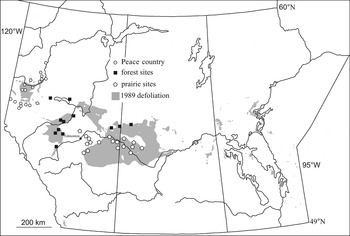
The forest tent caterpillar (FTC), Malacosoma disstria Hübner (Lepidoptera: Lasiocampidae), is a significant pest of aspen (Populus tremuloides Michx. (Salicaceae)) in Canada. Eruptive outbreaks frequently occur over large parts of the country resulting in reduced growth of trees, dieback, and even death (Hiratsuka et al. Reference Hiratsuka, Langor and Crane1980, Reference Hodson2004). The last widespread outbreak of FTC in western Canada began in the early 1970s as small pockets of defoliation in the three prairie provinces, Alberta, Saskatchewan, and Manitoba (Robins et al. Reference Robins, Patterson, Still, Mortensen, Gautreau and Tidsbury1972); it lasted for almost two decades and finally collapsed in 1991 (Hiratsuka et al. Reference Hiratsuka, Langor and Crane1980; Cerezke et al. Reference Cerezke and Gates1991; Cerezke and Gates Reference Cerezke, Emond and Gates1992). During that time, outbreak populations occurred across the mid-latitudes of Alberta and Saskatchewan, with pockets in Manitoba more or less simultaneously (Fig. 1).

FTC has a wide range of natural enemies including diseases (viruses, fungi), birds, and insect predators and parasitoids (Witter and Kuhlman Reference Witter and Kuhlman1972; Williams et al. Reference Williams, Parry and Langor1996) that can contribute to the natural control of populations (Parry Reference Parry1995; Parry et al. Reference Parry, Spence and Volney1997). The most diverse assemblage of natural enemies is parasitoid wasps (Hymenoptera); about 42 species of parasitoids are associated with FTC in Canada (Williams et al. Reference Williams, Parry and Langor1996). The best-studied parasitoids are those associated with FTC larvae (Witter and Kuhlman Reference Witter and Kuhlman1972, Reference Witter and Kuhlman1979; Parry Reference Parry1995; Parry et al. Reference Parry, Spence and Volney1997). A number of the parasitoids attack FTC eggs (Williams et al. Reference Williams, Parry and Langor1996) but they have not been well studied and virtually nothing is known about them in Canada. Although there has been some work on the biology of FTC egg parasitoids (McLeod and Ayre Reference McLeod and Ayre1956; Witter and Kuhlman Reference Witter and Kuhlman1972; Stacey et al. Reference Stacey, Roe and Williams1975; Smith and Goyer Reference Smith and Goyer1985), this has mainly been limited to small-scale studies of the factors influencing parasitism incidence or simple faunal surveys. The purpose of this study was to examine the geographic variation in egg parasitoid diversity and the abundance in the outbreak of FTC populations across a wide spatial scale in the Canadian prairies.
Larval FTC hatch from eggs in early spring, dependent on weather and coincident with aspen bud break. Immature stages are completed, and adult flight and oviposition begin in early July. Adult female FTC lay eggs in bands around aspen twigs, which are covered by a foamy substance known as spumaline, in mid- to late July. Eggs are exposed to parasitoid attack for the remainder of the summer and then to winter weather until hatching the following spring (Hildahl and Campbell Reference Hildahl and Campbell1975; Hiratsuka et al. Reference Hodson2004).
Methods
A total of 477 FTC egg bands were examined at 49 sites across Alberta and Saskatchewan in 1989 and 1990 (Fig. 1). The sampling method was modified from that used by the Canadian Forest Service Insect and Disease Survey for predicting defoliation intensity (Hildahl and Campbell Reference Hildahl and Campbell1975; Cerezke and Gates Reference Cerezke, Emond and Gates1992).
Sites for sampling egg parasitoids were selected in areas that experienced significant FTC defoliation in the summer the sampling was performed. Selected sites were within the major outbreak area, had the same outbreak history of prolonged and severe defoliation, and were at the same outbreak stage of imminent population collapse. Sites were located throughout as much as possible the FTC outbreak area in Alberta and western Saskatchewan. Sites were not controlled for egg band or larval density, but generally they were moderately to highly defoliated and had a high FTC larval density (H. Gates, personal communication), although counts or estimates of larvae were not performed.
Sampling sites were loosely grouped into three habitat types (Fig. 1). The northwestern limit of sampling was in the Peace country in northern Alberta, primarily an agricultural zone interspersed with large aspen “islands”, forested river bottoms and coulees, and agriculture and (or) forest interface (“Peace country” sites). Sites in central Alberta and western Saskatchewan were located in aspen or mixed-wood stands in more or less continuous aspen parkland or boreal forest (“forest” sites). Sites in southeastern Alberta and southwestern Saskatchewan consisted of aspen woodlots and windrows within an agricultural landscape (“prairie” sites).
Data on stand characteristics, such as mean DBH, volume, or height and age of co-dominant trees were not collected because they were not deemed necessary for the purposes of defoliation forecasting. Quantification of forest habitat metrics, which likely have a significant effect on FTC populations, was not available. However, the nature of collection sites indicated that the use of the three “habitat types” is biologically defensible. Prairie sites consisted of very small patches of only a few treed hectares or of windrows with as little as a few dozen open-grown trees (H. Gates, personal communication) separated from other such patches by many kilometres. Conditions on these sites are likely to be different from those of forest sites that consisted of large, closed-canopy forest stands in a mixed forest matrix. Peace country sites are likely to have a mixture of conditions because some sites were in agricultural zones and others in relatively continuous forest along the Peace and Wapiti rivers.
Sampling was performed in late September and early October over a 2-week period soon after leaf fall was completed and egg bands became visible and presumably well after parasitoid activity ceased. The order of sites was chosen for practicality, with sites more distant from Edmonton sampled together over a few days and sites nearer Edmonton sampled as opportunity allowed. There was no particular chronological order or pattern in sampling different habitat types.
At each site, three aspen trees (8–15 cm DBH with crowns completely separated from those of other trees) were randomly selected and were felled or bent over then sampled with pole pruners. For forecasting purposes, all egg bands on each tree were counted and 30–50 egg bands were randomly collected from each site for parasitoid rearing. Of the collected egg bands, 10 were randomly chosen from each site in 1989 and 15 per site in 1990 for rearing, or for 12 sites that had low numbers as many as were available. Each reared egg band was rated for degree of spumaline cover on a scale from 0 to 5 (0 = none, 1 = 1%–15% cover, 2 = 16%–40%, 3 = 41%–65%, 4 = 66%–90%, and 5 = 90%–100%). Egg bands were individually reared in the laboratory in 30 mL plastic vials at ambient temperature until emergence of FTC larvae and parasitoids was complete. Emerged parasitoids were counted and identified to species, and the number of hatched and unhatched eggs was recorded. Unhatched eggs were not assessed for cause of mortality.
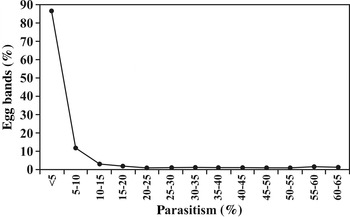
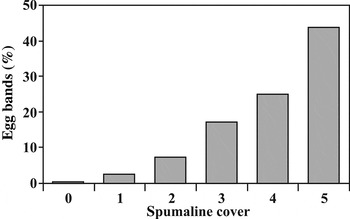
Percent parasitism (by each parasitoid species separately and by all species combined) and number of species present was calculated for each egg band and summarized by tree, site, and site type. Analyses were performed using the SAS 9.1 (SAS Institute Inc. 2009). The effect of the interaction between spumaline cover and site type on percent parasitism and on number of species per egg band was analysed separately by modeling percent parasitism and number of species as dependent variables against spumaline cover and site type in the General Linear Models procedure. Percent parasitism data were found to be highly zero weighted and exponentially distributed (Fig. 2). Egg bands with 100% unhatched eggs (9 of 477) and those with 0% parasitism (149 of 477) were deleted from the analysis of the interaction between spumaline cover and percent parasitism because it could not be determined if they had resisted parasitism or parasitoids had simply not encountered them. The remaining data from 319 egg bands were subjected to log transformation (log (%parasitism+1)). The resulting variable was normally distributed (Shapiro–Wilk W = 0.984373, Pr < W = 0.015). The average number of parasitoid species per egg band, although categorical in nature, was normally distributed when treated as a continuous variable (Shapiro–Wilk W = 0.942918, Pr < W = 0.0001). Separate analyses were also run on each species of parasitoid to determine if there were species-specific responses to any factor. The effect of site and year on spumaline cover was also analysed. Spumaline cover was found to be weighted toward category 5 (Fig. 3), over the whole data set and for each site type. Spumaline cover was analysed as categorical data by χ2 in the FREQ procedure (SAS Institute Inc. 2009). Least squares means and standard error estimates are presented.


Results and discussion
Three species of parasitic Hymenoptera, Telenomus clisiocampae Riley (Proctotrupoidea: Scelionidae), Ooencyrtus clisiocampae (Ashmead) (Chalcidoidea: Encyrtidae), and Baryscapus malacosomae (Girault) (Chalcidoidea: Eulophidae), were obtained from FTC egg bands in this study. All three are known to be common egg parasitoids of FTC (Witter and Kuhlmann Reference Witter and Kuhlman1972, Reference Witter and Kuhlman1979; Williams et al. Reference Williams, Parry and Langor1996) and were found throughout the range where egg bands were collected in this study. Total parasitism was low for individual egg bands (3.6% ± 8%, range 0%–62.5%), but parasitoids were found in all sampling sites but one. Telenomus clisiocampae was the most common parasitoid, recovered in every location but one (parasitism per egg band 1.7% ± 5.79%, range 0%–62.5%). Ooencyrtus clisiocampae was the second most common species, occurring in 44 of 49 locations (1.2% ± 3.33%, range 0%–47.4%). Baryscapus malacosomae was recovered from 42 of 49 sites (0.8% ± 2.09%, range 0%–33.3%). Of 477 egg bands assessed for incidence, 158 (32.9%) were not parasitized or had no emergence, 176 (37.1%) were parasitized by a single species, 93 (19.5%) were parasitized by two species, and 50 (10.5%) were parasitized by all three species.
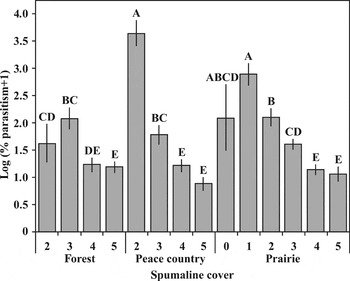
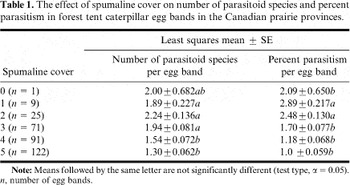
There was a significant effect of spumaline cover on number of parasitoid species per egg band (F 5,313 = 13.16, P < 0.0001) (Table 1). The number of parasitoid species per egg band, for egg bands with spumaline cover of 4 and 5, were significantly lower than for other values except 0, and this result may be because there was only a single egg band with 0 spumaline cover. There was also a significant effect of spumaline cover on total percent parasitism (F 5,313 = 37.45, P < 0.0001) for all species pooled (Table 1). Percent parasitism for egg bands with spumaline cover ratings of 1 and 2 were significantly higher than for egg bands with other spumaline cover ratings. This relationship was found in all three habitat types (Fig. 4).


Note: Means followed by the same letter are not significantly different (test type, ∞ = 0.05). n, number of egg bands.
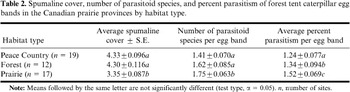
With all species pooled, there was a significant effect of habitat type on spumaline cover (F 2,316 = 36.43, P < 0.0001), on number of parasitoid species per egg band (F 2,316 = 6.44, P > 0.0018), and on level of total parasitism (F 2,316 = 3.58, P > 0.0289) (Table 2). Peace country and prairie sites were significantly different from one another for all three measures. Egg bands from prairie sites also had significantly less spumaline than forest sites (P < 0.0001). The two lowest categories of spumaline cover were found only at prairie sites (Fig. 4).

Note: Means followed by the same letter are not significantly different (test type, ∞ = 0.05). n, number of sites.
There were no significant differences between sampling sites within habitat types for spumaline cover, parasitism frequency, or average number of species per egg band, nor were there any discernable geographic or yearly patterns. There were also no significant differences among species for responses to any variable.
Egg parasitoid species were universally distributed on the scale of this experiment, though relatively uncommon. Percent parasitism estimates reported here were similar to those of previous reports (Hodson Reference Hodson1939; Witter and Kuhlman Reference Witter and Kuhlman1979). The three species reported here are widely distributed and common (Witter and Kuhlman Reference Witter and Kuhlman1972). They showed no particular geographic or habitat association in this study. It is possible that the absence of O. clisiocampae and B. clisiocampae from some sites, primarily in Peace country, might be due to the selection of poplar islands versus agriculture and (or) forest boundary sites. However, site characteristics (age class of trees, stand density, etc.) were not well documented during sampling and would require a more detailed study with stratified sampling to quantify. It is also possible that incidence and rate of parasitism were affected by egg-band density, of which no quantified measurement was made. However, egg-band density probably had minimal effect on the results, given that all sites selected were from areas that experienced moderate to high defoliation in the sampling years and had similar defoliation predicted for the following year (Cerezke and Gates Reference Cerezke, Emond and Gates1992). Additionally, the minority of sites from which few egg bands were available, and where moderate defoliation was predicted for the following year, were evenly distributed among the habitat types. A more detailed study including control of sites for egg-band density would be required to detect density-dependent effects, if any, for these widespread species.
Another caveat in interpreting the patterns of spumaline cover and parasitism is the confounding of habitat type with geographic location. The three habitat types occur approximately on a southeast–northwest gradient. In studies that cover a wide geographic area it is not possible to separate the effects of habitat type from the possible effects of geography and its attendant climatic variance, particularly for the Peace country and (or) prairie comparison. However, it is compelling that the same relationships between spumaline cover and parasitism incidence are found within and among habitat types, especially when considering that there is no apparent geographic pattern of parasitism incidence within a habitat type. Resolution of these two factors would require a different type of study on a smaller geographical scale with an increased number of sample sites in aspen patches of various sizes.
The results of this study are congruent with others in showing a clear correlation between spumaline cover and incidence of parasitism. It has been hypothesized that the role of spumaline is to protect FTC eggs from predation and parasitism (Witter and Kuhlman Reference Witter and Kuhlman1979; Fitzgerald Reference Fitzgerald1995). Darling and Johnson (Reference Darling and Johnson1982) examined the position of individual eggs in masses of eastern tent caterpillar, Malacosoma americanum (F.) and found a strong correlation of incidence of parasitism and degree of inviability with a position outside or under spumaline cover. Hodson (Reference Hodson1939) and Langston (Reference Langston1957) observed that egg parasitoids emerged mainly from eggs that were not spumaline covered. Smith and Strom (Reference Smith and Strom1993) demonstrated increased parasitism by Trichogramma Westwood (Hymenoptera: Trichogrammatidae) wasps in egg masses where spumaline had been mechanically removed immediately after oviposition.
It is possible that the reduced average spumaline cover on egg bands sampled from prairie sites was linked to food limitation. These samples were taken from aspen in small woodlots or windrows that are, under outbreak conditions, likely to be completely defoliated before completion of caterpillar development resulting in some level of larval starvation and reduced quality of adults. We expected that Peace country and prairie sites would be more similar to one another because egg bands were predominantly collected from tree patches in agriculture-dominated landscapes, but this was not the case. This result may be due to a higher density of forest patches in Peace country, which is largely an island of agricultural activity surrounded by relatively continuous mixed-wood forest (as opposed to the true aspen “islands” found in prairie sites). Peace country sites chosen at the agriculture and (or) mixed-wood forest boundary, particularly in river valleys with extensive continuous aspen stands, may have an ecological function more similar to forest sites. Stratified sampling, with more control of site type and aspen stand size, may be required to resolve this question and to separate the influence of nutrition from other factors such as weather.
Acknowledgements
We thank Colin Myrholm and Howard Gates (Northern Forestry Centre) who performed the egg band sampling. James Hammond (Northern Forestry Centre) and Chris MacQuarrie (Great Lakes Forestry Centre) provided useful discussion of data distributions and analysis methods. Greg Pohl and James Hammond reviewed earlier versions of the manuscript.