





Introduction
Most healthcare for children is family centred; however, for children with CHD, parental involvement may be particularly intense and demanding throughout childhood. Reference Sable, Foster and Uzark1 Youth with moderate to severe CHD often require multiple surgeries, ongoing monitoring, and lifelong cardiac care, especially those with critical CHDs requiring early intervention to improve survival and long-term outcomes. Reference Day and Adwani2–Reference Stallings, Isenburg and Aggarwal5 Additionally, some individuals experience deficits in executive functioning related to disease severity, which may have implications for driving safety. Reference Calderon and Bellinger6–Reference Ross, Jongen and Brijs10 During adolescence, parents may face added challenges in supporting their adolescent’s health and safety while fostering independence during the transition to adulthood.
Because motor vehicle crashes remain a leading cause of death and disability, driving introduces new risks for all adolescents. Reference Yellman, Bryan and Sauber-Schatz11 These risks may be heightened for youth with CHD, as literature in adults with cardiac disease demonstrates impaired driving ability and loss of vehicular control. Reference Pan, Pellicori and Walklett12 In the United States, parents play a central role in the path to licensure, and those of adolescents with CHD may seek additional guidance from healthcare providers to support safe driving and communication about risk. Reference Mirman and Kay13 However, little is known about parental perceptions of driving practices, the learning-to-drive process, and safety in this population, limiting resources to inform these discussions.
Therefore, to gain knowledge and improve understanding, a prospective qualitative descriptive study was conducted using semi-structured interviews of parent–adolescent dyads in which the adolescent has CHD. The study explored perceived barriers and facilitators to safe, independent driving practices and examined the impact of CHD on driving experiences. This report presents a distinct analysis of the parent interview data; findings from adolescent interviews within the same dyads have been reported previously. Reference DiFusco, Solomon and Lee14
Methods
This study used a qualitative descriptive approach, grounded in pragmatic inquiry, and analysed using conventional content analysis. The Institutional Review Board at the Children’s Hospital of Philadelphia approved this study.
Sample
Purposive sampling was used to capture variation in CHD severity and driving stage. Adolescents aged 15–19 years receiving care at the hospital were identified via CHD-related ICD-10 codes (Q20–Q28) in the electronic health record. Eligible adolescents and their parents were contacted using email or telephone information on file (December 2022–October 2023). Interested participants were screened for eligibility: adolescents had a learner’s permit or driver’s license or intended to obtain one, were able to read and write in English, and had access to a computer, tablet, or smartphone. Recruitment continued until thematic sufficiency was achieved, defined as no new concepts emerging.
Data collection
After consent and assent, participants received an electronic link to a demographic questionnaire, health survey, and scheduling portal for a 1:1 virtual interview. Parents and adolescents were interviewed separately. The parent interview guide, informed by the Theoretical Domains Framework, addressed graduated driver licensure, experiences as a passenger with an adolescent driver, adolescent driving, and raising an adolescent with CHD. Reference Atkins, Francis and Islam15 The guide was pilot tested with an adult with CHD and their parent, a CHD healthcare provider, and a nurse researcher with expertise in injury prevention. Semi-structured interviews were conducted from January to November 2023 by a PhD-prepared nurse researcher via a secure video platform. The researcher had no prior relationship with participants and was not involved in their clinical care. Although formal reflexive notes were not maintained, the researcher remained mindful of potential bias related to paediatric cardiology experience during data collection and analysis. Interviews were audio-recorded, professionally transcribed, and reviewed for accuracy and de-identification.
Adolescents’ primary CHD diagnoses were abstracted from the electronic health record. Anatomic severity (mild, moderate, and severe) was classified using 2020 European Society of Cardiology criteria. Reference Baumgartner and De Backer16 Classification was performed by the lead investigator (PhD-prepared nurse scientist with ∼10 years of paediatric cardiac clinical experience at the time). When diagnosis-to-severity mapping was unclear, an institution-hosted secure large language model was used as a supplementary tool to support guideline-based categorisation; final determinations were made by the lead investigator. 17 CHD severity was used for sample description only and did not inform sampling or eligibility. Some participants had lesions commonly described as “critical CHD;” because this descriptor spans moderate and severe categories, it was summarised descriptively rather than treated as a separate stratum.
Data analysis
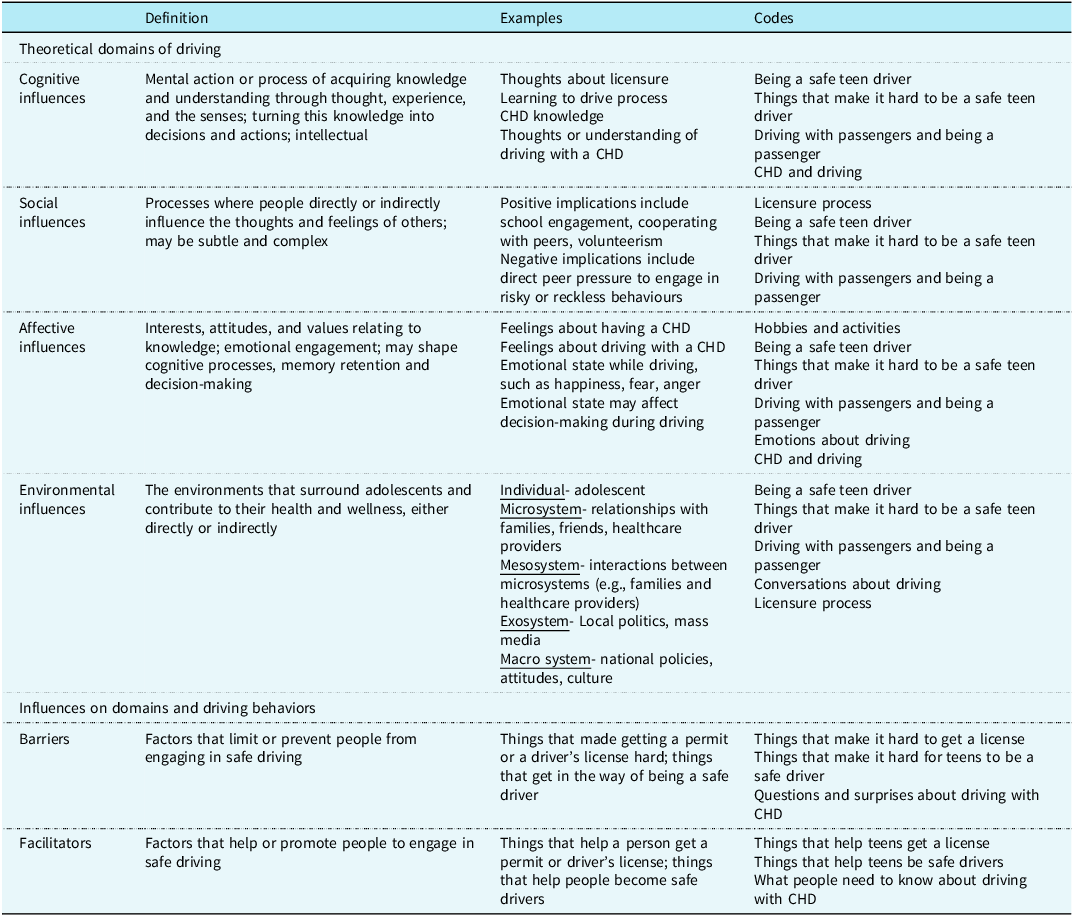
Demographic data were summarised using descriptive statistics. Data were analysed using conventional content analysis in NVivo. A codebook was developed based on the refined Theoretical Domains Framework, which captures cognitive, social, affective, and environmental influences on behaviour and has been used to identify barriers and facilitators. Reference Atkins, Francis and Islam15 Two study team members independently coded 29 parent interviews, achieving 98.3% agreement (kappa = 0.86). Discrepancies were resolved through discussion, and the codebook was refined for clarity. Codes were organised into patterns, and themes were generated (Table 1).
Codebook mapping to the theoretical domains framework α

Table 1. Long description
The table categorizes influences on driving behaviors among adolescents into four theoretical domains: cognitive, social, affective, and environmental. It includes definitions, examples, and codes for each domain. The cognitive influences section describes mental processes and knowledge acquisition related to driving, with examples like thoughts about licensure and learning to drive. The social influences section covers how people influence each other’ thoughts and feelings, with examples like peer pressure and school engagement. The affective influences section focuses on emotions, attitudes, and values, with examples like feelings about driving with a CHD and emotional states while driving. The environmental influences section discusses the environments surrounding adolescents, with examples like relationships with families and local politics. The table also includes influences on domains and driving behaviors, categorized into barriers and facilitators, with examples like factors that limit or promote safe driving.
α Parents answered interview questions based on their experiences or perceptions about supporting an adolescent driver with CHD.
Qualitative rigour and trustworthiness
Rigour and trustworthiness were ensured using Lincoln and Guba’s criteria and the Standards for Reporting Qualitative Research guidelines. Reference O’Brien, Harris, Beckman, Reed and Cook18,Reference Lincoln and Guba19 These approaches enhanced transparency, rigour, and credibility. An audit trail was maintained throughout coding, and dependability and transferability were supported through independent coding by two researchers, with review by a third coder (a practicing paediatric cardiac healthcare provider) to confirm identification of barriers, facilitators, and themes. Given the research team’s clinical experience in paediatric cardiology, reflexive practices, including audit trails and team-based coding, were used to minimise bias and ensure findings remained grounded in participants’ perspectives.
Results
Sample and recruitment
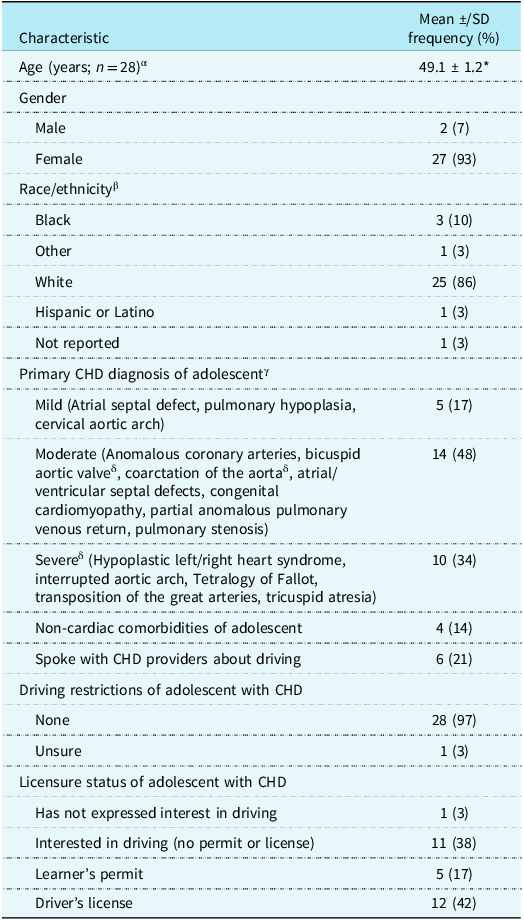
Of 298 parent–adolescent dyads assessed for eligibility, 104 (35%) did not meet inclusion criteria, 111 (37%) were unresponsive to contact attempts, and 53 (18%) declined participation. Thirty dyads (10%) consented, with adolescent assent obtained as applicable. After consent/assent, three participants from separate dyads (two adolescents and one parent) were lost to follow-up. The final analytic sample included 29 parents (Table 2).
Participant and adolescent characteristics (n = 29)

Table 2. Long description
A table with 12 rows and 2 columns. The columns are labeled ’Characteristic’ and ’Mean ± SD frequency (%)’. The table presents data on age, gender, race/ethnicity, primary CHD diagnosis, non-cardiac comorbidities, driving-related information, and licensure status of adolescents. Each row provides specific details under these categories. For example, the age is given as 49.1 ± 1.2 years with a sample size of 28. Gender distribution shows 2 males (7%) and 27 females (93%). Race/ethnicity includes Black (3 or 10%), Other (1 or 3%), White (25 or 86%), Hispanic or Latino (1 or 3%), and Not reported (1 or 3%). Primary CHD diagnosis is categorized into Mild, Moderate, and Severe with respective frequencies. Non-cardiac comorbidities are present in 4 (14%) adolescents. Driving restrictions are noted as None for 28 (97%) and Unsure for 1 (3%). Licensure status includes those not interested in driving (1 or 3%), interested but without a permit or license (11 or 38%), with a learner’s permit (5 or 17%), and with a driver’s license (12 or 42%).
α Date of birth not reported (n = 1; 3%).
β Multiple race/ethnicities reported (n = 1; 3%).
γ Multiple CHD diagnoses (n = 12; 42%).
δ Includes critical CHD (n = 17; 57%).
Participant characteristics
Parents were predominantly female (93%) and White (86%). Non-Hispanic ethnicity was reported among 97% of parents. Mean parent age was 49.1 ± 1.2 years (n = 28).
Adolescent clinical and driving characteristics
Adolescents’ CHD severity was classified as mild (17%), moderate (48%), and severe (34%); 57% had a critical CHD. Four adolescents (14%) had non-cardiac comorbidities. Seventeen parents (57%) reported that their adolescent held a learner’s permit or driver’s license. Most parents (97%) reported no current or anticipated driving restrictions. Six parents (21%) reported having spoken with a CHD healthcare provider about driving (Table 2).
Analysis resulted in two major themes reflecting parents’ perspectives on adolescent driving in the context of CHD: (1) parents see driving as a pivotal step towards adolescent independence, leading to both anticipation and apprehension, and (2) driving introduces challenges specific to adolescence that may not be evident earlier.
Theme 1: Parents see driving as a pivotal step towards adolescent independence, leading to both anticipation and apprehension
Parents supported their adolescents throughout graduated driver licensing programs and shared insights about barriers and facilitators of independent driving. Some had multiple children and previous experience with graduated driver licensing requirements, and this familiarity was helpful in supporting their adolescent with CHD. Several described mixed emotions as their adolescents pursued licensure—some anticipated the excitement of an unrestricted driving experience and greater independence, while others felt apprehensive.
“it’s one of those things that I wanted her to have – I wanted her to do. It’s a freedom when you have your own vehicle and are able to drive” (mother of a 17-year-old female).
“. . .his entire childhood, he was very restricted as far as sports and things like that were concerned. So it was important that he have this experience in his life” (mother of a 17-year-old male).
“. . .it [driving] definitely can be scary, but I feel like it’s definitely helped empower him. So I think you’ve got to look at the risk/reward factor in it” (father of an 18-year-old male).
“don’t let the fear of what can happen paralyze the child’s steps towards independence” (mother of a 17-year-old female).
Many parents normalised their concerns, describing them as similar to those of parents of adolescents without CHD, suggesting an effort to balance awareness of medical risk with typical developmental expectations. They expected their adolescents to be responsible and follow the rules of the road while driving but were also concerned about distractions from technology, other passengers, and other drivers.
“Focusing, wearing your seatbelts, going the speed limit. . .not playing the music too loud. . .following all the rules of the road. . .absolutely no alcohol in the car—or anything else—no marijuana [products]” (mother of a 15-year-old male).
“. . .no phone, no passengers that are distracting and obviously paying attention to what you’re doing, not worrying about a snack or the radio. . .” (mother of a 15-year-old male).
“. . .not only obeying the rules but having an understanding that you’re part of a larger community of drivers and that your decisions impact others. . . we are not planning to allow him to get his license until we can see better decision-making” (mother of a 15-year-old male).
Consistent with descriptive findings, few parents had discussed driving with their adolescents’ healthcare providers. Among those who had not, the qualitative interview data showed that some assumed providers would raise the topic if it were a concern. Several parents noted that conversations about driving during adolescence could be beneficial. A few parents expressed uncertainty when their own worries about driving conflicted with guidance from CHD healthcare providers.
“Our provider had told us to treat him like any normal human being, normal child. . . in the back of my mind, [I wondered] what if his pacemaker goes out?” (mother of a 16-year-old male).
“. . .having [driving] be part of the. . .[discussions] with their cardiologist or healthcare team, whether there are recommendations or not. . . might be helpful” (mother of a 15-year-old male).
Theme 2: Driving introduces challenges specific to adolescence that may not be evident earlier
Concerns about low energy, fatigue, cognitive side effects, and the potential connection between attention deficit hyperactivity disorder emerged as potential impacts on driving during adolescence.
“His energy levels are impacted, so he’s probably gonna be challenged to take a long drive more than another peer of his age that doesn’t have the same situation” (mother of a 16-year-old male).
“with everything he had gone through and being delayed. . .[I was] worried that he’d have a hard time grasping it or understanding” (mother of an 18-year-old male).
“He’s always struggled with attention and focusing issues, it’s something that he’s had difficulty with since he was a kid. He does have [attention deficit hyperactivity disorder and auditory processing disorder and]. . .needs a lot of redirection, so I just worry about him driving. . .” (mother of a 15-year-old male).
Some parents described experiences that diverged from this pattern, distinguishing between CHD-related challenges that did not affect driving and driving concerns unrelated to CHD.
“She is. . .developmentally delayed. . .has dyslexia. . .[and] the written test was a little more difficult. She’s not as quick to react so that’s a concern. There’s a direct correlation between. . . some of her development delays and her CHD, but. . .I don’t focus on that as an impact in her driving” (mother of a 17-year-old female).
“I am nervous. Not because of his condition - because he’s that social kid. . . he’s my preemie, so everything is fast-forward for him” (mother of a 15-year-old male).
Another mother of a 15-year-old male emphasised that driving might be impacted by CHD severity and that some adolescents may have more cognitive or mobility challenges than others. Two fathers described how delaying licensure (purposely or because of complications of CHD) helped to mitigate these types of concerns.
“We waited with him a little longer just because. . . heart issue and. . . maturity-wise, he was a little behind. . . “ (father of an 18-year-old male).
“. . .[licensure was] delayed year because he had plastic bronchitis. . . And the upside of that is that you’re older, so he’s matured a little bit just naturally.” (father of a 16-year-old male).
Discussion
This interview-based study is the first known research to explore parents’ perspectives on the barriers, facilitators, and impact of CHD on adolescents’ ability to drive safely and independently. Like other studies examining parent perceptions of the learning-to-drive process, parents in this study emphasised the importance of minimising distractions, following the rules of the road, responsibility, and control of social and emotional skills for keeping their adolescent and others safe. Reference Mirman and Kay13 No single systematic program for educating parents about how best to protect teenage drivers exists. Reference Simons-Morton20 Parents with multiple children had prior experience with graduated driver licensing programs and could leverage these experiences when it came time to support their adolescent with CHD. Parents navigating these programs for the first time may require different support. Healthcare providers can help bridge this gap by continuing to champion graduated driver licensing programs, hazard perception training, and on-road monitoring systems. Reference Pappas21
Parents viewed licensure as an important developmental milestone, both as an indicator of typical adolescent development and an opportunity to engage in a task that is not restricted by CHD. Similar to other studies examining physical differences in day-to-day activities, many parent participants reported that their adolescents had few activity restrictions, which allowed them to participate in a variety of activities like their peers without CHD. Reference Sharer, Kameny and Romaine22–Reference Jackson, Fox and Swenski24 Other parents shared how their adolescents were restricted from sports and activities, which could result in feeling different from peers without CHD, and driving provided an opportunity to live beyond their limitations. Reference Berghammer, Dellborg and Ekman25
Most adolescents in this sample had moderate-to-severe CHD, including 57% classified as having critical CHD (Table 2). This level of clinical complexity typically requires ongoing cardiology follow-up to monitor evolving symptoms and complications, which may be relevant to driving readiness and the need for anticipatory guidance. 26 Despite this, most adolescents had no current or anticipated driving restrictions, and only 21% of parents reported discussing driving with their adolescent’s paediatrician or CHD specialist. Regardless of disease severity, provider-led discussions about safe driving and related health behaviours may strengthen parent–adolescent communication. Reference Brar, Sieving and Steiner27,Reference Ford, Cheek and Culhane28 However, prior research suggests clinicians may feel unprepared for these conversations; in one study of 78 healthcare providers, only half felt prepared and just 20% felt comfortable addressing driving in adolescents with autism spectrum disorders, underscoring the need for evidence-based resources to support such discussions. Reference Sartin, Myers and Labows29
Only two parents identified challenges they attributed to their adolescent’s CHD diagnosis, noting that these challenges did not appear to affect driving ability. Two other parents described difficulties that they believed impacted driving performance yet did not perceive these issues as being related to their adolescent’s CHD diagnosis. These findings demonstrate that certain challenges associated with CHD may become more evident during adolescence, a period when parents may not yet appreciate their significance. Reference Karsdorp, Everaerd and Kindt30 Consequently, there is a critical opportunity for healthcare providers to proactively share information and support families during this transitional phase.
Developmental immaturity in executive functioning may contribute to unsafe driving behaviours in adolescents. Reference Walshe, Ward McIntosh and Romer7,Reference Ross, Jongen and Brijs10 Youth with CHD may be at increased risk for these difficulties, which vary by lesion complexity and disease severity. Reference Calderon and Bellinger6,Reference Cassidy, White and DeMaso8,Reference Gilboa, Devine and Kucik9 Deficits such as poor working memory, inattention, and disinhibition may further increase driving risk. Reference Walshe, Ward McIntosh and Romer7,Reference Klauer, Ehsani and McGehee31 Despite this, few studies have examined the impact of executive dysfunction on driving in this population; available evidence reports behaviours such as inconsistent seatbelt use, speeding, mobile device use, and motor vehicle crashes. Reference Fischer, Walshe and Gaynor32,Reference DiFusco33 These findings underscore the complexity of attributing functional difficulties to specific causes and suggest that both CHD-related and non-CHD factors may influence driving readiness. Parents can help mitigate risk by delaying licensure and setting limits on high-risk conditions (e.g., nighttime driving, peer passengers, and cellphone use). Reference Simons-Morton, Ouimet and Catalano34 Healthcare providers may also support families by identifying whether interventions targeting attention-deficit/hyperactivity disorder and related conditions could benefit adolescents with CHD. Reference DiFusco, Liu and Curry35
Although parents often perceived minimal impact of CHD on their adolescent’s driving, some expressed concerns that common symptoms, such as fatigue or low energy, could compromise safety. While providers frequently encouraged families to treat adolescents “like a normal kid,” lingering concerns led parents to question readiness for independent driving. These concerns may not be readily recognised within CHD care discussions, highlighting the potential for unintentional biases to shape provider–patient communication and decision-making. Reference Lopez36,Reference Shane, Sood and Slonim37 Supporting parents in articulating these concerns is critical as their role evolves from primary decision-maker to advisor during the transition to adult care. Reference Tyagi and Sontakke38
Limitations
This study was not without limitations. Most participants were White, non-Hispanic mothers of adolescents receiving CHD care from a single cardiac centre in a freestanding paediatric hospital in the northeastern United States, which may limit generalizability. CHD severity was classified from electronic health record diagnoses using guideline criteria and a secure language-modelling tool but was not independently verified, introducing the potential for misclassification and limiting interpretation of severity-based comparisons.
Larger and more diverse samples are needed to better understand differences in how adolescents gain driving experience, parental involvement in the licensure process, and variation in CHD care across institutions and countries. Focusing on specific CHD diagnoses may yield more targeted insights into barriers and facilitators to safe driving.
Future research should incorporate objective or proxy measures to better assess executive functioning and learning challenges, which may not be reliably self-reported and may have important implications for driving safety.
Conclusion
Findings from this study provide novel insights into parents’ perspectives as they navigate licensure and the learning-to-drive process with adolescents with CHD. Although most parents perceived minimal impact of CHD on driving ability and viewed licensure as a key step towards independence, many identified challenges not routinely addressed in clinical care. Few reported receiving guidance from healthcare providers, highlighting an opportunity for provider-initiated discussions that address both general and CHD-specific risks. Tailored resources and communication strategies may better support parents as their role evolves during the transition to adult care. While providers often encourage treating adolescents with CHD “like a normal kid,” this message frequently coexisted with parental concerns about safety and well-being, underscoring the need for more nuanced, individualised conversations about driving readiness and health behaviours. Future research should focus on specific CHD diagnoses and identify effective strategies to support families in promoting safe, independent driving among adolescents with CHD.
Acknowledgements
The authors acknowledge the efforts of Lorene Schweig, Evangelia Touring, Lauren Greenberg, Priscilla Liu, Kassady Gatz, and the Children’s Hospital of Philadelphia Recruitment Enhancement Core in supporting study activities.
Financial support
This work was supported in part by the National Institute of Nursing Research Award R01NR018425 (PI: McDonald) at the National Institute of Health and Center for Disease Control and Prevention Award R49CE003083 (PI: Meisel). The content is solely the responsibility of the authors and does not necessarily represent the official views of the National Institutes of Health or Center for Disease Control and Prevention. The sponsors had no role in the: design and conduct of the study; collection, management, analysis, and interpretation of the data; preparation, review, or approval of the manuscript; or decision to submit the manuscript for publication.
Competing interests
None.
The authors assert that all procedures contributing to this work comply with the ethical standards of the Federal Policy for the Protection of Human Subjects (“Common Rule”) and with the Helsinki Declaration of 1975, as revised in 2008, and has been approved by the institutional committees at The Children’s Hospital of Philadelphia.

 Open access

