


Symbols

Introduction
Steady-state creep and thermal finite-element models are used to simulate the creep and temperature behaviour along the central flow line of the Erebus Glacier tongue. This floating glacier, which is believed to be floating along its entire length, currently extends more than 12 km into McMurdo Sound (Fig. 1). This tongue has a history of reaching a critical length (approximately 12-13 km), at which time it undergoes ice-calving that reduces its length to approximately 8 km (Reference HoldsworthHoldsworth, 1974, 1982). Despite the transient nature, certain steady-state simulations can provide very useful information about the thermal regime of the Erebus Glacier tongue.
Location of Erebus Glacier tongue (personal communication from Reference HoldsworthG. Holdsworth, 1981).

Although the results regarding the temperature field obtained from the authors’ model were used by Reference HoldsworthHoldsworth (1982), these were merely used to help account for softening of ice as reflected by a certain temperature-dependent parameter in the creep power law that had been used for modelling the flow behaviour. This paper is an exposition of the modelling technique and demonstrates the importance of properly accounting for factors which influence the thermal regime. In order to predict the temperature distribution, it becomes necessary first to determine the velocity field within the glacier tongue. As will be shown, the velocity distribution itself is very sensitive to the up-stream boundary condition at the flotation line. This, in turn, affects the estimation of temperature field within the glacier tongue, due to strong advection.
The finite-element models used in the analyses are described very briefly. Only the essential components of the model, that are pertinent to modelling of glacier flow, are discussed in detail. The reader is referred to Zienkiewicz (1977) for details of the finite-element method.
Finite-Element Models
The stress equilibrium and the energy balance of an ice mass can be written in the following integral forms.


All symbols in the equations above are defined above. Assuming that an ice mass creeps in an incompressible manner, the constitutive relationship between stresses σ ij and the creep strain-rates ξ c ij is given by

where p is pressure, and μ is the strain-rate and temperature-dependent viscosity. Since stresses are not uniquely defined in terms of strain-rate due to incompressibility, one more equation is required to enforce incompressibility, i.e.
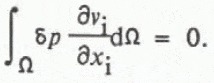
Details of conversion of Equations (1), (2), and (4) to their finite-element equivalents for planar isotropic flow have been presented by Reference StolleStolle (unpublished). It is noted here that three-node triangular elements with linear temperature distributions and six-node triangular elements with quadratic velocity and linear pressure fields have been used for the thermal analysis and steady-state creep analysis, respectively.
Creep Analysis of Erebus Glacier Tongue
The creep of floating ice masses is different from that of land-based glaciers in that the deformation is essentially one of longitudinal extension rather than shearing (Reference WeertmanWeertman, 1957). The incompressible, non-Newtonian creeping flow model is used to study the creep behaviour along the centre line of the glacier tongue. An isothermal temperature field is assumed for creep simulations to obtain the velocity fields for the following reasons: except near the flotation line, the influence of shearing within the glacier tongue is expected to be very small; the flow regime is dominated by the kinematics regarding the mass balance. As such, the use of an isothermal creep law is believed to be reasonable and more so because the surface velocities are specified.
Since the glacier tongue is not confined laterally except for the hydrostatic pressure due to sea-water, it spreads as well. Thus the plane-strain assumption incorporated in the creep model is not consistent with the actual creep-flow behaviour. To overcome this difficulty, it is assumed that the lateral strain-rate έc 33 is a fraction α of the longitudinal strain-rate έc 11. The vertical strain-rate έc 22 follows from incompressibility and is given by

For the case when α = 1, according to Weertman (1957), the influence of the lateral straining is to increase the longitudinal strain-rate by approximately 10%. In view of Weertman’s result and the condition expressed by Equation (5), the relative vertical velocities within the glacier tongue, for α = 1, are approximately double that given by a plane-strain analysis.
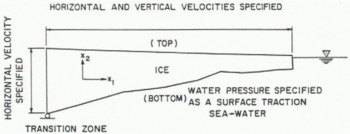
The boundary conditions for the creep analysis and the finite-element grid are shown in Figures 2 and 3, respectively. The data in Figure 3 are based on a short-term observation and were acquired from Reference HoldsworthHoldsworth (1982). Three cases are studied to establish a suitable velocity field which is later used for the temperature analyses: case A – the vertical and horizontal surface velocities are to maintain steady-state flow and the horizontal velocity is constant with depth at the up-stream boundary; case B – the vertical surface velocity is ten times that used in case A and again, the up-stream horizontal velocity is constant; and case C – the vertical surface velocity is ten times that used in case A, and the flotation-line horizontal velocity varies with depth according to a cubic relationship such that the velocity is zero at the ice–bedrock interface and reaches the measured horizontal velocity at the surface. At the flotation line, the vertical velocity at the base is set to zero for all simulations above. The material properties for the creep and temperature analyses are given in Table I.
Boundary conditions for creep analysis.
Finite-element grid and summary of data (personal communication from Reference HoldsworthG. Holdsworth. 1981).

The main uncertainty in the Erebus Glacier tongue study is the flotation-line boundary condition. Owing to the uncertain processes that occur within the transition zone, proper modelling of this region is extremely difficult. Reference SandersonSanderson (1979) discussed two important processes at the transition zone (from land-based to a floating glacier): the velocity-distribution changes from that of a land-based glacier where velocity decreases with depth to that of a floating glacier where the horizontal velocity is nearly constant with depth; and the temperature distribution undergoes a large change when the colder ice comes into contact with sea-water rather than the bedrock.
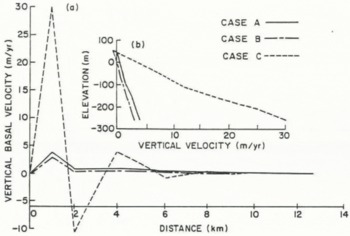
Figure 4a shows that a constant horizontal velocity along the depth at the up-stream boundary leads to more realistic vertical velocities than are observed when the ice is frozen to the bedrock at the up-stream boundary. The influence of changing the specified vertical surface-velocity distribution at the flotation-line boundary is small due to the small magnitudes of the vertical velocities relative to the horizontal velocities, as anticipated. Higher downward vertical surface velocities only decrease the upward vertical velocities at the bottom. By preventing sliding at the up-stream base of the glacier tongue, unrealistically high velocity gradients are observed (case C). The stresses calculated close to this boundary suggest that fracture is imminent, unless there is stress relief via basal sliding near the flotation line. These creep simulations suggest that the transition from a land-based glacier to a floating glacier is gradual and that no sharp boundary can exist without damage to the ice. The detailed modelling of temperature and velocity fields at the flotation line is left for a future study. In view of the predictions by the finite-element model, a uniform horizontal velocity along the depth specified at the up-stream boundary appears to be appropriate at this time.
Vertical velocities for various up-stream boundary conditions (a) along bottom of glacier tongue, and (b) at 1 km section.
Deviatone stress S 11 = (σ11 – σ22 )/2 and shear stress along the glacier tongue for case A.

The dominance of the longitudinal extension, first shown by Reference WeertmanWeertman (1957), is confirmed by the finite-element simulation of Erebus Glacier tongue in this study. A comparison between the shear stress and the deviatoric stress, at sections S1 to S5 in Figure 5, confirms that there is very little shearing along the glacier tongue except near the transition zone. The higher shear stresses near the transition zone are attributed to the manner in which the up-stream velocity-boundary condition is specified. Physically, higher shear stresses are expected in this region due to transition from a land-based to a floating glacier and a greater convergence rate of the upper and lower ice-mass boundaries. These results compare well with those of Reference Sanderson and DoakeSanderson and Doake (1979) who had shown that the shear stresses are small when compared with the direct deviatoric stresses along the glacier tongue. However, it is important to realize that the computed deviatoric stresses in Figure 5 can be sensitive to the creep-law parameters selected.
Thermal Analysis of Erebus Glacier Tongue
The temperature values are specified over the entire boundary by using the information indicated in Figure 3. Also note in this figure that the finite-element grid used for the thermal analysis is four times as refined and fully contained within the grid used for the creep analysis. The specified surface temperatures are based on measurements at 10 m depth while the basal and the terminal temperature values are estimated from the measurements of Reference Jacobs, Jacobs, Huppert, Holdsworth and DrewryJacobs and others (1981). The flotation-line temperature profile is based on several assumptions as discussed by Reference HoldsworthHoldsworth (1982). The influence of strain heating and the thermal advection are included in the finite-element temperature analyses by using the strain-rate and velocity fields obtained from the isothermal creep analyses. Two of the temperature simulations include heat release due to freezing of sea-water at the 10.5 km section shown in Figure 3. For these simulations, the latent heat is introduced as a surface flux at the boundary.
In the absence of thermal advection, it is observed that the strain heating changes the temperature distribution very little (see Fig. 6a and 6b) in the regions away from localized freezing. However, the latent heat due to freezing does have a profound local effect on the temperature field (see Fig. 6b). The following observations were made when advection was included using velocities from case A of creep analysis.
Temperature profiles for cases (a) conduction only, (b) conduction, strain heating, and latent-heat release due to freezing of sea-water, and (c) same as (b) plus advection.

-
The heat released during freezing has very small influence on the temperature field when advection dominates (see Fig. 6c).
-
Thermal advection in the horizontal direction is the dominating factor that determines the spatial temperature variation throughout Erebus Glacier tongue. Changes in the vertical advection cause negligible changes in the temperature field.
The spatial temperature variation is extremely sensitive to both the up-stream temperature and velocity-boundary conditions which, if not appropriately defined, can lead to erroneous results. Unfortunately, no englacial measurements are available for comparison. Although the glacier tongue is not in an overall steady state, the steady-state analysis is believed to give a reasonable description of the temperature variation, for the boundary conditions used, within most of the glacier tongue. This has to be due to the reasonably good estimation of the velocity field obtained that governs advection, i.e. a particle entering the glacier tongue travels across with very small changes in its temperature due to conduction. With the presence of basal crevasses at the transition zone, the thermal-boundary condition would be different. The water in the crevasses would keep the immediately surrounding ice at the phase-equilibrium temperature. Consequently, the mean column-ice temperature would be higher up-stream than is currently predicted by assuming that the up-stream temperature variation with depth corresponds to that of a cold land-based ice sheet.
In general, the updated temperature field from the thermal analysis should be used to re-do the creep analysis. However, due to the manner in which the boundary conditions are specified for the quasi-static equilibrium analysis and based on our experience with the finite-element models, very little improvement is expected in the velocity field through such iterations. Therefore, no recalculations were attempted for improving estimates of the velocity field from the isothermal creep analysis.
Conclusions
The finite-element models for creep and thermal analyses, based on steady-state assumptions, have been successfully applied for approximation of the thermal regime of Erebus Glacier tongue. It has been shown that the influence of lateral spreading of a glacier tongue on in-plane action can be approximated by doubling the relative vertical velocities.
A glacier tongue cannot be assumed frozen to the bedrock at the transition from the land-based part to the floating part without fracture and is important for proper idealization of the velocity-boundary conditions. The temperature fluctuations show that the temperature field is very sensitive to the up-stream boundary conditions as the horizontal thermal advection dominates. Furthermore, the heat given off during freezing of ice at the base has a minimal effect on the temperature field.
Acknowledgements
The authors wish to acknowledge the Natural Science and Engineering Research Council of Canada grant No. A1003 which made this research investigation possible. The authors would also like to acknowledge the review and suggestions made by Reference HoldsworthDr G. Holdsworth of Environment Canada.



