


Introduction
Situational avoidance – the avoidance of anxiety-provoking situations – is thought to play a major role in the development and maintenance of anxiety and related disorders (Beesdo-Baum et al., Reference Beesdo-Baum, Jenjahn, Höfler, Lueken, Becker and Hoyer2012; Porter and Chambless, Reference Porter and Chambless2015). The mechanisms through which situational avoidance increases anxiety appear to operate similarly across disorders and may reflect a general transdiagnostic application of the Behavioral Inhibition System that underlies anxiety pathology (Maack et al., Reference Maack, Tull and Gratz2012; Ran et al., Reference Ran, Zhang and Huang2018; Sportel et al., Reference Sportel, Nauta, de Hullu, de Jong and Hartman2011). For example, avoidance of panic-inducing situations, a symptom of panic disorder (PD; American Psychiatric Association, 2013), is associated with enhanced hypervigilance towards the bodily sensations associated with threat (Hoffart et al., Reference Hoffart, Sexton, Hedley and Martinsen2008), leading to greater anticipatory anxiety of future anxiety-provoking situations and negative reinforcement when subsequent situations are avoided. Similarly, avoidance of social situations is thought to maintain social anxiety disorder (SAD) by reinforcing the perception that social situations are unsafe through an immediate reduction in anxiety but longer-term increased apprehension and avoidance of future anxiety-provoking situations (Hofmann, Reference Hofmann2007). Models of generalized anxiety disorder (GAD) similarly include avoidance as a core maintaining factor of the disorder (Behar et al., Reference Behar, DiMarco, Hekler, Mohlman and Staples2009), and Beesdo-Baum et al. (Reference Beesdo-Baum, Jenjahn, Höfler, Lueken, Becker and Hoyer2012) reported that avoidance of anxiety-provoking situations at the end of treatment predicted worse long-term outcome in patients with GAD.
Despite similarities in the way avoidance of anxiety-provoking situations maintains anxiety transdiagnostically, to our knowledge there is no general measure of situational avoidance. Rather, measures such as the Acceptance and Action Questionnaire (Bond et al., Reference Bond, Hayes, Baer, Carpenter, Guenole, Orcutt, Waltz and Zettle2011) have typically focused solely on experiential avoidance – avoidance of internally distressing feelings – or behaviours unique to a single disorder. Specific anxiety disorder scales, including the Liebowitz Social Anxiety Scale (Liebowitz, Reference Liebowitz1987), the Mobility Inventory for Agoraphobia (Chambless et al., Reference Chambless, Sharpless, Rodriguez, McCarthy, Milrod, Khalsa and Barber2011) and the Worry Behaviors Inventory (Mahoney et al., Reference Mahoney, Hobbs, Newby, Williams, Sunderland and Andrews2016), measure avoidance in symptom-specific situations that are likely to be heightened disproportionately in those with that particular disorder. Yet, given the similarities in situational avoidance among anxiety disorders, it is likely that there is a general anxious avoidance construct that is not unique to a single disorder. Similar concerns have previously been addressed for other transdiagnostic constructs. For example, Ehring et al. (Reference Ehring, Zetsche, Weidacker, Wahl, Schönfeld and Ehlers2011) noted that measures of perseverative negative thinking were limited to scales that assessed solely disorder-specific content, despite similarities in how the construct operated across disorders. This discrepancy resulted in the development of the transdiagnostic Perseverative Thinking Questionnaire (Ehring et al., Reference Ehring, Zetsche, Weidacker, Wahl, Schönfeld and Ehlers2011). Similarly, it may be useful to have a measure of general situational avoidance that can be used across disorders to address limitations in the extant measures. In particular, high rates of co-morbidities among anxiety and related disorders, including SAD, GAD, PD, obsessive compulsive disorder (OCD) and post-traumatic stress disorder (PTSD; Camuri et al., Reference Camuri, Oldani, Dell’Osso, Benatti, Lietti, Palazzo and Altamura2014; Spinhoven et al., Reference Spinhoven, Penninx, van Hemert, de Rooij and Elzinga2014), suggests that assessing and treating avoidance within the confines of disorder-specific situations may be insufficient. Even for those with single disorders, current measures equate severity of avoidance to frequency of avoidance of certain situations. Some individuals may have severe avoidance that has not generalized to multiple situations. Furthermore, the advent of transdiagnostic interventions presents a need for accurate assessment of transdiagnostic treatment mechanisms (Riccardi et al., Reference Riccardi, Korte and Schmidt2017).
Within the context of a clinically relevant measure of situational avoidance, it may also be useful to consider characteristics that facilitate non-avoidance/approach of fearful situations. Although exposure therapy is an effective treatment for most anxiety disorders, it is also aversive, and questions have been raised about how to reduce attrition (McGuire et al., Reference McGuire, Lewin and Storch2014). Successful exposure depends on a person’s willingness to cope with heightened fear, a task that requires considerable courage (Magnano et al., Reference Magnano, Paolillo, Platania and Santisi2017), or action in response to a threat, despite the presence of fear (Gruber, Reference Gruber2011; Norton and Weiss, Reference Norton and Weiss2009; Rachman, Reference Rachman1990). Many definitions of courage also include the notion that courage must be achieved for a noble cause (Rate et al., Reference Rate, Clarke, Lindsay and Sternberg2007), including those that are unique to an individual, including actions to protect one’s identity (Detert and Bruno, Reference Detert and Bruno2017; Koerner, Reference Koerner2014) and psychological risk to achieve positive change in an individual’s life (Pury et al., Reference Pury, Kowalski and Spearman2007). Psychological courage includes actions like seeking mental health treatment despite the difficulty of participating in it (Gruber, Reference Gruber2011; Pury et al., Reference Pury, Kowalski and Spearman2007). Thus, psychological courage may be present even in those with heightened anxiety and could account for increased ability to reduce avoidance and participate in exposure. For example, Norton and Weiss (Reference Norton and Weiss2009) found that self-reported state courage was associated with greater approach towards taxidermied spiders in a sample with elevated spider anxiety. Although courage is usually discussed in terms of heightened fear, which is distinct from anxiety (Davis et al., Reference Davis, Walker, Miles and Grillon2010), individuals with anxiety disorders are placed constantly in situations that result in the necessity of confronting fears, particularly for successful treatment. For example, an individual with social anxiety disorder may feel anxious in advance of a social situation but experience fear of negative evaluation in the midst of the situation (Heimberg et al., Reference Heimberg, Brozovich and Rapee2014). Although courage could aid in the reduction of avoidance, it is not currently assessed alongside avoidance in any of the extant avoidance measures designed for a clinical setting. A measure of courageous/approach responding in combination with anxious avoidance could allow for the simultaneous assessment of these dual processes in the context of anxiety treatment.
Extant measures of courage are limited in their ability to assess courage in the context of anxiety pathology. For example, Woodard’s (Reference Woodard2004) Courage Scale assesses tendency to engage in actions that involve heightened risk, including entering a burning building for a pet, going to war for country, or taking part in a work conflict, rather than willingness to confront feared stimuli. Although designed to assess courage in the face of anxiety, Norton and Weiss’s (Reference Norton and Weiss2009) Courage Measure also consists of items that may assess general risk-taking (e.g. ‘I will do things even though they seem to be dangerous’) rather than courage. Indeed, Howard and Alipour (Reference Howard and Alipour2014) note that the Courage Measure was most strongly correlated with risk-taking and extraversion, suggesting that it may be more related to general willingness to engage in bold acts rather than willingness to endure fearful situations. Finally, Howard and Crayne (Reference Howard and Crayne2019) developed the Persistence Despite Fear subscale of the Multidimensional Persistence Measure, which assesses persistence in frightening situations. However, this measure relates more to general task perseverance than it does to courage in anxiety-provoking situations. To our knowledge, there is no scale that measures anxious avoidance and courageous/approach responding as distinct processes in anxiety-provoking situations, nor studied the relationship between these constructs in clinical groups or in relation to anxiety disorder symptoms.
The aim of the present study was to evaluate a general measure of anxious avoidance and courageous/approach responding – the Response to Fearful Situations Scale (RFSS). In Study 1, the factor structure of the RFSS was evaluated. We predicted that the RFSS would possess a two-factor structure representing distinct avoidance and approach subscales. In Study 2, this factor structure was evaluated again with a confirmatory factor analysis. In Study 3, we sought to show the concurrent validity of the RFSS in predicting fear and steps taken towards a feared stimulus in a behavioral avoidance task (BAT). We predicted that each RFSS subscale would be uniquely associated with both BAT fear and steps taken. In Study 4, we sought to evaluate the ability of the RFSS to predict anxiety symptoms over and above other measures of avoidance in an unselected student sample. In Study 5, we evaluated the performance of the RFSS in a clinic sample, predicting that both RFSS subscales would be associated with measures of anxiety symptoms above and beyond depression and an existing measure of avoidance. Additionally, we hypothesized that those with anxiety diagnoses would exhibit greater anxious avoidance and reduced approach compared with those without a diagnosis.
Study 1
In order to investigate correlates of response to fearful situations, seven items assessing anxious avoidance and six items assessing approach responses to fearful situations were devised and evaluated. An exploratory factor analysis examined the factor structure of the RFSS.
Method
Participants
Participants were 241 students (69.3% female) enrolled in introductory and upper-level psychology courses. Participants ranged in age from 18 to 38 years (mean = 19.37, SD = 2.0) and consisted of diverse racial/ethnic groups: Caucasian (71.8%), African American (12.4%), Hispanic (13.3%), Asian/Pacific Islander (2.4%) and other (0.8%). All participants completed the initial 13-item Response to Fearful Situations Scale (RFSS; author-constructed), which was part of a larger study examining the association between personality and psychopathology. This study took approximately 2 hours to complete. Institutional review board approval was obtained prior to study administration.
Measures
Response to Fearful Situations Scale (RFSS)
The RFSS consisted of 13 questions that were constructed and reviewed by two established anxiety disorder researchers to assess trait-level avoidant or approach responses to situations that provoke fear or anxiety. An exhaustive list of items was generated that these researchers viewed as adequately assessing the construct. The scale consisted of seven avoidance items (e.g. ‘I avoid doing anything that makes me feel nervous or afraid’) and six approach items (e.g. ‘I am good at confronting my fears’). These items were created in consultation with clinical researchers who have published extensively on anxiety disorders. Positively worded statements intended to assess approach responding were reverse-scored for ease of completing the factor analyses in Studies 1 and 2 but were not reverse-scored for the final version of the scale, which is provided in the Appendix.
Results
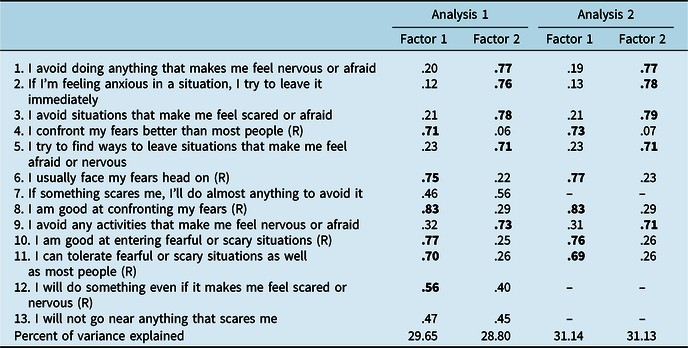
An exploratory principal axis factor analysis with varimax rotation was used to examine the factor structure of the RFSS. Factor loadings by item are presented in Table 1. I. Three items (nos. 7, 12 and 13) were eliminated because they loaded on multiple factors (≥.40). The final version of the RFSS consists of the remaining 10 items with distinct factor loadings above .50. Principal axis factoring with varimax rotation was again used to assess this 10-item RFSS. The two-factor solution was replicated using these items. The two factors explained 62.27% of the total variance (31.14 and 31.13%, respectively). Factor 1 (items 4, 6, 8, 10 and 11) pertained to approach in fearful situations, and factor 2 (items 1, 2, 3, 5 and 9) pertained to avoidance of fearful situations. Cronbach’s alpha was .89 for both Factor 1 (i.e. approach) and Factor 2 (i.e. avoidance), as well as for the total scale.
Study 1 rotated factor matrix of the initial version of the Response to Fearful Situations scale (n = 241)

R indicates that the item was reverse-scored for the factor analysis. The loadings in bold signify >.50.
Study 2
Study 2 was designed to validate findings obtained in Study 1 by testing the factor structure of the RFSS in a new sample and also provide test–re-test reliability on this measure.
Method
Participants and procedure
Participants were 423 students (74.2% female) enrolled in an undergraduate psychology course, who participated for course credit. Participants ranged in age from 18 to 27 years (mean = 19.40, SD = 1.56) and consisted of diverse racial/ethnic groups: Caucasian (70.4%), Hispanic (14.7%), African American (13.7%), Asian/Pacific Islander (2.4%) and other (2.3%). They were administered the RFSS among several other self-report measures. The RFSS avoidance (mean = 19.83, SD = 6.75) and approach (mean = 22.61, SD = 5.91) subscales were moderately correlated (r = –.50, p < .001). In a separate student sample, recruited from the sample subject pool, the RFSS was administered twice, one month apart. We examined test–re-test reliability using a Pearson correlation, expecting acceptable test–re-test reliability of r > .60, as has been found for other anxiety disorder measures (Fydrich et al., Reference Fydrich, Dowdall and Chambless1992; Molina and Borkovec, Reference Molina, Borkovec, Davey and Tallis1994). The RFSS total score (r = .78) and avoidance (r = .64) and approach (r = .74) subscales demonstrated adequate test–re-test reliability.
Results
Confirmatory factor analysis (CFA) of the 10-item RFSS was assessed using Mplus, version 6.1 (Muthén and Muthén, 2010). Model goodness-of-fit was assessed with the Comparative Fit Index (CFI; Bentler, Reference Bentler1990), the Tucker–Lewis Index (TLI; Tucker and Lewis, Reference Tucker and Lewis1973), the standardized root mean square residual (SRMR; Hu and Bentler, Reference Hu and Bentler1999) and the root mean square error of approximation (RMSEA; Browne and Cudeck, Reference Browne and Cudeck1992). Good fit is indicated by CFI and TLI values greater than or equal to 0.95, SRMR values less than 0.08 (Hu and Bentler, Reference Hu and Bentler1999), and RMSEA values less than 0.05, with RMSEA values between 0.05 and 0.08 indicative of a reasonable fit (Browne and Cudeck, Reference Browne and Cudeck1992).
Two latent factors were specified based on the results of Study 1: (1) approach in fearful situations (items 4, 6, 8, 10 and 11) and (2) avoidance of fearful situations (items 1, 2, 3, 5 and 9) as shown in Table 1. The latent factors were permitted to co-vary and the measurement model was fitted to the data: χ2 (34) = 140.71, p < 0.001, CFI = 0.96, TLI = 0.95, SRMR = 0.05 and RMSEA = 0.09. However, there was evidence of correlated error residuals between items 2 and 5. Due to theoretical overlap between these two items (‘If I’m feeling anxious in a situation, I try to leave it immediately’ and ‘I try to find ways to leave situations that make me feel afraid or nervous’), we respecified the model to allow the error covariance between these items to be freely estimated: χ2 (33) = 119.74, p < 0.001, CFI = 0.97, TLI = 0.95, SRMR = 0.05 and RMSEA = 0.08. The χ2 difference test (χ2 (1) = 20.97, p < 0.001) indicated that the respecified model was a better fit for the data.
Additionally, we examined a one-factor solution as an alternative model. Model fit was poor [χ2 (35) = 832.22, p < 0.001, CFI = 0.69, TLI = 0.60, SRMR = 0.12 and RMSEA = 0.23] and remained poor when items 2 and 5 were allowed to be freely estimated as done in the two-factor model above: χ2 (34) = 675.92, p < 0.001, CFI = 0.75, TLI = 0.67, SRMR = 0.13 and RMSEA = 0.21.
To further compare the two-factor and one-factor models, we used the model comparison procedure introduced by Bollen (Reference Bollen1980). In this procedure, the two-factor model is compared with a model in which the association between the two factors of the RFSS is constrained to be one (thereby pre-supposing a single factor), the uni-dimensional and two-factor models can be compared by interpreting chi-square change as a chi-square statistic. Constraining the association between the RFSS factors constrained to one resulted in a poor fit: χ2 (34) = 675.92, p < 0.001. Allowing for the two-factor model resulted in a significant change in chi-square for one degree of freedom change [χ2 (1) = 556.18, p < 0.001], indicating that the two-factor model fit the data significantly better.
Study 3
The aim of Study 3 was to test the convergent validity of the RFSS by examining associations between both RFSS subscales and fearful and approach responding on a behavioural avoidance task (BAT). We predicted that both subscales of the RFSS would be associated with greater fear and fewer steps taken towards fearful stimuli. In addition, we predicted that each subscale would be uniquely associated with BAT fear and steps over the effects of the other subscale.
Method
Participants and procedure
Participants were students who scored in the top 25% (8 or higher; n = 44) on the Vancouver Obsessional Compulsive Inventory (VOCI) contamination subscale (Thordarson et al., Reference Thordarson, Radomsky, Rachman, Shafran, Sawchuk and Ralph Hakstian2004), who participated in exchange for class credit. This group was 72.7% female, ranged in age from 18 to 24 years (mean = 18.77, SD = 1.27), and consisted of diverse racial/ethnic groups: Caucasian (59.1%), Hispanic (15.9%), African American (15.9%), Asian/Pacific Islander (2.3%) and other (6.8%).
Measures
The RFSS (avoidance α = 0.84, approach α = 0.95) was administered along with a contamination behavioural avoidance task (BAT), which has been used in previous research (Cougle et al., Reference Cougle, Wolitzky-Taylor, Lee and Telch2007; Fitch and Cougle, Reference Fitch and Cougle2013). The tasks were administered in random order and consisted of: (1) a pile of dirty laundry (e.g. underwear, socks and t-shirts), (2) A shallow box of potting soil, dead crickets and dog hair, and (3) a dirty toilet with an open lid. Participants were instructed to approach each BAT in a series of graduated steps, ranging from touching the stimulus with a sheet of tissue (step 1) to touching stimulus, then touching face (step 6). Upon completing each step, participants completed ratings of their peak fear during each step on a scale of 0 (no fear) to 10 (extreme fear).
Results
RFSS avoidance (mean = 22.39, SD = 5.62) and RFSS approach (mean = 21.27, SD = 7.25) were not correlated (r = –.22, p = .15). Significant correlations were found between RFSS avoidance with total BAT steps (r = –.36, p < .05) and mean BAT fear (r = .31, p < .05). The RFSS approach subscale was significantly correlated with mean BAT fear (r = –.50, p < .01), but not total BAT steps (r = .19, p = .23). In a regression model in which both RFSS subscales were entered simultaneously, RFSS approach remained associated with mean BAT fear (β = –.45, p < .01), whereas RFSS avoidance was not (β = .21, p = .12). By contrast, when RFSS approach was included in the model, RFSS avoidance remained associated with total BAT steps (β = –.33, p = .03).
Study 4
The aim of Study 4 was to evaluate if the RFSS demonstrated incremental validity in predicting anxiety symptoms over and beyond existing measures of avoidance.
Method
Participants and procedure
Participants (n = 253) were students enrolled in an introductory psychology course, who participated for course credit. The sample was 61.1% female and ranged in age from 18 to 30 years (mean = 19.10, SD = 1.49). Participants were 74.2% Caucasian, 12.7% African American, 11.9% Hispanic, 2.0% Asian/Pacific Islander and 2.0% other race/ethnicity. Institutional review board approval was obtained prior to study administration.
Measures
Response to Fearful Situations Scale (RFSS)
High internal consistencies were present for both the avoidance subscale (α = 0.88) and the approach subscale (α = 0.94).
Brief Fear of Negative Evaluation Scale (BFNE)
The BFNE is a 12-item self-report measure of the severity of social anxiety symptoms (Leary, Reference Leary1983). The BFNE has demonstrated good internal consistency in the past (Duke et al., Reference Duke, Krishnan, Faith and Storch2006). Internal consistency in the present sample was excellent (α = .94).
Penn State Worry Questionnaire (PSWQ)
The PSWQ is a 16-item self-report measure that assesses an individual’s general tendency to engage in excessive worry (Meyer et al., Reference Meyer, Miller, Metzger and Borkovec1990). The PSWQ has demonstrated excellent internal consistency in the past (Dear et al., Reference Dear, Titov, Sunderland, McMillan, Anderson, Lorian and Robinson2011) and in the present sample (α = 0.92).
Depression Anxiety Stress Scale-21 (DASS-21) – anxiety subscale (Lovibond and Lovibond, Reference Lovibond and Lovibond1995)
The DASS-21 was used as a measure of anxious arousal. The DASS-21 has demonstrated excellent psychometric properties in past samples (Antony et al., Reference Antony, Bieling, Cox, Enns and Swinson1998) and adequate internal consistency in the present sample (α = 0.74).
Mobility Inventory for Agoraphobia (MIA; Chambless et al., 1985)
The MIA is a measure of agoraphobic avoidance. Previous research indicates that the MIA has excellent psychometric properties (Chambless et al., Reference Chambless, Sharpless, Rodriguez, McCarthy, Milrod, Khalsa and Barber2011), and internal consistency in the present sample was good (α = .92).
Acceptance and Action Questionnaire (AAQ; Hayes et al., Reference Hayes, Strosahl, Wilson, Bissett, Pistorello, Toarmino, Polusny, Dykstra, Batten, Bergan, Stewart, Zvolensky, Eifert, Bond, Forsyth, Karekla and McCurry2004)
The AAQ is a measure of experiential avoidance, the tendency to avoid negative internal feelings. The AAQ previously demonstrated strong psychometric properties (Hayes et al., Reference Hayes, Strosahl, Wilson, Bissett, Pistorello, Toarmino, Polusny, Dykstra, Batten, Bergan, Stewart, Zvolensky, Eifert, Bond, Forsyth, Karekla and McCurry2004), but internal consistency in the present sample was poor to adequate (α = .64). We retained the AAQ for use as a secondary test of incremental validity alongside findings with the MIA.
Results
Bivariate correlations revealed small to moderate associations between RFSS avoidance (mean = 19.06, SD = 6.32) and the MIA (r = .31, p < .001) and AAQ (r = .27, p < .001), as well as RFSS approach (mean = 23.99, SD = 6.61) and the MIA (r = –.30, p < .001) and AAQ (r = –.30, p < .001). The RFSS subscales were also moderately correlated (r = –.49, p < .001).
Hierarchical regressions were conducted to examine the ability of the RFSS to predict anxiety symptoms above and beyond other measures of avoidance. The avoidance measure, MIA or AAQ, was entered in Step 1, followed by either RFSS avoidance or RFSS approach in Step 2. Models were run with worry, anxious arousal and social anxiety symptoms as dependent variables. MIA was significantly associated with worry in Step 1 (β = .27, p < .001), while RFSS avoidance was also associated with worry at Step 2 (β = .26, p < .001). Similarly, RFSS approach was also associated with worry when included at Step 2 (β = –.37, p < .001). MIA was also significantly associated with anxious arousal (β = .40, p < .001); RFSS approach was significantly associated with anxious arousal in Step 2 (β = –.17, p = .01), whereas these effects were observed with RFSS avoidance only at trend-level (β = .12, p = .05). Finally, MIA was a significant predictor of social anxiety symptoms (β = .35, p < .001), but both RFSS avoidance (β = .25, p < .001 and approach (β = –.19, p = .002) were associated with social anxiety above the effects of the MIA.
Effects with the AAQ closely mirrored those with the MIA. The AAQ was associated with worry (β = .48, p < .001) and RFSS avoidance (β = .20, p = .001) and RFSS approach (β = –.30, p < .001) were associated with worry beyond the effects of the AAQ. Similarly, the AAQ was associated with anxious arousal (β = .36, p < .001); RFSS avoidance (β = .15, p = .02) and RFSS approach (β = –.19, p = .002) were associated with anxious arousal beyond the effects of the AAQ. The association between the AAQ and social anxiety symptoms was significant (β = .44, p < .001), as was that for RFSS avoidance (β = .25, p < .001) and RFSS approach (β = –.17, p = .01) when entered separately in Step 2.
Study 5
The aim of Study 5 was to evaluate the validity of the scale in a clinical sample. We predicted there would be associations between both RFSS subscales and anxiety symptoms and that those with an anxiety disorder diagnosis would exhibit greater anxious avoidance and lower approach than those without a diagnosis. Additionally, we predicted that both RFSS subscales would predict anxiety symptoms above an existing measure of avoidance.
Method
Participants
Participants were 256 adult out-patients presenting for treatment or for participation in clinical research at an anxiety research and treatment clinic. The sample was 56.3% male and ranged in age from 17 to 87 years (mean = 36.08, SD = 16.33). The sample again consisted of diverse racial/ethnic groups: Caucasian (70.3%), African American (18.4%), Asian (0.8%) and other (10.6%). The majority of participants (97.3%) held a high school degree, and a third (32.8%) had completed a degree at a 4-year college. Participants presented with a range of primary diagnoses, including social anxiety disorder (SAD; n = 54, 21.1%), PD (n = 24; 9.4%), generalized anxiety disorder (GAD; n = 23, 9.0%), PTSD (n = 21, 8.2%), OCD (n = 12, 4.7%) and specific phobia (n = 7, 2.7%). For the present analyses, participants were divided into anxiety disorder groups based on whether they had any diagnosis of a particular disorder, regardless of whether it was their primary diagnosis. The four groups were those with any diagnosis of GAD (n = 43), SAD (n = 79), PD (n = 40) or specific phobia (n = 24). Additionally, there was a group with no diagnoses (n = 44), which served as the comparison group.
Procedure
Participants presenting for treatment or research participation at the clinic received a battery of self-report screening questionnaires. All measures in the current analyses were completed prior to the initiation of treatment. Graduate students in clinical psychology assessed diagnoses using the Structured Clinical Interview for DSM-IV Axis I Disorders (SCID-I; First et al., Reference First, Gibbon, Spitzer and Williams1995).
Measures
Response to Fearful Situations Scale (RFSS)
In the present sample, reliability analyses indicated high internal consistencies between the five items used to make up the RFSS avoidance subscale (α = 0.89) and the five items used to make up the RFSS approach subscale (α = 0.90).
Penn State Worry Questionnaire (PSWQ)
The PSWQ was again utilized to measure excessive worry. The PSWQ demonstrated excellent internal consistency in the present sample (α = 0.94).
Liebowitz Social Anxiety Scale (LSAS)
The LSAS is a 24-item self-report measure of social anxiety symptoms (Liebowitz, Reference Liebowitz1987). The LSAS demonstrated excellent internal consistency (α = 0.96), as it has previously (Heimberg et al., Reference Heimberg, Horner, Juster, Safren, Brown, Schneier and Liebowitz1999).
Beck Depression Inventory-II (BDI-II)
The BDI-II (Beck et al., Reference Beck, Steer and Brown1996) is a 21-item self-report measure of depressive symptoms. The BDI-II has demonstrated excellent internal consistency in past samples (Beck et al., Reference Beck, Steer and Brown1996) and in the present sample (α = 0.93).
Beck Anxiety Inventory (BAI)
The BAI (Beck et al., Reference Beck, Epstein, Brown and Steer1988) is a 21-item self-report measure of anxious arousal, with greater scores indicating greater anxiety. The BAI has demonstrated excellent psychometric properties in previous samples (Hewitt and Norton, Reference Hewitt and Norton1993) and in the present sample (α = 0.94).
Results
Correlations among study variables
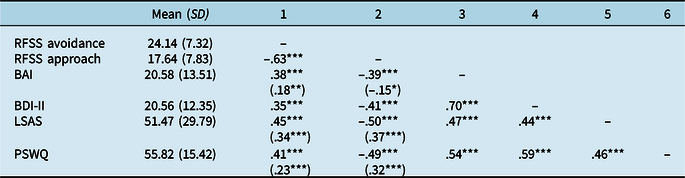
Correlational and partial correlational analyses (controlling for BDI-II scores) examined associations between RFSS subscales and BAI, PSWQ and LSAS. Results are presented in Table 2. Both RFSS subscales were correlated with all measures, and all associations remained when controlling for depressive symptoms.
Study 5 correlations and partial correlations (controlling for general depression) with RFSS subscales among the clinic sample (n = 256)

*p < .05, **p < .01, ***p < .001. Values in parentheses indicate coefficients from partial correlations controlling for depression. RFSS, Response to Fearful Situations Scale; BAI, Beck Anxiety Inventory; BDI-II, Beck Depression Inventory-II; LSAS, Liebowitz Social Anxiety Scale; PSWQ, Penn State Worry Questionnaire.
Group comparisons
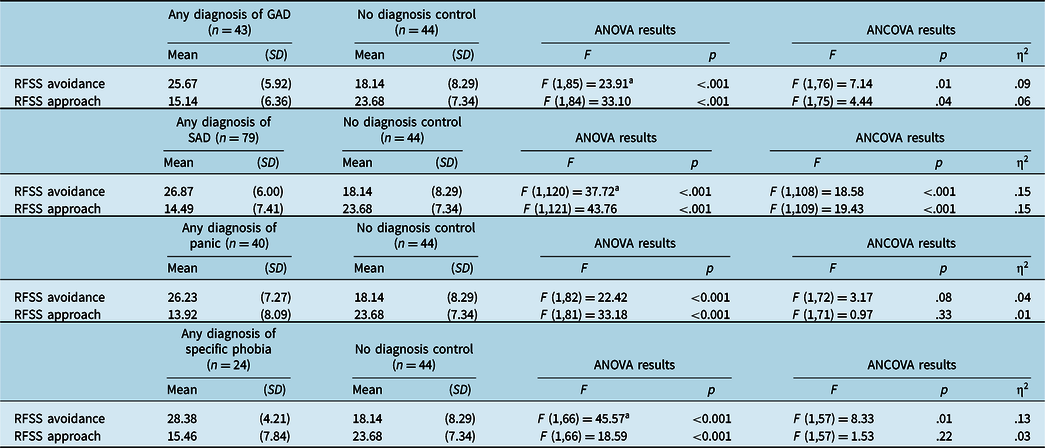
ANOVAs were conducted to examine if RFSS scores differed between those with and without anxiety disorder diagnoses. Each disorder was examined separately; thus, patients could belong to multiple disorder groups, regardless of their primary diagnosis. ANCOVAs were then conducted controlling for age, gender and BDI-II scores. Results of these analyses are presented in Table 3. In ANOVA analyses, all diagnosis groups – GAD, SAD, PD and specific phobia – presented with higher scores on both RFSS subscales compared with no diagnosis controls. In ANCOVA analyses, those with any diagnosis of GAD or SAD had significantly higher scores on both RFSS subscales compared with those with no diagnoses, but there were no significant differences between those with PD vs controls when controlling for gender, age and depressive symptoms. Those with specific phobia differed significantly from no diagnosis controls only on the avoidance subscale.
Study 5 ANOVA and ANCOVA models comparing anxiety disorder groups to those with no diagnoses in the clinic sample (n = 256)

RFSS, Response to Fearful Situations Scale. ANCOVAs controlled for age, gender and depressive symptoms. aWhen the assumption of homogeneity of variances was violated (i.e. when the Levene statistic was significant), the Welch test statistic is reported.
Associations between RFSS and anxiety symptoms
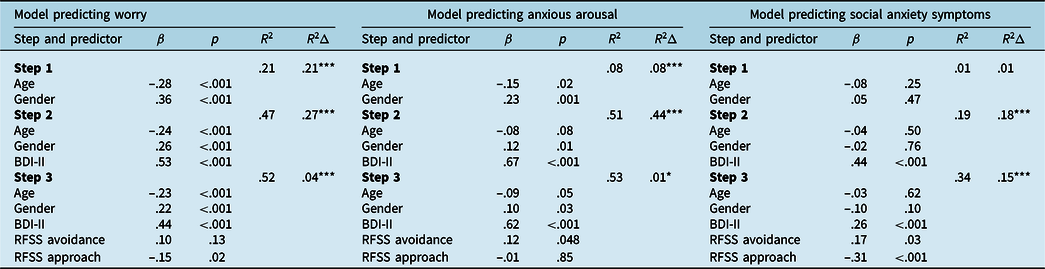
Hierarchical regressions were conducted to examine associations between RFSS scores and anxiety symptoms, controlling for age, gender and depressive symptoms. Results are presented in Table 4. PSWQ, BAI and LSAS total scores were used as dependent variables in three separate models. In Step 1, age and gender were entered. In Step 2, BDI-II scores were added to the model. In Step 3, both RFSS subscales were added. RFSS approach but not RFSS avoidance was a significant predictor of PSWQ scores when all covariates were included in the model. RFSS avoidance but not RFSS approach was a significant predictor of anxious arousal when all covariates were included in the model. Both RFSS avoidance and RFSS approach significantly predicted LSAS total scores above and beyond covariates.
Study 5 hierarchical regression models examining associations between RFSS and anxiety symptoms in the clinic sample (n = 256)

*p < .05, **p < .01, ***p < .001. BDI-II, Beck Depression Inventory-II; RFSS, Response to Fearful Situations Scale.
Additional hierarchical regression models examined the ability of the RFSS to predict worry and anxious arousal above an existing measure of avoidance, the LSAS avoidance subscale. LSAS avoidance was entered in Step 1, and one of the RFSS subscales was entered in Step 2. The dependent variable was either worry or anxious arousal. LSAS avoidance was significantly associated with worry in Step 1 (β = .42, p < .001), but both RFSS avoidance (β = .28, p < .001) and RFSS approach (β = –.37, p < .001) predicted worry when included in separate models at Step 2. Similarly, LSAS avoidance was significantly associated with anxious arousal in Step 1 (β = .46, p < .001), but both RFSS avoidance (β = .22, p = .001) and RFSS approach (β = –.20, p = .003) predicted anxious arousal when included in separate models at Step 2.
Discussion
A large body of literature suggests that behavioural avoidance is a maintaining component of multiple anxiety disorders (Beesdo-Baum et al., Reference Beesdo-Baum, Jenjahn, Höfler, Lueken, Becker and Hoyer2012; Hofmann, Reference Hofmann2007). Yet measures of avoidance have typically focused on disorder-specific behaviours (Liebowitz, Reference Liebowitz1987; Mahoney et al., Reference Mahoney, Hobbs, Newby, Williams, Sunderland and Andrews2016), rather than on general situational avoidance. Furthermore, extant measures have solely assessed avoidance and neglected to assess courageous approach responding, despite its potential relevance to the development and treatment of anxiety (Muris et al., Reference Muris, Mayer and Schubert2010). The aim of the present study was to construct and evaluate a measure of approach and avoidant responding to fearful situations – the Response to Fearful Situations Scale (RFSS). In Study 1, we developed the 10-item version of the RFSS and determined in exploratory factor analysis that it possessed a two-factor solution with distinct avoidance and approach subscales. In Study 2, we tested the factor structure of the RFSS with a confirmatory factor analysis and determined that the two-factor solution fitted the data better than a one-factor solution. These findings suggest that avoidance and approach in fearful situations are not simply two extremes of the same construct but appear to represent distinct characteristics. This is a novel finding given the dearth of research examining approach and avoidance simultaneously in the context of anxious or fearful responding. That they are distinct suggests that perhaps courageous responding could be targeted independently of readiness to cease avoidance.
Studies 3 to 5 assessed the validity of the RFSS. We evaluated concurrent validity of the RFSS in predicting avoidant and approach responding on a behavioural avoidance task. Partially consistent with the hypotheses, RFSS avoidance was associated with both mean BAT fear and mean steps taken on the BAT. RFSS approach was not associated with BAT steps, contrary to the hypotheses; however, it was associated with mean BAT fear. The finding that trait tendencies to approach anxious situations was not associated with BAT steps is consistent with previous findings suggesting that state courage may be a better predictor of steps taken on the BAT (Norton and Weiss, Reference Norton and Weiss2009). Some have conceptualized courage as acting towards a worthy goal (Rate et al., Reference Rate, Clarke, Lindsay and Sternberg2007), which may not be present in a laboratory task. Perhaps some individuals confront fearful situations as a means to larger ends and need this additional motivation in order to act courageously. It is also possible that the BAT utilized in the present study was complicated by its contamination focus, which may have elicited more disgust than fear responding in some participants. The RFSS approach subscale may not necessarily have been completed with contamination concerns in mind. Although fear of contamination is a noted fear (Rachman, Reference Rachman2004), it would be useful to examine associations between the RFSS and other BATs in the future. Nevertheless, the association between RFSS avoidance and mean BAT steps points to the validity of the scale in measuring behavioural avoidance. Lastly, when both subscales were entered in the model, RFSS approach but not avoidance was uniquely related to BAT fear, while RFSS avoidance but not RFSS approach was uniquely related to total steps. While these findings should not be over-interpreted, it is possible that approach subscale is more relevant to the emotional experience of fear, while the avoidance subscale better captures behaviour in such contexts.
We further established concurrent and discriminant validity by examining associations between RFSS subscales and clinical constructs. In Study 4, we determined that both subscales of the RFSS were associated with anxiety symptoms above and beyond two existing measures of avoidance, the Mobility Inventory of Agoraphobia and the Acceptance and Action Questionnaire. Study 5 sought to evaluate the validity of the RFSS in an anxiety clinic sample. All clinical variables were moderately correlated with both RFSS subscales, and these results remained when controlling for depressive symptoms. The RFSS again predicted anxiety symptoms over and above an existing measure of avoidance, the LSAS avoidance subscale. In hierarchical regression models, RFSS avoidance was associated with anxious arousal and social anxiety symptoms, while RFSS approach was associated with worry and with social anxiety symptoms, even when accounting for age, gender and depressive symptoms. Correlational and regression results provided support for the characterization of avoidance and approach as separate constructs, as the RFSS subscales performed differently in these analyses.
RFSS scores were greater in anxiety disorder groups than in a no-diagnosis control group. This is consistent with previous research demonstrating the potential clinical utility of the RFSS, in which the RFSS avoidance subscale fully mediated the association between a safety behaviour fading intervention and interference due to anxiety symptoms (Riccardi et al., Reference Riccardi, Korte and Schmidt2017). The RFSS may be a treatment-sensitive measure of avoidance, a key maintaining factor of anxiety pathology.
The present findings are limited by several factors. First, Studies 1 to 4 were constructed in student samples, which may differ from samples that may better represent the broader population. Nevertheless, the findings in Study 5 in a clinic sample suggest that the RFSS captures clinically relevant avoidance and approach. Although the RFSS is strengthened by its applicability to multiple disorders, ‘fearful situations’ may be interpreted differently for different individuals. Future research would benefit from probing further to examine how this language is being interpreted and the types of fearful situations respondents are envisioning when rating the items. Future research should also examine whether the RFSS subscales are predictive of daily avoidant and courageous acts, as well as avoidance and courage in the treatment of anxiety disorders. Future research must also establish discriminant validity between the RFSS and other measures of courage and related constructs, including Norton and Weiss’s (Reference Norton and Weiss2009) courage measure, Howard and Crayne’s (Reference Howard and Crayne2019) Persistence Despite Fear scale, and measures of risk-taking and extraversion. Finally, it should be acknowledged that different conceptualizations of courage exist apart from that used in constructing the RFSS. In particular, some definitions of courage include a moral component of acting in pursuit of a noble cause (Rate et al., Reference Rate, Clarke, Lindsay and Sternberg2007). Although these conceptualizations warrant research, moral language or use of the word ‘courage’ itself were excluded from the RFSS due to concerns of biased responding. Nevertheless, future research should examine the impact of broader motivation and context on willingness to act courageously in fearful situations.
The present study provides support for the use of the Response to Fearful Situations Scale in evaluating avoidant and approach responding in clinical and non-clinical samples. Our findings suggest that greater avoidant and less approach responding is present in those with anxiety diagnoses and that these processes are associated with anxious symptoms, even above existing measures of avoidance. Given the relevance of avoidant behaviors to anxiety maintenance and the potential for courage to be used as a novel treatment target, the RFSS may be useful in predicting the development, maintenance, and treatment of anxiety disorders. The RFSS may also be useful in studying the many contexts in which avoidant and courageous/approach behavior are relevant (e.g., relationship functioning).
Acknowledgements
None.
Financial support
Dr Cougle is supported by grant R34DA035944 awarded from the National Institutes of Health, Bethesda, MD, USA. However, the research presented in this study received no specific grant from any funding agency, commercial, or not-for-profit sectors.
Conflicts of interest
The authors report no conflicts of interest.
Ethical statements
All procedures performed in studies involving human participants were in accordance with the ethical standards of the institutional and/or national research committee and with the 1964 Helsinki declaration and its later amendments or comparable ethical standards. All authors have abided by the Ethical Principles of Psychologists and Code of Conduct as set out by the American Psychological Association.
Appendix: Response to Fearful Situations Scale
INSTRUCTIONS: Read the statements below carefully, and rate how much you agree or disagree with it. For each of the statements, choose the number matching the answer that best describes how you are. Because people are different, there are no right or wrong answers. To decide whether a given statement is typical of your way of behaving, simply keep in mind what you are like most of the time.

1. I avoid doing anything that makes me feel nervous or afraid.
2. If I’m feeling anxious in a situation, I try to leave it immediately.
3. I avoid situations that make me feel scared or afraid.
4. I confront my fears better than most people.
5. I try to find ways to leave situations that make me feel afraid or nervous.
6. I usually face my fears head on.
7. I am good at confronting my fears.
8. I avoid any activities that make me feel nervous or afraid.
9. I am good at entering fearful or scary situations.
10. I can tolerate fearful or scary situations as well as most people.
Note: Approach subscale items are in bold.



Comments
No Comments have been published for this article.