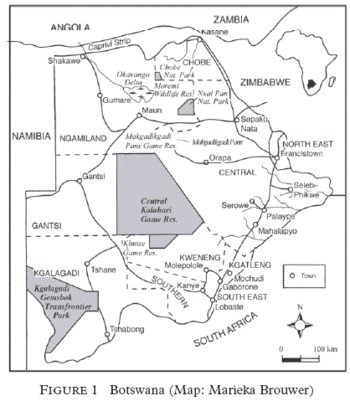
In December 2006 Botswana's High Court reached its judgement in the two-year case regarding the right of return of BushmenFootnote 1 to the Central Kalahari Game Reserve (CKGR). This was the longest and most expensive court case in Botswana's history and received extensive international and domestic attention. While the judges were not unanimous and the Bushmen did not win on all counts, they did achieve many of their aims, including the most crucial, the right of return.Footnote 2 The decision was covered widely in the international media and was, for some hours, the lead item on the BBC world news website. The decision was heralded as a resounding triumph for human rights, for the rights of indigenous peoples, for the rights of the Bushmen, and for Botswana's democracy. Once again, the High Court demonstrated the independence of the judiciary from the executive by making a principled decision that ran counter to the wishes of many in the executive.Footnote 3 The government agreed to abide by the decision and not to appeal.
The next day, the Attorney General's office issued a statement outlining how it would implement the decision. The state interpreted the court's ruling in the most narrow, stringent and severe manner. The plan provided for the 189 applicants and their dependent children to return unimpeded to the reserve; others would need permits, as do all other Botswana citizens. The applicants had to present official government identification at the gates; they could bring in limited amounts of water and building materials for non-permanent structures only, and they could not bring in domestic animals. They could apply for special subsistence hunting permits that allowed for hunting utilizing ‘traditional’ methods. After the initial celebration, the harsher reality of the judgement's interpretation began to set in (cf. Taylor 2007). Despite earlier and repeated pleas on the part of the Bushman applicants and some of their supporters that all they wanted was to be allowed to return to hunt and gather as ‘they have always done’, the applicants now argue that they cannot live without their livestock and services. Moreover, the conditions do not allow for automatic entry of the applicants’ spouses, other extended family members and so on (in practice, since the judgement, whole families have been allowed back into the CKGR with temporary permits, though hunting permits have not been issued).
While it is difficult to know for sure, I argue that the impossible and punitive conditions set out by the government are, at least in part, a response to the tactics and images deployed by certain foreign agents acting on behalf of the Bushmen and by the Bushman organization that was perceived as colluding with them. Therefore, the CKGR case invites us to rethink the role and agency of transnational NGOs, especially human rights organizations. Often considered as an international conscience safeguarding the rights of the vulnerable, NGOs have frequently enjoyed uncritical acceptance. But by what standards do we measure their efficacy, in whose interests do they work and to what constituencies are non-state actors accountable? My analysis of the CKGR case will illuminate these questions by examining the complicated terrain traversed by both non-state and state actors when the rights of marginalized minorities are at stake.
THE WAR OF WORDS FOR BOTSWANA'S DIAMONDS
The High Court judges disagreed on several points, but they were unanimous in their exoneration of the role of diamonds in the CKGR relocations. Here they were responding to an aggressive and well-funded international campaign by the British-based NGO Survival International (SI) and its affiliates to link the CKGR relocations to diamond mining and therefore to tarnish Botswana's diamonds as ‘blood’ or ‘conflict’ diamonds. This campaign has continued uninterrupted since as early as 2001 (Taylor and Mokhawa 2003: 279).
The release of the film Blood Diamond in late 2006 (2007 in the UK) thrust the diamond boycott into the public sphere as never before. It also provided the pretext for some of the most intense publicity conducted on the part of the Botswana government, as well as by a group known as First Peoples of the Kalahari (FPK) and, especially, by its supporter, Survival International. Both De Beers, which mines Botswana's diamonds in a joint venture with the Botswana government, and the government itself were very nervous about the film. SI saw it as a golden opportunity.
Prior to the film's release, the First Peoples of the Kalahari and SI placed a full-page advertisement in the magazine Variety appealing to the film's star, Leonardo diCaprio, to support the Bushmen's case. In a letter to diCaprio, Roy Sesana, spokesperson for the First Peoples of the Kalahari, wrote:
Friends have told us that you are in a film, The Blood Diamond, which shows how badly diamonds can hurt. … When we were chased off our land, officials told us it was because of the diamond finds. … Please help us. … We just want to go home, and hunt and gather and live in peace like we have always done.4
After the film's release, the appeal turned to hip hop artists:
We appeal to … our black brothers and sisters in the hip hop industry – to Russell Simmons, Snoop Dogg, Ludacris, and all the other musicians that are household names to help us. We know you love our diamonds. … If you are going to wear stones … then at least help us pressure our government to let us go home. Please don't let us perish for your ‘bling’.5
SI and its collaborators have done their best to compromise Botswana's hitherto impeccable human rights record and to threaten Botswana's economy, which is heavily dependent upon diamond exports (diamonds earn 80 per cent of export revenue and 40 per cent of GDP).Footnote 6 In addition to undermining the diamond trade,Footnote 7 SI also portrays Botswana as a pariah state and aims to spoil Botswana's desirability as a tourist destination. Botswana wishes to expand the value of its tourist market as one means to diversify its economy away from overdependence upon diamonds (tourism is the third largest earner of foreign revenue). In response, Botswana ramped up its efforts to present its own side. They hired an expensive PR firm and senior officials, including the President, have travelled to plead the government's case to as many high-profile international audiences as possible.
Survival's failure to win diCaprio to its side is one of Botswana's few successes in its propaganda war. In fact, diCaprio and other film stars appeared on the Oprah Winfrey show the day before the film's opening and lauded countries such as Botswana who use their diamonds for socially productive ends. Nonetheless, international criticism of Botswana's Bushman policy has been broad-based and effective.
SI's campaign has continued unabated since the court's decision and has included new websites, appeals in the print media, in anthropological publications (Corry Reference Corry2007) and television spots such as BBC and Al Jazeera. SI submitted a report to the United Nations Human Rights Commission in 2007 and recently announced that it intends to bring a new case against the Botswana government for what it argues is the government's refusal to implement the High Court's decision.
THE STAKES AND THE PLAYERS
The stakes are very high in this battle. They are high for the few hundred Bushmen who claim to want to return to the CKGR; they are high for Survival International, who have both raised and spent an enormous amount of money on their most prominent case; they are high for all NGOs and advocacy groups that work with the Bushmen and other marginalized groups in Southern Africa; they are high for Botswana, its future, its economy, its international standing and its sovereignty; and, by extension, they are high for the sovereignty claims of all African nations and for the fate of marginalized minorities in their midst. The stakes are also high for our representations of the various players but, perhaps most important, for representations and conceptions of culture and identity, especially of the Bushmen, and the work that these various representations and conceptual tools do in the wider political field. It is to these stakes, the players and the consequences that I wish to turn.
In examining this case I compare the activities and tactics – together with the range of consequences resulting from these – of various actors engaged in the struggle for ‘group’-based or collective rights in Botswana.Footnote 8 This has been an arena of intense activity during the past two decades in which the key actors can be distinguished by the different paths they have taken to press their claims. Essentially, these fall into two types. The first route is travelled by several organizations, the largest and most prominent being Reteng (‘we are here’). Reteng is a grassroots multi-cultural coalition of local NGOs representing ‘minority’ groups in Botswana (defined as peoples of non-ethnic Tswana background) that utilizes numerous state and supra-state recognized means to work simultaneously with and against the government to promote and preserve Botswana's linguistic and cultural diversity and to promote rights it believes have been denied to non-Tswana. In utilizing recognized methods and instruments, Reteng and its constituent members are, by the state's standards, legitimate actors. I argue that their perceived legitimacy has enabled their effectiveness. Survival International crowds the second category. As discussed below, its methods, with the possible exception of the recent court case that it supported and funded, reveal little cognizance or regard for Botswana's lawfully recognized protocols at both the national and supranational levels; therefore, unlike Reteng, in the state's estimation SI is illegitimate.
It is useful to note at this point that Botswana's experience with NGOs, especially international NGOs, differs from that of most other African countries. NGOs are certainly not a uniform lot and no set of accolades or criticisms has universal applicability. However, in recent decades, especially in the global South where states have been weakened by neo-liberal economic reform and Western aid is often tied to externally defined criteria of ‘worthiness’, NGOs have come under increased criticism for their sometimes overly intrusive roles. An Economist article aptly titled ‘Sins of the secular missionaries’ (27 January 2000) identifies numerous problems associated with the rise of NGO activity (see also Ferguson 2006). These include cultural insensitivity; agendas set by Western government and/or corporate interests, and funding with concomitant lack of accountability to local authorities/concerns; contribution to diminished state capacity as a result of providing infrastructure and usurping sovereignty; and the problem of self-perpetuation in which NGOs’ activities and priorities become increasingly dictated by the need to secure funding. Anthropologists have elucidated the processes by which NGOs frequently produce results at odds with their stated intentions. For instance, Elyachar (2005) explores the disempowering and dispossessing effects of NGOs and multilateral institutions in Cairo that, failing in their efforts to help the poor establish viable businesses, actually place them in debt. Englund (2006) analyses the disempowering impact of human rights NGOs in Malawi on the poor and the capacity of NGOs to promote the creation of elites, especially under neo-liberal reform.
Botswana's own wealth and its conservative economic policies have kept it free of externally imposed fiscal austerity programmes such as structural adjustment and the accompanying NGO activity that have afflicted most African countries. Botswana is not a ‘client state’ dependent upon NGOs to supply infrastructure; it does so itself. As such, it is able to act with greater autonomy in managing local ‘development’ than most African countries and to escape much of the intrusive and patronizing activity and attitudes that often accompany outsiders’ efforts. Botswana is increasingly following a self-imposed neo-liberal reform path. Its high gini co-efficient indicates a significant degree of economic inequality, yet neo-liberal state roll-back is very limited relative to other African countries, and the state continues to take a lead role in the provision of social services, including education, medicine and welfare. The public sector remains relatively large and well-paid. In addition, because of its previously stellar record of human rights and democratic governance, it has remained largely immune from the negative effects of outside scrutiny and is unaccustomed to facing and responding to the current critical gaze of the ‘secular missionaries’ arising from the CKGR case.
THE RELOCATIONS
Others have written extensively and eloquently about the Central Kalahari Game Reserve (CKGR) and the Bushmen who reside within it (Hitchcock and Vinding Reference Hitchcock and Vinding1999 [2001]; Hitchcock and Biesele Reference Biesele and Solway2006; Suzman Reference Suzman2002/3) so I will present only sufficient material to provide a backdrop. In 1961 the then colonial government established the Central Kalahari Game Reserve to conserve the natural habitat within its boundaries. It was also intended for the use of the hunting and gathering populations living within it. These were mostly Bushmen. Over the years, the government drilled boreholes for the inhabitants and provided welfare, education and medical services; and with the increased water points and services came more residents, Bushmen and non-Bushmen. Both the former and the new residents increasingly kept domestic animals, practised agriculture, received government rations, and hunted with horses and guns; some sold meat outside the reserve. In 1985 the government investigated the situation and recommended that the peoples of the CKGR be moved to a location outside the reserve. The residents’ mixed subsistence practices were seen as increasingly incompatible with wildlife conservation. Theoretically, relocation of the Bushmen would enable better wildlife management in the CKGR, enhance its tourist potential, and also enable the government to provide services more effectively and economically to the residents, who would be in more concentrated settlements. As Scott (1998) observes, such practices are typical of states that, in settling people, wish to render both the state and local areas mutually legible to each other and in mutual service to one another.
Over the next ten years the government encouraged people to move. In 1997 two villages were established outside the reserve and fitted with infrastructure; most residents of the CKGR were relocated to them. About 400 people remained in the CKGR, but in 2002 the government cut off all services (including water) inside the reserve and demanded that all remaining residents leave. Again, some remained and others returned (Hitchcock and Biesele 2006).
A negotiating team comprised of members drawn from local NGOs and the Ministry of Environment, Wildlife and Tourism's Department of Wildlife and National Parks formulated a Draft Management Plan (Republic of Botswana 2001) that would enable the Bushmen to continue to use portions of the CKGR while preserving some parts of it for mining, tourism and wildlife. In August 2002, the Ministry of Local Government rejected the plan; the government hardened its position, would brook no opposition, and brought the negotiations to an abrupt halt. Part of the difficulty for the CKGR Bushmen arose from the fact that their destiny fell between different government ministries that did not always share the same priorities. In addition, the executive branch became involved and members of the executive differed in their views as well. However, as events unfolded, certain moves and statements were made that either excluded or rendered other possible directions more difficult to follow. In this way, the flow of events seemed to gain its own momentum and to overtake actors’ intentions. A key turning point in the negotiation process appears to have occurred in mid–2001; soon after, negotiations ceased and in 2002 the Bushmen faced their most coercive pressure to leave the CKGR. By this time Survival International had initiated its invectives and launched worldwide vigils against Botswana and its diamonds.9
Despite the fact that diamonds have been discovered in many parts of the Kalahari, including the CKGR, there is little reason to believe that the Bushmen were moved as a consequence. If a mine were to be opened in the CKGR, it would take up a very small proportion of the land mass and thus not interfere with human settlement. The CKGR occupies 52,730 square kilometres of land; a diamond mine may take up a few square kilometres. If a mine did require the movement of people, there are well-established precedents within the country for such a removal. Section eight of Botswana's constitution allows the government to take any land for the public good on the condition that the residents are adequately consulted and adequately compensated. Botswana's other mines were established in this manner. In June 2007, the government announced that a diamond mine would be developed in a corner of the CKGR. Interestingly enough, many Bushmen with whom I spoke in 2007 believe that if diamonds were the reason for the move, it was to give access to the benefits of the mines (employment and entrepreneurship) to the Tswana and not to them. Indeed, Bushmen living near the CKGR are virtually unanimous in their desire for formal sector employment.
Botswana's high court affirmed that compensation for the CKGR residents had been adequate. Most of the relocated people received a standard compensation package that included five head of cattle, ten goats, agricultural implements, cash and the continued provision of monthly rations. However the high court also affirmed that consultation in this case had been insufficient. As noted by one judge – and echoed by many in the country – the lack of proper consultation reflected Botswana's condescending attitude towards the Bushmen.
In order to put the CKGR case in national perspective, it is instructive to note that the CKGR removals were part of a comprehensive strategy in place at the time in much of central and western Botswana. For example, in 1998, the Bushmen of the Kweneng District, which borders the CKGR and where I have conducted fieldwork for three decades, were going through a similar process. Most of these people lived on the outskirts of Kgalagadi villages or in small scattered settlements in the western part of the district, and by the mid-1980s had a mixed livelihood strategy that combined casual labour for the Kgalagadi, limited agro-pastoralism, some hunting and gathering, and, increasingly, dependence upon government rations. They were invited to move to new settlements established for them and fitted with infrastructure such as schools, roads, boreholes, and agricultural extension services. The Bushmen who moved received the standard compensation package noted above. I was in the field at the time and the village buzzed with talk of the move. Most Kgalagadi were unhappy with the plan; they complained that the government should not take away their ‘friends’; they asked why ‘development’ should divide rather than bring people together; and many were worried, unnecessarily as it turned out, that the village population would fall under 500, thereby placing it in a category in which the government would not be bound to continue to supply the same level of service. Many Kgalagadi confided to me that other Kgalagadi – but, of course, not they themselves – were worried that they would lose their workforce. The village councillor explained that
the council is moving the Basarwa [Bushmen] because they feel Basarwa can only develop and change when they are on their own with no one to intervene. They could be given things here but people [Bakgalagadi] would trick them into giving them those things so at the end of the day they would be back working for the Kgalagadi.10
Most Bushmen, he said, were happy about the move. Those that I spoke with echoed his view but also expressed some apprehension. Given the Bushmen's history of mistreatment, they are leery of any authority or promise.
To this day, most of the Bushmen remain in the new villages although they retain contact with their older homes. I visited several of these villages in the summer of 2007 and found a mixed but generally positive situation, at least in relation to their previous lives on the outskirts of Kgalagadi villages. Many of the Bushmen have taken their new resources and expanded them. They have their own compounds, most of which are quite large with relatively well-built houses. Many are active in local ‘civil society’ and seem to have a stronger sense of their rights than in the past. For instance, several told me that while in the past they believed that they could only work for the Kgalagadi, now they know they can take any job and, if they do work for Kgalagadi, should receive appropriate remuneration. I encountered numerous local initiatives such as community trusts, eco-tourism projects and the like. They have invited rights organizations from the capital to run workshops and are making inter-community connections. Some of the best school results from the western Kweneng are in predominantly Bushmen schools. People were proud to tell me of the livestock that they had accumulated or to show me donkey carts they had purchased, and many claimed that life was better than when they lived as servants of the Bakgalagadi. Some also noted that the hunting and gathering way of life was no longer a viable full-time livelihood option but that they remained proud of their heritage and maintained their healing practices. Indeed, I heard Sesarwa (Bushmen languages) spoken frequently. I certainly do not wish to portray a utopian situation, but I was generally impressed by what I observed. While it is difficult to measure ‘pride’ or ‘confidence’, I was struck by the forthrightness and assertiveness with which the Bushmen spoke and acted in the new villages; it was a distinct contrast to what I had observed decades before.
The Kweneng example reveals that relocation of the CKGR Bushmen was part of a wider strategy. The CKGR differed in that it was a game reserve and it became highly politicized. As a result the government behaved in an authoritarian manner. Moreover, the CKGR movements were not voluntary; in some instances they entailed force and they were more disruptive as people were resettled with others with whom they had no history of co-residence. In addition, in at least one of the CKGR resettlement villages, the residents are plagued by predator attacks on their livestock – paradoxically due to the proximity of the village to the game reserve.
THE ‘BUSHMAN QUESTION’
The state's rationale for resettling Bushmen reflects the current moment of the ‘Bushman question’ in Botswana and follows a long history. The situation of the Bushmen in Southern Africa is complex; that they are the most stigmatized, impoverished and marginalized minority is not in question, but the legacy, contours and causes of this situation have been the subject of much debate.Footnote 11 The Bushmen have long occupied the margins in Botswana (and most of Southern Africa); in ‘traditional’ Tswana geography, the Bushmen inhabit the ‘beyond’. Physically, along with the animals, they reside in the undomesticated and wild landscape of the ‘bush’, beyond the village, the agricultural fields and even the cattle-posts. That the Bushmen stand outside the Tswana social world was indicated by the term ‘Masarwa’ – with the prefix ma, in this instance, indicating non-human – an appellation that was universally applied to them until recently. Politically, the Bushmen occupied the category ‘malata’, indicating a servile, subordinate position that relegated them to perpetual minor status in relation to the dominant Tswana.
The economic benefits to the Tswana of the Bushmen are not straightforward. For centuries, Bushmen hunted for Tswana and performed other forms of servile labour, and many Tswana were dependent upon this labour. However, at the same time, the Bushmen did not make an entirely reliable or uncomplicated labour force; they could retreat into the bush at will, often absconding with or eating their employer's capital, especially cattle (Wylie Reference Wylie1990; Gordon Reference Gordon1992). In addition, as Hitchcock and Holm (1993) observe, for every Bushman employed on a cattle-post, dozens more squat and rely upon, or, in local terms, ‘eat’ the owner's resources. In more recent times, the economic ties between Tswana rural producers and Bushmen have lessened but not disappeared. As agro-pastoralism has become more commercialized, it has become less labour-intensive. In addition, new waves of migrants from neighbouring African countries have proved to be a more reliable and, often, cheaper labour force. Bushmen now also receive considerable state welfare benefits as they have been brought increasingly within the orbit of bureaucratic control (Hitchcock and Holm Reference Hitchcock and Holm1993). Thus their dependence on Tswana employers is diminished.
The Bushmen's legacy of exclusion from Tswana society and their incomplete absorption of its ideology is rooted in many sources that emanate from the encompassing political economy, Tswana society, and Bushman culture and society itself. The indeterminacy of the Bushmen's position was, in the past, reflected in their being alternatively cast as vermin to be killed at will by both their Bantu and white neighbours, especially in the settler colonies of South Africa and Namibia (see Gordon Reference Hitchcock and Holm1993) and exploited as labour. Gordon (Reference Hitchcock and Holm1993: 209–10) emphasizes the reign of terror inflicted upon the Bushmen in northern Namibia, in part as a consequence of their refusal to become completely embedded in capitalism and of the inability of the weak form of capitalism that existed in northern Namibia to completely pacify and absorb them. The spaces occupied by Bushmen in places such as northern Namibia and the Botswana bush continue to be on the frontiers of state control. Das and Poole (Reference Das, Das and Poole2004: 7) suggest that margins are sites where the state project is always incomplete, where the state is spoken of – and imagined – through an invocation of the wilderness, lawlessness, and savagery that not only lies outside its jurisdiction but also threatens from within. As Das notes, ‘there are always margins on which people have to be educated to become proper subjects of the state’ (Das Reference Das, Das and Poole2004: 249).
Methods of taming the margins have shifted over time. In Botswana, by the late twentieth century, ‘development’ became the state's method of taming. And development in this context meant bringing the Bushmen within the ambit of the state, ready to take their place in the modern world. In its paternalistic view, the state sought to provide Bushmen with the resources to ‘grow up’ into Tswana, to become village-based agro-pastoralists, attend school, and so on. Despite whatever benefits the moves have entailed, such a vision bespeaks an evolutionary and assimilationist understanding of development, not to mention smugness on the part of planners about the correctness of their own way of life (or, in this case, the way of life of their parents or grandparents). However, the move was not meant to oppress the Bushmen outright.
My assumption is that the initial plans for the CKGR were largely supported by such ideological motives; that is, to have the Bushmen develop and take their place as citizens of a modern state. The Bushmen needed to acquire the appropriate political subjectivity and in order to do so they had to live in appropriate conditions – settled life – and be provided with the means to make such a life viable. In the CKGR case, conservation concerns added extra weight but the general plan of ‘domesticating’ the Bushmen by inculcating Tswana values and citizenship was part of a bigger project. As the CKGR became increasingly politicized, the government became more authoritarian and expressed its desire for their development in more extreme and arrogant terms, thereby revealing its embarrassment at the existence of such ‘primitive’, poor and dependent people living in a modern country.
Margins, as Das and Poole (2004) write, are unruly. They are messy sites where ordinary state practices and the ordinary exercise of law prove least reliable, often leading the state and, in this case, its detractors to forms of regulation and practice not ‘normally’ countenanced. The CKGR debacle reveals this messiness in full force.
RETENG, THE LEGITIMATE ADVOCATE
My own position in this debate should be clear by this point but I will elaborate. I have carried out research in Botswana for over twenty-five years; for the past ten years I have focused on the efforts of marginalized minorities (who are defined as non-Tswana and who represent, arguably, over half of the nation's population) to gain official state recognition, greater political representation and improved material conditions for their largely rural populace (Solway Reference Solway1994, Reference Solway2002, Reference Solway2003, Reference Solway, Berman, Eyoh and Kymlicka2004; Solway and Nyati-Ramahobo Reference Patterson2004; Werbner Reference Werbner2002, Reference Werbner2004). I have also been an interlocutor in this project (Solway Reference Elyachar2005). My view is that it is the success thus far of Botswana's liberal democracy project and its rationalized bureaucracy that has enabled minorities to self-identify, re-evaluate their status and seek redress without fear of retribution. Minority groups, most recently through Reteng, have successfully utilized state instruments, especially the courts, to challenge the government over the official exclusions that still exist in Botswana and that ascribe the minorities’ secondary place in the polity.Footnote 12 Increasingly, they have also utilized international instruments – bodies such as the UN and the many conventions to which Botswana is signatory – in order to hold the government accountable.
While Reteng maintains that much more needs to be done,Footnote 13 the coalition has already accomplished a great deal. They and their constituent groups have forced the state to amend the constitution to recognize more ethnic groups and to provide them with direct representation in the Upper House of Parliament. After a successful lawsuit, the government struck down key sections of important acts that the court ruled were discriminatory towards minorities and thereby unconstitutional. Perhaps most important has been the change in public consciousness brought about by their efforts and the intense public discussion in the media, on the streets and in villages that has accompanied their campaign. Once smug in its assertion of ethnic homogeneity, an assertion that was widely accepted internationally, Botswana now recognizes its ethnic heterogeneity and is making greater efforts to institutionalize this recognition. Minorities, who in many cases were shy, or even ashamed, now, on the whole, feel greater pride in their identities and languages (Solway Reference Solway1994).14
BUSHMAN ADVOCACY AND IMAGES: ‘LEGITIMATE’ AND ‘ILLEGITIMATE’
While some Bushman groups have joined Reteng, in general the Bushmen have been less successful than other groups in organizing and taking their place on the national stage. For a complex of reasons, many noted above, Bushmen communities have not experienced the same degree of internal class formation as other minorities and have few urban-based middle-class or highly educated people amongst them, although this is beginning to change. Thus their situation is quite different from minorities who benefit from the new urban and educated classes for both their leadership and for the examples of ‘success’ they provide for their members (see Werbner 2004). In addition, the shortage of indigenous spokespeople also differentiates them from groups in other parts of the world who also lobby on the premise of indigenous rights. In the Americas and Australia, for example, years of activism have produced savvy and increasingly cosmopolitan indigenous actors and actions. As a consequence of their relatively late arrival in the activist world, the Bushmen, far more than any other regional minority group in Botswana, are represented by others who not only speak in their place but who speak for as opposed to with them (Saugestad forthcoming; see also Hodgson 2002: 1094).Footnote 15 Gordon notes that the Bushmen's inarticulateness, their lack of voice, especially in the past, is ‘perhaps the most damning evidence of their powerlessness’ (1992: 8).
The Bushmen's limited grassroots activism and leadership has opened a space into which many others with varying agendas have stepped. These range from regionally based NGOs and human rights groups – many of whom do work more with rather than simply for or on behalf of the Bushmen, to the Botswana government, celebrities such as Gloria Steinem and Colin Firth, international NGOs, lawyers and anthropologists. In addition to speaking on behalf of the Bushmen, many also take easy licence in fashioning images and cultural representations that often resonate more with the agents’ preconceived notions of what Bushmen are or should be like than they do with the situation on the ground.
For many people outside Botswana, the Bushmen occupy a unique place in the world as one of the last surviving examples of ‘stone-age’ culture and the ‘noble savage’, and as such they tap into a deep Euro-romanticism. The portrayal of the Bushmen in The Gods Must Be Crazy films typifies this representation and especially promotes a view of the Bushmen as the world's last innocents whose goodness but concomitant vulnerability require Western intervention (see also Lee Reference Lee1986). Thus it is not difficult to rally Western support and funds.
These representations ‘do work’ in the world. The images of the Bushmen projected for public consumption not only facilitate a certain political agenda, but they also feed back into the Bushmen's own self-representations and projections of themselves (Sylvain Reference Sylvain2005; Robins 2001). Similarly, some external agents project images of the Botswana government that may bear little resemblance to the policies and practices of the country but that, unfortunately, resonate with Western stereotypes of ‘brutal’, if not barbarous, African nations stricken with internal strife. Other images of Africa that circulate in Western media and that come to mind too quickly are of hapless, helpless, inept and corrupt states and leaders.
Survival International, formerly known as the Primitive Peoples Fund (Kuper Reference Kuper2003), is the most outspoken of the external agents claiming to support the Bushmen. Unlike Reteng, SI brazenly flouts Botswana's normal legal procedures and pays scant attention to Botswana's constitution, laws, precedents, policies, the international instruments to which Botswana has and has not been signatory, or its sovereignty. SI disparages other organizations working on behalf of the Bushmen and, perhaps most importantly, it seems purposely innocent of the history and reality of the Bushmen's circumstances in Botswana. For example, SI argues that Botswana's actions towards the Bushmen have been illegal because they contravene the ILO's convention regarding rights of indigenous peoples and that they similarly contravene what was, at the time of the trial, the draft UN declaration on indigenous peoples (now ratified). Since, at the time, Botswana had been signatory to neither,Footnote 16 these claims of illegality were regarded in Botswana as preposterous. In addition, international conventions have persuasive but not binding power. Similarly, SI's advocacy regarding the Bushmen's rights in relation to land and minerals reveal little recognition of Botswana's land and sub-surface mineral laws. Sub-surface mineral rights are invested in the state and individual communities have received no special benefit from any of Botswana's diamond mines; to grant the Bushmen special dispensation would have been especially divisive in the country. Such appeals made SI's case even less acceptable to Botswana's government and public.
Moreover, in claiming that Botswana's diamonds are blood or conflict diamonds SI trivializes the horrific wars and extreme brutality recently experienced in places such as Sierra Leone, Angola, Liberia, and the DRC where the quest for diamonds unfortunately has had bloody consequences. To claim further, as SI has done, that Botswana's treatment of Bushmen is ‘tantamount to genocide’ (BBC 2005), is not only absurd, but makes a mockery of events such as the 1994 Rwanda genocide and the current situation in Darfur. But Stephen Corry, head of SI, seems comfortable with such hyperbole – in a five-hour interview in 2007, he explained his use of the term genocide to me, but given that the instance in question produced no deaths, the explanation lacks substance.
RESPONSES OF THE STATE
Botswana counters SI's claim regarding blood diamonds by calling their diamonds ‘diamonds for development’. Botswana has been a leading member of the Kimberley Process started in 2002, a UN-mandated organization that ensures that diamonds sold through their markets are conflict-free. Botswana is rightly proud of its legacy with regard to its diamond revenues. Botswana is the largest producer of diamonds by value in the world (Taylor and Mokhawa 2003) and mines them in a joint venture with De Beers in which the Botswana government secures 50 per cent of the profits. Diamond revenues have fuelled the development of infrastructure of all kinds in the country, including education, transport, social welfare and health, and they have enabled the country to offer free anti-retrovirals to any HIV-positive individual, not an insignificant accomplishment for a country with the second-highest HIV prevalence rate in the world.
Reteng is a thorn in the government's side. Its campaign has been rigorous and relentless. But it has been, by Botswana standards, legitimate. Reteng has used appropriate channels, and has consistently invited the government to engage with it, to attend its functions and to debate the issues. As a result, Reteng is taken seriously. Its members are citizens who continue to carry out their civic duties while at the same time challenging the government to change some of its most foundational presuppositions, policies and laws. SI, on the other hand, has adopted a confrontational strategy in which they bypass the government in the hope of bringing about change through international media pressure and negative publicity. Because their claims and methods are so outrageous, because of Botswana's confidence in the international purchase it enjoys as a result of its stellar record of liberal democracy and human rights, and because of the government's own regrettable arrogance regarding the correctness of its ways, I believe that SI was not taken seriously, at least initially. In addition, as a non-state institution without the status of being connected to a prestigious international agency such as the United Nations or Amnesty International, it was perceived as a rogue actor.
There is a considerable historical legacy dating back to pre-colonial times of outsiders who have taken up the Bushman cause in order to scold and embarrass the Botswana government and Tswana chiefs for their treatment of Bushmen. The Bushmen have long functioned as a convenient vehicle for expressing a range of concerns over Africans’ treatment of other Africans.Footnote 17 This points to the paradox that while, in Botswana, Bushmen may be the most ‘invisible’ of minorities, to the wider world they are the most visible people in the nation. Their prominent place in most anthropological textbooks and the numerous films that have been made of them are testament to this. Perhaps Botswana assumed SI's interventions would eventually wither, like those of outside meddlers before them. Perhaps they also believed that the world would, like them, see the ‘wrong-headedness’ of SI's claims.
But the government was wrong. SI's successes in the propaganda war have been recognized in Botswana. An article in a local newspaper entitled ‘Govt losing propaganda war against SI’ (Mmegi, 15 September 2006) lists the many major European news services that have run stories sympathetic to SI's line. In 2007, Al Jazeera publicized SI's stance and in February 2008 the BBC aired a story sympathetic to SI's position.
SI and its collaborators have backed Botswana into a corner that has led the country to display some of the most illiberal and authoritarian behaviour in its history. This includes harassment and alleged torture of Bushmen in the CKGR (Hitchcock and Biesele Reference Biesele and Solway2006); unprecedented restrictions and censorship on the local media (Mmegi, 26 September 2006); the deportation of a foreign scholar accused of colluding with SI; visa restrictions on several foreigners, including prominent journalists (BBC) and some UN staff; the arrogant dismissal of other, less strident, groups working with the Bushmen to seek alternative and creative solutions to what has become the CKGR debacle; and the recent adoption of a new security and intelligence bill. So, in one sense, the campaign to depict Botswana as just another ‘African dictatorship’ may be working in so far as Botswana has become more dictatorial in response to it.
Equally disturbing is the impact SI's campaign has had on the ability of other, especially regionally based, NGOs and human rights groups to work with Bushmen. As SI's campaign became more strident and especially after the diamond boycotts began, the government withdrew from discussions with more ‘legitimate’ and locally based NGOs, most of whom have repudiated SI (BBC 2005).Footnote 18 The head of the local human rights organization Ditshwanelo, which has done very important work on behalf of Bushmen, states that the situation with Survival is just another example of North/South power relations. It is like a new form of colonialism.Footnote 19 And worst of all, the escalating and mutually combative stances of SI and the Botswana government have eliminated virtually any space for compromise.Footnote 20 According to Alice Mogwe, a Botswana human rights activist, in the war between SI and the government, the Bushmen ‘unfortunately tend to be the casualties’ (BBC 2005). While in Botswana in 2007, I was told that the country's intelligence service had identified the blood diamond campaign and those supporting it, especially NGOs, as the country's greatest security threat. This may account for the more stringent visa regulations and other actions taken by the government noted earlier. This is most unfortunate for a nation such as Botswana that has enjoyed positive collaboration with international organizations in the past and raises the questions noted at the outset regarding standards of accountability for NGOs.
Ultimately worse, perhaps, is the damage done to Botswana's democracy. Here it is useful to return to the comparison between Reteng and SI. Reteng has won important concessions from the government and has valorized the role of minorities vis-à-vis the state and society. It did all of this in an atmosphere of peace that affirmed the capacity of the state to face (and not punish) dissent, engage in public debate, and resolve conflict, and it affirmed the autonomy of the judiciary from the executive. SI, on the other hand, by flouting the state's authority and integrity, has brought out the worst in the state. Of course, SI is not accountable for Botswana's behaviour but unfortunately Botswana reacted angrily and, at times, recklessly to SI's inflammatory ‘blame and shame’ strategy (Mogwe, cited in BBC 2005) and deliberate attempts to destroy Botswana's reputation and economy. As a consequence, Botswana has breached some the most basic tenets of its liberal democratic practice.
THE ROLE OF IMAGES IN DECIDING ‘WINNERS AND LOSERS’
SI succeeded in its stated goal to win the law case to allow the Bushmen to ‘return to their homes inside the reserve and to hunt and gather there’ (Survival International 2006).Footnote 21 However, whether its campaign will benefit Bushmen in the long run depends upon how one interprets what that benefit might be and that benefit, in turn, depends on one's understanding and conception of culture. In addition, the question is whether the CKGR Bushmen themselves wish to live a ‘pure’ hunting and gathering way of life, and to what extent they have taken on an image that others have of them for strategic ends. What difficulties might they face if the cultural images that were necessary to win their struggle contradict or interfere with the ways their lives may actually unfold? Already we see consequences. Yes, the Bushman applicants can return to the CKGR to hunt and gather ‘as they have always done’, but now they want to bring their goats, to have a borehole, to be provided with radio transmitters, and so on.
Sylvain and Robins have written eloquently about the conundrums faced by Bushmen in negotiating the various representations put forward for them. Sylvain (Reference Sylvain2002, Reference Sylvain2005, Reference Sylvain and Solway2006) notes that globalized views of ‘authentic’ indigenous Namibian Bushmen hunter-gatherers draw from Western notions of culture as bounded and outside of history, and therefore do violence to the Bushmen's history of exploitation and servitude by silencing the class component of their identity. However, essentialized renditions of Bushman culture make them visible to the burgeoning NGO and donor world active on their behalf. Despite their origins, such images become embraced locally, in some instances as acts of genuine cultural pride, or at least are drawn upon in the quest for resources and material support (2005: 366). However, as Sylvain argues, in cases of extreme marginalization and class-based exploitation, as among the Omaheke Bushmen farm labourers with whom she worked, essentialized views of pristine hunter-gatherers can also be deployed against the Bushmen in exercising their rights as workers. So-called traditional views of the ‘true’ Bushmen as uninterested in material goods and profligate when they acquire them serve as justifications for underpaying them (ibid.: 360).
Robins (Reference Robins2001) discusses similar dilemmas faced by South African Bushmen who, as part of South Africa's post-apartheid land restitution policy, successfully gained partial control over a corner of the Kalahari Gemsbok National Park. They benefited in their land claim by adopting an essentialized version of Bushman culture but have been put increasingly into a double bind as a consequence. On the one hand, they have come under pressure to represent themselves as ‘traditionalist’ hunter-gatherers, unfamiliar with the ways of the modern world. On the other hand, NGOs impel the Bushmen to take their place in modern civil society, in part by meeting the demands of accountability and transparency expected by donors. The Bushmen are put in a contradictory situation; ‘pure’ Bushmen don't make good bureaucrats and vice versa.
It is evident then that representations of Bushmen have had real effects in neighbouring countries. What images are being bandied about in Botswana and what might be their possible effects? The main Bushman player in the CKGR case is an organization called First Peoples of the Kalahari that is backed by SI. They have made it clear that they ‘want to go home, and hunt and gather and live in peace like we have always done’. Their website (!) claims that until the removals, violence, AIDS and alcohol were unknown among them.Footnote 22 An SI spokesperson has asserted that CKGR ‘Bushmen … are among the last Bushmen anywhere to be living self-sufficiently by hunting and gathering on their own ancestral land … until … the Botswana government kicked them out’ (Democracy Now, 23 June 2005). Anyone who knows the local situation realizes the difficulties with this set of assertions. The Bushmen have not lived by pure hunting and gathering in the CKGR for decades and while rates of HIV, violence and alcohol abuse may have risen since the relocation, all three afflictions were widespread in the CKGR prior to relocation.
Further, SI has won international and high-profile support for its view that Botswana is committing genocide. At the boycott of the first US De Beers store in 2005, Gloria Steinem, who had recently returned from the Kalahari, said: ‘… the fact is that De Beers is supporting the genocide of this culture [sic]…. And I certainly feel completely clear in calling for a boycott of every diamond’ (ibid.).
Here we have a number of images circulating. On the one hand there is the image of a ‘pure’ hunting and gathering culture forced to relocate and, for the first time in its history, confront the ills of violence, HIV and alcohol. This is the ‘noble savage’ pure and simple; it may be an image that a minority of Bushmen themselves embrace, both in an instrumental or expedient sense as a way of commanding resources and attention and perhaps, less strategically, as an image that offers a positive evaluation of their culture as opposed to the negative ones that they face more often. But will the Bushmen's embrace of this image confront them with the set of contradictory demands that Sylvain and Robins describe? Already the evidence points in this direction.
The second image presented above is one of genocide and tainted diamonds. Apart from the truth claims of these sorts of assertions, I think SI and their collaborators have to consider the long-term consequences. When the dust settles from the CKGR case, will the Bushmen be better off in a country that has received pariah status as a consequence of perceived genocide and traffic in blood diamonds? And what about the rest of Botswana's citizens? If their economy is wrecked as a result of SI's campaign, are they going to be more or less favourably disposed towards the Bushmen? Batswana are justifiably proud of the country's political and economic accomplishments; it has had one of the world's fastest-growing economies in the past forty years, there is relatively little corruption, and Botswana has enjoyed peace and stability and the steady expansion of infrastructure (Samatar Reference Samatar1999). Citizens do not appreciate the intervention of vitriolic outsiders who compare their country's situation to the Rwanda genocide.
And what of the images deployed by the Botswana government? Shortly before he became President, Mogae referred to the Bushmen as ‘stone-age creatures who might perish like the Dodo if they don't move with the times’. A top-ranking government minister compared the Bushman situation to that of elephants, about whom she also received many letters from ill-informed foreign do-gooders. Another government minister said the Bushmen should ‘come up’. He is not living like his grandfather – in a mud hut – so why should the Bushmen want to live in the same conditions as their grandparents? They should develop. They are an embarrassment. This is a most regrettable stance, full of modernist hubris, paternalistic and patronizing, and unfortunately too often put into practice with little input from the Bushmen themselves. That the government's movement of Bushmen seems to have been more successful in western Kweneng is worth noting, but, even here, the Bushmen remain a marginalized minority whose fate seems to rest to a certain degree on the whims of others and not themselves. As noted earlier, margins are messy and the Botswana state has fallen prey to the difficulties of managing them.
CONCLUSION
I have shown the impact of a trans-national activist politics that shows no regard for the sovereignty of the Botswana state, drawing upon a geography of Africa that is at bottom more natural than cultural or political and that ignores not only Botswana law but the very vehicles of international human rights that could provide the only legitimate basis for external intervention. The dominant representations of the Bushmen feed into this politics and unfortunately are strengthened by it. With respect to the CKGR, it is lamentable that up until this point creative solutions that could have included Bushmen as well as local NGOs have been precluded by the actions of rogue outside forces and a paternalistic and unyielding government. As noted earlier, Botswana must take responsibility for its actions, but rights-based NGOs should also be subject to some form of accountability.Footnote 23 The High Court offered what many see as a high-minded and principled decision. But neither the state nor the external agents have relented – the struggle continues. One hopes that the citizens of Botswana, including the Bushmen, are not the long-term victims.
ACKNOWLEDGEMENTS
I gratefully acknowledge the Social Science and Humanities Research Council (SSHRC) of Canada and the Trent University SSHRC research fund for their generous financial support that enabled the research upon which this article is based. I presented earlier versions of this article at the American Anthropological Association meetings in 2006, at the University of Cologne, London School of Economics and Manchester University. I wish to thank the audiences for their helpful discussion. In Botswana, many people gave of their time and expertise; in particular, I wish to thank Jeffrey Tseboagae, Batlhalefhi Moeletsi, Omphemetse Motumise, Cedric Segwagwa, Neil Parsons, Alice Mogwe and Lydia Nyati-Ramahobo. I am grateful to Stephen Corry for granting me an interview in London and to Robert Hitchcock, Megan Biesele, Richard Werbner, Robert Gordon, Edwin Wilmsen, Richard Lee, Rosemary Coombe, Julie Taylor, Rob Albro, Chris Beyers and the two anonymous reviewers for Africa for their help in thinking through this article. Special thanks go to Michael Lambek for encouragement and critical comments. I am extremely grateful to the government of Botswana for granting me research permits over the years and, especially, to the many people of Botswana who so graciously welcomed my questions and presence.
Botswana (Map: Marieka Brouwer)