Implications
The results show that supplementing yeast-based nucleotides to weaned pigs raised in unsanitary condition enhanced gut health by positively modulating their immune response and gut bacteria composition. These results imply that supplemental nucleotides may be beneficial in mitigating weaning-associated stress on the piglet gut. Moreover, supplemental nucleotides can be affordably sourced from yeast-extracts, hence their use has less impact on feed cost compared with pure nucleotides. Furthermore, supplemental nucleotides do not pose drug resistance and environmental contamination challenges associated with in-feed antibiotics.
Introduction
Dietary nucleotides are bioactive compounds with the potential to mitigate weaning-associated challenges in piglets. The presence of nucleotides in sow milk has stimulated research on their importance in regulating growth performance, and development of gut immunity and microbiota in piglets. Various studies have suggested that under stressful conditions such as diseases or malnutrition, the beneficial effects of dietary nucleotides on growth performance and development of gut immunity and a healthy microbiota will be more pronounced (Grimble and Westwood, Reference Grimble and Westwood2001; Sauer et al., Reference Sauer, Eklund, Roth, Rink, Jezierny, Bauer and Mosenthin2011). Hence, nucleotides are viewed as conditionally essential nutrients in tissues requiring rapid cell replication (Van Buren and Rudolph, Reference Van Buren and Rudolph1997). Dietary nucleotides may be more essential for intestinal epithelium and lymphoid cells, which lack significant capacity for de novo synthesis of nucleotides (Uauy et al., Reference Uauy, Quan and Gil1994). In addition, it has been reported that dietary nucleotides may positively transform the gut microbial profile of piglets. For instance, Mateo (Reference Mateo2005) reported higher fecal counts of beneficial Lactobacillus and Bifidobacteria and lower counts of Clostridum perfringens in piglets fed diets supplemented with nucleotides.
Weaning deprives piglets of essential nutrients, immunoglobulins and nucleotides found in sow milk. Compounded feeds have lower concentrations of nucleotides compared with sow milk (Mateo, Reference Mateo2005). Consequently, the physiological systems of the piglet dependent on nucleotides such as cell division, ATP energy formation and co-enzymes activation are negatively impacted (Sauer et al., Reference Sauer, Eklund, Roth, Rink, Jezierny, Bauer and Mosenthin2011). In this regard, nucleotides are deemed conditionally helpful in mitigating the challenges piglets are predisposed to immediately after weaning (Grimble and Westwood, Reference Grimble and Westwood2001; Mateo, Reference Mateo2005; Sauer et al., Reference Sauer, Eklund, Roth, Rink, Jezierny, Bauer and Mosenthin2011). However, there is a paucity of studies showing the effects of dietary nucleotides in weaned pigs raised in stressful, unsanitary or disease conditions, which represent conditions pigs face in conventional farms. Therefore, unsanitary conditions were created in this study to mimic an environment of increased microbial load such as that often present in commercial farms, which could induce stress to the immature piglet immune system and consequently enhance the effect of supplemental nucleotides as suggested by Grimble and Westwood (Reference Grimble and Westwood2001), and Sauer et al. (Reference Sauer, Eklund, Roth, Rink, Jezierny, Bauer and Mosenthin2011). Therefore, it was hypothesized that in pigs raised under unsanitary conditions, supplemental nucleotide-rich yeast extract (NRYE) will enhance their growth performance, gut structure, immunity and microflora composition. Thus, the aim of the present study was to evaluate the short-term effect of dietary NRYE supplementation on growth performance, gut structure, immunity and microflora in response to a sanitary challenge.
Material and methods
All experimental procedures were reviewed and approved by the University of Manitoba Animal Care Committee, and pigs were handled in accordance with the guidelines described by the Canadian Council on Animal Care (2009).
Animals, diets and housing
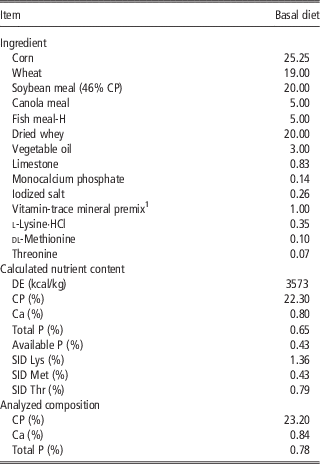
A total of eighty-four (Duroc×(Yorkshire×Landrace)) piglets (male and female, 1 : 1), weaned at 21 day of age with an initial average BW of 7.11±0.90 kg, were randomly allocated on the basis of BW to four treatments in a 2×2 factorial arrangement of a corn–soybean meal-based diet (0% or 0.1% NRYE) and sanitation (clean or unclean room). The composition of the basal diet is shown in Table 1. There were seven replicate pens per treatment each with three piglets. One group was raised in a room designated as the clean room that was washed once per week, whereas the second group was raised in a room designated as the unclean room in which 7 kg of manure from a sow herd was spread on each pen floor on day 1 and 7 and the room was not washed throughout the experiment. Each room had 14 pens equipped with a feeder, a suspended water line fitted with a low-pressure nipple, and plastic-covered expanded metal floors. Temperature in both rooms was maintained at 29±1°C.
Ingredient and chemical composition of the basal diets, as-fed basis

1 Provided the following per kg of complete diet: 9000 IU of vitamin A; 1500 IU of vitamin D3; 18 mg of vitamin E; 1.5 mg of vitamin K; 250 mg of choline; 30 mg of niacin; 27.5 mg of calcium pantothenate; 9.4 mg of riboflavin; 2 mg of pyridoxine; 25 µg of cyanocobalamin; 80 µg of biotin; 0.5 mg of folic acid; 18 mg of Cu from copper sulfate; 110 mg of Zn from zinc oxide; 0.2 mg of I from calcium iodide; 110 mg of Fe from ferrous sulfate; 50 mg of Mn from manganese dioxide; and 0.3 mg of Se from sodium selenite.
The NRYE supplement, Maxi-Gen Plus, was supplied by Canadian Bio-systems Inc. (Calgary, AB, Canada) and contained cell wall polysaccharides (21.6%), CP (32.7%), carbohydrates (14.3%) and a mixture of five nucleotides (1.1%; adenosine monophosphate, cytosine monophosphate, inosine monophosphate, uridine monophosphate and guanosine monophosphate). The diets were formulated to meet or exceed the NRC (2012) requirement specifications for weanling pigs, and were fed in a mash form. The pigs received feed and water on ad libitum basis throughout the experiment.
Sampling and measurements
Feed consumption and BW were recorded on day 1 and 14 for each pen. On day 14, one pig per pen was euthanized. The liver and kidneys were removed, blotted dry and weighed. A 2 cm section of distal ileum was collected and fixed with 10% buffer neutral formalin for morphological evaluation. Approximately 2 g of spleen and mesenteric lymph node (MLN) and another 2 cm of distal ileum were collected and immediately frozen in liquid nitrogen, and stored at −80°C for RNA extraction and gene expression analysis. About 5 g of the cecum and colon digesta were also collected and frozen in liquid nitrogen, and transferred to −80°C until required for bacterial genomic DNA extraction.
Sample preparation and chemical analyses
Dietary samples were processed and analyzed for CP, Ca and total P. Crude protein (N×6.25) was determined according to method 990.03 of Association of Official Analytical Chemists (AOAC) (1990) using a combustion analyzer (model CNS-2000; Leco Corp., St. Joseph, MI, USA). Dietary total Ca and P were analyzed following AOAC (1990) procedures (method 990.08) using a Varian inductively coupled plasma mass spectrometer (Varian Inc., Palo Alto, CA, USA).
Histomorphology measurements
The formalin-fixed ileal tissues were processed at the Veterinary Diagnostic Services Laboratory (Winnipeg, Manitoba, Canada). Villus height and crypt depth were measured at 10× magnification using Axiostar Plus microscope (Carl Zeiss, Oberkochen, Germany) equipped with a camera (Canon Canada Inc., Mississauga, Ontario, Canada) and ImageJ software (National Institutes of Health, Bethesda, MD) in at least 15 well-oriented villus and crypt columns. The villus height/crypt depth ratio was calculated.
Bacterial DNA extraction
Bacterial DNA in cecal and colonic digesta was extracted for the determination of the relative abundance of target bacteria at the genus level. Cecum and colon digesta samples were thawed before analyses and DNA was extracted (QIAmp DNA Stool mini Kit; QIAGEN, Hilden, Germany) according to the manufacturer’s protocol for stool pathogen detection as described by Li et al. (Reference Li, Gong, Cottrill, Yu, de Lange, Burton and Topp2003).
Total RNA extraction and complementary DNA synthesis
Total RNA of ileal, MLN and spleen samples was extracted for the determination of expression profiles of immune response-related cytokines. In brief, ~100 mg of tissue sample was placed in a tube containing 0.5 ml beads and 1 ml TRIZOL reagent (Invitrogen Canada Inc., Burlington, ON, Canada) and subjected to bead beating with PowerLyzer (MO BIO Laboratories, Inc., Toronto, Ontario, Canada) for 2 min at homogenization level of 2500 psi, and then chilled on ice for 5 min. The above procedure was repeated once. Total RNA was then extracted, washed and eluted following the manufacturer’s instructions for the TRIZOL reagent. Ribonucleic acid concentration and purity was measured using an ND-1000 spectrophotometer (NanoDrop Technologies, Wilmington, DE, USA). To remove genomic DNA contamination, total RNA was treated with DNase I according to the manufacturer’s protocol; 2 μg of total RNA with an optical density 260/280 ratio between 1.8 and 2.0 was used for complementary DNA (cDNA) synthesis using a High Capacity cDNA Reverse Transcription Kit (Applied Biosystems, Foster City, CA, USA) with RNase inhibitor according to the manufacturer’s instructions.
Real-time PCR
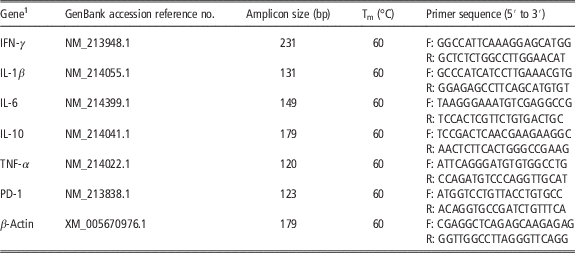
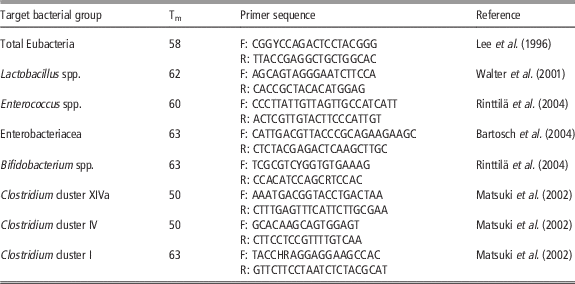
Real-time PCR for DNA and cDNA templates was carried out using a Bio-Rad CFX Real-time system (BioRad, Hercules, CA, USA). Each reaction mixture was run in duplicates using optical 96-well reaction plates (BioRad). Each amplification reaction was carried out with 12.5 µl of iTaq SYBR Green Supermix (BioRad) mixed with 1 µl of each primer set (Tables 2 and 3), 1 µl of genomic DNA or cDNA and 9.5 μl of nuclease-free water. Negative controls were created by replacing DNA or cDNA with nuclease-free water. Amplification consisted of initial denaturation for 5 min, followed by 40 cycles of denaturation at 95°C for 15 s, primer annealing at their individual optimal temperatures for 30 s and an extension step at 72°C for 30 s. After the amplification, a melt curve analysis with a temperature gradient of 0.1°C/s from 70°C to 95°C was performed to confirm that only specific products were amplified. The DNA templates were pooled and serially diluted eightfold to evaluate the efficiency (E) of the amplification of each primer set (Ivarsson et al., Reference Ivarsson, Roos, Liu and Lindberg2014). Amplification efficiency was calculated from the slope of the standard curve generated by plotting the threshold cycle v. logarithmic values of different DNA concentrations using the equation E=10(−1/slope) (Rasmussen, Reference Rasmussen2001).
Primers used for qPCR analysis of immune cytokines

Tm=annealing temperature.
1 IFN-γ=interferon gamma; TNF-α=tumor necrosis factor-α; IL=interleukin; PD-1=programmed cell death gene-1.
Primers used for qPCR analysis of gut bacteria groups

Tm=annealing temperature (°C).
Calculations and statistical analysis
The Sus scrofa β-actin gene and 16S rRNA gene of Eubacteria were used to normalize target genes transcript levels for immune cytokines and gut microbial groups, respectively. The relative abundance of each target gene was analyzed using the 2−∆∆Ct method. All data were analyzed using the Mixed procedure of SAS (SAS Inst., Inc., Cary, NC, USA). For all data analyses, significance was defined as P<0.05 and 0.05<P<0.10 was considered a trend.
Results
Growth performance
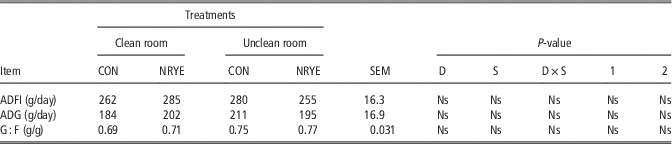
All piglets in both clean and unclean conditions appeared healthy throughout the experiment. Overall, no main effects of diet and sanitation or an interaction between them were observed for the average daily feed intake, average daily gain and gain/feed ratio (Table 4).
Growth performance of piglets fed diets without or with nucleotide-rich yeast extract (NRYE) and raised in clean or unclean conditions from day 1 to 14

CON=control diet; NRYE=diet containing 0.1% NRYE; D=main effect diet; S=main effect sanitation; D×S=diet×sanitation interaction effect; 1=contrast between CON and NRYE in the clean room; 2=contrast between CON and NRYE in the unclean room; ADG=average daily gain; ADFI=average daily feed intake; G : F=gain to feed ratio.
Carcass characteristics and ileal histomorphology
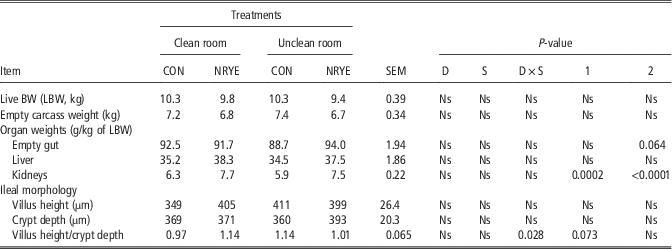
No main effects of diet and sanitation were observed for the carcass characteristics and ileal histomorphology parameters that were measured (Table 5). Diet×sanitation interactions were observed for villus height/crypt depth ratio (P=0.028) showing that NRYE tended to improve the villus height/crypt depth ratio (P=0.073) in the clean room. Compared with control, supplementing NRYE increased kidney weight of piglets in both clean (P=0.0002) and unclean (P<0.0001) rooms and tended to improve relative empty gut weight (P=0.064) in the unclean room.
Live BW, empty carcass weight, organ weights and ileal morphology of weaner pigs fed diets without or with NRYE and raised in clean or unclean conditions from day 1 to 14

CON=control diet; NRYE=diet containing 0.1% NRYE; D=main effect diet; S=main effect sanitation; D×S=diet×sanitation interaction effect; 1=contrast between CON and NRYE in the clean room; 2=contrast between CON and NRYE in the unclean room.
Immune response in the ileum, mesenteric lymph nodes and spleen
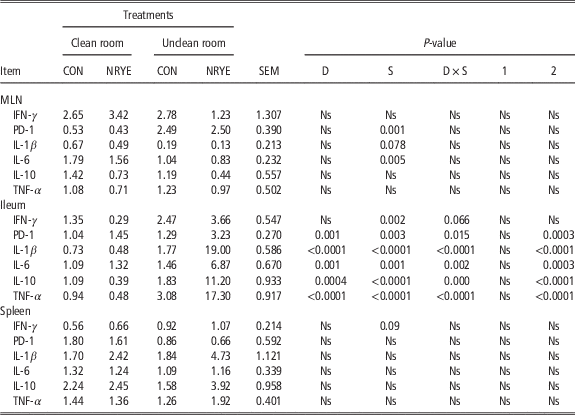
In the MLN, compared with pigs raised in the clean room, the main effect of sanitation was an upregulation of programmed cell death gene-1 (PD-1; P=0.001), downregulation of interleukin (IL)-6 (P=0.005), and a tendency towards downregulation of IL-1β (P=0.078) in pigs raised in the unclean room (Table 6). In the ileum, compared with pigs receiving the control diet, the main effect of diet was upregulation of PD-1 (P=0.001), IL-1β (P<0.0001), IL-6 (P=0.001), IL-10 (P=0.0004) and tumor necrosis factor-α (TNF-α; P<0.0001) in pigs receiving NRYE, whereas the main effect of sanitation was upregulation of interferon gamma (IFN-γ; P=0.002), PD-1 (P=0.003), IL-1β (P<0.0001), IL-6 (P=0.001), IL-10 (P<0.0001) and TNF-α (P<0.0001) in pigs raised in the unclean room. In the spleen, compared with pigs raised in the clean room, the main effect of sanitation was a tendency towards upregulation of IFN-γ (P=0.09) in pigs raised in the unclean room.
Mesenteric lymph node (MLN), ileal and splenal cytokine gene expression (log2) of weaner pigs fed diets without or with NRYE and raised in clean or unclean conditions from day 1 to 14

CON=control diet; NRYE=diet containing 0.1% NRYE; D=main effect diet; S=main effect sanitation; D×S=diet×sanitation interaction effect; 1=contrast between CON and NRYE in the clean room; 2=contrast between CON and NRYE in the unclean room; IFN-γ=interferon gamma; TNF-α=tumor necrosis factor-α; IL=interleukin; PD-1=programmed cell death gene-1.
Diet×sanitation interactions were only observed for the ileal expression of PD-1 (P=0.0003), interleukin (IL)-1β (P<0.0001), IL-6 (P=0.0003), IL-10 (P<0.0001) and TNF-α (P<0.0001) mRNA. Taken together, the interactions show that NRYE supplementation upregulated the expression of these genes only in the unclean room.
Relative abundance of bacterial groups in the cecum and colon digesta
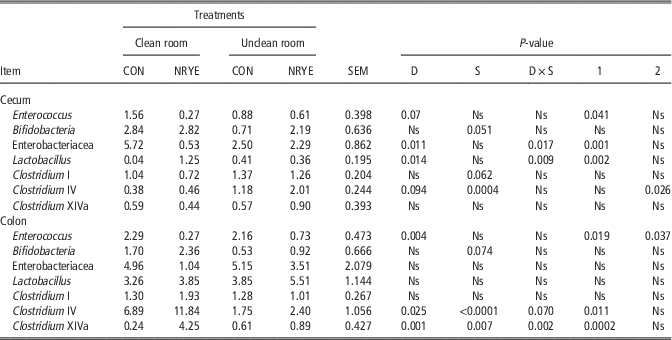
In the cecum, compared with pigs receiving the control diet, the main effect of diet was suppression of the abundance of Enterobacteriacea members (P=0.011), a tendency towards suppression of Enterococcus spp. (P=0.07), proliferation of Lactobacillus spp. (P=0.014) and a tendency towards proliferation of Clostridium cluster IV (P=0.094) in pigs receiving NRYE, whereas the main effect of sanitation was a tendency towards suppression of Bifidobacteria spp. (P=0.051), proliferation of Clostridium cluster IV (P=0.0004) and a tendency towards proliferation of Clostridium cluster I (P=0.062) members in pigs raised in the unclean room. In the colon, compared with pigs receiving the control diet, the main effect of diet was suppression of Enterococcus spp. (P=0.004) and proliferation of Clostridium cluster IV (P=0.025) and Clostridium cluster XIVa (P=0.001) in pigs receiving NRYE, whereas the main effect of sanitation was suppression of Clostridium cluster IV (P<0.0001) and Clostridium cluster XIVa (P=0.007) members, and a tendency towards suppression of Bifidobacteria spp. (P=0.074) in pigs raised in the unclean room.
Diet×sanitation interactions were observed for changes in abundance of cecal Enterobacteriacea members (P=0.001), Lactobacillus spp. (P=0.002) and colonic Clostridium cluster XIVa (P=0.002), whereas there was a tendency towards interaction for Clostridium cluster IV members (P=0.002; Table 7). Taken together, these interactions show that NRYE supplementation suppressed growth of cecal Enterobacteriacea members (P<0.001) and colonic Enterococcus spp. (P<0.019), and improved proliferation of cecal Lactobacillus (P<0.002) and colonic Clostridium cluster IV (P<0.011) and XVIa (P<0.0002) members in pigs raised in the clean room. Compared with control, supplementing the NRYE to pigs in the clean room also suppressed proliferation of cecal Enterococcus spp. (P=0.041), whereas supplementing the NRYE to pigs in the unclean room improved proliferation of cecal Clostridium cluster IV (P<0.026) and suppressed proliferation of colonic Enterococcus spp. (P<0.037).
Bacteria abundance (log2) in the cecal and colonic contents of weaner pigs fed diets without or with NRYE and raised in clean or unclean conditions from day 1 to 14

CON=control diet; NRYE=diet containing 0.1% NRYE; D=main effect diet; S=main effect sanitation; D×S=diet×sanitation interaction effect; 1=contrast between CON and NRYE in the clean room; 2=contrast between CON and NRYE in the unclean room.
Discussion
The aim of the present study was to evaluate the short-term effect of supplementing NRYE on growth performance, gut structure, immunity and microflora in response to a sanitary challenge. Supplementing NRYE did not influence feed intake, weight gain and feed efficiency in both sanitary conditions. The lack of differences on growth performance between piglets in clean and unclean conditions is consistent with the results of Zhao et al. (Reference Zhao, Harper, Estienne, Webb, McElroy and Denbow2007) who used a similar model and reported no significant differences on growth performance responses between pigs in clean and unclean conditions. Zhao et al. (Reference Zhao, Harper, Estienne, Webb, McElroy and Denbow2007) suggested that the response of weaned pigs to unsanitary environments may vary considering that microbial populations, lack of or degree of pathogen exposure, pig genetics, health status and other factors are inherently variable. The results of the current study on the treatments effect on immune responses (discussed hereafter) suggest that although the unsanitary condition induced stress in the gut immune system, the stress was not sufficient to significantly affect growth performance. Consequently, all pigs in both sanitary conditions regardless of the diet type appeared healthy and had similar average daily feed intake (ADFI) throughout the study. Although studies testing effect of nucleotides in piglets raised under unsanitary conditions are lacking, the results from pigs raised in the clean condition are consistent with those of Sauer et al. (Reference Sauer, Mosenthin and Bauer2012) who supplemented 0.1% of a mixture of pure nucleotides, and Andrés-Elias et al. (Reference Andres-Elias, Pujols, Badiola and Torrallardona2007) who supplemented 0.15% NRYE and reported no effect of the supplements on piglet performance. These results support the suggestion that nucleotides are conditionally essential nutrients (Van Buren and Rudolph, Reference Van Buren and Rudolph1997) whose beneficial effects are less pronounced under low levels of stress such as hygienic conditions, lack of disease and sufficient nutrition.
Regardless of sanitation condition, NRYE supplemented pigs had higher kidney weights than control which may indicate improved cell division due to the presence of nucleotides which are DNA and RNA monomers. Toback et al. (Reference Toback, Walsh-Reitz, Mendley and Kartha1990) reported that DNA synthesis in cultured renal epithelial cells could be stimulated by exogenous purine nucleosides and nucleotides but similar effect was not observed in fibroblasts (cells of connective tissues). Although NRYE supplementation improved kidney weight, there are no swine-related studies that associate heavier kidneys with beneficial impacts on growth performance and health. However, it is worth noting that the increase in kidney weight may be indicative of nephrotoxicity, a condition reflected by abnormal weights and histopathology in the kidneys, and there is evidence that large doses of dietary adenine (0.4% to 0.75%) have been associated with development of heavier kidneys in rats due to nephrotoxicity (Story et al., Reference Story, Shrader, Theriault, Lumijarvi, Shenoy, Savaiano, Shaffer, Ho and Clifford1977; Brulé et al., Reference Brulé, Sarwar, Savoie, Campbell and Van Zeggelaar1988). Pigs receiving NRYE in the unclean room tended to have higher relative empty gut weight, which suggests that NRYE influenced gut development. The enhanced growth of the gut may confer ability to adapt to solid diets (Van Barneveld and Dunshea, Reference Van Barneveld and Dunshea2011) and hence indicate the ability of NRYE to mitigate post-weaning challenges. The villus height/crypt depth ratio of the NRYE-receiving pigs in the clean room was increased by 18% compared with the control in the clean room. This is supported by the observation that ADFI of the NRYE-receiving pigs in the clean room was 8.8% higher than that of the control in the clean room. This implies that supplemental NRYE has beneficial effects on the development of gut structure which is partly associated with the observed increase in ADFI (McCracken et al., Reference McCracken, Spurlock, Roos, Zuckermann and Gaskins1999). However, this beneficial effect was not observed in the pigs receiving NRYE in the unsanitary room possibly due to the reduced ADFI (McCracken et al., Reference McCracken, Spurlock, Roos, Zuckermann and Gaskins1999). Generally, weaning stress lowers voluntary feed intake which is partially responsible for triggering a reduction in villus height and in the villus height/crypt depth ratio (Pluske et al., Reference Pluske, Thompson, Atwood, Bird, Williams and Hartmann1996).
Dietary nucleotides have been suggested as immune system stimulants (Kulkarni et al., Reference Kulkarni, Rudolph and Van Buren1994; Grimble and Westwood, Reference Grimble and Westwood2001). The mechanism by which nucleotides stimulate gut immune system is unclear, but it is mostly hypothesized that being building blocks of ATP, DNA and RNA, nucleotides promote cell division and development of the immune system of enterocytes which generally lack the capacity for de novo synthesis of nucleotides (Uauy et al., Reference Uauy, Quan and Gil1994). Kulkarni et al. (Reference Kulkarni, Rudolph and Van Buren1994) postulated that a nucleotide-free diet causes functional impairment of T-lymphocytes in mice, possibly due to the defect in the differentiation and maturation of T-lymphocytes associated with immunodeficiency.
In the present study, among the parameters that were measured, the main effects of diet and sanitation were most conspicuous in the ileum, showing higher upregulation of ileal PD-1 and cytokines in pigs receiving NRYE compared with those receiving the control diet regardless of sanitary condition and higher upregulation of ileal PD-1 and cytokines in pigs raised in unclean condition compared with those raised in the clean room regardless of the diet type. This observation implies that the sanitary challenge was sufficient to provoke immune responses in the ileum, a requirement to study the immunomodulation ability of NRYE. The effect of NRYE supplementation on the expression of IL-1β, IL-6, IL-10, TNF-α and PD-1 was localized in the ileum of pigs raised in the unsanitary conditions thus suggesting an immunostimulatory effect of NRYE. In addition, the observed upregulation of ileal IL-1β and IL-6 in NRYE-receiving pigs in the unclean room suggests that under the unsanitary conditions supplementing NRYE is beneficial to piglets in enhancing the expression of proinflammatory cytokines. This immunoresponse leads to activation of lymphocytes thereby improving host defense mechanisms that accelerate the process of pathogen clearance (Medzhitov, Reference Medzhitov2007; D’Elia et al., Reference D’Elia, Harrison, Oyston, Lukaszewski and Clark2013). In addition to pro-inflammation, upregulation of IL-1β is also associated with differentiation of epithelial cells at weaning (Pié et al., Reference Pié, Lallès, Blazy, Laffitte, Sève and Oswald2004). Interleukin-6 enhances differentiation of macrophages and type 2 T-helper cells, which engulf pathogens and enhance antibody secretion, respectively (Pescovitz et al., Reference Pescovitz, Pabst, Rothkötter, Murtaugh, Foss, Butler, Lunney, Vogeli, Llanes and Trebichavsky1998). The upregulation of ileal IL-10 in unclean room NRYE-receiving pigs suggests that the NRYE supplement has immunoregulatory effects because IL-10 inhibits the production of proinflammatory mediators and also augments the production of anti-inflammatory factors (Pescovitz et al., Reference Pescovitz, Pabst, Rothkötter, Murtaugh, Foss, Butler, Lunney, Vogeli, Llanes and Trebichavsky1998). In addition, the upregulation of PD-1 expression as observed in unclean room NRYE-receiving pigs is an indicator of improved immunoregulation after lymphocyte activation. Generally, PD-1 is expressed on the surface of activated T cells, B cells, and macrophages to regulate immune responses by increasing T-cell death (Sharpe et al., Reference Sharpe, Wherry, Ahmed and Freeman2007). An inability to express PD-1 is associated with multiple lymphoproliferative, uncontrolled, immune responses, leading to several types of severe autoimmune disorders (Liang et al., Reference Liang, Latchman, Buhlmann, Tomczak, Horwitz, Freeman and Sharpe2003).
Dietary nucleotides have been suggested to promote proliferation of beneficial gut microbiota such as Bifidobacteria spp. and Lactobacillus spp. as demonstrated by in vitro (Tanaka and Mutai, Reference Tanaka and Mutai1980) and in vivo studies with human subjects (Gil et al., Reference Gil, Corral, Martinez and Molina1986) and rodents (Uauy et al., Reference Uauy, Stringel, Thomas and Quan1990). Mateo (Reference Mateo2005) reported an increase in Bifidobacteria spp. and Lactobacilli spp. and a reduction in Clostridium spp. in feces of piglets fed a nucleoside-containing diet. In the current study, supplementing NRYE reduced the abundance of Enterobacteriacea members in the clean room and Enterococcus spp. in both the clean and unclean rooms. Enterobacteriacea family members (such as Salmonella sp., E. coli, Mycobacterium sp., Streptococcus sp., Staphylococcus sp.) and Enterococcus spp. are mostly opportunistic pathogens that have adverse effects on gut health and are increasingly resistant to antimicrobial agents (Baer et al., Reference Baer, Miller and Dilger2013). On the other hand, NRYE supplementation improved proliferation of Lactobacillus and Clostridium cluster XVIa members in pigs raised in the clean room and Clostridium cluster IV members in both clean and unclean room pigs. Clostridium cluster IV and XIVa members are butyrate producing bacteria (Levine et al., Reference Levine, Looft, Allen and Stanton2013). Butyrate is the main fuel for the colonocytes and regulates gene expression leading to anti-inflammatory effects (Hamer et al., Reference Hamer, Jonkers, Venema, Vanhoutvin, Troost and Brummer2008). Thus, the results imply that supplementation of 0.1% NRYE was associated with proliferation of beneficial gut bacteria and suppression of harmful ones, a factor that could be attributable to both the nucleotides and yeast cell wall polysaccharides present in the NRYE supplement. This observation supports recent findings of Li et al. (Reference Li, Zhao, Lei, Li and Kim2015) showing that in piglets orally challenged with E. coli K88, the NRYE-receiving groups had higher Lactobacillus fecal count and lower E. coli fecal count than control.
In summary, supplementing NRYE to pigs under the sanitary condition improved the villus/crypt depth possibly due to improved feed intake. Supplementation of NRYE had no effect on weight gain and feed efficiency in both sanitary conditions. Regardless of the sanitary condition, pigs receiving NRYE had heavier kidneys, which is attributable to enhancement of cellular growth by nucleotides. Supplementing NRYE to pigs in unsanitary conditions was associated with enhanced relative gut weight, which indicates enhanced ability to adapt to solid diets, and stimulation of both pro- and anti-inflammatory cytokines and PD-1 in the ileum, which indicates enhanced and homeostatic immune response. In addition, NRYE supplementation was associated with proliferation of beneficial bacteria in pigs raised in the clean room and suppression in the growth of harmful gut bacteria in pigs raised in the unclean room, which indicates improved gut immunity and health. It is worth noting that a yeast extract was the nucleotides’ source in this study. The product also contains yeast cell wall polysaccharides (21.6%) which may help in modulation of mucosal immunity and provision of binding sites for pathogens hence mediating their elimination from the gut (Kogan and Kocher, Reference Kogan and Kocher2007). Therefore, the beneficial effects of the NRYE may be multi-faceted and cannot be exclusively attributed to the effect of nucleotides present in the product (Sauer et al., Reference Sauer, Mosenthin and Bauer2012). In the present study, the use supplemental nucleotides from a yeast-extract was inspired by their affordability compared with pure nucleotides, a factor which may have less impact on feed cost and thereby facilitate their adoption in the animal feed industry.
Conclusions
Our results show that supplementing NRYE as a source of dietary nucleotides to weaned pigs raised in unsanitary condition positively modulated their immune response and composition of gut microbiota. This may have important implications for nutritional management of weaned pigs, where supplemental nucleotides could enable piglets to resist weaning-associated infections.
Acknowledgments
The authors thank the Natural Sciences and Engineering Research Council of Canada (NSERC), Manitoba Pork Council and Canadian Bio-Systems Inc. for funding this research.