Introduction
Vachellia species are widely distributed in arid and semiarid regions of the world (Aref et al. Reference Aref, El-Juhany and Hegazy2003; Teketay Reference Teketay1996). In Australia, several species of Vachellia were deliberately introduced; some of them are now considered invasive species (Erkovan et al. Reference Erkovan, Clarke and Whalley2013; Welgama et al. Reference Welgama, Florentine, Marchante, Javaid and Turville2019). Sweet acacia [Vachellia farnesiana (L.) Willd.; syn. Acacia farnesiana], known as mimosa bush in Australia, is one of the most problematic thorny Vachellia species in Australia (Kodela and Wilson Reference Kodela and Wilson2006). A native of Central and South America, V. farnesiana has encroached into grasslands and savanna communities (Meyer and Bovey Reference Meyer and Bovey1982; Scifres Reference Scifres1974), where it is able to form dense thorny thickets. For land managers, these infestations can cause difficulties in terms of herding livestock (i.e., mustering) and hindering the access of animals to water (Queensland Department of Agriculture and Fisheries 2020).
Vachellia farnesiana is a rounded shrub that can grow up to 5 m. Its leaves are a ferny type, with up to 6 pairs of leaf branches, each with 5 to 20 pairs of leaflets (Scifres Reference Scifres1974). At the base of each leaf, up to 10-cm-long thorns are found in pairs. The pods of V. farnesiana are dark brown or black at maturity, and they tend to stay on the plant for a long time after maturity. Seeds are primarily dispersed by livestock and feral animals, and seed dispersal has been found very crucial for the survival of this weed species (Traveset Reference Traveset1990). The invasiveness of V. farnesiana can be attributed to prolific seed production and a persistent seedbank. At room temperature, seeds of this weed species were shown to survive for as long as 150 yr (Leino and Edqvist Reference Leino and Edqvist2010). The long seed life of this species is mainly due to a large dormant soil seedbank (Erkovan et al. Reference Erkovan, Clarke and Whalley2013). Common for many Vachellia species, seeds of V. farnesiana have a hard seed coat, which is primarily responsible for its dormant seedbank. Despite the potential for large seedbanks, very limited information is available on the effect of environmental factors on seed germination of V. farnesiana. Such information is a prerequisite for the successful implementation of integrated weed management (IWM) practices for V. farnesiana.
Temperature, for example, is an important factor influencing weed seed germination. Information on the effect of temperature on seed germination of V. farnesiana may provide its potential expansion range in terms of regions as well as seasons. However, very limited information is available for V. farnesiana. The lack of a germination response to light in some weed species indicates that seeds may germinate under a forest canopy or when buried in the soil. Similarly, salt and water stress can affect seed germination of V. farnesiana. Salinity is increasing in arid areas of Australia (Rengasamy Reference Rengasamy2002) and the ability of V. farnesiana seeds to germinate at high salinity levels will increase the invasiveness of this species. Some weed seeds may remain ungerminated in high water stress conditions (Chauhan and Johnson Reference Chauhan and Johnson2010), demonstrating a survival mechanism. However, such information is not available for V. farnesiana in Australian conditions.
As V. farnesiana is a prolific seed producer, its seeds keep germinating throughout the year due to the hard seed coat dormancy. Young seedlings, the most sensitive developmental stage, are easier to control using herbicides compared with mature plants. Knowledge of the performance of commonly used herbicides on young seedlings of V. farnesiana will strengthen the development of IWM programs for this and similar weed species. This study was conducted to determine the effects of alternating day/night temperature, light, salt stress, and water stress on seed germination of V. farnesiana, and to evaluate the response of this weed to a range of commonly available postemergence herbicides in Australia.
Materials and Methods
Seed Collection
Seeds of two populations (NSW and QLD) of V. farnesiana were collected in December 2018. The NSW population was collected from a roadside near Moree, NSW, Australia (29.598°S, 149.813°E) and the QLD population was collected from a roadside near Capella, QLD, Australia (23.092°S, 148.002°E). Long-term (at least 30 yr) temperature and rainfall at the NSW location are 26.1 C mean maximum temperature, 12.4 C mean minimum temperature, and 582 mm annual rainfall (bom.gov.au). These weather parameters at the QLD location are 29.7 C mean maximum temperature, 15.0 C mean minimum temperature, and 666 mm annual rainfall. Seeds of each population were collected from at least 50 plants. Seeds were threshed from pods, and intact seeds were placed in plastic containers at room temperature (25 ± 2 C) until used in the study (July 2020).
Germination Test
Seed germination was evaluated by uniformly placing 25 seeds from each population in a 9-cm-diameter petri dish containing two layers of Whatman No. 1 (Whatman, Maidstone, UK) filter paper moistened with 5 ml of water or other appropriate experimental solution. Petri dishes were placed in sealed plastic bags to avoid water loss due to evaporation, and these bags were placed in an incubator set at alternating day/night temperatures of 35/25 C in the light (12 h)/dark (12 h) regime, unless otherwise indicated. Before conducting each experiment, seeds were placed for 10 min in hot water at 90 C. This treatment was found optimum to scarify the seeds in the scarification experiment. Seed germination was determined 15 d after the start of the experiment, as there was no further germination after this period in a preliminary experiment. A seed was considered germinated when its radical was at least 1 mm in length.
Experiment 1. Effect of Scarification on Germination
Seeds of both populations were immersed in hot water (90 C) for either 10, 20, 30, or 60 min using a temperature-controlled water bath. There was also a control treatment (0 min), in which seeds were not placed in hot water. Seeds were placed in petri dishes and incubated at 35/25 C as described earlier.
Experiment 2. Effect of Temperature on Germination
Scarified seeds of both populations were incubated at five different alternating day/night temperatures to evaluate the effect of temperature on seed germination of V. farnesiana. The temperature regimes were 15/5, 20/10, 25/15, 30/20, and 35/25 C. The higher-temperature cycle coincided with a 12-h photoperiod, and the lower-temperature cycle coincided with 12-h dark conditions. These temperature regimes were selected to represent temperatures in the eastern region of Australia.
Experiment 3. Effect of Light on Germination
Scarified seeds of both populations were incubated at 35/25 C under two different light treatments, either complete darkness or a 12-h/12-h photoperiod. The complete darkness treatment was achieved by wrapping three layers of aluminum foil around petri dishes. Seed germination was determined 15 d after the start of the experiment.
Experiment 4. Effect of Sodium Chloride (NaCl) on Germination
To evaluate the effect of NaCl on germination, scarified seeds of both populations were incubated at 35/25 C with solutions of either 0 (control), 20, 40, 80, 160, or 320 mM NaCl. These salt levels are commonly found in various parts of Australia (Rengasamy Reference Rengasamy2002).
Experiment 5. Effect of Water Stress on Germination
To evaluate the effect of water stress on germination, scarified seeds of both populations were incubated at 35/25 C with solutions of either 0, −0.1, −0.2, −0.4, −0.8, or −1.6 MPa osmotic potential. The solutions were prepared by dissolving polyethylene glycol 8000 in distilled water as described in Michel and Radcliffe (Reference Michel and Radcliffe1995).
Experiment 6. Effect of Herbicides on Survival and Biomass
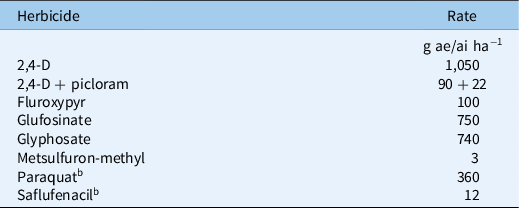
Ten seeds of each population were planted at 2-cm depth in 20-cm-diameter pots, using a commercial potting mix (Platinum Potting Mix, Centenary Landscaping, NSW, Australia). The potting mix contained biological organic-based products and had a pH of 5.6 and electrical conductivity of 1.6 dS m−1. After emergence, thinning was done to maintain 5 plants pot-1. These pots were kept outside on benches at the Gatton Farm of the University of Queensland, Gatton, QLD. An overhead mist sprinkler was used to irrigate pots. At the 6- to 7-leaf stage (approximately 6-cm height), plants were sprayed with different herbicides (Table 1); a control treatment was included in which no herbicide was sprayed. Herbicides were sprayed using a research track sprayer that delivered 108 L ha−1 water at a pressure of 200 kPa. Flat-fan nozzles were used in the sprayer. Seedling survival was determined 28 d after herbicide treatment with the survival criterion of at least one new leaf on the plant. Surviving plants were cut at the soil surface, placed in paper bags, and dried in an oven at 70 C for 72 h. Biomass was measured, and results were expressed as percent control.
Postemergence herbicides and rates used for evaluation of control of Vachellia farnesiana seedlings at the Gatton Farm of the University of Queensland, Gatton, QLD, Australia (September to December 2020). a

a Herbicides were sprayed at the 6- to 7-leaf stage, and seedling survival and biomass were determined at 28 d after herbicide application.
b 1% oil-based adjuvant was used.
Statistical Analyses
All experiments were conducted in a randomized complete block design, and each treatment was replicated three times. In the laboratory trials, blocking was done by placing dishes on different shelves within an incubator and in the pot trials by grouping pots of the same replicate together. All experiments were repeated; the second run was started within a month after the completion of the first run. Populations and experimental runs were considered as factors. No differences were found between the two experimental runs and two populations; therefore, the data from the repeated experiments and both populations were combined for analysis (Genstat 2019). Before analysis, the data variance was visually examined by plotting the residuals to check homogeneity of variance.
The data on the scarification, light, and herbicide experiments were subjected to ANOVA, and means were separated using the LSD test at the 5% level of significance. For other experiments, regression analysis was carried out using SigmaPlot v. 14.0 (Systat Software, San Jose, CA, USA). Germination resulting from alternating temperatures, NaCl concentrations, and osmotic potential concentrations was modeled using a functional three-parameter sigmoid function:
 $G = a/1 + e [-(x-T_{50})/b] $
In the function, G is the cumulative germination percentage at time x, a is the maximum germination (%), T 50 is the time (d) required for 50% inhibition of maximum germination, and b is the slope. Parameter estimates of the model were compared by using their standard errors.
Results and Discussion
Experiment 1. Effect of Scarification on Germination
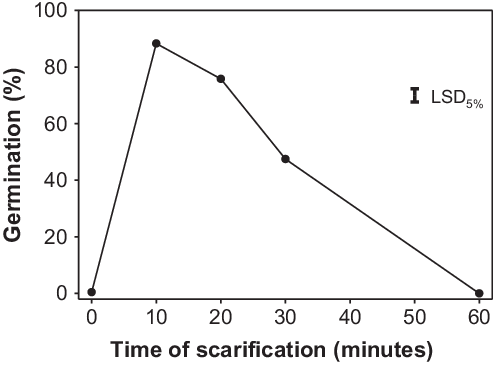
Seed germination of V. farnesiana was significantly improved by scarifying the seeds with hot water (90 C), with an optimum effect (88% germination) recorded after 10 min (Figure 1). Seed germination decreased after this duration of scarification, and no seeds germinated after being immersed in hot water for 60 min at 90 C. Only 0.4% of seeds germinated without scarification.
Effect of time length (min) of hot water treatment (90 C) on germination of Vachellia farnesiana seeds incubated at 35/25 C in light/dark conditions for 15 d. Error bar represents LSD where P = 0.05 (n = 12). The experiment was conducted in the weed science lab of the University of Queensland, Gatton, QLD, Australia, in July–August 2020.

It is well known that seeds of most Vachellia species have physical dormancy due to a hard seed coat (Tadros et al. Reference Tadros, Samarah and Alqudah2011; Welgama et al. Reference Welgama, Florentine, Marchante, Javaid and Turville2019). The hot-water treatment softened the seed coat, which caused an opening that made germination possible. Previous studies achieved similar results through physical or chemical scarification (Scifres Reference Scifres1974; Welgama et al. Reference Welgama, Florentine, Marchante, Javaid and Turville2019).
Other weed species with coat-imposed dormancy are sesbania [Sesbania cannabina (Retz.) Poir.] (Iqbal et al. Reference Iqbal, Manalil, Chauhan and Adkins2019); giant false sensitive plant (Mimosa diplotricha C. Wright; syn.: Mimosa invisa Mart.) (Chauhan and Johnson Reference Chauhan and Johnson2008); and flower of an hour (Hibiscus trionum L.) (Chauhan Reference Chauhan2016). Seeds with a hard seed coat are known to persist in the soil for a long period of time, as the scarification process in natural conditions is very slow. Seeds on the soil surface experience fluctuations in temperature and moisture conditions and predation activities (rodents, insects, microorganisms, etc.), which help to expedite the scarification process. High temperatures generated through fire can also soften the seed coat of V. farnesiana. In Portugal, for example, a large-scale invasion of Sydney golden wattle [Acacia longifolia (Andrews) Willd.] was observed after a fire occurrence (Marchante et al. Reference Marchante, Kjøller, Struwe and Freitas2008). Seed burial by any means (e.g., ants) will delay the scarification process and extend the seedbank persistence of V. farnesiana. Australian Vachellia species seedbanks have been reported to remain dormant for 50 yr or more (Holmes Reference Holmes1989; Leino and Edqvist Reference Leino and Edqvist2010).
Experiment 2. Effect of Temperature on Germination
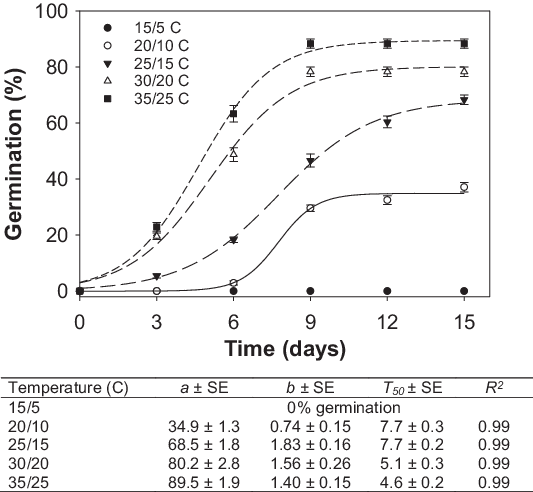
Seed germination of V. farnesiana was significantly affected by the alternating day/night temperature regimes tested (Figure 2). Highest germination (90%) was obtained at 35/25 C, and germination decreased with a decrease in temperature. No seeds germinated at 15/5 C, but 35% of seeds germinated at 20/10 C (a mild winter temperature in Queensland). Seeds took the shortest time to achieve 50% germination (T 50) at 35/25 C compared with other temperature regimes.
Effect of alternating temperature regimes (15/5 to 35/25 C) on germination of Vachellia farnesiana seeds incubated in light/dark conditions for 15 d. Lines represent a sigmoid model [G = a/1 + e[−(x − T 50)/b]; G is the cumulative germination percentage at time x, a is the maximum germination (%), T 50 is the time (d) required for 50% inhibition of maximum germination, and b is the slope] fit to the data, and vertical bars represent standard error of mean. The experiment was conducted in the weed science lab of the University of Queensland, Gatton, QLD, Australia, in August–September 2020.

A study conducted almost 50 yr ago in the United States reported V. farnesiana seed germination at different temperatures ranging from 16 to 38 C; however, the highest germination was observed at 30 C (Scifres Reference Scifres1974). Although the previous study was conducted at constant temperatures and such temperature conditions are rarely experienced in nature, the results support our observation of maximum germination at fluctuating day/night temperatures of 35/25 C (i.e., average 30 C). Acacia longifolia was also tested for germination at 17/7, 20/15, and 30/20 C alternating day/night temperatures (Welgama et al. Reference Welgama, Florentine, Marchante, Javaid and Turville2019).
Our results suggest that seeds of V. farnesiana can germinate throughout the spring, summer, and autumn seasons in northern Australia (personal observations). Seeds may remain ungerminated in very cold months and begin germinating after the weather starts warming up. Scarified seeds were used in this study, and the fastest germination was obtained at 35/25 C. In natural conditions, however, the scarification process will occur at a much slower pace. Therefore, depending on scarification status and moisture availability, seeds of V. farnesiana could germinate throughout the year at low altitudes in tropical countries.
Experiment 3. Effect of Light on Germination
At the optimum temperature regime (35/25 C), seed germination of V. farnesiana was similar (87%) between light/dark (12 h/12 h) and dark (24 h) conditions. These results are not surprising, as most Vachellia species are known to have similar germination between light and dark regimes. Seed germination of A. longifolia was also found to be similar between light (87%) and dark (85%) conditions (Welgama et al. Reference Welgama, Florentine, Marchante, Javaid and Turville2019).
Similar germination responses to light and dark conditions suggest that V. farnesiana seeds are not photoblastic. Seeds of such species are known to germinate under a plant canopy (forest, field crop, etc.) or even when buried in the soil. These results suggest that shading by the existing V. farnesiana plants will not stop the seeds from germinating.
Experiment 4. Effect of NaCl on Germination
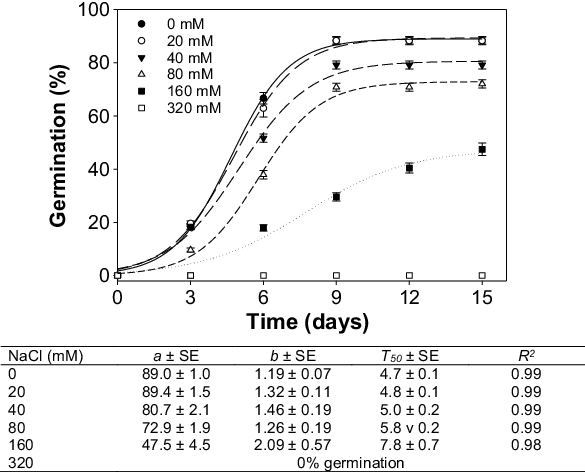
Salt stress significantly affected V. farnesiana seed germination (Figure 3). The sigmoid model revealed maximum germination (89%) at 0 and 20 mM NaCl. With further increases in NaCl concentration, seed germination decreased. Almost 50% of seeds germinated at 160 mM NaCl, although germination was completely inhibited at 320 mM NaCl. Time to 50% germination (T 50) increased from 4.7 to 7.8 d when NaCl concentration was increased from 0 to 160 mM NaCl.
Effect of sodium chloride (NaCl) concentrations (mM) on germination of Vachellia farnesiana seeds incubated at 35/25 C in light/dark conditions for 15 d. The lines represent a sigmoid model [G = a/1 + e[−(x − T 50)/b]; G is the cumulative germination percentage at time x, a is the maximum germination (%), T 50 is the time (d) required for 50% inhibition of maximum germination, and b is the slope] fit to the data, and vertical bars represent standard error of mean (n = 12). The experiment was conducted in the weed science lab of the University of Queensland, Gatton, QLD, Australia, in September–October 2020.

In the U.S. study, seed germination of V. farnesiana was similar between NaCl concentrations of 0 and 1250 ppm (Scifres Reference Scifres1974). The 1,250 ppm NaCl concentration is equivalent to 21 mM NaCl, suggesting that our results are similar to those of the previous study, as seed germination was not affected by 20 mM NaCl in our study. The previous study reported a 40% reduction in germination at 1,250 ppm NaCl (˜85 mM NaCl) compared with the no-salt treatment (Scifres Reference Scifres1974). In our study, only an 18% reduction in germination was observed at 80 mM NaCl, and more than 50% of seeds germinated at 160 mM NaCl (9,350 ppm NaCl). These results suggest that the Australian populations of V. farnesiana may be more tolerant to salinity than the U.S. population. Similar to our results, a recent study reported that seeds of A. longifolia germinated at NaCl concentrations ranging from 0 to 200 mM NaCl (Welgama et al. Reference Welgama, Florentine, Marchante, Javaid and Turville2019). These results suggest that most Vachellia species, including V. farnesiana, are salt tolerant.
Salinity is a major abiotic factor affecting the productivity of pastures and crops worldwide, including Australia. In Australia, 3% of the soils are affected by salinity (Bot et al. Reference Bot, Nachtergaele and Young2000). These results suggest that V. farnesiana has the potential to spread in salt-affected regions of Australia. This trait will enhance the invasiveness of V. farnesiana in Australia and other countries.
Experiment 5. Effect of Water Stress on Germination
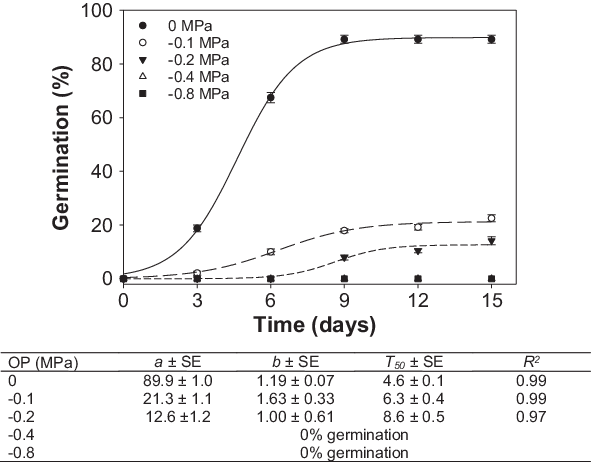
Seed germination of V. farnesiana was greatly affected by osmotic potential (Figure 4). Germination was greatest at 0 MPa (90%) and decreased dramatically to 21% at −0.1 MPa. Only 13% of seeds germinated at −0.2 MPa, and no seeds germinated at −0.4 MPa or lower osmotic potentials. Time taken to 50% germination (T 50) increased from 4.6 to 8.6 d when the osmotic potential was decreased from 0 to −0.2 MPa.
Effect of osmotic potential (MPa) on germination of Vachellia farnesiana seeds incubated at 35/25 C in light/dark conditions for 15 d. The lines represent a sigmoid model [G = a/1 + e[−(x − T 50)/b]; G is the cumulative germination percentage at time x, a is the maximum germination (%), T 50 is the time (d) required for 50% inhibition of maximum germination, and b is the slope] fit to the data, and vertical bars represent standard error of mean (n = 12). The experiment was conducted in the weed science lab of the University of Queensland, Gatton, QLD, Australia, in September–October 2020.

Our results are different from what was reported for a Texas, USA, population of V. farnesiana. In the previous study, seed germination ranged from 55% (−1.6 MPa osmotic potential) to 75% (no water-stress treatment) (Scifres Reference Scifres1974). It was reported that V. farnesiana is a drought-tolerant plant species, but our results indicate that scarified seeds of V. farnesiana may not be able to tolerate high levels of water stress. Reasons for the differential germination response between the two populations (Australia and United States) are not clear. In a recent study, about 30% of seeds of A. longifolia germinated at −0.4 MPa (Welgama et al. Reference Welgama, Florentine, Marchante, Javaid and Turville2019).
Our results suggest that the Australian V. farnesiana populations favor a moist environment for germination, and seeds can remain ungerminated in the soil until conditions become favorable for germination. Such conditions are known to increase the longevity of seeds in the seedbank (Chauhan and Johnson Reference Chauhan and Johnson2009).
Experiment 6. Effect of Herbicides on Survival and Biomass
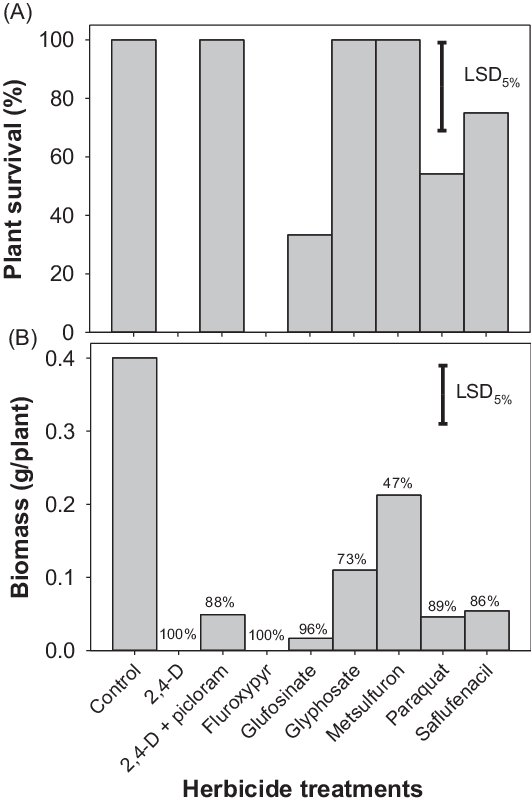
Postemergence herbicides were evaluated for the control of small seedlings of V. farnesiana (Table 1). No plants of V. farnesiana survived the application of 2,4-D and fluroxypyr (Figure 5A). Only 33% of plants survived the application of glufosinate. The effects of herbicide application were more pronounced on shoot biomass than survival. For example, 2,4-D + picloram, glufosinate, paraquat, and saflufenacil provided greater than 85% control of shoot biomass compared with the non-treated control treatment (Figure 5B). Metsulfuron-methyl was the least effective herbicide, followed by glyphosate. All seedlings survived the application of glyphosate, but it was able to reduce shoot biomass of V. farnesiana by 73%.
Effect of postemergence herbicide application on survival (A) and resulting dry biomass (B) of Vachellia farnesiana when sprayed at the 6- to 7-leaf stage. The experiment was conducted at the Gatton Farm of the University of Queensland, Gatton, QLD, Australia, from September to December 2020. Seedling survival and biomass were determined at 28 d after herbicide application. The error bars represent LSD, where P = 0.05 (n = 12), and the percentages above the bar represent percent reduction in biomass compared with the control treatment. Rates (g ai/ae ha−1) of herbicides applied were: 2,4-D, 1,050; 2,4-D + picloram, 90 + 22; fluroxypyr, 100; glufosinate, 750; glyphosate, 740; metsulfuron-methyl, 3; paraquat, 360; saflufenacil, 12.

Most herbicides used in our study are not recommended for V. farnesiana in Australia. Our results suggest that there are effective herbicides available in Australia and that chemical industries should work with researchers to develop IWM programs using effective herbicides. Small and newly emerging seedlings of V. farnesiana in non-crop situations can be controlled using nonselective herbicides such as glufosinate and paraquat. We used scarified seeds and, therefore, preemergence herbicides were not tested in our study, as these herbicides may interact very differently with scarified seeds compared with the seeds present in the field. In natural conditions, seeds lose physical dormancy over time. There is a need to evaluate the effect of preemergence herbicides on V. farnesiana control in natural conditions. To reduce reliance on herbicides and the development of resistance, IWM programs for V. farnesiana need to be developed. Research is in progress to develop biological control for V. farnesiana.
In summary, seed germination of V. farnesiana was similar between the two populations. The populations are most likely linked through the movement of cattle, which is the main mechanism for long-distance dispersal across Australia. The distance between the two sites is approximately 300 km. Scarification stimulated germination, suggesting the presence of physical dormancy in V. farnesiana, and this dormancy increases the seedbank longevity in the soil. Seeds germinated at a wide range of alternating day/night temperature regimes, suggesting that V. farnesiana seeds, once scarified, can germinate throughout the year in most parts of Queensland. Similar germination between light conditions suggests the ability of this weed species to germinate under a plant canopy or when buried in the soil. Vachellia farnesiana seeds were found to tolerate a high level of salinity, but they were susceptible to water-stress conditions. A number of effective postemergence herbicides provided effective control of small seedlings of V. farnesiana. However, there is a need to work with the private sector to develop IWM programs using effective herbicides. Knowledge gained from this study will help to predict the potential spread of V. farnesiana in other areas and develop effective control measures for this species.
Acknowledgments
This research received no funding. The authors declare no conflicts of interest.