Although rational choice arguments are enormously influential in political science and International Relations (IR), since their introduction they have been questioned by critics who claim their assumptions about strategic, utility-maximizing behavior are faulty.Footnote 1 Pointing to experimental evidence as well as case studies of decision making, detractors claim that political decision makers, whether regular voters or foreign policy elites, systematically depart from what would be considered rational choice.Footnote 2 Even proponents of rational choice theory thus sometimes claim that rational choice is best understood as normative in nature, prescribing how decisions should be made in theory, rather than describing how they are made in practice.Footnote 3
We think these critiques are too sweeping. Like Fearon and Wendt, we believe that a “great debate” pitting rationalism against its critics is not only unlikely to be resolved but also that it obscures more fruitful lines of inquiry.Footnote 4 In this spirit, we adopt the same behavioral approach as many of rational choice theory's critics, but attempt to build bridges between rational and psychological approaches by asking who is most likely to behave in the manner expected by rational choice theorists.Footnote 5 Who is this homo economicus that we hear so much about? What are the characteristics of this type of individual? In other words, who is more or less rational, and what implications does the answer have for the study of international affairs?
Drawing on a body of psychological research on epistemic motivation and social value orientations, we argue that rationality has psychological microfoundations. The kind of strategic self-interested behavior predicted in rationalist work is most likely exhibited by individuals with a particular set of psychological attributes: a pro-self, social-value orientation marked by egoistic behavior, and a high level of epistemic motivation—that is, a desire and willingness to think that allows them to act strategically. This is the psychology of rationality. In previous work, we focused on variation in pro-social and pro-self behavior.Footnote 6 In this article, we focus on epistemic motivation, which generates a commitment to reason and rational thought—what is called procedural rationality. It allows the individuals who have it to assess their options thoroughly and make the choice that maximizes preferences in light of constraints. We know this as instrumental rationality.
We test this argument in an IR context through both a laboratory bargaining game and a detailed archival-based case study of German foreign policy-making in the 1920s. This combination of methods allows us to establish both the internal and the external validity of our argument. We hypothesize that those with a pro-self value orientation and a higher degree of epistemic motivation are most likely to seize upon changes in the distribution of power. In both of these highly different decision-making environments, we find that those with an egoistic orientation and high epistemic motivation tend to restrict their demands of others in situations in which they are weak and raise them when they are strong. In situations where they are not favored by the distribution of power, their behavior tends to converge with pro-socials, who prefer to maximize joint gains. Pro-selfs with lower epistemic motivation, even though they share the same goals as their more cognitively engaged brethren, do not adapt to situational constraints to the same degree. As a consequence, we claim that the pro-self with higher epistemic motivation in foreign relations, this homo diplomaticus, is more instrumentally rational than those who engage in less cognitive effort and activity, a difference manifested even in the relatively simple strategic situations of our bargaining game. Despite the general gloom of rationalist critics, some do measure up to the normative standard of behavior set by rationalist theorists. But we would be wrong to assume that all do. Rationality is a variable.
Thinking of strategic rationality as something that varies is, in our view, a more fruitful avenue of research than asking whether human behavior as a whole is adequately described by rationalist work, which requires an absolute benchmark that is impossible to define. If we conceive of rational choice as marked by degree, it is of much more theoretical and conceptual use, since it allows us to account for variation in behavior. If everyone is equally rational, or no one is, why bother invoking the construct? Moreover, treating rationality as a variable enables us to build bridges between rationalist and psychological approaches erroneously considered to be antithetical to one another.
Rational Choice and Rational Thought
From rational deterrence theory, to bargaining models of war, to strategic choice frameworks more broadly, rational choice represents one of the most prominent approaches in the study of IR today.Footnote 7 Central to this framework is the notion of instrumental rationality: actors making decisions that maximize their expected utility in light of structural constraints.Footnote 8 Whether one calls it the environment, circumstances, or situation, constraints affect any cost-benefit calculation, with rational actors making judgments based on the likely consequences of their action. Those with the same beliefs and the same desires are generally expected to behave similarly in the same strategic environments. As a consequence, much of the explanation for social outcomes in rationalist theory lies in features of the structural situation that political actors find themselves in.Footnote 9
While rational choice work has been enormously influential in political science, critics both inside and outside the discipline claim that, in practice, individuals generally do not live up to the standard of strategic, calculating, and purposive decision making implied in the approach.Footnote 10 Herbert Simon wrote almost fifty years ago of the “complete lack of evidence that, in actual human choice situations of any complexity, these computations can be, or are in fact, performed.”Footnote 11 Huddy, Sears, and Levy conclude that “pure rationality is something of a fiction when applied to human behavior.”Footnote 12 This criticism has increased in volume in light of innovations in cognitive science. McCubbins and Turner say that “what we take for granted about human thought has proved in cognitive sciences to be unimaginably more complex than anyone had expected; to be profoundly misrepresented by our supposedly bedrock, commonsense, intuitive notions; and to be conducted almost entirely in the backstage of cognition, invisible to consciousness.”Footnote 13 Rational choice expectations are therefore considered normative, not descriptive of actual human behavior, with little hope of narrowing the gap between the two.Footnote 14
The common thread among rational choice's critics is the argument that rational choice is not possible without rational thought—that instrumental rationality is not possible without procedural rationality.Footnote 15 Procedural rationality includes all of those cognitive processes we associate with rational decision making, such as a thorough search for relevant data, unbiased consideration of information, and careful deliberation. This is rational thought or reason.
Much of the criticism in this vein emerges out of the findings from the “heuristics and biases” literature in psychology and behavioral economics that show how human beings systematically depart from the standards implied by the rational choice literature.Footnote 16 Human beings are merely “boundedly rational,” relying predominantly on intuitive, unconscious “System 1” processing rather than the deliberate and systematic “System 2” processing said to characterize rational thought and underlie procedural rationality.Footnote 17 As a result, optimal instrumentally rational behavior is relatively rare. These heuristics and biases have loomed large in IR scholarship, ranging from the fundamental attribution error, to reasoning by analogy, to the use of reference points in the assessment of risk.Footnote 18
The presumption is that making rational choices that maximize utility requires thinking hard, deliberately, and thoughtfully. One cannot be instrumentally rational without careful calculation, which implies procedural rationality: one needs to think rationally to act rationally.Footnote 19 This goes against the claims of many rational choice scholars. Rationalists generally respond to their critics by arguing that the utility of rational choice does not depend on the plausibility of its assumptions, which they admit are unlikely to be true, and that political actors can make substantively rational choices even without engaging in a decision-making process marked by procedural rationality.Footnote 20
The Psychology of Rationality: Epistemic Motivation and Social Value Orientation
Epistemic Motivation: The Commitment to Rational Thought
We are sympathetic with the cognitive critique that instrumentally rational behavior is rare because of a dearth of procedurally rational thought. However, we believe this criticism is too sweeping. While it might be the case that many individuals struggle to meet the benchmarks of rational decision making set by those who stress the necessity of procedural rationality for rational choice, this need not be the case for everyone. In their efforts to discredit and dismiss rational choice, its critics have precluded the possibility that there might be significant variation among individuals in their level of rationality. Stanovich and West have shown that while the average respondent might exhibit the cognitive failures documented so extensively by psychologists, many with only modest cognitive abilities nonetheless give the response considered normatively rational in rationalist models.Footnote 21 Too much attention is paid to the modal response, and not enough to individual-level differences. Empirically, we see that the same individuals who tend to make one kind of mistake highlighted in the heuristics and biases literature tend to make the others as well: errors are not random, but systematic. This suggests “true individual differences in rational thought.”Footnote 22 Psychologists and behavioral economists in the heuristics and biases tradition are largely dedicated to uncovering systematic patterns in human decision making, leaving unexplored the possibility of significant individual-level differences. Some are more bounded in their procedural (and therefore) instrumental rationality than others. Commitment to System 2 processing is not only a function of the situation but also a dispositional attribute.
We draw on this research to make the case that a particular conjunction of psychological attributes, epistemic motivation, and pro-self, social-value orientation generate the behavior we typically expect of the strategic rational actor models in political science and elsewhere. This is different than the usual approach of rationalist critics, who generally treat rational behavior as a normative baseline and use psychology to explain systematic departures from that benchmark.Footnote 23 Psychology becomes a theory of mistakes, a laundry list of biases rather than a systematic theory of how people think and behave. In our view, this falsely juxtaposes rationalism and psychologically inspired theories, something that both rationalists and psychologists are often guilty of. By developing a theory of who is more or less likely to behave in such a fashion, we seek instead to subsume rationality into psychology, establishing the unique psychology of homo economicus. This lends a system to the hodge-podge theorizing that often characterizes psychological approaches in IR.
An enormous body of work in cognitive psychology and related disciplines points to individual-level variation in what is known as “epistemic motivation.” According to Jost and colleagues, “epistemic motives, by definition, govern the ways in which people seek to acquire beliefs that are certain and that help to navigate social and physical worlds that are threateningly ambiguous, complex, novel, and chaotic. Thus, epistemic needs affect the style and manner by which individuals seek to overcome uncertainty and the fear of the unknown.”Footnote 24 Those with epistemic motivation feel “the need to develop a rich and accurate understanding of the world.”Footnote 25 Many cognitive attributes fall under the rubric of epistemic motivation. Here, we focus on the need for cognition, which Stanovich regards as capturing a rational cognitive style.Footnote 26 In the online appendix we discuss another way of capturing epistemic motivation that we also use for the bargaining game, the need for cognitive closure. We utilize it in the case study as well.
The “need for cognition” concept is based on the finding that individuals vary in the degree to which they engage in effortful cognitive activity. As Cacioppo and colleagues explain, “some individuals tend to act as cognitive misers in circumstances that call forth effortful problem solving in most individuals, whereas others tend to be concentrated cognizers even in situations that lull most individuals into a cognitive repose.”Footnote 27 Those with the need for cognition have active and exploring minds. They are more procedurally rational. There has been extensive research into the correlates of need for cognition, which include a whole host of factors, ranging from personality to political ideology.Footnote 28
Those who express a greater need for cognition have been found empirically to rely less on cognitive heuristics and other shortcuts for making decisions, leaning more heavily on empirical information in forming judgments. They pay less attention to peripheral or superficial cues, and are less susceptible to making the attribution errors well known to IR scholars.Footnote 29 In short, they are less guilty of those cognitive failings that have led many to question the usefulness of assuming rational behavior in politics.Footnote 30 In the terms mentioned earlier, those with a higher need for cognition rely more heavily on System 2 processing; those with a lower need for cognition rely more on System 1 processing. The latter make more impulsive and automatic decisions. The need for cognition captures variation in individuals’ propensity to think effortfully, which we consider crucial for instrumentally rational, strategic behavior.
Epistemic motivation is exactly that: a dispositional variable at the “intentional” level of analysis under the control of individuals. It is not reducible to one's cognitive abilities, which act as a more structural barrier to behaving rationally by reducing one's capacity for making computations. Epistemic motivation falls under the domain of individual goals and values. Individuals feel motivated or unmotivated to think hard. We prefer to think of procedural rationality not as a dichotomous attribute that an individual either possesses or does not, but rather as something that varies along a continuum. As Baron writes, “rationality is a matter of degree. It makes sense to say that one way of thinking is ‘more rational’ or ‘less rational’ than another.”Footnote 31
Greater commitment to procedural rationality (that is, epistemic motivation) should, when combined with other psychological-level factors (we discuss later), lead to the behavior and choices considered normatively optimal in rational choice models. There is an empirical foundation for such a hypothesis. In a series of laboratory experiments, Stanovich and West replicated many of the tasks from the heuristics and biases literature while also measuring individuals’ epistemic motivation, captured largely with measures of cognitive closure and need for cognition.Footnote 32 Importantly, epistemic motivation predicts what would normatively be considered correct behavior in all cases, even when controlling for individual variation in cognitive abilities. However, we still do not know whether epistemic motivation affects behavior in a strategic context.
Social Value Orientation: The Degree of Egoism
While rational choice models assume that individual actors maximize their utility in light of constraints, rationalist theory is agnostic about the content of individual preferences, hence the “subjective” in subjective expected utility theory.Footnote 33 That said, the working assumption in rationalist practice tends to be egoistic behavior in which actors maximize their own individual gains.Footnote 34 We might think of this as a colloquial corollary to what we think of as archetypically rational behavior—hence why, for example, theories of open economy politics assume that because voters are rational, they should favor trade policies that align with their material self-interest.Footnote 35 Even though we do not consider egoism a necessary part of rational action, it is something that must be studied and controlled for lest we confuse divergent behavior based on concern for others’ outcomes for a low level of epistemic motivation.
The literature on social value orientation in social psychology tries to make sense of the great empirical variation in individual behavior in the same structural circumstances, particularly the high level of cooperation in one-shot prisoner's dilemma experiments in which the optimal strategy is to defect. Social psychologists theorize that individuals transform objective decision matrices given by researchers into “effective” decision matrices that reflect their own subjective weights of particular outcomes.Footnote 36 In other words, egoism is a variable. Researchers separate subjects into different types based on their revealed preferences in decomposed games in which participants are asked to rank order a number of different own–other outcomes before a game begins. Individuals are often classified as being “pro-self” or “pro-social” in nature.Footnote 37 While the former look out only for themselves, the pro-socials seek joint gains. Pro-selfs are the kind of actors typically assumed to be operating in rationalist models.
Pro-socials seek fairer and more equitable outcomes in their negotiations. In a previous article we find that pro-socials, both in the laboratory and in the real world, are less likely to exploit their bargaining power, making more generous offers even when they are in a position of strength.Footnote 38 Committed to fairness, however, pro-socials respond negatively to a lack of reciprocity and their behavior becomes more selfish when they confront pro-selfs who think only of themselves.
Strategic Rationality in IR: Responding to the Balance of Power
We hypothesize that it is the combination of a pro-self, social-value orientation—what we call egoism—and epistemic motivation—the commitment to procedurally rational thought—that combine to produce the instrumentally rational, strategic behavior generally expected in rationalist models. When one is concerned with one's own utility but is procedurally rational enough to recognize that this depends on situational constraints and the actions of others, one acts in a strategic manner predicted by IR rationalists. To test this argument we bring to bear both quantitative and qualitative data based on an incentivized bargaining game in the laboratory and archival research on actual foreign policy decision makers, respectively.
We believe that the combination of experimental economics-style laboratory work and archival-based case study is unique, innovative, and necessary to establish the unique psychology of rationality in IR. The advantage of laboratory studies is in researchers’ ability to control the nature of the decision-making task and to measure the cognitive constructs of interest. However, there are important questions of external validity in laboratory studies, both because of the difficulty in generalizing from non-elite samples to the target population of interest, as well as the stakes of the choices.Footnote 39
Strategic, rational decision making in IR requires that decision makers adjust to changes in power.Footnote 40 The distribution of power is particularly important for the prospects of success as well as the costs of any particular choice. It is captured in what might be the oldest IR dictum, that the strong do as they will and weak as they must. Whether individual actors, however, respond to these structural differences is ultimately an empirical question, not a theoretical one. We analyze who is most responsive to their strategic situation.
Egoistic, rational-thinking actors who think strategically should be highly attuned to the relative distribution of power that prevails at any particular time. Those who combine a pro-self, social-value orientation with an epistemic motivation should exhibit this behavior most strongly. Their behavior should be the most responsive to changes in the strategic context. This is our homo diplomaticus. Crudely, they understand the maxim that the strong do as they will and the weak as they must. We recognize, of course, that social value orientation and epistemic motivation vary situationally. Experimentalists have found that increasing incentives can induce more pro-self behavior, and that accountability for decision making raises epistemic motivation, for example.Footnote 41 Our interest is whether, even in those instances, individuals might exhibit differences in behavior. This is why we combine a low-stakes laboratory experiment with a high-stakes empirical case.
Pro-self behavior in a laboratory setting focuses narrowly on one's personal self-interest. However, as diplomats and other leaders are tasked with negotiating on behalf of their country, we conceive of a pro-self value orientation in foreign policy negotiations as a hard-headed devotion to the national interest. This kind of rational egoism is a foundational assumption of both realist and liberal institutionalist approaches to the study of world politics but, as we show empirically in our case, some decision makers have less of a nationalist and egoistic bargaining orientation than others, seeking a balance of interests with their negotiating partners.Footnote 42
We focus on security affairs because outcomes do not have distributional implications within a country to the same degree as political economy issues, which complicates the analysis. In security affairs, we can conceive more easily of a nationally egoistic position. However, this is not completely the case (something that we consider later).
Our argument has a number of observable implications that we can formulate into hypotheses:
H1:
When the participant making the offer is in a position of weakness, pro-selfs with greater epistemic motivation (EM) should make larger offers than those with lower EM.
H2:
When the participant making the offer is in a position of strength, pro-selfs with greater EM should make less generous offers than those with lower EM.
H3:
When the participant receiving the offer is in a position of strength, pro-selfs with greater EM should be less likely to accept an offer, controlling for offer size, than those with lower EM.
H4:
When the participant receiving the offer is in a position of weakness, pro-selfs with greater EM should be more likely to accept an offer, controlling for offer size.
H5:
In positions of weakness, pro-selfs with high EM should demonstrate convergence with pro-socials who are likely to make more generous offers in general.
Bargaining Game
In the fall of 2013 we recruited 204 undergraduates from a large American research university to play a modified version of an incentivized bargaining game created by Tingley, one of the few experimental protocols suited to testing predictions from the bargaining model of war.Footnote 43
After an instructional period in which participants were taught the rules of the game and completed two practice rounds, participants played a series of matches against one another.Footnote 44 In the game, participants are tasked with dividing a resource worth ten experimental points: one of the players proposes a division of the resource to the other player, who can then choose to accept or reject the offer. At the beginning of each match, they were randomly assigned a role as either the proposer who makes the offer or the recipient who decides whether to accept or reject it—a role they occupied for the remainder of that particular match. The chance of occupying either position was 50 percent. After every round, the probability that a subject would continue to be matched with the same player for an additional round was 50 percent, so participants played from one to seven rounds in each match, depending on luck (the 50 percent stopping rule, described later). When a match concluded, each subject was paired with another for a new match, for fifteen matches in total. All matches were anonymous so that players were not aware of the identity of their opponent. Unlike a typical ultimatum game in behavioral economics, however, if the recipient rejects the offer, the resource is instead allocated to one of the players by a costly lottery that assigns the eight remaining points to one of the players with a known probability, meant to capture the construct of the distribution of power so important in IR.Footnote 45
Tingley's game is ideal for our purposes because subjects play a repeated game in which the distribution of power, captured by the likelihood of winning the entire resource, shifts from the first round to subsequent rounds. While the subject tasked with making an offer has only a 30 percent chance in the first round of winning the costly lottery if the recipient rejects the offer, that probability increases to 70 percent in subsequent rounds. In other words, we have variation in the strategic situation, the set of constraints that rational actors should adjust to so they realize their goals. Tingley's original purpose was to test how players’ offer size and probability of acceptance shifts with the length of the shadow of the future, operationalized with a probabilistic stopping rule that terminates the game at the end of any given round with a known probability. We are less interested in that variation here, so in our version of the game we fixed this probability at 50 percent. Like most bargaining games operating out of the experimental economics tradition, Tingley focuses on average treatment effects rather than individual-level heterogeneity, finding that, on average, offers by players in the weaker position were indeed higher than those made by participants in the stronger position. Building on Tingley's work, we look for individual-level variation in behavior based on psychological attributes captured in survey questionnaires measuring social value orientation and epistemic motivation.
While the lottery is meant to create a stylized interaction that resembles crisis bargaining in the shadow of force, it can be thought to represent any other number of interactions in which power is at play, including diplomatic negotiation. As statesmen frequently point out, failure to reach any kind of agreement often comes with a cost even when force is not on the table—hence James Baker's diplomatic advice to maneuver so that the opposing side is blamed for any breakdown in talks, so as to “have the cat die on someone else's doorstep.”Footnote 46 The common costs of failure are meant to capture the common rationalist insight that confrontation is costly for both sides.
The game was incentivized for pro-self behavior. First, the game is distributive rather than mixed motive in nature. Second, subjects were paid a certain amount based on the number of points they accrued in seven randomly chosen matches plus a show-up fee of ten dollars. Third, even though bargaining ends in each match once the costly lottery begins, players who won the costly lottery were awarded the full resource of ten points for all remaining rounds, modeling the extent to which actors can profit from the spoils of war into the future. There were therefore strong incentives to exploit bargaining leverage. Moreover, because of the extensive instructional period and the game's relatively straightforward set-up, the game can hardly be said to be cognitively taxing and therefore creates a harder test for our argument that a commitment to procedural rationality and cognitive effort captured by epistemic motivation is necessary to play it more optimally. Nor should differences in cognitive capacity matter much, although this is something we test for explicitly in the online appendix. In addition, participants completed a quiz on the main features of the game and could not proceed until they had answered all of the questions correctly. This should be something of an easy case for the rationalist case that participants will adjust their behavior “in natural ways,” as Achen and Snidal put it.Footnote 47
In addition to the bargaining game, participants also completed a dispositional questionnaire measuring their social value orientation, epistemic motivation, and demographic characteristics.Footnote 48 To avoid order effects, participants randomly received one of two different survey orderings, each of which was split in half and administered in two parts, one at the beginning of the session, and the other after the bargaining game had concluded. We are therefore able to use this order manipulation to ensure that our measures of participants’ social value orientations and epistemic motivations were not affected by the bargaining game, and vice versa. In total, 204 subjects participated. Each session (in groups of ten, twelve, or fourteen) lasted a little under an hour, and the average payout was approximately fifteen dollars.
Connecting the game with the hypotheses, it is the first round when pro-selfs with greater EM should make larger offers than those with lower EM because they are in a position of weakness. In subsequent rounds they should make less generous offers than those with lower EM because they are in a position of strength. The difference in the offer size between the first and subsequent rounds should be the most pronounced for pro-selfs with high EM who should be most attuned to the situational constraints. Conversely, when in the position of receiving offers, pro-selfs with greater EM should be more likely to accept an offer (controlling for offer size) than pro-selfs with lower EM in subsequent rounds when they are in a position of weakness. In the first round they should be less likely.
Results
We present the laboratory results in two phases. First, we simply look at the average effect of the change in bargaining power on offer size and the probabilities of acceptance. Second, we examine players’ epistemic motivation and social value orientations to show how different types of players responded to changing incentives differently.
On average, our participants responded to the shift in bargaining power as bargaining models would predict: situational factors mattered. First, proposers made less generous offers when their probability of winning the lottery was higher: on average, first-round offers were 2.94 points higher (95% clustered bootstrapped CI: 2.64, 3.25) than offers in later rounds.Footnote 49 Similarly, recipients were 16.5 percent more likely to accept offers in the second and later rounds (when their bargaining position was weaker) than in the first (95% clustered bootstrapped CI: 10.5%, 22.2%). In the aggregate, then, the strong did as they wished, while they weak did as they must.Footnote 50
However, simply focusing on the strategic situation leaves much individual-level variation to explain. When we model offer size using a one-way ANOVA with a random effect on bargaining power and compare it to an unrestricted model that also includes a random effect for each participant, a likelihood ratio test finds in favor of the latter (χ2 = 223.63, p < 0.000); the same is true when modeling the probability of acceptance (χ2 = 90.45, p < 0.000). In other words, a model taking individual-level variation into account fits the data significantly better than one considering only the structure of the game. Like Tingley, we find considerable variation in how individuals respond to changes in the distribution of power.Footnote 51 We therefore turn to a series of multivariate models to explain this variation theoretically, exploring the extent to which social value orientation and epistemic motivation predict how our participants play the game. Two points are important to note here. First, we measure participants’ preexisting levels of epistemic motivation and social value orientation, rather than trying to induce them through random assignment. This allows us to explore how participants with certain dispositions respond differently to the situational features of the game, but it also means that we are not studying their effects experimentally. Second, our measures of epistemic motivation and social value orientation are not correlated with one another; if we measure epistemic motivation using need for cognition, 34.5 percent of our sample are low-EM pro-selfs, 17 percent are low-EM pro-socials, 29.5 percent are high-EM pro-selfs, and 19 percent are high-EM pro-socials. Because we have multiple observations for each participant, we employ a linear mixed effects model with a random effect on each participant, as well as a random effect on each session to control for potential session effects.
Offer Size
We begin by exploring how social value orientation and epistemic motivation (operationalized using need for cognition) affect offer size when the proposer is in a position of strength, controlling for demographic characteristics like age, race, gender, and whether participants have taken any economics classes.Footnote 52 Since we expect that the effect of social value orientation depends on epistemic motivation, we include an interaction term between the two variables. Tingley shows that how players play the game changes as their familiarity with it increases—he conducts separate analyses for the first and second half of the matches. We have our own expectations about how dispositions interact with time. To model this longitudinal effect, we include a dichotomous variable (“Matches 1–7”) indicating whether the offer was given in the first half of the matches. Since this learning dynamic likely manifests itself differently in participants with differing social and epistemic orientations, we interact this longitudinal variable with these two dispositional characteristics, producing a three-way interaction model.
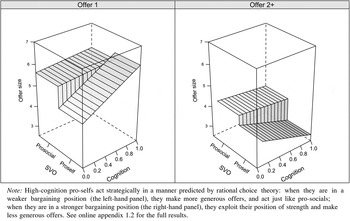
For reasons of both space and ease of interpretation, we plot the results visually with wireframe plots in Figure 1, and present the complete regression tables in online appendix 1.2. We divide subjects into two categories—pro-self or pro-social, represented by the two planes—and plot their offer size on the vertical axis by a continuous measure of the need for cognition.Footnote 53 The left-hand panel shows that as per H1, when in the first round and thus in a position of weakness, pro-selfs with greater epistemic motivation make better offers than those with lower epistemic motivation (p < 0.004). High-cognition pro-selfs in this situation act more strategically than low-cognition pro-selfs do, behaving more generously to avoid a costly lottery not in their favor. They give offers indistinguishable from high-cognition pro-social players (as predicted by H6). Low-cognition pro-selfs fail to appreciate their position of weakness and make stingier offers. This is consistent with impulsive, unreflective thinking of the System 1 variety. Low-cognition pro-selfs want more for themselves but do not deliberate enough to recognize that this requires short-term sacrifices. They simply claim more.
The joint impact of social value orientation and epistemic motivation on offer size

However, consistent with Saunders's findings on the role of experience, as Figure 1A in online appendix 1.2 shows, by the second half of the matches, the low-cognition pro-selfs have caught on and now play indistinguishably from low-cognition pro-socials. High-cognition pro-selfs still give slightly more generous offers than their low-cognition counterparts, but the difference is no longer statistically significant (p < 0.128).Footnote 54 As careful and deliberative thinkers, high-cognition pro-selfs think about the proper strategy given the situational constraints before they begin playing. They look before they leap. Low-cognition pro-selfs are more impulsive System 1 thinkers. Low-cognition pro-selfs need the experience and reinforcement provided by the game to induce strategic behavior, whereas high-cognition pro-selfs adjust to strategic circumstances immediately.
The right-hand panel shows the converse effect when proposers are in a position of strength, and offers considerable support for H2: high-cognition pro-selfs exploit their position of bargaining strength compared to their high-cognition pro-social counterparts (p < 0.06 for both the first and second half). Importantly, the slope of the pro-self plane shifts entirely. When players are in a position of weakness, the plane slopes upward toward the back of the plot, with offer size increasing as need for cognition increases. When players are in a position of strength, the pro-self plane slopes downward toward the back of the plot. Pro-socials also sometimes exhibit different behaviors based on their levels of epistemic motivation and demonstrate unique over-time effects consistent with prior research. These are the subject of another paper; we focus here on pro-selfs.Footnote 55 Supplementary analyses in online appendix 1.2 combine the previous two sets of analyses by examining the within-subject changes in predicted offer size between the first and later rounds of each match, showing that, especially early on in the game, the highest-cognition pro-selfs are the ones who most fully take advantage of their increase in bargaining power, and display larger decreases in offer size (4.4 points) than either their low-cognition (2.1 points—a difference significant at p < 0.02), or their pro-social (2.8 points—significant at p < 0.05) counterparts.
Probability of Acceptance
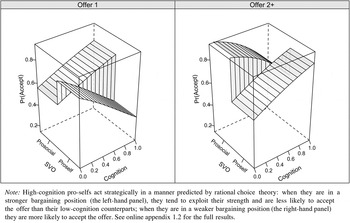
We have thus far seen that high-cognition pro-selfs propose offers in the way rational choice theory would predict: unlike low-cognition pro-selfs, they know not to overplay their hand when they are in a position of weakness, but unlike pro-socials, are more inclined to take advantage of their position of strength. How about when they are the recipient rather than the proposer? We estimate a series of logistic mixed effect models (the regression tables for which are presented in online appendix 1.2) examining the extent to which these dispositional characteristics predict whether players accepted the offer. Since the probability of accepting an offer depends on what the offer is, we control for offer size. For ease of interpretation, the substantive effects are illustrated in Figure 2 where the probability of accepting an offer, controlling for offer size, is scaled on the vertical axis.
The joint impact of social value orientation and epistemic motivation on the probability of acceptance

The left-hand panel, depicting results for the first half of the matches, offers support for H3: in first-round offers when the recipient has a higher probability of winning the costly lottery (and is thus in a position of bargaining strength), high-cognition pro-selfs are more likely to exploit their bargaining position and reject an offer (p < 0.05) than low-cognition pro-selfs, who play more similarly to their low-cognition pro-social counterparts. As results in the online appendix show, by the second half of the matches, the high-cognition pro-selfs play as they did in the first half, but the low-cognition pro-selfs attempt to compensate for their generous acceptance rate in the first half of the matches by being far less likely to accept, overshooting the high-cognition pro-selfs. Moreover, as with offers, high-cognition pro-selfs adjust to the change in bargaining power from the very beginning of play, whereas the low-cognition pro-selfs tend to display greater variation between their strategies in the first and second half of the game.
The right-hand panel displays the probability of offer acceptance when the recipient is in a position of weakness. Here, we find support for H4: when in a position of weakness, high-cognition pro-selfs are more likely to accept than low-cognition pro-selfs (p < 0.13 in the first half of the matches; p < 0.06 in the second half). Note again that the slope of the pro-self plane again shifts direction as the distribution of power shifts. Among pro-selfs, need for cognition leads to a greater likelihood of acceptance in a position of weakness and a lower likelihood of acceptance in a position of strength.
Thus, as both the proposer and recipient, high-cognition pro-selfs play as homo economicus would expect: driving hard bargains when in positions of strength, but behaving generously when in positions of weakness. In these situations, low-cognition pro-selfs display what Keohane calls “myopic self-interest”: attempting to maximize gains, but in a manner that ultimately leaves them worse off.Footnote 56 Their behavior is egoistic, constantly claiming more of the pie than pro-socials, but not strategic. Low-cognition pro-selfs simply demand more with less consideration of their strategic position and how this affects the likelihood of success.Footnote 57
Case Study
We combine our laboratory study with an in-depth analysis of German foreign policy in the 1920s. More than an illustrative case study, our analysis relies extensively on primary archival materials, probing deeply to establish whether the same mechanisms uncovered in our bargaining game are at work in real-world politics. One of the frequent critiques of laboratory studies is that they do not replicate the intense pressures of politics, particularly international politics, which are commonly thought to induce strategic rationality on the part of policy-makers. The uniquely anarchic nature of international politics is generally argued to cause egoistic, “self-help” behavior on the part of states because the high stakes induce careful deliberation on the part of decision makers.Footnote 58 As we show, however, even though the situational circumstances encourage epistemic motivation and pro-self behavior—which should make it harder to find evidence of variation in our two dispositional characteristics of interest—we nonetheless see remarkable variation in how decision makers behave, consistent with our hypotheses about the effect of social value orientation and epistemic motivation.
In the wake of World War I, Germany found itself economically and militarily prostrate. In addition to the burden of reparations, under the terms of the Versailles peace treaty Germany was permanently forbidden to construct fortifications or maintain troops on the left bank of the Rhine and fifty kilometers to the east of the river. The left bank was divided into three zones (Cologne, Koblenz, and Mainz), occupied and administered by French, Belgium, and British troops and to be evacuated in steps provided that Germany met its treaty obligations. Germany's army had been reduced to 100,000, its navy to a token number of ships, and its air force abolished, all monitored by an Interallied Military Control Commission.
During this period, Germany negotiated a multitude of issues with the allies regarding the length of the Rhineland occupation, membership in the League of Nations, compliance with the Versailles treaty's disarmament clauses, and the revision of Germany's eastern borders. There was significant domestic contestation over the proper course for Germany in light of its weakness, particularly vis-à-vis Britain and France, even among those who shared similar foreign policy goals. The major cleavage in German foreign policy was between pro-selfs committed only to German interests—allies of German Foreign Minister Gustav Stresemann with a high degree of epistemic motivation—and nationalist opponents in the German National People's Party (DNVP) with the same aims but a lower level of procedural rationality. Stresemann was the architect of German foreign policy during his lengthy stint as German foreign minister from 1924 until his death in 1929.
Because there is no change in bargaining power in the case study, we can test the expectations for the weaker actor only. Germany's power was reconstituted under the Nazi regime in the 1930s under a dictatorship that swept away Germany's political class of the 1920s. Nevertheless, pro-selfs with high epistemic motivation did, as we will see, discuss what they would do in a hypothetical situation of reconstituted strength.
Measuring epistemic motivation at a distance in a qualitative case study poses methodological challenges, since elite decision makers—particularly dead ones—cannot be given a survey instrument. The most direct way of measuring epistemic motivation is looking for evidence about how decision makers describe their thinking process. It is likely, however, that those who lack epistemic motivation will be less inclined to describe their decision making; it will be less salient in their minds precisely because they are not self-conscious about how they think. Even if they recognize their lower epistemic motivation, deliberate and effortful thought is normatively desirable, and no one wants to admit that they do not do it.
We thus also turn to behavioral indicators. First, those who lack epistemic motivation have a greater need for cognitive closure. Disliking ambiguity and uncertainty, they feel an urgency to make up their mind quickly and display a greater resistance to revising beliefs in light of disconfirming evidence. They “seize” and “freeze.” Those higher in epistemic motivation, on the other hand, are reluctant to commit early to a definite opinion and are more open to revisiting beliefs after forming their initial judgment.Footnote 59 Those who are epistemically motivated are more tolerant of ambiguity, and demonstrate less mental rigidity and closed-mindedness.Footnote 60 Crudely speaking, they think more and longer. They will be more aware of the uncertainty of their beliefs and remain open to the possibility that they might be proven wrong. Supplementary analyses in online appendix 1.3 show that need for closure affects strategic decision making in this manner in the bargaining game.
Second, epistemic motivation should manifest itself in a greater consideration of the beliefs and reactions of others with whom one is strategically interacting. Such an understanding, which requires cognitive effort, is necessary for instrumentally rational behavior. Behavioral game theorists have used this concept of “level-k” reasoning to specify a “cognitive hierarchy” of those who think more or less rationally.Footnote 61 Those higher in epistemic motivation will demonstrate an interest in “higher-order beliefs,” not just their own.
German Foreign Policy and the Negotiations over the Treaty of Locarno
In early 1925 Stresemann proposed a multilateral security pact in which France and Germany would both legally renounce the use of force to change their mutual border, backed by a British guarantee to both sides against aggression from the other.Footnote 62 Stresemann's plan entailed significant costs for Germany. A guarantee of the current territorial status quo between Germany and France amounted to a German “renunciation” of the Alsace-Lorraine, former German territory that many in his country still coveted and considered ethnically German. And to alleviate French concerns that Germany was simply trying to neutralize the French militarily by treaty so that it could move with force against the east, Stresemann offered in his memos to negotiate arbitration treaties with Germany's eastern neighbors who had alliances with France.Footnote 63 Revising the eastern borders was one of the most important foreign policy goals of Weimar Germany. France and Britain were impressed with the generosity of the German offer.Footnote 64
Stresemann and his centrist allies stressed Germany's current constraints in developing their bargaining strategy, particularly its weakness.Footnote 65 Stresemann was deeply “conscious of the limitations on our power.”Footnote 66 He wrote that “abroad, we have at present neither political power nor influence. You can conduct successful policy only if you have one or the other or the first through the second.”Footnote 67 “Power politics works to our disadvantage presently,” the foreign minister explained.Footnote 68
Stresemann constantly stressed the importance of adapting to the strategic situation. He was inspired by the example of Bismarck, as a “master of the art of the possible,” as he explained it.Footnote 69 He admired the legendary chancellor's ability to adapt to circumstances and conditions, quoting him in public that “consistency in a politician must mean that he had only one idea.”Footnote 70 Stresemann disliked the idea of a one-size-fits-all bargaining strategy.Footnote 71 As a consequence of Germany's position, Stresemann believed that Germany must exercise restraint in its negotiations with France and Britain.Footnote 72 Good diplomacy “depends on the actual restriction of these aims, and the consequent abandonment of a policy that attempts to advance in every direction at once.”Footnote 73 He called it “the realistic recognition of our own national interest.”Footnote 74 Stresemann was stressing the importance of seeing the world as it was, a marker of the need for cognition. This required cognitive effort because a recognition of these constraints was not an appealing realization. The foreign minister himself recognized this. It was “a difficult inner burden,” as he put it, for many Germans to admit their current circumstances.Footnote 75
Stresemann's initial proposal was made without the approval of the full cabinet because the country was in the midst of reconstituting a parliamentary majority in the wake of a recent breakdown. However, when the representatives of the most conservative of the major parties in Germany (and the largest in the coalition), the German National People's Party (DNVP), took their place at the cabinet table, they bitterly protested Stresemann's offer, complaining that the foreign minister had given away far too much. Nationalists objected to the very basis of the pact, the fixing of the borders of Alsace-Lorraine by treaty, since it conceded German claims without compensation. Lord D'Abernon, the British ambassador to Germany, explained to London that the DNVP did not understand why its government was giving something away for nothing.Footnote 76 Georg Schiele, the liaison between the DNVP's parliamentary party caucus and the cabinet, argued that by surrendering a concession without a counter-concession, Germany had “thrown a net over its own head.”Footnote 77
Some DNVP cabinet members demanded that the government call off negotiations. Schiele advocated abandoning the terms of the original German memorandum and walking back from any pledge on the Western borders.Footnote 78 Others thought it best to continue now that negotiations had begun but only with the explicit hope that they would fail. Neuhaus said in cabinet that it would be a “gift from God” if nothing ever came of the German memorandum because he saw “no advantage” to it.Footnote 79 Outside of government the DNVP launched a vigorous attack against Stresemann to try to force him to resign. Fifty-one of 111 nationalist delegates to the Reichstag signed a letter of protest demanding he step down.Footnote 80 Although they failed, Stresemann described the episode as among “the severest fights of his career.”Footnote 81
What explains the divisions within the cabinet and in the parliament on Stresemann's foreign policy? Both sides were pro-self in their social value orientation in that they were interested solely in gains for Germany, indeed the very same gains. Stresemann's generosity in bargaining behavior was purely strategic in nature. He wrote: “If I am told that I pursue a policy friendly to England, I do not do so from any love of England, but because in this question German interests coincide with those of England, and because we must find someone who helps us.”Footnote 82 The foreign minister believed that nations “are always egoists” and cooperation with other states depended on “parallel interest.”Footnote 83 As a conservative politician, Stresemann and his party colleagues had the same goals as the DNVP—the restoration of Germany as a great power. This included an end to the occupation of the German Rhineland, the end of allied military monitoring of the demilitarized zone, regaining territories lost to Poland and other eastern countries as part of the Versailles settlement, new colonies for Germany, and unification with Austria.Footnote 84
Varying degrees of epistemic motivation were the source of differences. In a situation of weakness, pro-selfs in Germany with high epistemic motivation made higher offers than those with lower epistemic motivation, as we expect from H1. Stresemann and his allies were simply more procedurally rational than their adversaries. They ridiculed the far right for their lack of epistemic motivation,Footnote 85 contrasting their position with Stresemann's policy of “rational understanding.”Footnote 86 A “nation must not adopt the attitude of a child that writes a list of its wants on Christmas Eve, which contains everything that the child will need for the next fifteen years” he complained in his diary.Footnote 87 The foreign minister admonished the nationalists for their non-deliberative egoistic behavior, comparing them to children. At a party conference, Stresemann spoke of a nationalist prayer, “Give us each day our daily illusion.”Footnote 88 In an anonymous article, he wrote “that Germany is completely disarmed and cannot contend with other great powers at its current strength is only contested by a few fools hoping for a miracle.”Footnote 89 Stresemann made explicit reference to the utilitarian logic of the rationalist actor: “Those who hope for a miracle can reject all constraints and dream of growing wings that will fly him again to the dawn. Those who think that we must have both feet on the ground will frame the question: What serves my ultimate goal and brings me forward?”Footnote 90
Prominent historians agree with Stresemann.Footnote 91 DNVP politicians were acting impulsively, simply demanding the satisfaction of their interests rather than deliberating about how to best achieve them given the constraints that were evident to those with greater need for cognition. They were System 1 pro-self processors.
We see variation in epistemic motivation in other, more indirect ways, revealed through the decision-making processes of the opposing sides. Stresemann demonstrated higher levels of level-k reasoning, which requires cognitive effort. He was careful to base his policy on what he believed the French would infer from it. Even in its preeminent state, France required reassurance given its fear of an eventual German revanche. In his diary, Stresemann revealed that he personally thought that French fears were irrational: “How far the madness has gone in France may be seen from the statement of a deputy in the French Chamber that Germany is today better equipped for a war than she was in 1914,” he wrote. “We ourselves know that we have no weapons … so that the way stands open for a Polish march on Berlin … Anyone who ventured on even a defensive war would be sending his men to certain death.”Footnote 92 Yet Stresemann also recognized that the Germans “shall do no good by ignoring this attitude. The other Allies will have to take it into account.”Footnote 93
Stresemann demonstrated a tendency to restrict German demands as negotiations with the French and British proceeded. Rather than making the guarantee of the Western territorial status quo contingent on French counter-concessions in the areas of German disarmament, the evacuation of Cologne or the alleviation of the occupation's conditions, as the DNVP wanted, Stresemann explicitly advised German representatives to not make any such demands and keep these questions separate from the pact negotiations,Footnote 94 something the British picked up on.Footnote 95 The Cologne zone had not been evacuated at the time promised under the terms of the Treaty of Versailles in light of somewhat trivial disarmament violations by Germany, which exposed again Germany's weakness for Stresemann. As Germany formulated its response to the first official French consideration of Stresemann's security pact, he cautioned that Germany's reply “should not be packed with demands.”Footnote 96 Even though he himself was highly desirous of these aims, he advised not to “burden the [discussions] with conditions”Footnote 97 because they could not be secured at this point.Footnote 98
Again the differences were not ultimate goals but what Germany could reasonably demand, given its current weakness. Stresemann declared at a cabinet meeting that he “agreed in general with all the comments” made by the nationalists “but not their conclusions. The role they conceive of for Germany can only be played when we are materially and militarily a great power. This will not be the case for a long time.”Footnote 99 Consistent with H2, Stresemann was prepared to demand much more if Germany's situation improved. He justified his bargaining position by referring to the distribution of power and the feasibility of achieving these other aims. For the time being, “there must be no attempt to make a condition of these matters beforehand. It is of course merely Utopian to try to put forward claims that, for those in responsible positions, do not come into question.”Footnote 100 Only when Germany returned to its former position of power could it make greater demands.Footnote 101 “We must first get the stranglehold from our neck,” he wrote privately.Footnote 102 Germany would behave differently, he promised, following the “recovery of our strength.”Footnote 103
While the countries somewhat easily settled on a security pact called the Treaty of Mutual Guarantee along the lines that Stresemann had proposed, the foreign minister faced opposition when he returned home. Stresemann's allies supported him as having attained the most that was possible in the circumstances.Footnote 104 The DNVP, however, did not find the agreement acceptable, consistent with H2. Schiele insisted that definitive concessions be brought home on the Rhineland occupation.Footnote 105 He wanted a specific commitment to reduce the length of occupation for the remaining zones.Footnote 106 The DNVP party caucus in parliament issued a communiqué denigrating the achievement as insufficient in gains for Germany in light of the concessions the country had made.Footnote 107 Shortly afterwards, the DNVP withdrew from the cabinet. Stresemann rebuked them for their lack of strategic sense. “I see in Locarno the preservation of the Rhineland, and the possibility of the recovery of German territory in the East. I may be wrong. But hitherto no one has shown me the slightest sign of any other way that might lead to the same goal.”Footnote 108
As a consequence, Stresemann was forced to rely on the votes of the opposition Social Democrats, the Reichstag's largest party, to secure passage of the Treaty of Locarno, something he had been reluctant to do. Even though the SPD had a political incentive to withhold support to see the government fall, they were persistent proponents throughout the entire process.Footnote 109 The German left was more pro-social in nature than the DNVP or Stresemann and his allies, consistently expressing support for a new United States of Europe and calling on Germany to join the League of Nations.Footnote 110 Consistent with H3, this made them natural allies for a pro-self in a weak position like Stresemann.
The SPD's leader, Rudolf Breitscheid, spoke warmly of the German initiative. In keeping with the left's pro-social motivation, he hoped for a “system of European states … without thoughts of the past, only with thoughts of the future, to live equally” in contrast to the vision of the nationalist right.Footnote 111 SPD parliamentarian Wels complained that the DNVP were trying to build walls between the people of Europe, asserted that there was a general European interest identical to the interests of each European state, and called for a “spirit of European solidarity.”Footnote 112 The SPD had suggested a similar pact idea, along with the centrist Democratic Party (DDP), the previous year.Footnote 113 This is not surprising; Kertzer and Rathbun show that the left-right divide often marks a pro-social/ pro-self one.Footnote 114 The SPD supported the treaty, which passed by a vote of 291 to 174, with no DNVP votes.Footnote 115 The German communists considered any security pact a de facto Western alliance against the Soviets so they therefore opposed the pact.Footnote 116
Alternative explanations of the differences between these factions might center on the different electoral interests and domestic constituents of Stresemann's center-right German People's Party (DVP) and the DNVP, which we consider in online appendix 1.4.
Conclusion
In finding that the kind of behavior predicted by rational choice theory has psychological microfoundations, our results have implications for the use of rational choice assumptions. Achen and Snidal write that “a major reason for the various axiomatizations of expected-utility theory is to show that decision makers need not calculate. If they simply respond to incentives in certain natural ways, their behavior will be describable by utility functions.”Footnote 117 In our study at least, this does not appear to be the case. Those who do think harder respond in a much more rational fashion to constraints. They adjust their behavior to reach their goals in a way that those with identical preferences but less epistemic motivation do not. The cognitive effort implied in strategy implies agency and will. There is nothing necessarily natural or automatic about it. And while it is true that actors need not calculate, in a strategic situation they will not get as much if they do not. Maximizing expected utility is aided by rational thought.
This is even true in the simple strategic situation we examine here. Both rationalists and their critics often make reference to “bounded rationality,” the notion that decision makers, limited in their cognitive capacity to cope with a very uncertain and complex environment, do not engage in the extensive calculations foreseen in formal rational choice models.Footnote 118 However, this is not what is occurring in the lab or our empirical case, which do not ask individuals to make highly complicated choices. What drives variation is the willingness and desire to engage in rational thought, captured in indirect or direct measures of epistemic motivation, not the ability to do so. Like the other contributions in this special issue, we find considerable heterogeneity in actors’ preferences and decision making, whether among members of the ordinary public in the lab, or world leaders in the field.Footnote 119
In situating rational choice in a psychological framework, we demonstrate the progressiveness of the behavioral revolution in IR, not simply explaining aberrations or deviations from rationality, but subsuming theories of rational decision making as well. However, our results are good news for rational choice. In their reliance on the “useful fiction” defense, rationalists are in a sense too modest. Some decision makers indeed make choices in the way that they describe, even if not all do. And by thinking of rationality as an actual construct that does guide some decision makers, it removes the tautological temptation inherent among those who simply rely on instrumental rationality. One can always work backwards, changing preference functions and beliefs to make political behavior understandable. By specifying the characteristics of rational decision makers a priori, we render it falsifiable. We have had a sighting of homo diplomaticus—a rare species perhaps, but easier to observe if we know how to look.
Supplementary Material
Supplementary material for this article is available at https://doi.org/10.1017/S0020818316000412.