Nomenclature
- APU
-
auxiliary power unit
- AR
-
aspect ratio
- BWB
-
blended wing body
- FTR
-
fighter
- KS
-
structural to takeoff weight coefficient
- MLG
-
main landing gear
- NLG
-
nose landing gear
- RCS
-
radar cross section
- RF
-
reserve fuel fraction
- UCAV
-
Unmanned Combat Aerial Vehicle
1.0 Introduction
The major distinction between manned and unmanned aircraft to perform the same mission is the fact that in contrast to the latter, the former requires one/two pilot crew(s), seats with mechanical adjustment features, safety harnesses and parachutes. Furthermore, the cabin should be wider to accommodate the crew and supplements such as windows for visibility and doors are required for manned aircraft. These items may account to hundreds of kilograms of extra weight that can be removed in unmanned aerial vehicles [Reference Essari1].
One of the criteria for an aircraft’s well-designed structure is a dimensionless structure coefficient, Ks, which is defined as the ratio of structure weight to aircraft gross takeoff weight. At present, the average structure coefficient of the third-generation fighter is about 0.3 [Reference Wang2]. The lambda wing Unmanned Combat Aerial Vehicle that is a type of general UCAVs with specific mission, is the scope of this paper. Since, these UCAVs do not usually have a vertical tail, and the ultimate load factor is less than the fighters. The safety factor of fuselage in fighters for pressurisation in cockpit area is 2.0 but for other structures it is considered 1.5. Hence, the structural coefficient for UCAV may be reduced significantly; however, the structure compensation for the large dimensions of hatch of UCAV ventral armaments bay leads to a rise in structure weight.
Aircraft’s components weight in conceptual design can be estimated with weight fraction method and empirical equations. While many references have been conducted on structural weight estimation of conventional configurations [Reference Roskam3–Reference Howe6], there are few studies regarding unconventional configurations, and data for comparison is rarely available. Due to a unique structural feature and no historical data for the structural weight, a significant difficulty in UCAV conceptual design is the lack of reliable methods for structural mass prediction. Several studies have been attempted related to this difficulty. Abdulkhamis [Reference Essari1,Reference Essari7] introduced novel equations for component weight estimation in conceptual design phase for a tactical unmanned aerial vehicle with 100 to 500 kg takeoff weight. Carsten M. Liersch et al. [Reference Carsten, Cummings, Schüttea, Vormwega, Mayec and Jeansc8,Reference Liersch and Bishop9] estimated the structural weight of a flying wing UCAV configuration in conceptual design with multi-disciplinary design and performance assessment. Arne Voss et al. [Reference Voss and Klimmek10] used a parametric structural model for an UCAV configuration with an optimisation method to achieve the minimum structural weight. Cerberus team [Reference Levy, Katz, Katzuni, Konevsky, Frumkin and Buium11] used customary empirical equations to estimate the structural weight of a UCAV with lambda and delta wing configurations. Beltramo [Reference Beltramo12] developed a parametric empirical equation for wing weight estimation at a preliminary design stage of BWB aircrafts. In this method the BWB aircraft has been considered as a composition of small wing sections. Every wing section must be defined geometrically as a classic wing. For every wing section, it is estimated the corresponding weight and the total wing weight for a BWB is a summation of wing sections weight. E.A Valencia [Reference Valencia13] used this empirical equation for weight assessment of a blended wing body-unmanned aerial vehicle.
The above studies were conducted using the case study of UCAVs or theoretical approach. However, the Unmanned Combat Aerial Vehicle lacks historical data that is typically used for sizing and weight estimation in the conceptual design phase. The main purpose of the present research is to develop an appropriate statistical method to estimate UCAV’s structural weight with respect to maximum takeoff weight. Accordingly, new weight estimation equations are derived using modifications to the weight formulas of manned fighters. To validate the new proposed method, the empty weight estimation results were compared against the actual values from available in-service UCAVs [Reference Ferguson, Magnuson, Fridley and Taha14–18]. Moreover, the structural weight estimated was validated against some previous case study researches [Reference Carsten, Cummings, Schüttea, Vormwega, Mayec and Jeansc8–Reference Valencia13].
The paper is organized as follows: in §2 some basics of UCAVs geometry and their geometry parameter characteristics are introduced. The proposed statistical method for estimation the empty and structural weight of the UCAVs is presented in §3. Validation of the results for the limited existing aircrafts and available data are discussed in §4. Finally, a conclusion of the study is discussed in §5.
2.0 UCAV’s specifications
Compared with the traditional manned combat aircraft, the lambda wing UCAV is a combat platform with lower cost, which aims mainly at ground attack rather than air combat. From the viewpoint of fighter performance, high manoeuvrability and agility as well as supersonic cruise are not currently the characteristics pursued by UCAV. In fact, what is required for UCAVs is limited and adequate manoeuvrability, which categorizes UCAVs in a class between fighters and bombers [Reference Wang2].
UCAVs must be able to achieve a great depth, long distance and concealed penetrations and attack the enemy’s high value and hazardous targets. Thus, high stealth performance is the most important elements here. Taking into account the complexity and entire early-warning capacity in enemy’s depth, the UCAV must be capable to realise wide-band and omni-directional stealth capacity. Furthermore, UCAV should have enough service range and endurance for long distance attacks [Reference Wang2]. Therefore, ground attacker UCAV requires higher inner fuel load capacity. All these factors and requirements determine the limitation and adequate level of UCAV manoeuvrability, and consequently its g-load capacity.
A schematic of lambda wing UCAV geometry is shown in Fig. 1. The UCAV can be parameterised with the seven inputs (b1, b2, CR, Ctip, Ckink, ΛLE1 and ΛLE2) with the addition of the airfoil incidence angle at each wing station.
Geometry input parameters of Unmanned Combat Aerial Vehicle.

3.0 UCAV in classification of combat aircrafts
Weight estimation of UCAVs, requires data collection for existing types which have similar characteristics, mission, and takeoff weight ranges. From the perspective of the nature of mission, the takeoff thrust-weight ratio and takeoff weight (as the most important parameters concerning the weight of UCAV), can be set by statistical analysis of corresponding parameters of various types of existing combat aircraft. Then the tonnage magnitude of UCAV can be determined for to the selected engine.
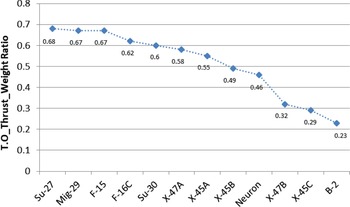
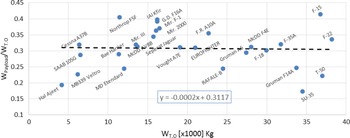
As shown in Fig. 2, from the early type A to present type B and type C, the respective evolution of X-45 and X-47 series UCAV has a common rule; that is, their thrust-weight ratios are all gradually decreasing from the original one close to 0.60 to later 0.29 for X-45C and 0.32 for X-47B.
Weight data of mainstream combat aircraft.

Based on the preliminary lower and upper limits of the takeoff thrust-weight ratio of attacker UCAV and referring to takeoff thrust-weight ratio of X-45/X-47 series, the takeoff thrust-weight ratio of UCAV can be set at not less than 0.30 and preliminary set at 0.4 that is proposed in [Reference Carsten, Cummings, Schüttea, Vormwega, Mayec and Jeansc8,Reference Liersch and Bishop9].
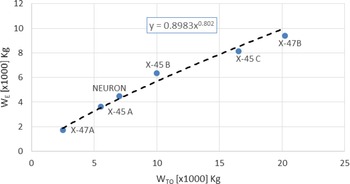
In Fig. 3, the empty weight to takeoff weight ratio of UCAVs is demonstrated for data of the most well-known existing types. Eq. (1) with minimum error can be fitted on the data shown in Fig. 3.
 \begin{align}{{\rm{W}}_{Empty}} = 0.8983 \times {W_{T.O}}^{0.802}\end{align}
The results obtained from the trend line weight have an error of less than 5 % especially for in service UCAVs as Neuron, X45C and X47B. Thus, Eq. (1) can be used for empty weight estimation of UCAVs for the validation purpose.
Empty weight-to-takeoff weight ratio of UCAV.

We discuss development of an accurate and universal method for structural weight prediction in UCAV conceptual design.
4.0 Description of the method
For new unmanned aircrafts that are not similar to manned types, novel weight techniques must be developed. Parametric-weight-estimating equations the are most used for rapid design space exploration at the conceptual design level. However, these methods are based on statistical curve fits of data within the applicable design space, and such data are difficult to obtain. UCAV’s component weights data or weight reports are rarely available outside of established companies or government labs. Consequently, in the absence of rich data sources, the forms of weight estimating equations of manned aircraft can be modified based on a few data points.
We used manned military fighters’ weight data, in which man-related components are eliminated, to estimate weight of UCAVs. All parameters in weight estimate equations of fighter were modified in respect with difference of manned fighters and UCAVs one by one. Then some new equations were derived for UCAV’ weight estimation such as empty weight, engine-to-thrust weight ratio and structural weight.
To have true estimation of UCAVs weight, it is essential to know the weight ratio and weight changing of military fighters in respect to maximum takeoff weight. Aircrafts weight specification that are explained in detail in references [Reference Roskam3,Reference Nicolai and Carichner4] can be used as a reliable data for the proposed novel approach for weight estimation. The first step is to monitor the empty-to-takeoff weight ratio for manned fighters.
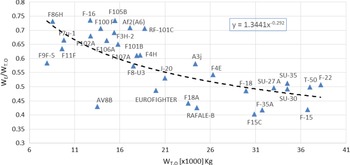
As shown in Fig. 4 for fighters, empty-to-takeoff weight ratio decreases as takeoff weight value increases. This implies that structure and system weight does not increase with the same scale of the takeoff weight.
Empty-to-takeoff weight ratio of fighters in respect to takeoff weight.

Generally, for manned fighters the takeoff weight can be calculated as follow:
 \begin{align}{W_{TO}} = {W_E} + W_{Fuel}^* + {W_{PL}} + {W_{crew}}\end{align}
Where W* Fuel is the internal maximum fuel weight.
The above equation is originally formulated for sizing piloted aircraft [Reference Roskam3]. By excluding the cockpit and pilot support equipment from Eq. (2) it can be used for unmanned aircrafts such as shown in Eq. (3).
 \begin{align}{W_{TO}} = \frac{{W_{PL}}}{{\left( {1 - \dfrac{{{W_{Fuel}}}}{{{W_{TO}}}} - \dfrac{{{W_E}}}{{{W_{TO}}}}} \right)}}\end{align}
While the payload weight is given as a design requirement, the empty weight and the fuel weight must be initially estimated as a function of the total weight at takeoff.
4.1 Fuel fraction ratio
The fuel fraction (WFuel/WTO ) is evaluated from an accumulated weight fraction of all mission segments in the design mission profile:
 \begin{align}\frac{{{W_{Fuel}}}}{{{W_{TO}}}} = \left[ {1 - \frac{{{W_1}}}{{{W_{TO}}}} \times \frac{{{W_2}}}{{{W_1}}} \times \ldots \times \frac{{{W_n}}}{{{W_{n - 1}}}}} \right] \times \left( {1 + RF} \right)\end{align}
Wn/Wn-1 represents a ratio of the final weight to the initial weight at the nth segment of the mission profile and the reserve fuel fraction (RF) is included. However, for the UCAV, a provision must be sufficient to cover an air refuelling period at the end of its design mission profile. The reserve fuel value of 15%, determined from preliminary testing of the design synthesis, was found to be appropriate [Reference Nilsuwan19]. For an UCAV type, calculation of fuel fraction without reserve fuel value was done in [Reference Levy, Katz, Katzuni, Konevsky, Frumkin and Buium11] which can be used for UCAVs with same mission, therefore, generally the fuel fraction can be calculated as follow:
 \begin{align}\frac{{{W_{Fuel}}}}{{{W_{TO}}}} = \left[ {1 - 0.8} \right] \times \left( {1.15} \right) = 0.23\end{align}
The fuel fraction for fighters [Reference Roskam20] is shown in Fig. 5.
Internal-fuel-to-takeoff weight ratio of fighters vs. takeoff weight.

As can be seen from Fig. 5, fuel fraction ratio for fighters with refuelling system is near to 0.23 and is suggested to be used for UCAVs in the proposed paper for weight estimation.
4.2 Payload fraction ratio
To reduce radar cross section (RCS), the stealth aircrafts avoid the external mounting payloads, such as airborne weapons, auxiliary tanks, pods, and so on, especially airborne weapons. Unlike the external mounting form, most of the buried airborne weapons need special designs so that they can be adapted to the limited space of the armaments bay. On the other hand, due to the very limited dimensions of fuselage, the dimensions of the buried armaments bay that fighter and attacker can provide are accordingly very limited. Likewise the number of airborne weapons in the armaments bay is also much smaller than that in the form of external mounting. Therefore, the total weight of the payload in the buried bay is significantly smaller than that in the form of external mounting. By statistical analysis of UCAVs, payload to takeoff ratio has an average of 0.11 as shown in Table 1.
UCAV Payload-to-takeoff weight ratio [Reference Ferguson, Magnuson, Fridley and Taha14–18]

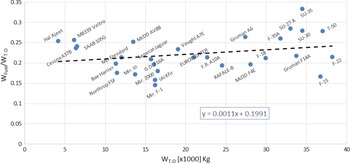
As shown in Fig. 6, this value for fighters that have the ability to carry an external weapon payload is approximately 0.31.
Payload-to-takeoff weight ratio of the fighters against takeoff weight.

4.3 Empty weight estimation
Generally, the fighters’ empty weight is calculated as below [Reference Roskam3].
 \begin{align}{W_E} = {W_{PWP}} + {W_{FEQ}} + {W_{STR}}\end{align}
Where WPWP is the power plant weight, WFEQ is the fixed equipment’s weight and WSTR is the structural weight.
For UCAVs each of these parameters should be calculated according to the differences between fighters and UCAVs.
4.3.1 Power plant
The major component in power plant weight is the engine weight that should be calculated for UCAVs based on the manned fighters’ equations with consideration for the difference in their mission purpose.
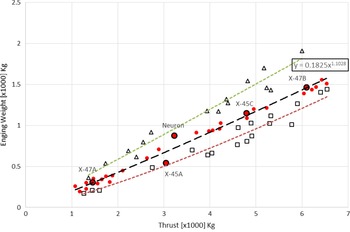
Other equipment such as air inlet, fuel system and propulsion system are assumed to be equal for fighters and UCAVs at the same takeoff weight. In view of the present thrust level of engine, UCAV can utilise two kinds of turbofan engine, including large-thrust and medium-thrust engines [Reference Wang2]. Figure 7 shows the estimated engine weight according to the statistical formula presented in [Reference Çakin21]. Three trend lines are used to illustrate the trends of the scattered data.
Relationship of thrust against engine weight.

As per a survey on most of in-service UCAVs [22–Reference Daly and Gunston26], the middle trend line, with below equation, may be used for UCAV engine weight estimation:
 \begin{align}{W_{Engine}} = 0.1825 \times {T^{1.1028}}\end{align}
Figure 8 shows variation of thrust against takeoff weight. As can be seen from the figure, the ratio of thrust to takeoff weight can be correlated using the below equation:
 \begin{align}T = 0.8904 \times W_{TO}^{0.6575}\end{align}
Thrust-to- takeoff weight of UCAVs.

By combining Eq. (7) and Eq. (8), the UCAVs’ engine weight may be calculated as:
 \begin{align}{W_{eng}} = 0.1605 \times W_{TO}^{0.7251}\end{align}
Table 2 presents the actual and estimated engine weight for available in-service UCAVs. The results indicate an acceptable tolerance between the predicted and estimated values.
UCAV engine weight: actual vs estimated [22–Reference Daly and Gunston26]

Weight of other power plant components such as air induct, fuel system and propulsion system are assumed to be equal for fighters and UCAVs in the same takeoff weight. Total power plant to engine weight ratio for fighters is shown in Fig. 9.
Power-plant-to-engine weight of fighters.

It can be seen that power plant weight of UCAVs has a linear relation with engine weight; therefore, by combining this equation with Eq. (9), UCAV power plant weight is calculated as
 \begin{align}{W_{PWP - UCAV}} = 0.2022 \times W_{TO}^{0.7251} + 0.2103\end{align}
4.3.2 Fixed equipment
The fighter’s fixed equipment weights can be estimated as
 \begin{align}{W_{FEQ - UCAV}} = {W_{FEQ - FTR}} - {({W_{AirCond.}} + {W_{Furnishing}} + {W_{APU}})_{FTR}}\end{align}
As far as the fixed equipment components is concerned, the major difference between fighters and UCAVs is air conditioning and pressurisation system, oxygen system, furnishing and auxiliary power unit (APU). Hence, the rest of terms in Eq. (11) can be neglected.
4.3.3 Structure
Structural weight for fighters is composed of the weight of the wing, empennage, fuselage, engine section and landing gear.
 \begin{align}{W_{STR}} = {W_{WING}} + {W_{EMP}} + {W_{FUS}} + {W_{Eng. Sec.}} + {W_{LG}}\end{align}
The structure weight of the UCAVs consists of outer wing, inner wing, main body and landing gear. The wing in fighters is the same as inner and outer wing in UCAVs. Fuselage in fighters corresponds to main body in UCAVs. The following are further discussions on a number of modifications, which are applied to the R.H.S. terms of Eq. (12) in order to make it applicable for UCAV.
4.3.3.1 Wing
Wing weight in fighters can be directly used for UCAVs wing weight except in the ultimate loading coefficient that is related to manoeuvrability of aircraft. This coefficient is variable for fighters and generally constant for UCAVs; hence, to estimate wing weight in UCAVs, USAF formulation (Eq. (13)) is applied [Reference Roskam3] by changing nult from nult-fighter to nult-UCAV.
 \begin{align}{W_{Wing}} = 3.08{\left\{ {\left[ {\left( {{K_w}{n_{ult}}{W_{TO}}} \right)/{{(t/c)}_m}} \right]\left[ {(\tan {\Lambda _{LE}} - \frac{{2\left( {1 - \lambda } \right)}}{{A{{\left( {1 + \lambda } \right)}^2}}} + 1.0} \right] \times {{10}^{ - 6}}} \right\}^{0.593}}{\left[ {A\left( {1 + \lambda } \right)} \right]^{0.89}}{\left( S \right)^{0.741}}\end{align}
The highest manoeuvre loads are caused by the design manoeuvres, which combine high load factors with high roll rates/accelerations [Reference Voss and Klimmek10]. The manoeuvres calculated according to CS 25.337 [27] have lower load factors of –1.8 g and 4.5 g, thus the ultimate load factor for UCAVs is assumed as 4.5.
The equation presented in [Reference Roskam3,Reference Nicolai and Carichner4] for estimation of actual weight of fighters’ wings is used to estimate UCAV wing weight according to the following:
 \begin{align}{W_{Wing - UCAV}} = {W_{Wing - FTR}} \times {\left( {\frac{{4.5}}{{{n_{ult - FTR}}}}} \right)^{0.593}}\end{align}
4.3.3.2 Empennage
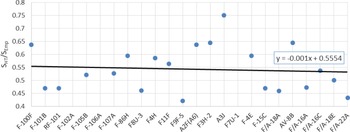
For stealth requirements and to achieve minimum RCS, UCAV is designed without vertical tail. It can be assumed that UCAV wing includes two horizontal tails too. Therefore, the weight of empennage in fighters can be used in UCAVs with removing vertical tail weight. By the survey on fighters [Reference Roskam3,Reference Nicolai and Carichner4] as shown in Fig. 10, the ratio of horizontal tail weight to empennage weight varies from 0.42 to 0.75, with an average of 0.55 that may be assumed for total fighters. Therefore, multiplication of the empennage weight of the fighters by 0.55 can be used in primitive UCAVs structural weight estimation. In the present approach, the actual fraction of horizontal to empennage weight of fighters is used.
Vertical tail weight to empennage weight for fighters.

On the other hand, the ultimate loading coefficient due to [Reference Roskam3,Reference Nicolai and Carichner4] affects empennage structural weight; hence, the modified formulation of empennage weight for UCAVs becomes:
 \begin{align}{W_{Emp - UCAV}} = {W_{Emp - FTR}} \times {\left( {\frac{{4.5}}{{{n_{ult - FTR}}}}} \right)^{0.813}} \times \left( {\frac{{{S_{HT}}}}{{{S_{Emp}}}}} \right)\end{align}
The exponent of 0.87 is used from empennage weight formulation for USAF fighters [Reference Roskam3].
4.3.3.3 Fuselage
Fighter fuselage can be divided into fore body, mid body and aft body. Aft body is sized for engine installation, whereas, likewise to the main body, mid body is designed to transfer the load of wing and its installed armament systems.
The fore body of fighters usually have more height than that of unmanned aircrafts due to pilot-body-standard requirements; however, the fore body of UCAV has a sweep angle for stealth requirement; therefore, it has more width than the fore body of fighters. This implies that, for the same maximum takeoff weight, the total volume of fuselage of fighters can be estimated to be equal with the UCAV main body volume. One of the most important parameters in design of the fore body structure of fighters is to satisfy the safety factor of 2 that is applied for pressurised structures, while UCAV main body is designed with no pressurise requirement with a safety factor of 1.5. A fair guess for the weight of the fore body of fighters can be assumed to be one-third of the total fuselage weight. Fuselage weight formulation includes design dive dynamic pressure that is related to the ultimate load factor with power value of 0.283 [Reference Roskam3]; therefore, nult-fighter is replaced by nult-UCAV. According to the above, the weight of the UCAV main body is estimated from the fuselage weight of the fighters as:
 \begin{align}{W_{Main\ Body}} = \left( {{W_{Fus - FTR}} \times \frac{2}{3} + {W_{Fus - FTR}} \times \frac{1}{3} \times \frac{{1.5}}{2}} \right) \times {\left( {\frac{{4.5}}{{{n_{ult - FTR}}}}} \right)^{0.283}}\end{align}
4.3.3.4 Engine section
Like stealth fifth-generation fighters, all UCAV systems (such as the engine) are in board to consider stealth requirements, thus the main body weight includes engine section weight. This implies the weight of engine section of the fighters can be directly used in the weight estimation of the UCAV’s empty weight.
4.3.3.5 Landing gear
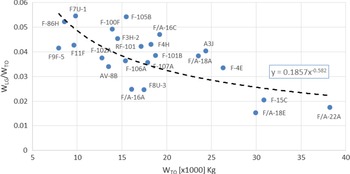
Estimation of the landing gear weight is directly associated with the takeoff gross weight, and in fact is estimated as a fraction of it. Figure 11 shows the ratio of the landing gear weight to the maximum takeoff weight in respect to WTO of the fighters. As can be seen, this ratio changes in the range of 0.02 to 0.052. However, the power equation of Fig. 11 is utilised for UCAVs.
LG-weight-to-takeoff weight ratio of the fighters against the takeoff weight [Reference Roskam3,Reference Nicolai and Carichner4].

4.3.4 Structure weight estimation
As per the discussions in §4.3.3, the components of the aircraft structure needs to be modified as the equations are used for UCAVs instead of the fighters as per Eq. (17):
 \begin{align}{W_{Str - UCAV}} &= \left[ {W_{Wing}} \times {{\left( {\frac{{4.5}}{{{n_{ult}}}}} \right)}^{0.593}} + {W_{Emp}} \times {{\left( {\frac{{4.5}}{{{n_{ult}}}}} \right)}^{0.813}} \times \left( {\frac{{{S_{HT}}}}{{{S_{Emp}}}}} \right) + \left( {{W_{Fus}} \times \frac{{11}}{{12}}} \right) \times {{\left( {\frac{{4.5}}{{{n_{ult}}}}} \right)}^{0.283}} \right.\nonumber\\ &\quad + {W_{Eng. Sec}} + {W_{LG}} \Bigg]_{FTR}\end{align}
Though structural weight of UCAV is an important parameter in optimisation of the UCAV structural architecture, to the best of the authors’ knowledge, its estimation is not available in the published literature. By graphing Eq. (17) in terms of takeoff weight, and fitting a power-law curve, a formula for estimation of the UCAV structure is achieved (Fig. 12).
Structure-weight-to-takeoff weight by new method for UCAVs.

Like the fighters [Reference Roskam3,Reference Nicolai and Carichner4], net structural weight is composed of all the structural component weight, without landing gear and engine section. Net structural weight of UCAV can be obtained from Eq. (18) by neglecting the weight associated with landing gear and engine section.
 \begin{align}{W_{Str - net}} = {W_{Wing}} + {W_{Emp}} + {W_{Fus}}\end{align}
The calculated net structural-to-takeoff weight ratio of UCAVs based upon our developed method is shown in Fig. 13. It is seen that the ratio changes from 0.21 to 0.11 over the range of the takeoff weights.
Variation of UCAV’s net structure-to-takeoff weight against the takeoff weight, using Eq (18).

Using Eq. (18), the calculated net structural to takeoff weight ratio of UCAVs is shown in Fig. 13 for takeoff weights less than 20 ton that power-law trend curve of this ratio for UCAVs is:
 \begin{align}{W_{STR - UCAV}} = 0.5289 \times W_{TO}^{ - 0.124}\end{align}
For some of the well-known UCAVs, this ratio is calculated and presented in Table 3.
UCAV net-structural weight estimation with new method

Mean value of this ratio for UCAVs is approximately 17.4%, whereas it is reported, by [Reference Carsten, Cummings, Schüttea, Vormwega, Mayec and Jeansc8–Reference Levy, Katz, Katzuni, Konevsky, Frumkin and Buium11], to be 17.5%, 16.8%, 18.3% and 18.7 %, respectively, for the conceptual design phase of some case studies of UCAV.
5.0 Results validation
5.1 Empty weight
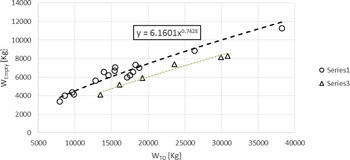
UCAVs empty weight can be obtained by substituting Eqs. (10), (11) and (17) into Eq. (6). Figure 14 shows the empty weight trend line of UCAVs, which is obtained by applying the developed method on the fighter’s actual data. To have an estimation of a UCAV’s empty weight with minimum error, two trend lines are plotted on the data. The upper trend line, which is curve-fitted using Series 1 data of UCAV empty weight, is estimated as
 \begin{align}{W_{E - UCAV}} = 6.1601 \times W_{TO}^{0.7428}\end{align}
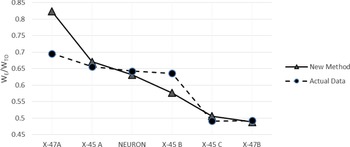
Figure 15 shows a comparison of the UCAVs empty weight between actual data and estimated results of the established method. Although the estimated weight for X45C, neuron, X-45A and X-47B are in good agreement with the corresponding actual values (with the error of the calculated weight for X-45B to be less than 10%), the error for the X-47A is significant. Nevertheless, the method used here has shown a relatively small error of less than 10% compared to the actual values; therefore, the results can be considered acceptable.
Empty weight to takeoff weight.

UCAV empty weight comparison, actual data with estimation by new method.

5.2 Structure weight
Evaluation of structural weight of UCAV can be obtained by using empirical equations that are developed for wing weight estimation. The wing weight equation provided by Beltramo et al. [Reference Levy, Katz, Katzuni, Konevsky, Frumkin and Buium11] is used to evaluate the wing weight of the blended-wing body (BWB). This approach was used by Liebeck et al. [Reference Liebeck28] to design the BWB design. This equation is given as:
 \begin{align}{W_{wing}} &= {\xi _1}{I_W} + {\xi _2}{S_{ref}} + {\xi _3} \nonumber\\[2pt] {I_W} &= {{n{{\left( {AR} \right)}^{1.5}}{{\left( {{{WZF} \over {TOGW}}} \right)}^{0.5}}\left( {1 + 2\lambda } \right)\left( {{{TOGW} \over {{S_{ref}}}}} \right)S_{ref}^{1.5}\left( {1 \times {{10}^{ - 6}}} \right)} \over {t/c(cos{\Lambda_{1/4}}c)(1 + \lambda )}}(lbs - ft) \nonumber \\[2pt] {\xi _1} &= 0.930\left( {f{t^{ - 1}}} \right),{\xi _2} = 6.44\left( {lbs - f{t^{ - 2}}} \right),{\xi _3} = 390\left( {lbs} \right) \end{align}
Where, n is ultimate load factor, AR is aspect ratio, Λ is taper ratio of the wing, Sref is wing reference area, Λ1/4 is quarter chord sweep angle, t/c is thickness to chord ratio, ZFW is zero fuel weight, and TOGW is takeoff gross weight.
By using Eq. (21), structural to takeoff weight ratio of several in-service UCAVs are shown in Fig. 16. X-47A is a delta-wing UCAV and structural-to-takeoff weight ratio is different with other UCAVs, so to have a curve-fitting equation with minimum error, the X-47A point is omitted. The ratio for UCAVs with respect to takeoff weight is then in the range of 0.21 to 0.11.
UCAV structure-to-takeoff weight ratio against takeoff weight.

For validation of the results, this ratio is compared with values that are obtained by using the curve-fitted equation in Fig. 13. Table 4 outlines a comparison of the results.
Comparison of UCAV structural weight between the established estimation method and Eq. (21)

It is seen that the net structure-to-takeoff weight of UCAVs calculated by Eq. (21) is approximately 16.3%, whereas it becomes 16.8% for the proposed method in Eq. (19) which X-47A data is omitted.
Frequently, new statistical weight-estimating equations must be developed for a design problem. To create these methods, the major driving parameters must be defined and captured in a formulation. The weight-estimating equation is curve-fitted to the data with variations in parameter ranges. The number of parameters is kept to a minimum if sparse data are available. Rich data sets likely enable the impact of more variables to be appropriately captured.
As presented in Table 4, the results of the proposed method are obtained simply from a power-law equation with respect to takeoff weight while structural weight equation is nonlinear and multi-variable problem. Structural weight of UCAV can be derived from a general wing-weight equation described in [Reference Gundlach29] with an estimation of true values for constant coefficients. By applying general specification and geometry of the well-known UCAVs and using the proposed method for structural weight estimation, the constant coefficients of this equation in [Reference Gundlach29], are derived and a new structural-weight equation for UCAVs is developed as shown in Eq. (22). Because of few numbers of in-service UCAVs, to have good values of coefficients, some research case studies of UCAV specifications were used, too. It should be mentioned that the results are obtained using MATLAB and EXCEL software.
 \begin{align}{W_{Stucture}} &= 0.561 \times S_W^{0.674} \times {\rm{ }}{\left[ {{{AR} \over {co{s^2}({\Lambda _{1/4c}})}}} \right]^{0.186}} \times {q^{0.929}} \times {\lambda ^{0.003}} \nonumber\\ &\quad \times {\left[ {{{t/c} \over {\cos (\Lambda_{1/4c})}}} \right]^{ - 0.173}} \times {({n_z} \times {W_{DG}})^{0.012}} + 25\end{align}
where AR is the wing aspect ratio, nZ the ultimate load factor, q the dynamic pressure, SW the wing area, t/c the wing average thickness-to-chord ratio, WDG the design gross weight,
 $\lambda$
the wing taper ratio, and Λc/4 the wing sweep at the quarter-chord in English system.
As shown in Table 5, the structural weight calculated by Eq. (22) for several UCAVs is compared with the ones computed by Eq. (21). Results show that Eq. (22) can be used as a good structural estimating formulation for UCAVs.

Conclusion
Due to the unique structural feature of Unmanned Combat Aerial Vehicles, the empirical methods of weight prediction for conventional aircraft are not suitable for structural weight estimation of these aircrafts type. The present paper reports a structural weight estimation method for UCAV conceptual design. In the first step, to know about UCAVs in classification of fighters, the takeoff trust-weight ratio has been used that show UCAVs is between fighter and bomber aircrafts. Due to lack of statistical data for UCAVs components weight, several novel formulations are developed to predict a realistic estimate of UCAV weight, based on fighters’ actual and available data. By applying appropriate correction factors to the fighters’ wings, fuselage, empennage, landing gear and engine section weight formulations, some novel equations are derived for component’s weight of the UCAV. Development of these modified formulas can be seen as the major contribution of the study. Application of these formulas estimates more accurate structural weight of the UCAVs. Ideally, the proposed method should be validated by data resulting from a detailed design or manufactured Unmanned Combat Aerial Vehicle, but the absence of such data prevents a full validation. The results of the empty weight estimation obtained from the formulation developed in this study are verified by the actual empty weight values for some of the well-known available UCAVs. Nevertheless, a combination of calculated structural weight of few UCAV case study with empirical methods is in good agreement for structural weight prediction in the conceptual design of the UCAV. The established method is expected to be suitable for the structural weight estimation in the conceptual design of the UCAV. Net structural weight (i.e. weight of all structural components except that of the landing gear and engine section) is an important parameter in the structural architectural design of UCAVs. The results of the proposed weight prediction method shows that net structural weight of UCAVs is approximately between 20% to 10% of their maximum takeoff weight, and decreases with increasing in-takeoff weight. This finding can be used as an appropriate initial estimation for UCAV architecture design in the conceptual phase.