Infections due to extended-spectrum β-lactamase–producing Enterobacterales (ESBL-E) are associated with increased morbidity and mortality compared to infections due to non-ESBL-E, due to delays in the initiation of effective antibiotic therapy.Reference Kang, Kim and Park1–Reference Tumbarello, Viale and Viscoli4 ESBL-E are resistant to many commonly used β-lactam antibiotics and may also harbor resistance to other classes of antibiotics but remain susceptible to carbapenems.Reference Rodríguez-Baño, Picón and Gijón5,Reference Bradford6 However, judicious carbapenem use is essential to reduce the risk of selecting for carbapenem-resistant organisms.Reference McLaughlin, Advincula, Malczynski, Qi, Bolon and Scheetz7 To inform antibiotic decision making, further understanding is needed regarding risk factors for infection with ESBL-Es, particularly among patients presenting to the emergency department (ED) where results of rapid diagnostic tests are typically unavailable at the time of empiric antibiotic selection. Additionally, a better understanding of risk factors for ESBL-E infection or colonization can help inform infection control measures.
Recent residence in or travel to a country with a high prevalence of ESBL-E has been identified as an ESBL-E risk factor.Reference Tängdén, Cars, Melhus and Löwdin8,Reference Woerther, Andremont and Kantele9 The prevalence of ESBL-E not only varies at the country level but also within smaller geographic regions such as a county or city.Reference Kaye, Gupta and Mulgirigama10,Reference Arias Ramos, Hoyos Pulgarín and Moreno Gómez11 These differences in prevalence are due to community characteristics that affect the transmission dynamics of ESBL-E and place patients in distinct communities at different risks for colonization or infection.Reference Otter, Natale and Batra12–Reference Leverstein-van Hall, Dierikx and Stuart17 Identifying whether a patient resides in a community with high ESBL-E prevalence can help clinicians risk stratify patients. However, no studies have investigated how to distinguish these different local communities to estimate the risk of ESBL-E infection or colonization at the patient level due to the community prevalence of ESBL-E. US Census Block Group (CBG) data can be used to cluster patients into aggregates based on shared demographics and geography, which may approximate different communities in a geographic region that have distinct transmission dynamics and prevalence of ESBL-E.
This study is a risk factor analysis with 2 objectives: (1) to reassess previously identified risk factors for ESBL-E colonization or infection among ED patients, and (2) to explore whether CBG data can be used to cluster patients into local geographic aggregates that approximate local communities with differences in ESBL-E transmission to more accurately capture a patient’s risk of ESBL-E colonization or infection based on the local prevalence in the patient’s area of residence.
Methods
Study setting and population
This study included patients aged ≥18 years who presented to Johns Hopkins Health System (JHHS) EDs located in the Baltimore–Washington, DC, region (Supplementary Table S1 online) from April 2019 to December 2021 with a culture obtained in the ED that grew Escherichia coli, Klebsiella pneumoniae, K. oxytoca, or Proteus mirabilis. Only these organisms were included (1) because they are the most common organisms that produce ESBLs and (2) because confirmation of ESBL status included phenotypic testing. Patients with these organisms identified via stool surveillance cultures were excluded. Case patients had at least 1 culture obtained in the ED that grew an ESBL-producing isolate while control patients did not have an ESBL-producing isolate identified. Only the most recent ED encounter for a given patient was included. Pediatric patients were excluded due to a limited number of ESBL-E cases in this population in JHHS. This study was approved by the Johns Hopkins University School of Medicine Institutional Review Board with a waiver of informed consent.
Data collection
Clinical data were extracted from the time of presentation to the ED from a limited data set of JHHS ED patients utilizing the Johns Hopkins Precision Medicine Analytics Platform, which includes data from the JHHS electronic health record (EHR) system (Epic Systems, Verona WI). Data included demographics, preexisting medical conditions and presence of devices at presentation; microbiologic data in the previous year; and hospitalizations, intensive care unit admissions, long-term care facility or nursing home admissions, procedures, and antibiotics and gastric acid suppressant use in the previous 6 months (Supplementary Table S2 online). When assessing for a prior history of ESBL-E, only E. coli, K. pneumoniae, K. oxytoca, or P. mirabilis isolates were included. Data regarding international travel, clinical symptoms, and specific ESBL genes in the ESBL-positive organisms were not available.
Microbiology methods
Bacterial cultures were processed at a JHHS clinical microbiology laboratory according to standard operating procedures. ESBL status was assessed in 3 ways. (1) Blood cultures growing a gram-negative organism underwent testing with the GenMark Dx ePlex blood-culture identification gram-negative (BCID-GN) panel. Detection of bla CTX-M genes on the BCID-GN panel was considered confirmatory for ESBL status. (2) All E. coli, K. pneumoniae, and K. oxytoca underwent automated screening and confirmation of ESBL status by the BD Phoenix Automated System (BD Diagnostics, Sparks, MD). (3) All P. mirabilis isolates with a ceftriaxone or ceftazidime minimum inhibitory concentration (MIC) ≥2 µg/mL underwent disk-diffusion testing using both cefotaxime and ceftazidime, alone and in combination with clavulanate. A ≥5-mm increase in the zone of diameter for either agent tested in combination with clavulanate compared to when tested alone was considered confirmatory for ESBL status.
Geospatial analysis
The assumption underlying the geospatial analysis was that ESBL-Es are more likely to transmit between individuals that are part of a community than to people outside that community. To define communities, we used data from SafeGraph (www.safegraph.com), which aggregates anonymized location data from mobile devices to provide insights about movement patterns, to create clusters of CBGs that are more connected. Data on movement for the CBGs in the Baltimore–Washington, DC, region were extracted from SafeGraph from January 2019 to March 2021. We used the greedy Clauset-Newman-MooreReference Clauset, Newman and Moore18 and the LouvainReference Blondel, Guillaume, Lambiotte and Lefebvre19 community detection algorithms to discover clusters of CBGs in which residents are more likely to interact with each other rather than with people from other clusters (Supplementary Methods online for complete methods).
Alteryx (www.alteryx.com), a software platform for spatial data analytics, was used to retrieve census block group information based on the patient’s home address. Patient CBGs were matched to community clusters and the prevalence of ESBL-E in the prior 3 months, 6 months, and 12 months were calculated using the number of ESBL-E out of the total number of E. coli, K. pneumoniae, K. oxytoca, or P. mirabilis isolates within each patient’s community. Because the community detection algorithm did not assign every CBG to a community, if a patient was not included in a community, the median prevalence of ESBL-E among all communities was imputed for the 3-month, 6-month, and 12-month prevalence of ESBL-E in their community. For each patient, the prevalences of ESBL-E in the last 3 months, 6 months, and 12 months were categorized as being in the <25th percentile, between the 25th and 75th percentiles, or above the 75th percentile among all communities during the respective period.
Statistical analysis
Descriptive statistics were calculated using median (interquartile range) or frequency count (percentage) as appropriate. Univariable logistic regression models were used to assess the relationship between potential risk factors identified in the prior literature and ESBL status. A multivariable logistic regression model was constructed using the same potential risk factors used in univariable analyses (model 1). Given clinical significance and association with the outcome in prior literature, all variables were retained in the model even if they were not statistically significant. Additional multivariable models were constructed using the same variables with the addition of a categorical variable indicating the percentile for the community’s ESBL-E prevalence in the past 3 months (model 2), 6 months (model 3), or 12 months (model 4) prior to presentation. Models 2, 3 and 4 were compared to model 1 using likelihood-ratio tests. The goodness of fit was assessed using the Hosmer-Lemeshow test. Subgroup analysis was performed including only patients without a history of an ESBL-positive culture in the prior 6 months utilizing the same multivariable models. All significance testing was done at an α level of 0.05. Data were analyzed using Stata version 17.0 software (StataCorp, College Station, TX).
Results
From April 2019 to December 2021, there were 12,940 bacterial cultures from 11,224 patients that grew E. coli (68.8%), K. pneumoniae (18.7%), K. oxytoca (3.0%), or P. mirabilis (9.6%). Among all isolates, 16.3% were from blood, 78.1% were from urine, 0.3% were from a respiratory source, and 5.3% were from other sources. In total, 1,167 patients (10.4%) had at least 1 culture growing an ESBL-E. The median age of patients was 69 years (IQR, 49–82), 30.1% were male, and 53.3% were non-Hispanic white (Table 1). Also 65% of patients were admitted to the hospital. In the preceding 6 months, 191 patients (1.7%) had a prior culture that grew an ESBL-E, 26.3% of patients had received at least 1 dose of antibiotics, 14.2% had exposure to a skilled nursing facility or long-term care facility, 16.6% had been hospitalized, 3.2% had been admitted to an intensive care unit (ICU), and 18.0% had a surgery or procedure.
Baseline Characteristics for Emergency Department Patients with Escherichia coli, Klebsiella pneumoniae, Klebsiella oxytoca, or Proteus mirabilis Isolated in Culture, by Extended-Spectrum β-Lactamase Status

Note. CBG, census block group; ESBL-E, extended-spectrum β-lactamase producing Enterobacterales; H-2, histamine H2-receptor; HIV, human immunodeficiency virus; ICU, intensive care unit; IQR, interquartile range; OR, odds ratio.
Among all CBG communities, the median prevalence of ESBL-E was 9.7% (IQR, 8.3%–11.1%) in the 3 months prior to presentation, 10.3% (IQR, 8.9%–11.7%) in the previous 6 months, and 10.1% (IQR, 9.3%–11.0%) in the previous 12 months.
On univariable logistic regression analysis, the variables with the greatest increase in odds of the outcome were carbapenem use in the past 6 months (OR, 8.41; 95% CI, 6.77–10.44), presence of a tracheostomy on presentation (OR, 8.13; 95% CI, 3.92–16.90), and history of an ESBL-positive culture in the last 6 months (OR, 42.68; 95% CI, 29.53–61.69) (Supplementary Table S3 online). Patients had a lower odds of having an ESBL-E isolated in culture if they were in a community with an ESBL-E prevalence less than the 25th percentile in the 3 months (OR, 0.84; 95% CI, 0.72–0.98) and 12 months (OR, 0.84; 95% CI, 0.72–0.98) prior to admission compared to patients in communities with ESBL-E prevalence rates in the 25th to 75th percentile during those periods. This association was not significant for communities with ESBL-E prevalence less than the 25th percentile in the 6 months prior to admission (OR, 0.86; 95% CI, 0.74–1.00). There was no significant association with the outcome for patients who were in communities with greater than the 75th percentile for ESBL-E prevalence regardless of timeframe in which prevalence was assessed.
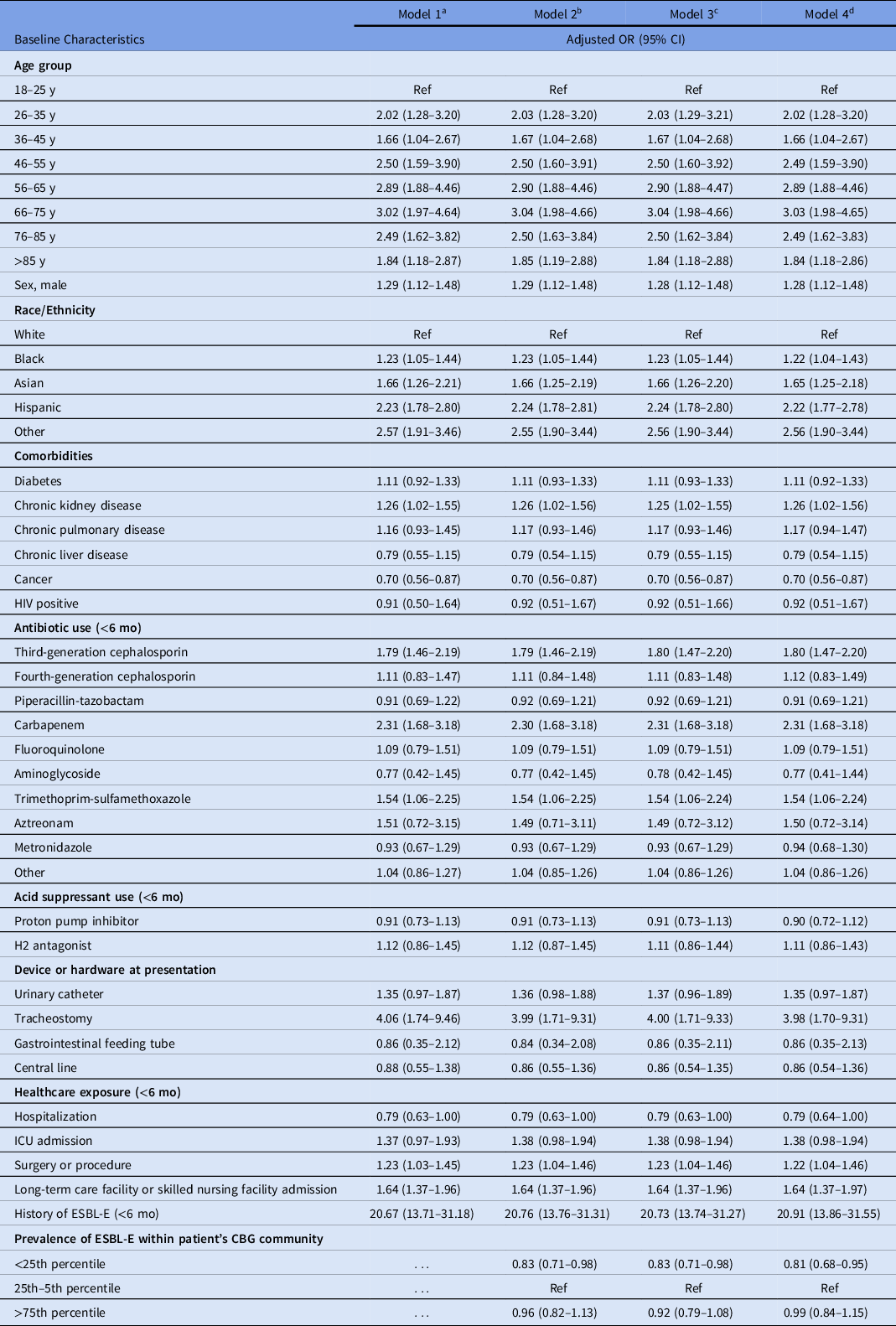
On multivariable analysis excluding the geospatial analysis, the odds of having an ESBL-E isolated in culture was higher among those who were aged 66–75 years (OR, 3.02; 95% CI, 1.97–4.64) and male (OR, 1.29; 95% CI, 1.12–1.48) (Table 2). Non-White patients were at higher risk with the highest odds being in Hispanic patients (OR, 2.22; 95% CI, 1.77–2.79) and patients who did not identify as White, Black, Asian, or Hispanic (OR, 2.51; 95% CI, 1.86–3.39). A prior history of an ESBL-positive culture in the prior 6 months was associated with the greatest increase in odds of ESBL-E isolation (OR, 20.67; 95% CI, 13.71–31.18). Exposure to a third-generation cephalosporin (OR, 1.83; 95% CI, 1.50–2.23), carbapenem (OR, 2.01; 95% CI, 1.46–2.78), or trimethoprim-sulfamethoxazole (OR, 1.53; 95% CI, 1.05–2.22) in the 6 months prior to presentation were also independently associated with ESBL-E isolation. Patients with chronic kidney disease (OR, 1.26; 95% CI, 1.02–1.55), a tracheostomy (OR, 4.06, 95% CI, 1.74–9.46), a surgery or procedure (OR, 1.23; 95% CI, 1.03–1.45), or long-term care facility or skilled nursing facility exposure in the previous 6 months (OR, 1.64; 95% CI, 1.37–1.96) were at increased risk. A history of cancer (OR, 0.70; 95% CI, 0.56–0.87) was associated with a lower odds of ESBL-E isolation.
Multivariable Logistic Regression Models Evaluating Risk Factors for Isolation of an Extended-Spectrum β-Lactamase–Producing Enterobacterales from Emergency Department Patients

Note. CI, confidence interval; CBG, census block group; ESBL, extended-spectrum β-lactamase; ESBL-E, extended-spectrum β-lactamase–producing Enterobacterales; H-2, histamine H2-receptor; HIV, human immunodeficiency virus; ICU, intensive care unit; OR, odds ratio.
a Model 1: Includes previously identified risk factors as dichotomous variables, except for age and ethnicity/race which are categorical.
b Model 2: Model 1 and a categorical variable indicating percentile for proportion of ESBL-producing isolates within the patient’s CBG community in the previous 3 mo.
c Model 3: Model 1 and a categorical variable indicating percentile for proportion of ESBL-producing isolates within the patient’s CBG community in the previous 6 mo.
d Model 4: Model 1 and a categorical variable indicating percentile for proportion of ESBL-producing isolates within the patient’s CBG community in the previous 12 mo.
We did not detect significant differences in the adjusted odds ratios and corresponding confidence intervals for the variables when adding the geospatial analysis (Table 2). Patients in communities with an ESBL-E prevalence less than the 25th percentile had a lower risk of having an ESBL-E isolated in culture compared to patients who were in communities with an ESBL-E prevalence in the 25th to 75th percentile regardless of whether the prevalence was assessed in the prior 3 months (OR, 0.83; 95% CI, 0.71–0.98), 6 months (OR, 0.83; 95% CI, 0.71–0.98) or 12 months (OR, 0.81; 95% CI, 0.68–0.95). There was no significant association with the outcome for patients who were in communities with greater than the 75th percentile for ESBL-E prevalence regardless of timeframe prior to presentation in which prevalence was assessed. Only the geospatial model assessing prevalence in the prior 12 months showed improved fit compared to the base model (P = .028). Results of the multivariable regression models were qualitatively similar when including only patients without a history of an ESBL-producing organism in the prior 6 months (Supplementary Table S4 online).
Discussion
The results of this study confirm the importance of several previously identified risk factors for ESBL-E colonization or infection, and they demonstrate a weak association between the estimated local prevalence of ESBL-E using CBG aggregations and a patient’s risk of ESBL-E infection or colonization.
Similar to prior studies, the most significant risk factor was a recent history of an ESBL-E positive culture with 20.67 times higher odds of having an ESBL-E colonization or infection.Reference Anesi, Lautenbach and Tamma20,Reference Bilavsky, Temkin and Lerman21 Additionally, a history of chronic kidney disease, a recent surgery or procedure, recent long-term care or skilled nursing facility admission, third-generation cephalosporin use, and trimethoprim-sulfamethoxazole use were associated with an increased risk.Reference Anesi, Lautenbach and Tamma20,Reference Martinez, Aguilar and Almela22–Reference Ben-Ami, Rodríguez-Baño and Arslan25 Recent carbapenem use was also associated with an increased risk even when controlling for a history of an ESBL-E in the past year. Although another study reported the same association, the reason is uncertain.Reference Martinez, Aguilar and Almela22 It may be due to residual confounding from providers accounting for more remote history of ESBL-positive cultures when prescribing antibiotics. Notably, patients with a history of cancer had a lower risk of having an ESBL-E isolated on culture, contrary to prior studies, perhaps due to behavioral factors that are more common in this group (eg, social distancing) that reduced exposure to ESBL-E in the community.Reference Ben-Ami, Rodríguez-Baño and Arslan25–Reference Islam, Camacho-Rivera and Vidot27
Community transmission of ESBL-Es has increased 8-fold over the past 20 years globally.Reference Bezabih, Sabiiti and Alamneh28 Patients who are from countries with higher prevalence are more likely to be colonized, and colonization confers higher risk for development of an ESBL-E infection.Reference Bezabih, Sabiiti and Alamneh28–Reference Adler, Gniadkowski and Baraniak32 Although differences in prevalence have most often been described on the country level, geospatial mapping has shown differences in prevalence within areas of a single city.Reference Arias Ramos, Hoyos Pulgarín and Moreno Gómez11 The differences in prevalence within local communities has been postulated to be related to specific environmental factors (eg, contaminated water sources and overcrowded housing), differences in demographics (eg, importation of ESBL-E into the community due to large proportion of foreign-born residents), and interconnectivity between individuals.Reference Otter, Natale and Batra12–Reference Leverstein-van Hall, Dierikx and Stuart17 Such factors lead to unique transmission dynamics within that specific community and thus lead to a different prevalence of ESBL-E. However, it is challenging to define these local communities given they are not defined by geography alone.
We sought to demonstrate the feasibility of utilizing geographic information about ESBL-E prevalence to aid clinicians in selecting empiric antibiotic therapy. We used a novel approach to estimate local prevalence of ESBL-E by utilizing CBG data to cluster patients into aggregates based on geography and shared demographics to approximate the communities in which there may be distinct ESBL-E transmission. Patients who were in communities that were below the 25th percentile for prevalence had 17%–19% lower odds of ESBL-E colonization or infection compared to those in the 25th to 75th percentile, although this association was weak. There was no increased risk for patients in communities that were above the 75th percentile in prevalence. The findings suggest that the methods used to aggregate CBGs may capture only a portion of the relationship between ESBL-E prevalence in local communities and the risk of ESBL-E colonization or infection. Further refinement to the methods, such as incorporation of additional culture data to assess local prevalence of ESBL-E or adjustment of the clustering algorithms, is needed to effectively inform patient-related risk of colonization or infection upon admission. Integrating information on ESBL prevalence into clinical practice will require additional research on provider acceptance of risk information regarding local prevalence, as well as timing and content of the message regarding risk stratification. However, similar real-time clinical decision support tools have been developed and implemented within our health system and have been accepted by clinicians.Reference Levin, Toerper and Hamrock33,Reference Hinson, Klein and Smith34
This study had several limitations. The majority of Enterobacterales isolated in this study were from nonsterile sites, and data were not available regarding clinical symptoms. Although it is presumed these cultures were obtained due to concern for infection at the site of collection, it is possible that the isolated organisms represented colonization. Thus, we were not able to assess the risk of infection alone. Data regarding travel to a foreign country was also not available for analysis so models could not be adjusted for recent travel to a foreign country with high ESBL-E prevalence; however, there was likely less foreign travel during this time due to the COVID-19 pandemic. Furthermore, data may have been missing (due to the retrospective nature of the study), which led to misclassification of exposures; however, this misclassification would not be expected to differ between cases and controls. Additionally, our study only assessed ESBL production in E. coli, K. pneumoniae, K. oxytoca, and P. mirabilis in which phenotypic identification of ESBL production was performed routinely by the microbiology laboratory. Thus, some patients with other ESBL-producing species may not have been included. Finally, the prevalence of ESBL-E within each community was estimated based on the proportion of ESBL-E among clinical isolates of E. coli, K. pneumoniae, K. oxytoca, and P. mirabilis in that community. This result may not truly represent the prevalence of ESBL-E in that community due to selection bias in which patients had indications for cultures to be obtained and bias due to varying culturing practices across sites, although culturing practices appeared to be relatively stable over time at each site (Supplementary Table S1 online).
In summary, our results confirm the importance of several previously identified risk factors for ESBL-E colonization or infection. Additionally, we identified a weak association between estimated local prevalence of ESBL-E using CBG aggregations and a patient’s risk of ESBL-E infection or colonization. Further studies are needed to explore whether geographic data can be used to better approximate local communities of transmission, and better capture the relationship between local community prevalence and the risk of infection or colonization.
Supplementary material
To view supplementary material for this article, please visit https://doi.org/10.1017/ice.2023.76
Acknowledgments
Financial support
This study was supported by the Modeling Infectious Diseases in Healthcare Network (grant no. U01CK000589) and by the Centers for Disease Control and Prevention’s Prevention Epicenters Program (grant no.U54CK000617-01-00). This work was also supported by the National Institute of Health (grant no. T32 AI007291 to J.C.). The content is solely the responsibility of the authors and does not necessarily represent the official views of the National Institutes of Health.
Conflicts of interest
All authors report no conflicts of interest relevant to this article.