Introduction
When citizens make requests of social institutions, the negotiation of entitlement is central to the outcome of their interactions. In telephone calls for emergency service (commonly known in the United States as calls to 911), callers must present themselves as appropriately entitled to the service they are requesting (e.g. ambulance, squad car, fire truck, etc.) lest that request ultimately be denied by call-takers. A significant body of research has thus been developed to examine precisely how callers discursively co-construct their level of entitlement on a moment-by-moment basis with call-takers (e.g. Zimmerman 1990; K. Tracy Reference Tracy1997; K. Tracy & S. Tracy Reference Tracy and Tracy1998; Whalen & Zimmerman Reference Whalen and Zimmerman1998; Curl & Drew Reference Curl and Drew2008; Drew & Walker Reference Drew, Walker, Coulthard and Johnson2010). These studies illustrate the highly contextual patterns of inference and nuanced use of language involved in this process.
Although typically a nonissue for the interactants—and therefore, by extension, typically a nonissue for analysts as well—this nuance requires a high level of linguistic competence to be shared between caller and call-taker. But what happens when the use of a language cannot be taken for granted in this manner?
Reflecting the daily reality of numerous (emergency) service call centers throughout the world, the present study considers interactions that begin with callers requesting assistance in a language other than the call-takers' default. In our specific case, we examine US calls to 911 in which callers request the use of Spanish instead of the default of English. We aim to uncover how caller and call-taker collaboratively address this added complication in their interaction: Which language—English or Spanish—should be used for the remainder the call in order to properly assess the emergency situation at hand?
To situate our approach to this question, we first review the role of entitlement as it factors into the design of requests in general before describing their specific import in service interactions. We zero in on the context and structure of monolingual calls to 911 in order to then illustrate how that structure can be modified to address language-related concerns, exemplifying (i) the ways in which callers formulate requests for Spanish language, and (ii) the ways in which call-takers subsequently manage those requests. It is argued that the context-based contingencies involved in processing calls to 911 render entitlement to language synonymous with callers' embodiment of that request as a necessity rather than a matter of personal preference.
Entitlement and the action of requesting
Designing requests
Speakers have a range of options at their disposal when formulating requests. A longstanding goal has thus been to explain what a speaker accomplishes—in social interaction terms—through his/her selection of one formulation over the others.
Conversation-analytic inquiries into the action of requesting have revealed that the grammatical design of these turns can serve as a window into the ground-level negotiation of entitlement between interactants. Curl & Drew (Reference Curl and Drew2008:147) demonstrate that participants' “choice of request form makes a claim as to what they believe themselves reasonably entitled to given the circumstances of the interaction, the item being requested, and/or the sequence in which the request is placed.” Drew & Walker (Reference Drew, Walker, Coulthard and Johnson2010:100) offer the following continuum of entitlement/contingency identities as they are enacted through various request formulations, given in Table 1.
Continuum or cline of requested forms (Drew & Walker Reference Drew, Walker, Coulthard and Johnson2010:100).

Thus an imperative formulation such as “Pass the salt” is argued as simultaneously embodying a speaker's high entitlement to receive the salt as well as the low contingencies involved for the hearer to be able to comply with that request.
Such work on requests in English parallels studies conducted on other languages as well. Lindström (Reference Lindström, Hakulinen and Selting2005), for example, compares request designs in Swedish and indeed finds that imperative formulations convey a higher level of entitlement than do question formulations (cf. imperatives vs. modals in Table 1). Heinemann (Reference Heinemann2006) looks within the modal category at “reinforcing” vs. “cross-cutting” preferences (cf. Schegloff Reference Schegloff2007:76–78) in Danish. She examines the deployment of “Will you” vs. “Can't you,” and argues that the latter is oriented to as displaying higher entitlement than the former.
While the immediate emphasis appears to center on the design of the requesting turn itself, it must be highlighted that requests—like all turns-at-talk—occur as part of sequences, not in isolation. As Schegloff (Reference Schegloff, Alexander, Giesen, Munch and Smelser1987:208) puts it: “Coordination between actors is… present, as are anticipation and modification of coordination. Although a single person seems to have talked, obviously the participants together have produced the bit of discourse, action, and interaction that has resulted.” This is precisely the reason that Curl & Drew (Reference Curl and Drew2008), quoted above, mention “the sequence in which the request is placed” as part of the entitlement-contingency negotiation process. Requests are born out of the talk that precedes them, and they are dealt with in the talk that follows them.Footnote 1 Interactants' entitlement is therefore “talked into being” (Heritage Reference Heritage1984) moment-by-moment in and through the ongoing, co-constructed discourse.
Requests in calls for service
Citizen callers bring these resources for requesting with them as they engage in interaction with a variety of institutional identities—in both emergency and nonemergency contexts (Drew & Heritage Reference Drew, Heritage, Drew and Heritage1992).
At one end of the spectrum are the requests typically found in what K. Tracy (Reference Tracy1997) straightforwardly calls “customer service” interactions in which high caller entitlement is readily assumed and attended to by participants. For example, Lee (Reference Lee2009, Reference Lee2011) investigates calls made to an airline service in South Korea, describing the requesting and responding practices of customers and agents. In this context, quite simply, customers want to buy an airline ticket, and agents want to sell them one. Consequently, agents avoid the explicit nongranting of requests (e.g. due to lack of flight availability) in favor of substitutions that provide callers with alternative options, interactionally restricting those options to only those that can in reality be granted. In other words, both interactants actively orient—through their talk—to the caller's high entitlement to purchase a ticket.Footnote 2
Such high citizen entitlement is not the default for all institutional interactions, though. Calls for emergency service fall into what K. Tracy (Reference Tracy1997) labels the “public service” frame. In calls to 911, callers must build a case in order to receive the service being requested: It is not sufficient to simply want the service, nor is it an issue of preference, as in the case of booking an airline ticket. On the contrary, the caller must demonstrate a justifiable need for the service, and communicate that need effectively to the call-taker.
Layout of calls for emergency service
The overall sequential progression of calls for emergency service is designed to attend precisely to this matter of the caller's entitlement to service (Whalen & Zimmerman Reference Whalen and Zimmerman1987). As Heritage & Clayman (Reference Heritage and Clayman2010:69) describe: “Since refusals are recurrent if not commonplace, emergency calls embody a gatekeeping process wherein call-takers screen incoming calls to determine whether material assistance is warranted or justified, and callers are accountable for providing an adequate justification” (cf. J. Whalen, Zimmerman, & M. Whalen 1988; Whalen & Zimmerman Reference Whalen and Zimmerman1990). The “monofocal” nature (Zimmerman Reference Zimmerman, Drew and Heritage1992) of these calls causes both a reduction and a specialization in terms of their layout when compared to “ordinary” calls: Here there is only a single point of business to discuss, namely, whatever the supposed emergency is (Wakin & Zimmerman Reference Wakin and Zimmerman1999).
Zimmerman (Reference Zimmerman and Schiffrin1984) proposes a five-part structure to such calls, summarized in (1) below.
(1) Structure of calls to 911
1. Opening
2. Request
3. Interrogative series
4. Response
5. Closing
Emergency service calls move directly from the opening into the first topic, a request for service. In a study of the London Metropolitan Police Service, Drew (Reference Drew1998) reports that nearly 80% of calls reported an incident in this slot but did not explicitly request police assistance (cited in Drew & Walker Reference Drew, Walker, Coulthard and Johnson2010). The call-taker then responds to that (embedded) request by beginning the interrogative series, which allows the call-taker—as the “gatekeeper”—to evaluate whether that request is “genuine” (Is there really a problem?) and “relevant” (Is this problem a matter of public safety?) (Heritage & Clayman Reference Heritage and Clayman2010:69–86). Various issues such as limited resources, false reporting, and caller paranoia, in addition to those who contact 911 with nonpoliceable situations (e.g. leaking faucet, malfunctioning air conditioner), make these inquiries necessary.
In continuing with our earlier discussion, note that the gatekeeping function of the call-taker is not a one-sided responsibility: The caller must communicate with the “gatekeeper,” presenting his/her emergency and responding to the call-taker's questioning in a way that successfully conveys adequate entitlement to service via appropriately formulated talk. Failure to do so may result in the call-taker denying the caller's request. Indeed, this is the very reasoning behind K. Tracy's (Reference Tracy1997) above-cited distinction of frames: Interactional trouble can arise when callers to 911 display a level of entitlement more appropriate to a “customer service” frame than a “public service” frame.Footnote 3 The call-taker's ultimate decision to grant or deny service is thus the result of the discursive negotiation between these two interactants.Footnote 4
Context and data
911 call centers in the United States undoubtedly constitute an English-language-based social institution. Call-takers and their surrounding environment and materials—the Computer Assisted Dispatch (CAD) screens, the codes used for incident reporting, the verbal communication among dispatchers in the call center, and between dispatchers and dispatched units (police, ambulances, etc.), and so on—all make use of English. Furthermore, the standard opening used by a call-taker upon answering a call is a variation of the English “Nine-one-one, what is your emergency?”. Such default English dominance naturally comes to bear on the use of non-English within the setting.
The data used in the present study are taken from a corpus of ninety-seven calls for emergency service from Spanish speakers, ranging from a few seconds to several minutes in duration and concerning a variety of emergencies (e.g. domestic violence, theft, medical assistance, etc.). The calls, which were first transcribed and subsequently analyzed, were placed to the “Newland” City Police Department,Footnote 5 located in the southwestern United States, in 2010. Additional data were also acquired through personal communications with Newland Police staff (including call-takers and supervisors), as well as through on-site observations and interviews at various other cities' call centers.
The year 2000 US Census reported just under 200,000 residents living in Newland, with approximately one-third of those residents being of Hispanic/Latino origin. Due to immigration trends in the last decade, however, current estimates cite Latinos—many of whom have limited English proficiency—as the majority (>50%) of city residents. This demographic profile parallels that of several cities in the U.S. Southwest, a region in which 14% of the total population aged five and over speak English less than “very well,” several thousand of whom being further classified as “linguistically isolated” (meaning that no person in the home aged fourteen or over speaks English at least “very well”), according to the US Census Bureau (Shin & Bruno Reference Shin and Bruno2003:3).
What makes this site particularly interesting for the purposes of the present inquiry is that all of the call-takers working at the Newland call center are monolingual speakers of English. While some may have taken language courses in high school or elsewhere and speak/understand a small amount of Spanish (or another language, for that matter), no operator at this location is certified to conduct emergency calls in a non-English language. That being the case, translation services are indeed available via an external company, which we refer to as LANG: If/When a call-taker decides that translation is necessary for the successful completion of a call, the call is remotely connected to this service (available twenty-four hours a day and paid for by the state on a call-by-call basis).Footnote 6 The end result, after a translator has been acquired, is a three-way interaction between caller, call-taker, and translator, all of whom are on the line simultaneously. It is important to note that LANG provides translation services in a variety of languages to a variety of clients; it is not connected in any special way to this or any other police department. Thus, these translators do not typically have any specific training in 911-call procedures or 911-dispatcher practices.
Transitioning from monolingual to bilingual calls
The existence of the LANG service invites inquiry into how exactly the default, dyadic, English-language interaction between caller and call-taker decidedly becomes—or not—a bilingual, triadic, translator-mediated call.
The language negotiation sequence
A US call-taker's use of English in answering a call is a mundane and routine practice. Nonetheless, that use of English is instantly transformed into a bid for English when a non-English speaker is on the other end of the line.Footnote 7 At this point, if a caller does not feel sufficiently confident in his or her English-language skills (or simply prefers not to conduct the call in English), he or she immediately counters with a request for a change of language. Take excerpt (2) below.
(2) Orienting to English by requesting SpanishFootnote 8

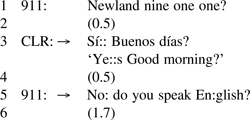
In this example, the caller responds to the default proposal of English in line 1 with a brief utterance in Spanish (line 3). The initial acknowledgment token “Sí” as well as the turn-final, rising intonation display the caller's orientation to the fact that English has already been proposed as the language of choice, while simultaneously resisting that proposal with a request for a change of language. Indeed, the call-taker responds specifically to the requesting nature of this Spanish-language utterance through the use of an explicit “No” in line 5, followed by an immediate counter proposal to use English.
Compare this procedure with that of an officially bilingual region such as Québec. In this governmentally dual-language province of Canada, call-takers answer emergency service calls with both French and English by using “Neuf un un, nine one one” as the institutional opening. That is, two languages are presented as options from the onset of the call, and the caller is free to take up either one without having to formulate a request to that effect.Footnote 9 The US context, however, presents callers solely with English, and thus the use of any other language for the business of the call must be requested in some active way by the caller.
Later examination of the call in (2) presents analysis beyond the few lines shown above; yet even in its present, abbreviated form, this excerpt reveals that callers' requests for a change of language are not simple matters that are granted or denied by call-takers in the following turn (cf. line 5). Rather, these requests launch language negotiation sequences, in and through which the request for language is assessed before it is ultimately granted or denied. Calls of this sort therefore expand the five-part structure proposed by Zimmerman (Reference Zimmerman and Schiffrin1984) (cf. (1)), the language negotiation sequence (2L → 3L → 4L) being inserted immediately after the opening and before the request for service, as seen in (3).
(3) Insertion of the language negotiation sequence

Just as in monolingual calls, addressing the emergency situation at hand remains the primary goal of the interaction. Nonetheless, participants attend to the fact that successfully accomplishing that goal is contingent upon their ability to understand one another's talk. After the language request has been sufficiently addressed via an interrogative series—and, if deemed necessary, after an appropriate translator has been acquired—the caller can then move on to make a second request, this time for emergency service, and the call continues by addressing that request. It should be noted that even hysterical callers orient to the need to request non-English-language before initiating their requests for service, doing so in their first turn even in the midst of crying or yelling (cf. Whalen & Zimmerman Reference Whalen and Zimmerman1998).
Let us illustrate this overall structure with a concrete example, seen in (4), a detailed analysis of which is presented in a later section.
(4) Language negotiation preceding service negotiation

The caller in this case quickly abandons his early attempt at the problem presentation (“I have um” at the end of line 4) specifically to produce a request for language in line 6 (and again in lines 11–14). By countering with her own request for subsequent action in lines 8–9 (and again in lines 16–17), the call-taker shows her interpretation of the caller's question as not merely a request for information. These turns together constitute the interrogative series. The call-taker's final request to “tell me in English?” in lines 16–17 then serves as the ultimate response to the original language request: Something else (although we don't yet know what specifically) needs to be told, and the present topicalization of language is actively oriented to as a prerequisite to be able to engage in that telling. Once the caller accepts this push for English in line 18, he seamlessly restarts his problem presentation in lines 20–21 with “Ah: My gra- my grandma:? i::s….” Both caller and call-taker thereby attend to the fact that English vs. Spanish was up for debate solely so that the service issue could be properly addressed; and so once a decision was made regarding language, the interaction immediately transitioned (back) to the emergency at hand.
Entitlement in negotiating language: The interrogative series
As seen in excerpts (3) and (4) above, a caller's request for language evokes the call-taker's identity as gatekeeper, and the interrogative series which follows in the language negotiation sequence has as its goal an assessment of that original request. In such contexts, then, the role of the gatekeeper is expanded to govern not only entitlement and access to service, but also entitlement and access to language. Indeed, requests for language require communicating legitimate need and are thus not automatically granted. Accordingly, there are no calls in the corpus that follow the hypothetical pattern in (5) below in which the language request is immediately granted (or denied) by the call-taker in the adjacent turn.
(5) Hypothetical immediate transfer (invented)
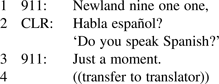
On the contrary, call-takers consistently respond to all forms of language requests with a bid for English (but see example (6) below). This typically takes the form of a reciprocal question somewhere in the next utterance: in this setting, most often some version of “Do you speak English?” (a “counter”; Schegloff Reference Schegloff2007:16–19). A counter for and in English inherently contains an embedded rejection of the caller's request for Spanish (cf. Jefferson Reference Jefferson, Button and Lee1987), while simultaneously inviting English. Furthermore, countering in this way both states as well as embodies a qualification of the caller's request as appropriate if and only if English is not an option. Other elements (e.g. a direct or “type-conforming” (Raymond Reference Raymond2003) response such as “No”) may accompany the call-taker's counter as well—and, indeed, this is examined typologically on a case-by-case basis below. But regardless of the inclusion or lack of these elements, it remains that some bid for the caller to speak English initiates all language interrogative series.
As with requests in monolingual calls, again there is responsibility placed on the caller: Callers must present themselves in a way which evidences that they are incapable of conducting the call in English, and therefore that assistance in another language is consequently warranted and required. As we demonstrate, this entitlement to language is most effectively accomplished by embodying an inability to produce appropriate, English-language contributions to the interaction. Just as is the case with requests for service, requests for language must be perceived as genuine if they are to be granted, otherwise they are denied. Agreeing to bring a translator on the line can thus be conceptualized as the linguistic equivalent to agreeing to send a squad car to the scene of an emergency: the granting of a caller's effectively negotiated request.
The rationale behind entitlement to language
Discussion of the requirement to demonstrate need over personal preference naturally raises the question as to why a translator is not simply acquired without further inquiry. The reasons for this pertain to the practical matter of time. First, in the present corpus, calls that do make use of translation services using LANG expend an average of ninety seconds locating, connecting to, and exchanging identification information with a translator—all prior to the call-taker finally instructing the translator to ask the caller what the emergency is. The delays do not end there, however. In translator-mediated calls, turn time is essentially doubled: Everything is said twice (once in the original language and again in the translated language), as is the general nature of live translation. Additionally, translator availability and quality issues may also arise, further delaying/compromising the emergency agenda of the call.
These context-based contingencies make contacting a translator interactionally oriented to as a last resort, used only when deemed absolutely essential to a call's success. The role of the call-taker as gatekeeper during the short, four-to seven-second language negotiation sequence is to assess whether or not this additional wait-time is actually necessary for the successful completion of the call, and to grant/deny the request for language in accordance with what will provide the caller with the fastest possible service. Given that emergency aid can arrive on-scene in as little as three minutes, the minute or two expended in locating a translator can be the difference—quite literally—between saving a life and losing one (cf. Whalen et al. Reference Whalen, Zimmerman and Whalen1988).
Bearing in mind these efficiency-based considerations, note the transfer to a translator that does indeed occur relatively quickly in example (6) below.
(6) No emergency

Responding to the presupposition of an emergency as expressed by the call-taker's line 2, here the caller begins by explicitly stating that there is no emergency (line 5). She then produces an accented yet perfectly intelligible request for Spanish, in English, in line 6. Following this, there is no back-and-forth assessment of language competence through an interrogative series. As we illustrate below, this relatively high level of English-language competence is typically met with a strong push for an English-language exchange (recall excerpt (4) above). In this instance, though, because it has been overtly stated that this is not an emergency situation, time is no longer an issue: The call-taker is assured that putting the caller on hold to locate a translator will not result in a death, for example, as it very well could in other calls in which the emergency at hand is still unknown. Exchanges such as (6) seem to suggest that the driving force behind these language negotiation sequences is triage-based, related to time and efficiency as opposed to language-ism; nonetheless a more systematic analysis would be necessary to arrive at a concrete conclusion on this particular matter.Footnote 10
In the sections that follow, we describe the precise ways in which sequences addressing language choice are negotiated between caller and call-taker when time is indeed a demonstrably relevant concern for the interactants.
Typology of language requests
There are three different types of requests that callers employ in petitioning to conduct their emergency service call in Spanish. They are: embedded requests in Spanish, direct requests in Spanish, and direct requests in English.
As each of these request classifications sets up its own interactional trajectory, the immediate goal is to establish a typology of request formats; we then analyze how each request type is subsequently interpreted and responded to by call-takers.
Embedded requests in Spanish are “embedded” because they do not make explicit reference to the language desired: no mention of either “Spanish” or “español.” Rather, these requests make use of the desired language in some brief way and leave it to the call-taker to interpret the utterance as a request for a change of language. (Note the parallel with embedded requests for service; cf. Whalen & Zimmerman Reference Whalen and Zimmerman1990; Drew Reference Drew1998.) Most often these embedded requests take the form of a greeting, as seen earlier in (2) and below in (7) and (8).
(7)
(8)
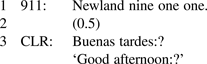

This class is particularly noteworthy given that greetings are normally absent from calls for emergency service (Wakin & Zimmerman Reference Wakin and Zimmerman1999). During language negotiation sequences, non-English greetings can indeed be present, but they are used from a social action perspective to “do requesting a language” as opposed to “doing greeting.” They serve simultaneously to reject the language of the call-taker's previous turn (English) and to invite the language of the greeting turn (Spanish). This is precisely the reason that these embedded requests can only be formulated in Spanish, as opposed to direct requests, which can be produced in English or Spanish.
Direct requests make explicit reference to the Spanish language. Direct requests in Spanish make reference to “español,” while in English the reference is to “Spanish.” Two examples of the former type are seen below.
(9)
(10)


These direct requests in Spanish may take the form of a single word (simply, “español”), or longer phrases as seen above in (9) and (10).
The formulation of the English class also varies in terms of length and morphosyntactic complexity, ranging from a pragmatically complete, full sentence as was exemplified in lines 4–6 of example (4), to a partial sentence or even a hesitant single word as seen in (11) and (12) below.
(11)
(12)
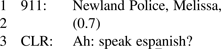
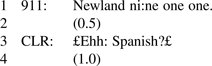
The wide range of linguistic and pragmatic accuracy in these requests is undoubtedly due to variation in caller English ability. Nonetheless, what binds this class of requests together is the explicit mention of “Spanish” during the turn.
Finally, take note of the pauses preceding the majority of these initial requests. One explanation is that these pauses could be the result of language difficulty, the caller not having adequately understood the call-taker's English-language opening; and indeed they can be retroactively interpreted by call-takers as signs of a lack of competence in English. Additionally, though, these pauses might be indicative of dispreferred responses to come (Pomerantz Reference Pomerantz, Atkinson and Heritage1984, Sacks Reference Sacks, Button and Lee1987), particularly in the case of callers who go on to display near-native English proficiency despite having requested Spanish. All of these requests are dispreferred in the sense that they do not answer the question originally posed by the call-taker in the first turn of each call. Furthermore, requests in Spanish (embedded and direct) are also disaligned with respect to language: They do not conform to the language choice set up by the call-taker. These pauses can therefore simultaneously be foreshadowing a variety of dispreferred and/or disaligning actions to come before the request for language is even produced.
Call-taker responses to language requests
Given this typology of caller request types, we now turn to the ways in which call-takers subsequently manage those requests and push for an English-language exchange.
Responses to embedded requests in Spanish
Responses to embedded requests in Spanish have in common the claim—be it implicit or explicit—that the call-taker is not proficient enough in Spanish to offer an appropriate reply to the caller's Spanish-language turn. Take examples (13) and (14).
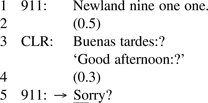

Example (13) finds the call-taker using an “open” class repair initiator (Drew Reference Drew1997) to invite the caller to reformulate his turn, while the call-taker in (14) repeats the institutional greeting more slowly. Due to their sequential positioning after first-pair part turns in Spanish, both of these types of responses make an implicit bid for English without conceding any knowledge of Spanish, just as the callers' initial requests make bids for Spanish without conceding any knowledge of English. Simultaneously, call-taker responses—as themselves first-pair parts—renew the initial relevance of a responsive turn in English from the caller. The additional speech that occurs in this next position will then allow the call-taker to better assess the caller's English-language competence, and therefore also the caller's entitlement to non-English.
An alternative strategy that accomplishes a similar agenda is seen in (15) below.
(15) Continuation of (2)

As in the previous two examples, this Spanish greeting has two possible actions: a greeting and a request for Spanish. The response here makes explicit the call-taker's selection of the latter as the action to which she will respond, accomplished through the use of an overt “No:,” paired with the counter “Do you speak En:glish?” in line 5. An explicit “No” is free to occur in response to embedded requests in Spanish precisely because it isolates and addresses the requesting action of the Spanish-language turn without conceding any knowledge of the turn's potential greeting action; thus there is no danger of the call-taker being perceived as possessing any Spanish-language abilities (cf. excerpt (17) below).
The caller's intonation in (15) also highlights the requesting action of his turns. The first instance (line 3) displays rising/question intonation, indicating low epistemic/social entitlement to make his request (Curl & Drew Reference Curl and Drew2008; Couper-Kuhlen Reference Couper-Kuhlen and de Ruiter2012), while the second utterance (line 7) displays final/period intonation, pushing back on the call-taker's displayed preference for English in line 5 and indicating that the language used in his turn (Spanish) is his “final answer.” When pressured again by the call-taker, he produces a third request that displays a concerted attempt to use English: “Eh: Perdón estoy buscando alguien espeak emi: espanish.” ‘Uh: Pardon I am looking for someone espeak emi: espanish.’ This turn is oriented to as embodying a lack of English-language production competence through the call-taker's immediately subsequent decision to acquire a translator. In short, this caller successfully evidenced his entitlement to Spanish by embodying an inability to contribute adequately to the interaction in English. As a result, his request for language is deemed legitimate and is granted by the call-taker.
Responses to direct requests in Spanish
Direct requests formulated in Spanish (referencing “español”) receive a slightly different sort of response from call-takers compared to those given to embedded requests. Consider example (16).
(16) Continuation of (9)

In (16), the caller's direct request in Spanish is responded to solely with a counter (line 5); there is no explicit, type-conforming “No” preceding the bid for English. Rather, the counter itself implicitly rejects the request for Spanish without overtly responding to the Spanish-language question or denying access to translation. That is, the turn actively promotes English while at the same time not committing definitively to either language. Furthermore, as a question, the counter invites an answer from the caller (as observed in previous examples), and so whatever talk (or lack of talk) is produced in the subsequent answer-slot will unavoidably enable the call-taker to further assess the caller's language competence.
In this class of request, just as was the case with the embedded requests above, the use of Spanish does not inherently convey any English-language competence. The call-taker's use of a negative polarity item in her counter in line 5 (“Do you speak any English”)—characteristic of responses to direct requests in Spanish—reveals her interpretation of the presumed need for Spanish as having been appropriately embodied by the caller in the previous turn. Nonetheless, the caller in this example easily answers the call-taker's question and reformulates his request into a direct one in English: “(N)ah:: (.) can you speak Spanish?” (line 7). While this class of request is more specifically described in the next section, note simply here that, with this turn, the caller has aligned with the call-taker's immediately prior push for English, thereby undermining the genuineness of his need for non-English through exposure of his English-language capabilities. In formulating her next turn, the call-taker takes into account the caller's having conceded to English (and the proficiency he has shown in doing so)—that is, his severely diminished entitlement to Spanish—by producing a minimal response “N:o.” with firm, period intonation in line 8, thereby promoting overall closure of the language negotiation sequence (Schegloff & Sacks Reference Schegloff and Sacks1973; Schegloff Reference Schegloff2007).
Although the initial request in (16) did evidence a need for non-English service at the time it was uttered, the turn-by-turn negotiation of that request with the call-taker revealed it to be a matter of personal preference as the caller quickly gave in to demonstrating his competence in English; consequently the request for language was denied (line 8). The caller subsequently—and immediately—begins his problem presentation with an extremely fluent level of English, retaking up the talk from the call-taker's opening turn by way of the acknowledgement token “Yes” (line 10). Furthermore, his declarative “I wanna report” phrasing shows the appropriate contingency/entitlement ratio expected from a competent speaker interacting in this institutional setting (Zimmerman Reference Zimmerman, Drew and Heritage1992).Footnote 11 Overall, the language negotiation sequence allowed these interactants to begin discussing the emergency situation itself after only five seconds, as opposed to two minutes later as in cases requiring translation.
The reason that direct requests in Spanish do not typically receive explicit answers from call-takers is intimately related to the issue of language assessment that we have been discussing. As illustrated, when call-takers formulate English-language turns to push for English, they evaluate callers' English competence based on their responses. But this evaluation process can function in the opposite direction as well: If call-takers give an explicit answer to a direct request in Spanish, they potentially undermine their own claim to lack Spanish language competence. This can thereby provide the caller with evidence on which to base subsequent pushes for Spanish, as shown in example (17) below.
(17)

Here the caller begins her turn in line 3 with an embedded request (a Spanish-language greeting), but completes it with a direct request in Spanish. In response, the call-taker immediately answers the Spanish-language question with an explicit “N:o ma'am.” followed by a counter. The caller then orients to the call-taker having exhibited some comprehension of Spanish, capitalizing on that fact by pushing for the continued use of Spanish in lines 8, 11, and 14.
Even while pushing for Spanish, though, this caller is simultaneously partially undermining her own presentation of genuineness, as each English-language question to which she responds is proof of some level of competence in English. Given her active understanding of the call-taker's turns in lines 5–6, 9, 12, and 16, it is reasonable to assume that “yes” and “no” figure into this caller's English-language repertoire, however passive and limited it might otherwise be. Nonetheless, systematically avoiding the use of English in her answers causes a different sort of “cross-cutting”: showing competence in understanding English while simultaneously demonstrating an unwillingness (or inability, as the case may be) to produce it. As production, not merely comprehension, of English is required in order to conduct the business of an emergency service call, this call results in the use of a translator.
Call-takers typically do not answer direct requests in Spanish explicitly, opting instead for bare counters such as “Do you speak any English?” (line 5 of (16)) and thereby avoiding exchanges such as (17). This strategy effectively allows call-takers to not show any competence in Spanish while simultaneously expanding the sequence to elicit more assessable talk from callers.
Although the ways in which call-takers respond to embedded vs. direct requests in Spanish differ, the larger sequence in progress remains constant: the use of an interrogative series to evaluate the caller's English-language competence while not revealing any Spanish-language ability. The common goal that is attended to by the interactants is to succinctly and successfully complete the language negotiation sequence so that the call can advance as quickly as possible to the caller's presentation of the emergency situation.
Responses to direct requests in English
Contrary to the two types of requests formulated in Spanish, when callers use English to formulate their requests for Spanish, they undermine the very entitlement they are attempting to convey, portraying their request for language—from its very first formulation—as a preference rather than as a necessity. Such callers are not actively embodying the need that they claim to have, and call-takers orient accordingly to such designs. Let us return to example (4) above, repeated below as (18).
(18)

In this example, as is the case with all requests formulated in English, the caller implicitly accepts the call-taker's preference for English as expressed via the institutional opening. Following the acknowledgment token in line 2 (a parallel with monolingual calls; Zimmerman Reference Zimmerman and Schiffrin1984), the caller begins his problem presentation before abandoning it to make a request for language. This block of speech from the caller (lines 2–6), although produced with the phonology of an English-as-a-second-language speaker, is completely intelligible; and crucially, this high level of competence with regard to English-language production is attended to by the call-taker in her response in which she makes a second bid for English (lines 8–9). The negative response in line 8 (“I'on't speak Spanish.”) is repetitional, thereby demonstrating the call-taker's agency and further strengthening her institutional identity as the gatekeeper. As Heritage & Raymond (Reference Heritage, Raymond and de Ruiter2012) note, full repeats also project a second turn-constructional unit (TCU); and indeed, here we find an immediate yes-preferring counter for English in line 9 (“D'you speak English?”). The design of this counter request displays the call-taker's positive assessment of the caller's English abilities given the interaction thus far, compared to the negative polarity counters with “any” seen earlier in response to Spanish turns.
The caller produces a type-conforming response in his line 11, again aligning with the caller's push for English simply by using English. In addition, he makes a second request for Spanish, again formulated in English, but now with negative polarity: “y-you don ha:ve (0.5) somebody with speak Spanish,” (lines 13–14). This change in the formulation of the caller's request—from a yes-preferring interrogative to a no-preferring declarative—indicates a shift in the epistemic gradient between the two interlocutors and further reveals his en-route concession to the use of English and self-canceling of his own request.
Following this demonstration of English proficiency, the call-taker provides an answer in line 16: “No:”. Although “somebody with speak Spanish” is indeed available via LANG, the call-taker's negative response illustrates a decisive selection of a narrow interpretation of the request in an effort to further push for an English-language exchange. The final push to close the language negotiation sequence and move on to the problem presentation (“Can you tell me in English?” in lines 16–17) is ultimately taken up by the caller. In this call, then, the turn-by-turn production of sufficiently comprehensible and sequentially appropriate English by the caller effectively undermined the genuineness of his entitlement to non-English. As a result, he restarts the presentation of his emergency situation in line 20—in English.
Finally, let us examine the trajectory of a call with a direct request in English that does ultimately result in a translator-mediated interaction.
(19) Continuation of (11)

As in (18), we again see a direct request for Spanish, made in English; however, this caller produces no acknowledgement token following the 911 institutional opening, only silence. The request itself in line 3 is more elementary—both pragmatically as well as syntactically—if we compare it to the previous example; nonetheless it is comprehensible. As such, the call-taker responds by combining a repetitional response with a subsequent reinforcing-preferenced request for English (line 4). This request meets with another full second of silence before the caller responds with “Na: me no?” in line 6. The adequate, colloquial English phonology and sequential relevance of line 6 (the caller does indeed answer the call-taker's question from line 4) seem to indicate a certain amount of English competence, and thus the call-taker continues the interrogative series for another round in lines 7–8.
As observed in previous examples, the change in polarity from reinforcing (line 4) to cross-cutting (lines 7–8) preferences illustrates the call-taker's orientation to the lack of success thus far regarding the caller's acceptance of English. These later requests also employ declarative syntax and end with falling intonation, compared to the original “Do you speak English?” in line 4, which used interrogative syntax and rising intonation. That is, after hearing an additional turn-at-talk from the caller in line 6, the call-taker reformulates the design of her request to reflect increased epistemic access to the caller's English speaking abilities (or the caller's willingness to use those abilities, as the case may be) (Couper-Kuhlen Reference Couper-Kuhlen and de Ruiter2012; Heritage Reference Heritage2012).
At this point, the caller indicates a lack of English proficiency with more silence and then corroborates that by producing Spanish phonology on “no” (Spanish pure vowel ['no] compared to the English diphthongized vowel ['noʊ] produced in line 6) and a conversationally incomplete/incoherent rest of the turn in line 10. After this sequence, the “trouble” indicated by the various pauses throughout the exchange may be retroactively understood by the call-taker as indicative of linguistic difficulty rather than as solely foreshadowing typical, monolingual dispreferred responses. The call is then transferred to a translator at line 11.
In all of the above examples, we observe call-takers pushing turn-by-turn for English in search of sufficient grounds on which to turn down callers' requests for non-English. Interactionally, call-takers take English-language turns from the caller—including requests for an alternative language that are formulated in English—as signs of English competence and then actively promote continued use of English. If they encounter sufficient evidence suggesting English capabilities, requests for language can be denied in the same way that requests for service can be. In order to have their requests granted, callers must therefore “prove their case” for non-English by embodying a moment-by-moment lack of English production ability.Footnote 12
Quantitative evidence
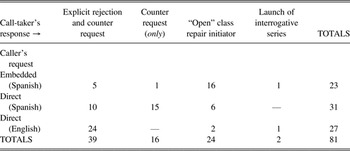
Here we provide quantitative support for the detailed, example-by-example claims put forth above as to the trajectory of each of the three classes of language requests. In Table 2 below, we show a frequency cross-tabulation of caller request designs by the initial types of response they receive from call-takers.
Frequencies of call-taker responses to caller requests.Footnote 13

The first overarching trend that these figures illustrate as a set is that the three types of language requests employed by callers are distributed relatively evenly: embedded Spanish (23/81, 29%), direct Spanish (31/81, 38%), direct English (27/81, 33%). That is, it is not the case that one of these sorts of requests is used in the vast majority of calls while the other two are relatively rare. Rather, all are nearly equally represented in the data.
Contrastingly, focusing on the call-taker responses, overt counter requests for English (both with and without an explicit rejection) are interactionally much more frequent than are other response forms (55/81, 68%). This indicates that some overt bid for English occurs relatively frequently in the call-taker's very first turn-at-talk in response to the caller's request for non-English. These figures illustrate quantitatively the sequential importance of this specific counter in this interactional context.
To briefly discuss the intersecting (request-response combination) tendencies of these distributions, let us begin with the last row of the table, call-taker responses to direct requests in English. Of the total twenty-seven requests of this sort, twenty-four (89%) received an explicit rejection before the counter request for English. Compare this with embedded requests in Spanish (5/23, 21%) and direct requests in Spanish (10/31, 32%). These numerical findings support the aforementioned qualitative claims as to the nature and potential interactional consequences of displaying language competence: Call-takers are free to explicitly reject an English-language request for Spanish as this does not threaten their claim of incompetence in Spanish. Responding directly to a request in Spanish, however, would demonstrate some competence in Spanish, thereby potentially allowing the caller to continue pushing for Spanish (cf. excerpt (17)). Thus, we observe a significant quantitative tendency to reject such requests in Spanish implicitly rather than overtly.
Paralleling this, note also the higher usage rate of devices of implicit rejection in response to requests formulated in Spanish: 18/23 (78%) in embedded requests and 21/31 (68%) in direct requests, compared to only 3/27 (11%) in response to requests formulated in English. Additionally, the least agenda-specific, most “open” responses (“open” class repair initiators like “I'm sorry?” and “Pardon?”) are most common with embedded requests in Spanish: 16/23 (70%) compared to 6/31 (19%) and 2/27 (7%) in the other two classes. Because these embedded requests are made up of various, possibly unfamiliar Spanish language greetings, call-takers often respond by initiating repair.
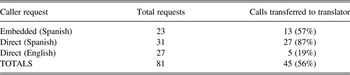
Finally, the following Table 3 relates the number of caller requests of each type that ultimately resulted in a transfer to a translator. These numbers too fall out naturally from our previous qualitative discussion. Requests formulated in Spanish embody a need for the requested language (Spanish) and thus show a higher rate of success in obtaining translation services. Requests formulated in English undermine the supposed need for non-English, thereby setting up an interactional trajectory that points towards English competence (i.e. no translation necessary) from the very utterance of the initial request.
Distribution of initial caller requests and transfer to translator (χ2= 27.5, p < 0.0001).

Conclusions and avenues for future research
In this study, we have analyzed calls for emergency service that begin with a request for Spanish language. In our analysis, we posited a parallel structure between service negotiation sequences and language negotiation sequences, both following the progression of Request → Interrogative series → Response. Parallels were shown to exist not only at the level of the overall structure and progression of the calls, but also in the identity roles evoked by the participants in the interaction (cf. Zimmerman Reference Zimmerman, Antaki and Widdicombe1998): call-takers as gatekeepers (not only to emergency service but also to language) and callers as having to justify or legitimize entitlement to their requests (not only for emergency service but also for language). Caller signs of competence in English—in the form of appropriate English-language pragmatics, full turns, and/or responses—were met with further insistence on English from call-takers, all without call-takers showing any signs of Spanish competence. The reverse situation, in which callers sequentially push for Spanish if call-takers demonstrate Spanish ability, was shown to be possible as well. This is therefore a unique interactional context in that the requirement is to display linguistic incompetence—a lack of linguistic ability—to one's interlocutor for one's request to be granted. In short, these participants are negotiating together the issue of entitlement to language, each embodying his/her own linguistic competencies on a turn-by-turn basis while simultaneously taking into consideration those of the interlocutor.
The rationale behind this system is based on the situational contingency of time in the context of a call for emergency service. Callers are very likely unaware of the fact that locating a translator can be such a time-consuming process (cf. K. Tracy Reference Tracy1997); nonetheless, a call-taker denying a caller's request for non-English very often results in faster emergency service for the caller than if a translator had been sought out (e.g. examples (4)/(18) and (16)). In a situation of life or death, the supreme importance of saving even a minute or two cannot be discounted.
These results underscore the need for further language-contact-based research in this and other institutional environments. As we have illustrated, the existence or availability of translation services is not synonymous with their accessibility or use. What context- and interaction-based contingencies affect citizens' ability to take advantage of language (and other) services in the public sphere? Furthermore, ours was the case of a language that is relatively well-known in the US Southwest. How might a call progress differently with one of these call-takers if the caller were a monolingual speaker of Mandarin or Arabic? For example, would embedded requests in Mandarin function in this context in the same way as do embedded requests in Spanish? Could a monolingual English-speaking call-taker definitively distinguish between Mandarin, Cantonese, Vietnamese, and Korean, and thereby request an appropriate translator for the interaction? One might also ask what happens after these negotiations have concluded and decisions regarding language have been made: Are later negotiations of entitlement to service affected by these earlier negotiations of entitlement to language?
Given the consistent growing diversity of societies throughout the world, continued inquiry into such bilingual encounters will undoubtedly contribute to a more complete understanding of how humans make use of the various discursive resources at their disposal—not only when engaging, but also when attempting to engage, in social interaction with one another.