Why do people believe conspiracy theories? The role of conspiracy theories in politics has become increasingly prominent in recent years, from the ‘paranoid style’ of the 1960s in the United States, to doubts about the official account of Princess Diana’s death in Britain, to rival theories about the terrorist attacks on 9/11 worldwide.Footnote 1 Recent surveys show that many Americans believe at least some conspiracy theories,Footnote 2 and the topic has gained new resonance during the Obama presidency. The recent prominence of conspiracy theories in the public sphere has raised concerns about their implications for democratic practice.Footnote 3 Societies in which distrust is deep and pervasive are likely to exhibit low levels of compliance and political participation, with troubling consequences for the functioning of government.Footnote 4 Conspiratorial publics are also more susceptible to nationalist and chauvinist political appeals, and widespread belief in conspiracy theories has historically enabled scapegoating and political violence.Footnote 5
To date, most social science research has viewed conspiratorial thinking as distinctive of specific personality types, and closely associated with paranoia, cynicism, and alienation.Footnote 6 If individual characteristics – representing, in particular, socially marginalized populations – are at the heart of conspiracy belief, then there is the risk that this group may be permanently alienated from the political system. Yet there are sound theoretical reasons to believe that many people – even ‘normal’ ones who lack the suspect personality traits – can be potential conspiracists under the right conditions. In this alternative view, conspiracy belief need not signal a categorical rejection of political engagement, but may be situational and compartmentalized from other beliefs. If different types of people are associated with different beliefs under varying circumstances, then conspiracy theories may be ephemeral rather than deeply rooted and can be consistent with pluralistic politics.
This article sheds light on two important questions that are still unresolved in the extant literature on conspiracy theories. First, how broad is the potential pool of conspiracy theory adherents in society? Most research to date has investigated the psychological traits that make a person more likely to buy into a conspiracy theory, suggesting that the prevalence of those traits will correspond with the frequency of conspiracy belief in society.Footnote 7 Yet this research has failed to incorporate insights on the situational and fluctuating nature of public opinion, which has shown that expressed political preferences are sensitive to contextual cues and cognitive stimuli.Footnote 8 If opinions about the veracity of a conspiracy theory develop in similar ways, then the vast majority of citizens may be potential conspiracists depending on the context.
Second, if conspiracy belief is indeed contingent and fluctuating, what determines whether an individual (dis)believes? Several possibilities emerge from political psychology. One factor is anxiety, which produces a need for control that may be satisfied by identifying patterns, which is analogous to conspiratorial thinking.Footnote 9 Another is the use of cognitive heuristics, which provide cues that help people make decisions in the face of uncertainty.Footnote 10 The cues can be linked to partisan attachments or other aspects of a person’s background, and help people preserve congruence between their preexisting beliefs and discrepant information.Footnote 11 These mechanisms, found in a number of political behavioral processes, have not been systematically applied to explain belief in conspiracy theories.
This study tests these mechanisms by presenting subjects with an original vignette embedded in a survey experiment with the goal of inducing conspiracy belief. The setup, which involves manipulating the surrounding context and specific details of a possible conspiracy, can reveal what makes people believe conspiracy theories in general. This differs from other studies, which solicit opinions about well-known theories and are unable to disentangle the many contributing factors.
In accordance with previous work, we posit that embracing a conspiracy theory is an attempt to make sense of uncertainty. When faced with information about an unexplained event, people seek to minimize uncertainty through cognitive shortcuts, which may attract them to simple yet satisfying narratives that involve attributing blame, following the logic of a conspiracy theory. As with opinions on conventional policy issues, people’s stated beliefs depend on individual characteristics, environmental factors, and the content of the information they are exposed to. Conspiracy theories are, therefore, treated not as a separate category of political belief, but rather as a highly mistrustful variant of the quotidian judgments people make, with all their attendant biases and simplifications, when confronted with uncertainty.
The results indicate that the pool of potential conspiracists is not limited to those possessing particular psychological and socio-economic traits, but that the set of adherents depends on subtle contextual variables both within and external to the content of a conspiracy conjecture. The findings suggest why belief in conspiracy theories is so pervasive yet prone to fluctuation depending on political and structural conditions. They also demonstrate the benefits of studying the phenomenon using the tools of political attitude formation, militating against the assumption that belief in conspiracies differs qualitatively from other kinds of belief.
The Causes of Conspiracy Belief
The dominant approach to studying conspiracy theories links belief to social stresses or personality type. Early research saw conspiracy beliefs as emanating from alienation and distrust, reflecting an individual’s material and social circumstances. Lack of power and an inability to influence the political process result in feelings of impotence and frustration, which cause people to imagine that their fates are a consequence of concerted action by powerful individuals or organizations.Footnote 12 More recent studies have located conspiratorial tendencies in individual personality differences, including alienation, social dominance orientation, self-esteem, political cynicism, attitudes toward authority, and the Big Five personality traits.Footnote 13 These findings are buttressed by several studies showing that belief in different conspiracies is correlated, suggesting that adherents possess a ‘monological belief system,’ in which people’s (unsubstantiated) beliefs reinforce one another but are detached from the surrounding context.Footnote 14 Additionally, several studies have linked marginalized population subgroups with specific conspiracies. For example, conspiratorial thinking about certain issues has been found to be more common among African Americans, who are disproportionately prone to believe, inter alia, that the US government deliberately spread the AIDS virus in minority communities.Footnote 15
Some scholars have noted the potential bias in ascertaining people’s opinions about existing conspiracy theories: their responses may be valid in a particular cultural context, but do not necessarily reveal attitudes about conspiracy thinking in general.Footnote 16 This critique can be extended to argue that, because people have already formed opinions about well-known theories, we cannot easily identify the emotional, social, and cognitive factors that underlie that belief.Footnote 17 In an attempt to address these problems, two recent studies have introduced scales measuring generic conspiracy belief.Footnote 18 While this approach can disentangle conspiracy beliefs from previous associations, it still relies theoretically on personality traits. These findings, which treat conspiracy belief as a manifestation of a latent construct of ‘conspiracy mentality,’Footnote 19 have trouble accounting for opinion surveys demonstrating the pervasiveness of conspiracy belief – of one sort or another – among a broad swath of the populationFootnote 20 and do not incorporate research on the dynamic and contingent nature of political attitudes.
If we relax the assumptions of the static psychological model, we can entertain several variables that may account for why an individual’s tendency to believe varies across (potential) conspiracies and over time. One likely cause of belief is people’s psychological state at the time of measurement, which can affect how they assimilate and interpret information. For example, insecurity causes people to believe that forces outside of their control are shaping events.Footnote 21 The loss of control triggers a need to compensate by imagining that they have a grasp on an otherwise complex situation, allowing them to reassert control.Footnote 22 Anxiety need not be dispositional, but may be primed through short-term triggers, as several laboratory and survey experiments have shown.Footnote 23 If anxiety leads to a desire to restore control, then respondents who experience anxiety should be more receptive to conspiratorial logics. Hence:
Hypothesis 1: Anxiety will make people more likely to perceive a conspiracy.
A second approach to complement the personality-centered model of conspiracism resides in the interaction of individual characteristics with the content of the claim being deliberated on. Scholars of political behavior have noted that conspiracy belief tends to map onto existing political cleavages, such as the tendency of ‘Truthers’ to lean liberal while ‘Birthers’ are predominantly conservative.Footnote 24 Partisan identities shape the assimilation of new information, as demonstrated by the tendency of people to accept only ideologically consistent facts and to reject information that conflicts with their (often mistaken) beliefs.Footnote 25 As applied to conspiracy theories, however, a focus on partisan information is limiting. Not all conspiracies fit partisan templates, and in everyday life people must reach tentative conclusions without guidance from elites about what to believe. People formulate attributions of blame individually or through conspiracy ‘communities,’ as they attempt to make sense of uncertainty.Footnote 26
We propose that the formation of quotidian conspiracy beliefs involves subtle cues that offer a way to resolve uncertainty. Where there are no overt political appeals to shape opinion, people rely on cognitive heuristics that link the information in question to relevant associations and identities.Footnote 27 For example, the identity of the perpetrator, even if ostensibly neutral in its propensity to be the mastermind of a conspiracy, can trigger heuristics.
Previous research suggests that sentiments about the benevolence or malevolence of the government or corporations can shape people’s attributions of blame.Footnote 28 Both are held in low regard by the public, but the relative level of distrust varies by race and political affiliation, among other factors.Footnote 29 One’s system of political values can therefore be used to guide belief formation by anchoring a search for information consistent with those values. In particular, because liberals tend to be more distrustful of corporations, while conservatives tend to distrust government, political ideology should moderate how people perceive those institutions. By the same logic of previous associations, African Americans may be especially suspicious of the government.Footnote 30 Especially considering the dominant discourses on the left and right at the time the experiment was conducted,Footnote 31 we expect that reactions to the government or corporations should vary systematically with self-reported political ideology:
Hypothesis 2a: When the potential conspirator is the government, conspiracy perceptions should be higher the more conservative a person is.
Hypothesis 2b: When the potential conspirator is a corporation, conspiracy perceptions should be higher the more liberal a person is.
Because race has been associated with distrust of the government (but not of corporations), we posit:
Hypothesis 2c: African Americans are more likely to see a conspiracy when it involves the government.
People may also make sense of new information by using general rules of thumb that employ intuition to make snap judgments,Footnote 32 but not in ways linked systematically to identity. For example, in a country with a history of political violence, people may disproportionately perceive a putatively accidental death as a conspiracy. We believe this logic applies more broadly, and that people make assessments about conspiracy based on their ‘gut reaction’ to new information. Concretely, we ask whether the type and number of victims can affect what ‘feels’ like a conspiracy. Studies of altruism have found that information that personifies the victim(s) makes a greater emotional impact by eliciting sympathy than when the victim(s) are not personally identified.Footnote 33 A recognizable victim – and only one – provokes greater charitable donations than when viewers are presented with a tragedy that affects unidentified hundreds.Footnote 34 Sympathy for the victim has in turn been linked with a desire to identify and punish the perpetrator.Footnote 35 On the other hand, at least one study has found that plots on a grander scale are more likely to be perceived as conspiracies.Footnote 36 We expect that while a named victim might generate greater sympathy, a larger number of fatalities should heighten conspiracy perceptions based on a rule of thumb that events of greater magnitude require more ambitious explanations.Footnote 37
Hypothesis 3: Perceptions of a conspiracy are more likely when victims are multiple and anonymous than when a victim is named.
Previous work has suggested a number of psychological variables that are associated with conspiratorial thinking. Due to constraints on the length of the questionnaire, we consider only a few of them here. The evidence on the effect of authoritarian personality on conspiracy belief is mixed. Some have argued that authoritarians tend to blame outgroups for their problems,Footnote 38 while others are more skeptical.Footnote 39 Low self-esteem has been linked to attributing blame for adverse events to external causes,Footnote 40 but this finding is inconsistent when applied to conspiracy theories.Footnote 41 Based on previous research, we posit:
Hypothesis 4a: Authoritarian values should be associated with higher conspiracism.
Hypothesis 4b: Higher levels of self-esteem should be associated with higher conspiracism.
Study Design
To advance upon previous studies, rather than analyze opinions toward existing conspiracy theories, our research design uses an original vignette that subjects may perceive as a conspiracy.Footnote 42 It is embedded in a survey and involves randomly assigned treatments.Footnote 43 Crucially, it is stripped of the emotional and ideological ‘baggage’ attached to existing conspiracy theories, and conceals the true aim of studying conspiracy beliefs, which could otherwise lead to social desirability bias. These moves reduce the influence of factors that confound the measurement of conspiracy belief in general and allow us to isolate the contributors to conspiracy belief.
Subjects in the study read a fictional ‘conspiracy vignette’ that excludes reference to actual actors and events, but retains realism by conforming to a common template for conspiracy theories. Presented as a news article within an internet-based survey, the vignette describes a mysterious illness that afflicts a small Midwestern town, causing fatalities. A biochemical plant in the town is identified as a potential source of the illness, but its spokesman denies responsibility, suggesting the possibility of a cover-up. This scenario contains all the elements of a conspiracy as defined above: a secretive plot (production of some lethal chemical; a cover-up) carried out by a small number of actors (operators of the plant; see below) for personal gain (whatever was being produced at the plant; to evade responsibility for the fatalities) and at the expense of the common good (the local victims). A number of details are deliberately left vague, such as what the plant is producing and why, and whether the release of chemicals is deliberate or accidental. This is precisely the point: where people want to see a conspiracy, they fill in the blanks to fit their explanation of the motives.Footnote 44
Vignettes as a component of a survey experiment can be employed to elicit reactions from subjects in the context of an artificial scenario – here, disguised as an excerpt from a newspaper article – while unobtrusively concealing the treatment within the vignette.Footnote 45 The vignette in this study compels respondents to process uncertainty without the potentially confounding awareness that they are evaluating a conspiracy theory. People are unlikely to have emotional or ideological associations with the unvarying elements in the vignette that could potentially result in bias, making it possible to isolate the effects of the manipulations on subjects’ post-treatment attitudes. At the same time, because the vignette resembles a scenario one might encounter in the media or through word-of-mouth, in which people must determine how to attribute blame, it has a strong claim to mundane, in addition to experimental, realism.Footnote 46
Three randomly assigned manipulations in the survey correspond to variables that we expect to generate conspiratorial beliefs: a prime to induce anxiety; information that the plant operator is a government or corporate entity; and information that the victim(s) are multiple and anonymous or individual and named.
In the first manipulation, to test Hypothesis1, half the subjects are randomly assigned a prime to induce anxiety, a psychological state that has been shown to ‘increase … cognitive preoccupation with threatening sources’.Footnote 47 For the Macroeconomic Anxiety Prime (MAP), subjects are asked to read a statement about the negative consequences of the US financial crisis and presented with a text box in which to describe how the downturn has affected them personally. A follow-up question, which acts as a manipulation check, asks whether the respondent is feeling worried at the moment. The second manipulation, corresponding to Hypothesis 2, is the random assignment of the identification of the biochemical plant as a government or a corporate entity, a piece of information that is mentioned twice in the vignette and in the post-treatment questions. To test Hypothesis 3, whether the identifiability and number of victims affects the inference of malevolent intentions, subjects are randomly assigned information that sixteen unnamed people working for the plant were infected and five died; or one person, a mother of three named Sharon Miller, died. This acts as a strong test of the theory that a major event should have a major cause, as the identifiable victim is expected to arouse greater sympathy. A manipulation check asked subjects how much sadness they felt toward the victim(s). In addition to the treatments, we include psychological, attitudinal, and demographic questions from the survey. Authoritarian personality is operationalized as child-rearing values, which has been shown to align closely with other measurements of authoritarianism and is an unobtrusive measure that does not prime subjects in ways that might affect their responses to treatments.Footnote 48 Our measure of self-esteem is a four-item question devised by Stinson et al. (Reference Stinson, Logel, Zanna, Holmes, Cameron, Wood and Spencer2008) based on a scale developed by Rosenberg (Reference Rosenberg1965). The variable for political ideology is a seven-point scale ranging from very liberal to very conservative.Footnote 49 Controls include variables thought to correlate with conspiracism – income, education, and African American – along with age and sex.
The dependent variable in this study is measured by three questions that immediately follow the vignette: the degree to which (1) there is a connection between the company/government and the victim(s), (2) the company/government ‘did something wrong’, and is (3) ‘is hiding something’. Questions are arrayed on a five-point Likert scale (Cronbach’s α=0.82) and the average of these three scales produces an overall conspiracy score, which we label ‘C-score’.
To reiterate, the experiment is conducted as follows: half the subjects are randomly assigned (1) the macroeconomic anxiety prime and asked to write their response. Then all subjects are presented with a mock article, within which subjects are randomly assigned (2) that the largest employer in the town is a government or corporate biochemical plant and (3) that the victim is a named mother of three or a larger number of anonymous people. As a manipulation check, we included a question immediately following the vignette that tests respondents’ comprehension: the region in which the illness in the article took place.
The survey was conducted over the internet by Knowledge Networks (KN) on 1,997 US-based respondents in August 2011. KN uses random-digit dialing and address-based sampling to generate a probability sample representative of US adults, with oversampling of underrepresented groups. Subjects who participate in KN panels take several surveys a month and are given free internet access. Before beginning the questionnaire, subjects were informed that the survey was about ‘how much attention people pay to details of news stories’, which directed respondents to read the mock article attentively without revealing the true purpose of the study. They were later instructed to ‘read an excerpt from a recent newspaper article’, which suggested that the item was real rather than fictional. They were debriefed about the true purpose at the end of the survey.
Results
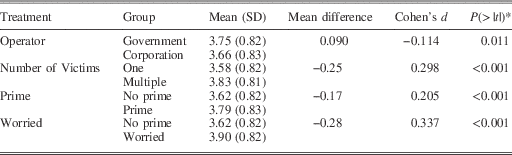
To make the presentation of results intuitive, responses are scored so that higher numbers correspond to higher levels of conspiracism. Means on the primary questions of interest – connection, wrong, and hiding – suggest a tendency toward conspiratorial perceptions: Mconnection=3.98 (sd=0.97), Mwrong=3.50 (0.95), and Mhiding=3.63 (0.99) out of 5.Footnote 50 A t-test comparing means reveals that recipients of the MAP were significantly more prone to see a conspiracy than those who did not receive it, 3.79 versus 3.62 (two-tailed p<0.001).Footnote 51 Yet not all of those who received the prime expressed in a follow-up question that they felt worried at that moment. The mean for those who ‘accepted’ the treatment by indicating that they felt worried or very worried was higher, as expected, at M=3.90. In subsequent models, we use exposure to the MAP as an independent variable. However, similar results obtain if we substitute respondents who accepted the treatment by stating that they were worried.Footnote 52
The second treatment is the operator of the plant: government or corporation. Although we were agnostic as to which would result in higher a C-score as a main effect, respondents were significantly more likely to see a conspiracy if the corporation was involved (Mcorp=3.75, Mgov=3.66; p<0.05). The final treatment is the victim(s). Consistent with expectations, respondents were significantly more likely to see a conspiracy in the condition in which more (unnamed) people died (Mmultiple=3.83, Mindiv=3.58, p<0.001). The manipulation check on sympathy reveals that subjects expressed a high level of sadness under both treatments but with no significant differences between them (Mindiv=3.09, Mmultiple=3.05, p=0.42), suggesting that associations based on the scale of the incident, rather than the emotions it generated, triggered conspiracy perceptions.
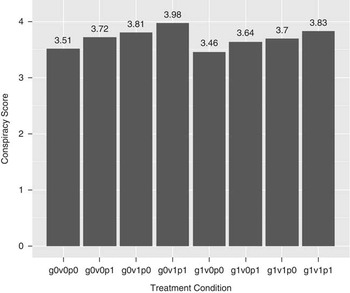
Conspiracy scores by combinations of treatments Note: gov0=corporation; gov1=government; v0=single victim; v1=multiple victims; p0=no prime, p1=prime.

Descriptive Statistics for Conspiracy Scores by Treatment

* P values are adjusted using Holm’s method to control the family-wise type I error rate.
We can look at the results with more precision by breaking the sample down into the eight experimental conditions that result from the 2×2×2 factorial design of the prime and vignette. The most ‘conspiratorial’ combination of treatments, as shown in Table 1, involves the MAP, corporation, and multiple victims. The second most conspiratorial is the MAP, government, and multiple victims. The least conspiratorial version is no MAP, government, and the individual victim. The second least conspiratorial is no MAP, corporation, and individual victim.Footnote 53 Table 1 shows descriptive statistics for C-scores under each treatment and Figure 1 displays the mean C-score for each combination of treatments.
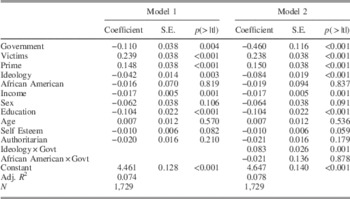
OLS Regressions for Conspiracy Belief

Note: Variables are coded so that higher absolute values correspond to assignment of the macroeconomic anxiety assignment of the government manipulation, more conservative ideology, higher income, positive economic views, higher education, and increasing age. Positive coefficients indicate greater conspiracy belief.prime,
To explore the effect of the experimental treatments along with covariates, we use Ordinary Least Squares (OLS) regression, which has the advantage of being robust and of providing directly interpretable results. We add variables for ideology, black, education, income, sex, age, authoritarian personality, and self-esteem. Results are shown in Model 1 of Table 2. As suggested by the differences in means, the treatments are all highly significant. For example, the expected C-score of recipients of the MAP is 0.148 points higher than for non-primed respondents (p<0.001). Political ideology is negatively associated with conspiracy perceptions, indicating that people on the liberal end of the spectrum are more prone to perceive a conspiracy than conservatives. This may seem unexpected, given the coverage of conservatives’ skepticism about President Obama’s birth certificate. Yet the finding is robust to different model specifications, suggesting that anti-Obama conspiracies stem from the expression of partisan attitudes rather than a general tendency toward conspiracism.Footnote 54 The dispositional variables (Hypotheses 4a and 4b) do not show a strong association with conspiracism. Lower self-esteem is associated with greater conspiracism (p<0.10), but the effect is small (b=−0.010), while authoritarianism exhibits no significant relationship. Consistent with the conventional wisdom, people with less education and lower income are more conspiratorial. However, African Americans do not appear to be more prone to conspiratorial belief.
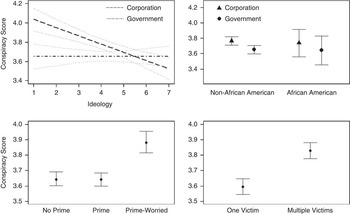
Model 2 introduces interactions terms. Consistent with Hypothesis 2b, the interaction of ideology with the operator treatment is positive and significant (p<0.001),Footnote 55 indicating that when the operator is a corporation, higher levels of liberal ideology increase conspiracy perceptions to a greater extent than when the operator is governmental. But there is no corresponding effect for conservatives in the government condition (Hypothesis 2a). As the visualization in Figure 2 shows, there is little difference between liberals and conservatives who received the government treatment. Thus, the significance of corporation as a main effect was likely due primarily to the responses of this part of the ideological spectrum – liberals, who were more conspiratorial overall. This is reflected in the negative relationship between ideology and C-score in Model 1 (b=−0.042), which does not contain the interaction with the operator treatment.Footnote 56
Simulated effects of treatments on conspiracy perceptions Note: In the top left chart, higher values of ideology indicate being more conservative.

The second interaction, African Americans with the government treatment, is not significant, contrary to Hypothesis 2c, that African Americans should be more suspicious of the government. Yet neither are they more likely to associate corporations with conspiracy. As a main effect (p=0.837) and as part of an interaction (p=0.878), the non-significance of this variable fails to confirm the stereotype of black conspiracism.Footnote 57 Figure 2 shows simulations of expected conspiracy scores for the anxiety prime, the two interactions involving the plant operator, and the victims’ treatment, holding all other variables at their means.Footnote 58 The bottom left chart uses a model including covariates for both assignment of the MAP and acceptance of the treatment (prime-worried). The significance of MAP disappears when adding the second variable, indicating that most of the variation in the MAP is accounted for by those in whom anxiety was induced, as reflected in the visual.
Together, the results show at least three situational paths to conspiracy belief. One is psychological, and stems from a momentarily primed surge of anxiety. The higher scores support the notion that anxiety produces a sensation of loss of control, while the invocation of a conspiracy restores a sense of certainty. A second mechanism is the use of cognitive heuristics. Even though the vignette entailed no explicit partisan information, the identification of the operator as government or corporate provided a cue from which to draw inferences in the face of uncertainty. This occurred along predictable ideological lines, in that increasing levels of liberalism were associated with greater conspiracy perceptions in the corporation condition. Third, the contextual cue of multiple victims lent more plausibility to conspiracy than a recognizable victim. This occurred despite the empirical regularity that an identifiable victim elicits a greater emotional response – although the manipulation check found that people were not more sympathetic to the victims in either treatment. Jointly, the three treatments significantly increase explained variation in conspiratorial thinking over the other covariates in the model (p<0.001). These findings provide support for the idea that conspiracy belief depends on context and is not simply a manifestation of persistent psychological traits.
Discussion and Conclusions
The study of conspiracy theories has evolved since Hofstadter’s focus on right-wing anger and paranoia, yet even recent investigations have centered on enduring personality traits as a root cause for conspiracy belief. This article has shown that the formation of conspiracy beliefs is also conditional on context. Using a fictitious scenario embedded in a survey experiment, we revealed that people can come to adopt conspiratorial beliefs on the basis of factors both internal and external to the information on which they are asked to render judgment. This insight challenges the notion that individual differences are sufficient to account for the formation of conspiracy beliefs, and supports the emerging research agenda that conceives the development conspiratorial beliefs as a dynamic and contingent process.Footnote 59
One of the main findings of this study was the effect on conspiracy belief of heightened anxiety stemming from the experimental prime. Anxiety caused subjects, when confronted with the conspiracy vignette, to impute (malign) agency to the biochemical plant at higher rates than those who were not primed. Anxiety has been associated with openness to new information,Footnote 60 risk aversion,Footnote 61 a desire to assert control,Footnote 62 and identification of scapegoats,Footnote 63 but it has only recently been linked experimentally to conspiracy belief. It has not yet been incorporated into the non-experimental literature or popular writing on conspiracy theories.Footnote 64
The association of anxiety with conspiracy perceptions perhaps confirms what political entrepreneurs already know: an anxious mind is a pliable one. The anxiety mechanism may help explain why conspiracy theories, though present in every society at times, become more salient when prevailing conditions threaten people’s economic security or when there are political benefits to stoking anxiety.Footnote 65 It may be no accident that politicians act out the two-step process simulated in this study, fomenting suspicion and uncertainty and then proffering solutions by identifying a source of blame. This mechanism may also explain why, since the 2008 financial crisis, there appears to have been an uptick in the prevalence of conspiracy theories unrelated to the financial crisis.Footnote 66
The treatment for the operator of the biochemical plant tested for an entirely different mechanism by serving as a heuristic cue. On average, subjects who received the corporation treatment scored higher on conspiracy perceptions. At the time of the survey, criticism of the Wall Street ‘bailouts’ was in the news, making salient a discourse on corporate greed. Yet this effect was conditional on political ideology; it was only in the corporation version of the treatment that (liberal) ideology was associated with greater conspiracy perceptions. This is a striking finding for two reasons. First, the cue in this experiment was more subtle than the highly charged issues used in experiments on motivated reasoning,Footnote 67 yet the minimal information provided was sufficient for people to assert or reject culpability. Second, although conservatives have received significant recent attention for their propensity toward conspiracy theories, government was not affectively charged for them in the same way corporation was for liberals.Footnote 68 Research on the Tea Party movement suggests that more explicit cues such as ‘Obama’ or ‘liberal’ might carry greater negative valence that could result in conspiratorial attitudes for extreme conservatives.Footnote 69
In the third treatment, subjects were more likely to associate multiple deaths with conspiracy, despite the lack of personal information for the victims. In the context of the vignette, it is logical that if a biochemical accident occurred, the putative conspirator would have a strong incentive to cover up numerous deaths, whereas an individual death might generate less attention and could more easily be explained away. Intuition and rules of thumb about the requisites of a conspiracy appear to have outweighed emotional triggers arising out of sympathy. This may go part of the way toward explaining the persistence of the 9/11 Truther movement; the vast scale of the event heightens the attractiveness of imputing an elaborate and sinister explanation, even though the scale also makes a cover-up implausible. The finding is also consistent with another interpretation: multiple victims represent a pattern, which, as referenced above, helps people resolve uncertainty and biases cognition toward conspiracy.Footnote 70
The findings provide evidence that people can exhibit conspiratorial thinking without necessarily subscribing to a monological belief systemFootnote 71 or exhibiting predictable individual differences.Footnote 72 Some of the factors thought to be associated with conspiracy theories such as low education and low income were found to be strongly associated. Self-esteem was found to be (marginally) but significant but authoritarianism was not. African Americans are no more likely than others to perceive a conspiracy than other groups. Demographic and dispositional traits thus have some bearing on conspiracy belief, as findings elsewhere have shown, but the evidence here that conspiracism can be experimentally induced points to previously neglected mechanisms that can bring about the same result by different means.
This study can be extended in several ways. The fact that the vignette did not come with expressive or political baggage, one of the main virtues of this study, also makes it different from the well-known conspiracy theories that concern scholars and the broader public. Because respondents had no previous exposure to the vignette, their assessments may be shallower and more ephemeral than their beliefs about ‘real world’ conspiracies. To approximate popular political conspiracies, future work might use fictitious events involving real actors, although that would risk embedding affective cues that reintroduce details which confound measurement of the sources of belief. Another direction for future research is to incorporate social aspects of conspiracy theories. As political preferences are shaped by social influences,Footnote 73 so is identification with conspiracy theories.Footnote 74 Research examining both their believability and the social capital that accrues to those who embrace them can reveal why some theories become viable and spread through networks while others do not.
Taken as a whole, the findings lend some insight into how ordinary Americans – and not only the paranoid and powerless – can become conspiracy theorists. Elites who seek to mobilize opinion can (and do) disseminate insinuating information, through the media and repetition, over time to shape attitudes in systematic ways. Mass opinion about agency and causality in the political world, which at times is articulated as a conspiracy theory, tends to follow elite cues.Footnote 75 Yet not all conspiracizing is elite driven.Footnote 76 In most cases, people are forced to make judgments about issues that are not of global or national importance, and must come to their own conclusions about how the system works. Faced with uncertainty in daily life, people make snap judgments about whom and how much to (dis)trust. Although not all working hypotheses become grand conspiracies on a par with the Kennedy assassination, it is at the cognitive and grassroots level that mass attitudes take shape. By identifying the conditions under which individuals are drawn toward conspiracy thinking, we can understand why some conspiracy theories eventually become mainstream and take on political salience.
Yet there continues to be a disjuncture between the ubiquity of conspiracy belief and the stigma attached to it, which has shaped how scholars study the phenomenon. It may be that people who have the potential for conspiratorial thinking do not openly admit it – or may not even be aware of it themselves – causing us to neglect ordinary believers in favor of the most strident voices. If this is the case, then we might revise how we see the role of conspiracy theories in American politics. Rather than a marginal phenomenon, scholars should study conspiracy theories as a natural byproduct of political reasoning under uncertainty, as people contend with multifarious voices in the media and on the internet, and cope with structural forces outside their control.Footnote 77 And while the prevalence of conspiracy theories may rise and fall with economic and political shifts, they are likely never to disappear completely.