


Introduction
Alien species are a major cause of biodiversity loss globally (Bellard et al. Reference Bellard, Cassey and Blackburn2016), and their negative effects are felt strongly in vulnerable island ecosystems (McCreless et al. Reference McCreless, Huff, Croll, Tershy, Spatz and Holmes2016, Bellard et al. Reference Bellard, Rysman, Leroy, Claud and Mace2017, Russell & Kaiser-Bunbury Reference Russell and Kaiser-Bunbury2019). Seabirds using those islands as breeding grounds are particularly sensitive to the negative impacts of alien species (Spatz et al. Reference Spatz, Holmes, Reguero, Butchart, Tershy and Croll2017, Holmes et al. Reference Holmes, Spatz, Oppel, Tershy, Croll and Keitt2019). Seabirds are amongst the most threatened vertebrates globally and are the subject of intensive research and conservation efforts worldwide (Croxall et al. Reference Croxall, Butchart, Lascelles, Stattersfield, Sullivan, Symes and Taylor2012, Barbraud Reference Barbraud2017, Dias et al. Reference Dias, Martin, Pearmain, Burfield, Small and Phillips2019, Rodríguez et al. Reference Rodríguez, Arcos, Bretagnolle, Dias, Holmes and Louzao2019). Population growth rates in seabirds are generally driven by adult survivorship and juvenile recruitment rates and, as such, processes negatively influencing either of these demographic parameters need to be explicitly considered in the conservation and recovery plans of threatened seabirds (Russell Reference Russell and Musick1999, Sæther & Bakke Reference Sæther and Bakke2000, Croxall et al. Reference Croxall, Butchart, Lascelles, Stattersfield, Sullivan, Symes and Taylor2012). Seabird juvenile recruitment is negatively affected by the impacts of alien species (Spatz et al. Reference Spatz, Holmes, Reguero, Butchart, Tershy and Croll2017, Dias et al. Reference Dias, Martin, Pearmain, Burfield, Small and Phillips2019, Rodríguez et al. Reference Rodríguez, Arcos, Bretagnolle, Dias, Holmes and Louzao2019), whereas mortality from fisheries by-catch is a major factor affecting adult survival (Anderson et al. Reference Anderson, Small, Croxall, Dunn, Sullivan, Yates and Black2011, Dias et al. Reference Dias, Martin, Pearmain, Burfield, Small and Phillips2019, Rodríguez et al. Reference Rodríguez, Arcos, Bretagnolle, Dias, Holmes and Louzao2019). Understanding the current trends and factors shaping those two key demographic parameters is fundamental for designing and implementing effective conservation actions to manage seabird populations (Russell Reference Russell and Musick1999, Sæther & Bakke Reference Sæther and Bakke2000, Jones et al. Reference Jones, Lyver, Davis, Hughes, Anderson and Hohapata-Oke2015, Buxton et al. Reference Buxton, Jones, Lyver, Towns and Borrelle2016).
The pink-footed shearwater (Ardenna creatopus) is a globally threatened species, listed as ‘Vulnerable’ by the International Union for Conservation of Nature (IUCN 2017), and considered as ‘Endangered’ in Chile (https://clasificacionespecies.mma.gob.cl) and Canada (Committee on the Status of Endangered Wildlife in Canada 2018). In 2015, the species was added to the Agreement on the Conservation of Albatrosses and Petrels, a binding international treaty created to advance the conservation of threatened procellariiform seabirds (Azócar et al. Reference Azócar, García, Colodro, Arata, Hodum and Morgan2013). Its vulnerable status is attributable to anthropogenic threats, its restricted breeding range (exclusive to Isla Mocha and the Juan Fernández Archipelago in Chile) and a relatively small breeding population size (Brooke Reference Brooke2004, Croxall et al. Reference Croxall, Butchart, Lascelles, Stattersfield, Sullivan, Symes and Taylor2012, IUCN 2017).
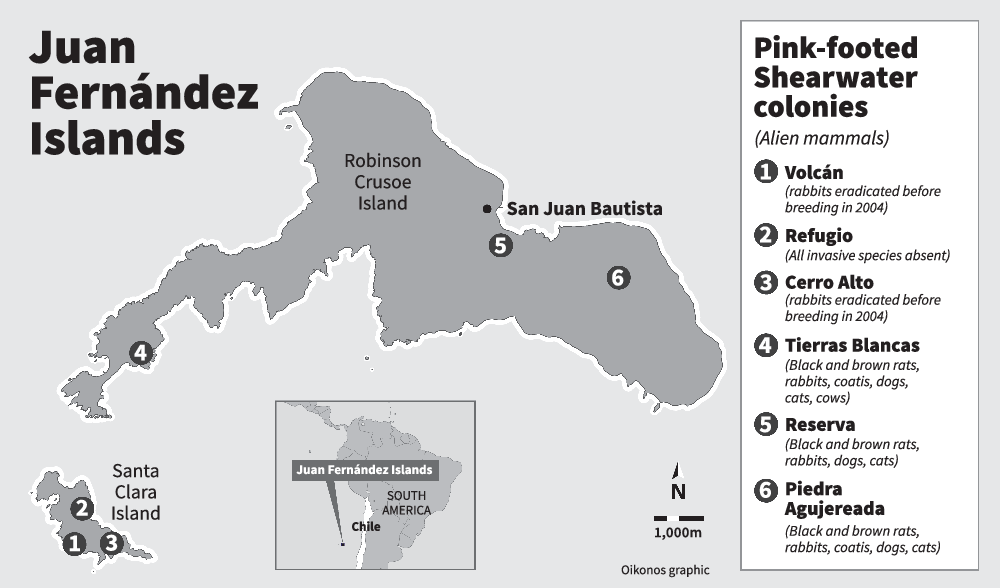
Pink-footed shearwaters suffer from fisheries by-catch mortality and the negative impacts of alien mammals (Suazo et al. Reference Suazo, Cabezas, Moreno, Arata, Luna-Jorquera and Simeone2014, Carle et al. Reference Carle, Beck, Colodro and Hodum2016, Reference Carle, Felis, Vega, Beck, Adams and López2019). A wide range of alien mammals are present in the breeding colonies of the pink-footed shearwater (Croxall et al. Reference Croxall, Butchart, Lascelles, Stattersfield, Sullivan, Symes and Taylor2012, Committee on the Status of Endangered Wildlife in Canada 2018). For example, in the Juan Fernández Archipelago, seven species of alien mammals are suspected of interacting with pink-footed shearwaters in their colonies (Fig. 1) (Hahn & Römer Reference Hahn and Römer2002, Croxall et al. Reference Croxall, Butchart, Lascelles, Stattersfield, Sullivan, Symes and Taylor2012): feral cats and dogs (Felis catus and Canis lupus familiaris, respectively), southern coati (Nasua nasua), rats (Rattus rattus and Rattus norvegicus), European rabbits (Oryctolagus cuniculus) and cattle (Bos taurus). Mice (Mus musculus) are present on the islands and likely in the colonies. Given that we had only partial information on their presence in the different pink-footed shearwater colonies, we did not include them in the present study. The impacts of these alien mammals on the breeding ecology and reproductive performance of the pink-footed shearwater are poorly understood, despite mammal control and eradication being priorities for the conservation of the species (Hahn & Römer Reference Hahn and Römer2002, Croxall et al. Reference Croxall, Butchart, Lascelles, Stattersfield, Sullivan, Symes and Taylor2012). The seven alien mammals may exert a range of negative pressures on breeding shearwaters, from predation (e.g., by cats, coatis and rats) to habitat alteration and competition for burrowing space (e.g., European rabbits and cattle) (Imber et al. Reference Imber, Harrison and Harrison2000, Jones et al. Reference Jones, Holmes, Butchart, Tershy, Kappes and Corkery2016, McCreless et al. Reference McCreless, Huff, Croll, Tershy, Spatz and Holmes2016, Stolpmann et al. Reference Stolpmann, Landers and Russell2019).
Geographical location and alien mammal assemblages present in six colonies of the pink-footed shearwater in the Juan Fernández Archipelago.

In this study, we focused on assessing the effects of different alien mammal assemblages on burrow occupancy by breeding pink-footed shearwater pairs in the Juan Fernández Archipelago (Robinson Crusoe and Santa Clara islands; Fig. 1) and their subsequent hatching success in that breeding burrow, defined as the presence of a chick in the burrow (Dinsmore et al. Reference Dinsmore, White and Knopf2002, Shaffer & Thompson Reference Shaffer and Thompson2007). The presence of different mammal assemblages, and their concurrent management on the two islands, in the various breeding colonies yielded a natural variability that allowed us to investigate the effects of these assemblages on breeding pink-footed shearwaters. In the colonies on Robinson Crusoe Island, seven introduced species were present during the study (Fig. 1; based on Croxall et al. Reference Croxall, Butchart, Lascelles, Stattersfield, Sullivan, Symes and Taylor2012): black and brown rats, European rabbits, southern coati, feral dogs, feral cats and cattle. All of these species were present at all Robinson Crusoe shearwater colonies (Hahn & Römer Reference Hahn and Römer2002), with the exception of cows being excluded from Piedra Agujereada (Carle et al. Reference Carle, Beck, Colodro and Hodum2016) and cows and coatis being absent from Reserva. On Santa Clara Island (Fig. 1), only rabbits were present at Cerro Alto and Volcán before the 2004 breeding season (95 and 96 burrows monitored while rabbits were present, respectively). No alien mammals were present at Refugio during the whole monitoring period, and none were present at Cerro Alto and Volcán after the 2003 breeding season when rabbits were eradicated (281 and 598 burrows monitored, respectively). We also assessed trends in burrow occupancy and hatching success as functions of the breeding island and breeding year.
Methods
Study area
The Juan Fernández Archipelago is a volcanic group of islands and islets located c. 660 km off the coast of central Chile (Fig. 1). The three main islands of the archipelago – Robison Crusoe (48.0 km2), Santa Clara (2.2 km2) and Alejandro Selkirk (49.5 km2) – are characterized by a rugged topography and a subtropical climate (Haberle Reference Haberle, Gillespie and Clague2009). Forested areas occur in lowland areas and gullies, whereas the upper elevations are dominated by bush and grasslands, interspersed with unvegetated zones (Stuessy et al. Reference Stuessy, Swenson, Crawford, Anderson and Mario-Silva1998, Bernardello et al. Reference Bernardello, Anderson, Stuessy and Crawford2006, Haberle Reference Haberle, Gillespie and Clague2009). The proximity of the archipelago to the Humboldt Current means that the ocean surrounding the islands is relatively productive, which in turn translates into high terrestrial and marine biodiversity (Hahn et al. Reference Hahn, Römer, Vergara and Walter2009). It is not surprising, then, that the Juan Fernández Archipelago is home to important breeding colonies of seabirds and the Juan Fernández fur seal (Arctocephalus philippii) (Colwell Reference Colwell1989, Bourne et al. Reference Bourne, de Brooke, Clark and Stone1992, Hahn et al. Reference Hahn, Römer, Vergara and Walter2009). The natural values of the Juan Fernández Archipelago are recognized and protected as a Chilean National Park (www.conaf.cl/parques/parque-nacional-archipielago-juan-fernandez).
The Juan Fernández Archipelago is sparsely populated by humans, with a total population of 926 people in 2017 (https://reportescomunales.bcn.cl/2017/index.php/Juan_Fernández). The entire population lives in San Juan Bautista on Robinson Crusoe Island (the main township in the islands) and seasonally on Alejandro Selkirk, while Santa Clara Island is uninhabited.
Monitoring of pink-footed shearwater breeding colonies
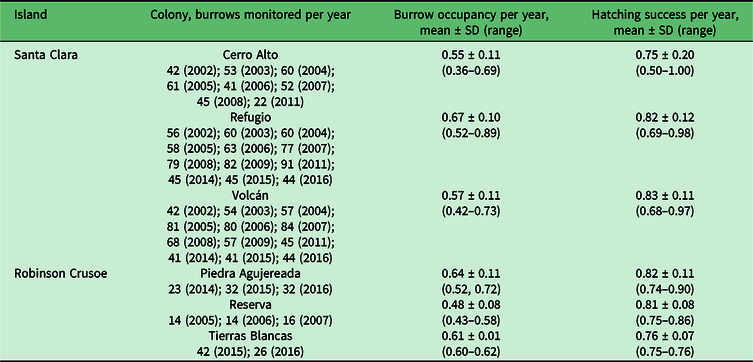
We monitored a representative sample of breeding burrows in six colonies on two islands in the Juan Fernández Archipelago (Fig. 1 & Table 1): Robinson Crusoe Island (three colonies) and Santa Clara Island (three colonies). The ruggedness of the terrain and the difficulty of access to the breeding colonies imposed logistical and safety constraints to monitoring the breeding colonies. Moreover, many breeding burrows were located in soft volcanic soil, making them prone to being altered or destroyed by human activity. Therefore, we took care to ensure that our monitoring activities did not disturb or affect the breeding burrows. Our monitoring regime included reproductive samples chosen non-randomly to maximize spatial representativeness within colonies while ensuring accessibility for the researchers and a low risk of disturbance to the breeding burrows. In each colony, we monitored 30–100 burrows each year (Table 1). We excluded from the sample any burrows that were too long for the infrared camera to confirm nest contents (the 3-m-long camera was sufficient to see the back of the majority of burrows). In the smaller colonies on Santa Clara Island, all viable burrows were included.
Characteristics of the six pink-footed shearwater colonies monitored in the Juan Fernández Archipelago. Number of burrows monitored each year and summary statistics of the burrow occupancy and hatching success per year are shown (mean ± standard deviation, and range; excluding missing data for hatching success).

The breeding burrows were monitored using a miniature camera with infrared illumination through two stages of the annual reproductive season: (1) burrow occupancy – the viable burrow being occupied by a breeding pair with an egg; and (2) hatching success – transitioning from the presence of an egg in a burrow to the presence of a chick. All of the burrows were monitored during the first stage (burrow occupancy), but not all of them were monitored during the second stage (hatching success) within the same reproductive season. Unoccupied burrows were not monitored for hatching success, and we optimized our monitoring efforts by selecting a sample of occupied burrows to be subsequently surveyed for hatching success. Burrow occupancy was determined by two checks during the incubation period between late December and mid-January. Burrows were considered occupied if an egg was seen once or if an adult was seen in the burrow during both checks (it was not always possible to see the egg under the incubating bird). A previous study determined that >99% of burrows with adults observed during both incubation-stage checks contained an egg (Hodum et al. unpublished data). We determined hatching success by checking burrows once during mid- to late February, following the conclusion of the hatching period. Presence of a chick during this check indicated successful hatching, while absence of a chick indicated failure to hatch. Burrows with no egg or an unattended egg during the hatching check were considered to have failed to hatch a chick. Similarly to other procellarid seabirds, pink-footed shearwaters are not known to re-lay eggs after the first attempt, so failure to hatch indicated reproductive failure for a breeding pair for the entire year.
Three colonies were monitored on Robinson Crusoe Island (see Fig. 1 & Table 1 for further details): (1) Piedra Agujereada had a total of 87 burrows monitored from 2014 to 2016 (total 64 burrows with information on hatching success, 73.6%); (2) Reserva had a total of 44 burrows monitored from 2005 to 2007 (30 burrows with information on hatching success, 68.2%); and (3) Tierras Blancas had 67 burrows monitored from 2015 to 2016 (all burrows with information on hatching success). Another three colonies were monitored on Santa Clara Island (see Fig. 1 & Table 1 for further details): (1) Cerro Alto had a total of 376 burrows monitored from 2002 to 2016 (221 with information on hatching success, 58.8%); (2) Refugio had a total of 760 burrows monitored from 2002 to 2016 (386 burrows without information on hatching success, 50.8%); and (3) Volcán had a total of 694 burrows monitored from 2002 to 2016 (360 burrows with information on hatching success, 51.9%). Note that the number and spatial location of the breeding burrows monitored were not necessarily constant across the whole study period.
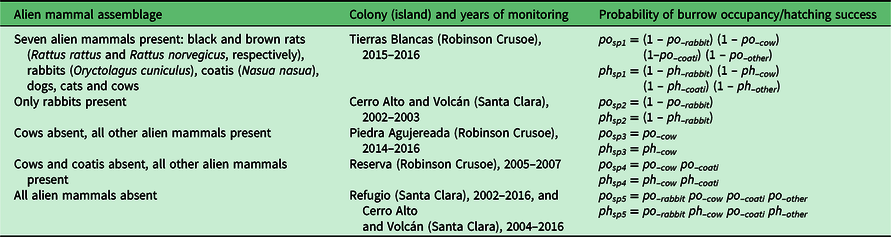
The spatial and temporal autocorrelation induced by our monitoring design was accommodated in our modelling framework that accounts for the year- and island-specific effects (see details below). The between- and within-island variation in the presence of alien mammals allowed us to develop and fit a statistical model to evaluate the impacts of different alien mammal assemblages on the burrow occupancy and hatching success of the pink-footed shearwater (Table 2). The presence of each of the seven alien mammals in each of the six pink-footed shearwater colonies was obtained from the literature (Hahn & Römer Reference Hahn and Römer2002, Croxall et al. Reference Croxall, Butchart, Lascelles, Stattersfield, Sullivan, Symes and Taylor2012, Carle et al. Reference Carle, Beck, Colodro and Hodum2016) and from our personal observations during the fieldwork. The burrow monitoring data are publicly available from FigShare: 10.6084/m9.figshare.12017814.
Calculation of the probabilities of burrow occupancy and hatching success as a function of the five alien mammal assemblages in the six colonies monitored.

p –rabbit = the probability of occupancy (po) or hatching success (ph) given rabbits are absent (i.e., the probability of burrow occupancy or hatching success when only rabbits are absent); p –cow = the probability of occupancy (po) or hatching success (ph) given cows are absent (i.e., the probability of burrow occupancy or hatching success when only cows are absent); p –coati = the probability of occupancy (po) or hatching success (ph) given southern coatis are absent (i.e., the probability of burrow occupancy or hatching success when only southern coatis are absent); p –others = the probability of burrow occupancy (po) or hatching success (ph) given alien mammals other than cows, coatis and rabbits are absent, but cows and rabbits are present (i.e., the probability of burrow occupancy or hatching success when cows, coatis and rabbits are absent, but other alien mammals are present).
Statistical analysis
We developed a model to separate the effects of alien species assemblages (Table 2), the island where the monitored burrows were located (Santa Clara or Robinson Crusoe) and the monitoring year. We assumed that these three factors affected the observed burrow occupancy and hatching success independently. This means that the observed burrow occupancy and hatching success in each monitored burrow were assumed to be the outcomes of the combined, but independent, effects of the three factors. This yielded a model whose components can be interpreted as the probabilities of burrow occupancy and hatching success directly attributable to the alien mammal assemblages, the island and the monitoring year alone, regardless of the effects of the other factors. Therefore, to obtain the probability of burrow occupancy and hatching success in any given breeding burrow on any of the two islands, it was necessary to use the three independent probability estimates together and not separately (see model description below).
We modelled the transitions between the two subsequent stages, defining burrow occupancy and hatching success as a function of five alien species assemblages, monitoring year and island through a Bayesian hierarchical model, whereby one stage depends on the state of the previous stage (Hobbs & Hooten Reference Hobbs and Hooten2015, Kéry & Royle Reference Kéry and Royle2016):
 $${O_{j,z,y}}\sim Bernoulli\left( {p{o_{j,z,y}}{V_{j,z,y}}} \right),$$
 $$p{o_{j,z,y}} = 1\!-\!\left( {\left( {1-p{o_z}} \right)\left( {1-p{o_{sp}}} \right)\left( {1\!-\!p{o_y}} \right)} \right),$$
 $${\rm{logit}}\left( {p{o_y}} \right) = \beta oy\,{\rm{year}},$$
where O j,z,y ϵ {0, 1} is the occupancy of breeding burrow j of a colony on island z during year y, V j,z,y is the viability of breeding burrow j of a colony on island z during year y, po j,z,y is the probability of occupancy of breeding burrow j of a colony on island z during year y, po z is the island-specific probability of burrow occupancy (one parameter for each island), po sp is the alien mammal assemblage-specific probability of burrow occupancy (see Table 2 for equations to derive these probabilities), po y is the year-specific probability of burrow occupancy and βoy is the effect, on the logit scale, of the monitoring year on po y. The hatching success was modelled conditional on burrow occupancy (a burrow needs to be occupied for hatching to occur):
 $${H_{j,z,y}}\sim Bernoulli\left( {p{h_{j,z,y}}\,{O_{j,z,y}}} \right),$$
 $$p{h_{j,z,y}} = 1\!-\!\left( {\left( {1-p{h_z}} \right)\,\left( {1\!-\!p{h_{sp}}} \right)\,\left( {1\!-\!p{h_y}} \right)} \right),$$
 $${\rm{logit}}\left( {p{h_y}} \right) = \beta hy\,{\rm{year}},$$
where H j,z,y ϵ {0, 1} is the hatching success in burrow j of a colony on island z during year y, ph j,z,y is the probability of hatching success in burrow j of a colony on island z during year y, ph z is the island-specific probability of hatching success (one parameter for each island), ph sp is alien mammal assemblage-specific probability of hatching success (see Table 2 for equations to derive these probabilities), ph y is the year-specific probability of hatching success and βhy is the effect, on the logit scale, of the monitoring year on ph y.
Note that the effect of the monitoring year was measured by equating the first year when any monitoring occurred (2002) to zero, and subsequent years were re-coded accordingly as one (2003), two (2004) and so on. Therefore, the year 2002 provided the baseline for assessing the temporal trends. The year 2002 was also the reference for those colonies for which the first monitoring took place later than 2002. For instance, this means that the first year that Piedra Agujereada was monitored (2014) was re-coded as 12 in our analyses. By following this approach, together with the cross-validation procedure described below, we reduced the potential biases in the modelling induced by the unbalanced sample size corresponding to each year and colony (Table 1). Moreover, we did not estimate year-specific parameters (i.e., one parameter for each year), but instead a trend across years and colonies. This will further minimize any potential effects of the unequal sample sizes.
Our hierarchical model was fitted to the breeding burrow monitoring data using Bayesian Markov chain Monte Carlo methods implemented in the package NIMBLE (de Valpine et al. Reference de Valpine, Turek, Paciorek, Anderson-Bergman, Lang and Bodik2017) as interfaced to the R statistical environment (R Development Core Team 2019). Given the imbalance in the monitoring data (different sample sizes for the two islands and the five invasive species assemblages) and the missing hatching success data, we used a 10-fold cross-validation approach to fit and validate the model (Hooten & Hobbs Reference Hooten and Hobbs2015, Roberts et al. Reference Roberts, Bahn, Ciuti, Boyce, Elith and Guillera-Arroita2017, Conn et al. Reference Conn, Johnson, Williams, Melin and Hooten2018). In each fold, we randomly selected 30 burrow occupancy observations of each alien mammal assemblage (150 observations in total) and randomly assigned 70% of those observations to a within-sample data set (a training data set used to fit the model; 105 observations) and 30% to an out-of-sample data set (a test data set used to validate the model; 45 observations). This procedure produced a total of 150 burrow occupancy observations used in each fold, such that for each alien mammal assemblage there were 21 observations in the within-sample data set and nine observations in the out-of-sample data set.
We ran our Bayesian hierarchical model using one chain with 42 000 iterations and no thinning in each of the 10 folds. We discarded the first 2000 iterations of each fold as burn-in time after visually checking for the appropriate mixing and convergence of the 10 chains (one chain per fold). This procedure produced a total of 400 000 draws of the posterior distribution of all of the parameters in the hierarchical model. We used relatively uninformative Beta priors for all the probability parameters in the hierarchical model ~Beta (1,1) and an uninformative Normal prior for the effects of the monitoring year, βoy and βhy, ~Normal (0, σ = 3.16). The script for fitting the Bayesian hierarchical model is available in Supplementary Appendix S1 (available online). We assessed the goodness of the fit and the predictive abilities of the hierarchical model by estimating a Bayesian p-value based on the deviance of the model (Hobbs & Hooten Reference Hobbs and Hooten2015, Kéry & Royle Reference Kéry and Royle2016, Conn et al. Reference Conn, Johnson, Williams, Melin and Hooten2018). A Bayesian p-value compares the estimate of a goodness-of-fit test – the deviance in this case – with the test expected value if the model is adequate. Extreme Bayesian p-values (i.e., <0.05 or >0.95) indicate a poor-fitting model (Hooten & Hobbs Reference Hooten and Hobbs2015, Kéry & Royle Reference Kéry and Royle2016, Conn et al. Reference Conn, Johnson, Williams, Melin and Hooten2018).
Results
The percentages of occupied burrows and hatching success were similar across colonies and the two islands when considered collectively (i.e., without accounting for the effects of alien mammals and differences between monitoring years; Table 1). The three colonies on Santa Clara Island had mean burrow occupancy percentages above 50% across monitoring years (Cerro Alto: 55.0%; Refugio: 67.0%; and Volcán: 57.0%). In comparison, the three colonies on Robinson Crusoe Island showed more variability across monitoring years (Piedra Agujereada: 64.0%; Reserva: 48.0%; and Tierras Blancas: 61.0%). The hatching success in those occupied burrows was relatively high across colonies and, considering the whole study period, was always above 75%. Across years, the mean hatching success of Santa Clara Island’s colonies (Cerro Alto: 75.0%; Refugio: 82.0%; and Volcán: 83.0%) was remarkably similar to the estimates from Robinson Crusoe Island’s colonies (Piedra Agujereada: 82.0%; Reserva: 81.0%; and Tierras Blancas: 76.0%).
Our Bayesian hierarchical model fitted the data (within-sample Bayesian p-value (mean ± standard error): 0.13 ± 0.08; 95% credible interval (CI): 0.03–0.26) and predicted the out-of-sample data adequately (0.34 ± 0.10; 95% CI: 0.22–0.48). Nonetheless, the 10-fold 95% CIs for the Bayesian p-value of the within-sample data set also included 0.03, suggesting that in some rare instances the model might not fit the data adequately.
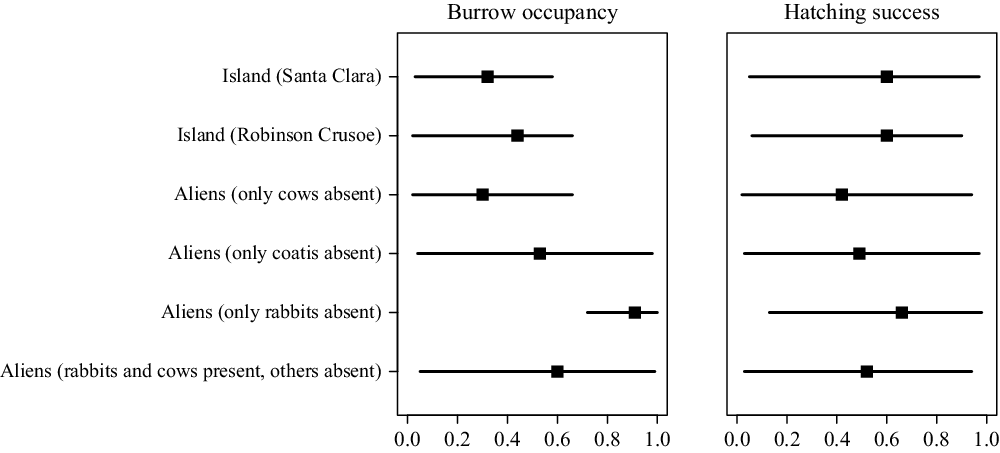
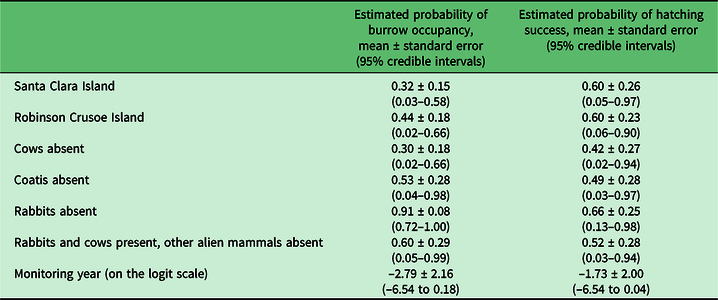
The posterior estimates of the parameters of the model indicated that there were differences in the probability of burrow occupancy, but not in the hatching success. Hatching success was similar across islands and alien mammal assemblages (Fig. 2 & Table 3), with estimates overlapping widely. On the other hand, there were substantial differences in the effects of the same factors on burrow occupancy (Fig. 2 & Table 3). The probability of burrow occupancy was lower in Santa Clara Island than in Robinson Crusoe Island after accounting for the effects of the alien mammal assemblages and the monitoring year (Fig. 2 & Table 3). This result suggests there may be processes other than alien mammal assemblage and year affecting the burrow occupancy of pink-footed shearwaters on Santa Clara Island that do not exist on Robinson Crusoe Island. Both burrow occupancy (monitoring year effect (logit scale), –2.79 ± 2.16; 95% CI: –6.54 to 0.18) and hatching success (–1.73 ± 2.00; 95% CI: –6.54 to 0.04) showed a negative temporal trend, which suggests that burrow occupancy and hatching success had declined over the monitoring period, regardless of the island and the pressure of invasive mammals. Nonetheless, the posterior 95% CI of the effect of monitoring year marginally overlapped zero, implying that the negative trends were slightly uncertain (Table 3).
Posterior estimates (means and 95% credible intervals) of the probabilities of burrow occupancy and hatching success on two islands and with five alien mammal assemblages. See Table 2 for the equations used to estimate these parameters from the monitoring data

Posterior estimates of the parameters of the hierarchical model of burrow occupancy and hatching success in six pink-footed shearwater colonies. Note that these estimates show the probabilities independently. In order to obtain the probability of burrow occupancy or hatching success in any given burrow on any of the two islands, it is necessary to use the independent probability estimates together (i.e., the effect of year, the effect of island and the effect of alien mammals).

The absence of rabbits from pink-footed shearwater colonies resulted in the highest probabilities of burrow occupancy and hatching success compared to the absence of other alien mammals (Fig. 2 & Table 3). The absence of cows, coatis and other alien mammals produced almost identical effects on burrow occupancy and hatching success (Fig. 2 & Table 3). The impacts of alien mammal assemblages on hatching success were more uncertain than they were on burrow occupancy, implying unclear effects of mammal assemblages on the hatching success of the pink-footed shearwater (Fig. 2 & Table 3).
Discussion
Our field monitoring and quantitative modelling revealed that both burrow occupancy and hatching success were similar across six pink-footed shearwater colonies, but these patterns are the product of different underlying mechanisms. The observed variability in burrow occupancy and hatching success was a consequence of the differences in burrow occupancy probabilities rather than in hatching success. Therefore, conservation interventions attempting to improve the reproductive performance of pink-footed shearwaters would better focus on understanding and managing burrow occupancy rather than hatching success. Our results showed that burrow occupancy was determined by the interplay between the impacts of the alien mammal assemblages using the shearwater colonies and other uncertain factors specific to each island. That is, we found differences between the two islands even after controlling for the monitoring year and alien mammal assemblages. Nevertheless, it is important to re-emphasize that our results do not imply that the overall observed burrow occupancy on Santa Clara Island was necessarily lower than on Robinson Crusoe Island, because we modelled the overall burrow occupancy as emerging from the collective effects of the three factors modelled, rather than in isolation.
Our analysis showed that the presence of rabbits had a negative impact on the burrow occupancy of pink-footed shearwaters, whereas the impacts of the other six alien mammals were more uncertain, although they did exist. These findings concur with previous research showing the negative impacts of invasive rabbits on breeding seabirds globally (Imber et al. Reference Imber, Harrison and Harrison2000, Olivera et al. Reference Olivera, Menezes, Trout, Buckle, Geraldes and Jesus2010, Brodier et al. Reference Brodier, Pisanu, Villers, Pettex, Lioret, Chapuis and Bretagnolle2011, Towns et al. Reference Towns, Borrelle, Thoresen, Buxton and Evans2016). Interference competition, whereby rabbits monopolize the available habitat and thus exclude breeding shearwaters, is the most likely direct impact of rabbits on pink-footed shearwaters (Ainley & Lewis Reference Ainley and Lewis1974, Brodier et al. Reference Brodier, Pisanu, Villers, Pettex, Lioret, Chapuis and Bretagnolle2011). Rabbits may also affect the burrow occupancy of pink-footed shearwaters indirectly. For example, rabbit grazing pressure can lead to the severe alteration of plant communities, resulting in seabird burrow damage and breeding habitat loss due to erosion (Bergstrom et al. Reference Bergstrom, Lucieer, Kiefer, Wasley, Belbin, Pedersen and Chown2009, Bried et al. Reference Bried, Magalhães, Bolton, Neves, Bell and Pereira2009).
Interestingly, the uncertain effects of the other six alien mammals, including coatis, rats and cats, on pink-footed shearwater burrow occupancy and hatching success contrasted with the negative effects of alien mammal predators on the reproductive performance of other seabird species reported on other islands (Imber et al. Reference Imber, Harrison and Harrison2000, Jones et al. Reference Jones, Tershy, Zavaleta, Croll, Keitt, Finkelstein and Howald2008, Reference Jones, Holmes, Butchart, Tershy, Kappes and Corkery2016, McCreless et al. Reference McCreless, Huff, Croll, Tershy, Spatz and Holmes2016). Nevertheless, and similarly to our results, the abundance of Mediterranean shearwater species has not been found to be limited by invasive rats (Ruffino et al. Reference Ruffino, Bourgeois, Vidal, Duhem, Paracuellos and Escribano2009). Similarly, rat visitation rates to grey-faced petrel (Pterodroma gouldi) nests in New Zealand do not seem to influence hatching success (Stolpmann et al. Reference Stolpmann, Landers and Russell2019). It is important to note that we evaluated the negative effects of alien mammal assemblages only on burrow occupancy and hatching success, and it is probable that predatory alien mammals impact other life stages such as chick fledging and/or survival of adults, which we did not assess here. Indeed, there are documented instances of predation on pink-footed shearwater adults and chicks by cats and coatis (Hahn & Römer Reference Hahn and Römer2002, Hodum et al. unpublished data). In summary, more information is needed in order to evaluate the hypothesis that only rabbits affect the reproductive ecology of pink-footed shearwaters.
Despite the overall burrow occupancy being similar on Santa Clara and Robinson Crusoe islands (Table 1), our modelling showed that, after accounting for the differences in alien mammal assemblages and temporal trends, burrow occupancy was lower on Santa Clara Island than on Robinson Crusoe Island (Table 2). This result might deserve further research, as it suggests there may be processes affecting the burrow occupancy of pink-footed shearwaters on Santa Clara Island that do not affect the colonies on Robinson Crusoe Island. Potential differences unrelated or indirectly related to alien mammal assemblages that could result in lower occupancy on Santa Clara Island are greater rates of erosion and burrow damage related to loss of native vegetation from intense historical rabbit, sheep and goat herbivory and rockier soil resulting in shorter, perhaps less desirable burrowing habitat. In addition, we found a negative temporal trend in both burrow occupancy and hatching success, although this trend was marginally uncertain (95% CIs overlapping zero).
The uncertainties reported here require explicit consideration in the conservation management of pink-footed shearwaters (Conroy & Peterson Reference Conroy and Peterson2013, Groves & Game Reference Groves and Game2016, Milner-Gulland et al. Reference Milner-Gulland, Shea and Punt2017). Adopting an adaptive monitoring and management approach could help contend with these uncertainties while ensuring that adequate actions are employed to conserve the species (Lindenmayer & Likens Reference Lindenmayer and Likens2009, Conroy & Peterson Reference Conroy and Peterson2013, Salafsky et al. Reference Salafsky, Margoluis and Redford2016). The continued monitoring of pink-footed shearwater colonies would produce new data that could be used to update our Bayesian hierarchical model, helping narrow the uncertainties in the posterior estimates of our model (Dietze Reference Dietze2017, García-Díaz et al. Reference García-Díaz, Prowse, Anderson, Lurgi, Binny and Cassey2019). It is fundamental to investigate the mechanisms by which alien mammals are producing the negative impacts reported here (e.g., habitat alteration versus competition in the case of rabbits), perhaps framed within the standardised Environmental Impact Classification of Alien Species (Blackburn et al. Reference Blackburn, Essl, Evans, Hulme, Jeschke and Kühn2014). This classification system incorporates a standardized set of impact outcomes and mechanisms that can be used to conceptualize and frame hypotheses to explain the processes underlying the reported impacts of the different alien mammals. Moreover, additional research should explore factors not studied here that may be driving the reported differences between islands, as well as the negative temporal trends in both burrow occupancy and hatching success. This research can also be framed within the context of an adaptive monitoring and management programme that updates its methods and objectives with the arrival of new information (Conroy & Peterson Reference Conroy and Peterson2013, Salafsky et al. Reference Salafsky, Margoluis and Redford2016).
The conservation of the threatened pink-footed shearwater requires attention to both adult survival rates and juvenile recruitment rates, including burrow occupancy and hatching success, to reach a positive or at least stable population growth rate that will steer the species away from decline (Sæther & Bakke Reference Sæther and Bakke2000, Croxall et al. Reference Croxall, Butchart, Lascelles, Stattersfield, Sullivan, Symes and Taylor2012). A population viability analysis of the pink-footed shearwater would likely be necessary in order to evaluate the importance of adult survivorship versus recruitment in driving population growth rates, and our model and results can be incorporated into such an analysis (Russell Reference Russell and Musick1999, Sæther & Bakke Reference Sæther and Bakke2000, Saunders et al. Reference Saunders, Cuthbert and Zipkin2018). Managing the presence of alien rabbits in breeding colonies by either eradicating or excluding them would produce higher burrow occupancy rates compared to the current situation. Eradicating rabbits from Robinson Crusoe Island is an important goal to achieve in order to ensure the long-term viability of breeding pink-footed shearwaters (rabbits have already been eradicated on Santa Clara Island and are not currently present in shearwater breeding colonies on Isla Mocha). Due to existing social (gaining local community support) and operational (rugged topography and remoteness) challenges, rabbit eradication on Robinson Crusoe Island is not an immediate prospect (Gregory et al. Reference Gregory, Henderson, Smee and Cassey2014). In the meantime, other measures can help mitigate the impacts of rabbits on breeding shearwaters. For example, the planned installation in 2020 of a fence to exclude rabbits, cattle, dogs and cats to protect the Piedra Agujereada colony can be an effective interim measure to alleviate the negative effects of these mammals (Carle et al. Reference Carle, Beck, Colodro and Hodum2016). In summary, managing rabbits while gathering additional data to fill in knowledge gaps is critical to effectively managing pink-footed shearwater colonies.
More broadly, our findings showcase the crucial role of system-specific information for effectively managing the impacts of alien mammals on seabirds. As demonstrated in our analyses, not all alien mammals affect breeding seabirds equally. Therefore, targeting alien mammals that have been shown to affect seabird populations elsewhere may not be an effective conservation strategy when coping with alien mammals in locations with little or no context-specific information. Alternatively, implementing conservation actions based on pre-existing information and assessing both their efficacy and the impacts of alien mammals using a quantitative approach, drawing on the one described here, will produce new knowledge to support the development of context-specific interventions suited to each situation.
Supplementary material
To view supplementary material for this article, please visit https://doi.org/10.1017/S0376892920000132.
Acknowledgements
Thanks to the many people who have worked on monitoring shearwater burrows and the management of invasive species, including J Beck, S DeRodt, G DeRodt, J Dolliver, M Flores, P González, H Gutiérrez, E Hagen, N Hamel, A Hamel-Hodum, C López, A Leist, K Lindquist, R Recabarren, S Schoppman, M Schreiner, M Wainstein and M Yarbrough. Thanks to the staff of Chilean Corporación Nacional Forestal (CONAF) and Parque Nacional Archipiélago Juan Fernández for extensive logistical and permit support for the fieldwork. Thanks to B Warburton, D Tompkins, A Gormley, D Anderson, D Latham, G Norbury and C Jones (Manaaki Whenua). Three anonymous reviewers and the editor provided comments that helped improve a previous version of this manuscript.
Financial support
This project was funded by the National Fish and Wildlife Foundation and Strategic Science Investment Funding provided by the New Zealand Ministry of Business, Innovation and Employment to Manaaki Whenua – Landcare Research. PG-D was partially supported by NERC grant NE/S011641/1 under the Newton Latam programme.
Conflict of interest
None.
Ethical standards
This research was conducted under permits issued by the Chilean Corporación Nacional Forestal (CONAF) and the Servicio Agrícola y Ganadero. No birds were handled during this study.