Introduction
How do subsidiary managers sell their initiatives to headquarters? The literature has long shown that corporate headquarters is the ultimate decision-maker for corporate initiatives, whereas subsidiaries are at relatively low-status positions (Menz, Kunisch, & Collis, Reference Menz, Kunisch and Collis2015). The micropolitical perspective has informed the scholarship addressing political contests in which low-power actors legitimize their initiatives in the eyes of their supervisors (Bacharach & Mundell, Reference Bacharach and Mundell1993; Christopher & Lee, Reference Christopher and Lee2009; O'Brien, Sharkey Scott, Andersson, Ambos, & Fu, Reference O'Brien, Sharkey Scott, Andersson, Ambos and Fu2019). For example, middle managers can subtly sell issues to top managers (Dutton & Ashford, Reference Dutton and Ashford1993; Ryan, Reference Ryan2000), and foreign subsidiaries attract attention and mandates from their headquarters for their initiatives (Ambos, Fuchs, & Zimmermann, Reference Ambos, Fuchs and Zimmermann2020; Birkinshaw & Ridderstråle, Reference Birkinshaw and Ridderstråle1999; Dörrenbächer & Gammelgaard, Reference Dörrenbächer and Gammelgaard2011). However, both streams tend to simplify multilayer high-power actors into a single entity and thus do not answer how low-power actors deal with multilayer audiences, although the corporate hierarchy is commonplace in large, complex organizations (Allison & Zelikow, Reference Allison and Zelikow1999).
The hierarchy at corporate headquarters indicates multilayer actors, such as the top management team (TMT) and various department heads that provide corporate-level functions (Menz et al., Reference Menz, Kunisch and Collis2015), where the power dynamics inside complicate subsidiaries' initiative-taking (Gillmore, Andersson, & Dellestrand, Reference Gillmore, Andersson and Dellestrand2022). Given the agency of subsidiary managers in multinational enterprises (MNEs) (Ambos, Andersson, & Birkinshaw, Reference Ambos, Andersson and Birkinshaw2010; Cavanagh, Kalfadellis, & Freeman, Reference Cavanagh, Kalfadellis and Freeman2021; Cheng & Huang, Reference Cheng and Huang2021), previous research has focused on how subsidiary managers influence the decision-making of ‘faceless’ actors at corporate headquarters (Kostova, Marano, & Tallman, Reference Kostova, Marano and Tallman2016; Mudambi, Pedersen, & Andersson, Reference Mudambi, Pedersen and Andersson2014; Najafi-Tavani, Giroud, & Andersson, Reference Najafi-Tavani, Giroud and Andersson2014). Subsidiaries are advised to develop a toolkit of micropolitical tactics (i.e., efforts at building social relationships, framing, etc.) (Dörrenbächer & Gammelgaard, Reference Dörrenbächer and Gammelgaard2016; Gorgijevski, Lind, & Lagerström, Reference Gorgijevski, Holmström Lind and Lagerström2019) and to pay attention to the temporal sequence of applying such tactics (Geppert & Dörrenbächer, Reference Geppert and Dörrenbächer2014). Although multilayer parenting is common in MNEs (Conroy, Collings, & Clancy, Reference Conroy, Collings and Clancy2017; Gillmore et al., Reference Gillmore, Andersson and Dellestrand2022), to the best of our knowledge, studies on how subsidiaries deal with multilayer actors at corporate headquarters are lacking. Additionally, an overarching plan (i.e., strategy) is essential for managing this complexity (Hardy, Reference Hardy1996), whereas strategic-level subsidiary micropolitics are relatively understudied (Conroy, Collings, & Clancy, Reference Conroy, Collings and Clancy2019). Thus, we propose a deeper examination of how subsidiaries adopt micropolitical strategies to sell initiatives to multilayer decision-makers in MNEs' corporate headquarters, consisting of TMT managers and department heads.
Outward foreign direct investments (OFDIs), initiated by subsidiaries of Chinese MNEs, provide a great research opportunity for exploring this question. Primarily, Chinese MNEs have been regarded as having high power asymmetry (Buckley & Casson, Reference Buckley and Casson2019) and placing more emphasis on centralization and hierarchy in the decision-making structure and process (Cheng, Rhodes, & Lok, Reference Cheng, Rhodes and Lok2010), subsidiaries must go through multilayer judgments before obtaining final approval. Moreover, Chinese MNEs' OFDIs have diverse goals, such as obtaining valuable resources, new market opportunities, advanced technologies, besides national goals (Buckley, Clegg, Voss, Cross, Liu, & Zheng, Reference Buckley, Clegg, Voss, Cross, Liu and Zheng2018), increasing the flexibility in interpreting the importance of OFDI initiatives for MNEs. Thus, there is room for exerting an influence on corporate headquarters' decision-making through micropolitical interactions (Dörrenbächer & Gammelgaard, Reference Dörrenbächer and Gammelgaard2011), especially among multiple layers of actors with different OFDI interests. Additionally, such subsidiaries, which are deeply embedded in China's informal institutions (Dau, Li, Lyles, & Chacar, Reference Dau, Li, Lyles and Chacar2022), frequently and informally interact with their corporate headquarters.
As suggested by phenomenon-driven research (Ghauri, Strange, & Cooke, Reference Ghauri, Strange and Cooke2021), we conduct multiple case studies using longitudinal process data by purposely selecting six cases in which the subsidiaries successfully sold OFDI initiatives to their corporate headquarters, a leading Chinese MNE. Following the synthetic strategy for the analysis of process data (Eisenhardt & Bourgeois III, Reference Eisenhardt and Bourgeois1988; Langley, Reference Langley1999), we reveal three subsidiary micropolitical strategies and their adoption process for selling OFDI initiatives. Specifically, subsidiary managers adopt the political tension retrieving strategy to identify whose interests and power are aligned with the specific initiatives. Then, they adopt a selective coalition-building strategy before utilizing allies' ties to win over the others (i.e., a transitive relation leveraging strategy).
This exploratory study contributes to the understanding of micropolitics in contemporary MNEs. First, by addressing the complexity stemming from multilayers at corporate headquarters, we add to the subsidiary-centered research on selling initiatives to headquarters (Clegg, Geppert, & Hollinshead, Reference Clegg, Geppert and Hollinshead2018; Conroy & Collings, Reference Conroy and Collings2016). Specifically, our findings highlight that subsidiary managers must respond to multilayer decision-makers with divergent interests and powers rather than treating them as monistic. Second, we add to what we know about subsidiary micropolitical tactics to attract powerful headquarters actors (Conroy et al., Reference Conroy, Collings and Clancy2019; Dörrenbächer & Geppert, Reference Dörrenbächer and Geppert2009; Strutzenberger & Ambos, Reference Strutzenberger and Ambos2014) by revealing three subsidiary micropolitical strategies and their adoption process. Given that complexity calls for strategic-level consideration before specific activities (Hardy, Reference Hardy1996), we identify the process of retrieving political tension, selectively building coalitions, and leveraging transitive relations, which at least provide valuable insights for emerging-market MNEs characterized by informal, relationship-based governance. Third, our findings also extend the OFDI decision-making research on reducing costs, risks, and uncertainties (Bai & Liesch, Reference Bai and Liesch2022; Deng, Reference Deng2012) by highlighting internal politics in addition to decision-makers' rationality. We reveal that the decision for a specific OFDI initiative results from the micropolitical interactions between subsidiary managers and multilayer headquarters managers with varying interests and power. Additionally, our findings reveal that subsidiary micropolitical efforts may edit the motivation of MNEs for OFDI after success.
Theoretical Background
Micropolitics in MNEs
The micropolitical perspective, rooted in the context of organizational politics (Christopher & Lee, Reference Christopher and Lee2009), refers to ‘the use of formal and informal power by individuals and groups to achieve their goals in organizations’ (Blasé, Reference Blasé1991: 11). The micropolitical perspective conceptualizes actors as embedded agencies that are not merely executive organs of the structural and institutional environment but represent subjective interests in organizing and strategizing (Dörrenbächer & Geppert, Reference Dörrenbächer and Geppert2006), thus highlighting interest conflicts, power, and strategies in the political arena (Gutierrez-Huerter O, Reference Gutierrez-Huerter O2023).
The micropolitical perspective, when addressing the influence of low-power actors within organizations, further assumes that not only do high-status actors with authority power have the right to make decisions stemming from a formal hierarchy, but low-status actors can also exert influence to persuade those with authority to make decisions in a certain way (Bacharach & Lawler, Reference Bacharach and Lawler1980). That is, ‘those with influence try to sway those in authority’ (Bacharach & Mundell, Reference Bacharach and Mundell1993: 434), reflecting the Weberian perspective (i.e., negotiation for meaningful social actions) (Weber, Reference Weber1947). In particular, previous studies have proposed that low-power actors can exert the power of internal or external resources (Gutierrez-Huerter O, Reference Gutierrez-Huerter O2023) and manipulate the meaning of their goals and actions (Gorgijevski et al., Reference Gorgijevski, Holmström Lind and Lagerström2019; Hensmans & Liu, Reference Hensmans and Liu2018).
This work focuses on subsidiaries in general (Sengul & Gimeno, Reference Sengul and Gimeno2013) and subsidiaries that propose foreign business initiatives to their corporate headquarters in particular. Thus, the extensive literature on political interaction in MNEs, which focuses on foreign subsidiaries' initiatives (Dörrenbächer & Geppert, Reference Dörrenbächer and Geppert2009), provides insights into how low-power subsidiary actors proactively attract headquarters' attention in a hierarchical structure (Belenzon, Hashai, & Patacconi, Reference Belenzon, Hashai and Patacconi2019). For example, subsidiaries carrying out initiatives, which are beyond their scope of responsibility (Birkinshaw, Hood, & Jonsson, Reference Birkinshaw, Hood and Jonsson1998), require support from headquarters (Strutzenberger & Ambos, Reference Strutzenberger and Ambos2014). As they are closely connected with the local environments, subsidiaries proactively sell such initiatives and aim to help overcome the bounded rationality of corporate headquarters managers in the process of making unilateral decisions (Aguilera & Crespi-Cladera, Reference Aguilera and Crespi-Cladera2016; Aguilera, Marano, & Haxhi, Reference Aguilera, Marano and Haxhi2019; Wang, Luo, Lu, Sun, & Maksimov, Reference Wang, Luo, Lu, Sun and Maksimov2014). Additionally, a successful initiative contributes to the development of the power of subsidiaries within MNEs and in transnational markets (Birkinshaw & Hood, Reference Birkinshaw and Hood1998).
Despite showing great potential for both sides, obtaining headquarters acceptance is not straightforward because of the politics, such as power asymmetry and goal conflicts, that pervade corporate headquarters–subsidiary relationships (Kostova et al., Reference Kostova, Marano and Tallman2016; Kostova, Nell, & Hoenen, Reference Kostova, Nell and Hoenen2018). Corporate headquarters may not pay attention to subsidiaries' initiatives (Bouquet & Birkinshaw, Reference Bouquet and Birkinshaw2008; Gorgijevski & Andrews, Reference Gorgijevski and Andrews2021) or may interpret their initiatives as opportunistic behaviors geared toward empire building (Birkinshaw, Holm, Thilenius, & Arvidsson, Reference Birkinshaw, Holm, Thilenius and Arvidsson2000; Cavanagh, Freeman, Kalfadellis, & Cavusgil, Reference Cavanagh, Freeman, Kalfadellis and Cavusgil2017). State ownership may further constrain subsidiary managers' autonomy in initiative-taking due to the default of market-oriented incentives (Cuervo-Cazurra & Li, Reference Cuervo-Cazurra and Li2021). Additionally, the government helps overcome institutional constraints to reduce the tendency toward headquarters autonomy (Hensmans & Liu, Reference Hensmans and Liu2018).
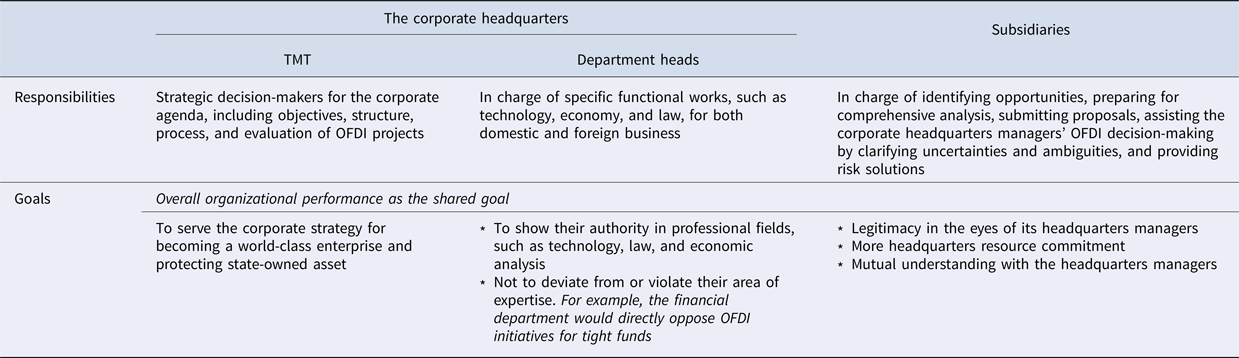
In addition to the political interactions in corporate headquarters–subsidiary relationships, the literature increasingly addresses the political tensions between multilayer decision-makers at corporate headquarters (Gillmore et al., Reference Gillmore, Andersson and Dellestrand2022). Corporate headquarters is composed of top management and function departments (Goold & Campbell, Reference Goold and Campbell2002), for which TMT managers and department heads can vary in their levels of power, interests, and agendas (Menz et al., Reference Menz, Kunisch and Collis2015). In particular, TMT managers have overall responsibility for a multifunction operation and thus are more likely to strategically understand an initiative, whereas department heads prefer issues that are directly related to their functional areas and make efforts to mitigate the risk of damaging their image in the organization when they go to bat for issues (Dutton & Ashford, Reference Dutton and Ashford1993).
Subsidiaries' Selling of Initiatives From a Micropolitical Perspective
MNEs are regarded as the contested terrains of budgeting and subsidiary mandate allocation (Geppert & Dörrenbächer, Reference Geppert and Dörrenbächer2014). Thus, subsidiaries may proactively influence their audiences at corporate headquarters through micropolitical game-playing to obtain resource support (Dörrenbächer & Gammelgaard, Reference Dörrenbächer and Gammelgaard2016). Micropolitical activities can directly attract corporate headquarters' positive attention (Bouquet & Birkinshaw, Reference Bouquet and Birkinshaw2008). Otherwise, they can indirectly leverage subsidiary structural advantages regarding resources, network positions inside and outside MNEs, and local conditions (Raziq, Benito, & Ahmad, Reference Raziq, Benito and Ahmad2021).
We outline the two main streams of the related research as follows. First, several studies have strongly suggested that subsidiaries leverage a toolkit of micropolitical tactics to influence decision-making (Clegg et al., Reference Clegg, Geppert and Hollinshead2018). This research stream is closely related to the literature on upward influence (Dutton, Ashford, O'Neill, & Lawrence, Reference Dutton, Ashford, O'Neill and Lawrence2001; Ling, Floyd, & Baldridge, Reference Ling, Floyd and Baldridge2005). However, the micropolitical perspective is distinguished through its ability to address the power and conflicts within MNEs (Geppert & Dörrenbächer, Reference Geppert and Dörrenbächer2014). For example, the subsidiary initiative literature explicitly or implicitly addresses the importance of tactics in building coalitions to sell initiatives (Clegg et al., Reference Clegg, Geppert and Hollinshead2018; Conroy & Collings, Reference Conroy and Collings2016). This is because a subunit cannot act by itself (Bacharach & Mundell, Reference Bacharach and Mundell1993), especially for less powerful actors. To increase their influence, subsidiary managers ally the host partners, sister subunits, and/or influential actors at headquarters (Bouquet & Birkinshaw, Reference Bouquet and Birkinshaw2008; Dörrenbächer & Geppert, Reference Dörrenbächer and Geppert2009). Other tactics include showcasing resources and capacities (Dörrenbächer & Geppert, Reference Dörrenbächer and Geppert2009) and other means for properly designing the framing method (Gorgijevski et al., Reference Gorgijevski, Holmström Lind and Lagerström2019; Hensmans & Liu, Reference Hensmans and Liu2018).
Second, scholars are increasingly addressing the sequence of the above micropolitical tactics from a process perspective (Conroy et al., Reference Conroy, Collings and Clancy2019). In particular, establishing social relationships with headquarters actors and interpreting their intentions are essential (Dörrenbächer & Gammelgaard, Reference Dörrenbächer and Gammelgaard2011) before engaging in careful maneuvering to remove any opposition and to gain influence for taking these initiatives (Dörrenbächer & Gammelgaard, Reference Dörrenbächer and Gammelgaard2006, Reference Dörrenbächer and Gammelgaard2010). In Table 1, we summarize the literature on selling subsidiary initiatives from a micropolitical perspective.
Summary of literature on micropolitics in selling subsidiary initiatives (in chronological order)

Although these two streams provide great insights for investigating subsidiary initiatives from a micropolitical perspective, an additional challenge for subsidiaries' selling initiatives is the power and conflicts of the corporate headquarters (Conroy et al., Reference Conroy, Collings and Clancy2017). The literature addresses the emerging tensions between competitive demands, such as social‒commercial objective tensions (Ambos et al., Reference Ambos, Fuchs and Zimmermann2020; Buckley, Doh, & Benischke, Reference Buckley, Doh and Benischke2017) and local integration‒global responsiveness tensions (Bartlett & Ghoshal, Reference Bartlett and Ghoshal2002), in MNEs' strategic decision-making. The management of the above tensions calls for a deep investigation into the interplay between those tensions at the corporate level (i.e., the corporate headquarters' side) along with subsidiaries' responses (Ambos et al., Reference Ambos, Fuchs and Zimmermann2020; Balogun, Fahy, & Vaara, Reference Balogun, Fahy and Vaara2019), especially at the strategic level. To the best of our knowledge, two exceptions explicitly mention resource mobilization strategies (Dörrenbächer & Geppert, Reference Dörrenbächer and Geppert2009) and the strategy of leveraging social and political skills (Conroy et al., Reference Conroy, Collings and Clancy2019). However, few studies have discussed effective micropolitical strategies (i.e., overarching sets of plans) adopted by subsidiary managers in dealing with multilayer decision-makers.
OFDI Decision-Making
As one of the most important strategic issues for MNEs, OFDI decision-making has received substantial attention from scholars and managers (Luo & Tung, Reference Luo and Tung2007; Luo, Zhang, & Bu, Reference Luo, Zhang and Bu2019). The existing research has addressed the rationality of headquarters managers for MNEs' choices of foreign investments (Bai & Liesch, Reference Bai and Liesch2022). In particular, the final decision is made with a cost–benefit analysis that integrates risks, uncertainties, and expectations (Liesch, Welch, & Buckley, Reference Liesch, Welch and Buckley2011). Although there is a long tradition of the idea that strategic decision-making is ‘the evolution of coalitions around issues or conflicts’ (Narayanan & Fahey, Reference Narayanan and Fahey1982: 25), there is a dearth of more in-depth research on the power, politics, and conflicts inherent in the OFDI decision-making process.
The literature indicates that the micropolitics between subsidiaries and corporate headquarters in OFDI decision-making matter by addressing subsidiaries' entrepreneurial opportunities, in addition to working primarily from the perspective of the headquarters or the MNE as a whole (Deng, Li, & Liesch, Reference Deng, Li and Liesch2022). Additionally, MNEs have divergent motivations in OFDI decision-making, such as market seeking, efficiency seeking, or resource seeking (including strategic asset seeking) (Dunning, Reference Dunning1988); thus, there is room for negotiations among internal actors to understand the motivations behind specific opportunities.
The literature also suggests that decision-makers at different levels show divergent interests or have divergent powers regarding subsidiary initiatives (Gillmore et al., Reference Gillmore, Andersson and Dellestrand2022), thus profoundly influencing OFDI decision-making. However, we know little about how low-power subsidiary managers influence high-power, divergent headquarters managers' OFDI decision-making from a political perspective.
Methods
We used a multiple case study design in which sufficient, first-hand data were sought (Eisenhardt, Reference Eisenhardt2021; Yin, Reference Yin2014) for several reasons. First, considering this study's exploratory nature, the use of a case study as a qualitative approach can facilitate an in-depth understanding of the understudied subsidiary's micropolitical strategizing for the selling of initiatives to different levels of managers at corporate headquarters (Creswell, Reference Creswell2015; Welch, Piekkari, Plakoyiannaki, & Paavilainen-Mantymaki, Reference Welch, Piekkari, Plakoyiannaki and Paavilainen-Mantymaki2011). Second, the qualitative and longitudinal data of each case are well positioned to capture the rich context and temporal process of OFDI decision-making (Nguyen & Tull, Reference Nguyen and Tull2022). Previous research has highlighted its benefits in obtaining a deep understanding of subsidiary initiatives (Cavanagh et al., Reference Cavanagh, Kalfadellis and Freeman2021; Conroy et al., Reference Conroy, Collings and Clancy2019; Dörrenbächer & Gammelgaard, Reference Dörrenbächer and Gammelgaard2016). Finally, the multiple case study research design can enhance external validity by facilitating the identification of empirical regularities across cases (Yin, Reference Yin2014).
Research Setting
To investigate the abundant and fine-tuned observations of subsidiary micropolitical strategy adoption that face hierarchies at corporate headquarters, we focus on cases of OFDI decision-making by a leading, world-class Chinese MNE. We focused on a single company to make in-depth comparisons with thick descriptions and control for the confounding effects of other firm-level characteristics (Eisenhardt, Reference Eisenhardt2021; Eisenhardt & Graebner, Reference Eisenhardt and Graebner2007; Shepherd & Rudd, Reference Shepherd and Rudd2014). Chinese MNEs are widely concerned, because they are representative, especially in the process of internationalization (Arikan, Arikan, & Shenkar, Reference Arikan, Arikan and Shenkar2022; Lyles, Tsang, Li, Hong, Cooke, & Lu, Reference Lyles, Tsang, Li, Hong, Cooke and Lu2022; Ramamurti & Hillemann, Reference Ramamurti and Hillemann2018; Tsui, Zhao, & Abrahamson, Reference Tsui, Zhao and Abrahamson2007). The following are the detailed reasons for selecting Chinese MNEs as our research setting.
First, our research objective is to study subsidiaries selling OFDI initiatives to relatively powerful actors in their corporate headquarters. Chinese MNEs are known to have hierarchical power relationships between corporate headquarters and their subsidiaries in decision-making (Cuervo-Cazurra & Li, Reference Cuervo-Cazurra and Li2021; Hong & Snell, Reference Hong and Snell2021). This is because OFDI represents a key decision that enables the entire set of Chinese MNEs to exercise effective control and undertake value-adding activities in foreign countries (Buckley, Clegg, Cross, Liu, Voss, & Zheng, Reference Buckley, Clegg, Cross, Liu, Voss and Zheng2007).
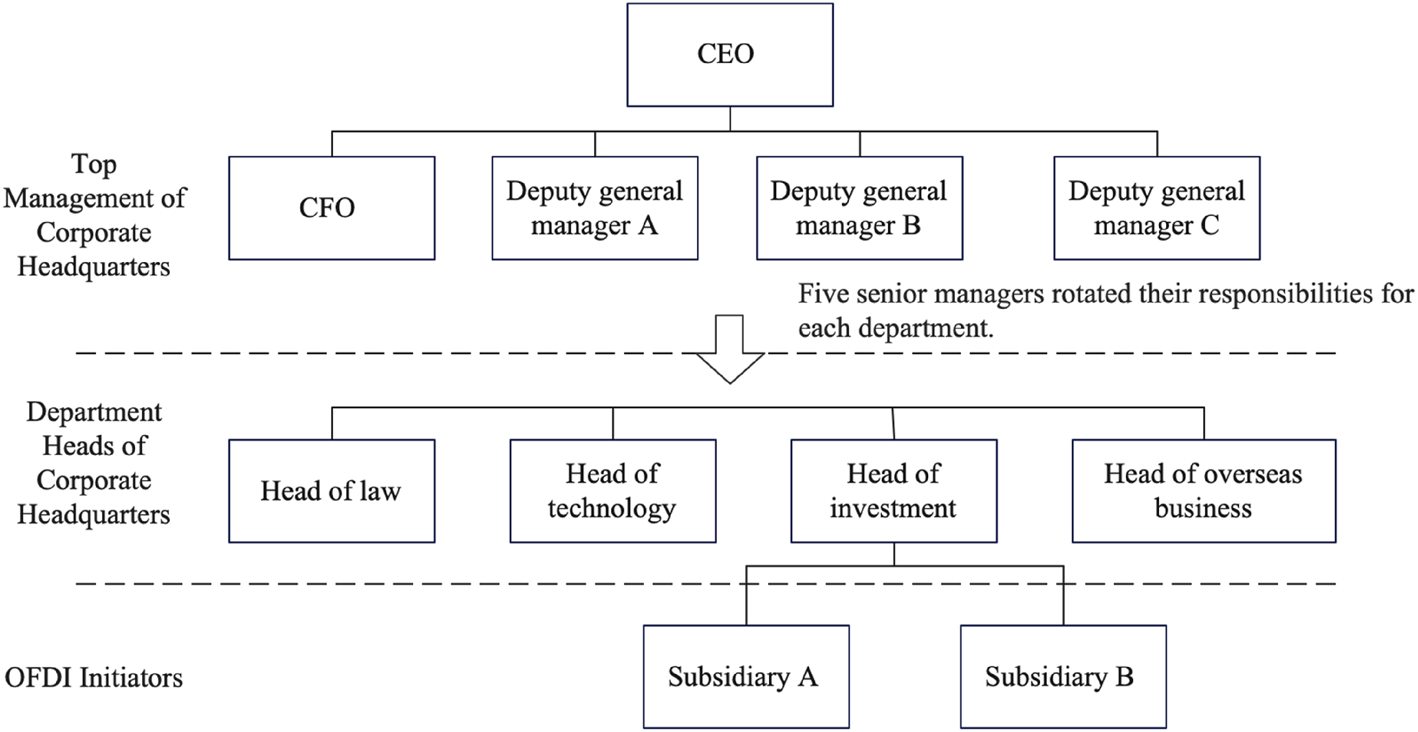
Second, and related to above mentioned, Chinese MNEs are characterized by a centralized, hierarchical decision-making structure and process (Cheng et al., Reference Cheng, Rhodes and Lok2010). In the selected Chinese MNE, department heads (i.e., law, investment, overseas business, etc.) and TMT managers, such as the chief executive officer (CEO), chief financial officer (CFO), and deputy general managers, play important roles in OFDI decision-making. Thus, it is suitable for exploring our research question, how subsidiary managers deal with multilayer actors at corporate headquarters.
Third, our research focuses on the micropolitics inherent in subsidiaries' selling processes, which represent informal negotiations between key actors. On the one hand, Chinese OFDIs always reflect multiple and divergent perspectives and goals, such as market seeking, resource seeking, and strategic asset seeking (Buckley et al., Reference Buckley, Clegg, Voss, Cross, Liu and Zheng2018; Luo & Tung, Reference Luo and Tung2018), leading to opportunities for subsidiary micropolitical navigation. On the other hand, subsidiaries of Chinese MNEs are embedded in China's institutions, where informal relations and activities are prevalent (Dau et al., Reference Dau, Li, Lyles and Chacar2022). Thus, we can obtain sufficient data on the micropolitical interactions of subsidiaries with their corporate headquarters managers.
Case Selection
Using the OFDI initiative as the unit of analysis, we scrutinized all projects initiated by two subsidiaries of the focal Chinese MNE and selected six cases (see Table 2) on the basis of theoretical sampling (Patton, Reference Patton2002; Yin, Reference Yin2014). Several criteria were applied. First, we chose only successful cases that aligned with our objective of exploring the selling of OFDI initiatives by subsidiaries to multilayer actors at corporate headquarters. The initiators of six individual cases, namely, Subsidiaries A and B, were wholly owned subsidiaries and located in China. Additionally, their establishment dates were closed (i.e., 2016 and 2012). Second, we selected cases in which subsidiaries assisted in corporate headquarters' OFDI decision-making from the beginning to the end of the process, allowing us to conduct a more comprehensive investigation of the process of micropolitical strategy adoption. Third, we chose cases with high profiles for both the corporate headquarters and subsidiaries. Thus, we obtained sufficient information for conducting further comparisons. Overall, this exploratory study of OFDI initiatives by Chinese MNEs' subsidiaries provides insight into how subsidiaries from emerging-market MNEs sell initiatives for foreign business to their corporate headquarters while facing centralized decision rights, multilayer decision-makers, and prevalent sociopolitical interactions.
Cases in the sample

Note: aThe commitment year indicates the time when an actual investment happens.
Table 3 presents an overview of the corporate headquarters and subsidiaries. To clarify the organizational structure of OFDI decision-making in our cases, we drew Figure 1 to represent the main actors of both the subsidiaries and corporate headquarters involved in OFDI initiatives. In particular, five senior managers (i.e., the CEO, the CFO, and three deputy general managers) constituted the TMT, whereas five members rotated their responsibilities among each department (i.e., law, overseas business, investment, technology, etc.). Thus, all five TMT managers preferred to assess OFDI initiatives from multiple dimensions rather than from a narrow perspective.
Profiles of the corporate headquarters and subsidiaries in OFDI decision-making

Structure of multilayer actors involved in OFDI decision-making
Note: We only include department heads who are involved in OFDI decision-making

Data Collection
The sources and uses of the data are shown in Tables 4 and 5.Footnote 1 Our engagement with the firm began in 2019. Through a collaborative relationship with this firm, we were able to gather sufficient information about how the subsidiaries struggle for approval from multilayer actors at corporate headquarters over time. First, we collected archival data from annual reports, media articles on corporate websites and other public channels, and other internal documents related to OFDI initiatives. Therefore, we obtained a more fine-tuned understanding of the divergent responsibilities, interests, and major activities involved in the OFDI decision-making process and ensured proper case selection. Additionally, we conducted a preliminary understanding of six cases and designed questions to be used in formal interviews. The use of multiple sources also provided benefits by enabling us to ‘triangulate’ the data (Eisenhardt & Graebner, Reference Eisenhardt and Graebner2007; Yin, Reference Yin2014).
Interview data

Other data

In 2020, one of the authors of this study worked directly at the corporate headquarters during a two-month field investigation and acquainted herself with the corporation's investment decision-making processes. In this way, we began to conduct formal interviews for the six cases. Following the literature that has focused on the interactions between subsidiary and headquarters actors (Balogun et al., Reference Balogun, Fahy and Vaara2019; Gillmore et al., Reference Gillmore, Andersson and Dellestrand2022), we interviewed multiple informants from both subsidiaries and corporate headquarters. This approach enabled us to gain a thorough understanding of micro-level behavior and decrease response bias (Eisenhardt & Graebner, Reference Eisenhardt and Graebner2007).
For each case, through the assistance of acquaintances at corporate headquarters, we interviewed at least three subsidiary managers, who were recommended because of familiarity with the project. Using an open-ended format, the interviewees were first encouraged to talk about the OFDI decision-making process as much as possible, including when and how such an initiative was undertaken, who participated in making the decision, and what conflicts they encountered. The interviewees were then asked to recall how they mitigated the above conflicts, whether their efforts were effective, and how they adapted their actions. The interviewees were also consulted to clarify any uncertain information.
Simultaneously, we interviewed managers at corporate headquarters. Specifically, at least one TMT manager and one department head served as interviewees for each selected case, aiming to capture their divergent opinions on OFDI initiatives. Moreover, we also concerned the difference of the personnel involved in investment decision-making at corporate headquarters, including their roles, key activities, and relationships, as well as their understanding of the company's overseas investment strategy. This approach helped us gain a better understanding of the power and conflicts at play at corporate headquarters. The interviews continued until 2023. All the subsidiary interviews lasted between 1 and 3 hours, and the headquarters interviews lasted between 0.5 and 1.5 hours; all the interviews were recorded and transcribed within 24 hours (Eisenhardt, Reference Eisenhardt1989).
In addition, we had the opportunity to participate in three meetings with subsidiaries, and their experiences in conducting OFDI initiatives were broadly discussed. Thus, we gathered additional evidence on subsidiary micropolitical strategies. During and after the data analysis, we also asked for their comments on the findings to ensure that they more accurately reflected the actual practices (Yin, Reference Yin2014).
Data Analysis
We followed a synthetic strategy for analyzing process data (Langley, Reference Langley1999), which can facilitate cross-case replication (Eisenhardt & Bourgeois III, Reference Eisenhardt and Bourgeois1988; Langley, Smallman, Tsoukas, & Van De Ven, Reference Langley, Smallman, Tsoukas and Van De Ven2013). First, we constructed rich descriptions of the chronology of a subsidiary's activities in selling the OFDI initiative to multilayer actors at corporate headquarters for each case on the basis of archival data and interviews. In these descriptive accounts, we captured details of how subsidiaries identified the differences between TMT managers and department heads around specific OFDI decision-making and of the best practices in adopting the relevant micropolitical activities correspondingly. Individual accounts were subsequently used for both within- and cross-case analyses.
In the within-case analysis, we are concerned about the temporal processes by which subsidiaries seek approval from multilayer actors at corporate headquarters for their OFDI initiatives. We adopted process as the focus and closely tracked the sequence of how this phenomenon emerges and changes over time (Langley et al., Reference Langley, Smallman, Tsoukas and Van De Ven2013). In particular, we considered the selling of a subsidiary OFDI initiative to its headquarters as a practice that is continually constituted and adapted through ongoing micropolitical activities by subsidiary managers, which is compatible with the metaphysics of the relevant process.
We built a clear understanding of each case and conducted a cross-case analysis in which we carefully coded the emerging themes. Specifically, we followed inductive data analysis and established coding techniques (Gioia, Corley, & Hamilton, Reference Gioia, Corley and Hamilton2013; Yin, Reference Yin2014) to develop the data structure. Initially, we identified 12 first-order codes by iteratively moving between the data and the data categories to obtain cross-case themes (Eisenhardt, Reference Eisenhardt1989). By using the terms identified in the interviews, our initial coding reflected the interviewee's terminology on real-world activities (Gioia et al., Reference Gioia, Corley and Hamilton2013). By tracing the micropolitical patterns (Conroy et al., Reference Conroy, Collings and Clancy2019; Dörrenbächer & Geppert, Reference Dörrenbächer and Geppert2009), we repeatedly iterated between the data and theory to identify the second-order codes (Gioia et al., Reference Gioia, Corley and Hamilton2013). For example, we turned to the idea of retrieving information from headquarters (Dörrenbächer & Gammelgaard, Reference Dörrenbächer and Gammelgaard2011) and the key concepts of interest and power in micropolitics (Dörrenbächer & Gammelgaard, Reference Dörrenbächer and Gammelgaard2016). Thus, we clustered department heads' power based on their professional knowledge and TMT holding power to decide key resource allocation like finance into identifying divergent power between multilayer decision-makers on specific initiatives. As a result, the second-order codes represented specific micropolitical tactics as theoretical interpretations of the first-order concepts (Gioia et al., Reference Gioia, Corley and Hamilton2013). At the end of the coding, we clustered the second-order themes into aggregate dimensions (Gioia et al., Reference Gioia, Corley and Hamilton2013), that is, micropolitical strategies guiding specific tactics. Given their continuous evolution, all the authors agreed on the coding results, and no new themes arose from the data (Eisenhardt, Reference Eisenhardt2021; Yin, Reference Yin2014). We present a summary of the data structure in Figure 2.
Data coding structure

On the basis of these codes, we further drew graphs to facilitate cross-case analysis (Bresman, Reference Bresman2013). We revisited the original data to refine our understanding of the similarities and differences across cases. By continuously iterating between the data and the existing literature (Langley et al., Reference Langley, Smallman, Tsoukas and Van De Ven2013), similarities in micropolitical strategy adoption emerged across cases. However, differences in specific micropolitical activities between market-seeking (i.e., Cases 1–3) and strategic asset-seeking (i.e., Cases 4–6) OFDI also emerged. We carefully discuss these similarities and differences in the following sections.
Results
By addressing the hierarchy at corporate headquarters, our data provide unique insights into the adoption of subsidiary micropolitical strategies from a process perspective. Our cases revealed that subsidiaries identify divergent interests and powers among multilayer decision-makers (i.e., political tension retrieving strategy). Then, they could build a coalition with one level (i.e., a selective coalition-building strategy) before leveraging allies' ties within corporate headquarters to win over the others (i.e., a transitive relation leveraging strategy). Please refer to Table 6 for more evidence.
Representative quotations

Political Tension Retrieving Strategy
Our data revealed that subsidiary managers continuously identified political tensions in the form of divergent interests and goals at play between TMT managers and department heads in OFDI decision-making. On the basis of comparisons across cases, our coding further revealed that specific micropolitical activities were impacted by how subsidiary managers translated the motivations underlying the specific OFDI initiatives (i.e., market-seeking and strategic asset-seeking OFDI) into divergent interests and power between multilayer decision-makers around specific initiatives.
In Cases 1–3 (i.e., market-seeking OFDI initiatives), subsidiary interviewees agreed that TMT managers mostly paid attention to maintaining equilibrium within the MNE network rather than assessing the OFDI initiative itself. In other words, TMT managers seldom paid attention to understanding differences among market-seeking OFDI initiatives. For example, ‘Those big bosses usually made decisions to balance the power and resource distributions between us (i.e., Subsidiaries A and B) and between different host countries, while accounting for all kinds of initiatives yet ignoring the differences in technology, local markets, and so on’ (Former Subsidiary B executive in Case 2). Cases 1–3 did not address the willingness of department heads to approve specific market-seeking OFDI initiatives. However, we observed that market-seeking OFDI initiatives, highlighted the fact that department heads could actively exercise their power to legitimize the details and feasibility of specific OFDI initiatives. For example, ‘They provided expert knowledge support for the entire company; hence, their advice was respected by all members, including TMT managers’ (Project manager of Case 1).
Cases 4–6 (i.e., strategic asset-seeking OFDI) indicated that an OFDI project regarded as a breakthrough could greatly increase TMT managers' influence inside and outside the MNE. For example, ‘it would be the highlight of his career (i.e., the CEO of corporate headquarters) since this project marked Company A's first foray into overseas transportation investments, collaboration with foreign banks under the Equator Principles, and limited recourse financing, establishing a new model for its internationalization’ (Project manager of Case 6). Additionally, our data indicated the exceptional influence of the power of TMT managers in advancing ambitious and promising strategic asset-seeking OFDI initiatives. As the project manager of Case 4 expressed, ‘These big bosses could effectively drive their concepts into reality, exerting influence from the top down’.
In contrast, department heads, such as those in Cases 4–6, exhibited a relatively low willingness to approve of strategic asset-seeking OFDI initiatives. Specifically, the investment manager of Subsidiary A stated, ‘We were a bother to them (i.e., department heads)’ (Case 6). Even worse, pursuing strategic asset-seeking OFDI without convincing income may lead to questioning of their ability. ‘Once the project failed, the big boss would question our specialties’ (Head of investment of corporate headquarters in Case 5). Moreover, department heads had a low level of power for approving strategic asset-seeking OFDI initiatives. For example, ‘They only provided professional advice and did not offer financial or other resources because they did not have them either’ (Project manager of Case 4).
Our data indicated that the retrieving process was full of fragmented and messy information for reasoning and always lasted a relatively long time, although this was not explicit from the interviews. On the basis of the translation of motivations underlying specific OFDI initiatives, subsidiaries in our cases understood that, for market-seeking OFDI, there was no explicit personal interest in approving OFDI initiatives at any level, and department heads represented the power of professional knowledge. In contrast, strategic asset-seeking OFDI was translated as TMT managers representing high interest and high power for approving the initiative, whereas department heads represented low interest and low power. Although the specific activities may vary across different types of OFDI, the essential role of the political tension retrieving strategy was supported across all the cases.
Selective Coalition-Building Strategy
In this study, the subsidiaries adopted a deliberate design for adapting their micropolitical activities to build a coalition with actors of one layer rather than the other. Our cases revealed that their choices were based on the restoration effect of the political tensions between multilayer actors. Furthermore, to attract potential allies, subsidiary managers sought to adjust specific micropolitical activities.
We observed that department heads were the main targets of subsidiary micropolitics in Cases 1–3 (i.e., market-seeking OFDI). Subsidiaries proactively involved department heads as soon as they began to prepare reports, such as economic analysis reports. In particular, they may ask for suggestions or comments from the department head in charge of economic evaluation, which was not formally needed. The benefits of the involvement of department heads in initiative development were illustrated: ‘We were prone to provide comprehensive feasibility of policy, economy, and other things, which showed that we understood our initiative deeply. The department heads carefully reviewed our report and asked for explanations when facing uncertainties. Based on their comments during the discussion, we could refine and adjust our reports’ (Project manager of Case 3). Throughout the process of co-developing initiatives, the frequent and informal meetings between subsidiary managers and department heads at corporate headquarters were illustrated by ‘we have contacts with the heads of corporate functional departments. In addition, discussions would be held at least once a month to increase their (department heads) familiarity with the initiative’ (Communication manager of Subsidiary B in Case 2).
In contrast, subsidiaries prioritized TMT managers in Cases 4–6 since their interests and power were aligned with the facilitation of strategic asset-seeking OFDI. Our findings revealed that subsidiary managers attempted to blend their initial motives with TMT managers' interests to avoid their proposal being seen as driven by self-interest. Specifically, subsidiary managers argued that the OFDI initiative serves as a vital source of corporate profit by indicating that ‘… this project was as good as one of the most representative projects in China in the aspects of profitability’ (Project manager of Case 5). Additionally, the OFDI plan applicable to our cases revealed that corporate headquarters agreed with the importance of strategically seeking new markets overseas. For example, ‘Although under the “red line” for the profit, we bundled it with our strategies related to the market. It was a potential market for clean energy’ (Former project manager of Case 4).
In addition to the corporate agenda, successfully bundling OFDI initiatives with national strategy trends greatly impacted the shifting mindset of TMT managers toward OFDI projects, as illustrated in Case 4: ‘We advocated that OFDI was an essential means of being a world-class enterprise, which was encouraged by the Chinese government’ (Communication manager of Subsidiary B).
Our data also revealed that the above proactive communications between the key subsidiary actors and TMT managers at corporate headquarters were always private and personal. In Case 5, Subsidiary A's executive noted, ‘I did a lot of work in communicating with the CEO of the headquarters, to show our clear business plan’. The project manager of Case 4 also noted, ‘If they (the Subsidiary B's executive and one deputy manager) could not convince headquarters at the time, they would continue to attempt their best to have private communications during the process’.
However, coalition building did not always proceed as smoothly as expected, thus requiring subsidiary managers to reconsider the power or interests of the targeted actors. For example, Subsidiary A executive stated, ‘I failed to attract their (i.e., TMT managers') attention, although I continuously emphasized that this project was promising for realizing a corporate agenda on profit. After several lunches, I understood that their budget for overseas investments was strict at that time; thus, they would prefer to invest only in projects with remarkable impact’ (Case 5). As a result, the Subsidiary A executive decided to change the manner in which the initiatives were blended with TMT managers' interests and then succeeded in coalition building with the TMT managers.
Overall, all the cases revealed the importance of a selective coalition-building strategy. While subsidiaries were more likely to co-develop initiatives with department heads in market-seeking OFDI, they were more likely to blend initiative motives with TMT managers' interests in strategic asset-seeking OFDI. Additionally, there were iterations between coalition building and identifying the specific target's interest and power at that time.
Transitive Relation Leveraging Strategy
Our findings revealed that building a coalition at one level did not guarantee the successful selling of a proposed initiative since ‘the rejection may come from any level. There was no more chance of obtaining an opposite yet powerful voice at any meetings’ (Investment manager of Subsidiary A). ‘An unexpected opponent was painful. Their view may even change at this stage. That was not an extreme situation’ (Head of legal of Subsidiary B in Case 4). We observed that subsidiaries focused on utilizing the achievement of selective coalition building. In particular, they utilized the relationships between TMT managers and department heads, where the allied actors were requested to share positive feedback with the other level.
In particular, Cases 1–3 were usually able to pass the judgment of department heads as a result of the development of initiatives, whereas tracking TMT managers' opinions was necessary for success. Our findings revealed that subsidiaries asked department heads to provide positive feedback regarding their initiatives (e.g., profitability, viability, etc.) to the TMT managers to whom they reported or with whom they had personal guanxi. The interviewed project manager of Case 3 admitted that ‘as a result of comprehensive communications with department heads, we achieved an agreement on the economic and technological feasibility of this project. They (i.e., department heads) greatly helped us make the initiative attractive for their upper echelons. Thus, our initiative has received almost no opposition from the TMT managers’.
Cases 4–6 illustrated how subsidiaries, successfully legitimizing their motives to TMT managers, asked those TMT managers to help inform the department heads with whom they had connections. For example, in Case 4, the head of legal of Subsidiary B noted, ‘Once the big boss showed support for your initiative, they would express their supportive attitude before the department heads when they had a chance’. In particular, TMT managers, in our cases, would express their confidence in the initiative's potential. The head of legal of corporate headquarters noted that ‘we professionally suggested that this project was pretty risky compared with any other domestic one, but it seems that the potential market sharing attracted the top managers’ (Case 5).
When the resources of internal alliances were utilized, our data revealed that subsidiary managers may encounter unexpected negative behaviors from their partners at corporate headquarters. In Case 3, the executive of Subsidiary B stated, ‘They (i.e., department heads) should have agreed with our ideas. However, I did know why they hesitated when I asked them to help say something to their bosses. We made an appointment for a closed-door discussion around the initiatives to strengthen our relations’.
In summary, the subsidiary managers in our study continuously made efforts to leverage their allies' ties with the other group until they received approval for their initiatives. The importance of transitivity was explicitly emphasized by the former Subsidiary A executive, who stated, ‘Knowing how to leverage the internal relationships between them (i.e., TMT managers and department heads) was a delicate process. It was important to understand who was connected to the key players you had already allied with and then use those existing connections to persuade the indirect players’.
After receiving approval, both subsidiaries' and corporate headquarters' interviewees agreed that the initial perceptions of the OFDI motivations of MNEs were revisited and edited, thus becoming more aligned between the subsidiaries and corporate headquarters. This is because ‘after this long process of information-sharing, negotiations, and decision making, both of us (i.e., subsidiaries and corporate headquarters) understood the OFDI from a deep and fine-grained view. It was not only a split between the market or other opportunities. However, we needed to address what this project could deliver specifically, a new profit source, an image, or others, and the goals that should be prioritized at this time’ (CEO of corporate headquarters).
Discussion
Conflicts in goals and the asymmetry of power in corporate headquarters–subsidiary relations have been extensively investigated (Hoenen & Kostova, Reference Hoenen and Kostova2015; Kostova et al., Reference Kostova, Nell and Hoenen2018). Micropolitics is used in MNEs to address interactions between powerful actors with divergent interests, specifically regarding executives from corporate headquarters and those from subsidiaries (Dörrenbächer & Geppert, Reference Dörrenbächer and Geppert2009). From the micropolitical perspective, literature on subsidiary initiatives has identified numerous approaches for upward influence, such as issue-selling tactics (Dörrenbächer & Gammelgaard, Reference Dörrenbächer and Gammelgaard2016; Gorgijevski et al., Reference Gorgijevski, Holmström Lind and Lagerström2019), legitimacy and other resource mobilization (Bouquet & Birkinshaw, Reference Bouquet and Birkinshaw2008; Conroy & Collings, Reference Conroy and Collings2016), and coalition-building endeavors (Clegg et al., Reference Clegg, Geppert and Hollinshead2018). The choice of credible and knowledgeable actors in such approaches has received substantial attention (Dutton et al., Reference Dutton, Ashford, O'Neill and Lawrence2001).
Some studies have suggested that there is heterogeneity among parenting roles with subsidiaries, rather than a unified entity (Menz et al., Reference Menz, Kunisch and Collis2015), which may complicate subsidiaries' initiative selling. In particular, TMT managers can earn respect in MNEs through their roles in effectively coordinating value-added activities, whereas the reputations of department heads in MNEs are derived from their specialized role in serving the entire company (Menz et al., Reference Menz, Kunisch and Collis2015). Additionally, TMT managers possess power over the allocation of key resources, such as finance, in MNEs, whereas the power of department heads is limited to their professional fields (Collis, Young, & Goold, Reference Collis, Young and Goold2007; Menz, Reference Menz2012). However, we know little about how low-power subsidiary actors sell initiatives to multilayer decision-makers at corporate headquarters. We extend these arguments to our process model in the following section.
Process Model of Subsidiary Micropolitical Strategy Adoption
We reveal three subsidiary micropolitical strategies and develop a process model of their adoption. Figure 3 provides a summary of our process model, which consists of political tension retrieving, selective coalition building, and a transitive relation leveraging strategy. The solid, bidirectional arrows represent the iterative process of adopting subsidiary micropolitical strategies. The dashed arrows represent the interplay between motivations underlying specific OFDI initiatives for MNEs and subsidiary micropolitical activities.
Process model of subsidiary micropolitical strategy adoption
Notes: The solid, bold black arrows represent the sequence of adopting the three specific subsidiary micropolitical strategies. The solid, regular black arrows represent the feedback mechanism that may require readjusting activities between stages. The dashed arrows represent the interplay between motivations underlying specific OFDI initiatives for MNEs and subsidiary micropolitical activities

First, our model elucidates how subsidiary managers may retrieve the divergent interests and power between TMT managers and department heads around specific initiatives on the basis of their understanding of MNEs' OFDI motivations. In market-seeking OFDI, subsidiaries can identify the TMT's intention to maintain equilibrium at corporate headquarters, whereas there is no explicit manifestation of department head interest. Additionally, subsidiaries realize that department heads can exercise their professional power to make specific initiatives competitive. For example, they can strongly recommend the feasibility of specific OFDI initiatives from the perspectives of return on investments, acceptable risks, and so on. In strategic asset-seeking OFDI, subsidiaries realize that the TMT's influence emerges from breakthrough OFDI projects, whereas department heads suffer from an increased workload and lose their reputation if a project fails. Moreover, it is difficult for department heads to leverage sufficient power to support a promising yet risky project since they have no control over resource allocation, which rests in the hands of TMT managers.
Afterward, subsidiaries engaged in building a coalition with decision-makers at one level. Our exploratory work suggests that subsidiaries should prioritize blending initiatives with TMT managers' interests in strategic asset-seeking OFDI since they may realize their interests via a breakthrough project. Additionally, TMT managers possess the power to allocate sufficient resources to cover an ambitious plan. In market-seeking OFDI, no one can get individual benefits from implementing initiatives. Subsidiary managers are more likely to engage in informal communications with department heads about evaluating project attractiveness due to their professional expertise. The support of department heads whose power is derived from specialists enhances the competitiveness of the initiative for TMT managers. Regardless of which level is targeted, subsidiary managers would like to carefully adapt their specific micropolitical activities to MNEs' OFDI motivations around specific initiatives.
Finally, our work suggests that subsidiaries utilize their allies to obtain approval from the other level by strategically utilizing ties between TMT managers and department heads. The idea of transitivity in network theory (Batjargal, Reference Batjargal2007) strongly supports this micropolitical strategy. In particular, transitivity enhances the chances of cooperative tie formation because the common actor can work as an information conduit, a reference for credibility, and a moderator for deterring opportunistic behaviors (Cuypers, Ertug, Cantwell, Zaheer, & Kilduff, Reference Cuypers, Ertug, Cantwell, Zaheer and Kilduff2020; Useche, Miguelez, & Lissoni, Reference Useche, Miguelez and Lissoni2020). In market-seeking OFDI, subsidiaries can leverage their connections with department heads in initiative co-development. The power distance is lower and interactions are more frequent among entities at corporate headquarters than in a corporate headquarters–subsidiary relationship. Thus, department heads might help an OFDI initiative be noticed by the TMT and persuade TMT managers to select one initiative over another. In strategic asset-seeking OFDI, TMT managers who are convinced of the merits of the initiative can express their supportive intentions to the department heads. As a result of information exchange, negotiation, and coalition building, subsidiary managers can alter OFDI motivations at the corporate level (i.e., editing) by providing a fine-grained understanding of the projects that should be considered.
Although beyond the scope of this article, our data revealed that such resources could come from the host-country government and influential partners. For example, in Case 1, the former Subsidiary A executive stated, ‘We had established a stable relationship with the host-country government there, and the political environment was relatively stable. Therefore, we had greater confidence in undertaking this initiative’. The project manager of Subsidiary B, who was in charge of Case 4, said, ‘We co-invested with the other company in that project, which was a leading company in the provision of wind power and a strategic partner of our headquarters. Through this partnership, we could successfully address the headquarters' concerns about potential risks’. This is consistent with the argument that political activities with host governments and credible co-investors serve as strong assurances to corporate headquarters (Cuervo-Cazurra, Mudambi, & Pedersen, Reference Cuervo-Cazurra, Mudambi and Pedersen2019).
Theoretical Contributions
This article contributes to the research on micropolitics in MNEs, especially their OFDI decision-making. First, we extend the existing subsidiary-centered initiative research conducted from the micropolitical perspective (Clegg et al., Reference Clegg, Geppert and Hollinshead2018; Dörrenbächer & Gammelgaard, Reference Dörrenbächer and Gammelgaard2016) by addressing how to manage the hierarchy at corporate headquarters when selling initiatives for the subsidiaries. The literature on subsidiary initiatives strongly adopts a micropolitical view in the study of power, politics, and conflicts in corporate headquarters–subsidiary relationships (Conroy et al., Reference Conroy, Collings and Clancy2019; Dörrenbächer & Gammelgaard, Reference Dörrenbächer and Gammelgaard2006; Dörrenbächer & Geppert, Reference Dörrenbächer and Geppert2009). The impacts of goal conflicts and power dynamics among divergent audiences at headquarters on subsidiary behaviors are also prevalent in the literature (Young, Peng, Ahlstrom, Bruton, & Jiang, Reference Young, Peng, Ahlstrom, Bruton and Jiang2008). For example, subsidiaries can face uncertain guidance (Foss, Foss, & Nell, Reference Foss, Foss and Nell2012) and extra costs (Lunnan, Tomassen, Andersson, & Benito, Reference Lunnan, Tomassen, Andersson and Benito2019). However, there is a dearth of studies on how subsidiary managers respond to divergent audiences at corporate headquarters. We draw attention to audiences at different levels and suggest that subsidiary managers proactively identify the divergent interests and power around specific initiatives at corporate headquarters rather than treating them as a single entity. Various types of divergent audiences exist in complex structures, such as regional and divisional headquarters (Dellestrand, Reference Dellestrand2011; Mahnke, Ambos, Nell, & Hobdari, Reference Mahnke, Ambos, Nell and Hobdari2012). Our work provides a foundation for studying how low-power actors understand and address the heterogeneities among high-power actors.
Second, we extend the use of micropolitical tactics and related temporal sequences in the literature (Conroy & Collings, Reference Conroy and Collings2016; Gorgijevski et al., Reference Gorgijevski, Holmström Lind and Lagerström2019; Ling et al., Reference Ling, Floyd and Baldridge2005) by conceptualizing subsidiary micropolitical strategies and their adoption process in addressing multilayer decision-makers. Many micropolitical tactics, such as mobilizing legitimacy (Jacqueminet & Durand, Reference Jacqueminet and Durand2020; Suddaby, Bitektine, & Haack, Reference Suddaby, Bitektine and Haack2016), coalition-building efforts (Clegg et al., Reference Clegg, Geppert and Hollinshead2018), and issue-selling tactics (Dutton & Ashford, Reference Dutton and Ashford1993; Dutton et al., Reference Dutton, Ashford, O'Neill and Lawrence2001), and the sequences of above tactics (Strutzenberger & Ambos, Reference Strutzenberger and Ambos2014) are identified. However, few studies have explicitly addressed subsidiary micropolitics at the strategic level, as expected for Dörrenbächer and Geppert (Reference Dörrenbächer and Geppert2009) and Conroy et al. (Reference Conroy, Collings and Clancy2019). Additionally, existing research cannot determine what subsidiary managers should do when facing high-power decision-makers with divergent interests and power. Our findings propose the process of adopting three micropolitical strategies – political tension retrieving, selective coalition building, and transitive relation leveraging – to ally one level first and jointly sell to the other level. Our findings suggest the process of adopting three micropolitical strategies – political tension retrieving, selective coalition building, and transitive relation leveraging – which aligns with the concept of transitivity in network research (Batjargal, Reference Batjargal2007; Cannizzaro, Reference Cannizzaro2020; Cuypers et al., Reference Cuypers, Ertug, Cantwell, Zaheer and Kilduff2020). That is, by first allying at one level and leveraging existing connections to jointly sell to another level, the initiatives are more likely to be approved.
Third, we extend the OFDI decision-making literature (Bai & Liesch, Reference Bai and Liesch2022; Deng, Reference Deng2012; Luo et al., Reference Luo, Zhang and Bu2019) by shedding light on the political dynamics between subsidiaries and corporate headquarters, and between multilayer actors in the corporate headquarters. Previous studies have addressed the rationality of decision-makers in evaluating the costs, risks, and uncertainties facing specific OFDI opportunities to make decisions on the choice of location, mode of entry, and divestments (Liesch et al., Reference Liesch, Welch and Buckley2011). That is, commitment to foreign entry is unlikely to proceed unless the risks and uncertainties of a foreign entry can be reduced to an acceptable level precepted by the decision-maker (Johanson & Vahlne, Reference Johanson and Vahlne1977, Reference Johanson and Vahlne2009; Tan, Brewer, & Liesch, Reference Tan, Brewer and Liesch2007). However, in addition to rationality, micropolitics matter in strategic decision-making since decision-makers with divergent interests prefer to compete to realize their intents, and the power dynamics among them are intensive (Ambos et al., Reference Ambos, Fuchs and Zimmermann2020). Our findings highlight that subsidiary micropolitical strategies can influence power dynamics between multilayer decision-makers. Moreover, we extend the research on the impacts of divergent motivations, including efficiency seeking, market seeking, resource seeking, and strategic asset seeking, on attention and preferences in OFDI decision-making (Buckley et al., Reference Buckley, Clegg, Cross, Liu, Voss and Zheng2007; Luo & Tung, Reference Luo and Tung2007) by revealing how subsidiary managers may, in turn, understand corporate-level motivations for OFDI better as a result of intensive interactions with multilayer actors in the headquarters.
Managerial Implications
Emerging-market MNEs seek to synergize overseas investments through subsidiary initiatives. However, the relevant rights and resources are centralized by involving multilayer constituencies of corporate headquarters in decision-making. This case study focuses on Chinese MNEs and answers a significant question for MNEs from emerging markets in general, that is, how low-power actors in subsidiaries sell initiatives to multilayer high-power actors at corporate headquarters. Although subsidiary initiatives are important sources of foreign opportunities for these latecomers in international business, the hierarchy and complexity of corporate headquarters may slow down and impair strategic decision-making. Our exploratory work suggests building coalitions with the level of those whose interests and powers are aligned with the initiative and leveraging allies' ties as effective strategies to legitimize promising initiatives in hierarchical organizations.
Additionally, Chinese investments in Belt and Road Initiative (BRI) countries have been rapidly increasing during the past decade. There has been criticism that Chinese MNEs thoughtlessly rushed into these BRI economies. However, based on six OFDI cases in developing countries between 2015 and 2020, we revealed the cautious and centralized decision-making process of Chinese MNEs in OFDI with multiple participants.
Limitations and Future Research
The most notable limitation is that our results are derived from cases taken from a single Chinese MNE to control for the organizational-level confounding effects. The selected MNE is a representative of the OFDI decision-making mechanism of Chinese MNEs, which is even suitable for MNEs from emerging markets. MNEs from emerging markets usually have centralized decision rights in the corporate headquarters that coordinate the final decisions among multilayer decision-makers and engage in prevalent sociopolitical interactions. In contrast, MNEs from developed countries generally tend to have a more decentralized governance structure and a more direct communication style, although there are some exceptions, such as Japan. To mitigate concerns about the generalizability of the findings, further comparison between MNEs from developed and developing countries would be interesting and important since it would be valuable to investigate whether our findings on alliance and transitivity can be modified to adapt to new environments.
Second, we identify subsidiary micropolitical strategizing that involves two distinct levels of actors at corporate headquarters, which can provide a reference for studying more complex headquarters scenarios. For example, potential heterogeneity within the TMT, such as the variance between the CEO and other general managers, may force subsidiary actors to adapt their micropolitics in a flexible manner. Different groups of decision-makers can also be built and analyzed for distinct personal social connections, attributes, capacities, or cultures (Collis et al., Reference Collis, Young and Goold2007; Menz et al., Reference Menz, Kunisch and Collis2015). Future research can address other types of heterogeneity within headquarters and study whether the micropolitics in subsidiary initiatives change across modes.
Relatedly, this work addresses the heterogeneity of decision-makers at corporate headquarters, and the same may apply to subsidiary managers. For example, subsidiary managers who travel back and forth between headquarters and subsidiaries may have high loyalty to corporate headquarters managers, thus representing distinct patterns in micropolitics. Future research should investigate the adaptation of micropolitical strategies with respect to the differences among subsidiary managers. Moreover, the interplay between micropolitical interactions and subsidiary mandate evolution is a sweet spot for future attention.
Third, although the two subsidiaries in this case study are not the typical foreign subsidiaries described in the subsidiary initiative literature, they were established for foreign business. Therefore, their strategies and initiative selling processes can provide valuable insights for subsidiaries involved in foreign activities. Given that subsidiaries located in the home country may experience less distance (e.g., institutional distance, cultural distance, geographical distance) and more frequent interactions with corporate headquarters, future research may wish to investigate whether further adaptations of these strategies are necessary for subsidiaries in other countries.
Fourth, considering that subsidiary micropolitical strategies are deeply embedded in the external environment, multiple external stakeholders may influence the interactions between subsidiaries and corporate headquarters managers. The findings of this exploratory work are applicable across various host countries and industry segments. Additionally, our data indicate how subsidiary actors make sense of the external environment at the beginning and how external stakeholders may facilitate the decision-making process. Although our interviews with Company A revealed no significant differences between investments in developed and developing countries (i.e., high-risk countries), future research may wish to investigate when location matters for selling OFDI initiatives, especially for MNEs with different ownership, size, and international experience. Moreover, the impact of changes in the corporate headquarters–subsidiary relationship, driven by shifts in the external environment (such as COVID-19 as a shock), requires further investigation.
Finally, ownership type is important when considering hierarchy and micropolitics in subsidiary initiatives. Subsidiaries of privately owned firms are usually characterized as having more autonomy than those of state-owned firms. A further comparison among state-owned, private-owned, and jointly owned enterprises would be interesting and important.
Conclusion
Through multiple case studies of Chinese MNEs' OFDI decision-making, our research proposes a process model of subsidiary micropolitical strategy adoption to address multilayer audiences at corporate headquarters. This proposed theory extends subsidiary micropolitics to the selling of initiatives to headquarters by shedding light on the management of the hierarchy that exists at corporate headquarters. That is, subsidiaries should proactively retrieve the divergent interests and powers of multilayer decision-makers at headquarters regarding specific initiatives before strategically deciding on priorities among different levels of audiences and pursuing consensus. The findings of this article have important implications for the subsidiaries of emerging-market MNEs that face centralized decision rights and multilayer actors involved in decision-making. Primarily, we suggest that subsidiaries should pay more attention to the complexities at headquarters rather than treating headquarters as a unified whole and strategically adopting their micropolitical activities. In particular, they should prioritize actors whose interests are aligned with the focal initiatives and whose power can facilitate the achievement of consensus and then leverage the ties among multilayer decision-makers.
Data availability statement
The data that support the findings of this study are available from the corresponding author, upon reasonable request.
Acknowledgements
The authors gratefully acknowledge the grants supported by the National Natural Science Foundation of China (grant numbers 71972143, 72372113, and 72072124), and the National Social Science Fund of China (grant number 20BGL131).
Xinya Guan (guanxinya@tju.edu.cn) is a PhD candidate at Tianjin University and the City University of Hong Kong. Her primary research area focuses on the role of multinational enterprises in achieving Sustainable Development Goals (SDGs) from the perspective of institutional theory.
Junying Liu (liujunying@tju.edu.cn) is a professor at the College of Management and Economics, Tianjin University. She is the Head of the Department of Construction Management. She has been a visiting scholar at both the University of Cambridge in the UK and Chalmers University of Technology in Sweden. Her main research interests include international business and project risk management. She has over 50 peer-reviewed journal publications and 4 managerial books.
Michael N. Young (michael.young@wvstateu.edu) is an associate professor in the Department of Management and International Business at West Virginia State University. He has lived and worked for 19 years in Hong Kong and has traveled to nearly every Chinese province. He has over 100 peer-reviewed cases, conference presentations, and journal publications. His research interests involve corporate governance, the management of Asian firms, state-owned enterprise reform in China, and financial and organizational economics.
Hongjuan Zhang (jenny_zhang12@163.com) is a professor at the College of Management and Economics, Tianjin University. Her main research interests include strategic management, international business, and innovation. She has published her research in the Journal of World Business, Journal of Management Studies, Entrepreneurship Theory and Practice, and Management World (in Chinese), among others.