Introduction
Bryophytes are one of the dominant components of the present-day Antarctic flora in terms of species diversity and total biomass (Longton Reference Longton1988, Ochyra Reference Ochyra1998, Ochyra et al. Reference Ochyra, Bednarek-Ochyra and Smith2008a, Reference Ochyra, Lewis Smith and Bednarek-Ochyra2008b). They are sensitive to ecological and climate change and therefore form important indicators of environmental alterations (Jonsgard & Birks Reference Jonsgard and Birks1995, Green et al. Reference Green, Sancho, Türk, Seppelt and Hogg2011).
Fossil records of bryophytes from the Antarctic are sparse. The oldest reported Antarctic fossil moss is the Permian permineralized Merceria augustica Smoot & T.N. Taylor from the Transantarctic Mountains (Smoot & Taylor Reference Smoot and Taylor1986). More recent moss records from the Antarctic are the Cretaceous Livingstonites gabrielae Vera from Livingston Island, South Shetland Islands (Vera Reference Vera2011) and mid-Miocene Drepanocladus longifolius (Mitt.) Paris from the Olympus Range in the McMurdo Dry Valleys of the Transantarctic Mountains (Lewis et al. Reference Lewis, Marchant, Ashworth, Hedenäs, Hemming, Johnson, Leng, Machlus, Newton, Raine, Willenbring, Williams and Wolfe2008).
Bryophyte macrofossils have not been studied in much detail in the Antarctic and sub-Antarctic regions. Recently, the plant macrofossil radiocarbon analysis from sub-Antarctic South Georgia, dated organic and peat bank sequence from the Holocene (Van der Putten et al. Reference Van der Putten, Stieperaere, Verbruggen and Ochyra2004, Reference Van der Putten, Verbruggen, Ochyra, Spassov, de Beaulieu, De Dapper, Hus and Thouveny2009). So far, the best studied deposits in the Maritime Antarctic relate to Chorisodontium-Polytrichum peat banks and Polytrichastrum alpinum (Hedw.) G.L. Sm. mounds subject to permafrost (Fenton & Smith Reference Fenton and Smith1982, Birkenmajer et al. Reference Birkenmajer, Ochyra, Olsson and Stuchlik1985).
Aquatic benthic mosses living on the sediment of Antarctic lakes have been well documented. They are known from various sites both in the Maritime Antarctic and continental Antarctica and have recently been summarized by Li et al. (Reference Li, Ochyra, Wu, Seppelt, Cai, Wang and Li2009). The Schirmacher Oasis is one of the most extensive ice-free areas of continental Antarctica, excluding the McMurdo Dry Valleys. Yet, knowledge of the bryoflora of this area is still fragmentary and recent fieldwork yielded some remarkable new moss additions to it (Ochyra & Singh Reference Ochyra and Singh2008, Kurbatova & Ochyra Reference Kurbatova and Ochyra2012).
Systematic diversity analysis of the present moss flora and records of sub-fossil moss have received little attention in Schirmacher Oasis. This study was therefore conducted to systematically survey the oasis and collect moss specimens from different terrestrial locations and lake sediments of Schirmacher Oasis so as to analyse the sub-fossil moss of the past and moss diversity of the present.
Materials and methods
Sampling area
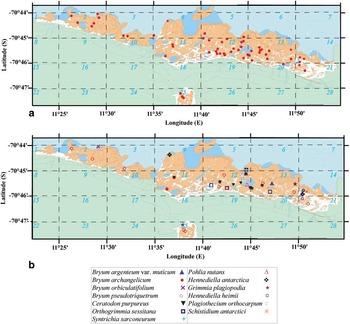
Schirmacher Oasis, Dronning Maud Land (70°46′04′′–70°44′21′′S, 11°49′54′′–11°26′03′′E) is a 34 km2 hilly/undulating strip of ice-free land with numerous freshwater lakes, ponds and pools covering a total area of 3 km2 (Fig. 1a). Depending upon their topographic setting, they occur as inland lakes, ice margin lakes, and epishelf lakes. The average annual temperature of the oasis is -10.4°C and mean wind velocity is 10 m s-1 (Deshpande & Tripathy Reference Deshpande and Tripathy2010). The average precipitation (snow) ranges between 250–300 mm and the relative air humidity is 15–20%. The soils are characterized by acidic pH ranging from 4.42–6.80. The mean organic carbon content was 0.62% and ranged from 0.06–1.29%. The electrical conductivity ranged from 0.06–1.29 dS m-1 for soil water ratios of 1:2 (Singh et al. Reference Singh, Sharma, Singh and Ravindra2008).
Map of Schirmacher Oasis. a. Sampling locations. b. Distribution of species. One nautical mile (arcminute) = 1.852 km.

Lake sediment coring
Three sediment cores, each separated by a distance of 30–50 m, were sampled from “Priyadarshani lake” (unofficial name, 70°45′47.3′′S, 11°44′22.3′′E) by gravity corer, and “L6 lake” (unofficial name, 70°45′21.4′′S, 11°35′52.6′′E) by manually pushing and hammering of steel pipe with an inner PVC pipe. The diameter of the inner PVC core pipe was 5 cm. Sampling was done in the summer of 2003 and winter of 2005. The thickness of lake ice varied from 90–120 cm, when the lake was frozen. Collected core sizes were 55–60 cm (Priyadarshani lake) and 164 cm (L-6 lake). After draining the cores were cut into pieces of 2 cm, safely packed in sterile bag and stored at -20°C deep freezer. The cores showed alternate layers of thin sediment with algal mats. The core had sandy, silty and clayey layers with organic matter. Lower layers of core were sandy and silty with successive development of microbial mats and mosses.
Radiometric dating
Six samples at different levels where lithological changes occurred were sent to the USA for 14C dating. Radiocarbon 14C dating was done by accelerator mass spectrometer (AMS), at the National Ocean Science Accelerator Mass Spectrometry (NOSAMS) Facility at Woods Hole Oceanographic Institute, USA.
Sub-fossil moss and present-day diversity analysis
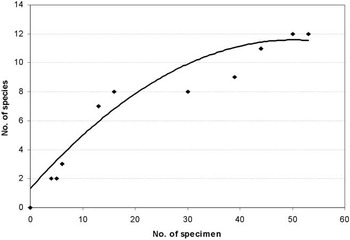
The sub-fossil moss shoots were separated, cleaned in distilled water and observed with a Nikon stereoscopic zoom microscope (SMZ1500) equipped with image analysis software. For diversity analysis of present-day mosses, samples were collected from Schirmacher Oasis in the summer of 2003–04 during the 23rd Indian Antarctic Expedition. A total of 38 specific sampling locations were considered (Fig. 1). Sampling heterogeneity for the area was determined through the rarefaction curve plotted by examining the relationship between the number of specimens collected and the number of species recorded. All samples are archived in the Polar Herbarium at the National Centre for Antarctic & Ocean Research, India, and in the Bryophyte Herbarium of the Institute of Botany, Polish Academy of Sciences (KRAM), Poland.
Results
Stratigraphy of lake sediment core
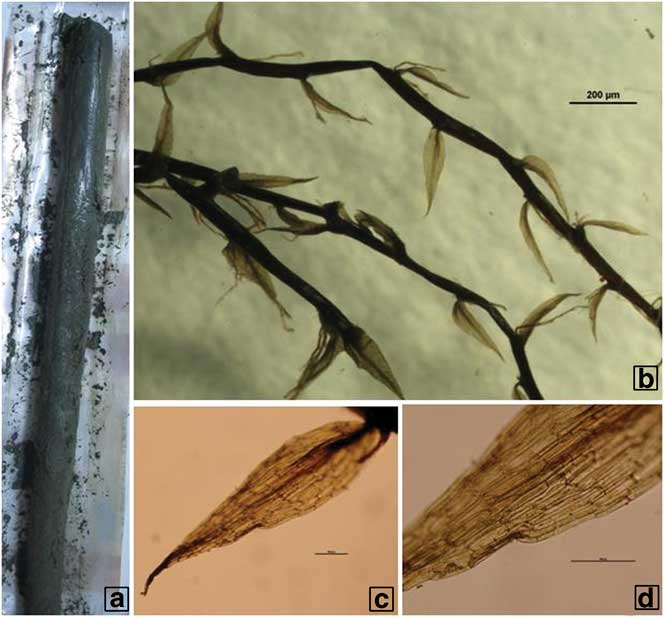
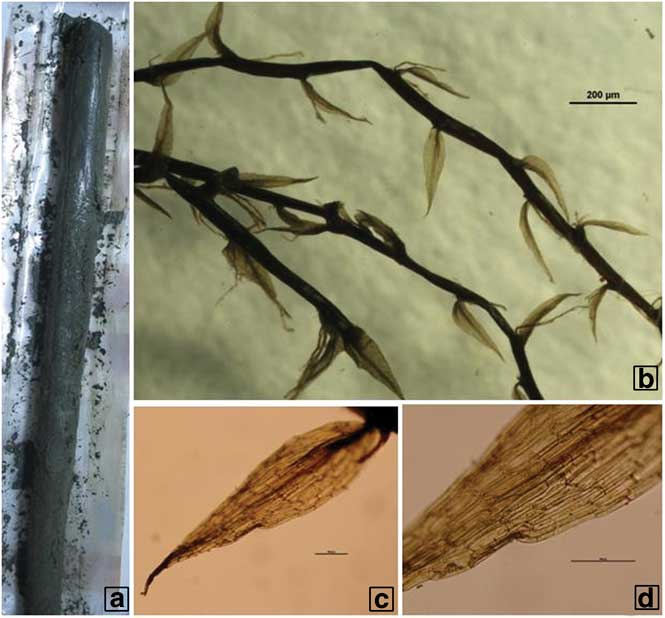
Stratigraphic studies show that the moss only occurred at 160–162 cm depth of the sediment core (Fig. 2a). The sediment core did not show distinctive zones in lithology, except at the bottom where sand and small gravel with organic layers contained moss remains, while the upper part of the sediment core was fine clay of greenish black colour, laminated with microbial mat. The 14C analysis shows a difference in the age throughout the sequence. The lowermost 160–162 cm represents 10.65 kyr while the upper 6–8 cm corresponds to 0.64 kyr.
a. Portion of core, and b.–d. morphological details of sub-fossil Pohlia nutans.
Sub-fossil study
The moss sample isolated from 160–162 cm depth of the sediment core from L-6 lake, is identified as Pohlia nutans (Hedw.) Lindb. (Fig. 2b–d). About 50 moss plantlets of the species have been found in 1 g sample, with well-preserved morphological details. The shoots of the moss are etiolated. The leaves are lanceolate, small, 1.2–1.5 × (0.25−) 0.3–0.4 mm and they are distantly set on the stem, a habit typical for all deeply submerged mosses. The leaf cells are thick-walled, oblong- to elongate-hexagonal, becoming more elongate towards the margin, 28–72 × 6–12 μm and the costa is fairly strong and subpercurrent. The axis is flexible, parenchymatous, c. 0.25 mm thick, with scattered rhizoids attached to the outer layer of the cortex.
Radiocarbon (14C) dates by AMS confirmed the age of the P. nutans specimen to be 10.65 kyr bp indicating that the vegetation at the base of the core dates back to the beginning of the Holocene, probably when the ice retreated from the oasis as a result of amelioration of the climate.
Diversity analysis of the present-day moss flora
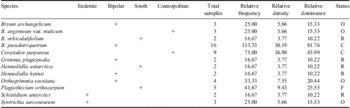
The moss flora has 12 species in eight genera and five families in the Schirmacher Oasis and neighbouring nunataks (Table I). The rarefaction curve (Fig. 3) indicates that sufficient samples were obtained from the location to give a reasonable estimate of overall moss diversity. The species distribution maps (Fig. 1) can be used as a baseline to assess vegetation changes over time.
Moss species collected, their distribution, frequency, density and dominance.

Note: relative frequency (RF) = number of samples for species A x 100/total species, relative density = number of samples for species A x 100/total samples, relative dominance = (relative frequency + relative density)/2 (Priddle & Belcher Reference Priddle and Belcher1982). Based on frequency of occurrence the status for each species is given as common (C; RF > 75), frequent (F; RF = 50–75), occasional (O; RF = 25–50) and rare (R; RF < 25).
Rarefaction curve of species number vs specimen number.

The extant moss flora of the Schirmacher Oasis includes six genera which are represented by single species, namely Ceratodon, Syntrichia, Grimmia, Orthogrimmia, Schistidium and Plagiothecium. The other two genera, Bryum and Hennediella, consist of four and two species, respectively. Two species are endemic or near-endemic to Antarctica (17%), five are bipolar (41%), two cosmopolitan (17%), while three are American temperate in occurrence (25%). When computed, relative frequency, density and dominance values of the species showed that Bryum pseudotriquetrum (Hedw.) P. Gaertn., B. Mey. & Scherb. is the most abundant and widespread moss and forms the most extensive stands, while Bryum orbiculatifolium Card. & Broth., Grimmia plagiopodia Hedw., Hennediella antarctica (Ångstr.) Ochyra & Matteri, Hennediella heimii (Hedw.) R.H. Zander and Schistidium antarctici (Cardot) L.I. Savicz & Smirnova are the most sparsely distributed species in the region. Values of the rest of the documented species varied widely (Table I).
Overall, four species (Bryum archangelicum Bruch & Schimp, B. argenteum Hedw. var. muticum Brid., Orthogrimmia sessitana (De Not.) Ochyra & Żarnowiec and Syntrichia sarconeurum Ochyra & R.H. Zander) occurred occasionally, two (B. pseudotriquetrum and Ceratodon purpureus (Hedw.) Brid.) were of common occurrence, five species (B. orbiculatifolium, G. plagiopodia, H. antarctica, H. heimii and S. antarctici) were rare, while one (Plagiothecium orthocarpum Mitt.) was a frequently found benthic moss, occurring only in Lake Glubokoe, from whence it is known from several collections at depths of 23.5−34 m (Fig. 1b, Table I).
Discussion
Unlike most vascular plants, mosses lack rigid structures and therefore are rarely fossilized. Even when fossilized, due to their small size, they may possibly be overlooked. Palaeobotanical data do not throw much light on the origin and composition of the present-day moss flora of Antarctica. Information on their biogeographical affinities, ecological behaviour and dispersal modes is also limited.
The Holocene moss P. nutans discovered in the present study from Schirmacher Oasis had features typical for mosses of submerged and extreme environmental conditions (Seppelt & Selkirk Reference Seppelt and Selkirk1984). Nonetheless it resembles very much the extant plants of P. nutans in its essential anatomical traits. This is the first report of this sub-fossilized species from Dronning Maud Land. The species is widespread and locally common in the present-day moss flora of Maritime Antarctica but on the continent it is known only from five terrestrial sites in northern Victoria Land (3), Queen Mary Land (1) and Ellsworth Land (2) (Ochyra et al. Reference Ochyra, Lewis Smith and Bednarek-Ochyra2008b).
It is worth noting that in some lakes on the Sôya Coast of Enderby Land another species of the genus Pohlia, P. wilsonii (Mitt.) Ochyra, was found to form benthic moss pillars (Imura et al. Reference Imura, Bando, Saito, Seto and Kanda1999, Reference Imura, Bando, Seto, Ohtani, Kudoh and Kanda2003). This is the only known occurrence of this typical South American Andean species in Antarctica. However, both species are unlikely to be confused because the leaves of P. wilsonii are oblong-lanceolate to ovate and the costa vanishes far below the leaf apex (Ochyra et al. Reference Ochyra, Lewis Smith and Bednarek-Ochyra2008b).
There is a wide assumption that the majority of the Antarctic flora originated after the last Pleistocene glacial maximum and the subsequent retreat of glaciers and ice sheets (Hertel Reference Hertel1987, Galloway Reference Galloway1991, Ochyra et al. Reference Ochyra, Bednarek-Ochyra and Smith1998, Reference Ochyra, Lewis Smith and Bednarek-Ochyra2008b). Various hypotheses have also been previously proposed to explain the distributional patterns and the origin of Antarctic mosses, most of which favour the concept of Holocene immigration by long-distance dispersal of diasporas by wind (Muñoz et al. Reference Muñoz, Felicisimo, Cabezas, Burgaz and Martinez2004, Van der Putten et al. Reference Van der Putten, Verbruggen, Ochyra, Verleyen and Frenot2010). Moss peat accumulations on King George Island have revealed that the peat banks were formed after mid-Holocene tephra fallout, which was a period dated between 3.8 and 5.0 kyr bp (Birkenmajer et al. Reference Birkenmajer, Ochyra, Olsson and Stuchlik1985, Tatur et al. Reference Tatur, del Valle, Barczuk and Martinez-Macchiavello2004). The current study, however, suggests that the moss flora at Schirmacher Oasis existed much earlier, around 10.65 kyr bp. Although the palaeoclimatological data of continental Antarctica is considered to be different from sub-Antarctica, as the two followed different routes during the Holocene (Jones et al. Reference Jones, Hodgson and Chepstow-Lusty2000), the South Georgia flora was also found to have established at around 10 kyr bp (Smith Reference Smith1991). Controversial opinions exist about the time of deglaciation at Schirmacher Oasis (Krause et al. Reference Krause, Krbetschek and Stolz1997). If the record by M. Schwab (in Ingólfsson et al. Reference Ingólfsson, Hjort, Berkman, Björck, Colhoun, Goodwin, Hall, Hirakawa, Melles, Möller and Prentice1998) is followed, deglaciation at Schirmacher Oasis started relatively recently, at about 3.5 kyr bp. Pohlia nutans probably survived the last glacial period on Schirmacher Oasis in a refugia. Recent biological evidence suggests that low altitude refugia must have remained available throughout glaciations within these regions (Hodgson et al. Reference Hodgson, Noon, Vyverman, Bryant, Gore, Appleby, Gilmour, Verleyen, Sabbe, Jones, Ellis-Evans and Wood2001, Squier et al. Reference Squier, Hodgson and Keeley2005, Convey et al. Reference Convey, Bindschadler, di Prisco, Fahrbach, Gutt, Hodgson, Mayewski, Summerhayes and Turner2009a, Reference Convey, Stevens, Hodgson, Smellie, Hillenbrand, David, Barnes, Clarke, Pugh, Linse and Cary2009b).
Distribution of the present-day mosses within Antarctica
Our site specific data are consistent with the low measures of distribution and diversity of moss species in the continental Antarctic. Of the total of 111 species and two varieties of moss that are documented from the entire Antarctic biome (Ochyra et al. Reference Ochyra, Bednarek-Ochyra and Smith2008a, Reference Ochyra, Lewis Smith and Bednarek-Ochyra2008b), only 24 species, and one variety are reported from continental Antarctica. Recently one more species, Notoligotrichum trichodon (Hook. & Wilson) G.L. Sm. was discovered in Marie Byrd Land (Andreev & Kurbatova Reference Andreev and Kurbatova2009). Of these, two species may be considered as doubtfully occurring on the continent because they are either not confirmed (Dicranella hookeri (Müll. Hal.) Cardot) or collected in man-made habitats in a horticultural greenhouse (Funaria hygrometrica Hedw.). Thus, realistically, only 23 species may be considered as native to continental Antarctica. From Dronning Maud Land 13 moss species have been reported, 12 of which are known from the Schirmacher Oasis (Ochyra et al. Reference Ochyra, Lewis Smith and Bednarek-Ochyra2008b, Ochyra & Singh Reference Ochyra and Singh2008, Kurbatova & Ochyra Reference Kurbatova and Ochyra2012). However, very recently two species have been added to the moss flora of the oasis, Hennediella antarctica and Grimmia plagiopodia (Kurbatova & Ochyra Reference Kurbatova and Ochyra2012). Accordingly, the moss flora of Dronning Maud Land consists of 13 species, because the latter species is known from other parts of this sector.
Bryum pseudotriquetrum has been reported previously to be one of the most widespread and abundant mosses occurring in the Antarctic continent (Savicz-Lyubitskaya & Smirnova Reference Savicz-Lyubitskaya and Smirnova1972 as B. algens Cardot). The present study agrees with this in the Schirmacher Oasis.
The biogeography of the mosses from the Oasis suggests most species are bipolar. Much has been discussed about the bipolar distribution of moss elements recently (Ochyra & Buck Reference Ochyra and Buck2003). These taxa are not primitive but have rather dispersed over long distances. Cosmopolitan, endemic and temperate elements were also present.
Availability of ice-free area however, is not the only criteria for moss colonization. The time elapsed after the retreat of ice from the area also plays an important role in determining the colonization rate and contributes to potential diversity (Peat et al. Reference Peat, Clarke and Convey2007).
Conclusion
Although a few studies have been carried out in Antarctica, the current study focused on examining the sub-fossil moss, Pohlia nutans, and systematic documentation of distribution patterns of current moss flora in the Schirmacher Oasis, Antarctica. The sub-fossil Holocene moss is a new record to Dronning Maud Land and is a key finding of this study. The current moss distribution data will be useful in monitoring the changes in its population and diversity in the Schirmacher Oasis region.
Acknowledgements
The authors are grateful to Secretary, Ministry of Earth Sciences India, for encouragement and facilities. Thanks are due to anonymous reviewers and Prof D.W.H. Walton, editor, Antarctic Science for their valuable suggestions. We are thankful to Dr Puja Gawas and Ms Simintini Naik for technical help.