INTRODUCTION
In 1996, an area of approximately 1000 km2 in Cardigan Bay, Wales, was designated as a candidate Special Area for Conservation (SAC) by the European Union. This decision was taken in accordance with the EU Habitats Directive (Anonymous, 2007), to protect the bottlenose dolphins (Tursiops truncatus) regularly occurring in the area (eg. Reid et al., Reference Reid, Evans and Northridge2003). In 2004, the area was formally designated as an SAC.
Bottlenose dolphins are observed near the coast of Cardigan Bay SAC throughout the year. However, visual observations indicate that dolphins are more abundant from April to October (Bristow et al., Reference Bristow, Glanville and Hopkins2001; Evans et al., Reference Evans, Anderwald and Baines2003; Ugarte & Evans, Reference Ugarte and Evans2006). Harbour porpoise (Phocoena phocoena) can also be seen throughout the year close to the shore, especially from August to October (Evans et al., Reference Evans, Anderwald and Baines2003; Ugarte & Evans, Reference Ugarte and Evans2006). Both species are listed in Annex II of the EU Habitats Directive (Anonymous, 2007), requiring specific conservation measures.
Due to difficulties in carrying out visual surveys during the winter months, when the days are short and the weather tends to be less favourable, the use by harbour porpoise and bottlenose dolphin of the Cardigan Bay SAC during the winter is poorly known. Where traditional survey techniques describe the distribution and occurrence of animals during daylight, with reasonable weather and over short time periods, acoustic data loggers can continue monitoring for up to several weeks at a time in all weather and light conditions. This can therefore provide a more continuous record of the occurrence of animals over long periods of time and passive acoustic monitoring (PAM) is now used on a broad scale on vocal marine mammals (e.g. Carstensen et al., Reference Carstensen, Henriksen and Teilmann2006; Mellinger et al., Reference Mellinger, Stafford, Moore, Dziak and Matsumoto2007).
Bottlenose dolphins and harbour porpoises are the only cetaceans seen regularly in the Cardigan Bay SAC. They use echolocation signals for navigation and to find and capture prey (Au et al., Reference Au, Moore and Pawlowski1986, Reference Au, Kastelein, Rippe and Schooneman1999; Au, Reference Au1993; Verfuß et al., Reference Verfuß, Miller and Schnitzler2005, Reference Verfuß, Miller, Pilz and Schnitzler2009; Villadsgaard et al., Reference Villadsgaard, Wahlberg and Tougaard2006). The signals of bottlenose dolphins and harbour porpoises have distinctive acoustic characteristics and are easily recognized from each other. In the wild, harbour porpoises use narrow-band echolocation signals with a centre frequency of 130–142 kHz and a mean source level of 191 dB (maximum 205 dB) re 1µPa (pp) at 1 m (Villadsgaard et al., Reference Villadsgaard, Wahlberg and Tougaard2006). By contrast, the bottlenose dolphin uses broadband echolocation clicks with a centre frequency around 100 kHz but with high energy content down to 30 kHz and source levels of up to 227 dB re 1µPa (pp) at 1 m (Au, Reference Au1993).
T-PODs (Chelonia Ltd, Long Rock, Plymouth, UK; www.chelonia.co.uk) are acoustic self-contained data loggers comprising a hydrophone, a filter and digital memory, logging the time of detections and durations of sequences of echolocation clicks. The T-POD has mainly been used in acoustic monitoring of harbour porpoises (Verfuβ et al., 2007) and for impact studies on harbour porpoises in conjunction with wind farm construction and operation (Koschinski et al., Reference Koschinski, Culik, Henriksen, Tregenza, Ellis, Jansen and Kathe2003; Carstensen et al., Reference Carstensen, Henriksen and Teilmann2006). T-PODs can be set to monitor echolocation clicks of other toothed whales as well, and have been used to monitor habitat use of bottlenose dolphins (Senior, Reference Senior, Leeney and Tregenza2006; Philpott et al., Reference Philpott, Englund, Ingram and Rogan2007), effects of pingers on bottlenose dolphins (Leeney et al., Reference Leeney, Berrow, McGrath, O'Brien, Cosgrove and Godley2007) and the acoustic behaviour of bottlenose dolphins around fishing gear (Leeney & Tregenza, Reference Leeney and Tregenza2006).
We deployed calibrated T-PODs along the coast of Cardigan Bay SAC for more than a year, acoustically monitoring the echolocation clicks of bottlenose dolphins and harbour porpoises, to investigate habitat use and potential habitat partitioning between the two species.
MATERIALS AND METHODS
T-POD calibration and settings
We used ten T-PODs, of which four were version 3 (V3) and six were version 4 (V4).
To select echolocation clicks of cetaceans, the T-POD compares the sound energy picked up by a pair of bandpass filters with adjustable bandwidth (setting ‘click bandwidth’ in V4 and ‘integration period’ in V3), one of which (the target filter) is set to the click frequency of the species of interest. The energy picked up by the target filter has to be a certain amount higher than the energy picked up by the reference filter to cause a registration of the presented sound. This ratio is set by the ‘click bandwidth’ in V4 and ‘selectivity (Ratio A/B)’ in V3. The minimum sound pressure level picked up by a T-POD is adjusted with the setting ‘threshold’ (V4) and ‘sensitivity’ (V3), respectively (see below).
We used target filter 50 kHz and reference filter 70 kHz to detect dolphin click trains and target filter 130 kHz and reference filter 92 kHz (V4) and 90 kHz (V3), respectively, to detect porpoise click trains. The target filter for harbour porpoises is set at the centre frequency of harbour porpoise clicks (Villadsgaard et al., Reference Villadsgaard, Wahlberg and Tougaard2006). In general, the detection of dolphins by the T-POD is less well described and understood than detection of porpoises. An apparent paradox exists through the fact that on-axis clicks of dolphins can have their peak energy at 100 kHz or higher and thus presumably could fail to be detected by a T-POD with dolphin settings, where the target filter is set at 50 kHz, but could be detected on T-PODs with porpoise settings. Off-axis dolphin clicks however can have peak energy at around 50 kHz and are therefore likely to be detected with T-POD dolphin settings. Setting the T-POD to detect off-axis clicks increases the chance of detection, as more off-axis clicks than on-axis clicks are likely to ensonify deployed T-PODs.
Within each minute, the T-POD runs six successive scans of 9.3 seconds each to record clicks at different frequencies. For each scan the user defines the target and reference frequencies, the ‘bandwidth’ (V4) and ‘selectivity’ (V3) as well as the ‘threshold’ (V4) and ‘minimum intensity’ (V3). In this study the channels were alternating between the two species, with three channels dedicated to log dolphin click trains and three to log porpoise click trains. ‘Bandwidth/selectivity’ as well as ‘threshold/minimum intensity’ for each T-POD were set regarding the outcome of a calibration experiment (see below).
Recent studies on the variability and inter-T-POD comparability concluded that T-PODs should be calibrated in experimental set-ups before setting up a multiple T-POD monitoring programme (Teilmann et al., Reference Teilmann, Henriksen, Carstensen and Skov2002; Verfuß et al., Reference Verfuß, Honnef, Meding, Dahne, Mundry and Benke2007; Kyhn et al., Reference Kyhn, Tougaard, Wahlberg, Teilmann, Jørgensen and Beck2008). Here, we undertook an extensive test tank calibration experiment prior to the deployment. Calibration of the T-PODs was carried out at the German Oceanographic Museum, Stralsund, Germany.
To determine the detection threshold for each setting, a series of harbour porpoise echolocation clicks with decreasing and known sound pressure level was transmitted to each T-POD on eight positions around the horizontal plane of the hydrophone (for details, see Dähne et al., Reference Dähne, Verfuß, Diederics, Meding, Benke, Leeney and Tregenza2006; Verfuß et al., Reference Verfuß, Honnef, Meding, Dähne, Adler, Kilian, Benke, Wollny-Goerke and Eskildsen2008). This allowed the determination of the T-POD's horizontal receiving pattern as well as its minimum receiving level. For the determination of the adjustability of the minimum receiving level, the click series was played back to the T-POD with ‘threshold’ or ‘sensitivity’, set to different values.
To identify the settings where high frequency dolphin clicks were no longer recorded in the porpoise channel, we played back apparent on-axis bottlenose dolphin clicks with high levels of energy around 100 kHz. During this experiment, the T-PODs were set to log porpoise frequencies, and the ‘click bandwidth’ and ‘selectivity’ were varied for each trial. Lowering the ‘click bandwidth’ or raising the ‘selectivity’ results in a higher energy ratio between target filter and reference filter needed for at click train to be registered by the T-POD. Based on the calibration experiment, we chose the porpoise settings where dolphin clicks were no longer detected and where the minimum receiving level of the T-POD to porpoise clicks was unchanged. These settings were selectivity 8 for V3 and click bandwidth 3 for V4 T-PODs.
Played back porpoise clicks were not recorded on channels set to dolphin logging, therefore we used the manufacturer's standard setting click bandwidth = 5 and selectivity = 4 for the dolphin settings.
All T-PODs, except three, were set to sensitivity/minimum intensity 6 and three of the V3 T-PODs had setting 4, 5 and 9, respectively. All channels of the T-PODs had the same sensitivity/minimum intensity setting on the porpoise and dolphin channels. The settings were chosen so that the minimum receiving level of the T-POD hydrophone was 128 dB re 1µPapp (±2 dB). A single exception was the T-POD (V3) placed at Aberport Out, that was 123 dB re 1µPapp because it was not possible to adjust the minimum receiving level of this instrument. All hydrophones were omni-directional to ±2 dB.
The V4 T-PODs have a noise adaptation feature that raises the ratio by which the target band must exceed the reference band when the reference band intensity is high. The gain is fixed at calibration. In practice the noise adaptation affects neither the minimum receiving level nor the amount of click detections recorded by the T-PODs (Verfuss & Tregenza, unpublished data). We switched on the noise reduction in the V4 T-PODs used for this study.
To validate the settings, the T-PODs were placed together in a crab cage in the sea for 3–10 days (N = 5 field deployments), and the detections of porpoise and dolphin click trains on each T-POD were compared.
T-POD data collection
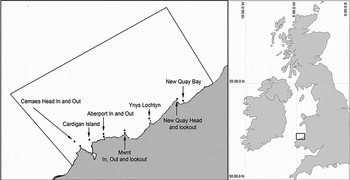
From April 2005 to July 2006, local fishing boats were used to deploy ten T-PODs along the coast of the Cardigan Bay SAC (Figure 1). At seven locations, T-PODs were placed 500 m from shore. At three of these locations (Aberporth, Mwnt and Cemaes Head), an additional ‘offshore’ T-POD (Aberporth Out, Mwnt Out and Cemaes Head Out) was deployed 1.5 km from shore (Figure 1). The ‘offshore’ T-PODs were located 1 km from the closest ‘inshore’ T-POD (Aberporth In, Mwnt In and Cemaes Head In).
Map of study area, Cardigan Bay Special Area for Conservation (SAC). The dots show the T-POD positions. ‘In’ stands for inshore T-POD, ‘Out’ for the offshore T-POD in locations where there are two T-PODs. The arrows point at the T-PODs and the two lookouts at Mwnt and New Quay Head, from where visual observations were carried out. The lines are the boundary for the SAC.

Although the calibration test was conducted to minimize differences between T-PODs, the units were always deployed at the same location and using the same settings to further minimize biases due to intrinsic differences between individual T-PODs. The T-PODs were set for continuous recording and they were retrieved and redeployed at intervals of 4–7 weeks to download the data from the T-PODs.
In order to ensure that the seafloor near the T-POD was free from obstacles that could increase scattering and shadowing of incoming echolocation clicks, the area was investigated over a radius of 100 m from the T-POD, using echo-sounders.
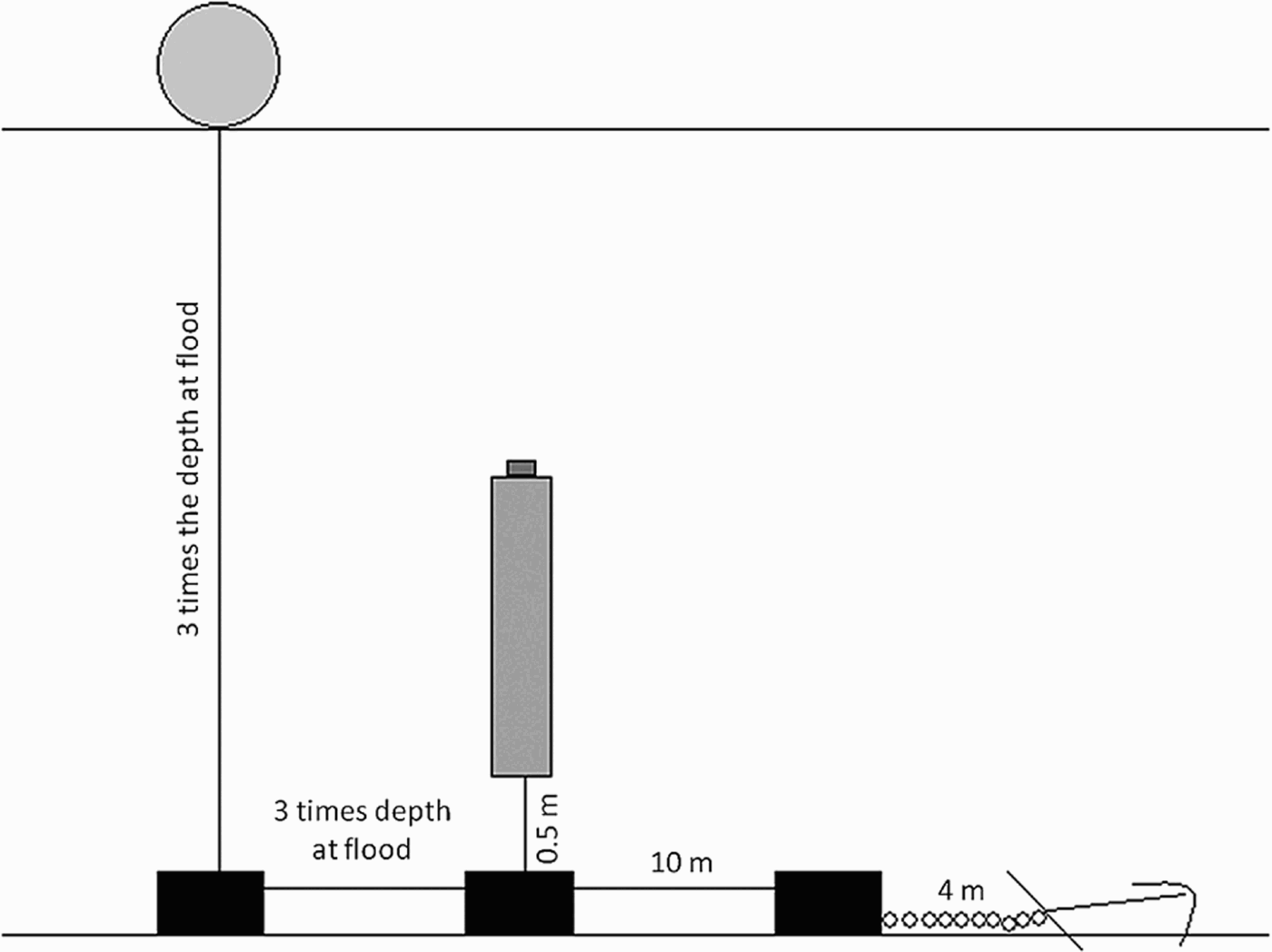
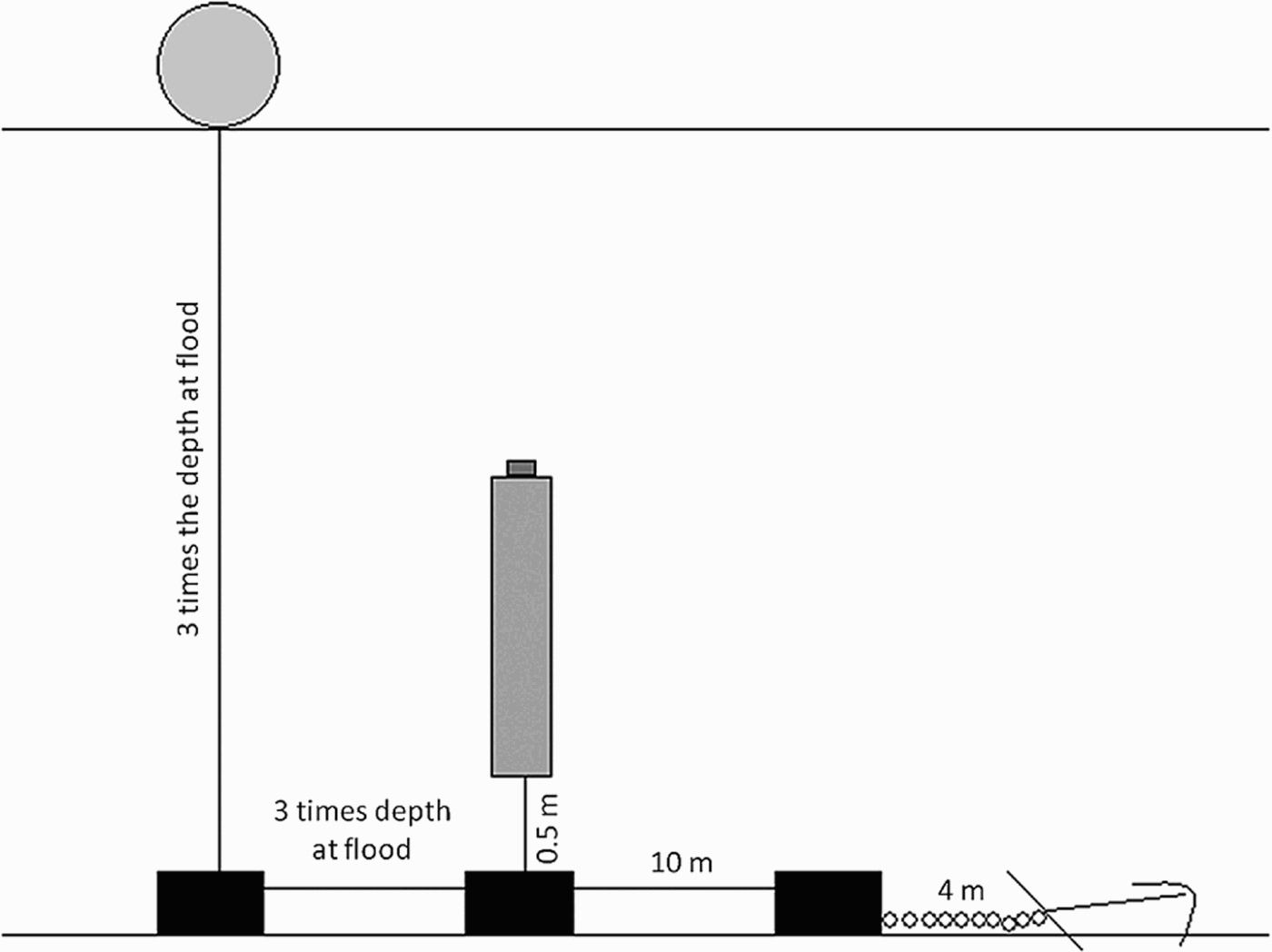
The mooring system was developed in cooperation with professional crab and lobster fishermen to keep the equipment in place over long periods and to withstand severe storms. It consisted of three separate weights, the T-POD and a surface buoy, connected with a long length of rope (Figure 2). During deployment, the T-PODs were floating with the hydrophone approximately 1.5 m above the seafloor attached to a weight.
Schematic illustration of the deployment mooring used in this study for the T-PODs. Three weights (40 cm sections of old railway tracks) are connected with leaded rope. The first one is connected to a surface buoy, the middle one is connected to the T-POD, which floats in the water. The third weight is also connected to a chain with an anchor.
Data analysis
Data logged by the T-PODs was extracted using T-POD exe v. 8.17 (www.chelonia.co.uk). This software classifies the click-trains into four classes: ‘Cet Hi’ and ‘Cet Low’ for high probability trains of cetacean origin while those resembling ‘chance’ trains or boat sonar are placed in ‘doubtful’ and ‘very doubtful’ categories. The ‘Cet All’ setting, which includes clicks with both, ‘Cet Hi’ and ‘Cet Low’, high and low probability of being of cetacean origin, was used to export cetacean click times and train details for both species from the T-POD data. Detection positive days (DPD) and detection positive minutes (DPM) were used to describe the presence of dolphins and porpoises at each site. These indicate the number of days/minutes that an echolocation click train was detected by the T-POD.
RESULTS
Data from all ten T-PODs were successfully recovered during the study period, and none of them were lost. A total of 72,896 hours of acoustic data were collected. There were a few short gaps in the collection of data due to either malfunction of the T-POD or delayed re-deployment resulting from bad weather after the equipment had been taken ashore for maintenance and downloading. These gaps varied from few hours to few days.
Seasonal variations
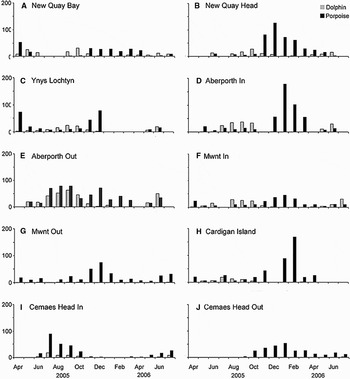
Bottlenose dolphins were detected acoustically in Cardigan Bay SAC during all months of the study period. In most months, there were dolphin detections by at least one T-POD, and regularly by multiple T-PODs every day. The months January–April 2006 formed the period with least dolphin detections ranging from 10–33% of detection positive days per month. All locations showed peaks in the detections of dolphin click-trains, starting between April and June and extending until October to December (Figure 3A–J). The only locations where dolphin registrations were rare throughout the study were Mwnt Out and Cemaes Head Out (Figure 3 G, J).
(A–J) Seasonal variations in bottlenose dolphin and harbour porpoise acoustic detections showing mean detection positive minutes (DPM) per day for each month for both species at each of the ten locations.

Harbour porpoise clicks were detected every day on at least one of the T-PODs, except for three days in June 2005 and one day in September 2005. Patterns in seasonal occurrence were more complex than for bottlenose dolphins (Figure 3A–J), but generally presented a contrasting pattern: in six out of eight locations where both species occurred; harbour porpoise detections peaked during the months where detections of bottlenose dolphins were lowest (Figure 3A–D, F & H).
Simultaneous detections of both species
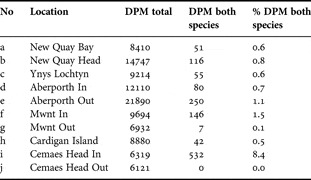
When pooling data from all ten T-PODs, only 1.2% of all DPM (N = 104,314 DPM) contained detections of both species within the same minute. When looking at each T-POD separately, the DPM on all T-PODs but one consisted of more than 98.5% of single species detections (Table 1), i.e. on all T-PODs most of the time either only porpoises or only dolphins were detected. The exception was Cemaes Head In, where both species were logged together in more than 8% of the DPM (Table 1). However, also in this location, single species detections were dominant. The T-POD at Cemaes Head Out, located only 1 km from the T-POD at Cemaes Head In, was the only one where not a single DPM detected both species.
Single and simultaneous detections within one minute of both species at each of the ten locations.

DPM, detection positive minutes.
If dolphins displace porpoises, or porpoises become silent in the proximity of dolphins, then the time lag from porpoise encounters followed by dolphin encounters could be shorter, compared to the time lag from dolphin encounters followed by porpoise encounters. However, there was no significant difference in the length of the time lags between porpoise encounters followed by a dolphin encounter or vice versa (ANOVA non-parametric df = 1, H = 0.02, P < 0.05; Barnard et al., Reference Barnard, Gilbert and McGregor2001).
DISCUSSION
Bearing in mind that it is not possible to estimate animal abundance from T-POD data, the high amount of DPM for harbour porpoise in all the T-PODs (Figure 3 A–J), even though harbour porpoise are more difficult to detect, points to the fact that harbour porpoise are indeed very abundant in the Cardigan Bay SAC.
T-PODs detect both harbour porpoise and bottlenose dolphin over only a relatively small area (Tougaard, Reference Tougaard2008), calling for several T-PODs in monitoring studies covering larger areas. The importance of using multiple T-PODs is exemplified by the T-PODs located at Cemaes Head In and Cemaes Head Out, which were placed only 1 km apart, but showed completely different patterns of bottlenose dolphin occurrence: here, dolphins were regularly detected in Cemaes Head In from June to October, and absent most of the time from Cemaes Head Out. Notwithstanding this finding, the other T-PODs placed within a kilometre of each other exhibited similar patterns of occurrence for the two species. However, the large difference in sensitivity between T-PODs, especially in older versions (T-POD V < 4) makes studies with multiple T-PODs challenging. Even with the possibility—gained by the calibration—to adjust the sensitivity, our T-PODs had a fairly high range in sensitivity. This was mainly due to the performance of one old version (V3) T-POD, which sensitivity could only be adjusted in a very short range of sensitivity values. However, the difference in sensitivity of V4 T-PODs in contrast was only 2 dB. Hopefully future PAM devices will have stable and well adjustable sensitivities to ensure equal performances.
Patterns in detections of harbour porpoise and bottlenose dolphin
In order to develop sound management for cetaceans within the Cardigan Bay SAC, it is important to describe variation in the usage of the area by the two principal species, and to measure both short- and long-term trends in their abundance. The T-POD data from this study have shown that both bottlenose dolphins and harbour porpoises are present in the Cardigan Bay SAC year round. This means that the two species are potentially at risk from anthropogenic disturbance, such as noise from recreational vessels, commercial and recreational fishing, including dredging and commercial wildlife watching operations all year round, and the management of this disturbance should not be confined to restricted periods. Although the bulk of the recreational vessels and commercial wildlife watching operations occur mainly in the summer months, the fishing activities take place throughout the year and the dredging is limited to the winter months when there are no visual surveys and no observers in place to monitor the compliance of boats to the boating code of conduct.
Visual observations have shown that dolphins are most abundant from April to October (Bristow et al., Reference Bristow, Glanville and Hopkins2001; Evans et al., Reference Evans, Anderwald and Baines2003; Ugarte & Evans, Reference Ugarte and Evans2006), and the acoustic data presented here have confirmed this.
To our knowledge, there are no published studies of the seasonal occurrence of harbour porpoise within the Cardigan Bay SAC, although sightings of the species in West Wales occur year round (Evans et al., Reference Evans, Anderwald and Baines2003), whilst strandings throughout Wales during 2005 peaked in June (Penrose, Reference Penrose2006). In this study, detections of harbour porpoise by T-PODs were highest at seven locations out of ten from October to March. Given the difficulty of visually monitoring porpoises during winter months, T-PODs would seem to give a more accurate description of seasonal occurrence for this species than visual observations of live or stranded animals. The summer peak of porpoise strandings reported by Penrose (Reference Penrose2005) may reflect an increase in violent interactions with dolphins, rather than an increase in porpoise abundance (see below).
Habitat partitioning of harbour porpoise and bottlenose dolphins
The number of porpoise strandings on the Welsh coast has increased sharply since 1998, reaching a peak in 2004, and has remained relatively high thereafter (Penrose, Reference Penrose2006). Post mortem examinations have shown that one of the most common causes of death for stranded harbour porpoises in the SAC is killing by bottlenose dolphins (Penrose, Reference Penrose2006). Dolphins do not prey on porpoises and the motivations for these attacks are unknown (Jepson & Baker, Reference Jepson and Baker1998). Porpoises killed by dolphins were first reported from the Moray Firth, Scotland (Ross & Wilson, Reference Ross and Wilson1996). Patterson et al. (Reference Patterson, Reid, Wilson, Grellier, Ross and Thompson1998) suggested that the porpoise kills were the result of bottlenose dolphins practising infanticide, since porpoises are of a size comparable to dolphin calves. However, bottlenose dolphins and harbour porpoises have considerable overlap in their prey species (Santos et al., Reference Santos, Pierce, Reid, Patterson, Ross and Mente2001; Santos & Pierce, Reference Santos and Pierce2003) and the fact that the killed and stranded porpoises found on the coast of Cardigan Bay often have stomachs full of fresh fish, could indicate that the porpoises were killed shortly after feeding and that the violent interactions between dolphins and porpoises in this area may be related to competition for food resources (Penrose, Reference Penrose2003).
Although the trigger for these agonistic inter-specific interactions is unclear, it is likely that porpoises will avoid areas where dolphins are present, leading to temporal and/or spatial habitat partitioning between the two species. However, the fact that both porpoises and dolphins were logged year around on all T-POD sites shows that they do occur sympatrically. For eight out of the ten T-POD locations, there was a seasonally divided temporal partitioning between the peak occurrence of dolphin and porpoise detections, with dolphins generally being more abundant in the summer months and porpoises more abundant in the winter. The two exceptions were Aberporth Out and Cemaes Head In, where dolphins and porpoises were most abundant in the same months, from June to October. Cemaes Head In is also the location with the highest percentage of double species recordings. We find it highly unlikely that the double species recordings were a result of dolphin clicks recorded on the porpoise channel, as a much higher amount of single species recordings occurred in this area (see Table 1), providing strong evidence that the false detection rate of dolphins recorded on the porpoise channel was zero or very low. For the rest of the locations, dolphin and porpoise click trains were not recorded simultaneously on any of the T-PODs, indicating that the two species clearly avoid each other, or at least one species avoids echolocating in presence of the other. It is worth noting that the beaches close to Cemaes Head were the most common locations for strandings of harbour porpoises killed by dolphins in West Wales during 2005 and 2006 (Penrose, Reference Penrose2006, Reference Penrose2007).
In summary, there appears to be temporal habitat partitioning between harbour porpoise and bottlenose dolphin in all the areas monitored in Cardigan Bay SAC, with the exception of Cemaes Head In, where the more frequent overlap between the two species may result in a higher risk of death for the porpoises from bottlenose dolphin attacks.
T-POD as a monitoring tool in areas with multiple echolocating species
The current study shows T-PODs can be a useful monitoring tool that also can be used in multiple species areas. When using T-PODs to monitor bottlenose dolphin and harbour porpoises, there is a risk of high frequency on-axis dolphin clicks being logged in the porpoise channels. As part of the novelty of this study, we calibrated the T-PODs to find the settings where no dolphin signals were detected on the porpoise channels. Only 1.2% of the thousands of detections in our study had both species within the same minute. Even if these were false detections, it is still extremely low and certainly useful for distinguishing the two species. This strongly indicates that the calibration was successful and that we can trust the species recognition in our data.
There are few days during the Welsh winter with wind conditions adequate for visual surveys, and it is therefore difficult to assess the abundance or even presence of marine mammals in the SAC during this harsh period. This is especially true for visually inconspicuous species, such as the harbour porpoise, that may use the area of interest during the winter. The presence of such species will likely be under-estimated. In protected areas where there are limited funds to provide the legal monitoring requirements, passive acoustic monitoring has a clear advantage over visual surveys for monitoring echolocating cetaceans during all weather conditions all year round with minimal staff requirements and relatively inexpensive setup costs.
ACKNOWLEDGEMENTS
We thank fishermen W. Evans and L. Walters for their help in the field. Also special thanks go to M. Dähne and co-workers at the German Oceanographic Museum in Stralsund, Germany, for calibration of the T-PODs; and to Dr N. Tregenza for help with the T-PODs and comments on this manuscript. Thanks to Dr P.T. Madsen, Dr J. Tougaard and one anonymous referee for comments on the manuscript. We thank volunteers at Sea Watch Foundation, Wales, for help in the field. The project was funded by the Countryside Council for Wales (Contract No. FC 73-02-314) and by the Sea Watch Foundation.