While China's tremendous social transition has been the subject of much study, the change in its political communication patterns remains opaque. One way to explore such change is to study journalists, who are important agents in the political communication process. As a result of the migration of journalists from the north to the south after 1989 and its frontier position in the Chinese market economy, Guangzhou has, since the 1990s, become the centre of liberal journalism. This report paints a portrait of Chinese liberal journalists.
Compared with a typical national journalist ten years ago, contemporary journalists have a lower median age, are more likely to be a college graduate, more likely to be a woman and less likely to be a Communist Party member. More importantly, the survey data present evidence of the endurance of literati values coexisting with both the modern professional and Party journalism values during the current journalistic professionalization in China. Such coexistence results in a complexity in journalists' attitudes on diversified issues as well as their journalistic behaviour. Journalists tend to be inactively liberal: they possess liberal attitudes but do not themselves engage in action. They delicately balance their professional standards with other concerns. As shown in the vignette tests – short stories on hypothetical circumstances to which interviewees are invited to respond – the dominant logic of journalistic practice is contingent on the nature of conflicts journalists encounter.
Data and Method
The survey was conducted in Guangzhou in the summer of 2005. The population in Guangzhou was about 7.5 million and average income per capita was 33,853 yuan (about $4,340), ranked seventh among 659 Chinese cities.Footnote 1 There were three newspaper groups with 35 newspapers and magazines in total. Through a stratified PPS (proportional to population size) sampling, eleven media outlets were sampled.Footnote 2 Within each organization, 10 per cent of journalists were randomly selected from organizational rosters. A local co-ordinator helped to distribute the questionnaire. The response rate was 76.04 per cent.
Basic Characteristics
Gender
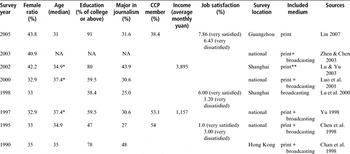
The proportion of female participation in journalism has been increasing. In 2005 Guangzhou, 43.8 per cent of journalists were female, compared to 40.9 per cent in the 2003 national surveyFootnote 3 and 42.2 per cent in the 2002 Shanghai survey.Footnote 4 In the 1995 national survey the figure was only 33 per cent,Footnote 5 and 35 per cent in a 1990 Hong Kong survey.Footnote 6Table 1 presents the trend shown in different surveys.Footnote 7
Chinese Journalists in Various Surveys

Notes:
* These figures are mean.
** The survey included both print and broadcasting media, but the statistic is from the print media in the survey.
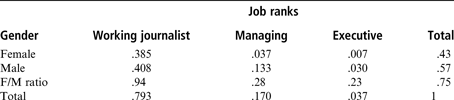
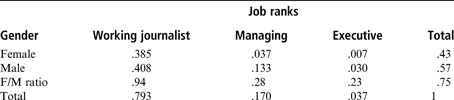
The proportion of females at the executive and managing levels was significantly lower than that at the working journalist level (p = 0.02).Footnote 8 The overall female-to-male ratio was 0.75. The ratio was 0.94 among working journalists, 0.28 among managing editors and 0.23 among executive editors, as shown in Table 2.
Gender Ratio in Different Positions (%)
Age and marriage
The median age among Guangzhou journalists was 31, about 3.9 years younger than the national median age ten years earlier. The gender gap in the median age was smaller: on average, the median age was 31 for male and 30 for female journalists, while ten years ago the gap was five years. Footnote 9 Associated with increasingly young journalists, the proportion of single journalists has increased: 47 per cent were single.
On average, as indicated in Table 3, working and managing journalists in Party organs were three years older than their colleagues in market-oriented newspapers, while for executive editors the age gap between two types of organizations was seven years. The age gap is related to the structural changes that have occurred in the newspaper industry since commercialization. Many market-oriented newspapers were started in the mid-1990s and recruited young journalists. A few years later, this first batch of journalists were promoted into management and executive levels. However, upward career mobility is much slower in the older Party organs.
Median Age in Different Ranks across Newspapers

Education
Print journalists were well educated. Over 94 per cent of them have completed a four-year college degree or above, and only 5.9 per cent do not have a bachelor degree. This proportion was much higher than the national average ten years ago (47 per cent), and the proportion in 2002 Shanghai (80 per cent). Gender did not have a significant effect on education (p = 0.44). The older generation of journalists had a lower degree of education (p = 0.00).
Professional training has also become more prevalent. Among those who had a degree at the bachelor level or above, 31.6 per cent majored in journalism or communication. This was higher than the proportion in the 1995 national average (27 per cent).Footnote 10 Another 64.39 per cent of those with bachelor's degree were trained in social sciences and humanities, and 4.55 per cent studied science. About 95 per cent knew at least one foreign language, 67 per cent self-reported as possessing fair foreign language skills and 46 per cent spoke dialects fluently. Approximately 36.3 per cent of journalists worked in the same city as where they went to school, among which females had a higher probability of staying in the same city (p = 0.02).
Ethnicity and religion
Ethnicity and religion patterns were stable. Han ethnicity was still the dominant majority (92.8 per cent). Around 90 per cent of journalists claimed no religious beliefs, 4.27 per cent were Buddhists and less than 1 per cent were Christians.
Political affiliation
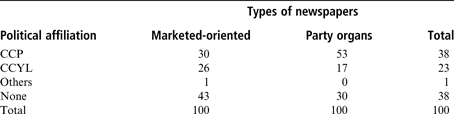
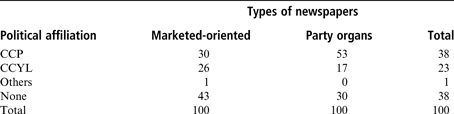
Members of the Chinese Communist Party (CCP) made up 38 per cent of the sample, less than the national proportion ten years earlier (54 per cent). In Party organs, 53 per cent of the samples were CCP members, 17 per cent were Chinese Communist Youth League (CCYL) members and 30 per cent had no political affiliation. In market-oriented newspapers, the proportions in these three categories were 30, 26 and 43 per cent, respectively. The remaining 1 per cent were affiliated with parties other than the CCP and CCYL. Journalists in the Party organs were more likely to be CCP members and less likely to associated with non-CCP parties (p = 0.008), as presented in Table 4.
Political Affiliation across Newspapers (%)
Income
Guangzhou journalists were doing relatively well economically. Roughly 59.7 per cent had monthly incomes between 5,001 and 10,000 yuan. Compared with the Party organs, market-oriented newspapers had higher proportions in both the low (45 per cent versus 26 per cent) and high (2 per cent versus 0 per cent) income ranges, as shown in Table 5.
Income Distribution in Different Types of Newspapers (%)

Journalists' incomes have two components: fixed salary and monthly bonus. All newspapers adopted an evaluation system to determine journalists' monthly bonuses, based on the quantity and quality of their work. Only 14.39 per cent of journalists had fixed salaries comprising more than 75 per cent of their monthly income, while the fixed salaries of 38.64 per cent comprised less than 25 per cent of their monthly income. Besides income, 92.8 per cent had house insurance, 97.4 per cent had social security insurance and 61.43 per cent had health insurance.
Job Experience
Employment relationship
There are two types of labour relationships between the journalists and their media organizations. One is the market system (he tong gong 合同工) in which journalists have to sign contracts with the organization every year. The other is the quota system (shiye bianzhi 事业编制) in which journalists are treated in a similar way to a staff member of the government. In Party organ newspapers, 65 per cent of respondents were in the quota system and 35 per cent were in the market system; while in market-oriented newspapers, 22 per cent were in the quota system and 78 per cent were in the market system (the difference is significant p = 0.000). In addition, the older generation (p = 0.000) and CCP members (p = 0.001) were more likely to be in the quota system.
Job autonomy and satisfaction
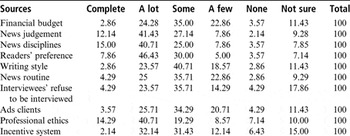
Since propaganda departments usually issue mandatory official news releases on sensitive issues, journalists' verbal expressions are limited. Thus, visual information becomes an alternative avenue to express their concerns.Footnote 11 None of respondents reported complete autonomy on content, but 2.5 per centFootnote 12 reported enjoying complete autonomy on page design. Meanwhile, 43 per cent reported having “a lot” of autonomy on content and 60 per cent on page design, and the difference between them was significant (p = 0.000).
“News discipline”Footnote 13 (xinwen jilü 新闻纪律) and “professional ethics” (zhiye daode 职业道德) were two top factors limiting journalistic autonomy, closely followed by “readers' preferences” and “news judgement,” as summarized in Table 6.
Sources of Job Autonomy Limitation (%)

With respect to job satisfaction towards their current job, 7.86 per cent of the respondents said “very satisfied,” 56.43 per cent were “satisfied,” 21.43 per cent were “neutral,” 0.71 per cent were “somewhat dissatisfied” and 6.43 per cent were “dissatisfied”; 7.14 per cent refused to answer this question.
A strong sense of the middle class has arisen among journalists. About 91.43 per cent of journalists self-reported as belonging to the middle class, among which 16.43 per cent classified themselves as upper middle class and 10.71 per cent as lower middle class.
Views on Professionalism
A sense of professionalism has been strengthened over years. Some 86 per cent of respondents regarded themselves as professional and preferred staying in the profession. This is higher than the 75.3 per cent reported in the 1997 national survey.Footnote 14 Journalists blended the Chinese literati tradition into Anglo-Saxon professionalism discourse.Footnote 15 Such a mixture was evident in their opinions both on what the roles of media should be and on how to implement these roles.
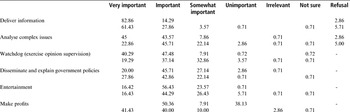
Respondents were asked to rate the importance of the various roles the news media should play as well as the roles they actually did play in their current organizations. Information delivery was still rated as very important (83 per cent), but only 61 per cent thought that their current organizations fulfilled this role. Analysis of complex issues (45 per cent) and watchdog function (40 per cent) were also, theoretically, very important. Yet only 23 and 19 per cent of journalists (respectively) thought their organization emphasized these two roles. Entertainment was the least important role the media should play (16.42 per cent), and its emphasis in theory was very similar to its actual practice (16.43 per cent). The largest discrepancy between role-in-theory and role-in-practice existed in the revenue-making function. None of the journalists thought that the media should focus on increasing revenue, but 41.43 per cent thought their current organization views this function as a very important one, as shown in Table 7.
Role of Media in Theory and in Practice (%)

Relating the role of the media with social transitions in China, 67.14 per cent agreed that the media should take responsibility to push reforms, compared to 21.42 per cent who argued that news media should focus on reporting objective facts rather than taking a position pushing for reforms.
Respondents were also asked how the role of media should be fulfilled. Internal reporting (neican内参) is an interesting example to show the effects of the Chinese literati tradition on journalists' views of professionalism. Internal reporting was a common practice in the Party journalism era. Through internal channels journalists' reports, usually “negative” ones, on various social problems were sent to high-ranking government and Party officials for their solutions. This method of communication is similar to traditional literati practices: good literati offer suggestions (jinjian 进谏) to the emperor for the sake of the nation, and a good emperor takes these suggestions into consideration (najian 纳谏).
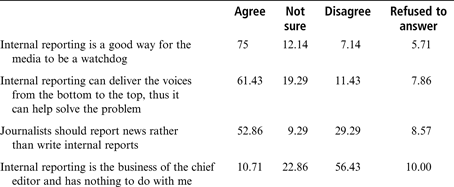
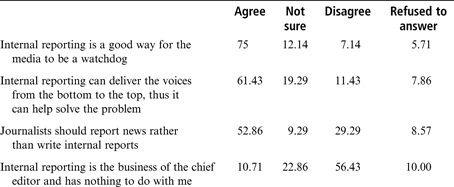
Over time, internal reporting as a journalistic practice has become less common, as shown in the generational difference in journalists' experience of it (p = 0.012). Some 75 per cent of journalists who were over 50 had written internal reports, but only 10.53 per cent of journalists under 30 had done so. However, young journalists still held strong positive opinions on the practice: 75 per cent agreed that internal reporting is an effective practice for the media to fulfil its watchdog function. In addition, only 11 per cent thought that internal reporting has nothing to do with them, as shown in Tables 8 and 9.
Internal Report by Different Ages (%)

Opinions on Internal Reporting (%)
Even though the exact impacts of the literati tradition in the current journalistic profession require a more detailed investigation, the coexistence of the literati tradition with modern professionalism and Party journalism creates complexity in journalists' attitude and practices, as shown in the next two sections.
Views on Commercialization and Media Reform
The effect of commercialization
Ever since media reform, the issue of the effect of commercialization on journalism has been one of the most debated. Some 72.93 per cent of respondents agreed that commercialization had affected their judgement on what constituted news by shifting the news selection process from being supervisor-centred to reader-centred. More than half of them acknowledged the existence of negative market effects such as paid journalism. In this respect, 25 per cent self-reported themselves as being involved in paid journalism, and 46 per cent thought their colleagues had been involved in the same.
However, 27.07 per cent of respondents thought commercialization would not affect journalism, especially judgement on what constituted news. This was mainly because of the structural separation between editorial departments and business management, and the tight supervision of propaganda departments.
Media reform
Overall, journalists thought the news environment was more open than before. They were more positive about reform on the business management side than that on the journalistic side.
On editorial policies, only 9 per cent agreed that editorial polices were more open compared with those in 2004, while 40 per cent thought no significant progress had occurred in reporting political news and 25 per cent regarded the press environment as tighter than the year before.
On the business management side, 37 per cent of respondents agreed that structurally separating the editorial department from business management was the right move, and 28 per cent thought that the capital investment structure of media organizations had been a big obstacle blocking reform. Another 40 per cent agreed that the dual nature of the media in China meant that reform can never be complete, and thus the direction of reforms in future remains unclear. Some 12 per cent doubted that the logic of reforms is right, and 3 per cent complained that management reform had interfered with editorial independence.
Social issues
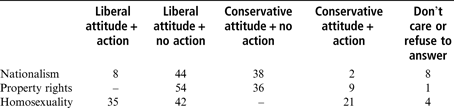
On social issues like nationalism, property rights and homosexuality, journalists were “inactively liberal”: they were liberal in attitude, but did not actively promote their liberal views, as summarized in Table 10.
Journalists' Attitude and Actions on Various Issues (%)
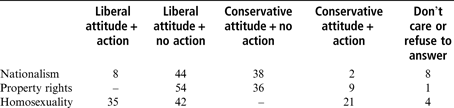
Immediately before the survey, Japan had applied to join the United Nations, which triggered Chinese anti-Japanese sentiments. There was an informal social protest against Japanese commodities at that time. In the survey, 44 per cent of respondents supported the movement but would not persuade others to participate, and another 38 per cent opposed it but would not persuade others to do so either. Only 8 per cent supported it and would also persuade others to participate in it, and 2 per cent opposed it and would persuade others to do so. The rest either did not care or refused to answer this question.
Regarding reform of property rights, 54 per cent thought the reform was going in the right direction, 9 per cent thought it was heading in the wrong direction, and the remainder either blamed the reform for increasing wealth inequality or complained that the reform process lacked transparency.
When asked about their attitude towards homosexuality, 35 per cent did not mind having homosexual friends, 42 per cent said they respected the choices of each individual but did not want to have gay friends, and 21 per cent were against homosexuality and did not want to have homosexual friends. Four per cent refused to answer the question.
Vignette Tests on Journalistic Behaviour
As a departure from previous surveys on Chinese journalists, this survey included a set of vignette tests. They consisted of six hypothetical scenarios reflecting common conflicts journalists frequently encounter at work. Scenario 1 represents an ethical dilemma in which journalists have to choose between a professional requirement and their moral beliefs. Scenario 2 reflects the increasing concern of legal repercussions when conducting interviews. Scenario 3 is a story in which journalists have to balance their professional concern and the commercial interests of the organization. Scenario 4 constructs a situation in which journalists have to deal with news bans from the propaganda department. Scenario 5 asks journalists to deal with a politically sensitive story which is happening in the other city. And scenario 6 concerns homosexuality which is against the culture tradition.
These six scenarios were modified based on the stories that journalists told during the interviews. During the author's in-depth interviews prior to the survey,Footnote 16 journalists were asked to describe the most difficult situations or cases they encountered at work. The hypothetical scenarios represented the conflict between professional concern and ethical, legal, commercial, political and cultural concerns respectively. For each type of conflict, respondents were asked to make choices and defend their choices assuming they were a chief editor of the newspaper.
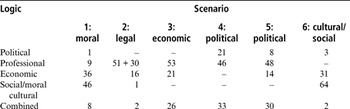
Table 11 summarizes the journalistic behaviour manifested in the above scenarios. Their logic indeed varied according to the different nature of conflicts. First, professional logic – including concerns on timely report, credibility, objectivity and independence – has been a strong position journalists adopt to justify their behaviour, except when they are facing a moral (scenario 1) or cultural (scenario 6) dilemma.
Logic of Journalistic Behaviour in Hypothetical Scenarios (%)

Second, more journalists preferred mixed strategies when dealing with economic (26 per cent in scenario 3) and political (33 per cent in scenario 4 and 36 per cent in scenario 5) concerns than when facing legal issues (2 per cent in scenario 2). Only when handling the moral and cultural conflicts, neither professional logic nor mixed strategy dominated journalists' justification.
Third, regarding the classic critical theorists' dilemma of commercial concern prevailing over journalists' professional standards, the data revealed the triumph of commercial logic. For journalists, commercial logic was more popular when they were facing conflicts involving moral (36 per cent) and cultural (31 per cent) concern, than when they were facing legal conflict (16 per cent), mild political conflict (14 per cent) and economic issues (21 per cent). When the political pressure was severe, commercial concerns had to be relinquished (0 per cent in scenario 4). Of course, one caveat that needs to be emphasized is that the respondents are journalists, not business managers of the media outlet. In the current Chinese media system, the editing part is under control of the Party, while the business part is not.
Discussion
Compared with the national average ten years ago, a typical Guangzhou print journalist in 2005 was younger, better-educated and more likely to be female, and to be a contracted journalist. They regarded themselves as belonging to the middle class. They believed that there should be an independent media system, while their ideal was a mixture of Western professionalism and the Chinese literati tradition, since they felt obliged to push the nation's development as well as to emphasize news' societal effects. Such coexistence shapes the complexity of journalists' attitudes and their professional behaviour in various aspects. Even though they thought the press has become more open, they were not satisfied with the autonomy and freedom they had. The majority welcomed commercialization and they were inactively liberal in various social issues. They consciously emphasized professional standards, as well as performing a delicate balancing act with the conflicts they encountered at work. The survey presented empirical evidence on the contingency of behaviour logic. Professional logic showed its popularity among journalists when the nature of conflicts involved legal, economic and political concerns, but not in the case of moral or cultural conflicts. Neither professional nor commercial concerns was strong enough to oppose political concern when journalists faced severe political issues. As a result, mixed strategies have been popular in most situations.
However, over three decades, Chinese political communication has evolved into a three-tier landscape. The first tier consists of the most developed cities in the coastal provinces, highlighted by Guangzhou, Beijing and Shanghai. The second tier includes medium-sized provincial capital cities; and the third tier is the less-developed areas.Footnote 17 Thus, it would be misleading to generalize the characteristics of Guangzhou print journalists as a representative pattern of the whole nation, even though journalists have widely acknowledged that the Guangzhou pattern is indicative of the trend towards liberal journalism in China.
In addition, it will be helpful to compare journalists with other knowledge-based professions such as lawyers and doctors. In 2005, the gender ratio (female percentage of the total) for full-time lawyers (zhuanzhi lüshi 专职律师) was 18.81 per cent nationwide and 20.55 per cent in Guangdong province.Footnote 18 For licensed doctors (zhiye yishi 执业医师), it was 42 per cent nationwide.Footnote 19 Both ratios are lower than for journalists. The proportion of Chinese Communist Party members among lawyers is 27.34 per cent nationwide and 35.57 per cent in Guangdong province, also lower than the proportion among journalists. Further analysis on comparison on the transitions across these intellectual occupations will be helpful.