INTRODUCTION
The form and function of infant vocalizations have received separate attention in the literature (e.g., Oller, Reference Oller, Yeni-Komshian, Kavanagh and Ferguson1980; Stark, Bernstein & Demorest, Reference Stark, Bernstein and Demorest1993), focusing on their characteristics as speech-like sounds and the context in which they occur as communication signals, respectively. Coupling relations between prelinguistic form and function have also been explored (e.g., Bloom, Reference Bloom and Enns1990; D'Odorico & Franco, Reference D'Odorico and Franco1991; Hsu & Fogel, Reference Hsu and Fogel2003; Papoušek & Papoušek, Reference Papoušek1989). The present study was designed to systematically examine the frequency and types of infant prelinguistic vocalizations as a function of the context of ritualized social games between mothers and their infants that share an invariant structure but differ in social dynamics.
Form of infant vocalizations
The form of infant vocalizations undergoes rapid changes in the first year of life. After crying sharply declines at around age 0;2, non-distress vocalizations become more frequent in an infant's vocal repertoires (for a review, see Oller, Reference Oller, Yeni-Komshian, Kavanagh and Ferguson1980). Non-distress vocalizations are typically classified as either non-speech-like or speech-like. Non-speech-like vocalizations, including fixed signals (e.g., laughs) and vegetative sounds (e.g., burps and hiccups), are directly linked to biological or social–emotional functions and are deemed to have only indirect linkages to speech (Oller, Reference Oller2000). As opposed to non-speech-like sounds, speech-like vocalizations, or protophones, are thought to be precursors to later speech development (Oller, Reference Oller2000; for an opposing view, see Stark, Reference Stark, Yeni-Komshian, Kavanagh and Ferguson1980, Reference Stark1989).
According to Oller's (Reference Oller, Yeni-Komshian, Kavanagh and Ferguson1980, Reference Oller2000) infraphonological model, protophones can be further classified into four different types, based on the degree to which they approximate the infrastructural articulatory characteristics of adult speech. These protophones progress along a continuum during the first year of life. quasi-resonant nuclei are primitive vowel-like sounds that are produced by the vocal tract during an at-rest position. They begin to emerge by age 0;2 and are frequently observed till ages 0;6 to 0;8. fully-resonant nuclei, which are typically observed between ages 0;3 to 0;8, are vowel-like sounds with full resonance and sound like mature adult vowels. marginal syllables are primitive consonant–vowel combinations produced with normal phonation and slow formant transitions, which are typically produced prior to the emergence of canonical syllables. canonical syllables are mature consonant–vowel combinations with adult-like formant transitions. They first emerge around ages 0;5 to 0;10 (Oller, Reference Oller, Yeni-Komshian, Kavanagh and Ferguson1980; Stark, Reference Stark, Yeni-Komshian, Kavanagh and Ferguson1980) and become more frequent at ages 0;9 to 1;8 (Nathani, Ertmer & Stark, Reference Nathani, Ertmer and Stark2006).
Function of infant vocalizations
Views about the functional nature of prelinguistic vocalizations have changed over time. Prelinguistic vocalizations were once thought to be random and reflexive without active control by infants. As a result, they were believed to be reflex-like passive responses to stimulation that exerted no influence on others and bore no psychological meaning to the infant (see Oller, Reference Oller, Yeni-Komshian, Kavanagh and Ferguson1980, for a review) and could be reinforced by social stimulation through repeated conditioning (for a review, see Poulson & Nunes, Reference Poulson and Nunes1988). Alternatively, a constructive exploration view suggests that infants are innately predisposed to creatively explore their articulatory movements and to practice control of their respiratory system with little need for adult motivation or shaping (e.g., Ferguson, Reference Ferguson, Perkell and Klatt1986). Another view is that infant vocalizations are expressive in nature. They are likely to occur in conjunction with significant changes in the external context reflecting subjective internal experiences (Hilke, Reference Hilke1988). Similar to animal vocalizations, prelinguistic vocalizations are also thought to serve as a source of self-stimulation to increase arousal and attention (cf. Cheng, Reference Cheng2003), and thereby provide self-regulation (Goldstein, Schwade, Briesch & Syal, Reference Goldstein, Schwade, Briesch and Syal2010). Furthermore, infant vocalizations consistently elicit responses from others, indicating a social regulatory function (Hsu & Fogel, Reference Hsu and Fogel2003). For example, infant vocalizations varying in speech quality elicit differential maternal response (Hsu & Fogel, Reference Hsu and Fogel2003). Mothers respond to speech-like vocalizations with brief pauses, vocal imitation, and high-pitched vocalizations with rising melodies. Such patterning is distinctly different from their responses to infant physiological and cry sounds (Keller & Schölmerich, Reference Keller and Schölmerich1987).
Prelinguistic vocalizations may also function as a symbol of cognitive understanding of the context, which can be gleaned from experimental evidence involving perturbation of the social context. For example, in response to planned violations of social expectations and contingencies such as the ‘still face’ procedure, in which the adult partner poses a neutral face without talking or touching the infant, the frequency of vocalization by five-month-olds shows not only an overall increase, but also a burst–extinction pattern of an initial increase followed by a decrease (Goldstein, Schwade & Bornstein, Reference Goldstein, Schwade and Bornstein2009). Increased vocalization toward an unresponsive partner appears to demonstrate an instrumental use of vocalizations by infants in an attempt to elicit response from their partner, indicating cognitive processes are involved. Indeed, infants tend to vocalize when they engage in effortful mastery and contingent learning (McCall, Reference McCall1972; Watson, Reference Watson1972). Experimental studies on infants' vocal response to non-social stimuli have demonstrated that vocalization is a concomitant of cognitive mastery, achievement of control, and withdrawal of control (McCall, Reference McCall1972; Millar, Reference Millar1988; Watson, Reference Watson1972; Zelazo, Reference Zelazo1972).
Taken together, analogous to infant cries (Barr, Hopkins & Green, Reference Barr, Hopkins and Green2000), child speech (Halliday, Reference Halliday1975), adult affective vocalizations (Scherer, Reference Scherer1988, Reference Scherer, Papoušek, Jurgens and Papousek1992), and animal vocalizations (Owings & Morton, Reference Owings and Morton1998), prelinguistic vocalizations are multi-functional, serving at least three different functions: as a symptom reflecting an infant's motivational and affective state, as a symbol representing an awareness of and information about the context in which vocalizations are produced, and as a signal for establishing and maintaining social contact with others. Previous research has primarily focused on the signal function, less is known about the symptom and symbol functions. The first goal of this study, therefore, was to investigate the symptom and symbol functions of prelinguistic vocalizations as indicators of underlying affective and cognitive processes, respectively.
Infant vocalizations and social contexts
The tripartite symptom–signal–symbol functional views of infant vocalizations highlight the role of social contexts, in which the functions of infant vocalization can be understood only within its context of production. The context-selection hypothesis (e.g., Bloom, Reference Bloom and Enns1990; D'Odorico & Franco, Reference D'Odorico and Franco1991), for example, postulates that vocalizations are selectively uttered with respect to their production context. The occurrence pattern and acoustic characteristics of infant vocalizations are specific to their social and communicative contexts. Vocalizations with speech-like quality are more likely to be produced by infants when interacting with a person than with an object, when interacting with their mothers than with a stranger, and when engaging with an adult in turn-taking and verbal interaction (for a review, see Bloom, Reference Bloom and Enns1990; Legerstee, Reference Legerstee1991). Speech-like vocalizations are also more likely to occur during mother–infant mutual engagement than maternal unilateral engagement (Hsu & Fogel, Reference Hsu and Fogel2001).
An alternative view is the infrastructural model (Oller, Reference Oller2000, Reference Oller, Oller and Griebel2004; Oller & Griebel, Reference Oller, Griebel, Burgess and MacDonald2005). It is hypothesized that the form and function of non-distress prelinguistic vocalizations are decoupled, which allows for flexible adaption to communication. This contextual freedom hypothesis contends that infants produce vocal sounds without a particular social ‘intent’. Even when they are alone without any apparent contextual influence, infants frequently produce vocalizations (Delack, Reference Delack1976). Only fixed signals such as cry and laughter are tightly coupled to the context (Oller, Reference Oller2000). These fixed signals are, therefore, easily recognized and understood and are often used by caregivers as a guide in caregiving (Papoušek, Reference Papoušek1989). Although it is difficult for infants to inhibit their cries (fixed signals) in the condition of pain or hunger, it is relatively easy for infants to inhibit their non-distress vocalizations in conditions that typically elicit vocal production. As mentioned above, after their exposure to still-face interaction, infants decrease their vocalization after an initial increase (Goldstein et al., Reference Goldstein, Schwade and Bornstein2009). The lack of obligatory response or high inhibitability is seen as the contextual freedom of vocalization. The contextual freedom hypothesis of vocal production argues for the decoupling of a systematic patterning in form–function relations. A wide variety of sounds are used by infants in serving as symptoms, signals, and symbols of their feelings, social influences, and understandings, respectively.
Development of form–function (de)coupling
At first glance, it appears that the contextual freedom hypothesis is incompatible with the context-based tripartite symptom–signal–symbol functional model. These two contrasting views, however, can be reconciled within a developmental framework.Footnote 1 Given that the contextual freedom hypothesis of form–function decoupling makes no demand on the infant or the listener (e.g., caregiver), it is expected to emerge first in development. As the infant gains repeated exposures to a variety of experiences, form–function coupling becomes more consistent and reliable. The symptom function of affective state reflects the infant's sensorimotor abilities in expressing responses to external influences and is also expected to develop gradually as the infant matures. Initially, while the infant's vocalizations sometimes meaningfully reflect his/her affective arousal, they often fail to show such consistency. As the symptom function consolidates, the signal function begins to take shape. The signal function makes a strong demand on the listener (e.g., caregiver) in recognizing and interpreting the vocalization as a meaningful cue to guide her response. Although regular and stable form–function coupling is a necessary condition that precedes the signal function, the specific patterns of coupling are often idiosyncratic and unique to individual infant–caregiver dyads. The symbol function relies on the infant's perceptual and cognitive sophistication in perceiving and understanding changes in the context; thus, it is expected to emerge last. Both quantitative (e.g., changes in frequency and duration) and qualitative (e.g., coupling between form and function) measures provide some supporting evidence for this developmental framework. For example, by six months, infants vocalize more when their mothers are silent than when they are talking (Berger & Cunningham, Reference Berger and Cunningham1983). Also, in the above-mentioned still-face experiment, infants change the occurrence pattern of their vocalization (Goldstein et al., Reference Goldstein, Schwade and Bornstein2009).
It should also be noted that the symptom–signal–symbol functions are not mutually exclusive; rather, they often operate concurrently. A vocalization can simultaneously serve as a symptom, a symbol, and a signal. Developmentally, the dominance of form–function decoupling gradually transitions into the context-based functions after its first emergence in early infancy. During this developmental transition, form–function coupling and decoupling co-exist. As speech begins to emerge at the end of the first year of life, the form–function coupling begins to prevail and symbolic functions begin to consolidate. The second goal of this study was to explore the form–function (de)coupling relations between vocalization types and social game contexts among six- and twelve-month-old infants.
Infant vocalizations and social games
Social games are jointly regulated activities between mothers and their infants, which are thought to be the foundation for pragmatics development (Ratner & Bruner, Reference Ratner and Bruner1978). The role of infants in social games evolves with age, progressing from being interested passive observers, to active participants without following the game rules by age 0;9, and to playing by the rules by ages 1;0 to 1;3 (Rome-Flanders & Ricard, Reference Rome-Flanders and Ricard1992). Peek-a-boo and tickle are two commonly played games between mothers and infants across cultures (Fernald & O'Neill, Reference Fernald, O'Neill and Macdonald1993; van Hoorn, Reference van Hoorn, Monighan-Nourot, Scales, Hoorn and Adny1987). Both games have a similar invariant two-phase structure, involving set-up and climax. Such structure allows for a systematic comparison between and within games. Previous studies have created experimental paradigms using regularization in these games as a tool for investigating emotional expression and regulation (e.g., Fogel, Nelson-Goens, Hsu & Shapiro, Reference Fogel, Nelson-Goens, Hsu and Shapiro2000). For the peek-a-boo game, set-up is the covering or disappearance of the mother's face (“Where's mommy?”), and climax is the uncovering or reappearance, which is typically accompanied by maternal vocalization of “Peek-a-boo!” For the tickle game, set-up is an approach of the mother's looming hands toward the infant's body (“I'm gonna get you!”), and climax is the act of tickling, which is typically accompanied by maternal vocalization of “Tickle, tickle, tickle!”
With age, infants change the pattern of vocal production from expressing a general arousal throughout the course of the game to coordinating with the game structure (e.g., Rome-Flanders & Cronk, Reference Rome-Flanders and Cronk1995). Ten- to twelve-month-olds laugh more than four- to six-month-olds during both tickle and peek-a-boo games (Sroufe & Wunsch, Reference Sroufe and Wunsch1972). During tickle games, twelve-month-olds produce more vocalizations and laughs than six-month-olds (Hsu & Fogel, Reference Hsu and Fogel1999). Also, the types of vocalizations exhibited during social games show developmental changes characterized by a decrease in more primitive sounds and an increase in more mature sounds (Rome-Flanders & Cronk, Reference Rome-Flanders and Cronk1995). Although the effects of ritualized social games on vocalization types have not been specifically examined, smile amplitude and types of smiling have been found to vary systematically according to game, game phase, and game perturbation. For example, smile amplitude is significantly higher during tickle than peek-a-boo and during game climax than game set-up (Fogel, Hsu, Shapiro, Nelson-Goens & Secrist, Reference Fogel, Hsu, Shapiro, Nelson-Goens and Secrist2006). Simple smiles (lip corner retraction), which have the lowest amplitude ratings, are more likely to occur during peek-a-boo than tickle, whereas duplay smiles (lip corner retraction with jaw drop), which have the highest amplitude ratings, are more likely during tickle, particularly tickle climax, than peek-a-boo (Fogel et al., Reference Fogel, Nelson-Goens, Hsu and Shapiro2000; Fogel et al., Reference Fogel, Hsu, Shapiro, Nelson-Goens and Secrist2006). When perturbed games are played, for example, when mothers delay uncovering their faces during peek-a-boo or when they pretend to, but do not actually tickle the infant, the amount of smiling is reduced (Fogel et al., Reference Fogel, Hsu, Shapiro, Nelson-Goens and Secrist2006).
The two major goals for this study were to further understand the functions of prelinguistic vocalizations as symptoms and symbols within social game contexts and to explore the (de)coupling of form– function relation during the first year of life. First, based on the symptom function hypothesis that prelinguistic vocalizations serve as an indicator of affective arousal, it was expected that infants would vocalize more during tickle than peek-a-boo and during game climax than game set-up. Second, based on the symbol function hypothesis that prelinguistic vocalizations serve as an indicator of social understanding, it was expected that six- and twelve-month-olds who played the perturbed games would vocalize more than those who played the normal games. Finally, based on the developmental model of form–function (de)coupling, it was hypothesized that vocalization types would not vary systematically between games, between game phases, or between normal and perturbed games by twelve months of age.
METHODS
Participants
Infants were identified from records of births published in a daily newspaper in a capital city in the western United States. A letter was sent to mothers of infants who were approaching ages 0;6 or 1;0, inviting them to participate in a studyFootnote 2 of mother–infant social games at a university playroom. For the combined samples, mothers' education ranged from 12 to 19 years with a mean of 14·6 years. Family income ranged from $5,000 to $120,000 (mean = $38,530). Mother–infant dyads were randomly assigned to either a normal game or perturbed game condition. In the six-month-old group, a total of 74 infants participated in the game playing and 71 infants (31 girls; 64 White, 4 Hispanic, 1 Asian, and 2 mixed race) completed both games. In the twelve-month-old age group, a total of 66 infants participated in the game playing and 64 (33 boys; 61 White, 2 Hispanic, and 1 Asian) completed both games.
Procedures
Mothers and their infants sat across from each other at a child-sized table. The infants were seat-belted across their waist. Three cameras mounted on the walls focused on the upper body of mothers and their infants. Two of the three cameras with the best views of the mother and the infant were selected and mixed by a special effects generator. One camera focused on the infant's upper body and face, whereas the other camera focused on the mother's upper body and face. A digital clock accurate to one video frame (1/30 second) was superimposed on the merged video image.
Upon arrival at the playroom, mothers were asked to play one peek-a-boo and one tickle game with their infant, each consisting of six trials. A trial is a sequence of set-up and climax phase of the game. For peek-a-boo games, the cover and uncover of maternal face are the set-up and climax, respectively. For tickle games, the looming hands and tickle are the set-up and climax, respectively. The order in which the two games were played was randomly assigned and counterbalanced across dyads. Prior to game playing, training was provided to the mothers. Each mother was shown a video with instructions and a demonstration of an adult playing peek-a-boo and tickle games with an infant. Each mother was also asked to practice each game with the experimenter. The mothers assigned to the perturbed game condition were trained to alter the game climax during two perturbed trials (see details below). They received instructions from a research assistant via headphones. Mothers were instructed when to begin playing the first game, when to perturb the game, and when to switch to the other game.
Mothers and infants assigned to the normal game condition simply played the games normally for six consecutive trials, that is, the mothers repeated the same set-up and climax sequences six times. In the dyads assigned to the perturbed game condition, the mothers first played two normal trials of set-up and climax, which were followed by two perturbed trials, and then they returned to normal play for the remaining two trials. For peek-a-boo, instead of rapidly uncovering her face after the set-up, the mother continued to cover her face with hands and then slowly, after saying “peek-a-boo”, uncovered her face. For the perturbed tickle, the mother made tickling movements with her fingers, that is, looming hands, and continued vocalizing “Tickle, tickle, tickle!” without actually touching the infant. The action in the climax, thus, was changed for both games. For the perturbed peek-a-boo, it was the delay in face uncovering and for tickle it was the absence of the actual tickle.
Coding
Coding was done on three separate passes of video viewing. The first pass was to identify the onset and offset times of set-up and climax game phases, which was done by a psychology undergraduate research assistant. In peek-a-boo games, the onset of climax was the mother's covering of her face before saying “peek-a-boo”. In tickle games, the onset of climax was the mother's stopping of wiggling finger movements before looming toward the infant. During perturbation trials, climax was coded from the onset of the perturbation action until the beginning of the subsequent set-up. A second psychology undergraduate assistant served as the reliability coder. Inter-coder reliability was assessed for game phase coding on 14% of the sample. The average Cohen's kappa, which was calculated based on a second-by-second comparison of each coder's classifications, was ·88.
The second pass was to identify the occurrences of infant non-distress vocalizations. A psychology undergraduate coder was trained to identify infant non-distress vocalizations. The coder first played the video and listened to the sound until a non-distress infant vocalization was heard. The coder then stopped the video to record the onset time. The procedure was repeated several times to recheck the recorded onset time and identify the offset time. If there was either an audible ingressive breath or a perceivable silence of one second or longer in a long bout of vocalization, two separate vocalizations were recorded. Following previous studies (e.g., Oller, Eilers, Steffens, Lynch & Urbano, Reference Oller, Eilers, Steffens, Lynch and Urbano1994), vegetative sounds (e.g., sneezes, coughs, and hiccups), physical effort sounds (e.g., grunts), negative vocalizations (e.g., fuss and cry), and laughs were excluded. Inter-coder reliability was assessed for the occurrence of infant non-distress vocalization on 19·3% of the sample. The first author served as the reliability coder. The average Cohen's kappa was ·64 and percentage of agreement was 93%.
Finally, in the third coding pass, speech-like protophones were coded based on an auditory perceptual method. Two graduate speech–language pathology students served as coders. The two coders were provided with definitions for the five infraphonological types, as described in the infraphonological coding scheme (Nathani & Oller, Reference Nathani and Oller2001; Oller, Reference Oller2000): (1) quasi-resonant nuclei are vowel-like vocalizations produced by a vocal tract at rest that lack full resonance and do not sound like adult vowels; (2) fully-resonant nuclei are vowel-like vocalizations produced with an open vocal tract that sound like mature, adult vowels; (3) marginal syllables contain primitive vowel–consonant combinations produced with normal phonation, slow (>120 ms) formant transitions between closures and openings of the vocal tract, and sound ‘sloppy’ or ‘slurred’ to the listener; (4) canonical syllables also contain consonant–vowel combinations but with rapid (<120 ms) formant transitions between the consonant and vowel resembling mature, adult-like syllables, and sound ‘crisp’ and ‘well-formed’ to the listener; and (5) others are vocalizations that could not be classified as any of the first four types, such as raspberries and clicks. Formant transition values were provided so listeners had a complete definition of marginal and canonical syllables, even though actual spectrographic data were not available. Several audio examples of each vocalization type were provided to the two coders by the second author, who has extensive experience with coding infant vocalizations. The coders-in-training were then required to classify protophones types for several audio examples independently and when they were able to identify the various protophones types with 80% accuracy, training was discontinued and actual data analysis began. Each judge coded approximately half of the data. The experienced judge verified all protophone judgments by the two coders. Any discrepancies were resolved by mutual consensus.
Coding reliability was assessed by randomly and separately selecting 21% of the six- and twelve-month samples for independent coding by a second judge (who was either one of the original coders or a third coder who had also been trained using similar procedures as described above). The inter-coder reliability for kappa was ·76 and percentage of agreement was 89% for six-month-olds, and kappa was 1·0 and percentage of agreement was 100% for twelve-month-olds, respectively.
RESULTS
Preliminary analyses were first conducted to examine the effect of infant sex on vocalizations. Since no significant sex difference was found, infant sex was eliminated from further analyses.Footnote 3
On average, the infants in this study produced 1·91 (SD = 1·60) vocalizations during tickle and 1·84 (SD = 1·60) vocalizations during peek-a-boo. Overall, 21·1% (n = 15) of six-month-olds vocalized during both tickle and peek-a-boo games, whereas 51·6% (n = 33) of twelve-month-olds did so (χ2(1, N = 134) = 13·61, p < ·01). During tickle, 33·8% (n = 24) of six-month-olds vocalized at least once whereas 57·8% (n = 37) of twelve-month-olds did so (χ2(1, N = 134) = 7·83, p < ·01). During peek-a-boo, 40·8% (n = 29) of six-month-olds vocalized at least once, whereas 51·1% (n = 69) of 12-month-olds did so (χ2(1, N = 134) = 6·32, p < ·05). Taken together, it was evident that twelve-month-olds were more likely to vocalize than six-month-olds during game playing.
Given that infants are more likely to smile with a jaw drop during faster tickles (Fogel et al., Reference Fogel, Nelson-Goens, Hsu and Shapiro2000), the effects of age and game on vocalization may be due to individual differences in the pace (i.e., speed) of maternal game playing. To examine individual differences in maternal game pace, a (2) age (six- vs. twelve-month-olds) × (2) game (tickle vs. peek-a-boo) × (2) infant vocalization (presence vs. absence) × (2) game perturbation condition (normal vs. perturbed game condition) mixed-design ANOVA was conducted to compare the mean duration of games. Overall, mothers played the tickle games (M = 6·24 seconds per trial) longer than the peek-a-boo games (M = 5·19 seconds per trial) Wilks' Λ = ·869 (F(1,124) = 18·69, p < ·01, partial η2 = ·13). Mothers also played longer games with their twelve-month-olds (M = 6·22 seconds per trial) than with their six-month-olds (M = 5·22 seconds per trial) (F(1,124) = 8·16, p < ·01, partial η2 = ·06). There was no significant difference between normal and perturbed games or between infants who did or did not vocalize. No significant interaction effect was found either. Given the significant difference between games and two age groups, maternal game pace was first included as a covariate in subsequent analysis.
Frequency of vocalization
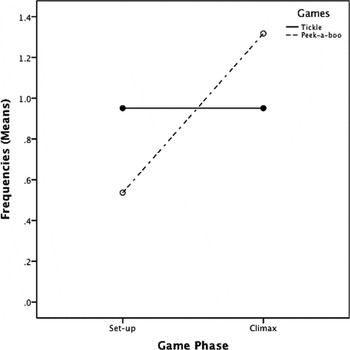
All infants, regardless of whether they vocalized or not, were included in a (2) age × (2) game × (2) game phase × (2) game perturbation condition mixed-design ANCOVA, with maternal game pace as the covariates. The results revealed the covariates of maternal pace for the tickle (F(1,129) = ·14, n.s.), and peek-a-boo (F(1,129) = ·16, n.s.), were not significant. Thus, a (2) age × (2) game × (2) game phase × (2) game perturbation condition mixed-design ANOVA was performed without the covariates. See Table 1 for descriptive statistics broken down by age, game, game phase, and game perturbation condition. Consistent with the results from chi-square tests reported above, a significant main effect was found for infant age (F(1,131) = 6·35, p < ·05, partial η2 = ·05). Twelve-month-olds (M = 2·89, SD = 3·12) produced more vocalizations than six-month-olds (M = 1·73, SD = 2·26). Although the main effect for game was not significant, a significant main effect was found for game phase, Wilks' Λ = ·932 (F(1,131) = 9·61, p < ·01, partial η2 = ·06). Infants produced more vocalizations during game climax than game set-up. A significant two-way interaction effect was also found for game × game phase, Wilks' Λ = ·914 (F(1,131) = 12·37, p < ·01, partial η2 = ·09). Follow-up analysis further revealed that both six- and twelve-month-olds produced significantly more vocalizations during tickle set-up than peek-a-boo set-up (t(134) = 2·08, p < ·01). By contrast, they produced more vocalizations during peek-a-boo climax than tickle climax (t(134) = 2·83, p < ·05). In other words, infants increased their vocalizations from set-up to climax during peek-a-boo (t(134) = 4·79, p < ·01) but not during tickle (t(134) = 0·07, n.s.) (see Figure 1). Finally, no significant main or interaction effect was found for game perturbation; six- and twelve-month-olds, regardless of whether they played the perturbed or normal games, did not differ in the frequency of their vocalizations.
The total frequency of infant vocalization during the set-up and climax phase of tickle and peek-a-boo games.

Descriptive statistics for the frequency of infant vocalizations

Types of vocalization
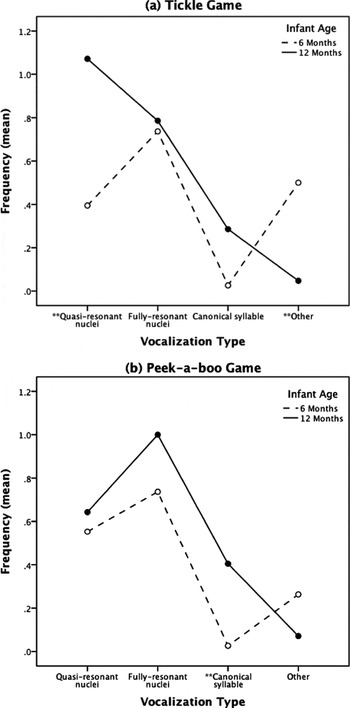
To explore the effects of age, game, game phase, and game perturbation on the types of vocalization, a (2) age × (2) game × (2) game phase × (2) game perturbation condition × (4) vocalization type (quasi-resonant nuclei, fully-resonant nuclei, canonical syllables, or other) mixed-design ANCOVA was performed. Preliminary analyses had indicated that very few marginal syllables were produced (<5% of data). These sounds were therefore collapsed with the ‘other’ category. Maternal pace of tickle and peek-a-boo games were included as covariates. This analysis was done with infants who vocalized at least once during the games. The results revealed that the covariates of maternal pace for the tickle (F(1,76) = ·14, n.s.) and peek-a-boo (F(1,76) = 1·36, n.s.) were not significant. As a result, a (2) age × (2) game × (2) game phase × (2) game perturbation condition × (4) vocalization type mixed-design ANOVA was performed without the covariates. Results revealed that there was no significant main effect for infant age, game, or game perturbation condition. A significant main effect was found for vocalization type, Wilks' Λ = ·553 (F(3,76) = 20·45, p < ·01, partial η2 = ·45). The follow-up Bonferroni tests indicated that infants produced significantly more quasi-resonant nuclei (M = 0·32) and fully resonant nuclei (M = 0·43) than canonical syllables (M = 0·08) and other (M = 0·12). There was a significant main effect for game phase, Wilks' Λ = ·895 (F(1,78) = 9·16, p < ·01, partial η2 = ·11), and a significant two-way interaction effect for game × game phase, Wilks' Λ = ·849 (F(1,78) = 13·90, p < ·01, partial η2 = ·15). These findings were consistent with the analysis of total frequency of vocalizations reported above. Moreover, although the main effect for infant age was not significant, a two-way interaction for age × vocalization type was significant, Wilks' Λ = ·724 (F(3,76) = 9·63, p < ·01, partial η2 = ·28). Using an adjusted p value of ·0125 (=·05/4) based on the Bonferroni method, follow-up t-tests revealed that relative to six-month-olds, twelve-month-olds exhibited significantly more canonical syllables (t(80) = 3·99, p < ·01) and fewer other types of vocalization (t(80) = –4·40, p < ·01). The three-way interaction for age × game × vocalization type, Wilks' Λ = ·902 (F(3,76) = 2·77, p < ·05, partial η2 = ·10), was also found to be significant. Specifically, during tickle, twelve-month-olds produced significantly more quasi-resonant nuclei (t(80) = 3·06, p < ·01) but fewer other types of vocalizations than six-month-olds (t(80) = –3·66, p < ·01) (see Figure 2a). By contrast, during peek-a-boo, twelve-month-olds exhibited significantly more canonical syllables than six-month-olds (t(80) = 3·01, p < ·01), but not any other types of vocalizations (see Figure 2b). When specifically comparing between the two games, however, no significant difference was found in six- or twelve-month-olds' production of any of the four types of vocalizations. Again, no significant main or interaction effect was found for game perturbation condition; both six- and twelve-month-olds who played the perturbed or normal games did not differ in the types of vocalizations that they produced.
The frequency of different types of infant vocalization exhibited by six- and twelve-month-olds during tickle and peek-a-boo games. ** t-test significant at p < ·01.

DISCUSSION
This experimental study was designed to better understand the functions of prelinguistic vocalizations as symptoms and symbols and the development of form–function (de)coupling within social contexts. Specifically, the contextual effects of mother–infant ritualized social games on infants' vocalization production during the first year of life were examined. First, it was hypothesized that the frequency of infant vocalization during social games would reflect their positive affective arousal (symptom function hypothesis) and cognitive understanding of social context (symbol function hypothesis). Next, it was expected that vocalization types would not vary systematically across the different social games contexts by twelve months of age (form–function (de)coupling hypothesis).
Frequency of vocalization
Symptom function hypothesis
Both six- and twelve-month-olds exhibited more vocalizations during tickle set-up than peek-a-boo set-up, whereas they produced more vocalizations during peek-a-boo climax than tickle climax. Thus, the hypothesis of symptom function that infants would produce more vocalizations during tickle than peek-a-boo received partial support. During tickle set-up, the mother often looms toward her infant with wiggling fingers and a big smile on her face while uttering “I'm gonna get you!” in a high-pitched voice. In contrast, during the peek-a-boo set-up, although the mother utters “Where is mommy?” in a similarly high-pitched voice, her face is hidden behind her motionless hands. Early experimental studies have demonstrated that the occurrence, pattern, and quality of vocalization by age 0;3 are affected by an adult partner's eye contact. Three-month-olds vocalize more when they maintain eye contact with the adult partner than when the partner's eyes are invisible (e.g., Bloom, Reference Bloom and Enns1990). In a naturalistic longitudinal study of mother–infant communication, it was found that when gazing at their mothers' face, infants were more likely to vocalize at 12 and 26 weeks of age (Kay & Fogel, Reference Kaye and Fogel1980). Other longitudinal studies have also reported that the occurrence of vocalization during eye contact with a parent shows a steady increase over time (Keller & Schölmerich, Reference Keller and Schölmerich1987). Thus, the greater frequency of vocalizations during tickle set-up than peek-a-boo set-up may have been influenced by the availability of eye contact and the exposure to maternal smiling face. Establishing eye contact with their mothers and seeing their mothers' smiling face may heighten infants' positive arousal.
Infants are attentive to and enjoy peek-a-boo games. In concert with the symptom hypothesis of increased positive arousal, infants were found to increase their vocalizations from peek-a-boo set-up to climax. This pattern mirrors the change in infants' smiles. For example, six- to eight-month-olds decrease their smile size after the mothers' disappearance and show a large increase in smile size just after reappearance (Parrott & Gleitman, Reference Parrott and Gleitman1989). Also, six- and twelve-month-olds maintain their gaze at their mothers' face and increase the duration and amplitude of their smiles from peek-a-boo set-up to climax (Fogel et al., Reference Fogel, Nelson-Goens, Hsu and Shapiro2000; Fogel et al., Reference Fogel, Hsu, Shapiro, Nelson-Goens and Secrist2006).
Unexpectedly, during tickle, six- and twelve-month-olds did not increase their vocalizations from set-up to climax. Given that both six- and twelve-month-olds increase the duration and intensity of their smiles from tickle set-up to climax (Fogel et al., Reference Fogel, Nelson-Goens, Hsu and Shapiro2000), it is reasonable to expect that infants experience an increased positive arousal in tickle. The lack of set-up to climax increase in infant vocalization during tickle games may simply be due to the increased production of laughter from set-up to climax, a fixed positive vocalization that is directly associated with the expression of joy and excitement. Indeed, not only do a large number of both four- to six-month-olds and ten- to twelve-month-olds laugh during tickle games (Sroufe & Wunsch, Reference Sroufe and Wunsch1972), six- and twelve-month-olds increase their laughs from tickle set-up to climax (Hsu & Fogel, Reference Hsu and Fogel1999). An alternative explanation is also plausible. Adults have reported that tickle elicits both pleasure and displeasure (Harris & Alvarado, Reference Harris and Alvarado2005). In addition to the facial expressions of joy and interest, infants respond to tickle with the expression of surprise (Bennett, Bendersky & Lewis, Reference Bennett, Bendersky and Lewis2005). The set-up to climax increase in the smiling duration and amplitude is significantly less for tickle than peek-a-boo (Fogel et al., Reference Fogel, Hsu, Shapiro, Nelson-Goens and Secrist2006). In fact, some six- and twelve-month-olds turn their entire bodies away from their mothers during tickle climax (Fogel et al., Reference Fogel, Nelson-Goens, Hsu and Shapiro2000). Taken together, it is likely that instead of responding to tickle climax with a heightened positive affect, infants respond with a mixture of negative and positive arousal. Distress vocalizations and laughter were not considered in this study; consequently, no significant increase was found in the frequency of infant vocalization.
Finally, in addition to increased frequency, changes in phonatory characteristics may serve as markers of arousal. The underlying emotional states in infant vocalizations are directly indexed by their phonatory properties (Scherer, Reference Scherer and Izard1982), such as pitch, voice quality, and loudness. A high-pitched squeal and a loud growl, for example, may indicate heightened arousal. Focusing on speech-like characteristics, the articulatory-based coding system used in this study may not have fully captured the emotional states reflected in infant vocalizations. Future studies may include a phonatory-based coding strategy to complement the articulatory-based coding strategy.
Symbol function hypothesis
Focusing on perceptual–cognitive processes, it has been suggested that infants' production of vocalizations is a sign of readiness for learning (Goldstein et al., Reference Goldstein, Schwade, Briesch and Syal2010), a concomitant of cognitive activities during active assimilation–accommodation learning (McCall, Reference McCall1972; Zelazo, Reference Zelazo1972), and a reflection of self-perceived efficacy in control (Millar, Reference Millar1988; Watson, Reference Watson1972). However, in this study, the hypothesis of symbol function, that six- and twelve-month-olds' cognitive sensitivity to game perturbation would be indicated by increased frequency of vocalization, was not confirmed. The frequency of vocalization between six- and twelve-month-olds who played the normal or perturbed games did not differ significantly. The lack of game perturbation effect may be simply because the infants did not recognize the subtle alterations to the games. Nonetheless, even newborns are believed to have innate competence for detecting the violation of social expectations (Nagy, Reference Nagy2008). Because the amplitude and duration of smiles are less during the perturbed games than the normal games (Fogel et al., Reference Fogel, Hsu, Shapiro, Nelson-Goens and Secrist2006), infants are expected to differentiate between normal and perturbed games. The differential response in smiling and vocalization to game perturbation is, however, similar to the finding of a previous study, which showed that infants responded to their adult partner's still face with decreased smiling, but with an overall increase and a burst–extinction of increased-then-decreased pattern in vocalization (Goldstein et al., Reference Goldstein, Schwade and Bornstein2009).
It may be that vocalizations are less sensitive than facial displays to brief perturbations. By twelve months of age, although infants may have a sufficient understanding about the context, they may need a longer time to respond vocally to changes in social contexts. Indeed, in the above mentioned still-face study (Goldstein et al., Reference Goldstein, Schwade and Bornstein2009), five-months-olds showed a change in their vocalizations to a two-minute-long perturbed social interaction. Still, the lack of difference in vocal response to the normal and perturbed games in the present study may suggest that infants' self-regulation is at work. In response to the unrealized climax in perturbed games, infants may continue to produce vocalizations for self-stimulation in an attempt to maintain their attention and arousal (cf. Cheng, Reference Cheng2003; Goldstein et al., Reference Goldstein, Schwade, Briesch and Syal2010; McCune, Vihman, Roug-Hellichius, Delery & Gogate, Reference McCune, Vihman, Roug-Hellichius, Delery and Gogate1996).
Developmentally, the symbol function of prelinguistic vocalizations is expected to emerge last after symptom and signal functions. It may be a product of social attunement, rather than simply a within-the-child competence. A history of contingent and reciprocal interactive experience with their mothers may not only sensitize infants to discriminate between normal and perturbed games, but also motivate them to produce vocal signals (cf. Locke, Reference Locke2001). Put more simply, infants' understanding of the game rituals is formed within their interactions with their caregivers. Marked individual differences among infants in their sensitivity to game perturbation as expressed in vocalization production can be expected. In light of previous findings on maternal contingent response to infant vocalization (e.g., Hsu & Fogel, Reference Hsu and Fogel2003; Keller & Schölmerich, Reference Keller and Schölmerich1987), it would be beneficial to evaluate whether maternal responsiveness has a moderating effect on the symbol function of prelinguistic vocalizations.
Applying a quasi-experimental design, an effort was made in this study to ‘standardize’ mothers' game playing behavior, which prevented the possibility of testing inter-dyad differences. Nonetheless, in future studies the symbol function can be examined based on the frequency and types of prelinguistic vocalizations. Based on the frequency measure, a group-focused approach comparing dyads known to be different in their interactive quality and relational history can be applied. For example, depressed mothers are known to be less sensitive and contingent to their infants than non-depressed mothers. It has also been documented that although infants of both depressed and non-depressed mothers are able to detect non-contingency in their mothers' behavior, they show different responses when their mothers resume contingent behaviors (Nadel, Soussignan, Canet, Libert & Gerardin, Reference Nadel, Soussignan, Canet, Libert and Gerardin2005). Inter-dyad differences can be unraveled by between-group comparisons in frequency and occurrence pattern of infants' vocal response to changes between maternal contingency and non-contingency. Based on the types of infant vocalization, the form–function (de)couplings can be detected and documented as they begin to form and stabilize within individual dyads. To reveal the relational history, a dyad-focused approach with an intensive longitudinal design in which the mother–infant dyads are observed frequently (e.g., daily or weekly) over an extended period of time (e.g., six months) is called for (e.g., Hsu & Fogel, Reference Hsu and Fogel2003). The emergence and formation of dyad-specific form–function coupling can then be tracked.
Types of vocalization
The form–function (de)coupling hypothesis that there is no systematic relation between vocalization types and social games by twelve months of age was largely confirmed, as vocalization types did not differ between games, between game set-up and game climax, or between normal or perturbed games. Oller (Reference Oller2000, Reference Oller, Oller and Griebel2004) suggests that the contextual freedom in prelinguistic vocalization production offers infants the opportunities to adapt to communication contexts. The parental selection hypothesis proposed by Locke (Reference Locke2006) further argues that variable prelinguistic vocalizations elicit parents' attention and engagement, which promote infants' ultimate survival. It may be an adaptive need for young infants to coordinate vocalizations with other forms of communicative acts such as gaze and facial expression (e.g., Yale, Messinger, Cobo-Lewis, Oller & Eilers, Reference Yale, Messinger, Cobo-Lewis, Oller and Eilers1999) to enhance their ‘interpretability’ or ‘recognizability’ by a social partner. This cross-modal coordination may sustain the dominance of form–function decoupling in prelinguistic vocalizations. To further understand the form–function relation, future research needs to explore the organization of different types of prelinguistic vocalizations with gaze, facial expressions, and/or body movements as well as their regulatory effects on the partner's response.
The lack of developmental difference in the form–function (de)coupling between six- and twelve-month-olds supports the developmental account that form–function coupling is not fully established until the speech system begins to develop. For example, a developmental progression is seen with early effortful grunts indexing physiological function early in the first year of life to grunts being used by the infant as communicative vocalizations at the transition to speech (McCune et al., Reference McCune, Vihman, Roug-Hellichius, Delery and Gogate1996). After its repeated association with the infant's attentional focus and internal mental state across a variety of contexts, the grunt takes on a personal meaning for the infant and the parents. The experience of sound–meaning correspondence increases the likelihood for the grunt to be used in communication. In future studies, developmental transitions of form–function coupling and decoupling relations should be explored within ritualized games and conventional communication routines.
The infraphonological model of vocal development (Oller, Reference Oller, Yeni-Komshian, Kavanagh and Ferguson1980, Reference Oller2000) posits that infants' vocal repertoires progress from relatively primitive quasi-resonant nuclei to fully resonant nuclei and mature canonical syllables. Indeed, our results demonstrated that both six- and twelve-month-old infants produced significantly more quasi- and fully resonant nuclei (both vowel-like vocalizations) than canonical syllables and other types of vocalizations and that twelve-month-olds produced more mature canonical syllables than six-month-olds during peek-a-boo. These findings are also consistent with empirical evidence that mature vocalizations are produced by older infants during games (Rome-Flanders & Cronk, Reference Rome-Flanders and Cronk1995) and Nathani et al.'s (Reference Nathani, Ertmer and Stark2006) findings that vowel-like vocalizations are prominent in infancy.
Unexpectedly, twelve-month-olds exhibited significantly more primitive quasi-resonant nuclei than six-month-olds during tickle. A ‘push-and-pull’ effect, proposed by Scherer (Reference Scherer, Papoušek, Jurgens and Papousek1992) to explain qualitative differences in animal calls, may be useful to explain why primitive vocalizations are more likely to be produced by twelve-month-olds than six-month-olds during tickle games. According to Scherer (Reference Scherer, Papoušek, Jurgens and Papousek1992), vocal production is subjected not only to an external pull effect constrained by environmental factors, but also an internal physiological push elicited by cognitive or emotional processes. For example, smiling during peek-a-boo set-up and climax is more likely to occur if mothers vocalize (Fernald & O'Neill, Reference Fernald, O'Neill and Macdonald1993). Four- to five-month-olds smiled less to the climax reappearance that was accompanied with a non-speech sound or silence than to a normally occurring ‘peek-a-boo’ (Greenfield, Reference Greenfield1972), presumably because there were less ‘pull’ and ‘push’ forces. Different from the peek-a-boo game, maternal eye contact and smiling face are available to infants during the tickle game. As discussed above, twelve-month-olds typically respond with greater arousal (i.e., more intense smiles and laughs) than six-month-olds to the tickle game. During tickle, mothers' visual, auditory, and/or tactile signals may work to ‘pull’ the twelve-month-olds to a state of hyper arousal. In spite of their more mature articulatory configuration, such hyper arousal may ‘push’ the twelve-month-olds to produce primitive vocalizations. The increased amplitude and jaw-drop smiles (i.e., duplay smiles) during tickle (Fogel et al., Reference Fogel, Nelson-Goens, Hsu and Shapiro2000; Fogel et al., Reference Fogel, Hsu, Shapiro, Nelson-Goens and Secrist2006) may also facilitate the production of primitive quasi-resonant forms of vocalization and/or preclude the production of more advanced forms of vocalizations due to the vocal tract assuming a relaxed at-rest position. Future studies are needed to provide the direct evidence of co-occurrence between primitive vocalizations and heightened physiological arousal (e.g., increased heart rate).
Despite a long history of the functional view of infant vocalization, there has been a substantial gap in empirical studies on this topic during past decades. Earlier research in the form of case studies was often burdened by methodological challenges. With advances in theory and technology (i.e., digital recordings and automated audio processing), greater clarity and consensus on relevant coding categories, empirical studies have re-emerged and have begun to take a systematic approach to adequately testing the functional properties of infant vocalizations. Due to the labor-intensive nature of investigating infant vocalizations, the sample size for related studies tends to be small (for a review, see Hsu, Fogel & Cooper, Reference Hsu, Fogel and Cooper2000). The present study is one of the few studies that included a relatively large number of infants. The brevity and emotion-laden nature of the games played by infants in this study, however, may limit the opportunity to reveal prelinguistic vocalizations' symbol function of social understanding and the specific coupling between their forms and functions.
In conclusion, based on the frequency of vocalization, our findings suggest that within social game contexts, prelinguistic vocalizations appear to reflect positive arousal. The symbol function of vocalization as an indicator of social understanding was not supported. However, developmental differences in the effect of social games on vocalization types were found. Based on vocalization types, the contextual freedom hypothesis was also supported by the lack of specific form–function link between vocalization types and social games context (i.e., type, climax, and perturbation) in six- and twelve-month-olds. Further systematic experimental manipulation of different aspects of the social context would allow researchers to better discern the form–function relation in prelinguistic vocalizations. Relative to non-distress vocalizations, laughs and distress vocalizations by infants may be more likely to be interpreted by parents as symptoms for positive and negative arousal respectively, symbols of social understanding, and signals for social interaction. Future research on the form–function relation in game contexts may also include these fixed signals to explore questions such as whether the symptom, symbol, and signal functions of prelinguistic vocalization are affected by the occurrence of fixed signals. Finally, it may be fruitful to further explore the developmental significance of symptom, symbol, signal functions of prelinguistic vocalization to later language development.