
Introduction
Pottery appears around the world for a number of reasons (Sassaman Reference Sassaman1993; Barnett & Hoopes Reference Barnett and Hoopes1995; Roosevelt Reference Roosevelt, Barnett and Hoopes1995; Rice Reference Rice1999, Reference Rice2015; Skibo Reference Skibo, Walker and Skibo2015; Wang et al. Reference Wang, Zhang, Gu, Wang, He, Wu, Qu, Zhao, Chen and Bar-Yosef2015). Although there is some evidence that ritual played a role in some early pottery technologies (e.g. Vitelli Reference Vitelli, Skibo and Feinman1999), they are more often associated with food processing. A primary performance advantage of ceramic vessels is that they can be placed directly over a fire for heating of the contents, permitting the processing of new foods such as rice and cereal grains, and more effective preparation of others. Although it is possible to heat water indirectly with hot stones or to place water-saturated organic containers directly over a fire (Speth Reference Speth2015), pottery is a far more effective tool for cooking. This type of direct heating in cooking vessels is a primary reason that this technology was invented and widely adopted. It is now important to explore, at a regional level, the contexts for pottery adoption and the food being processed.
A recent Antiquity article by Taché and Craig (Reference Taché and Craig2015: 186) suggests that the “invention and widespread uptake of pottery throughout north-eastern North America was associated with the preparation of aquatic resources”. The authors conducted lipid analysis on 143 Vinette 1 samples (112 vessels) from many different archaeological sites located in the north-eastern United States and the eastern Great Lakes. The appearance of Vinette 1 pottery, which they date to between 3100 and 2300 cal BP (Taché & Hart Reference Taché and Hart2013), signals the beginning of the Early Woodland Period. Similar thick, heavily tempered pottery, such as Marian Thick and Schultz Thick, are found throughout much of the eastern United States (Griffin Reference Griffin and Deuel1952; Garland & Beld Reference Garland, Beld and Halsey1999).
Using gas chromatography mass spectrometry, Taché and Craig (Reference Taché and Craig2015) found lipid biomarkers of aquatic species on 29 (40 per cent) of the vessels from inland sites and 21 (53 per cent) of the vessels from coastal sites. Although they did find some evidence of animal fats, the overwhelming signatures were for aquatic sources, such as fish. The dominance of aquatic biomarkers was surprising to Taché and Craig because the faunal evidence, where available, was dominated by animals, especially white-tailed deer. This disparity between faunal data and pottery lipids led them to suggest that these early vessels were part of feasting rituals that involved the processing of fish oil produced as an exchange commodity.
Although the Taché and Craig article is interesting, their results cannot be applied to the entire north-eastern part of the USA or to the Great Lakes region, as they suggest. Recent research on material from three early pottery sites in the Upper Great Lakes area finds no evidence of the processing of aquatic resources in the pottery. Rather, we find that the pots were used for stewing vegetables and meat and the processing of acorns, perhaps in the rendering of nut oil. These results should not be considered a contradiction of the Taché and Craig study, but rather a fine-tuning of our understanding of the first pottery in the region. Research here—and elsewhere—suggests that there is no single reason for the appearance of pottery, and that even in the relatively small region covered in this study, there will be variability. Pottery emerges within a web of social and economic factors involving individual choices by hunter-gatherers who were not only encountering foods that required processing in vessels but were also experiencing changing social relationships (Sassaman Reference Sassaman1993, Reference Sassaman, Barnett and Hoopes1995; Rice Reference Rice1999; Skibo et al. Reference Skibo, Malainey and Drake2009; Skibo Reference Skibo2013, Reference Skibo, Walker and Skibo2015). We employ a performance-based approach that seeks to understand the interaction of these various factors as individuals choose to make use of this new technology. By combining use-alteration traces with a performance-based life history approach, this study explores the adoption of pottery at three sites in the Upper Great Lakes: the Schultz site (Ozker Reference Ozker1982), located in Michigan's Saginaw Valley; the Naomikong Point Site (Janzen Reference Janzen1968; Kooiman Reference Kooiman2012, in press), on the southern shore of Lake Superior; and an early pottery site on Grand Island (Skibo et al. Reference Skibo, Malainey and Drake2009), also on Lake Superior's southern shore. It is shown that other, competing cooking technology (stone-boiling) and a variety of social and economic factors influence the performance of these early ceramic containers and when and how they were adopted by local communities.
Methods
There are two basic types of pottery function: intended and actual. Potters have at their disposal a number of technical choices in the design of a vessel—temper type, size and amount, firing temperature, and a number of morphological attributes—to suit a particular intended function. Although it is important to link these technical choices to vessel performance and intended purpose, more precise understanding of actual function must be inferred from evidence of use. On pottery this occurs in three forms: internal and external carbonisation, attrition and organic residue (see Skibo Reference Skibo2013). The focus of this paper is residue analysis, and these techniques are discussed in more detail below.
Our study focused primarily on lipids, which occur in different forms and relative amounts in different species of plants and animals. Lipid residues extracted from the samples were analysed using routine gas chromatography, high-temperature gas chromatography and high-temperature gas chromatography/mass spectroscopy (Evershed et al. Reference Evershed, Heron and Goad1990; Evershed Reference Evershed1993, Reference Evershed, Ciliberto and Spoto2000).
Fatty acids are the major constituents of fats and oils (lipids), and occur in nature as triglycerides in different relative amounts and combinations in various plants and animals, making them ideal for linking archaeological residues to the foods that produced them. Since it was employed by Condamin et al. (Reference Condamin, Formenti, Metais, Michel and Blond1976), routine gas chromatography has been used extensively to analyse the fatty acid component of absorbed archaeological residues. The technique used here, for identifying archaeological pottery residues on the basis of fatty acid composition, was developed by Malainey (Reference Malainey1997; Malainey et al. Reference Malainey, Przybylski and Sherriff1999a, b & c, Reference Malainey, Malisza, Przybylski and Monks2001a). Instead of relying on the fatty acid ratios observed in fresh animals and plants (Marchbanks Reference Marchbanks1989; Skibo Reference Skibo1992; Loy Reference Loy, Ricklis and Collins1994), an approach was followed that was similar to that of Patrick et al. (Reference Patrick, de Konig and Smith1985), which simulated the effects of long-term decomposition on seal meat. Baseline data on the fatty acid compositions of many food plants and animals native to North America were collected, and the effects of decomposition (as a result of cooking and ageing) on the occurrence and distribution of fatty acids were explored (Malainey et al. Reference Malainey, Przybylski and Monks2000a, b & c, Reference Malainey, Malisza, Przybylski and Monks2001b). This work enabled the development of criteria for the characterisation of archaeological lipid residues (Malainey et al. Reference Malainey, Malisza, Przybylski and Monks1999b), and the identification of other animal and plant products that produce similar residues.
Early pottery at the Schultz site
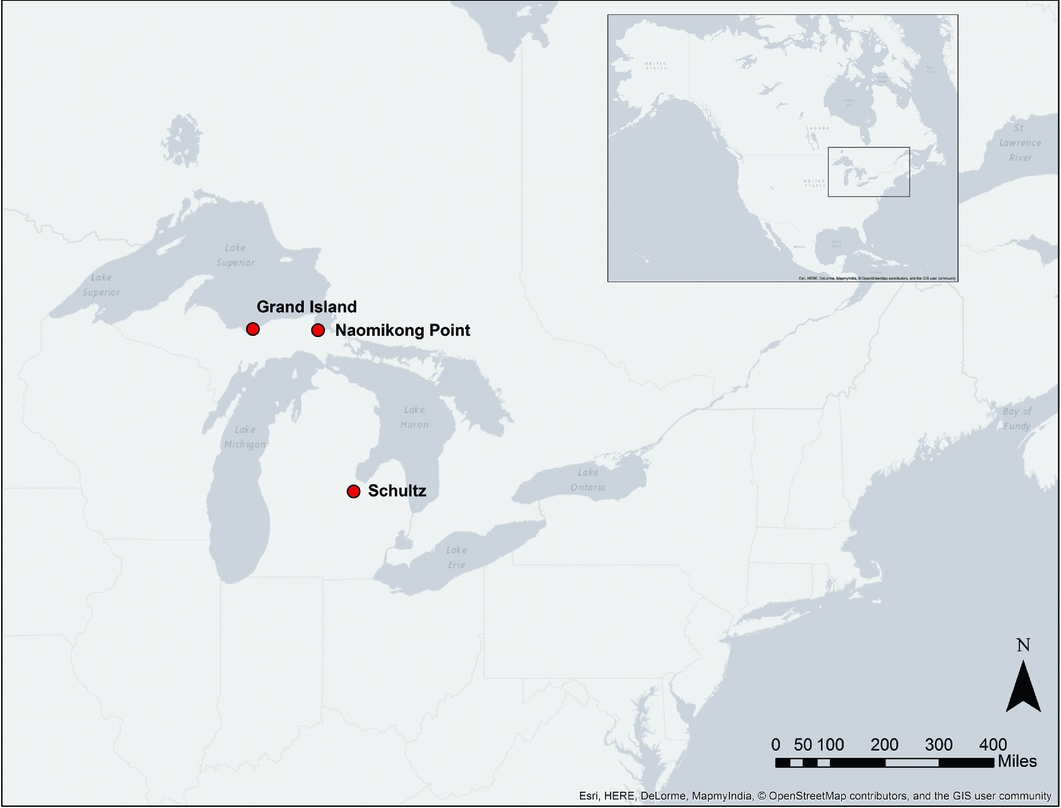
The Schultz site is located in the present-day city of Saginaw, Michigan, at the head of Lake Huron's Saginaw Bay and near the confluence of the Tittabawassee and Shiawassee Rivers (Figure 1). Ozker (Reference Ozker1982) argues that the site was a base camp for four or so households, which occupied the site during two seasons. During the summer, they collected mussels and cultivated squash, and in the autumn they collected hard shell nuts such as acorns, and harvested squash. The site also has some of the best examples of Early Woodland pottery in the region, which appears by about 500 BC. The pottery, known as Early Woodland Thick Schultz pottery, is simply made with straight walls and a flat or rounded base; it is heavily tempered and, as the name implies, is often quite thick—a design well suited to long-term simmering. The open shape and thick walls would give it poor heating effectiveness, but its low firing temperature and abundant temper would give the vessels good thermal shock resistance. Such vessels would be good for long-term simmering (at 85–88°C), but would not be well suited to cooking something that required it to reach boiling temperature.
Locations of sites mentioned in the text.

The co-occurrence of pottery and extensive evidence of acorns suggested to Ozker (Reference Ozker1982) that the vessels were used to process acorns for the extraction of nut oil (similar to our own findings for the Grand Island pottery located on Lake Superior, 500km to the north; see below). Our analysis of the Shultz site pottery, however, suggests something quite different. Five sherds held by the University of Michigan were sampled and analysed. The sherds were >10mm in thickness and had cord marking on the interior and exterior surfaces: traits associated with Early Woodland Shultz Thick pottery.
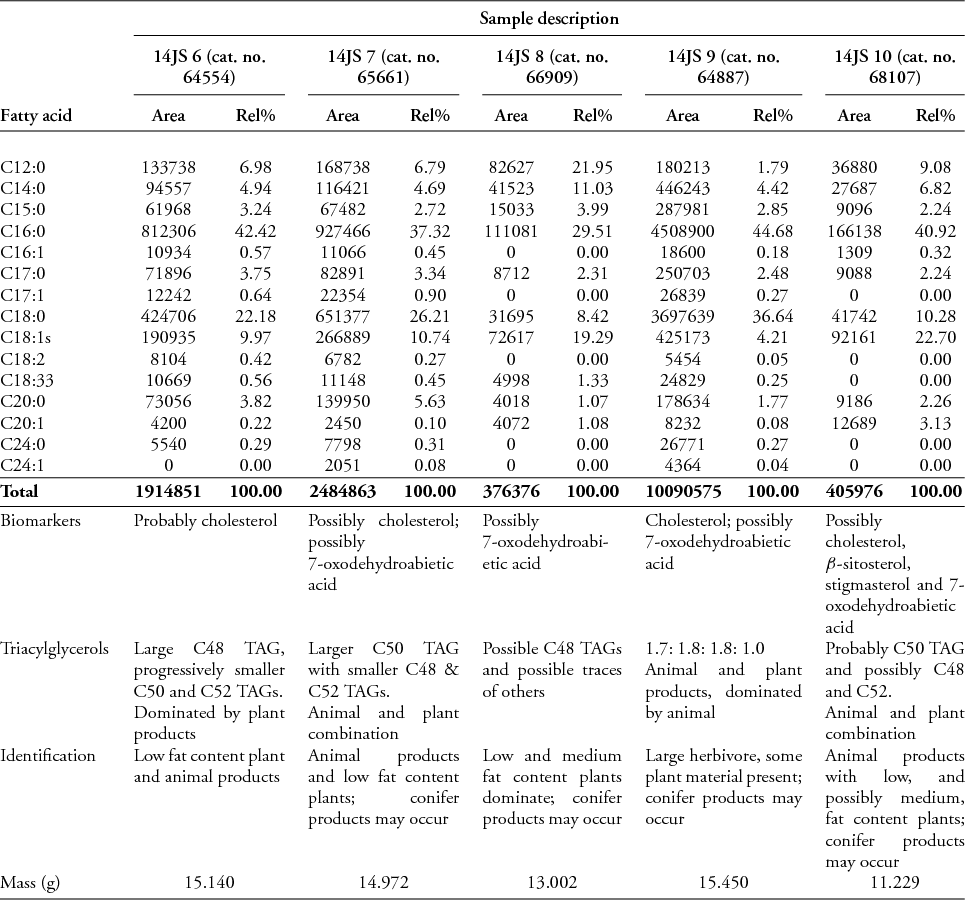
All five sherds had lipids from a variety of plants and animals, but not from acorns (Table 1). Two of the samples (14JS6 and 14JS7) had evidence of low fat content plants and lean animal meat. The residue in one vessel (14JS8) was the result of primarily low fat content plants, such as plant roots, greens and certain berries, but medium fat content food was also present. While both plant and animal foods can produce medium fat content residues, the low level of the fatty acid C18:0, the absence of cholesterol and the distribution of triacylglycerols (typical of plants) suggest that this residue is of plant origin. One vessel (14JS9), however, had residue that was very indicative of the cooking of large herbivores, such as deer, moose or fatty elk meat. Finally, one sample (14JS10) had evidence of both plants and medium fat content animals. The faunal evidence from the site includes white-tailed deer, beaver, muskrat, porcupine, raccoon, marten, bobcat, black bear, dog, moose and elk; the botanical evidence includes squash, hackberry, goosefoot and cherry (see Ozker Reference Ozker1982). The residue analysis suggests that any of these plants and animals could have been cooked in these vessels. It is also interesting that several of the sherds have evidence of conifer, which may have been the remnants of a pine-pitch resin that was applied to the interior of the vessels. Very low-fired pots are often so porous that they will not hold water, so the adding of the resin is necessary to slow down water leakage (Schiffer Reference Schiffer1990).
Sample descriptions, lipid compositions and identifications of Schultz site pottery residues.

All five of these samples represent classic stew pots, in which plant and animal foods of various kinds were simmered. It should be noted that we found no evidence of aquatic products being processed in the vessels. Although our sample is small and we cannot rule out the possibility that other vessels were used for acorn fat rendering, as suggested by Ozker (Reference Ozker1982), these particular vessels were not. The Early Woodland pottery from the site is ideally suited to long-term stewing, which requires reaching and maintaining a simmering temperature. In fact, it would be difficult to reach a boiling temperature in these porous, thick-walled vessels. Pots that have too great a heating effectiveness, and would permit boiling, may not have been desirable, because boil-overs would potentially extinguish the fire. As Reid notes, simmering temperatures (85–88°C) reduce “white connective tissue or collagen to a gel, while cooking it at a boil coagulates the protein, resulting in toughness and shrinkage” (Reid Reference Reid and Mack1990: 10). Schultz Thick vessels, or any of the Early Woodland pottery from this region, could be left on the fire all day, and food could be added or taken out as needed. The simmering temperatures would be ideal for removing nutrients, especially fat, from bone, which were important in the diet of these northern hunter-gatherers.
Early pottery at the Naomikong Point site
The Naomikong Point site, which lies along the southern shore of Lake Superior in the Upper Peninsula of Michigan, along the shore of Tahquemonon Bay (Figure 1), was excavated by the University of Michigan in 1966 and 1967 (Quimby Reference Quimby1965; Janzen Reference Janzen1968). The ceramic assemblage was dominated by Laurel pottery, allowing Janzen to confidently attribute the site to the Middle Woodland Period (AD 0–600). Although not as early as the Schultz material, pottery was not used in this area prior to this period, and Naomikong Point is one of the earliest known sites containing ceramics in the western Upper Great Lakes.
Janzen concluded that Naomikong Point was a fishing camp, based on its shoreline location, the presence of nearly 300 ‘netsinkers’ and the lack of patterning in the postholes, which he believed represented fish-drying racks rather than dwellings (Janzen Reference Janzen1968: 90, 92–93). Historic accounts refer to the area as a premier location for catching whitefish (Pitezel Reference Pitezel1901: 40), but faunal remains from the site were sparse and poorly preserved, and there were no macrobotanical remains; the general subsistence practices at the site remain largely unclear.
Recent re-analysis of the pottery from Naomikong Point focused on inferring vessel function (Kooiman Reference Kooiman2012, in press). Based on a sample of 167 sherds, the technical characteristics of Naomikong Point's ceramic assemblage included thin walls, subconoidal bases, vertical or slightly everted rims, sufficient tempering and low-fired paste (Kooiman Reference Kooiman2012, in press). These correlate with the ideal characteristics for a cooking pot (Skibo & Schiffer Reference Skibo, Schiffer, Skibo, Walker and Nielsen1995; Rice Reference Rice2015: 422–24). Additionally, over 50 per cent of Naomikong Point sherds showed traces of burnt food residue on the interior surfaces, providing further evidence of their intended manufacture and use as cooking vessels (Kooiman Reference Kooiman2012, in press).
Malainey and Figol (Reference Malainey and Figol2012) conducted lipid residue analysis on four sherds selected from the Naomikong Point assemblage using the same protocol described above. These sherds were from the Middle Woodland component of the site, and all four contained lipids from low fat content plants and mammals. The only possible evidence of medium fat content animal foods, such as fish, occurs in one residue (14JS2). As with the Schultz site residue 14JS8, Naomikong Point residue 14JS2 is dominated by low fat content plants, but the somewhat elevated level of C18:1 isomers suggests that medium–low or medium fat content foods are present. If the location was an intensive fish-procurement site, the lack of fish lipids in cooking vessels indicates an intentional exclusion of pottery in the fish-cooking process. If Naomikong Point occupants were not cooking their fish in pots, then how were they processing them? Ethnographic sources indicate that in the historic period, Ojibwe people rarely stewed or boiled fish, preferring instead to spit-roast or smoke them (Densmore Reference Densmore1979; Hilger Reference Hilger1992). This method of fish preparation was also common among Contact-period indigenous groups across much of eastern North America (Lovis & Hart Reference Lovis and Hart2014). Although historic Ojibwe groups did occasionally boil fish for broth or to render fish oil (Densmore Reference Densmore1979: 42), these practices were not as common as alternate means of preparation.
The absence of fish lipids in Naomikong Point pottery suggests that even if other Middle Woodland occupants of the southern Lake Superior shoreline cooked fish in vessels, it was not a ubiquitous practice, nor was it a long-held tradition. Lipids were also absent from pottery vessels from the nearby Late Woodland Sand Point site (Kooiman Reference Kooiman2012, in press; Malainey & Figol Reference Malainey and Figol2012), which demonstrates that subsequent groups in the region did not partake in fish stews either. Instead, pottery in the Upper Peninsula from the Middle Woodland and later periods was used to cook low fat content plants and mammals of various sizes, and was probably adopted simply to increase the efficiency of food processing in general (Kooiman Reference Kooiman2012, in press; Malainey & Figol Reference Malainey and Figol2012).
Early pottery on Grand Island
Grand Island is located on the southern shore of Lake Superior in Michigan's Upper Peninsula (Figure 1). Since 2000, the senior author has been examining the occupation of the island from its first inhabitants, around 2000 BC, to the Contact period between Native Americans and Euro-Americans, and the various uses of the island into the twentieth century (e.g. Skibo et al. Reference Skibo, Martin, Drake and Franzen2004, Reference Skibo, Franzen, Drake, Skibo, Graves and Stark2007, Reference Skibo, Malainey and Drake2009; Drake et al. Reference Drake, Skibo and Franzen2009).
Similar to the nearby Naomikong Point Site, the residents of Grand Island and other prehistoric inhabitants on the southern shore of Lake Superior did not adopt pottery until quite late compared to regions not far to the south. One of the hallmarks of the Early Woodland Period in the eastern USA is the appearance of pottery, but on Grand Island it does not appear until around the first centuries AD: the Middle Woodland Period in the local chronology.
One characteristic of pre-pottery (Late Archaic) Grand Island sites is the great quantities of fire-cracked rock, much of it made from locally available quartzite. Many of the sites have so much that the surface of the site is virtually paved with the material (see Neubauer Reference Neubauer2015). One unexplored hypothesis is that some of the fire-cracked rock was the product of stone-boiling, with inhabitants of Grand Island in the Late Archaic Period collecting locally available rock for stone-boiling. The fractured rock was left where it was used and, by the following year's occupation, had either sunk into the sand or been covered by seasonally deposited plant litter. A clear way to examine whether Grand Island Archaic-Period fire-cracked rock was indeed used for stone-boiling is to examine organic residues, and, of course, one key to understanding the transition from stone-boiling containers to pottery is to determine what was being boiled.
For our analysis of organic residues, three sherds and three fire-cracked rocks were processed, all recovered from excavated contexts of Site 754. Samples were removed from the artefacts, and the fatty acid extracts were examined using gas chromatography and gas chromatography/mass spectrometry (see Skibo et al. Reference Skibo, Malainey and Drake2009).
The analysis found residues from plant materials in both the sherds and fire-cracked rock. The presence of plant sterols, very high levels of C18:1 isomers and extremely low levels of C18:0 in these residues are consistent with their identification as nut oils. Small amounts of cholesterol, indicating traces of animal products, were detected in several residues; slightly elevated triacylglycerol levels, however, occurred in only one residue from a pot sherd.
Our Grand Island research demonstrates that nuts (probably acorn and hazelnut) can now be added to the list of foods that required processing with heat, and thus might account for the first appearance of pottery. Remarkably absent in the lipid profiles, and similar to the other two sites discussed, is any evidence that the pots were used to process fish.
The presence of lipid residues in all three of the fire-cracked rock samples is the most significant finding of this preliminary study, as it strongly suggests that this material was used in stone-boiling. The large quantity of fire-cracked rock found at Grand Island Late Archaic sites has long been a puzzle, but we can at least begin to explain it with these initial results. The presence of nut oil in the ceramics provides an important clue as to how these vessels were being used. Such high nut oil content and the lack of fats from other plants and animals (except in trace amounts in three samples) suggest that both the pots and rocks were primarily used for rendering nut oil.
Although this could be achieved with stone-boiling, there were a number of performance advantages to direct fire cooking with pottery for this process: the need to remove cooking rocks from the container is eliminated, reducing nut oil loss; ceramic vessels require less monitoring and also use less fuel than hot rock-boiling; and simmering temperatures are easier to maintain with direct heating (for further discussion see Skibo et al. Reference Skibo, Malainey and Drake2009).
Conclusion
Our work suggests that there is no single reason for the adoption of pottery, even in this relatively small region. These hunter-gatherers used this technology for long-term simmering, either to render nut oils, as in the Grand Island case, or to stew meat and vegetables, as was seen at the Schultz and Naomikong Point sites. No evidence was found of fish or other aquatic resource processing in any of the pottery from the three sites investigated. This cannot completely rule out the possibility that fish were processed in the vessels; one would expect, however, that the occurrence of medium fat content residues with C18:1 isomer levels of 15–27.5 per cent would be much higher if this were the case. In previously analysed sites with strong evidence of fish procurement, between 30 and 50 per cent of the pottery residues were medium fat content residues, typical of boiled fish (Malainey Reference Malainey1997; Malainey et al. Reference Malainey, Malisza, Przybylski and Monks1999b & c). These findings are in contrast to what Taché and Craig (Reference Taché and Craig2015) found in their analysis of Vinette 1 pottery from the region directly to the east of our study area. They suggest that the vessels may not have been used in everyday cooking, but rather for the processing or storage of fish or fish products as part of large-scale seasonal gatherings. Although this is a possible explanation for the early use of vessels in this region, our results suggest that this is not a general explanation that can be more widely applied to the greater north-east. Rather, it appears that vessels were used in everyday cooking for the stewing of vegetables and meat, and the processing of nut oil. Globally, it is found that pottery was used for a variety of functions, from the sacred and symbolic to the everyday and mundane (Rice Reference Rice1996a & b, Reference Rice2015). As there is no single explanation for the origins or adoption of pottery, more contextual work like that described here, and that by Taché and Craig (Reference Taché and Craig2015), is required to determine the actual function of these vessels. The objective of our ongoing research is to expand this type of analysis to other sites and assemblages.
Acknowledgements
We would like to thank Prudence Rice, Barbara Mills and Karine Taché for their comments and suggestions on an earlier draft. Thank you to the Laboratory of Anthropology at the University of Michigan and the United States Department of Agriculture's Hiawatha National Forest for permission to use their samples in the analysis. We appreciate the help of Kelsey Hanson in the preparation of Figure 1.